Categories
Reviews, News and Commentary

The APO’s “Brahms and Bellincampi”

Reviewed by John Daly-Peoples
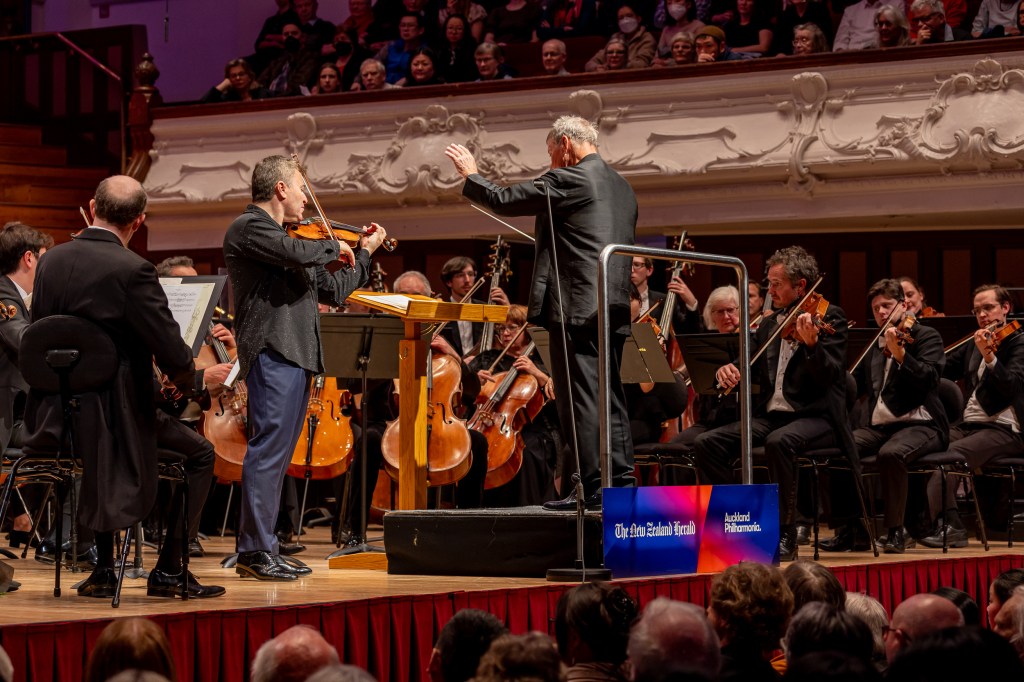
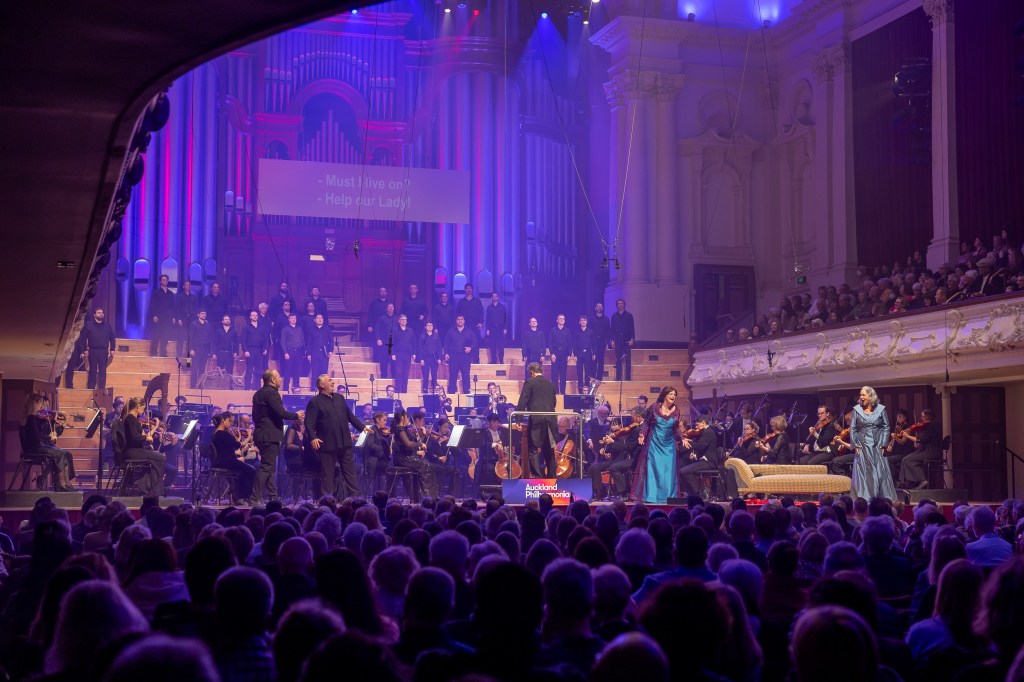
Alexander Melnikov and Giordano Bellincampi Image. Sav Schulman

Auckland Philharmonia Orchestra

Brahms and Bellincampi

Auckland Town Hall

June 6

Reviewed by John Daly-Peoples

The opening of Brahms’ Piano Concerto No 1 is dramatic with the timpani delivering a tumultuous sound accompanied by ferocious strings. The intense opening  was intended by the composer to be a depiction and reflection on  Robert Schumann’s attempted suicide in leaping into the Rhine at Dusseldorf few years earlier.

For the first few minutes it was the orchestra which dominated  as pianist Alexander Melnikov waited for his entry. Showing what would be his intense approach to playing he seemed  restless as he contemplated the piano – leaning into it and caressing its surface as though communing with the instrument.

Following the stormy performance of the orchestra Melnikov made his entrance, referencing the orchestras’ dramatic themes but with simple and deliberate playing as though reflecting on the drama which had just occurred.

Much of the first movement saw him responding to the themes that the orchestra had explored with a bravura performance where he developed  the main theme, playing with a relentless  insistence.

Melnikov’s relationship with the piano continued, at times he appeared to be praying and at other times conducting. All the time he appeared to physically respond to the performance of the orchestra, his body moving reflectively in time to the music.

In the second movement his playing was almost lethargic inserting some delicate passages into the orchestras brooding sounds. Then in the third movement the music seemed to electrify him with some relentless playing which was  almost  Byronic, of the individual confronting his demons, loves and destiny.

His Brahms encore finished as a cell phone call came through in the hall, so when he was leaving the stage, he put his hand to his ear with the universal sign of “I’ll call you”, eliciting  further applause from the audience.

The other work on the programme was Brahms’s symphony No 2, a glorious pastoral work inspired by a holiday at the resort of Lake Worth in Austria. The work is full of images of nature and the heightened drama of the alpine  environment.

While it is a captivating depiction of the landscape there are  undertones of melancholy with the strings, timpani and brass creating a sense of disquiet.

The more reflective second movement conveys a sense of an emotional  journey and the delights of life. all leading to enlightenment.

Then in the third movement there were charming dance-like seqcnces followed by the dramatic fourth movement with its big crescendos punctuated by idyllic interludes, the audience kept in suspense as the work raced to its fiery conclusion.

To subscribe or follow New Zealand Arts Review site – www.nzartsreview.org.

The “Follow button” at the bottom right will appear and clicking on that button  will allow you to follow that blog and all future posts will arrive on your email.

Or go to https://nzartsreview.org/blog/, Scroll down and click “Subscribe”

Categories
Reviews, News and Commentary

NZ Opera’s Le Comte Ory

Reviewed by John Daly-Peoples

Le Comte Ory (Act I) Image Andi Crown

NZ Opera

Le Comte Ory by Gioachino Antonio Rossini

Kiri Te Kanawa Theatre, Auckland

May 30 & June 1

Reviewed by John Daly-Peoples

If Rossini was still writing operas today his pick for a librettists would have to be Simon Phillips. The original libretto was by Eugene Scribe and Charles Delestre-Poirson, adapted from a comedy they had first written in 1817. While traces of the original can be detected in NZ Opera’s latest version it is Phillips’ new translation, re-write and update which dominates.

This update is what makes the work entertaining and significant. Phillips has taken something of risk in filling the libretto with colloquial speech but it makes for  a clearer understanding of the narrative and his contemporary references give the work an immediacy.

His new libretto avoids having to deal with  the issues of misogyny which are always there in Rossini’s works. It also avoids the contentious issue in the original of having one group of men going off to fight the crusade in Palestine.

Examples of his language updates include someone being referred to as “not a happy camper” “Stuff this for  a caper, I’m buggered” says The Coach after  one adventure, “He really found my chi”  exclaims of one ecstatic young woman  and at the point when Ory is unmasked the entire cast gives a sustained  “What the F…K”

There are lots of rugby references including mention of a John Eales award – this reinforces the idea that Ory’s team is Australian as New Zealand players would not engage in such dastardly undertakings.

The setting for the opera is moved from medieval France to New Zealand, probably the Central Plateau where we find the wives of a rugby team who are off on an international tour staying at a wellness centre in the Chateau Whareora.

Adjacent to the wellness centre is a campsite where Ory and his rugby teammates have set themselves up with the dodgy intentions.

Ory uses this base to  establish himself as a guru / advisor on matters of the heart in an attempt to woo Adele, the sister of the owner of the centre who is away on tour .The team’s personal physiotherapist, Isolier is also in love with Adele and tries to thwart Orys undertakings.

This conflict between pure love and the profane is actually more about a form of selfishness and narcissism which Ory shows in both words and deeds.

The opera revolves around lots of deception, disguises and sexual intrigue where the only character, Count Ory, seems to be in control, yet he is the one who constantly fails ,

Manase Latu as Ory captures the characters inflated sense of self with a bravura performance, parading around the stage in his orange Buddhist robes, behaving like a faith healing tele evangelist.

His voice had the richness of the glib politician / priest with touches of both wit and seriousness, brilliantly captures the suave veneer. In the first act he was great as a Dalai Lama character. Partly his acting, partly the libretto but his character comes over as flawed and despite his belief in his charms and sexual prowess he is never in control of his endeavours.

Emma Pearson as Adele displayed a range of emotional responses with her iridescent voice which at time conveys a sense of rapture.

Hanna Hipp as Isolier played an ambivalent character in taking on  the traditional ‘trouser role’ of female playing male as well as that of a bi-sexual woman in her relationship with Adele. Her duo with Ory was riveting with its mixture of the comic, and sexual friction.

The various duos are performed superbly while the septet at the end of Act I was a great showing off of their voices as they slowly morphed into what sounded like a delightful barbershop singing group.

Andrea Creighton’s Ragonde fulsome voice was a quiet force. Moses Mackay as Raimbaud displayed a fine sense of the comic and Wade Kernot as the Team Manager had a genial style with a nice flexibility of tone.

The sets and costumes by Tracy Grant Lord worked well in defining place and character but some of the costumes worn by the locals in Act I seem to have been borrowed from an amateur production of Oklahoma.

For a little-known opera this production offers originality, riotous performances  with  some of the country’s best voices. The APO conducted by  Brad Cohen brought Rossini’s sparkling music to life, particularly the two overtures.

St James Theatre, Wellington June 13 & 15

Isaac Theatre Royal, Christchurch June 27 & 29

To subscribe or follow New Zealand Arts Review site – www.nzartsreview.org.

The “Follow button” at the bottom right will appear and clicking on that button  will allow you to follow that blog and all future posts will arrive on your email.

Or go to https://nzartsreview.org/blog/, Scroll down and click “Subscribe”

Categories
Reviews, News and Commentary

New exhibitions by John Pule and Fatu Feu’u

Reviewed by John Daly-Peoples

John Pule. As we stood one misty morning near the ocean the desire the solitude gone gone forever

Haia

John Pule

Gow Langsford, Onehunga

Until June 8

Vai Manino

Fatu Feu’u

Artis Gallery

Until June 9

Reviewed by John Daly-Peoples

Two recent exhibition by Pacific artists focus on the ways in which artists draw on the physical and topographic  and historic , merging them, with social, political and personal insight and visions.

John Pule’s latest exhibition “Haia” was  the result of a nine-month residency in Niue provided by the government in 2023. The work contains much of the artist previous iconography but have a greater immediacy given the artists response to in his ancestral land.

The works are in a sense both a discovery and rediscovery  of the land and its mythologies as well as the artists own journeys.

As he says in his notes to the exhibition

“For nine months I rode my bike each day through the canopy forest from Liku to Alofi [around 15 kilometres]. Through rain or shine, winds, storm, or calm. The road is bordered with plantations, forests, tracks into the interior. Big blue skies and clouds, shadows of trees stretch across the makatea (limestone) road. Returning to Liku every evening, the sun is warm on my back.  These paintings and drawings are about that particular time.”

His works have often dealt with his growing up in New Zealand, his discovery of traditional Niuean art, the islands history, flora and fauna and developing his own iconography. This had led to him dealing with wider issues of colonialism, the impact of Christianity as well as  the mythology and spirituality of Niue.

John Pule. Many times at night I sit up and watch you sleep

Works such a “Many times at night I sit up and watch you sleep” with their strips of images – symbols, shapes and figures are like the trails that that the artist has ridden on his bike but also the pathways which reach back in time. They are analogous to the songlines of aboriginal art as well as the lines of musical compositions, imagining the way the sounds evolve, carrying a narrative expressing joy. sorrow and wonderment.

In the more dramatic paintings  such as “As we stood one misty morning near the ocean the desire the solitude gone gone forever” a road snakes into the distance and there are several figures  depicted recalling tales of the Bible and other mythological histories. 

The foliage depicted is at once colourful and local as well as surreal and mythological – a portrays of Pule’s Niue as well as an imagined paradise.

The pathways and journeys depicted in his paintings are metaphors for the artist’s own physical, spiritual and aesthetic journeys.

John Pule. Foulua Pukenamo Tau Misi

Other works such as “Foulua Pukenamo Tau Misi” feature plans,  grids and designs – locating islands, stars, measuring winds and sea currents, all ways of comprehending the environment

Fatu Feu’u. The Golden Age

In his latest exhibition “Vai Manino” (Clear Water) Fatu Feu’u focusses on the social political and historical aspects of Samoan fisheries with works that follow on from his previous exhibitions which have  addressed social, political and environmental issues which are confronting Samoan society. Several are  based on the Samoan tradition of ‘ifoga’ or reconciliation/rebuilding with the dominating  central letter ‘I’ as a motif captures this, with different colours coalescing. The large “I” which he has used many times before also references Colin McCahons use of the letter / symbol.

His work draws inspiration from ancient designs and patterns – from tapa cloth. siapo, lapita pottery and tattoo along with contemporary Samoan design. There are also the influences of abstract art and that of other artists such as Colin McCahon and Tony Fomison.  The artist has employed shapes and symbols that he has developed over many years – masks, fish, birds and sails along with hints of human figures and landscape. Many of the siapo patterns themselves are derived from insects, leaves, shells, animals and fish.

Fatu Feu’u First Ritual

In many of the works such as “First Ritual” there are swirls of colours which seem to reference shoals of fish and  the ocean currents along with curving lines which can indicate the trawling nets used by fisherman.

Works such as “Pacific Conference II” have more complex structures with reference to the historical and mythological past pf the Pacific with an Easter Island monolith. The swarms of fish which morph into humans and birds refence journeys, distance and the dependence on the sea.

Fatu Feu’u. “Pacific Conference II”

Like the works of John Pule several of the paintings feature bands of colour representing journeys and histories. And with both artists there are gridded area which are related to cartography, structure and measurement

To subscribe or follow New Zealand Arts Review site – www.nzartsreview.org.

The “Follow button” at the bottom right will appear and clicking on that button  will allow you to follow that blog and all future posts will arrive on your email.

Or go to https://nzartsreview.org/blog/, Scroll down and click “Subscribe”.

Categories
Reviews, News and Commentary

NZ Opera’s “Le comte Ory” to tour three centres

John Daly-Peoples

Manase Latu as The Count in rehearsal Image: Andi Crown

NZ Opera

Le comte Ory by Gioachino Antonio Rossini

Kiri Te Kanawa Theatre, Auckland May 30 & June 1

St James Theatre, Wellington June 13 & 15

Isaac Theatre Royal, Christchurch June 27 & 29

John Daly-Peoples

Rossini’s penultimate comic opera, Le Comte Ory has many of the qualities of his other operas with great melodies virtuosic singing and an anarchic plot. However it has  generally been overshadowed by his other works such as The Barber of Seville and La Cenerentola and has not attracted contemporary audiences. Recently however it has had a revival and been produced by a number of the international companies including the MET and Garsington Opera.

The gloriously ribald work was first performed in Paris in 1828, when it ran for over 400 performances. Rossini amalgamated some of his previous work  and  vaudeville components were altered and expanded into the two-act comic libretto with six extended musical numbers from his “Il Viaggio” recycled into the new score. At the time it was hailed as one of his wittiest and most seamless and sophisticated works.

The operas tells of  a libidinous aristocrat attempting to seduce the virtuous Countess Adele and other women while their menfolk are away. In his various attempts, he dons outrageous disguises but continues to fail in his amorous endeavours. .

The work was originally set in  medieval France, but this new production of Le comte Ory is relocated to New Zealand, which allows for more local humour.

Director Simon Phillips says “I have always believed that if you want people to laugh, the closer you bring something to a contemporary era, the more chance you’ll have. We can recognise ourselves, and elements of our society in what we’re watching – and it gives the satire more zing. This production felt like a brilliant opportunity to make a new version of this bonkers, madcap rom-com of an opera – unapologetic, irreverent and funny, just as Rossini intended it to be.”

Emma Pearson as Countess Adele in rehearsal Image: Andi Crown

The cast features some great talents including Manase Latu as The Count, Emma Pearson as Countess Adele,  Hannah Hipp as Isolier  as well as Moses Mackay, Wade Kernot, Andrea Creighton and Tayla Alexander.

Categories
Reviews, News and Commentary

NZ Trio’s “Unquiet Dream”

Reviewed by John Daly-Peoples

Amalia Hall, Sarah Watkins and Ashley Brown Image Chris Watson

NZ Trio

Unquiet Dream

Auckland Concert Chamber

May 19

Reviewed by John Daly-Peoples

With their latest concert “Unquiet Dream” the NZ Trio have shown again their ability to deliver concerts featuring music which is innovative as well as drawing on the established canon. This approach shows an intelligent and sophisticated approach to chamber music  which makes their concerts  always rewarding.

The first work on the programme was  Benjamin Britten’s “Introduction and Allegro for Piano Trio”, a very early work in which the young composer  was trying out his approaches to the modernist music which was then beginning to take an interest in.

The work opened with the instruments tentatively seeking out an elusive  melody, playing various sequences which overlapped and intersected as though the composer was assembling his musical structure out of disparate elements.

Many of these sequences were ethereal, touching on the flickering images of water, wind, shadows and scudding clouds. This search for physicality was reflected in the physicality of the playing of the instruments – the blunt striking of the piano and the sharp rasps of the violin and cello.

In Chris Cree Browns  “The Second Triumvirate”  he imagines each of the instruments having its own language  with which they engage in communications  which range from the  simple human conversations  to the more intricate interactions of animal and bird sounds. All these interchanges there are filled dramatic echoes and reverberations.

Lera Auerbach’s  “Trio No2 Triptych” is sub-titled “This mirror has three faces” and she says of the work that “one can look at three different faces or roles of the same person or at three different personalities”.

So, each of the instruments takes on an aspect of the personality which can be in conflict or in harmony with the other. This psychoanalytic approach hints at the idea of multiple personalities or the different faces a person presents – the public, the private or the intimate.

The work is filled with shifting dynamics. Simple sequences develop and change, minimalist statements escalate to create bold and adventurous musical forms.

Shards of music coalesce and then disperse, in surreal juxtaposition, the various elements leaving the image of the person unresolved.

Where  things seem to fall apart in Auerbach’s piece there is a very different outcome with Mendelsohn’s “Piano Trio in D Minor”. With this piece the Trio was focussed on drawing all the elements together to create a symphonic sweep for one of his great “songs without words” providing the work with an emotional richness and depth.

The work hints at the composer’s own desires and struggles using the instruments to create a narrative in which he is by turns heroic, romantic and despondent.  

Throughout the work pianist Sarah Watkins provided the measured mainstay with both a delicacy and vividness of expression. Amalia Hall’s violin  provided a range of emotion from the sensuous to the dramatic and Ashley Brown’s cello ranged from the melancholic to the agitated.

With their playing they were able to capture the romanticism, the wistfulness and the drama of the work as well as effortlessly  incorporating references to  the composers his own Midsummer Night’s Dream and the that of Bach.

Categories
Reviews, News and Commentary

Ans Westra: A life in photography

Reviewed by John Daly-Peoples

Ans Westra: A life in photography

By Paul Moon

Massey University Press

Published May 2024

RRP $49,99

Reviewed by John Daly-Peoples

Ans Westra, who died in 2023 was probably the  most prolific contemporary photographer  who focussed on  recording the life and times of New Zealanders.

With a career spanning over sixty years, she took hundreds of thousands of photographs of people, places and events.

Now a new book “Ans Westra: A life in photography” by cultural historian  Paul Moon documents her life and her contribution to the cultural life of the country.

The book charts her photographic career  from her early involvement with the Wellington Camera Club in the 1960’s and her first sale  of a work to the quarterly journal Te Ao Hou, a publication she would continue to provide images for,

She also gained early recognition in 1961 winning a prize in a photographic competition run by Arts Committee of the Festival of  Wellington.

Much of her work was commissioned for publications originated with the Department of Education and several of her books were for educational publishers as well. One of her earliest publications was ”Viliami of the Friendly Isles” based on her travels to Tonga, Fiji and Samoa in 1962. As well as taking the pictures she wrote the text which describes the dramas, tragedies and excitement of the various locations and events she encountered.

Then there was the controversial booklet “Washday at the Pa”  which was a school bulletin published in 1964 by the Education Department’s School Publications section. Ans Westra wrote the text and took the photographs during a visit to Ruatōria.

Ans Westra, Ruatoria, 1963 (from ‘Washday at the Pa’), courtesy of {Suite} Gallery

The bulletin followed a day in the life of a rural Māori family with nine children. Her images of the family’s living conditions caused enormous controversy, notably from The Māori Women’s Welfare League and the work was subsequently removed from schools and destroyed. Only latterly was the work republished by her Wellington gallery Suite.

Her more substantial publication “Māori” was published by Alistair Taylor in 1967 which was co-produced with James Ritchie and designed by Gordon Walters.

Her motive for participating  in the project was the misguided notion, held by many pakeha writers that Māori were likely to become extinct at some time in the future and their culture needed to be recorded.

She was also involved with another controversial publication “Down Under the Plumtree” published by Alistair Taylor. Published in 1972, the book openly discussed sex, sexuality and drugs at a time when there was very little reliable information on these issues for young people. 

Moon writes about all her major bodies of work such as “Notes on the Country I live in”  and “We Live by a lake” which was written by Noel Hilliard.

He also outlines the rational and impetus for the various projects, the political and social climate at the time and the reactions to them.

The 84 images used to illustrate the book show the various aspect of her photographic  approach which changes over the years. One is conscious of her ability to frame an image, capture the sense of a person or place and find the drama of the moment.

Ans Westra, Wellington, 1974 courtesy of {Suite} Gallery

This ability to capture the sense of place can be seen in her “Wellington” of 1974 with the wet streets of the capital by the cenotaph.

She also shows an understanding  of architectural space with an image of the dam structure in “We Live by a Lake” and she is aware of the possibilities of contrast through light and shade as well as means of creating drama and movement as shown in her image of a policeman and dog confronting a protestor during the anti-Springboks tour campaign.

While she did not photograph all that much in colour, when she did, she was able to use colour to great effect as in her image of a Dutch doll from her Toyland series.

Ans Westra, Dutch Doll, 2004, courtesy of {Suite} Gallery

The book not only documents Westra’s immense contribution to our history in documenting social change but also reveals an enthusiastic and  dedicated  artist.

The book deals with several of the important events in her own life from her move from Holland in her youth, the brief  return to Holland in the late 1960’s and her short-lived affair with the writer Barry Crump  and the resulting son, Erik.

Dr Paul Moon ONZM is professor of history at Auckland University of Technology’s Te Ara Poutama, the Faculty of Māori Development, where he has taught since 1993. He is the prolific author of many books, including biographies of William Hobson, Robert FitzRoy, and the Ngāpuhi rangatira Hone Heke and Hone Heke Ngapua. He is a Fellow of both the Royal Historical Society at University College London and of the Royal Society of Arts.

All Images extracted from Ans Westra: A Life In Photography by Paul Moon, published by Massey University Press,

Categories
Reviews, News and Commentary

(Gen)-X rated Satire

Zoe Triggs, Mika Austin, and Lizzie Buckton in HR The Musical
Photo: Jinki Cambronero (she/they)

HR The Musical

A Performance Revue

Created and directed by Amy Mansfield

Artsense Productions

Part of the 2024 NZ Comedy Festival

With Mika Austin, Zoe Triggs, Lizzie Buckton & Amy Mansfield

SM Simon Todd

Rangatira, Q Theatre

Review by Malcolm Calder

14 May 2024

This delightful little show had an outstanding run in the summer series at Q.  So much so that it has popped up again on the national 2024 Comedy Festival circuit.  HR The Musical has some very, very funny lines and lyrics and confirms Amy Mansfield as genuine talent in the field.  It has now finished its return run at Q in Auckland but Wellington and Christchurch audiences still have something to look forward to.

So if you are in either city, don’t miss it.

Despite the principal title, the subtitle is far more appropriate (and barely hides a satire on itself) –  HR is very much a contemporary and wickedly comedic Performance Revue.  And a good one too.  But you’re looking for a plot or story, then forget it.  This is a series of sketches …and it works.

Set in amorphously non-specific workplaces, the cast of four have a lot of fun with some delightful lyrics, at times bitingly so.  Mansfield has a genuine skill at finding rhymes and rhythms and then delivering them with a scattergun regularity.  Standout for me was undoubtedly the ‘Mansplaining’ scene, but only narrowly losing out to the ‘Coalition of Chaos’.

She takes aim at the meaninglessness that enshrouds many of today’s workplace practices.  Y’know … the term for ‘personnel’ (which used to be about employment) soon became ‘people operations’ in the cyborg workplaces that seem to have flowered in our endemic post neo-liberal economic era.  The audience got it, and got it well, as the term was morphed into ‘human resources’, ‘recruitment and selection’, ‘performance management’, ‘learning and development’, ‘succession planning’, ‘onboarding’ and a myriad of other clichaic terms – don’t get me started on teams and team-building.  Each is instantly recognisable to its target audience.  Couple that with a close familiarity with the attitudes and processes that underpin employment and you have an audience that relates to many of the painfully recognisable and satirically drawn characters, and they get it even more. And therein lies the principal reason for this production’s success.   Audiences relate.

In keeping with this, Mansfield’s music covers a range of styles, necessarily scattergun at times, but none are inappropriate.  It is held together by a keyboard supported by a couple of guitars and even a plastic flute or two.

It would seem to me that the southern venues for HR The Musical may be a tad on the small side.  In Wellington particularly !

However, it also struck me that HR The Musical is something of a work in progress.  Its final scene starts to hint at querying why the workplace is the way it is.  It would be fascinating to see Mansfield explore this further.

Christchurch 16-18 May, Little Andromeda

Wellington 21-22 May, Te Auaha

Categories
Reviews, News and Commentary

My Brilliant Divorce

Reviewed by Malcolm Calder

Jackie Clarke in My Brilliant Divorce                     Photo: Darren Meredith

My Brilliant Divorce

By Geraldine Aron

Dir Janice Finn

With Jackie Clarke

Tadpole Productions

Pumphouse Theatre, Takapuna

to 25 May

Review by Malcolm Calder

16 May 2024

As a mere male, I feel something of a fraud attempting to review something that tackles its subject entirely from a woman’s perspective.  But, rest assured, I have sought the opinions of female friends, so plough on (in truth ARE thoughts for menfolk in the work too).

Geraldine Aron’s play tracks one woman’s three-year path through a pending divorce after 20 or so years of marriage.  It is ripe for many emotional, social and potentially dangerous situations and that’s no bad thing.  In fact Aron’s script largely treats them as a self-deprecatingly comedic and the twinkling sparkle and dry self-observations of Jackie Clarke helps ensure this is the case – although not without some truly heart-rending moments along the way.

There is occasional recognition of Aron’s truths, but the laughter flows, there are giggles galore and  it is these spoonfuls of sugar that help ease the shock, the pain, the anxiety and the self-doubt – embarrassingly so at times. 

While Aron’s stereotypically deserted wife reflects with shredded self-esteem, loneliness and self-induced neuroses, she finds little support around her.  Older family members prefer to look to their own future with generational glee, children don’t look back too hard because they are focussed on other things, while men wish to pursue their new path clearly preferring glitz and glam (and youth of course, now THERE’S a stereotype).  And when the loyalty of her hitherto best friend the delightful Dexter wavers, she hits rock bottom.

In sum, My Brilliant Divorce portrays a women who has thought of herself as ‘provided for’ until she isn’t.  And then discovers her own future right in front of her.

Initially Jackie Clarke’s Angela Kennedy Lipsky came across as a little tense and a tad overly-quick with her delivery on Opening Night, but she soon grew into the character, quickly found her comic timing and really started to make the most of some of Aron’s delicious lines.  In fact, the way her girl-koala demolished her boy-koala (both longtime gifts from her ex), there was real venom behind it and even Dexter looked startled.  Even the audience lapped it up when she crawled off-stage looking for the bits.

Self-doubt is at the core of this play.  In one or two places it seemed a little dated and some of the localisations didn’t quite work, but that didn’t matter.  The audience intuitively knew it would all work out for the best in the long run.  Far be it for me provide a spoiler alert though.

Finally, congratulations once again to Tadpole, a company that knows and understands its audience rather well, and keeps coming up with productions to which they can relate.  That’s not to suggest the opening night audience for My Brilliant Career was stacked with divorcees.  Far from it.  In fact I have a feeling that many were there largely because of Jackie Clarke’s presence on stage.

Categories
Reviews, News and Commentary

Swan Lake: A Warm Glow Inside

Image Stephen A’Court

Swan Lake

Royal New Zealand Ballet in association with AVIS

Choreography: Russell Kerr ONZM QSM after Marius Petipa and Lev Ivanov
Staging: Turid Revfeim

Set & Costume Design: Kristian Fredrikson

Lighting: Jon Buswell

Music: Pyotr Ilyich Tchaikovsky

Auckland Philharmonia, Conductor Hamish McKeich

Kiri Te Kanawa Theatre, Aotea Centre, Auckland until 12 May

Review by Malcolm Calder

Swan Lake is a classic. And rightly so.


This production, originally choreographed by the legendary late Russell Kerr, lives on and will continue to remain something of a benchmark for the company.


Swan Lake is a work of staggering beauty and power. The magic of the swans, the sumptuous costuming and the elaborately subtle set changes continue to captivate.


Mesmeric and somehow timeless, it truly suspends disbelief, draws on both imagination and
emotion and eventually ushers its audience homeward shrouded in an inner warmth and secure in the knowledge that tradition is something to be both valued and prized.


The work itself is as familiar as old boots, is far removed from the concept of a ‘hackneyed standby’ as occasionally perceived by some, and showcases the traditions, skills and techniques that are such an essential part of the artform.
Drawing on sets and costumes nearly 30 years old, this RNZB Swan Lake remains lush, vibrant and very, very satisfying. Assiduous attention to detail has resulted in a restoration job to be applauded,

giving Wardrobe a more than gentle workout and Staging with a restoration that is far from counterfeit.


Other commitments prevented this reviewer from attending Opening Night in Auckland, and I was delighted to be able to see the second night cast with the alternate principals and some shuffles in the corp.


Under maestro Hamish McKeich, the Auckland Philharmonia brought the much-loved and thoroughly familiar Tchaikovsky score to life establishing and maintaining the atmospheric and at times mesmeric tone that marries brilliantly well with Turid Revfeim’s staging. Special mention too to the work of harpist Ingrid Bauer.


I found Joshue Guillemot-Rodgerson to be rivettingly imperious as Prince Siegfried in Act 1 – outstanding control and very much a Prince among his subjects. Then I delighted further as he smoothly grew into the smitten and then the confused, before finally leaving us with a feeling of hope for the future. It was a remarkably well-conveyed journey of maturation and growth perhaps drawing from his own journey from the one I first saw in Romeo and Juliet a couple of years back.


However, I found Ana Gallardo Lobaina initially a little aloof, daunting and even ice-like at times as Odette. Her technique was flawlessly detailed and her control immaculate but her connection with
Siegfried only really flowered for me after she had slid seamlessly into her alter ego of Odile. However I soon stopped fretting as the two came breathtakingly together in their two pas de deux in Act 3.


Dane Head was delightfully cheeky as the athletic Jester and Zacharie Dun gave us a sleek and
demonically insidious Rothbart we all love to hate.
But Swan Lake is about swans after all. At a lake. And swans, being swans, are something of pack
animals. In turn it follows that they move in unison, think in unison and breathe in unison. And these swans did so with only the slightest of occasional nerves from newcomers, conjuring images
that personify Swan Lake.
My only disappointment was that, despite their three multi-cultural scenes and significant overall contribution, for some reason the boys did no final bow at the performance I attended. What a pity – I would have applauded them too.


This Swan Lake is a rather mammoth production and RNZB is to be congratulated. It has an enormous energy, is fabulously presented and attracted an audience representing pretty much every age-group. It presents few intellectual challenges, only aesthetic ones and has many, many talking points.


As more than one writer has suggested, this alone may be responsible for drawing more children into dance than any other. That this work will tour regionally will no doubt assist this process.

RNZB Touring to:

Napier, Municipal Theatre, May 17-18
Christchurch, Isaac Theatre Royal, May 23-26
Dunedin, Regent Theatre, May 30
Invercargill, Civic Theatre, June 2

Categories
Reviews, News and Commentary

Bach & Bruckner in Contrast

Review by Peter Simpson

David Fray

Bach & Bruckner

Auckland Philharmonia

Auckland Town Hall

May 2

Reviewed by Peter Simpson

The APO’s recent Bach & Bruckner concert was a study in extraordinary contrasts. The Bach pieces: the Harpsichord Concerto No. 5 in F
Minor, BWV 1056 and, Harpsichord Concerto No. 4 in A Major, BWV 1055, date from his Leipzig years, probably around 1740. Bruckner’s unfinished last Symphony No. 9 dates from the 1890s – a 150 year gap between them into which almost all classical and Romantic music falls.


The first contrast was one of scale. For the Bach, a dozen or so stringed instruments clustered around not an antiquated harpsichord, for which the music was written and first performed on, but a shiny black concert grand, looking vast and sleek, like an elephant on the stage surrounded by pygmies.

For the Bruckner after the interval the stage filled up with a crowd of
musicians; I’m not sure exactly how many; my attempts to count them always broke down, but it must have been close to 100, certainly at least 80. In the numerous climaxes – Bruckner’s music often seems composed almost entirely of crescendos and decrescendos – they made the loudest noise I’ve ever heard in a concert hall (at least since Bruce Springsteen’s E-
Streetband drove me out of the Arts Centre in Ottawa fifty years ago); it left me with ringing ears for some time after the finale.

Then there is the matter of time. The concert began at 7.30 with the two Bach concerti. By 8 o’clock, they were all over; all six movements (three for each piece) together with pauses, applause and encore, took less than half an hour (9 minutes 17 second, and 13 minutes, 40 seconds, respectively, according to one recording). By contrast, the Bruckner stretches out to well over an hour in most recordings (Bernard Haitink’s is 67 minutes long), with each of the outer movements taking almost half-an-hour and about 10 minutes for the intervening scherzo.


French soloist, David Fray, born in 1981, has recorded much of Bach’s keyboard music including the concerti. BBC Music described one such recording: ‘Fray’s command of colour and imaginative highlighting is intoxicating, and there is a freshness which makes for indisputably
rewarding listening’. I couldn’t have said it better myself. His playing was as lean and elegant as his person, especially in the lovely melody over pizzicato strings in the slow movement of BWV 1056.


The Bruckner 9th Symphony is sometimes described as a ‘magnificent torso’ of a work, in that it remains uncompleted, the composer having left only sketches of the fourth movement. Even so it seems a shapely structure – I found myself thinking of Gaudi’s Sagrada Familia in Barcelona – with the two vast evenly balanced outer movements joined by the comparatively brief and frenetic scherzo. In my notes I scribbled ‘glorious and sonorous horns suspended over shimmering beds of strings’ and ‘the sensation of bathing in an ocean of sound’.

Replacement conductor Karl-Heinz Steffens, who stood in for the previously advertised Johannes Fritzsch, who was forced to withdraw because of an injury, appeared in total command of music and musicians and had the APO sounding magnificent.