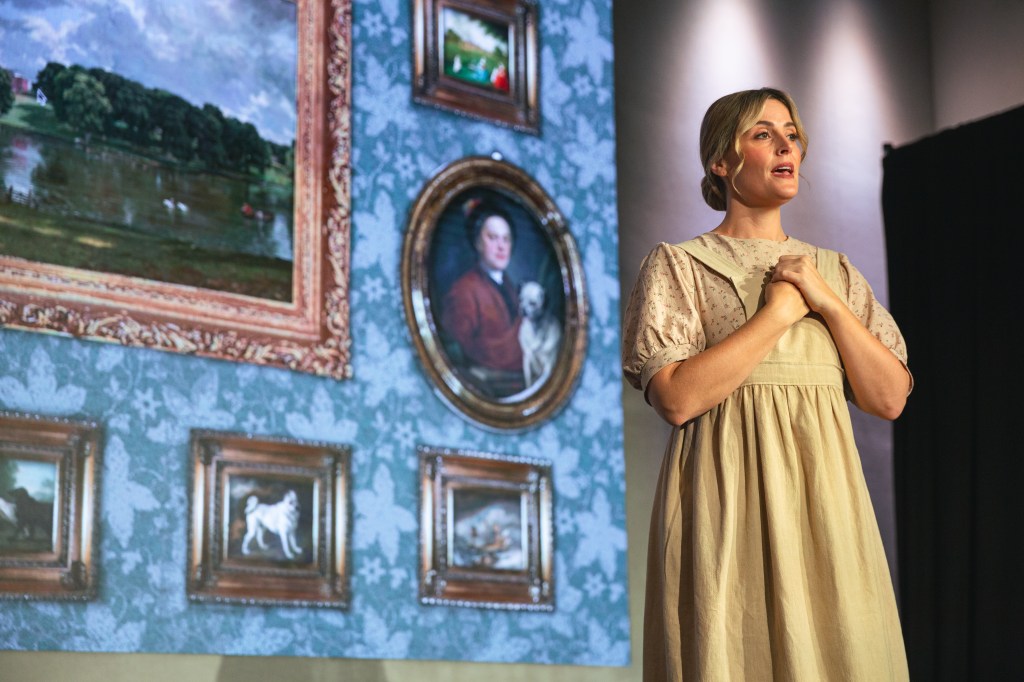
Jackie Clarke in My Brilliant Divorce Photo: Darren Meredith
My Brilliant Divorce
By Geraldine Aron
Dir Janice Finn
With Jackie Clarke
Tadpole Productions
Pumphouse Theatre, Takapuna
to 25 May
Review by Malcolm Calder
16 May 2024
As a mere male, I feel something of a fraud attempting to review something that tackles its subject entirely from a woman’s perspective. But, rest assured, I have sought the opinions of female friends, so plough on (in truth ARE thoughts for menfolk in the work too).
Geraldine Aron’s play tracks one woman’s three-year path through a pending divorce after 20 or so years of marriage. It is ripe for many emotional, social and potentially dangerous situations and that’s no bad thing. In fact Aron’s script largely treats them as a self-deprecatingly comedic and the twinkling sparkle and dry self-observations of Jackie Clarke helps ensure this is the case – although not without some truly heart-rending moments along the way.
There is occasional recognition of Aron’s truths, but the laughter flows, there are giggles galore and it is these spoonfuls of sugar that help ease the shock, the pain, the anxiety and the self-doubt – embarrassingly so at times.
While Aron’s stereotypically deserted wife reflects with shredded self-esteem, loneliness and self-induced neuroses, she finds little support around her. Older family members prefer to look to their own future with generational glee, children don’t look back too hard because they are focussed on other things, while men wish to pursue their new path clearly preferring glitz and glam (and youth of course, now THERE’S a stereotype). And when the loyalty of her hitherto best friend the delightful Dexter wavers, she hits rock bottom.
In sum, My Brilliant Divorce portrays a women who has thought of herself as ‘provided for’ until she isn’t. And then discovers her own future right in front of her.
Initially Jackie Clarke’s Angela Kennedy Lipsky came across as a little tense and a tad overly-quick with her delivery on Opening Night, but she soon grew into the character, quickly found her comic timing and really started to make the most of some of Aron’s delicious lines. In fact, the way her girl-koala demolished her boy-koala (both longtime gifts from her ex), there was real venom behind it and even Dexter looked startled. Even the audience lapped it up when she crawled off-stage looking for the bits.
Self-doubt is at the core of this play. In one or two places it seemed a little dated and some of the localisations didn’t quite work, but that didn’t matter. The audience intuitively knew it would all work out for the best in the long run. Far be it for me provide a spoiler alert though.
Finally, congratulations once again to Tadpole, a company that knows and understands its audience rather well, and keeps coming up with productions to which they can relate. That’s not to suggest the opening night audience for My Brilliant Career was stacked with divorcees. Far from it. In fact I have a feeling that many were there largely because of Jackie Clarke’s presence on stage.
Choreography: Russell Kerr ONZM QSM after Marius Petipa and Lev Ivanov Staging: Turid Revfeim
Set & Costume Design: Kristian Fredrikson
Lighting: Jon Buswell
Music: Pyotr Ilyich Tchaikovsky
Auckland Philharmonia, Conductor Hamish McKeich
Kiri Te Kanawa Theatre, Aotea Centre, Auckland until 12 May
Review by Malcolm Calder
Swan Lake is a classic. And rightly so.
This production, originally choreographed by the legendary late Russell Kerr, lives on and will continue to remain something of a benchmark for the company.
Swan Lake is a work of staggering beauty and power. The magic of the swans, the sumptuous costuming and the elaborately subtle set changes continue to captivate.
Mesmeric and somehow timeless, it truly suspends disbelief, draws on both imagination and emotion and eventually ushers its audience homeward shrouded in an inner warmth and secure in the knowledge that tradition is something to be both valued and prized.
The work itself is as familiar as old boots, is far removed from the concept of a ‘hackneyed standby’ as occasionally perceived by some, and showcases the traditions, skills and techniques that are such an essential part of the artform. Drawing on sets and costumes nearly 30 years old, this RNZB Swan Lake remains lush, vibrant and very, very satisfying. Assiduous attention to detail has resulted in a restoration job to be applauded,
giving Wardrobe a more than gentle workout and Staging with a restoration that is far from counterfeit.
Other commitments prevented this reviewer from attending Opening Night in Auckland, and I was delighted to be able to see the second night cast with the alternate principals and some shuffles in the corp.
Under maestro Hamish McKeich, the Auckland Philharmonia brought the much-loved and thoroughly familiar Tchaikovsky score to life establishing and maintaining the atmospheric and at times mesmeric tone that marries brilliantly well with Turid Revfeim’s staging. Special mention too to the work of harpist Ingrid Bauer.
I found Joshue Guillemot-Rodgerson to be rivettingly imperious as Prince Siegfried in Act 1 – outstanding control and very much a Prince among his subjects. Then I delighted further as he smoothly grew into the smitten and then the confused, before finally leaving us with a feeling of hope for the future. It was a remarkably well-conveyed journey of maturation and growth perhaps drawing from his own journey from the one I first saw in Romeo and Juliet a couple of years back.
However, I found Ana Gallardo Lobaina initially a little aloof, daunting and even ice-like at times as Odette. Her technique was flawlessly detailed and her control immaculate but her connection with Siegfried only really flowered for me after she had slid seamlessly into her alter ego of Odile. However I soon stopped fretting as the two came breathtakingly together in their two pas de deux in Act 3.
Dane Head was delightfully cheeky as the athletic Jester and Zacharie Dun gave us a sleek and demonically insidious Rothbart we all love to hate. But Swan Lake is about swans after all. At a lake. And swans, being swans, are something of pack animals. In turn it follows that they move in unison, think in unison and breathe in unison. And these swans did so with only the slightest of occasional nerves from newcomers, conjuring images that personify Swan Lake. My only disappointment was that, despite their three multi-cultural scenes and significant overall contribution, for some reason the boys did no final bow at the performance I attended. What a pity – I would have applauded them too.
This Swan Lake is a rather mammoth production and RNZB is to be congratulated. It has an enormous energy, is fabulously presented and attracted an audience representing pretty much every age-group. It presents few intellectual challenges, only aesthetic ones and has many, many talking points.
As more than one writer has suggested, this alone may be responsible for drawing more children into dance than any other. That this work will tour regionally will no doubt assist this process.
RNZB Touring to:
Napier, Municipal Theatre, May 17-18 Christchurch, Isaac Theatre Royal, May 23-26 Dunedin, Regent Theatre, May 30 Invercargill, Civic Theatre, June 2
The APO’s recent Bach & Bruckner concert was a study in extraordinary contrasts. The Bach pieces: the Harpsichord Concerto No. 5 in F Minor, BWV 1056 and, Harpsichord Concerto No. 4 in A Major, BWV 1055, date from his Leipzig years, probably around 1740. Bruckner’s unfinished last Symphony No. 9 dates from the 1890s – a 150 year gap between them into which almost all classical and Romantic music falls.
The first contrast was one of scale. For the Bach, a dozen or so stringed instruments clustered around not an antiquated harpsichord, for which the music was written and first performed on, but a shiny black concert grand, looking vast and sleek, like an elephant on the stage surrounded by pygmies.
For the Bruckner after the interval the stage filled up with a crowd of musicians; I’m not sure exactly how many; my attempts to count them always broke down, but it must have been close to 100, certainly at least 80. In the numerous climaxes – Bruckner’s music often seems composed almost entirely of crescendos and decrescendos – they made the loudest noise I’ve ever heard in a concert hall (at least since Bruce Springsteen’s E- Streetband drove me out of the Arts Centre in Ottawa fifty years ago); it left me with ringing ears for some time after the finale.
Then there is the matter of time. The concert began at 7.30 with the two Bach concerti. By 8 o’clock, they were all over; all six movements (three for each piece) together with pauses, applause and encore, took less than half an hour (9 minutes 17 second, and 13 minutes, 40 seconds, respectively, according to one recording). By contrast, the Bruckner stretches out to well over an hour in most recordings (Bernard Haitink’s is 67 minutes long), with each of the outer movements taking almost half-an-hour and about 10 minutes for the intervening scherzo.
French soloist, David Fray, born in 1981, has recorded much of Bach’s keyboard music including the concerti. BBC Music described one such recording: ‘Fray’s command of colour and imaginative highlighting is intoxicating, and there is a freshness which makes for indisputably rewarding listening’. I couldn’t have said it better myself. His playing was as lean and elegant as his person, especially in the lovely melody over pizzicato strings in the slow movement of BWV 1056.
The Bruckner 9th Symphony is sometimes described as a ‘magnificent torso’ of a work, in that it remains uncompleted, the composer having left only sketches of the fourth movement. Even so it seems a shapely structure – I found myself thinking of Gaudi’s Sagrada Familia in Barcelona – with the two vast evenly balanced outer movements joined by the comparatively brief and frenetic scherzo. In my notes I scribbled ‘glorious and sonorous horns suspended over shimmering beds of strings’ and ‘the sensation of bathing in an ocean of sound’.
Replacement conductor Karl-Heinz Steffens, who stood in for the previously advertised Johannes Fritzsch, who was forced to withdraw because of an injury, appeared in total command of music and musicians and had the APO sounding magnificent.
By Deborah Moggach Director, Lucy Waterhouse Producers, Stewart and Tricia Macpherson, Ben MacDonald With Rula Lenska, Harmage Singh Kalirai, Shaan Kesha, Sudeepta Vyas, Dhiya Redding, Georgina Monro, Helen Moulder, Edward Newborn, Cathy Downes, Annie Ruth, Paul Barrett, Ravi Gurunathan, Alvin Maharaj, Tiahli Martyn, Kate Jasonsmith
Civic Theatre, Auckland until 5 May then St James, Wellington and James Hay, Christchurch
Review by Malcolm Calder
I simply cannot remember when I last saw a large-scale commercial theatre production in this country. Music theatre and countless concerts yes, but not a straight play. In fact hardly ever! Marigold Hotel is a huge commercial undertaking fraught with risk and a mammoth achievement.
So, first off, congratulations to the Macphersons and to Ben McDonald.
There’s always something about entering a big theatre that takes me back. Viscerally. Especially for something like this. Maybe it’s the deliciously faux theatrical decor, perhaps that unique smell or even just the sense of occasion that can never be replicated in smaller, newer venues. As such, I cannot even suggest a more apt stage for this production than Auckland’s Civic and its Wellington counterpart – I can only presume Christchurch’s Royal is unavailable.
Although she did not write the screenplay for the movie, Marigold Hotel is Deborah Moggach’s stage adaptation and is largely based on her original novel These Foolish Things. It was first produced in the UK a couple of years back and toured extensively before a run on the West End.
This New Zealand production brings in only the revered Harmage Singh Kalirai and the popular Rula Lenska from London to reprise the roles they created in the UK, and surrounds with a local cast overseen by Lucy Waterhouse to ensure consistency.
Put briefly, Marigold Hotel is hardly a serious drama. Rather it is a comedy that is endearing and loveable tale about a group of English retirees who, for diverse reasons, find themselves in a rundown hotel in India. While not just a retread of the film, it presumes some familiarity with that source.
Miss Lenska’s Madge is a central role, and she is rightly billed as the star, Marigold Hotel is essentially an ensemble piece (supported with some backup) and provides ample opportunity for each of the key characters to deliver from their immense experience. Many are recognisable, even for non-theatre afficionados, and it is a joy to see such on-point timing, situational awareness and even improvisation around a couple of minor technical hitches with nary a blink.
There is not a weak link amongst them and some will remain memorable – Cathy Downes’ Dorothy being but one example. Conversely, Moggach’s script provides only two-dimensional roles for most of the Indian characters. Harmage Singh Kalirai is a standout as the omnipresent Jimmy, but it was the near line-less Tikal (Ravi Gurunathan) who captures with a rivetting on-stage presence, along with Sudeepta Vyas who wheedles and manipulates her Mrs Kapoor as only some mothers can.
However, it is also true to concede that Moggach’s first act might have benefitted more from tighter editing and the opposite in the second where the final denouement is a bit brisk.
On balance though, The Best Exotic Marigold Hotel is a warm and heartfelt story with a joyous finale that assures audiences of a good night out. It is an undertaking that is far from small for its producers, and a welcome opportunity for some of our finest character actors. All are to be congratulated.
Ashlyn Tymms (Fanny Price in Mansfield Park) Photo Lewis Ferris
Mansfield Park Music by Jonathan Dove Libretto by Alasdair Middleton Based on the novel Mansfield Park by Jane Austen Director, Rebecca Meltzer Maestro Concertatore, Brad Cohen A New Zealand Opera production Settlers Country Manor, Waimauku Sunday, 21 April With Ashlyn Tymms (Fanny Price) Kristin Darragh (Lady Bertram) Robert Tucker (Sir Thomas Bertram) Sarah Mileham (Maria Bertram) Michaela Cadwgan (Julia Bertram) Joel Amosa (Edmund Bertram) Andrea Creighton (Aunt Norris) Joanna Foote (Mary Crawford) Taylor Wallbank (Henry Crawford) Andrew Grenon (Mr Rushworth) And Soomin Kim and David Kelly (piano for four hands)
The incoming General Director of New Zealand Opera Brad Cohen has described Mansfield Park as a touchstone for the future. And judging by this offering of Mansfield Park, opera-lovers have a rather fascinating future to look forward to.
Jonathan Dove’s score is contemporary, which may prove difficult for some but it points to an operatic future that is to be lauded and, unlike last year’s perhaps controversial Unruly Tourists, retains some links to literary tradition.
Mansfield Park is a two-act, 18 chapters adaptation of Jane Austen’s early 19th century novel. It takes a few liberties with the original but retains the essential context of the Crawford family and their grand old country pile in which familial mores, social positioning and aspirations are played out. Alasdair Middleton’s libretto deftly and succinctly summarises these in the very first chapter as being about ‘profit, pride, position, posterity and prestige’.
Remote niece, Fanny Price, is recently fostered into this social setting ‘for her betterment’ before patriarch Sir Henry soon departs for the family’s sugar plantation in Antigua. It soon becomes apparent that a simmering undercurrent of familial disputes, bad-mouthing, marital intrigues and backstabbing are revealed before eventual resolution is reached. Through all this the quiet, reserved and subservient Fanny, grows with increasing maturity to become a shining example of all that is good, honest and true.
Mounted in semi-rural splendour of the main reception room at Settlers Country Manor at Waimauku near Kumeu, this initial offering is a chamber opera in the true sense of the word. There is no purpose-built stage as such and it is performed on and around a tiny elevated space measuring perhaps 5m x 4m. Importantly for the future, this production is readily portable, relatively inexpensive to produce and could be easily mounted in a wide range of suitable spaces all over the country.
Director Rebecca Meltzer copes with the questionable acoustics and difficult shape of the room by tossing out any hint of grand opera and uses the tiny performance space to elicit performances of nuance and subtlety from a 10-strong ensemble supported only by a single piano played by four hands. The entire reception hall (set up with rows of chairs for about 300) is used for entrances, exits and even voices from the rear of the room. Meltzer even allows more than just hints of that actor’s stock in-trade – improvisation.
The effect is to offer a new and vibrantly different connection for audiences who are almost invited to become a part of the Crawford family either as flies on the wall, or perhaps imagining themselves as auxiliary staff or even just as close observers. Proximity to the performers induces intimacy and connection, something hammered home at one point when an audience member becomes part of the action on the stage.
This is a genuine and uniformly strong ensemble cast that feeds off, balances and enhances each other so it is no surprise that, as a unit, it was genuinely strong. Some of the lyrics were occasionally lost in the acoustics but these were readily overcome through the availability of a QR code enabling the audience to read them if required.
But it was Sydney-based mezzo Ashlyn Tymms who captured the room especially when Fanny’s low-key presence in the first act grows to increasing prominence in the second. Tymm’s delivered two strong arias at the top of the second act and then seemed to go from strength to strength leaving us in no doubt whatsoever that Fanny Price was unquestionably good, honest and true.
As such, it certainly affords NZ Opera opportunity to connect with new audiences in new ways and perhaps in new locations.
The Effect By Lucy Prebble Director, Benjamin Kilby-Henson An Auckland Theatre Company Production With Jayden Daniels, Jarod Rawiri, Zoë Robins, Sara Wiseman
Production Design, Dan Williams Lighting Design, Jane Hakaraia Sound Design, Chelsea Jade
ASB Waterfront Theatre Until 11 May Review by Malcolm Calder
Suggested in some quarters as a revival, Lucy Prebble’s The Effect could almost be described as a work in progress.
Its context is the clinical trial of a new anti-depressant drug featuring two young people. Very simply, the two fall in quite-possibly dopamine-fuelled love and this play tracks the development of their relationship while questioning the role of psychopharmacology and the intricate relationship between the heart and the brain. Is their love a meaningful long-term thing, or mere drug-inspired infatuation? All of this is observed through the eyes of a supervising psychologist and is overseen by a singularly focussed psychiatrist whose self-espoused objectivity is on the process and on the future.
But The Effect is more than this. While studying (what may be) his heart surgeon father’s brain, Dr Toby Sealey (Jarrod Rawiri) reflects that while traditional medical practices may have once referred to ‘the sane and the insane’, more recent treatment might instead refer to ‘the insane and the sane-for-now’! And therein lies the nub of Lucy Prebble’s The Effect.
Now 12 years old this play has been adapted and updated by its author taking on board increasingly complex and debateable practices about depression within the medical profession and the impact of Big Pharma and chemical treatments. Quite simply, it is about medical ethics. One wonders where this play may go to in another 12 years time.
Nonetheless, Prebble’s script is script-heavy, delightfully structured and demands close attention from its audience. It has light and shade, appropriate localisations and even unexpected flashes of comedy allowing director Ben Kilby-Henson to give full reign to an exceptionally strong cast.
Two ATC newcomers provide standout performances on their respective emotional roller coasters. Both Zoë Robins (Connie Hall) and Jayden Daniels (Tristan Frey) are driven with energy showing us blinding flashes of brilliance at times, while being riven with uncertainty at others. They are a wonderful example of younger actors coming to our stages.
Sara Wiseman (Dr Lorna James) and Jarod Rawiri (Dr Toby Sealey) counter balance them with assuredness and maturity and their respective disintegrations are handled with sensitivity, subtlety and a deftness that comes with experience. They watch and listen to each others’ arguments, articulate the core sense of The Effect with both passion and logic and leave the audience questioning – well, everything really.
No doubt echoing the somewhat scrambled state of its characters brains, Dan Williams’ set and presentation is high tech and another good example of the high production values we expect from ATC. At times this could almost have been a distraction but, on the other hand, it could also be a quite deliberate choice. Even when the younger actors struggled to find a light at times – they were struggling to find themselves.
So does The Effect work ? Emphatically yes
Prebble uses the situation to explore some big questions. It is contemporary. It is dynamic. And I resolutely agree with her ultimate truism – the future is unfinished.
The opening work on the Mahler programme was Salina Fisher’s “Kintsugi” which was originally commissioned by the NZ trio. This augmented work relates to the Japanese art of repairing broken pottery and dusting the new work with gold.
The music focussed on the gaps in the pottery and the broken fragments of the pieces, highlighting the delicacy of the process as the pieces were slowly assembled.
The music seemed to describe the colours, textures and contours of the bowl or vase with Bridget Douglas’s flute describing curvaceous shapes. The orchestra then picked out the seams of the material bonding the broken shards and the shimmering gold.
While describing the physical changes in the pottery the work with its delicate, brittle sounds acted as a metaphor the ability of humans to mends broken bodies and damaged minds.
The American composer Adam Schoenberg’s Percussion Concerto “Losing Earth” was a dazzling work inspired the climate catastrophe threatening our natural world with musical images of cities being inundated by rising oceans.
Jacob Nissly Image NZSO/Jono Tucker
The work opened with the sounds of gunshots from drums which were placed around the auditorium. These sporadic salvos, warnings of a present danger were followed by subterranean groaning of the horns which also suggested looming disaster. This was followed by collisions of the strings and horns against the percussion section.
The audiences was then treated to a remarkable display from Jacob Nissly the soloist who is the San Francisco Symphony’s Principal Percussionist. From his first appearance at the front of the hall playing a snare drum he combined the style of a professional percussion player and that of an outlandish rock band drummer.
At his disposal was an array of instruments; drums, gongs marimba, wood blocks and cymbals with which he and the orchestra created the images of an encroaching ocean with the murmuring strings and brass backgrounding Nissly’s s sonic wonderland. This all ended with his making one final display using a spinning Roto Sound cymbal which emitted an eerie sound as the earth-like globe spun to its whispering end.
Where “Losing Earth” addressed a crucial time in the physical nature of our world , Mahler’s Fifth Symphony addressed a crucial time in the composer’s personal world. The work was written at time when he had a near death experience, his career was blossoming but there many detractors and it was also the time he met future wife. It is these personal and psychological issues the fears, anxieties and pleasures of his life which form the basis of the work and we were presented with the man and his attempts to understand and explore his inner psychological struggles, endeavourimg to express himself through his music in a way few other composers have managed to achieve.
While it is an autobiographical work exploring the composer’s personality, there are parallel themes as he depicts narratives, landscapes and other emotion states.
The measure of a great performance is the way in which these aspects of the composer’s life are realized by the conductor and the orchestra. Conductor Gemma New and the NZSO certainly achieved it with an intelligent and emotional performance.
From the opening trumpet blast to the final triumphant conclusion New was firmly in control of the orchestra, understanding the drama, inventions and contrasts of the music. She seemed by turns, a battling duellist, a lithe dancers and meticulous guide. Subtle nuances were made evident and individual instruments were allowed to shine. Even the long silences between the movements became part of the music, allowing the audience to reflect on each of the previous movements.
New managed to give the blaring, brass opening funereal march a sense of desolation while the singing strings provided a sense of optimism. This romantic reflective mood depicted the man trapped between despair and hope.
In the second movement New seemed to be battling the ferocious sounds of the orchestra and the nightmarish, reckless drama of the music before it morphed into quiet reverie, bringing out nuances and subtleties that seemed to explore the tragedy and triumphs of human and personal history and she allowed the interweaving of the solo violin, the brass and the strings to give the work an intense melancholy.
The final two movements, which included the famous adagio for strings which is considered to be something of a love letter to his wife Alma Schindler, were delivered perfectly filled with an aching sense of love and loss.
The final movement was filled with changing moods, alive with bright woodwinds and brass. New led the orchestra in a brilliantly controlled finale where the doors of perception open and the funeral tones of much of the work are replaced by more exultant sounds offering hope and renewal.
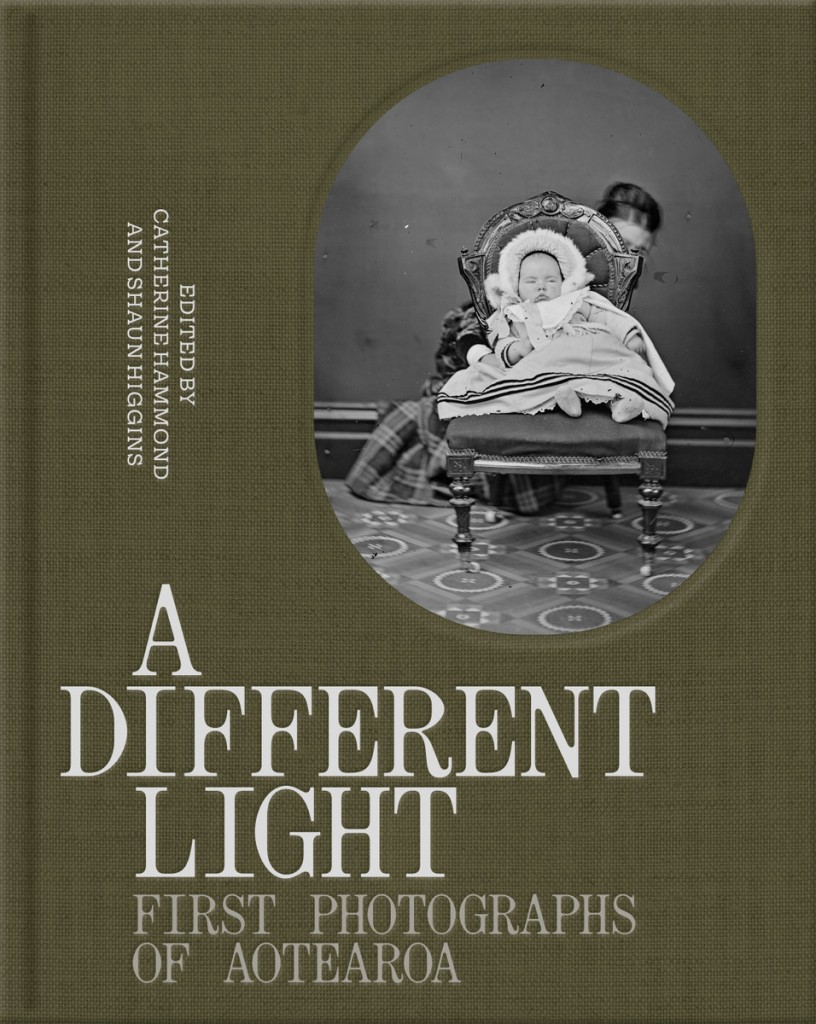
Opening at the Auckland Museum this month is the exhibition “A Different Light: First Photographs of Aotearoa” which will also see the launch of the book “A Different Light: First Photographs of Aotearoa” published by Auckland University Press.
The exhibition is groundbreaking in bringing together work from some of the most extensive photographic collections in the country – Auckland Museum, The Alexander Turnbull Library, The Hocken Collection and The National Library.
While early artists had recorded aspects of life in New Zealand through paintings, drawings and engravings it was the photograph which enabled them to record the full range of people, events, landscapes and the built environment.
The full range of such photographs can be seen in the exhibition and the accompanying new book
The first recorded use of photography in Aotearoa was in 1848, less than a decade after it became commercially available in Europe. Over the second half of the 19th century, professionals and amateurs alike experimented with the new technology and set in motion an image revolution that changed the way our lives were recorded.
These first photographs reveal important individuals as well as ordinary people, imposing landscapes and the New Zealand bush. There are example of Māori architecture and the fledgling townships. In those towns, there are examples of the most imposing of buildings which speak of government and wealth as well as the rudimentary dwellings of settlers.
Cold Water Baths White Terrace; circa 1880s; Charles Spencer; Auckland Museum Collection
The famous Pink and White terraces were photographed by numerous photographers including John Kinder, George Valentine and Josiah Martin. In the book/exhibition there is one by Charles Spencer “Cold Water Baths, White Terraces”. It has been printed as a cyanotype which gives the image a Prussian Blue colour. Another of Spencer’s cyanotypes is of Auckland Harbour which has an eerie appearance.
There are images which help give us an understanding of our past such as Francis Coxhead/ William Meluish’s photograph which shows Gabriels Gully in 1862 with its collection of tents dotted over the barren valley.
Maori King, Tukaroto Matutaera Potatau Te Wherowhero Tawhiao Auckland Museum Collection
There are a couple of images of Auckland by Hartley Webster including what is probably the earliest depiction of the town along with several other views of the town. There are also images of other towns in their infancy including Dunedin, Wellington, Hokitika and Lyttleton.
Two wāhine; circa 1887-1890 Harriet Cobb. Alexander Turnbull Library
From the very first there were images of Māori such “Two Wahine” by Harriet Cobb and many images were printed commercially. One of the most widely distributed was of Wiremu Tamihana te Waharoa who was known as the “king maker”. At one point there was even court action over the plagiarised of images of him.
Other important figures represented in the exhibition include Sir George Grey, Tamati Waka Nene and Gustav von Tempsky.
” The Native Earthworks at Rangiriri partially destroyed. ” Photo: M. Higginson, Auckland Museum
References are also found to the Land Wars with Monatague Higginson’s “The Native earthworks at Rangariri” which was taken after the decisive battle for the Waikato fought in November 1863. There are aspects of cultural exchange to be seen in the dual portrait of Tom Adamson and Wiremu Mutu Mutu where styles of dress and fabrics are merged.
The exhibition provides information on the development of the photographic processes from the expensive, silver-coated daguerreotype portraits to the gelatine silver process, which when paired with a fast-shutter, could capture Victorian-era subjects in action for the first time.
Tom Adamson and Wiremu Mutumutu, Wanganui; circa 1867–1874; Batt & Richards; Hocken
With this growth in understanding of the technical aspects of the photograph came experimentation as can be seen in the double exposure image of John Buchanan, the noted botanist in “Spirit photograph of John Buchanan” by McGregor and Company.
David Reeves, Auckland Museum Tumu Whakarae Chief Executive, says, “The advent of photography in the mid-19th century was a remarkable technological event which had significant impacts on society at the time. This exhibition gives us a chance to reflect on that and more recent changes in the way images are captured and shared and what that means for identity, privacy, and connection with each other.”
The exhibition travels to the Adam Art Gallery (Wellington) in February 2025 and the Hocken Collections (Dunedin) September 2025.
The “Follow button” at the bottom right will appear and clicking on that button will allow you to follow that blog and all future posts will arrive on your email.
It’s easy to appreciate why Sibelius’s Symphony No 2 has been seen as a programmatic work conveying idea about patriotism and nationalism. At the time of writing the symphony the Russian occupiers were restricting the use of the Finnish language and attempting to change the nature of Finnish society.
So, with this symphony, while the Finnish language was being stifled Sibelius was allowing the Finnish voice to be heard through music which reflected on Finnish language, landscape and history.
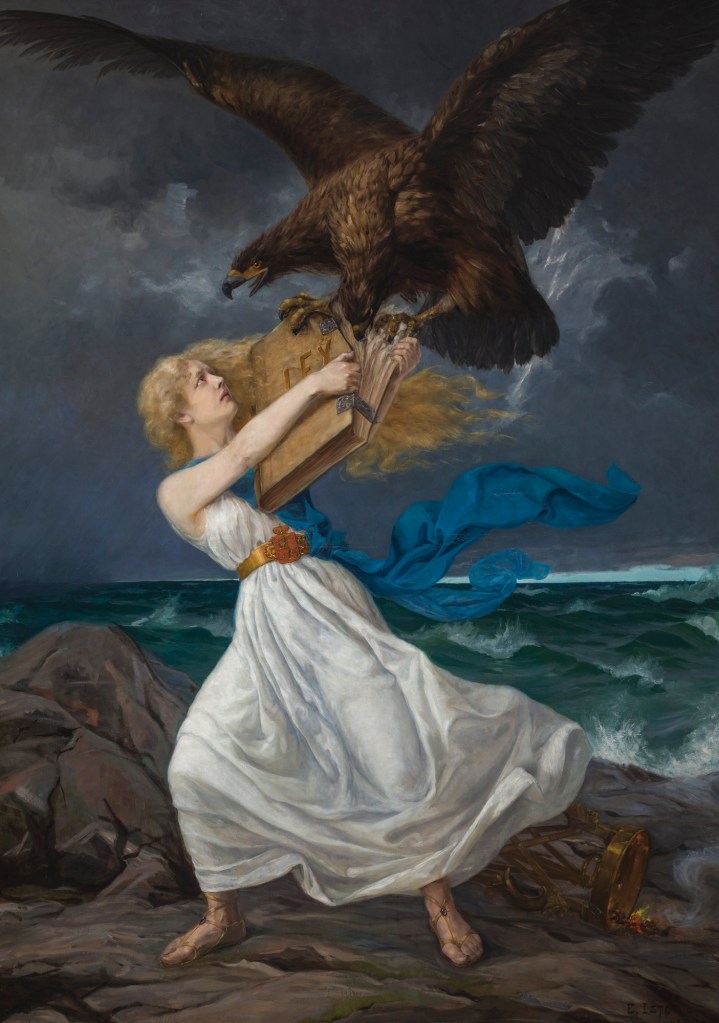
He attempted to convey in music what the painting, ”The Attack” by the Finnish artist Edward Isto did visually. Painted at the same time it illustrated the feelings of many Finns. The work depicts a double headed eagle, representing the Russian state, attempting to snatch a book of laws from a while clad female.
Edward Isto, The Attack
The opening movement with its stirring blasts of the woodwinds and horns followed by the surging strings provided musical images of landscape which conveyed ideas of Finnish Nationalism. Later when the vigorously plucked cellos contrasted with the deep sounds of the bassoons there a sense of personal loneliness or struggle.
The notion of the individual alone in the landscape and awe at their surroundings which is present throughout the work was also apparent in the opening work on the programme, Mendelssohn’s “Hebrides Overture” which also linked landscape, history and myth.
Later the militaristic sounds of a rampant orchestra ended with a triumphant anthem all this sounding like a great storm and its aftermath.
The work was by turns nostalgic, revolutionary and celebratory with repeated themes evoking a call to arms and a new dawn.
The newest work on the programme saw a trio of South Korean artists on stage with violinist Inmo Yang playing Unsuk Chin’s 2001 work “Violin Concerto No 1“ and the orchestra conducted by Shuiyeon Sung.
Inmo Yang
Unsuk Chin’s Violin Concerto is one of her most famous works and has won a number of awards and is fine example of cross-cultural music where the experimental and the traditional are fused.
Inmo Yang backed by a percussion rich orchestra – marimba, gongs, harps, bells and xylophone gave an extraordinary performance.
From the first bars of the first movement with his rapid bowing, he attempted to dominate the orchestra in what seemed at times like a competition.
His almost dementated, playing and the abstract sequences he produced contrasted with the more controlled playing of the orchestra with many of the sequences sounding as though Yang and the orchestra were responding to different musical scores.
His high-pitched sounds worked well with the percussion instruments producing otherworldly feelings and soft disturbing moments. There were also random moments of intimacy as well as magical sounds full of exuberant colour as he joined with and riffed off the various percussion instruments.
In the final movement his dexterous playing set the stage for a battle between violin and orchestra where their sounds would combine and then separate with a massive sonic, Doppler Effect.
Chin’s violin concerto requires a player who has focus, exceptional technical skills and understanding of the work. Inmo Yang possessed all those qualities.
Future APO concerts
April 11th
Viennese Feast
Conductor Christoph Altstaedt Violin Amalia Hall
Brahms Variations on a Theme by Haydn Haydn Violin Concerto No.1 Mahler (arr. Britten) What the Wild Flowers Tell Me Schubert Symphony No.6 ‘Little C major’
The “Follow button” at the bottom right will appear and clicking on that button will allow you to follow that blog and all future posts will arrive on your email.
“I feel very strongly that where I’m going is where paintings must go.”
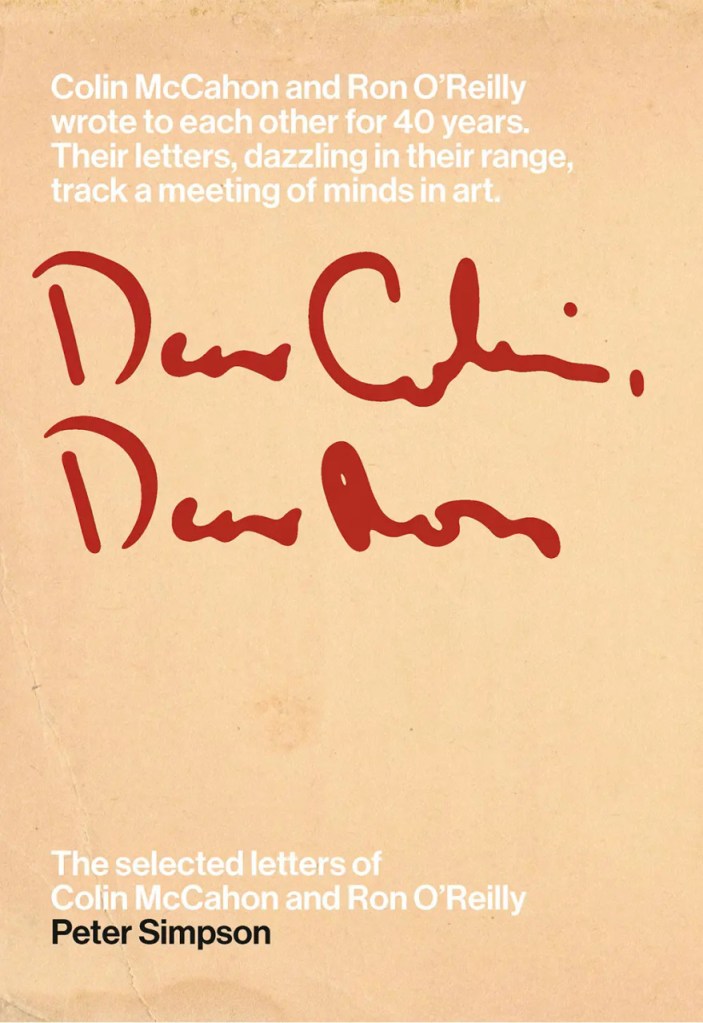
So wrote Colin McCahon in his final letter to his friend Ron O’Reilly. The two of them had been writing to each other for thirty-seven years and in many ways their letters chart the history of McCahon to the point that he was justified in making such as statement.
This statement and other observations about his own art and the development of art in New Zealand over four decades are revealed in new book “Dear Colin, Dear Ron” by Peter Simpson. It adds new dimensions to our knowledge of the life of Colin McCahon as well as exploring the art scene of the 1940’ through to the 1980’s.
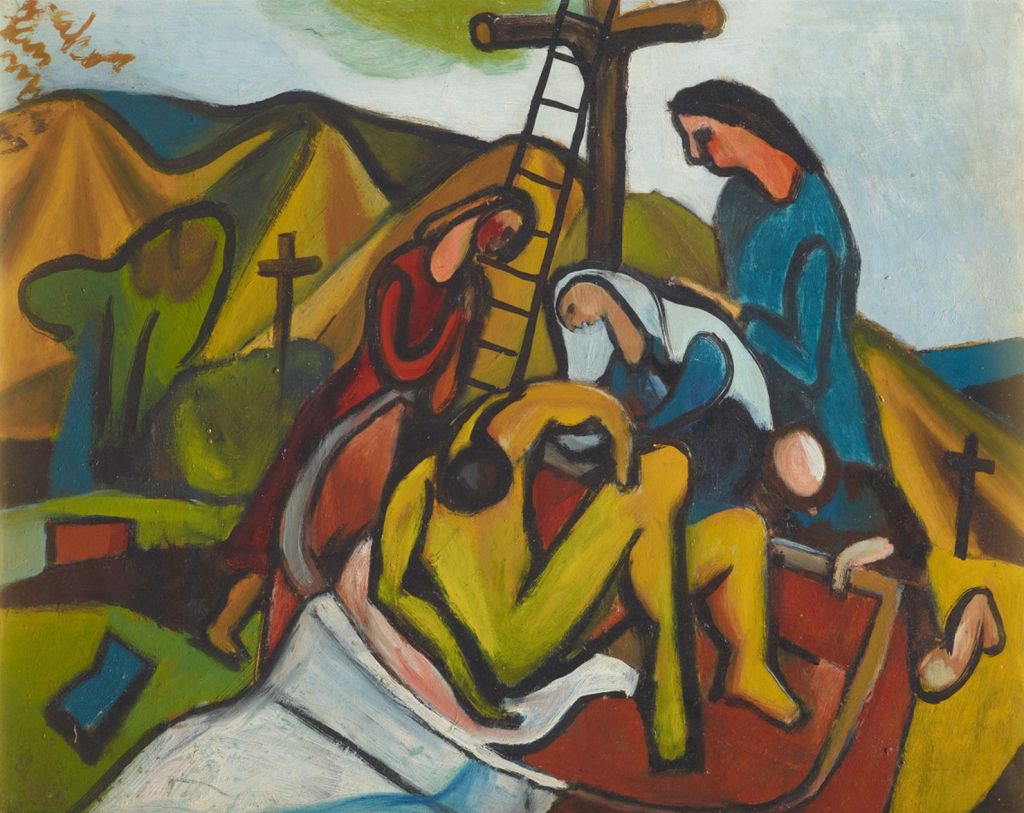
“Entombment (after Titian”), oil on cardboard on hardboard, 1947
Simpson has brought together the correspondence of Colin McCahon and O’Reilly who first met in 1938, in Dunedin when McCahon was 19 and O’Reilly 24. They remained close, writing regularly to each other until 1981, when McCahon became too unwell to write.
Their 380 letters, more than 165,000 words covers McCahon’s art practice, the contemporary art scene, ideas, philosophy and the spiritual life. Their letters deal with a wide range of interests and reveal two men deeply committed to the notion that art can make a difference to society ..
O’Reilly was a philosophy graduate who for many years worked for the Canterbury Public Library where he was influential in showing and collecting the work of McCahon. He subsequently became the director of the Govett Brewster Art Gallery.
This regard for each other can be seen when McCahon applied for job at Elam . O’Reilly wrote: ‘After years of viewing, as I know from the works of his that I possess, one is still discovering more in them, is still more and more impressed by the acuteness of the perception, the fineness of the thought and the breadth of the compassion revealed in their artistry. There is no other artist in New Zealand of whom I would say this. It should be clear that I regard Mr McCahon as the foremost painter in New Zealand and a very great man.’
Reilly’s respect for McCahon can be seen throughout the letters along with his intense interest in getting the rest of New Zealand to see the value of the artist’s work and he worked tirelessly to organise exhibitions of the artist’s work.
Their friendship and correspondence brought out the best in each other – intelligence, empathy, compassion, loyalty, trust: these qualities are obvious through the letters as though the two men appreciated that the issues the y were addressing were important to themselves as well as for posterity.
The book is illustrated with 64 images of McCahon’s work along with some of the drawings which the artist included in some of his letters to illustrate idea about composition.
The letters reveal O’Reilly to be a more intellectual and focussed thinker with carefully considered pieces of writing while McCahon’s responses seems to be more urgent but there are many passages of serious reflection.
The book is sprinkled with snippets of information about other artists, exhibitions and the art world generally which provides a sense of the emerging art scene.
There is Ron O’Reilly’s reports on talks by the visiting British critic Herbert read in 1963 and the American critic Clement Greenberg in 1968 where the notions of international versus the local and the local were addressed.
There is also references to the arts politics of various arts institutions, art events and artists. In a couple of letters Ron O’Reilly (at the time the director of the Govett Brewster Art Gallery) writes about Billy Apple who was going to have a show at the gallery. He notes that ”Billy is a good man and a serious and dedicated artist. He is also touchy and won’t play when people want to use him or assume ever so bigheartedly that he is an entertainer cum pervert or treat him as a bum”.
The letters are full of such perceptive observations about artists and institutions. They also provide a fascinating insight into a relationship which is both personal as well as verging on the philosophical and spiritual as they both try to understand their own and each other’s motivations and ideas.
Simpson says there are many interesting comments about the nature of the paintings in the letters. In 1950 “Colin spoke of making changes to Easter Morning, a painting Ron especially liked. Ron wrote: ‘I am sorry you felt the Easter Morning needed altering: no doubt there are things one is trying for which are not achieved to satisfaction: however I wonder if one ever does achieve them by long labour on the same work. That picture had a magnificent feeling: the quiet movement of the women, the expectancy the fulfilment, the lovely early morning light . . . What you do is so good, so good, it doesn’t seem to me to matter much if you leave a painting which is not quite what you want: the development goes on so richly’. Colin replied: ‘About repainting, I don’t know, but I think Picasso is right that nothing is lost the destroyed discovery reappears in a new and better form. The Easter Morning is certainly better. The three women [in The Marys at the Tomb] remain – the alterations are to the angel[;] he has been enlarged & the landscape, lowered & the colour gone from blue to red[;] there is now a warmth as well as early morning coolness & a less cramped appearance to the whole picture.’
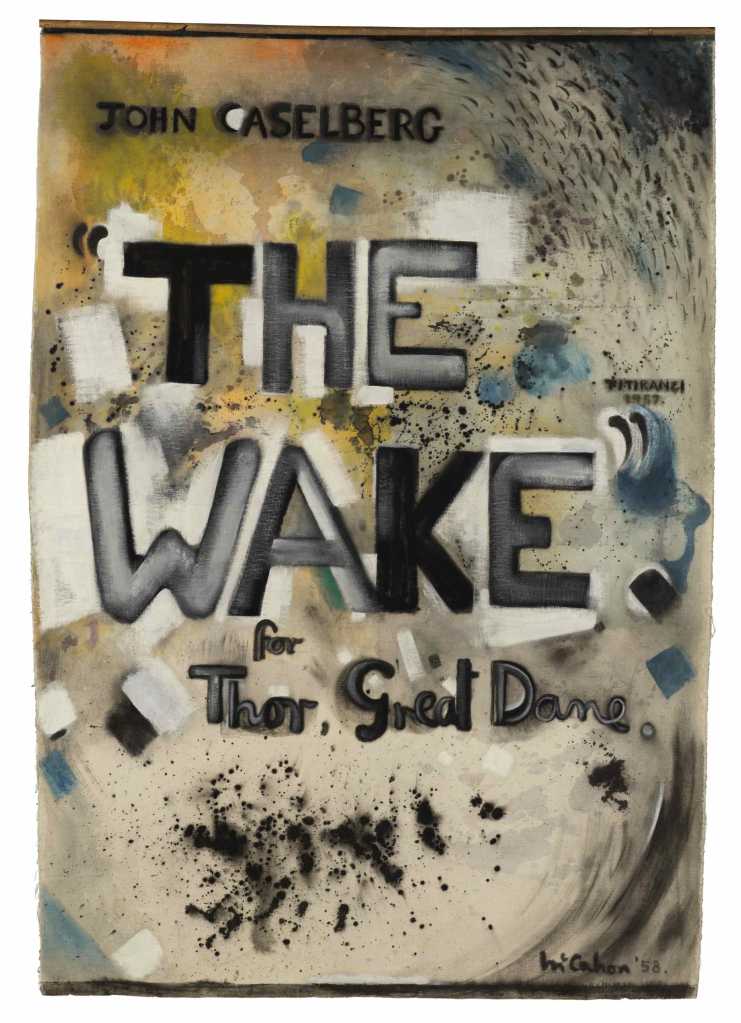
McCahon makes many comments about his own work. At one point in 1958 when he was working on the panels for “The Wake” which was based on the John Caselberg poem he write to O Reilly saying
“The Wake” (panel one) ink and oil on unstretched canvas on sixteen panels, 1956
“I don’t understand the poem with any thoroughness at all either before I started work on it or when I finished. The feelings of what was being expressed comes over strongly – all builds into one feeling & builds this very largely by piling up of word on word in just such a relentless fashion”. Then in reference to the opening line of the poem,
“Your going maims God: God”
He writes “It is a line where bitterness is so strong that all the other feelings seem cancelled & is I feel foreign to the quality of a wake.”
But just a few lines later he writes “I think I’m wrong in what I say of the first line. I can’t work out what I do feel about it…No doubt this bitterness is right as a start.”
The book is a masterpiece of academic scholarship and shows a daunting level of hard work with Simpson transcribing the letters as well as researching and writing 1500 explanatory notes to make the contents of the letters fully accessible to contemporary readers.
O’Reilly’s son Matthew O’Reilly and McCahon’s grandson Finn McCahon-Jones contribute insightful essays that round out the unique perspective the letters afford.








 New Zealand Arts Review