Reviewed by John Daly-Peoples
New Zealand Symphony Orchestra
Four Last Songs
R. Strauss: Rosenkavalier Suite
R. Strauss: Four Last Songs (Vier letzte Lieder) performed by Madeleine Pierard
Johannes Brahms: Symphony No. 3
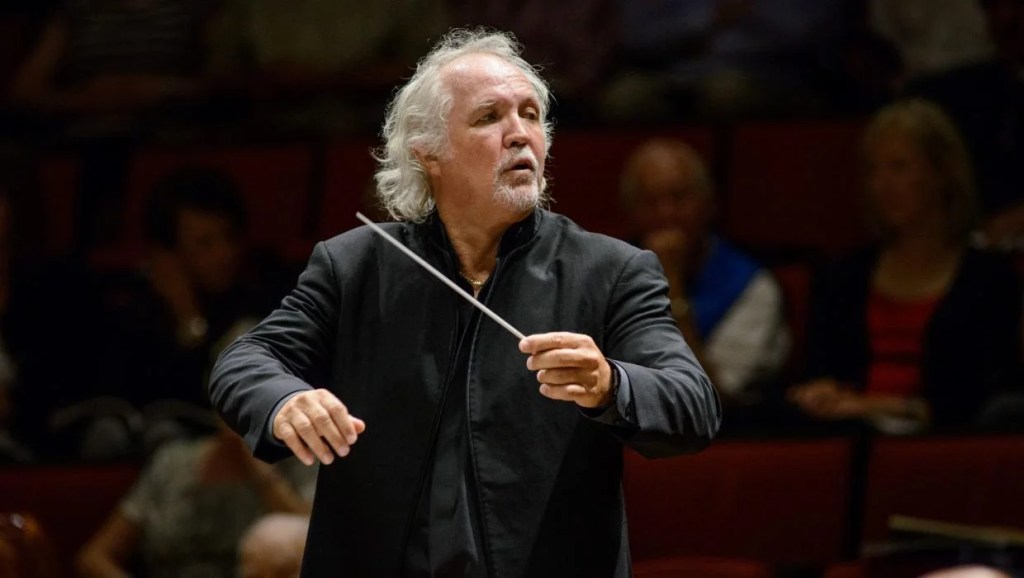
Conductor; Sir Donald Runnicles
Auckland Town Hall
October 2
Reviewed by John Daly-Peoples
The Rosenkavalier suite is an orchestral arrangement derived from Richard Strauss’s famous 1911 comic opera and consists of five connected sections that capture the emotional and melodic core of the opera. It is a marvellous piece of composition which showed off the strength of the orchestra with Sir Donald Runnicles conducting with tremendous energy particulary in the final, uproarious waltz sequence, where Sir Donald seemed to be like a ringmaster in charge of a circus band.
Throughout the work he ensured that all the tonal and percussive qualities of the music were appreciated, bringing out the intense drama of the work as well as the more pensive parts where the orchestra was almost whispering and in several of the dance sequences, he almost seemed to take flight.
The strings were particularly expressive in the presentation of the rose sequence as well is in the final trio, but the finest sequence of all was the prelude, with its marvellously colourful horns.
Strauss’s Four Last Songs come at the end of the period of great German music and while the songs are something of a requiem for the composer, they are also a meditation on the downfall of Germany and the end of its romantic period. However, the mixture of the depressing and the defiant can also be seen as a celebration of the eventual resurrection of the man as well as that of the country.
The four poems which are set in a garden trace out both a day and a life from the perspective of the composer reflecting on the passing of time and his own life.
The first song Frühling (Spring) is a setting of a poem by Hermann Hesse about waking up in a scent filled spring garden. The second song September makes use of a Hesse poem depicting the garden’s colours changing to autumn.
In Beim Schlafengehen (Going to Sleep) the composer uses the poem to explore his desire to escape the demands and worry of the day and to escape into the night.
The final song Im Abendrot (At Sunset) takes a poem by Joseph von Eichendorff in which the composer depicts himself and his wife at sunset contemplating death with the composer quoting from his own composition Death and Transfiguration.

Madeleine Pierard managed to capture the sense of life slowly ebbing from the body and contemplation of death with the occasional vision of tranquillity. Her shimmering gown seemed to mirror her shimmering voice shot through with light sparkling against the dark.
At times she allowed the music to overwhelm her voice as though overcome by the forces of death and despair, only to then rise above the music. At times her voice seemed like a musical instrument as it flowed among the sounds of the orchestra
Throughout the songs her voice had an introspective quality, the music providing the garden in which she wandered, her aching despairing voice emerging as though striving to find new life.
Her voice had a superb quality of emotional expression matching the emotional quality of Strauss’s music, always able to complement the power and delicacy of the music.
Concertmaster Vesa-Matti Leppanen provided a soulful violin solo in the Going to Sleep song, mirroring the vocal soaring of Pierard’s voice depicting the rising of the soul in flight and is emotional highlight of the song cycle.
The major work on the programme was the Brahms “Symphony No 3, a work which is full of marvellous melodies, but which is something of an enigmatic work.
In many ways it is a forerunner of the impressionist works of Debussy and Ravel reflecting the interest of the Impressionist artists of the late nineteenth century. Much of the music is linked to visions of landscape, light and shade, colours and texture.
Sir Donald took a very nuanced approach to the music exploring the chiaroscuro of the work. Every tonal change seemed to have an extra emphasis with some sections slightly truncated while others were extended and several sequences had a palpable tension.
These images he created parallel a world of emotions and feelings, the composers inner and exterior worlds mingling. In building a structure based on these links Brahms explores the nature of the human condition. This is particularly evident in the final movement with its passages of drama and tumult suggesting natural forces as well as the inner turmoil of love and passion.


