Reviewed by John Daly-Peoples

John Pule
The first incision I saw I dreamt no more
Gow Langsford, Onehunga
Until September 5
Reviewed by John Daly-Peoples
The catalogue to John Pule’s latest exhibition “The first incision I saw I dreamt no more” has an introductory poem / note by the artist about the exhibition
“my poetry comes from soil
The exertion of ants, the mucus of worms
The last evenings of caterpillars
The froth of centipedes”
It is an acknowledgment that the art works are based on natural forms and his incisions or enquires into the natural world with works such as the eponymous work on paper is like a page from a scientific notebook with drawings of natural forms, the flora and fauna of the artists environment – fish, plants, insects and centipedes. Theses drawings can also be seen as microscopic views and diagrams of biologicals structures.
These references to the natural world and the plant forms that provide shelter also hint at a parallel world of mythological creatures and lands.

His dramatic approach can be seen in works like “Tau Po Haaku Tau Aho Haaku” ($95,000) where the plant forms which dominate are based on local vegetation but on a larger scale become like a mythological wonderland – somewhere between fantasy and microscopicscans of cellular forms. There are also reference to the natural world with a lake in “Are we able to live here” ($95,000) or a group of Lilliputian scale group of people in “We will always begin here” ($95,000).
The artists work draws on the physical, topographic and historic, merging them, with social, political and personal insights and visions. The work contains much of the artists previous iconography but have a greater immediacy given the artists recent responses to in his ancestral land.
The works are in a sense both a discovery and rediscovery of the land and its mythologies as well as the artists own journeys.
Of his time spent in Niue producing these works he says “I rode my bike each day through the canopy forest from Liku to Alofi, through rain or shine, winds, storm, or calm. The road is bordered with plantations, forests, tracks into the interior. Big blue skies and clouds, shadows of trees stretch across the makatea (limestone) road. Returning to Liku every evening, the sun is warm on my back. These paintings and drawings are about that particular time.”
His works have previously dealt with his growing up in New Zealand, his discovery of traditional Niuean art, and developing his own iconography. This had led to him dealing with wider issues of colonialism, the impact of Christianity as well as the mythology and spirituality of Niue.
With several of the works in the exhibition the artist has created pathways which reach into the foliage much like the trails that that the artist has ridden on his bike but also the pathways which reach back in time. These pathways and journeys can also be seen as metaphors for the artist’s own physical, spiritual and aesthetic journeys.
They are analogous to the songlines of aboriginal art as well as the lines of musical compositions, imagining the way the sounds evolve, carrying a narrative expressing joy. sorrow and wonderment.
The foliage depicted is at once colourful and local as well as surreal and mythological – a portrayal of Pule’s Niue as well as an imagined paradise.
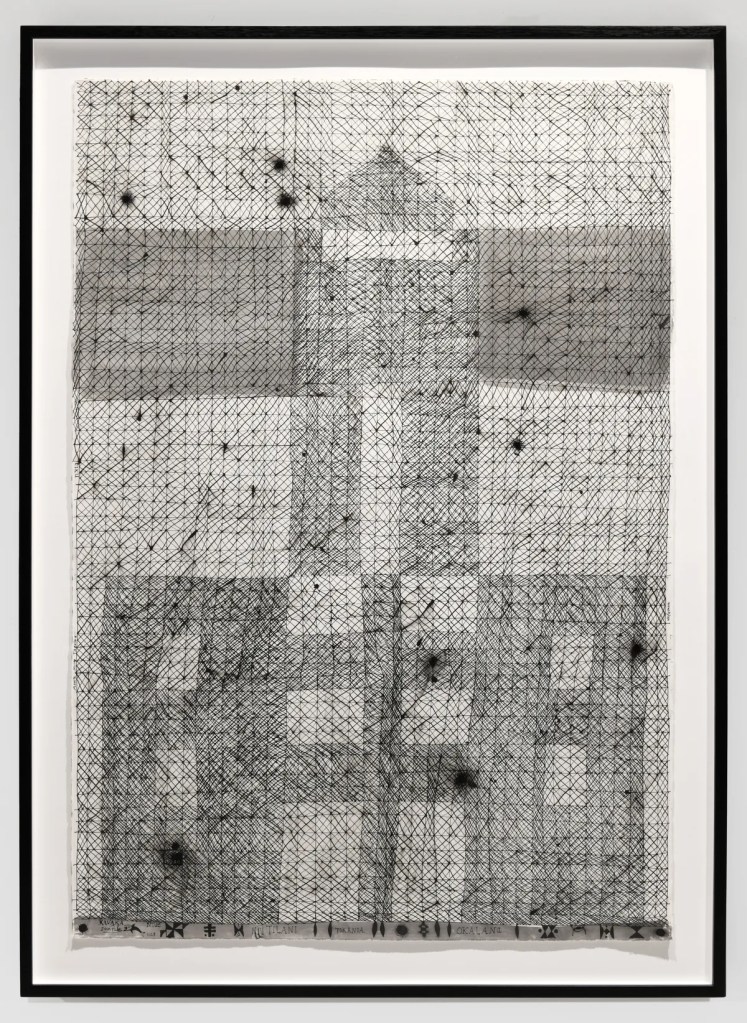
Other works such as “We are waiting for them” ($28,000) “Niu Tilani, Takanoa Okalana” ($28,000) feature plans, grids and designs – locating islands, stars, measuring winds and sea currents, all ways of comprehending the environment
David Eggleton provides an essay to the show which provides an overview of the artist’s work with insights into the artist’s work and perceptive observations such as –
“The paintings are transformative in their poetic intensity, maintained by the deft juxtaposition of various intense hues, which, like lava flows, have pooled and puckered into glossy skeins and skins – the oil-based enamels slathered on in virtuoso fashion, or worked around with brush and pen and rag. Here, in these dense, mirage-like gardens, the shining plants have taken on the powers of sorcery or enchantment. They are part of a fantastic botanical order, not necessarily benign, that over-arches the anonymous, small-scale human figures depicted. And we too as spectators bearing witness are enfolded, or perhaps embraced, by the forking tree limbs, the fleshy leaves, the many-seeded climbing vines.”


