Review by John Daly-Peoples
This week the Auckland Art Gallery Toi o Tāmaki will be exhibiting et al.’s 2005 Venice installation “the fundamental practice” marking the first time the work has been displayed in its entirety in Aotearoa New Zealand.
First exhibited as New Zealand’s official presentation at the 2005 Venice Biennale, the multisensory installation combines five moving ‘autonomous systems’ with computer-generated voices and sounds in a dystopian orchestra. The work forms a layered exploration of belief systems, extremism and its influence on individual freedom and collective life
In 2005 as the Arts Writer for National Business Review I went to the Venice Biennale to report on et al’s installation “the fundamental practice” marking. The work was presented at the Istituto Provinciale per I’Infanzia Santa Maria della Pietà, (La Pieta), a space behind the church where Fiona Pardington is currently showing her work Taharaki Skyside at the 2026 Biennale.
The overarching theme for the 2005 biennale was Sempre un po più lontano (Always a Little Further) andfor the first time in its history, the exhibition was directed by two Spanish women: María de Corral and Rosa Martínez.
NBR published the following article on June 17th 2005
During the opening days of the Venice Biennale in 2005, the international magazine Frieze had a text campaign to alert people to important exhibitions. On the second day the message read. “Unravel oblique systems of communications at the New Zealand pavilion”.
It was going to make good sense to see the New Zealand work early on in the daunting trek around the 100 exhibition sites as the fundamental practice was a central reference point for much of the work on show at this year’s biennale.
Et al’s“the fundamental practice” marking was a central reference point for much of the work on show at this year’s biennale.
A number of other artists appeared to refer to or build on the ideas around “the fundamental practice” marking, which had a density and intricacy as well as a sense of narrative that were not fully developed in other installations.
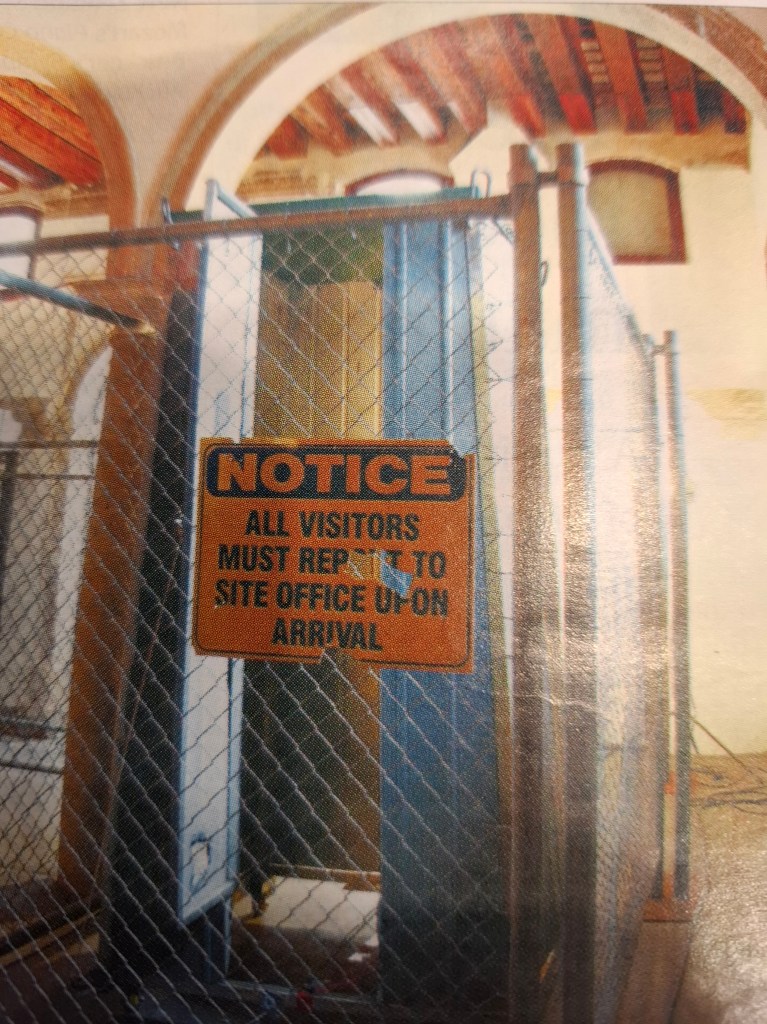
The et al show consists of four old port-a-loos that run on tracks within chain mail fence enclosures. Each of the structures has been adapted and contain motors and sound systems, making them like mysterious alien pods.
The sounds which blare out from the four pods includes classical music such as Vivaldi, various sounds, pealing bells along withy spoken texts. There are also occasional shrieks as the modules erupt into action within their enclosures.
The four pods sprawl through the elaborate gothic entrance foyer of a small palace just off the Grand Canal.
The place looks like the set from a B grade movie where we discover the sinister underground lair of the mad scientists or megalomaniac who want tot rule the world – a place full of weirds machines, lights and silly pseudo scientific gabble.
Et al’s work has been investigating systems of mind control and behavior modification for some time and here there was a questioning of the way we receive, comprehend and accept concepts and beliefs.
The installation also built on the notion many have of the notion of secret corporate, religious or political underworlds involved in the great conspiracies to control, via such people as Osama Bin Laden, Brian Tamaki and Bill Gates.
So, the installation can be seen as part of the mechanism employed for creating mass delusion or imparting propaganda.
Another section of the show has large images of a New Zealand lake with drawings of the port-a-loo modules on the horizon as though these are alien invaders or planned developments. They are reminiscent of the present Transpower debacle over new power pylons.
“the fundamental practice” marking can also be seen as an allegorical installation, representing the political, religious and bureaucratic agencies that attempt to tell people what to think.
One can also look at the installation as being part of an elliptical self-referential device, analogous to the art-making process in which the artist attempts to establish an environment within which the viewer can create and reflect on ideas.
The controversy about the artist not speaking to the media and her practice of calling herself by other names are also practices employed by a Belgium artist calling himself Honore d’O.
His installation had similarities to the et al la show, but where she uses wire cages, modules and elaborate texts, his installations are made of plastic tubing used as a drawing medium as well as for sculptural forms.
Honore d’O and et al’s work both have the appearance of chaotic and alien environments but they also seem to hint at the tortuous creative process. Both artists engage in a deliberate obscuring of logic as thought in that there is as much method to the madness as there is madness to the method.
Another of the major works in the Biennale that has resonances with “the fundamental practice” marking is the brain wave measurement work by New York-based Japanese artist Mariko Mori in which people are hooked up with electrodes in a large space pod, in a setting recalling the end of Close Encounters of the Third Kind, to have their brain waves analysed. This combination of pseudo-science, new age hype and technological controlled environment is only a stylish version of et al’s grungy myth-making laboratory.
Others saw that the mesh fences and ageing machines looked like much of Venice, with its crumbling buildings surrounded by protective fences. Another noted that the whole idea of the installation seemed particularly relevant in Venice, which had invented clandestine bureaucracy many centuries before.


