Categories
Reviews, News and Commentary

Olafur Eliasson: The Leonardo da Vinci of our time

Reviewed by John Daly-Peoples

Olafur Eliasson. The glacier melts series

Reviewed by John Daly-Peoples

Olafur Eliasson, Your Curious Journey

Auckland Art  Gallery

Until March 23, 2025

Reviewed  by John Daly-Peoples

Much of the work of the Danish / Icelandic artist Olafur Eliasson focusses on issues around the impact of changing climate on our lives and our impacts on the environment. In his current exhibition “Your Curious Journey” at the Auckland Art Gallery the most obvious of his works which address these issues is “The Glacier Melt series 1999/2019”. In this series of 15 paired  photographs the artist shows several; glaciers in Iceland ten years apart showing the extent of the glacier melt. The works are a clear visual documentation of the way in which warming temperatures are changing the nature of the environment. While they provide physical evidence of climate change they are also a metaphor for the issue and many of his other works are metaphorical or medications on the nature of the issues.

Eliasson is the Leonardo da Vinci of our times combining art and science with each of the disciplines informing the other providing observations and insights.

The title of the exhibition “Your Curious Journey” could be applied to the set of photographs as we witness the glaciers journeys of expansion and retraction, alerting us to the fact that climate change is part of the evolutionary journey of our past and future.

Linked to that work is  one of the newer pieces, The Last Seven Days of Glacial Ice “(2024) where the progression of  a melting block of ice over seven days has been rendered in bronze. The melted water has been captured in seven glass globes which are exhibited alongside the bronzes, The original block of ice is condensed to a shard of bronze and a globe of water but in reality the ice has disappeared, like some magic trick

While these and other works have a polemic quality to them, all his works are concerned with aspects of aesthetics -and scientific enquiry – light, structure, colour and movement. This mix  of science and art can also be seen in “Double Spiral” where a long steel tube   coils around itself creating a double helix in reference to the structure of DNA

One of the works which encapsulated all of these  aspects is “Movement Microscope” (2011), a  16-minute video set in the artists studio / office in Berlin where the everyday activities of the staff become an elaborate dance routine and simple movements are elaborately observed.  All the movements and interchanges are heighten by the inclusion of a group of “performers who move at a reduced pace, seemingly moving as though their recorded movements have been filmed at a slower speed.

We observe his designers and artists communicating ideas,  working on designs, constructing works, sharing meals, their constructed works now on display in the gallery.

His largest work :”Under the Weather” hangs above the gallery atrium and appears to flicker and change as the observer moves beneath it. The images created are like weather patterns or brain scanner. The illusion of movement is created by an optical effect of two patterns similar to the auditory intersection of the Doppler Effect. Similar effects  can be seen “Multiple Shadow House”.

Olafur Eliasson. Yellow Corridor

One of the more impressive works is at the  entrance to the show. “Yellow Corridor “is an version of a  work the artist has created in m any locations, flooding an  area with yellow light which effects our perceptions of colour and form. The almost blinding light of the lit corridor recalls the quote of Robert Oppenheimer who described the Atom Bomb as brighter than a thousand – which also links to Eliasson’s  “The Weather Project”  which featured a massive  sun located in the Tate’s Turbine Hall.

Eliasson also plays with water and in “Beauty (1993), films of  misty water, illuminated by projected light create a mini Aurora Australis and  with “Object defined by activity (then) a fountain of water is rendered as an almost solid figure by the use of stroboscopic light.

“Still River” brings the issue of climate change down to a local level with three large cubes of ices, slowly melting in the gallery. The ice is frozen water taken form the Waikato River at Lake Whakamaru. We witness the ice melting, see the drops of water falling into the collection tray and hear the sound of the ice cracking and the water melting. We can also see in the water the residue contained in the water – the chemical, effluent and soil and other contaminants.

It provides a physical reminder of the process of the natural world and the ways they can be disrupted.

To subscribe or follow New Zealand Arts Review site – www.nzartsreview.org.

The “Follow button” at the bottom right will appear and clicking on that button  will allow you to follow that blog and all future posts will arrive on your email.

Or go to https://nzartsreview.org/blog/, Scroll down and click “Subscribe”

Categories
Reviews, News and Commentary

ATC’s six plays for 2025

John Daly-Peoples

Murder on the Orient Express

AUCKLAND THEATRE COMPANY 2025 SEASON

John Daly-Peoples

Auckland Theatre Company have announced their 2025 Season of six plays ranging from Shakespeare’s 400-year-old Romeo and Juliet to Roger Halls latest.

These plays include two world premieres, an Auckland premiere, and a translation of a one of the classics. The productions will be directed by some of the country’s best talent including Shane Bosher, Oliver Driver, Benjamin, Alison Quigan QSM and Katie Wolfe,

The Plays

a mixtape for maladies
by Ahi Karunaharan
4 – 23 Mar
Ahi Karunaharan’s talesweeps from 1950s Sri Lanka to modern-day Aotearoa. Directed by Jane Yonge (Scenes from a Yellow Peril) this is both a love letter to Sri Lanka and a lament, the story plays out over 17 songs – ranging from Dusty Springfield to La Bamba to the hit single from a Tamil rom-com.

A collaboration between Agaram Productions, Auckland Theatre Company and Te Ahurei Toi o Tāmaki Auckland Arts Festival.

Agatha Christie’s Murder on the Orient Express
Adapted for the stage by Ken Ludwig
22 Apr – 10 May
The classic that birthed an entire genre comes to the stage with Cameron Rhodes (King Lear, North by Northwest) as the inscrutable Hercule Poirot, supported by Rima Te Wiata, Sophie Henderson, Ryan O’Kane and Mayen Mehta. This play was adapted for the stage by Tony-nominated playwright Ken Ludwig and is directed by Shane Bosher.

Roger Hall’s End of Summer Time
17 Jun – 5 Jul
New Zealand’s most successful playwright Sir Roger Hall brings back one of his most famous characters, Dickie Hart who made his first appearance almost 30 years ago in C’mon Black. This is an affectionate and hilarious skewering of an old grump who realises he still has a lot to learn about the world when he moves to Auckland to be closer to his grandkids. Directed by theatre stalwart Alison Quigan, the play sees Andrew Grainger (Peter Pan, North by Northwest) bringing his big-hearted comedic talent to this solo show that like, all of Hall’s plays, has more than a little bite to it.

William Shakespeare’s Romeo and Juliet
15 Jul – 9 Aug
William Shakespeare’s tale of passion and heartbreak is recast as a fast-paced thriller in this large-scale production of Romeo and Juliet, directed by the co-director of 2023’s runaway hit King Lear, Benjamin Kilby-Henson. Theo Dāvid (Shortland Street) and Phoebe McKellar (One Lane Bridge) make their Auckland Theatre Company debuts as the star-crossed lovers in a Missoni and Pucci-inspired take on 1960s’ Italy, supported by a stellar cast including Bronwyn Bradley, Miriama McDowell and Beatriz Romilly. As potent today as it was when written more than four centuries ago, this tragedy celebrates the triumph of love over hate.

Mary

MARY: The Birth of Frankenstein
by Jess Sayer
19 Aug – 7 Sep
A villa in Switzerland, in the dark winter of 1816. Mary Shelley stands over a bloodied corpse and knows her words are to blame. The script, written by award-winning playwright Jess Sayer in collaboration with Oliver Driver, builds on the bones of history to re-imagine the events of the infamous night that birthed one of the most famous novels of all time: Frankenstein. In Mary: The Birth of Frankenstein, co-created and directed by Oliver Driver (Amadeus), the production transforms from a parlour drama into an unsettling, drug-fueled, lust-drenched Gothic horror as Shelley, played by Olivia Tennet, casts off the men who seek to control her and steps from childhood into life.

Tiri: Te Araroa Woman Far Walking

TIRI: TE ARAROA WOMAN FAR WALKING
by Witi Ihimaera
4 – 23 Nov
The Season closes out with a history-making new adaptation of the epic tale of Tiri Mahana, a 185-year-old matriarch, from her birth at the signing of the Treaty of Waitangi to present day Aotearoa. For the first time, the play will be performed in two parts, English and te reo Māori, with both versions capturing the enduring spirit of Te Ao Māori. With the multi-award-winning team of The Haka Party Incident creator Katie Wolfe (Ngāti Mutunga, Ngāti Tama) and actor Miriama McDowell (Ngāti Hine, Ngāpuhi); Witi Ihimaera’s (Te Whanau a Kai and Ngāti Porou) extraordinary play will shine once again, re-imagined in te reo Māori by Maioha Allen and company.

Categories
Reviews, News and Commentary

Ka Mua Ka Muri: Backwards to the Future

Reviewed by Malcolm Calder

Ka Mua Ka Muri Image, Andi Crown

Ka Mua Ka Muri

Choreographers: Bianca Hyslop and Eddie Elliott

Sound composition: Eden Mulholland

Set and costume design: Rona Ngahuia Osborne

Lighting design: Owen McCarthy

Projection Design: Owen McCarthy (Remain), Dan Mace (Whakamaheahea)

With Abbie Rogers, Caleb Heke, Madi Tumataroa, Matiu Hamuera, Oli Mathiesen, Tai Taranui Hemana, Toalei Roycroft,

An Atamira Dance Company production

Q Theatre, Rangitira

Until 27 July

Then Clarence Street Theatre, Hamilton 29 July.

Review by Malcolm Calder

25 July 2024

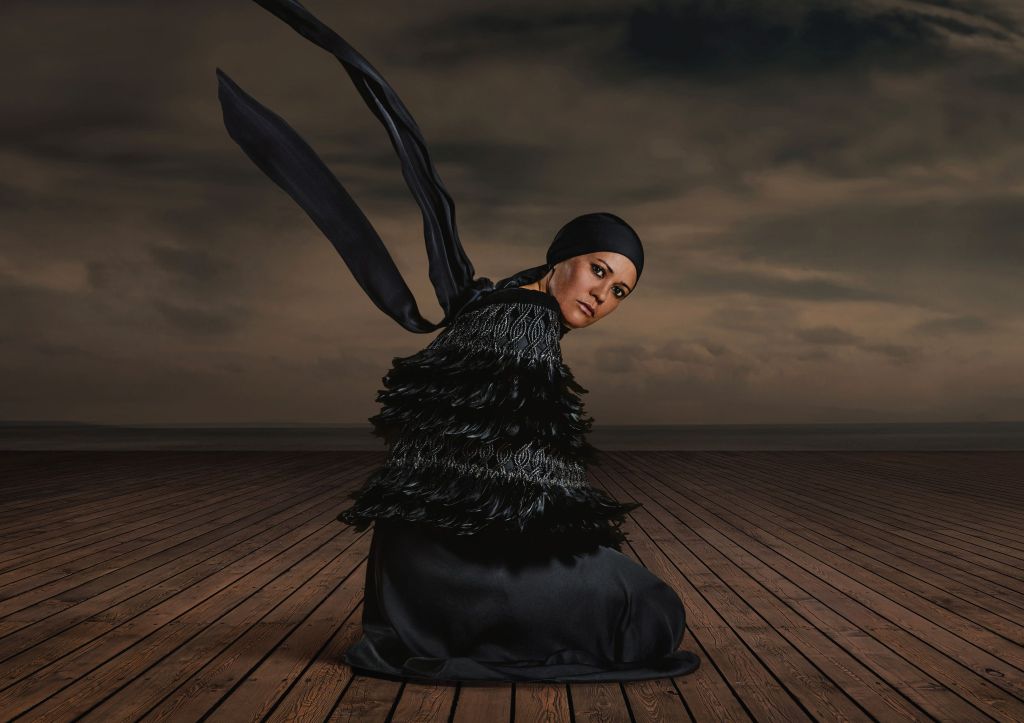
This significant work comprises two collaborative creations without an interval – Eddie Elliott’s Remain followed by Bianca Hyslop’s Whakamaheahea.  Although each could easily stand alone, they are not really a double bill.  There is no interval, simply a pause, or perhaps a lengthy segue between the two, and each reflects the other.  Hence the title which loosely translates into Before and After.

Elliott’s Remain does far more than simply relate the past and provide a context for today however.  It helps to explain that past and how the intertwining of traditions with their origins, social practice and evolution delivers a whakapapa that is as rich with meaning and significance in contemporary Aotearoa as it has been since Ranginui and Papatūānuku.

Elliott has mined the humour and playfulness of everyday life, pride in achievement and evolutionary contributions to making Aotearoa what it is today.  And, no, it is far from a sugar-coating.  There are brief flashes of anger, resentment and disagreement and, after all, that’s life.

Conversely, Hyslop’s Whakamaheahea takes all this as a given or starting point and looks to the world we live in today while providing a basis for navigating the path ahead.  A future that shimmers one moment and then cowers the next.  As Hyslop has noted, cultural identity is a continuum and the place of māoritanga is clearly identified and deeplyembedded in the social context of our country.

The dancers provide a strong ensemble quality with individual characters allowed to emerge and some of the solo work is of a high quality indeed.

Of special mention is the creative team who handled the production aspects of this work admirably.  It is slick, extremely contemporary and entirely captivating.

Importantly, this work acknowledges and further develops the legacy that is Altamira Dance Company.  Yes, there may be some ‘fooling about’ along the way but there is also a strong sense of empowerment, transformation, and resilience that underpins Ka Mua Ka Muri.  It has the potential to inspire a bright collective future.

Categories
Reviews, News and Commentary

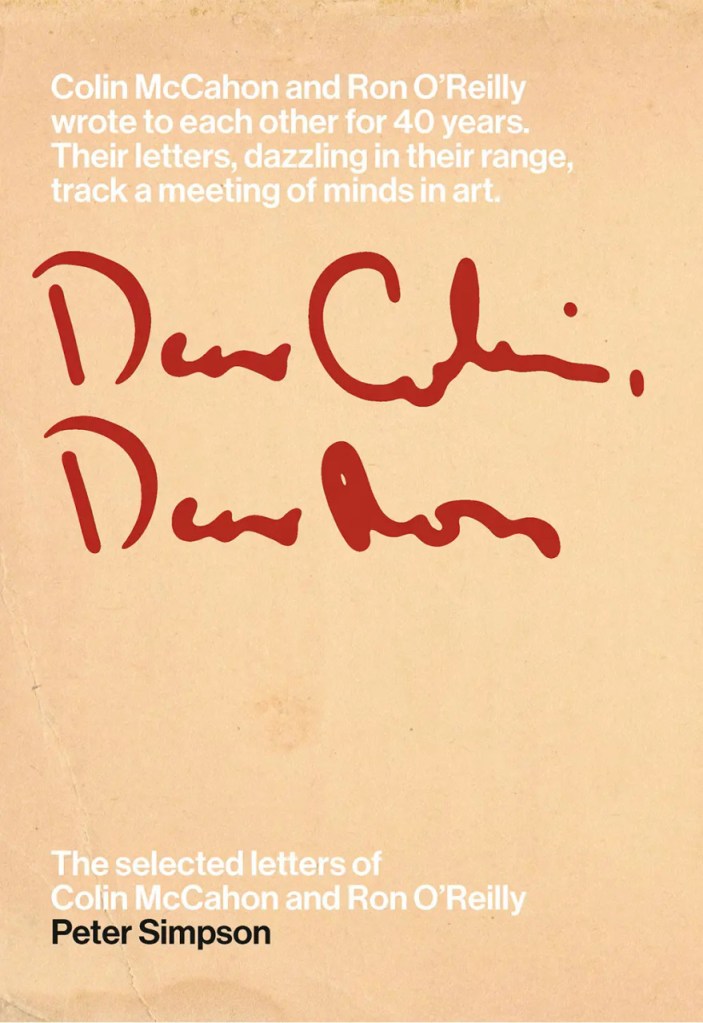
Dear Colin, Dear Ron

Reviewed by John Daly-Peoples

Dear Colin, Dear Ron

By Peter Simpson

Te Papa Press

RRP $65.00

Reviewed by John Daly-Peoples

“I feel very strongly that where I’m going is where paintings must go.”

So wrote Colin McCahon in his  final letter to his friend Ron O’Reilly. The two of them had been writing to each other for thirty-seven years and in many ways their letters chart the history of McCahon to the point that he was justified in making such as statement.

This statement and other observations about his own art and the development of art in New Zealand over four decades are revealed in new book “Dear Colin, Dear Ron” by Peter Simpson. It adds new dimensions to our knowledge of the life of Colin McCahon as well as exploring the art scene of the 1940’ through to the 1980’s.

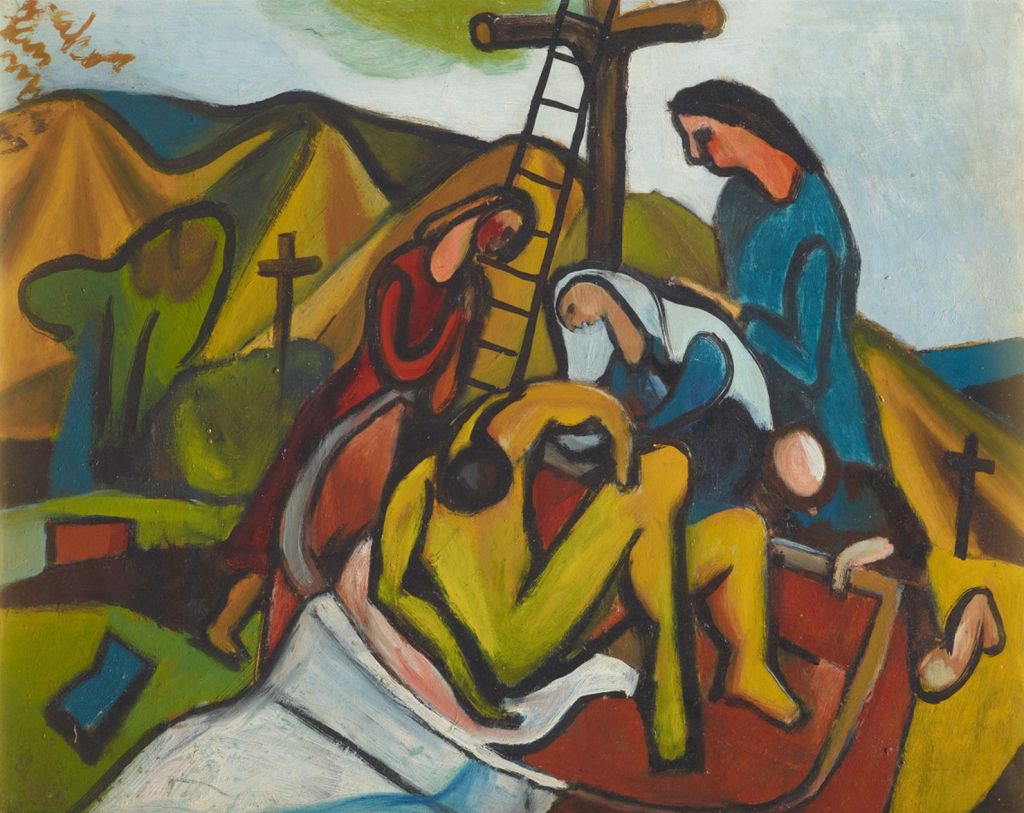
“Entombment (after Titian”), oil on cardboard on hardboard, 1947

Simpson has brought together the correspondence of Colin McCahon and O’Reilly who first met in 1938, in Dunedin when McCahon was 19 and O’Reilly 24. They remained close, writing regularly to each other until 1981, when McCahon became too unwell to write.

Their 380 letters, more than 165,000 words covers McCahon’s art practice, the contemporary art scene, ideas, philosophy and the spiritual life. Their letters deal with a wide range of interests and reveal two men deeply committed to the notion that art can make  a difference to society ..

O’Reilly was a philosophy graduate who for many years worked for the Canterbury Public Library where he was influential in showing and collecting the work of McCahon. He subsequently became the director of the Govett Brewster Art Gallery.

This regard for each other can be seen when McCahon applied for job at Elam . O’Reilly wrote: ‘After years of viewing, as I know from the works of his that I possess, one is still discovering more in them, is still more and more impressed by the acuteness of the perception, the fineness of the thought and the breadth of the compassion revealed in their artistry. There is no other artist in New Zealand of whom I would say this. It should be clear that I regard Mr McCahon as the foremost painter in New Zealand and a very great man.’

Reilly’s respect for McCahon can be seen throughout the letters along with his intense interest in getting the rest of New Zealand to see the value of the artist’s work and he worked tirelessly to organise exhibitions of the artist’s work.  

Their friendship and correspondence brought out the best in each other – intelligence, empathy, compassion, loyalty, trust: these qualities are obvious  through the letters as though the two men appreciated that the issues the y were addressing were important to themselves as well as for posterity.

The book is illustrated with 64 images of McCahon’s work along with some of the drawings which the artist included in some of his letters to illustrate idea about composition.

The letters reveal O’Reilly to be a more intellectual and focussed thinker with carefully considered pieces of writing  while McCahon’s responses  seems to be more urgent but there are many passages of serious reflection.

The book is sprinkled with snippets of information about other artists, exhibitions and the art world  generally   which provides a sense of the emerging art scene.

There is Ron O’Reilly’s reports on talks by the visiting British critic Herbert read in 1963  and the American critic  Clement Greenberg in 1968 where the notions of international versus the local and the local were addressed.

There is also references to the arts politics of various arts institutions, art events and artists. In a couple of letters Ron O’Reilly (at the time the director of the Govett Brewster Art Gallery) writes about Billy Apple who was going to have a show at the gallery. He notes that ”Billy is a good man and a serious and dedicated artist. He is also touchy and won’t play when people want to use him or assume ever so bigheartedly that he is an entertainer cum pervert or treat him as a bum”.

The letters are full of such perceptive observations about artists and institutions. They also provide a fascinating insight into a relationship which is both personal as well as verging on the philosophical and spiritual as they both try to understand  their own and each other’s motivations and ideas.

Simpson says there are many interesting comments  about the nature of the paintings in the letters. In 1950 “Colin spoke of making changes to Easter Morning, a painting Ron especially liked. Ron wrote: ‘I am sorry you felt the Easter Morning needed altering: no doubt there are things one is trying for which are not achieved to satisfaction: however I wonder if one ever does achieve them by long labour on the same work. That picture had a magnificent feeling: the quiet movement of the women, the expectancy the fulfilment, the lovely early morning light . . . What you do is so good, so good, it doesn’t seem to me to matter much if you leave a painting which is not quite what you want: the development goes on so richly’. Colin replied: ‘About repainting, I don’t know, but I think Picasso is right that nothing is lost the destroyed discovery reappears in a new and better form. The Easter Morning is certainly better. The three women [in The Marys at the Tomb] remain – the alterations are to the angel[;] he has been enlarged & the landscape, lowered & the colour gone from blue to red[;] there is now a warmth as well as early morning coolness & a less cramped appearance to the whole picture.’

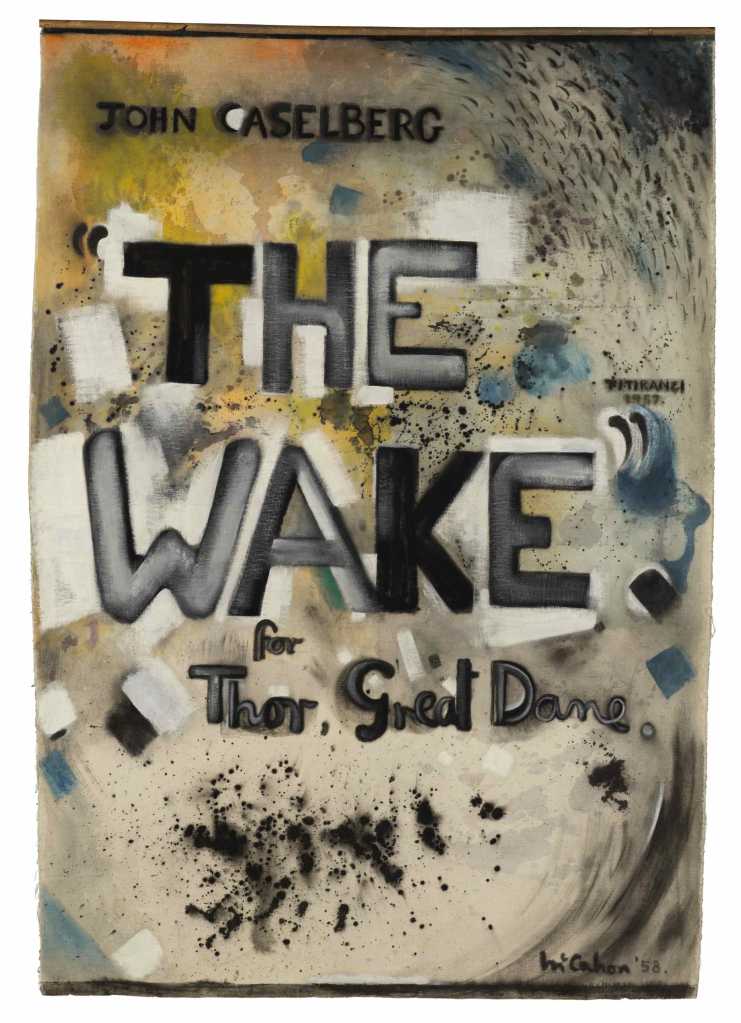
McCahon makes many comments about his own work. At one point in 1958  when he was working on the panels for “The Wake” which was based on the  John Caselberg poem he write to O Reilly saying

“The Wake” (panel one) ink and oil on unstretched canvas on sixteen panels, 1956

“I don’t understand the poem with any thoroughness at all either before I started work on it or when I finished. The feelings of what was being expressed comes over strongly – all builds into one feeling & builds this very largely by piling up of word on word in just such a relentless fashion”. Then in reference to the opening line of the poem,

“Your going maims God: God”

He writes “It is a line where bitterness is so strong that all the other feelings seem cancelled  & is I feel foreign to the quality of a wake.”

But just a few lines later he writes “I think I’m wrong in what I say of the first line. I can’t work out what I do feel about it…No doubt this bitterness is right as a start.”

The book is  a masterpiece of academic scholarship and shows a daunting level of  hard work with Simpson transcribing the letters as well as researching and writing 1500 explanatory notes to make the contents of the letters fully accessible to contemporary readers.

O’Reilly’s son Matthew O’Reilly and McCahon’s grandson Finn McCahon-Jones contribute insightful essays that round out the unique perspective the letters afford.

Categories
Reviews, News and Commentary

Not King Lear: A sophisticated play addressing social and personal issues

Reviewed by John Daly-Peoples

Auckland Arts Festival

Open stage: Not King Lear

Hobson Street Theatre Company

Until March 10

Reviewed by John Daly-Peoples

Goethe once noted that “Ein alter Mann ist stets ein König Lear” – an old man is a King Lear, meaning that the problems which Lear faced were the same for all old men.

Lear’s problems were not necessarily of his own making as events and people conspired to take advantage of him and he found himself virtually alone, deprived of home, authority and family.

This gradual loss of place in society is central to a new play “Not King Lear” which is directed by Adrain Jackson who has worked for many years Royal Shakespeare Company and with people experiencing street homelessness in London

In this latest play he has created a playful yet serious retelling of the story of an old man in conflict with his children, who gives away his authority and falls into homelessness and mental ill-health.

“Not King Lear” has had input from and is performed by members of the Hobson Street Theatre Company which works in partnership with the Auckland City Mission, with an aim to tell stories that are based on real life experiences, addressing social issues.

There is level of sophistication to the play  that is rewarding both in terms of the ideas it explores about relationships and homelessness but also in its approach to theatre.

In making use of Shakespeare’s original text, they are able to background some of the issues with a few passages from the play and some brief character and plot outlines. They present most of the Act I dialogue of the speeches of the three sisters which includes the powerful speech by  Lear.

The cast also use this as an opportunity for jokes about the characters with Regan being referred to as Vegan and Cordelia as Corduroy. There are other parts of the play which are dealt with in a light hearted and ironic way while others are eloquent and insightful.

The players are uneven in their acting skills but there is a passion and honesty to all the performances which make for a rewarding theatrical experience. Some of the actors are brilliant with the one playing Lear providing a profound and expressive interpretation of the character.

The play has elements of Shakespeare’s approach to drama with the idea of the play within play as we see in Hamlet or Midsummers Nights Dream while another sequence features is a Men’s Group which touches on the issue of estrangement.

The audience participation is at a very different level. Early on the audience was asked to take out their cell phones, divided up into groups who then have to find things on their phones which will get used later in the show. So people had to search for Branch, Climate change, Storm and Trumpet. These then  became the source of sounds which audience could then contribute to the soundscape. So when the King first appears the Trumpets let their trumpets blast away.

There is some very effective staging as in the final sequences where projected images of the mean streets of Auckland are used as a counterpoint to Lear’s blasted heath and the filmed images of the homeless pushing shopping trolleys is replicated with a shopping trolley being moved around the stage.

The inclusion of this work by the Hobson Street Theatre Company alongside international productions in the Auckland Arts Festival is to be commended and shows that New Zealand theatre has a crucial role to play in addressing social and personal issues as well as reaching new audiences. 

To subscribe or follow New Zealand Arts Review site – www.nzartsreview.org.

The “Follow button” at the bottom right will appear and clicking on that button  will allow you to follow that blog and all future posts will arrive on your email.

Or go to https://nzartsreview.org/blog/, Scroll down and click “Subscribe”