Categories
Reviews, News and Commentary

Six The Musical: More Than Mere Glitz

Reviewed by Malcolm Calder

Photo : James D Morgan

SIX THE MUSICAL

by Toby Marlow and Lucy Moss

Directors Lucy Moss and Jamie Armitage

Choreography Carrie-Anne Ingrouille

Set Design Emma Bailey

Costume Design Gabriella Slade

Lighting Design Tim Deiling

Sound Design Paul Gatehouse

Orchestrator Tom Curran

Musical Director Beighton

Civic Theatre, Auckland (until 30 March)

Reviewed by Malcolm Calder

1 March 2025

It would be easy to pigeon-hole SIX as a high energy show with lots of froth and bubble, and aimed fairly and squarely at the tiktok generation.  But you would be wrong.  It is rather more.

All things must change and musical theatre is no different.  SIX is important enough to represent another of those significant change points in history – following in the footsteps trodden by Oklahoma or West Side Story or Cats or Hamilton.

On leaving, I overheard an audience member mutter something about SIX being really just a glossed up pub cabaret.  And, to a certain extent, it is.  Originally conceived by a couple of then relatively unknown Cambridge students in 2017, Moss and Marlow took it to the Edinburgh Fringe that year, was a huge success and soon wound up at the Arts Theatre in the West End before a Broadway opening almost immediately before Covid struck.  There was a sort of relaunch in 2021 and SIX now enjoys semi-permanent residence in both London and New York and has gone on to world-wide success with multiple productions all over the anglosphere, as well as Europe and in Asia.

So what has driven this success? A well-known Australian commentator once suggested it resembles a Spice Girls concert directed by Baz Luhrman – but one where the girls can actually sing.  Quite apt I thought at the time.  But this show is a lot more than that.  It is VERY much a significant part of the musical theatre tradition.  In fact there are so many references, acknowledgments and subtle nuances running through SIX that enumerating all of them becomes difficult.

First and foremost, this is a NOW show.  As such it reaches its target easily and then some. So, yes, to the tiktok generation.  But it is  bigger than that and, while it might help grow memberships of amateur music theatre organisations, that is rather simplistic view as it impact is considerably greater. Not to put too fine a point on it, the key fundamental of SIX is pure entertainment built around that old adage – a good story told well that enthrals its audience.  And good entertainment knows no age boundaries – the grandmother in front of me was up and out-boogying her two grandchildren at the end.  Underlying import counts too. 

The stories of the six queens are told in the language of the second decade of the 21st century – not by the archival or even slanted recollections of historians about the politics and intrigue surrounding the first Tudor king.  Most of whom were men, and of a fairly clearly-defined social class at that.  Further, it is told from a women’s perspective.  And remember, some of the queens were all exceptionally young when they married and the Royal Court revolved around power, politics and intrigue.  So we leap immediately to empowerment for women – a rallying cry for millions – and a clear audience profile for SIX.

Structurally, as the fairly comprehensive promotional campaign has pointed out, SIX is built around a history lesson and a competition.  OK.  Thank you.  Got that.  It puts the six queens up against each other each other – an Eisteddfod if you will – or is that merely a device for something bigger?

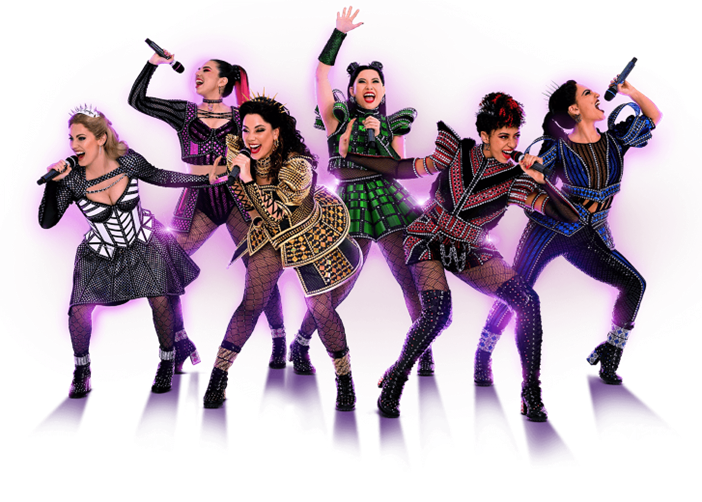
The six queens never leave the stage and their individual songs merge into six-voice choral arrangements, complimentarily and contrapuntally at times, with occasional snatches of spoken dialogue (but not very much at all).  The staging itself is outstandingly conceived by Emma Bailey and reflects a modern high-tech concert stage that integratesTim Deiling’s dynamic lighting and Paul Gastrehouses’s sound in a way that clearly works.  The stage is also peopled by an astonishingly well-rehearsed, syncopathic and complimentary all-girl band for the entire show.

This primarily Australian cast comes well credentialled.  Dancing skills are clearly in evidence with very tight routines throughout and, even if there were one or two very minor vocal wobbles, vocal strength was generally strong and led by the assurance of Loren Hunter (Jane Seymour).  But let’s face it, this show is presented more like an eisteddfod or a competition and it doesn’t really matter – one voice will always overlap another. The tenderness of Heart Of Stone and the hilarious rap of Haus of Holbein were both standouts for me.

The primary focus of attention however is largely rivetted on Gabriella Slade’s award-winning costumes. Little wonder that her outfits have a dash of Spice Girls about them as she devised Spice World back in the 1990s.  But now she has embellished some glittering and futuristic sequinned outfits in ways that not only catch the eye, but help tell each queen’s story.  The ‘beheadeds’ have chokers for example, Jane Seymour’s black and white bodice echoes the half-timbered houses of Tudor England, the green of Anne Boleyn’s outfit references the popular myth that this evergreen was composed by the much-wedded Henry VIII himself (that’s factually incorrect, but let’s stick with the myth). It’s interesting that one interpretation of this song concerns the promiscuity in young women, something Henry’s henchman Archbishop Cranmer used in arranging divorce and subsequent beheading.

The references go on.  In fact they are never ending.  There are the pop divas found in the songs : I think I heard echoes of Beyonce, Ariana Grande and Alicia Keys and probably missed a few more.

The sense of fun and campness is constant.  SIX takes neither itself, nor musical theatre in general, seriously and whimsy is everywhere.  Phones in the theatre, for example, were quite correctly asked to be turned off pre-show and then during the encore (or more correctly the ‘finale’), encouraged the audience to light them up again.  And they certainly did. It was another moment of sheer joy and made the audience a part of the show. I think that grandma in front of me got a pretty good video take.

Any good production simply tells a story.  SIX does so with succinctness and very, very well.  It is not a long show, but is pretty demanding on both voices and the attention-span of audiences.

I always relish a well written show that is objective and contemporary rather than one that delves into the introspective meanderings of L-plate writers.  SIX is mature writing and very clever staging.  

The filmed on-stage reunion of Six’s original West End queens will be released in cinemas next month and, rather ironically, Auckland’s Civic remains one of the larger in-theatre venues it has played.  After here, it’s off to complete its second lap of Australia at the Civic’s sister in Newcastle, while Asia awaits

To subscribe or follow New Zealand Arts Review site – www.nzartsreview.org.

The “Follow button” at the bottom right will appear and clicking on that button  will allow you to follow that blog and all future posts will arrive on your email.

Or go to https://nzartsreview.org/blog/, Scroll down and click “Subscribe”

Categories
Reviews, News and Commentary

Shakespeare in the Park: A cold blooded tragedy and a highly promising comedy

Auckland Shakespeare in the Park 2025

A Shoreside Theatre production

Pumphouse Amphitheatre

(if wet – Pumphouse Theatre)

Richard III

By William Shakespeare

Dir Catherine Boniface

Jan 22, 23, 24, 28, 31, Feb 1, 5, 6, 9, 11, 13, 15

The Taming of the Shrew

By William Shakespeare

Dir Mags Delaney-Moffat

Jan 23, 29, 30, Feb 4, 7, 8, 10, 12, 14

Review by Malcolm Calder

22 January 2024

Richard, Duke of Gloucester (Chris Raven) surrounded by his friends, perceived rivals
and even some who survived his ascension to the throne

Tragedy is a commonly used euphemism in theatre for when lots of people die.  Richard III doesn’t quite reach Titus proportions, but it has to be up there and this particular production is in good company.

It is part of Shoreside Theatre’s annual Shakespeare in the Park series, now in its 29th iteration, and staged at the delightful, terraced, outdoor amphitheatre adjacent to Lake Pupuke at Takapuna’s Pumphouse theatre.

Rather than try and recreate Shakespeare’s historical setting and fail, Director Catherine Boniface has chosen to locate her Richard III in a seedy but sartorially splendid 1930s London.  Her program notes suggest the setting is reminiscent of Peaky Blinders – and, yes, there were some artfully angled flat caps on display.  Gangland in a word.  It works too, largely because it is analogously appropriate to the dastardly deeds that Richard, Duke of Gloucester got up to towards the end of the the English Civil Wars.

I won’t even begin to list all the deaths he generates.  Suffice to say it’s a lot – one might even suggest he ‘eliminated’ his way to the top.  And misogynistically too because, as far as I recall, all those who died were males.  Something to do with lineage in those dastardly days when York’s rose challenged that of Lancaster and the distaff lines were those who suffered the pain and of loss.

Richard, of course, received his final comeuppance and the reference to Leicester reminded me that his remains were eventually discovered under a carpark there only 15 years ago.

Chris Rather played Richard with a suavely cool and assured arrogance, his ambition plainly on display, and even his disintegrating final days were well handled.  He was a standout for me in 2024’s Measure for Measure and it was good to see him progress to the Richard role.  The supporting roles more than served to enhance and focus attention on Richard’s dominance but the standout for me this time was Suzie Sampson as Lady Margaret – subtle, nuanced and very, very professional.

The period setting on a simple stage is fairly stark but allowed the inclusion of some delightful props – the wooden Lancaster bomber, the pistols and, of course, the costumes.  I could swear the ghoulishly severed head with spectacles intact was still dripping blood.  Although I did wonder if the prominently held and waved cigarettes may have in fact been vapes.

On balance, another competent and highly entertaining part of the Shakespeare in the Park series.

Conversely the comedic Taming of the Shrew is the very antithesis of Richard.  Its content, gender-neutral casting and the fact that it is performed by what is effectively Shoreside’s youth company mean it would be facetious to compare the two.

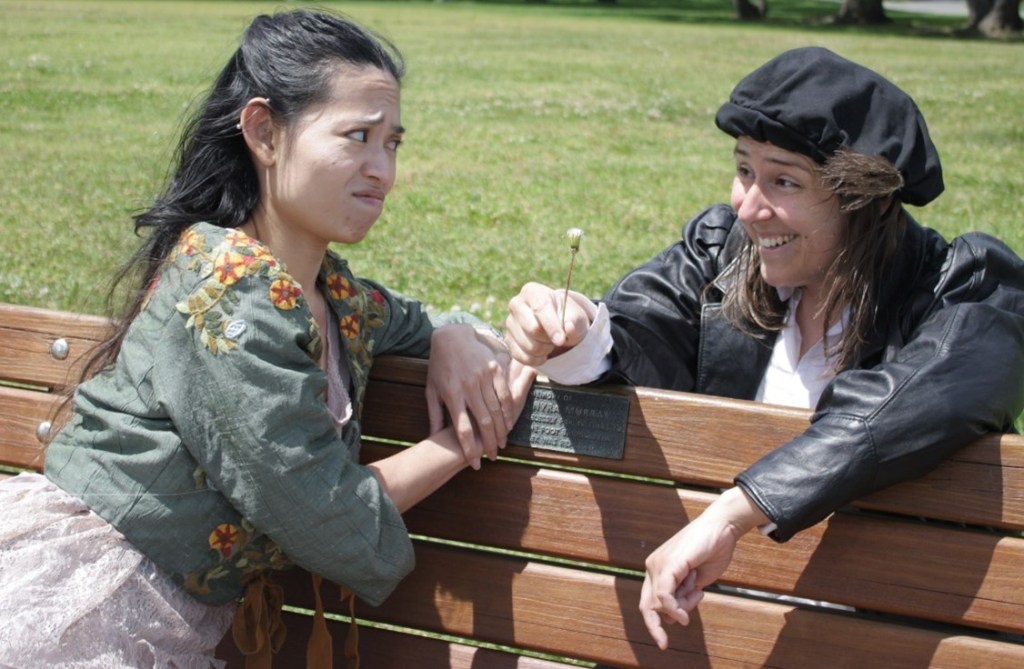
Katerina (Matilda Chua) and Petrucio (Heather Warne) in The Taming of the Shrew

The plot itself of Shrew is well-known.  In overly-simple words, Lucentio loves Bianca but cannot court her until her shrewish older sister Katerina marries. The eccentric Petrucio marries the reluctant Katerina and uses guile and trickery to render her an obedient wife.  Lucentio marries Bianca and, in a contest at the end, Katerina proves to be a most obedient wife.  The end !

There is probably a moral in there somewhere but the play is almost like a minefield for actors with cross-cuts of double entendre, split-second timing and that all important factor – suspension of disbelief. Shrew calls for a closer understanding of, and appreciation of the nuance in Shakespeare’s words coupled with the timing that is essential to pull this off revealing the farce beneath.  Without them the humour just doesn’t work.

And that is where director Mags Delaney-Moffat is to be congratulated on clearly focussing her youthful and highly-promising cast.  They work as an ensemble, there are laughs aplenty and the work that has gone into achieving them is clearly on display.  

It would seem churlish to single out anyone but the work of Heather Warne (Petrucio) is almost upstaged at times by the wit, humour and general antics, and indeed the timing and presence, of Lizzie Morris as her ‘man’-servant Grumio.  And, despite a demure start, Matilda Chua (Katerina) grows in confidence as true love with Petrucio eventually blossoms.

But there are many highlights and both director and cast are to be congratulated.

The annual two-play Shoreside season is now firmly established on the Auckland theatrical calendar in this, its 29th season.

Note: If wet, transfers indoors.

To subscribe or follow New Zealand Arts Review site – www.nzartsreview.org.

The “Follow button” at the bottom right will appear and clicking on that button  will allow you to follow that blog and all future posts will arrive on your email.

Or go to https://nzartsreview.org/blog/, Scroll down and click “Subscribe”

Categories
Reviews, News and Commentary

A Midsummer Night’s Dream: A Triumph Returns

Image. Stephen ACourt

Reviewed by Malcolm Calder

A Midsummer Night’s Dream

Royal New Zealand Ballet

Choreography – Liam Scarlett

Music – Felix Mendelssohn

Music Arranger – Nigel Gaynor

Set & Costume Design – Tracy Grant Lord

Lighting Design – Kendall Smith

Conductor – Hamish McKeich

Orchestra – Auckland Philharmonia

Kiri Te Kanawa Theatre, Aotea Centre (until Dec 8)

Then Bruce Mason Theatre, Takapuna

OK, Shakespeare started all this theatrical fantasy stuff more than 4 centuries back when he developed some of the Greeks’ allegorical reflections on love and its mythical interpretations by writing A Midsummer Night’s.

It has a convoluted and fantastical plot that epitomises the suspension of disbelief and is perfectly suited to the meandering minds of creatives.   So they did.

A young Felix Mendelssohn had an initial stab at expressing it musically before King William Frederick IV convinced him to enhance his music further as accompaniment to a theatrical staging where it became a favourite of the Prussian court.

I have no idea what William Blake was on when he expressed Shakespeare’s work visually a century later, nor the mindset of various theatre and even movie directors as the original was variously interpreted until eventually becoming a stock in trade for theatre over a couple of centuries.   Little wonder then that it would evolve much later into a significant full-length ballet that is commonly attributed to Georges Ballanchine – apparently a fairly tame interpretation by contemporary standards.  Eventually The Royal New Zealand Ballet was to be congratulated on collaborating in 2015 with the fairly progressive Queensland Ballet in a completely new interpretation devised by the even more weirdly wonderful and progressive mind of the late Liam Scarlett. 

Mendelssohn’s original incidental music was skillfully re-arranged and expanded by former RNZB Music Director Nigel Gaynor and, with an innovative set and a costume design by the distinguishd Tracy Grant Lord, the result was a full-length two-act contemporary ballet that audiences greeted with joyous rapture.

A subsequent 2021 season was rudely interrupted by Covid and this Dream only played in Wellington.   However it has finally toured nationally and reached Auckland where those earlier plaudits can ring even more true today.  This Midsummer Night’s Dream is something that makes one wallow in pure enjoyment.

Yes, of course the threads of serious Greek allegory on humankind are not lost, but it is the telling of the tale that makes this production so outstanding and to marvel at what Liam Scarlett, and the team he headed, has produced.

Firstly, lets look at Tracy Grant Lord’s set.  This combines colour and texture that, when coupled with Kendall Smith’s lighting, results almost as if an additional dimension has somehow been added to the stage. There is a depth and a height and a breadth that I could swear somehow exceed the theatre’s stage dimensions.  This dimensionality is exploited to the fullest in the choreography and the costumes that somehow reinforce the set rather than the other way around.  It is night.  It is a woodland.  It is ethereal.  It is enchanted.  It is a place where subtlety, confusion and a comedy of errors are rife.  It is actually the inside of someone’s mind.

That is largely achieved and certainly enhanced by Nigel Gaynor’s sympathetic musical arrangement of Mendelsson’s sumptuous score and which itself defies traditional convention.  Off-stage voices are introduced under Hamish McKeich’s baton and I could swear I heard someone humming along during the triumphal Wedding March.

The ballet opens with an imperious Oberon (Joshua Guillemot-Rodgerson) and his compellingly superior Queen Titania (Ana Gallardo Lobaina), assisted by his energetic and whimsical sprite Puck (Shaun James Kelly) who attempt to influence and even thwart the course of true love via the use of a supposedly magical pixie dust.  When sprinkled this confuses things a bit and just about everyone on stage loses track of who is love with whom.  There is whimsy and humour around each and every corner and the characterisations are superb – none more so than Bottom (Calum Gray) who magically develops a donkey’s head and tail.

The characterisations are superb, the detail in the dancing shows real connections and Liam Scarlett’s stunning choreography is built around fluidity and motion that blurs fantasy with reality and gives us something unexpected at each turn.  Just as one is starting to relax after a particular marvellous pas de deux, for example, this Dream slides effortlessly into something equally ethereal albeit several feet in the air serving only to amplify, elevate and unify the whole.

Plotwise … no, I won’t bother you with the complexities … suffice to say it all becomes totally confusing but love wins out in the end.  Of course.  And the donkey is human underneath it all – a message for all of us.

This Midsummer Night’s Dream is indeed a sparkling, spectacular ballet of sheer theatrical magic that is a Christmas treat for audiences everywhere

Categories
Reviews, News and Commentary

This Doll’s House Sizzles

Reviewed by Malcolm Calder

Laura Hill (credit Tatiana Harper)

A Doll’s House Part 2

By Lucas Hnath

Directed by Paul Gittins

Design John Parker

Costumes Elizabeth Whiting

Lighting Jane Hakaraia

Production/SM Teresa Sokolich

With Laura Hill, Stephen Butterworth, Danyelle Mealings, Maya Dalziel

Herald Theatre, Aotea Centre, Auckland

14 Nov to 1 Dec 2024

Reviewed by Malcolm Calder

A Doll’s House, Part 2 runs about 90 minutes with no interval and is a bit like a well-cooked, multi-course series of tastes – or tapas if you will.  It is a meal that sizzles and left me feeling delightfully sated.

Each taste is marvelously well-prepared and each is impeccably presented.  Chef Hnath’s initial offerings covered ground prepared by others although he put an individual tweak to each and ensured they were delightfully delivered in ways that addressed time-proven issues of women’s independence, choice and self-fulfillment. 

His chief protagonist Nora Helmer arrives through the same door through which Ibsen had exited her 15 years previously.  But now she bears the scars, world-weariness and hard-won wisdom of a woman who has emphatically found and secured her place in the world as a clearly successful writer.  She is confronted by the worldly-wise Ann-Marie , Nanny to her abandoned children, an older woman who has looked, listened and learned much.  Ann-Marie is able to match Nora when it comes to verbal sparring and their discussion, debate, and general discourse delves into independence, freedom, patriarchies and the expectations of society.  And what that means.  But up to this point Hnath’s menu largely provides tastes with which we are familiar – albeit extremely well done with lashings of aspiration and confidence and some magical energy exchange between the two women.

Humour is never far away, arguments are sophisticated and standpoints and circumstances are outlined one after the other.

However well-presented these standpoints are and just as I was thinking I had heard most of their supporting arguments previously and had mistakenly arrived at a law moot, Hnath introduces Nora’s perhaps-former husband and not quite-ex Torvald.  His arrival is somewhat unexpected to the two women and now the meal and its courses becomes successively tastier.  New garnishes are added – subtly at first as incomprehension, resentment and self-doubt became apparent between all three.  But liberal sprinklings of emotion that initially bubble to the surface and then burst forth as spicy aromas that grow as they are savoured.

And that is the crux of Hnath’s play.  I sat enthralled as each new dish was served raising questions about family, marriage and responsibility.   Again, hardly new arguments, but assembled in dramatic combinations.

The dialogue is fast and vibrant – some of it using very modern vernacular. There is confusion and disagreement and miscomprehension that is sharp and pointed.

Director Paul Gittins is the interpreter of Hnath’s dishes and adds depth and nuance to each.  Designer John Parker enhances them with a simple set that is little more than a platform containing three or four chairs, a small table and an omni-present door frame that acknowledges where Ibsen left off.  Its very simplicity allows Gittins’ cast to better explore and extract light and shade.  Elizabeth’ Whiting’s costumes hint at Ibsen’s period, but nor are they of the present.  Timeless and script-driven are terms that spring to mind.

Rightly so, Laura Hill is billed as the ‘star’ and makes a compelling Nora as the chemistry between her and others is abundantly clear.  Her initial interactions with a remarkably strong Maya Dalziel as Nanny Anne-Marie and then with Torvald reveal the maelstrom that lurks beneath the surface of their worlds.

From being initially nervous and confused Torvald’s emotions soon take over and A Doll’s House 2 really starts to sizzle.  His Torvald is achingly sympathetic one moment, a blustering tyrant the next and ultimately a confused soul.

Their calm and rationale daughter Emmy (Danyelle Mealings) attempts to metaphorically and literally patch up the father-she-never-has-known as a voice of balanced reason but her voice is largely ignored, becoming almost that of a rather more dispassionate audience.

In conclusion one can only applaud.  This is an actor’s play that provokes its audience to empathise with different perspectives and director Gittins allows his universally strong and highly experienced cast to do so.

It is rather like that tapas meal where each course sizzles making A Doll’s House Part 2 a delight and, for me, one of the standouts of Auckland theatre in 2024.

As advised in all the pre-promotional material, familiarity with Ibsen’s 1879 original is not essential, but there are direct and indirect references and clues to it are strewn liberally throughout Hnath’s 21st century sequel. One might think of them as yet another layer of satisfaction – or a hidden dessert if you prefer.

Categories
Reviews, News and Commentary

ATC’s six plays for 2025

John Daly-Peoples

Murder on the Orient Express

AUCKLAND THEATRE COMPANY 2025 SEASON

John Daly-Peoples

Auckland Theatre Company have announced their 2025 Season of six plays ranging from Shakespeare’s 400-year-old Romeo and Juliet to Roger Halls latest.

These plays include two world premieres, an Auckland premiere, and a translation of a one of the classics. The productions will be directed by some of the country’s best talent including Shane Bosher, Oliver Driver, Benjamin, Alison Quigan QSM and Katie Wolfe,

The Plays

a mixtape for maladies
by Ahi Karunaharan
4 – 23 Mar
Ahi Karunaharan’s talesweeps from 1950s Sri Lanka to modern-day Aotearoa. Directed by Jane Yonge (Scenes from a Yellow Peril) this is both a love letter to Sri Lanka and a lament, the story plays out over 17 songs – ranging from Dusty Springfield to La Bamba to the hit single from a Tamil rom-com.

A collaboration between Agaram Productions, Auckland Theatre Company and Te Ahurei Toi o Tāmaki Auckland Arts Festival.

Agatha Christie’s Murder on the Orient Express
Adapted for the stage by Ken Ludwig
22 Apr – 10 May
The classic that birthed an entire genre comes to the stage with Cameron Rhodes (King Lear, North by Northwest) as the inscrutable Hercule Poirot, supported by Rima Te Wiata, Sophie Henderson, Ryan O’Kane and Mayen Mehta. This play was adapted for the stage by Tony-nominated playwright Ken Ludwig and is directed by Shane Bosher.

Roger Hall’s End of Summer Time
17 Jun – 5 Jul
New Zealand’s most successful playwright Sir Roger Hall brings back one of his most famous characters, Dickie Hart who made his first appearance almost 30 years ago in C’mon Black. This is an affectionate and hilarious skewering of an old grump who realises he still has a lot to learn about the world when he moves to Auckland to be closer to his grandkids. Directed by theatre stalwart Alison Quigan, the play sees Andrew Grainger (Peter Pan, North by Northwest) bringing his big-hearted comedic talent to this solo show that like, all of Hall’s plays, has more than a little bite to it.

William Shakespeare’s Romeo and Juliet
15 Jul – 9 Aug
William Shakespeare’s tale of passion and heartbreak is recast as a fast-paced thriller in this large-scale production of Romeo and Juliet, directed by the co-director of 2023’s runaway hit King Lear, Benjamin Kilby-Henson. Theo Dāvid (Shortland Street) and Phoebe McKellar (One Lane Bridge) make their Auckland Theatre Company debuts as the star-crossed lovers in a Missoni and Pucci-inspired take on 1960s’ Italy, supported by a stellar cast including Bronwyn Bradley, Miriama McDowell and Beatriz Romilly. As potent today as it was when written more than four centuries ago, this tragedy celebrates the triumph of love over hate.

Mary

MARY: The Birth of Frankenstein
by Jess Sayer
19 Aug – 7 Sep
A villa in Switzerland, in the dark winter of 1816. Mary Shelley stands over a bloodied corpse and knows her words are to blame. The script, written by award-winning playwright Jess Sayer in collaboration with Oliver Driver, builds on the bones of history to re-imagine the events of the infamous night that birthed one of the most famous novels of all time: Frankenstein. In Mary: The Birth of Frankenstein, co-created and directed by Oliver Driver (Amadeus), the production transforms from a parlour drama into an unsettling, drug-fueled, lust-drenched Gothic horror as Shelley, played by Olivia Tennet, casts off the men who seek to control her and steps from childhood into life.

Tiri: Te Araroa Woman Far Walking

TIRI: TE ARAROA WOMAN FAR WALKING
by Witi Ihimaera
4 – 23 Nov
The Season closes out with a history-making new adaptation of the epic tale of Tiri Mahana, a 185-year-old matriarch, from her birth at the signing of the Treaty of Waitangi to present day Aotearoa. For the first time, the play will be performed in two parts, English and te reo Māori, with both versions capturing the enduring spirit of Te Ao Māori. With the multi-award-winning team of The Haka Party Incident creator Katie Wolfe (Ngāti Mutunga, Ngāti Tama) and actor Miriama McDowell (Ngāti Hine, Ngāpuhi); Witi Ihimaera’s (Te Whanau a Kai and Ngāti Porou) extraordinary play will shine once again, re-imagined in te reo Māori by Maioha Allen and company.

Categories
Reviews, News and Commentary

Tempo Dance Festival: In Transit, Matter and Slip

Reviewed by John Daly-Peoples

In Transit

Te Rerenga o Tere | Tempo Dance Festival 2024

Rua, – In Transit & Matter

Q Theatre

October18

Slip , Rebecca Jensen

October 20

Reviewed by John Daly-Peoples

In Transit

Choreographer, Louise Pōtiki Bryant

Sound / Av, Paddy Free

Lighting, Jo Kilgour

Costumes , Kasia Pol

Slip, Rebecca Jensen

Louise Pōtiki Bryant’s In Transit imagines the links between Maori  myth, ritual and their notion of the ancestors observing the nutuarl  world and its cretasures. Here the shaping of the creation myths, are given narratuives and images which give meaning to the transition in human life  paralleling those of the spirit world.

The work appears to dwell on several aspects of Māori myth such as the creation story of Ranginui and Papatūānuku, whose, children exist for a time in  in the dark world until Tāne, separates their parents, bringing the children into light.

There is also reference to the evolution of the  taiaha which Tū, the god of war asks Rūrūtangiākau, the weapon maker of the gods to create a weapon.

The dance opens with a low droning sounds as the sole figure, representing Tū or Rūrūtangiākau who dances through shafts of light with a  branch balanced on his head., He moves from an underworld into light and is joined by five other dancers who perform with long sticks or the evolving taiaha. They dance to a soundscape which [provides a sense of the being under water along with bird sounds.

The dancers seemingly inspired by bird and reptile  movement, move with short sharp steps id birds, strutting, foraging and pecking. These  movements were accompanied by staccato like breath which add to the sense of existing n another dimension.

Some of the dancers entwine cresting manaia shapes suggesting the notion of messenger between the mortal and spirit worlds.

The slender taiaha are used to create a Papatūānuku womb-like shape out of which  a figure emerges.

The work is full of robust dancing, flickering shafts of light along with a mesmerizing soundtrack along with relentless beats. It blends together sound, music, visual and movement describing the transitions between the physical world and the spirit dimensions.

Matter

Matter

Choreographer & Sets, Ross McCormack

Composer, Jason Wright

Lighting, Jo Kilgour

Costumes , Vicki Slow

“Matter” choreographed by Ross McCormack opens with a lone figure seemingly transfixed by one of the five post erected on the stage. He was joined by another figure and from their fitful movements it appears that they are inhabiting a world where they are seeking, discovering or being activated by lines of force or energy, possibly emanating from the poles.

Then they are joined by a group of dancers who move to a cacophony of sound, inching forward, creating a reptilian-like form with a nod to the work of the German choreographer Pina Bausch. Their erratic shuffling moves, driven by an inner tension and massive roars of music is by turns orderly as though responding to laws of Nature or manipulated by an unseen hand.

Two of the dancers appear to respond to other sounds as though out of their control and they engage in movements which area mix of tussle and dance, their movements  hinting at forces which are attracting and repelling g them.

We get the sense that the poles are the xxx of these forces-  electromagnetic, natural rhythms or xx.  Other bodies separate and merge becoming alien creatures and the sounds and music we hear are the sound of  massed bodies  and the arms and legs becomes tentacles.

Throughout the work the dancers seemed to be either seduced or buffeted by the music and sounds, their movements at times urgent and  sharp while at other times graceful and submissive.

In the latter part of the dance the poles /  pou are moved taking on more symbolic meaning- the crucifixion, the triumphal Iwo Jima image  of WWII.

There is a surreal beauty to the dancing which is created with a subtle mix of  sound and lights while at one point the music takes on the rhythms of the Pacific with a hypnotic quality.

Another dramatic sequence involves first two dancers and ultimately all eight moving and dancing as mirror images of each other creating a dramatic frieze. This architectural aspect is also present in many of the other sequences, deriving from the five poles.

Much of the time the dancing could be likened to the movements of atoms and molecules in chemical and physical reactions, conforming to notions of particle physics and string theory.

Slip

Slip, Rebecca Jensen

We don’t often get to see true absurdist dance in the style of the absurdist dramatic works of the 1950s and ’60s. Nothing that suggest the human condition is essentially absurd and devoid of purpose.

Rebecca Jensen’s “The Slip” seemed to offer an absurdist dance which was set in a bizarre or surreal environment. The stage looked like an art installation  – a step ladder, bucket, watering can, a table cluttered with apparatus, a sole cup and a large, directional microphone.

The opening minutes of the work continued the absurdist premise as we watched a couple of stagehands pouring water into containers and splashing it over  the stage. It looked as though it was a work about sea level and climate change. This idea was reaffirmed throughout  the production with images and the sounds of water.

After that opening  sequence Rebecca Jensen appeared, dressed in a medieval gown, the first of her iterations. She sat, meditatively  on the stage, performing simple gestures which were  in marked contrast to her hectic movement in the latter part of the work.

“Slip” is a filled with precise  and deliberate movements, mixed with moments of humour and provocation. It is an experimental work where the  flaws and interventions that show up over the course of the performance add to its idiosyncratic quality.

It’s a work which can be interpreted as having  surreal narratives, the themes of which will occur to the individual viewer as they come to grips with  the many vignettes.

The focus of the work comes from the title, ”Slip”. There is a constant slippage between what we see and what we hear, between what is natural and what is fabricated between the  role of the performer and the place of the technician.

While Jensen is the dancer/actor in “Slip” she is aided by Aviva Endean who acts as sound technician, participant and  guide,  controlling a table full of noise producing devices both physical and electronic.

When Jensen first appears, she dives into her backpack extracting various items such as a key, a bag of chips a bottle of water and a newspaper. But when she handles these items, it is not their natural sound we hear, it is Endean – shaking her own newspaper and pouring her own bottle of water, the sounds picked up and enhanced by the large microphone. When Jensen eats a chip, the crunch we hear is from Endean’s microphone enhancing the sound of her biting on a stick of celery.

This dislocation and enhancement occurs throughout the work in different forms. When Jensen walks around the stage we hear the sounds of Endean’s feet crunching on shells. At other times when Jensen walks, we hear the sounds of her body creaking as though she is robotic.

Jensen explores a range of movements from small gestures though fluid and dramatic balletic moves to the volatile actions which see her almost out of control.

The soundscape produced by Endean is similar to the enigmatic sounds created by the experimental group From Scratch and like that group she uses unlikely items to create the sounds.

Categories
Reviews, News and Commentary

Peter Pan: Loads of Command but little Control

Review by Malcolm Calder

Jennifer Ludlum as Captain Hook Photo Andi Crown

Peter Pan

By Carl Bland

Adapted from the story by J M Barrie

An Auckland Theatre Company and Nightsong production

Directors, Ben Crowder and Carl Bland

Set, John Verryt

Lighting Sean Lynch

Costumes Elizabeth Whiting

Composer and Music Claire Cowan

Sound Max Scott

Choreography Dayna Pomare Pai

With Andrew Grainger, Jungwhi Jo, Tupe Lualua, Jennifer Ludlam, Anika Moa, Nova Moala-Knox, Lotima Nicholas Pome’e, Theo Shakes, Angus Stevens, Tess Sullivan, the Nightsong Youth Company and Roux the dog.

ASB Waterfront Theatre

Until 27 October

Review by Malcolm Calder

Whether as Captain Hook or the understated Mr Darling, Jennifer Ludlum commands the eyes, the ears and the senses every time she takes to the stage in this rather unique production.  Striding around guiding, leading and even cueing other actors, she is totally in command.  Her pedigree and experience is clear in her every nuanced action and clearly demonstrates why she is one of this country’s finest character actors. 

However it seems she is not supported by any kind of control structure at all in this Peter Pan and that is a great pity.

Nightsong has developed a fine reputation over the years and its I Want To Be Happy remains one of my 2023 standouts.  But this collaboration under the Auckland Theatre Company umbrella has confused me.  It would be easy to dismiss it as a rather ginormous mishmash with no one in control.  That is possibly true to a degree but there are clues as to what it is trying to do.

Writer Carl Bland pays homage to Barrie’s 1920s original.  This is not a hi-tech show and he has kept it old-fashioned in many ways.  However his work as a director is where things go a little awry – a good reason why writers who direct their own work sometimes incline towards the over-indulgent.  Bland has tinkered with Barrie’s original and thrown in many asides, one-liners and loads of whimsy.  Many of them work while others are wasted and become mere throwaways.

It is a bit like all those things got put in a bucket and then someone threw them at the stage.  As a result things just sort of ‘happen’ in this Peter Pan rather than become magically ‘revealed’ after characters evolve, situations develop their own dynamic energy and tension has been drawn tighter and tighter.

Perhaps these things may have evolved after another week or two of rehearsal, but inter-character dynamics were all but absent and few did little more than appear onstage and utter their lines.

Some did their best. Theo Shakes developed a certain presence as Pan, especially in Act 2, Lotima Nicholas Pome’e sang with beauty towards the end of Act 1 and Andrew Grainger blustered about a lot.

Perhaps the whole thing could be summed up by the inclusion of Anika Moa.  Apart from providing some, admittedly nuanced, contributions to the accompanying soundscape I have no idea why she was included.  Her Mermaid Queen simply occupied a space, may have added an occasional vocal harmony and tickled a few percussion instruments.  Poor Anika wound up a distracting sideshow. I felt sorry for her.

John Verryt’s set looked like it might possibly have been relocated from Barrie’s era, a beautifully-crafted wolf suit seemed to cover Tess Sullivan’s mic so we could barely hear her words, low-tech flying is a bit yawn-inducing these days and the whole thing looked under-rehearsed –at a production level too.  Even the intelligently-included ATC Youth Company, making up numbers as pirates and Lost Boys, occasionally looked a little lost themselves.

Through all of this the missing element was command.  One could almost sense Ludlum willing others in the cast to react, respond and become personalities matching the energy, effort and detail she put into her work  – but this production allowed them to do so only rarely.  As her Captain Hook met his demise I’ll swear I could hear her sigh of relief as the crocodile finally clamped its jaws around her and carted her off to who knows where.

And, while conceding that Barrie’s original has a dark side and may provide a few giggles for children I’m inclined to believe its moral about transitioning from childhood is somehow lost in translation for children anyway.  On leaving the theatre I overheard a 10-year-old son respond to his father’s question about what he thought of the show.  His response ‘too long but I liked the dog’ was his summation.

So, thank you ATC for your policy of diversifying your product range in 2023.  However this Peter Pan raises other questions too.  Not least its timing – one wonders why a show specifically targeting children and families should open at the very end of the school holidays.  There have been many successes this year and I am sure this little blip does not negate the others.

But, finally, congratulations to Jennifer Ludlum for two finely-crafted characters.  They commanded the stage.

To subscribe or follow New Zealand Arts Review site – www.nzartsreview.org.

The “Follow button” at the bottom right will appear and clicking on that button  will allow you to follow that blog and all future posts will arrive on your email.

Or go to https://nzartsreview.org/blog/, Scroll down and click “Subscribe”

Categories
Reviews, News and Commentary

Matilda the Musical: Fun to Go

Review by Malcolm Calder

Revolting children in Matilda the Musical

Roald Dahl’s Matilda the Musical

Book Dennis Kelly

Music and Lyrics Tim Minchin

North Shore Music Theatre and Amici Trust

Co-directors Grant Meese and Hamish Mouat

Musical Director Jack Barnard

Bruce Mason Theatre

Until 13 October 2024

Review by Malcolm Calder

 ‘My mummy says I’m a miracle,’ lisps a pampered early-maturer near the top of this deliciously-dark family show.  It is echoed by her diverse classmates and quickly becomes their mantra because, as they well know, even if you’re little you certainly can do a lot.

And they do.  In fact, there are sometimes so many little people doing things in this Matilda, one can readily understand why two directors are occasionally required.  Which might suggest that the principals, the subprincipals, the alternating Maggots, Worms and childrens’ choruses could easily get tangled up a bit.  Not on your life.  They flow as one.  And that is a credit Grant Meese, Hamish Mouat and those who have supported them.  The energy levels never flag and I came out feeling just a tad breathless.

Based on the splendidly grotesque Roald Dahl novel from 1988, and turned over to Tim Minchin and Dennis Kelly prior to its original West End opening in 2010, the music and the songs quickly become owned by the children, the story develops a life of its own and the whole thing becomes a fun-filled romp driven largely by Minchin’s nonsensically-wondrous lyrics as by Roald Dahl’s original.

It tells a tale of the collective power of children and how they address the perceived wrongs of the world they inhabit.  Their ringleader is one Matilda Wormwood – a young girl with the gift of telekinesis. She loves reading, has an unsupportive and cringe-worthy family and ends up at a school run by the terrible Miss Trunchbull.  But, with the help of teacher Miss Honey and town librarian Mrs Phelps, she and the other children overcome all the odds and triumph.  Of course they do.

In the process the character of Matilda’s awful parents are stripped bare; Mrs Trunchball,the butch, granite-faced principal who used to be an Olympic hammer thrower and unleashed by George Keenan-Davies is effectively neutered; the sweet natured Miss Honey – that teacher we all love to love – provides a neat balance that demonstrates not all grownups are nasty. 

As for the children themselves, they are irresistible, stomping and skipping through some marvellous choreography through both this show and through life, demonstrating that growing up is a lifelong endeavour. For kids, yes, but also for the children that we all remain at heart, this is wise, wicked, glorious fun.  Both chocolate cake and the hammer throw will never be the same again.

Of special note is the choreography of Hamish Mouat who manages to sustain multiple overlapping conversations yet never loses sight of a group statement.

Falling neatly into the school holidays, the timing of his show is impeccable.  It is pure, top-end family fare.

Categories
Reviews, News and Commentary

The dark world of “Hamlet” from Opera Australia

Reviewed by John Daly-Peoples

Act I Hamlet Image Keith Saunders

Opera Australia

Hamlet,

Brett Dean , Music

Matthew Jocelyn, Libretto 

Until August 9

Reviewed by John Daly-Peoples

“or not to be “, are the first lines we hear from Hamlet in Opera Australia’s latest offering by composer Brett Dean and librettist Matthew Jocelyn. They are of course a clip from one of the plays most well know soliloquies – “To be or not to be, that is the question”.

That question is

“Whether ’tis nobler in the mind to suffer

The slings and arrows of outrageous fortune,

Or to take arms against a sea of troubles”

In other words act now or prevaricate.

Hamlet never answers his own question and delays taking action to revenge the death of his father. In a typical revenge tragedy of the time that revenge would be quickly and simply exacted but his  equivocation is a sign of his own mental illness or his inconsistent political decision-making which ultimately leads to the death of multiple individuals.

Hamlet doesn’t even speak the words of the soliloquy that is left to a player from the theatre troupe, later in the play.

The opera explores questions of Hamlet’s mental state, how it impacts on his relationship with other members of court, his friends and his betrothed, Ophelia.

Librettist Mathew Jocelyn has done this by cleverly concentrating on some key lines and phrases while Brett Dean has produced a musical landscape which creates moods, emotional portraits and dramatic moments. The score is largely percussion with raw and unusual sounds along with traditional instruments pushed to their limits, providing an edginess and inventiveness to the work.

Director Neil Armfield has realised the visions of Dean and Jocelyn with an impressive production employing a stellar class including Allan Clayton who has performed the leading role at Glyndebourne and the Met. This is an opera which seems as relevant today as it was 400 years ago.

The opening scene, which is replicated in the final duel scene is the main hall in Elsinore where the new King Claudius and Gertrude enter for a banquet. Hamlet, looking remarkably like Peter Jackson  prowls the room in his ‘inky cloak’, gets his own bottle of wine and makes sharp comments about his mother and new father. Along with his brusque complaints there is also a playfulness when he greets his friends Horatio and Marcellus

One becomes aware of the conflict within the work. Is Hamlet actually mad or is it a ploy  which he uses. There are a number of scenes where the theme of pretence, subterfuge  and acting are cleverly developed by Jocelyn. This  notion of reality and artifice is seen at its most powerful in the Players scene where Hamlet adds some lines to the fictional “Murder of Gonzaga” play.

.One of the clever approaches that Jocelyn uses is to repeat particular words and phrases, giving emphasis to them so they become striking mantras

Allan Clayton’s Hamlet is very different from most theatrical versions, there is little that is princely or all that perceptive about him – he is a man burdened with a task, angry with most of those about him and lacking in empathy. He is in a dark world of his own making and that is conveyed through Brett Deans oppressive and stressful music.

It conveys something of the internal melancholy of Hamlet and Clayton’s rough tenor makes one aware of his struggles as he flails physically and vocally with his feelings and (in) actions. His approach to revenge is insipid compared to the pesky Laertes (Nicholas Jones) who leaps at the opportunity of dispatching Hamlet.

Much of Hamlet, as with many of Shakespeare’s plays is focussed on the nature and the future of the royal family and by implication, the future of the state, with reference to the  legitimacy of Claudius and Gertrude and the rottenness of the state of Denmark.

Hamlet (Allan Clayton) and Ghost of his Father (Jud Arthur) Image Keith Saunders

Many of the scenes are brilliantly staged. When the ghost of his father (Jud Arthur) appears to Hamlet it is in a surreal setting worthy of Salvador Dali. The Frankenstein-like figure moves slowly across the stage, a beam of light cuts across the stage from a door giving onto a misty swirling nether world. The ghost tells Hamlet of the need for revenge as the quivering woodwinds and tentative percussion aid his growling voice. The relationship between the two becomes particularly  physical as the two embrace.

Lorina Gore’s  Ophelia gives a splendid performance as she expressed love, confusion and ultimately madness. Her performance was particularly touching in her mad scene where, having strewn herbs around the stage, she proceeded to beat her breast and used her strangled voice along with the sharp strings of the orchestra to convey her fragile mental state. Her cries were accompanied by a small female chorus situated high in the boxes who initially shouted their concerns but then became a choir of angels.

Ophelia (Lorina Gore), Guildenstern (Christopher Lowery) & Rosencrantz (Russell Harcourt) Image Keith Saunders

Rod Gilfry as the guilty Claudius stepping into his new role as king was able to convey his own ambivalent position with a voice which ranged from the rough to the benign while Catherine Carby’s Gertrude duets with her son and Ophelia were taut with genuine feeling.

Kanen Breen’s supercilious bureaucrat, Polonius was excellent with his finger clicking insistence, and Samuel Dundas as Horatio, the only likable character in the opera, gave an intelligent and perceptive performance.

Most of the characters were white faced, as though already embalmed but it was Jud Arthurs monstrous, white figure and his penetrating bass which made the most impression. Arthur was also magnificent as the cocky, philosophical Gravedigger.

The two foppish counter tenors, Rosencrantz (Russell Harcourt) and Guildenstern (Christopher Lowrey) looking like the artwork, Gilbert and George added an element of comedy as well another dimension to the notion of artifice.

The set designed by Ralph Myers with its changing structures was something of a metaphor for the changing veneers, masks and stratagems of the characters while the lighting by Peter Harrison provided many moments of visual drama.

Categories
Reviews, News and Commentary

Wall to Wall Māfana

Red White and Brass: The Play

Stage adaptation by Leki Jackson-Bourne

Directors, Anapela Polata’ivao, Vela Manusaute

Musical Director, Joanna Mika Toloa

Production Design, Sean Coyle

Costume Design, Chrissy Vaega

Sound Design, Matt Eller

Choreography, Mario Faumui

With Haannz Fa’avae-Jackson, Mikey Falesiu, John-Paul ‘JP’ Foliaki, Onetoto Ikavuka, Saala Ilaua, Diamond Langi, Lauren Jackson, ‘Aisea Latu, Jason Manumu’a, Rocky Manusaute, Michaela Te Awa Bird, Kasi Valu

Original screenplay by Halaifonua Finau and Damon Fepulea’i

Co-produced by Piki Films and Miss Conception Films

A World Premiere

ASB Waterfront Theatre

Until 7 July

Reviewed by Malcolm Calder

Last weekend I had a cold and spent most of it confined to quarters.  You know – a bit of this, a bit of that and an overly-heavy dosage of highly-predictable news, current affairs and media gossip monochromatically detailing financial woes, political faux pas, a couple of murders, the inevitable obsession with car crashes and countless opinion from a whole heap of ‘experts’ confidently predicting an imminent emigration across the ditch. I was miserable.

Then I went to the Auckland Theatre Company’s world premiere of a new stage production of Red, White and Brass: The Play!  And I wondered what I was being miserable about.

The basic plot is well publicised and closely follows the original screenplay of the same name by Halaifonua Finau and Damon Fepulea’I about sporting underdogs who over-achieve just as Eddie the Eagle and those Jamaican bobsledders did at the Olympics.  Hollywood loves a good sports story especially where the underdog comes out on top and this story has a unique local flavour.

But this stage production is more subtly nuanced, goes well beyond sport and is weighted more towards capturing hearts and minds in ways that both embrace and express the social psyche that is Tongan Māfana.

It is a thing that generates joy and, without being in the slightest bit didactic about all things Tongan,

it assumes a knowledge of many things in a long, long list.  These range from the place of religion to the place of rugby; from gently acknowledging the contrapuntal role of the matriarch in a purportedly patriarchal society; from an acknowledgement that achievement rests ultimately on aspiration; from generational clash to resolution and to an understanding that even addresses the subsets within the contemporary urban Tongan diaspora in Aotearoa.

As Leki Jackson-Bourne has noted… this production is loud, proud and unapologetically Tongan. It is a statement about community, heritage and sense of self.  But it is more than that.  It also says something very important about our increasingly multicultural society and as such provides a further plank in the evolution of New Zealand theatre history.  It does so with unashamed pride and joy, and celebrates both.

JP Foliaki reprises the movie role of Maka, arguably with more light and shade than the movie allowed, and his relationship with his ‘bit less Tongan’ cousin Veni (Saale Ilaua) is well handled.  Overall the cast is strong and well-balanced and their choral work mesmerizingly memorable.

Sean Coyle’s busy set morphs well in multiple directions, the costumes are a hoot and the dialogue a completely understandable mix of Lea Faka-Tonga and English. The finale is a triumph- but no spoiler alert from me other than to say the band grows on one.

Congratulations to Auckland Theatre Company and mālō Leki – the last vestiges of my cold vanished on the spot!

To subscribe or follow New Zealand Arts Review site – www.nzartsreview.org.

The “Follow button” at the bottom right will appear and clicking on that button  will allow you to follow that blog and all future posts will arrive on your email.

Or go to https://nzartsreview.org/blog/, Scroll down and click “Subscribe”