Reviewed by John Daly-Peoples

Auckland Philharmonia
Richard Wagner
Tristan and Isolde
Auckland Town Hall
August 10
Reviewed by John Daly-Peoples
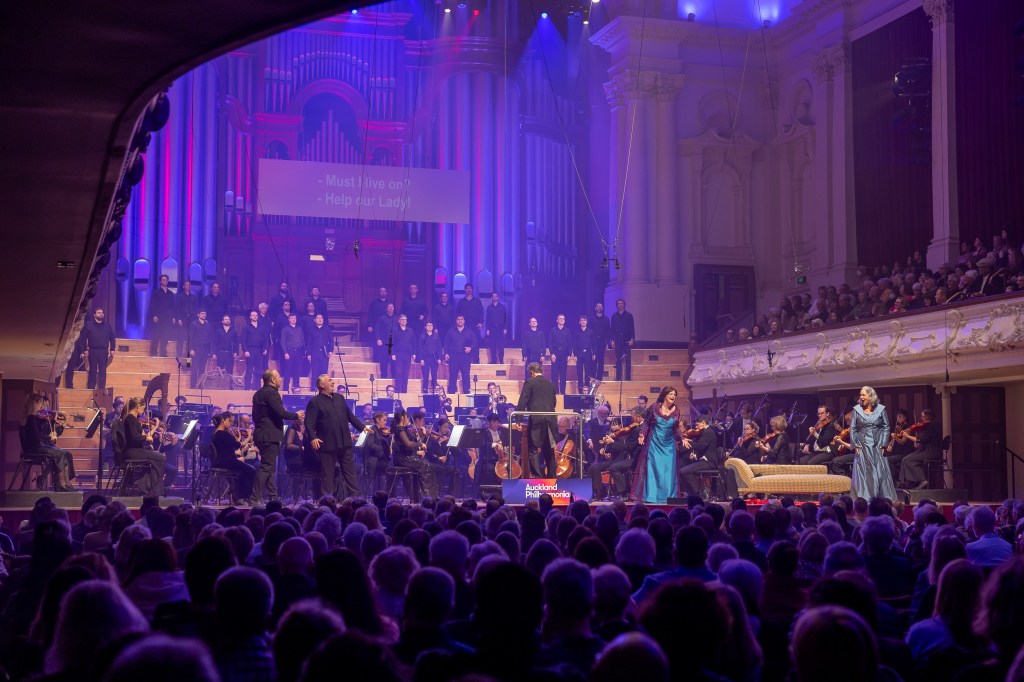
The Auckland Philharmonia’ s recent production of Tristan and Isolde was probably the highlight of this year’s programme. The opera, lasting over five hours is a marathon for audience, singers and orchestra and requires exceptional singers and players which this performance delivered.
With Tristan and Isolde Wagner began moving opera in a new direction away from the traditional love story format, using opera to express ideas about the nature of love, sex. death and existence.
While Wagner may have been influenced by Schopenhauer’s ideas about love and the links between love, sex, and death the composer was probably more interested in providing some sort of rational for his infatuation and possible adulterous relationship with his patron’s wife – Mathilde Wesedonck.
The opera has a simple plot line – Tristan who had previously killed Isolde’s fiancé is taking her to England to marry King Marke but they become attracted to each other (partly due to having drunk a love potion). The king is told of their relationship and seeks to kill Tristan but who dies from wounds and Isolde expired from a broken heart. They presumably become immortal just as all Wagner’s later gods and enter Valhalla.
The opera really only needs the two main characters as well as the music but Wagner gives it a narrative structure and a few other characters who provide contrast and tension.
The music describes the emotions and drama emanating from the two characters with the opening Prelude and the closing Liebestad or “love death song” sung divinely by Isolde over Tristan’s body.
The music of the Prelude was used extensively by Lars van Trier in his film Melancholia expressing something of the same ethos as Tristan and Isolde with ideas about the nature of love, knowledge of our death and the end of civilization.
With Tristan and Isolde the two lovers embody different aspects of love and this is expressed through their singing and their acting.
Act II which takes place over a single night presents an emotional landscape where we experience their unfolding relationship with its deep emotional conflicts,
Their duo “O eternal Night”, touches on a number of aspects of their love and the urgency of their singing conveys a sense of bliss and transcendence.
O’Neill gave an impressive account of Tristan with potent stage presence enhanced by his stance and gestures. He was able to convey a sense of the nobility of love while Merbeth’s Isolde expressed the passion and emotion. With much of her singing her ferocious voice seemed to effortlessly express the conflicting emotions of anger and passion.
This was a semi-staged performance but Frances Moore’s clever staging gave the performance some added drama with several of the cast making use of the various parts of the Town Hall.
Isolde made her final sensational entrance in walking up the centre aisle of the hall, Andrew Goodwin’s ship’s captain made a dramatic appearance singing from the Circle in Act I and Katarina Karneus singing an elegant Brangane sang from the Circle, looking down on the couple in Act II.
Albert Dohmen gave a forceful performance as King Marke singing from up by the organ, towering about the orchestra and Jared Holt as Melot, Tristan’s one-time friend turned villain gave a nuanced performance with his long denunciation.
Johan Reuter gave an impressive account as Kurwenal, Tristan’s servant capturing the close ties between the two men with his sympathetic voice.
The orchestra provided the backbone for the opera and under the skilful direction of Giordano Bellincampi provided sustained emotional and dramatic music, particularly the opening Prelude which made for a magnificent musical experience.


 New Zealand Arts Review