Categories
Reviews, News and Commentary

Gravity & Grace : a refreshing and inventive NZ play

Reviewed by John Daly-Peoples

Auckland Arts Festival

Gravity & Grace by Eleanor Bishop and Karin McCracken.

Q Theatre

Until March 24

Reviewed by John Daly-Peoples

Gravity  & Grace is adapted from Kraus’ account of the unsuccessful film she made in the 1990’s – Gravity & Grace. That film follows Grace as she finds a connection to a cult predicting doomsday and the arrival of a spaceship, and Gravity, who leaves New Zealand to try her luck as an artist in New York City.

Kraus is probably most well known for her book and TV series “I Love Dick” but Eleanor Bishop and Karin McCracken have mined he obscure Gravity & Grace to make a play which addresses ideas about the flawed or failed artist as well as reflecting on the creative process generally.

The play set in the US and New Zealand where much of the filming was shot because she had obtained NZ Arts Council funding. We follow her inexperienced attempts as a director and her unsuccessful efforts to get interest from the film festivals and agents. Along with this we delve into her personal and professional relationships which blight the films development.

Her own attempts at creating art works are paralleled in her homage  to three other flawed creatives: the French writer and philosopher Simone Weil and her book La pesanteur et la grâce (Gravity and Grace), the American artist Paul Thek whose star burnt out after an initial burst of success and  the German Red Army activist Ulrike Meinhof.

Its as if she is saying these great artists also made mistakes, just like  me.

The two writers of the play also are the stars of the work with Eleanor Bishop’s faultless direction and  Karin McCracken giving an incisive portrayal of  Chris Kraus.

McCracken is on stage the whole time and holds the play together with her range of emotions as well as some witty dialogue . She is  also cleverly presented with many sequences featuring her filmed. Often her projected head loomed over her as she sat at her desk or she was shown from strange angles suggesting the characters many dimensions.

The cast play a variety of roles including Andy Warhol (Sam Snedden); Ulrike Meinhof (Ni Dekkers-Reihana); Simone Weil (Rongopai Tickwell) and Paul Thek (Simon Leary). Sneddon also plays Sylvère Lotringer, Kraus’s husband as well as Gavin her S&M phone lover.

Much of the success of the play comes from the innovative staging created by designer Meg Rollandi, the visuals of Owen McCarthy, and Rachel Neser, the soundscape designed  by Emi 恵美 Pogoni and lighting by Rob Larsen.

The work is overwritten at times and could do with a trim and there are a few sequences such as the cast working on what was possibly a Paul Thek mural which doesn’t seem to add much to the work.

But it is one of the most refreshing and inventive recent New Zealand works with  fine writing, and suburb stage craft.

To subscribe or follow New Zealand Arts Review site – www.nzartsreview.org.

The “Follow button” at the bottom right will appear and clicking on that button  will allow you to follow that blog and all future posts will arrive on your email.

Or go to https://nzartsreview.org/blog/, Scroll down and click “Subscribe”

Categories
Reviews, News and Commentary

A Very Old Man With Enormous Wings: Delightful Ingenuity

Reviewed by Malcolm Calder

Genevieve Hulme-Beamanand Manus Halligan

Auckland Arts Festival

A Very Old Man With Enormous Wings

By Dan Colley and Riverbank Arts Centre, Newbridge

Based on the short story by Gabriel García Márquez

Herald Theatre, Aotea Centre

Until 24 March

Review by Malcolm Calder

Director, Dan Colley

Lighting, Sarah Shiels

Sound, Alma Kelliher

Just outside of Dublin is a small town in Co Kildare called Newbridge. Its Riverbank Arts Centre, is funded by both the local authority and the Arts Council of Ireland, and it serves its community well. Rather like similar ventures in this country its facilities are available to local community groups, but at its artistic heart is a carefully-curated program featuring selectively chosen professional work from all over Ireland, the UK and Europe.

Unlike the vast majority of its New Zealand counterparts however, the Riverbank Centre is much more than just a receiving theatre. It also carefully nurtures talent and creativity and has developed into what is referred to in the trade as a ‘producing theatre’ with some of its work touring extensively

A Very Old Man With Enormous Wings typifies this. It is the work of a small cooperative group under the leadership of Dan Colley who have created a perfect show for young and old to share, gorgeously formed around music, puppetry and live video, but also thoughtful and emotionally rich in its exploration of human nature.

Its informality and studied casualness is very quickly established. Non-speaking actor Manus Halligan (well he makes some mouth-noises) is ‘doing things’ with tiny models on a table as the audience is seated. When the lights find a little focus, narrator Genevieve Hulme-Beaman simply announces “we’ve started”. She goes on to urge the audience for this offbeat adaptation of Gabriel García Márquez’s children’s story, to not go looking for a lesson. “There isn’t one.”

And that’s precisely what we get. It’s like a children’s story told by children and, as is often the case with children’s stories, introduces flashes of unexpected insight and depth. The story certainly examines the human response to those who are weak, dependent, and different and there are moments of striking cruelty and callousness throughout. But it essentially brings a magical revelation of itself to the stage and reveals itself through a beautiful, strange, emotional richness. It is offbeat, quirky, funny and its 43-minute runtime flies.

Above all it reveals what creative minds can generate using little more than ingenuity. And what can gestate in a small regional arts centre where producing is as important as receiving.

Categories
Reviews, News and Commentary

The Kings Singers: Vocal Magicians

Reviewed by John Daly-Peoples

Auckland Arts Festival

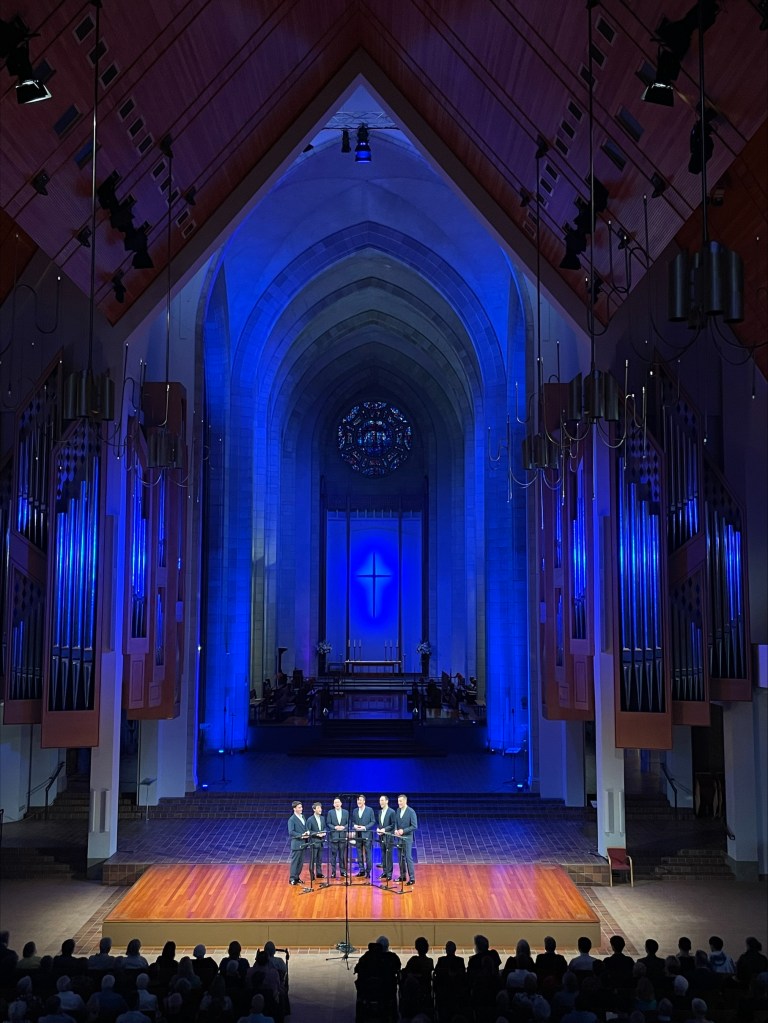
The King’s Singers, Finding Harmony

Holy Trinity Csthedral

March 14

Reviewed by John Daly-Peoples

The King’s Singers  are the most well-known and probably the greatest exponents of  cappella singing who have been touring the world’s major  concert venues for the last fifty years.

With their sole Auckland performance, “Finding Harmony they displayed their superb technical skills and an extraordinary blend of vocal cohesion.

As well their ability to sing like a choir of angels they can sing like a rowdy pub crowd or an earnest revolutionary mob.

They understand what music is capable of and why it is important. They are not merely singing great songs with interesting lyrics, they are singing songs which have inspired people at particular times.

Their programme presented songs grouped together with sets from the time of the Reformation, works from Africa, Georgia, Estonia and the Scottish Highlands.

They opened with songs under the title “I have a dream“ featuring music of the US Civil Rights movement including works by Mahalia Jackson and U2.

The U2 song, simply titled “M.L.K.” opened in a sombre mood with some of the voices created a bagpipe-like sound with the voices floating above the hum of the pipes, the  funereal sounds slowly changing to that of the reflective.

Another set was of songs focused on the Estonian struggles against the Soviet occupation of the late twentieth century.

There was “Parismaalase”  a work by Vejio Tormis with its primitive sounds and rhythms  and the refrain “tabu-tabu”  (taboo) repeated 300 times the chant referencing the inability of the Estonians to speak out during the Soviet occupation. Accompanied by a single drum their voices ranbged from that of a whisper to a shout.

With a trio of Georgian songs, the group explored several traditional songs which had a mix of extotic sounds which showed the influence of Eastern music and a different approach to singing with sounds like that of a mouth harp along with a piercing yodel-like sound in one of the works.

They introduced their suite of works under the title of “Lost Songs of the Highlands” with a short history of the Highland Clearances before singing John Cameron’s wistful longing for the Scottish landscape. Their singing of “Loch Lomond” which they made into an achingly sad work telling of the separation of  man and wife as well as the separation of the land. They gave these works a real power with their voices replicating the sounds of the pipes and fiddle along with some plaintive whistling.

They presented music of the Reformation much of which was set in motion by Martin Luther, developing an alternative to the spiritual monopoly of the Roman Catholic Church . This Protestant music changed from the  polyphonic motets sung in latin to a simpler style which was illustrated with  Luther’s very own hymn, “Ein feste Burg”, which became something of an anthem for the Protestant movement, being sung in the common language with more relevant lyrics.

They also sang works by the English composers William Byrd and Thomas Tallis who  were more Catholic in their output favouring elaborate compositions and the singers made the most of this quality with their entwined voices.

The final miscellany of works included a witty mashup of the Mary Poppins  song “Supercalifragilisticexpialidocious and “Take Care of the Children”,  a work composed by Robert Wiremu, setting the words of Dame Whina Cooper to music. Here the singers also managed to  imitate the sounds of the koauou (flute) and porotiti (whirling hummer). In a tribute to the visionary Māori leader.

The final work on the programme was their version of the Beatles song “When I’m Sixty-four” where the singers imitated the instrumental sounds rounding out a concert filled with moments of vocal magic.

To subscribe or follow New Zealand Arts Review site – www.nzartsreview.org.

The “Follow button” at the bottom right will appear and clicking on that button  will allow you to follow that blog and all future posts will arrive on your email.

Or go to https://nzartsreview.org/blog/, Scroll down and click “Subscribe”

Categories
Reviews, News and Commentary

Beyond Words: a lament, a reflection and a celebration

Reviewed by John Daly-Peoples

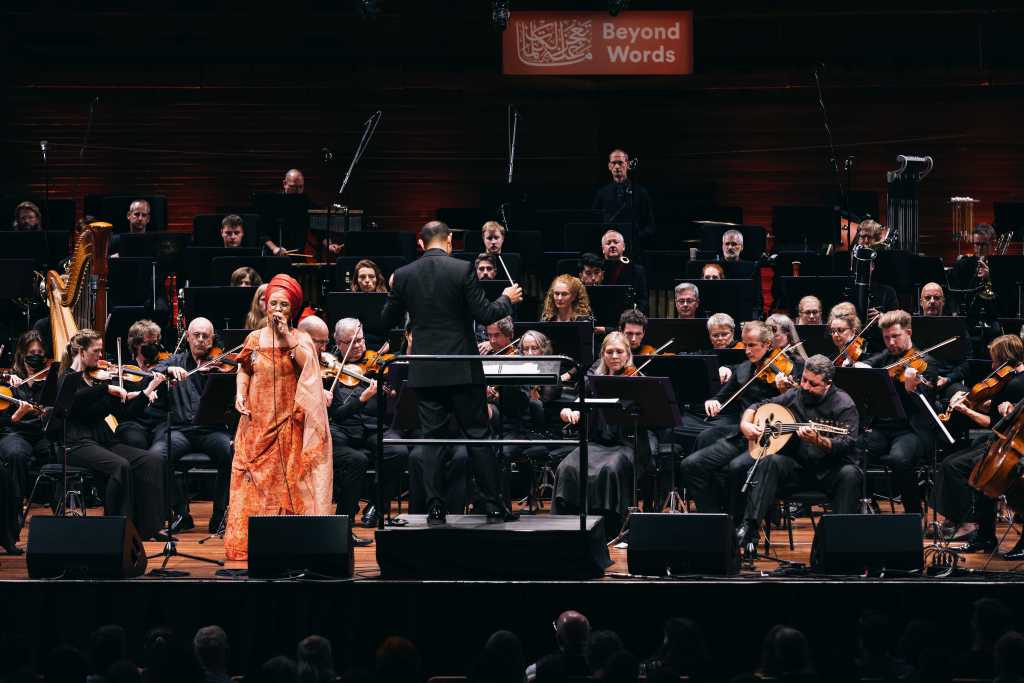
Oum with conductor Fawzi Haimor and the NZSO Image Jono Tucker

Auckland Arts Festival

Beyond Words

New Zealand Symphony Orchestra

Auckland Town Hall

March 10

Reviewed by John Daly-Peoples

The “Beyond Words” concert which had its third performance following its premiere in Christchurch and a performance in Wellington was a collaboration to promote unity and peace through music and to honour the lives lost in Ōtautahi Christchurch on 15 March 2019.

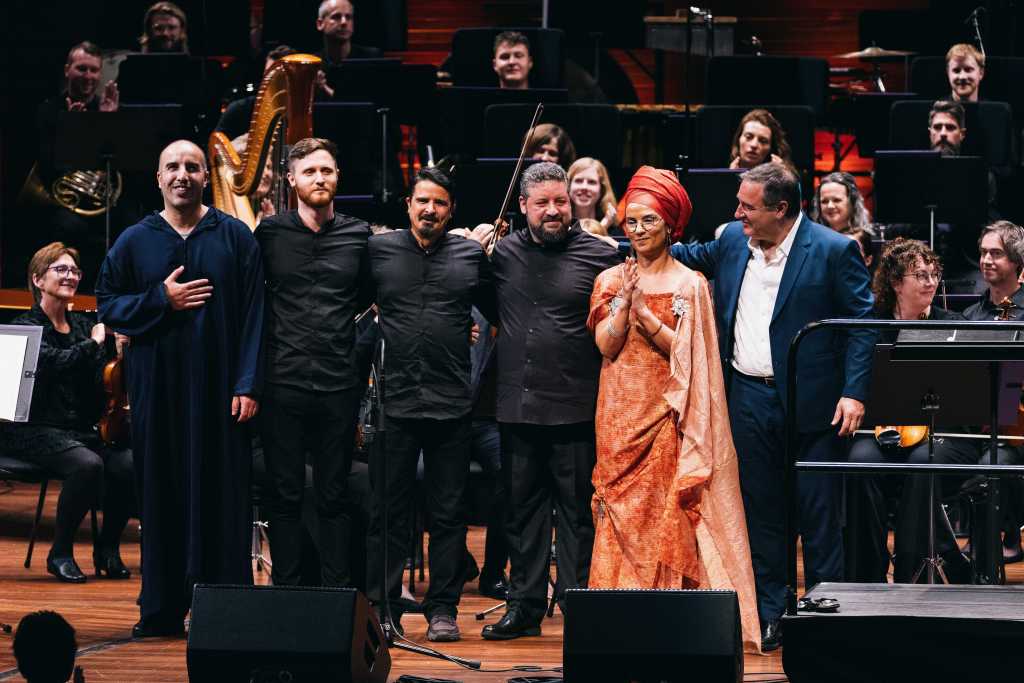
Conducted by Fawzi Haimor the concert featured the Moroccan vocalist OUM  El Ghait Benessahraoui and Cypriot/Greek oud player Kyriakos Tapakis.

Vocalist Abdelilah Rharrabti, saz player Liam Oliver, vocalist and daf player Esmail Fathi, oud player Kyriakos Tapakis, vocalist Oum and composer John Psathas [From Wellington concert] image Jono Tucker

The concert also featured  works by the American Valerie Coleman, Reza Vali, Arvo Pärt and the world premiere of a new work by the New Zealand composer John Psathas.

Psathas’ “Ahlan wa Sahlan, composed in collaboration with OUM and Tapakis, uses the Arabic welcome to let people know they are in a place where they belong. The work fused together musical styles from Eastern and Western music traditions.

The work features energetic and dramatic sounds with subtle changes of texture and moods, providing a background for the two soloists OUM  El Ghait Benessahraoui and Kyriakos Tapakis.

The composer as previously demonstrated his ability to compose celebratory anthems having written works for the ceremonies at 2004 Athens Olympics and with this work there is sense of the music being both a lament, a reflection and a celebration. With waves of shifting percussive and evocative sounds

OUM was resplendent in her shimmering gown and elaborate head covering  Her voice with its roots in Morocco  and in the tradition of Egyptian singers of the 1930’s like Umm Kulthum drifted and soared above the orchestra’s tapestry of eastern sounds along with answering voice of Tapakis’s oud.

Her singing and movements at times suggested she was in a trance-like state while at other times she exuded an emotional intensity  and in her singing  “Hijra” she sounded like a French chaunteuse. Later there were passages where her voice was close to over-elaborate crooning.

Tapakis provided a riveting performance where he played together with Xylophone and timpani in a filmic sounding section filled with percussive sounds

The other major work in the programme was Arvo Pärt‘s Silouan’s Song which is  fine example of the composer’s low-key minimalism with simple repetition and contemplation sequences of notes.

This was a reflective piece which connected contemporary music with Medieval plainchant and Eastern mystical  music and the various sections were stressed by the meditative silences between them giving the work a ritualistic feel.

In the first part of the programme there were five shorter works including a traditional work sung by Hasbi Rabbi and Molle Mamad Jan which had an achingly unsettling melodic line as well as a beguiling performance by OUM.

There was also  contemplative, work by the Iranian Reza Vali which was filled with despondency and funeral sounds hinting at a vision of paradise.

Kyriakos Tapakis performed his own work “Mantilatos” which was filled with extraordinary sounds and rhythms. While the NZSO accompanied  him, emphasising much of the work it would have been more interesting if he had been able to play as a soloist.

A major disappointment with the programme was the lack of English translations for the various vocal segments. Presumably the lyrics were relevant to the spirit of the event and even though the concert was one that was “beyond words”  with the music conveying emotional and spiritual dimensions it was pity the audience was not able to  appreciate the greater depth which would have come from a knowledge of the word.

To subscribe or follow New Zealand Arts Review site – www.nzartsreview.org.

The “Follow button” at the bottom right will appear and clicking on that button  will allow you to follow that blog and all future posts will arrive on your email.

Or go to https://nzartsreview.org/blog/, Scroll down and click “Subscribe”

Categories
Reviews, News and Commentary

Manifesto full of relentless energy and amazing invention

Reviewed by John Daly-Peoples

Auckland Arts Festival

Manifesto

Aotea Centre

Until March 10

Reviewed by John Daly-Peoples

Thankfully Manifesto didn’t have a manifesto, any sort of declaration of the intent or views on issues, but they did make manifest their intention to entertain, amaze and transport the audience.

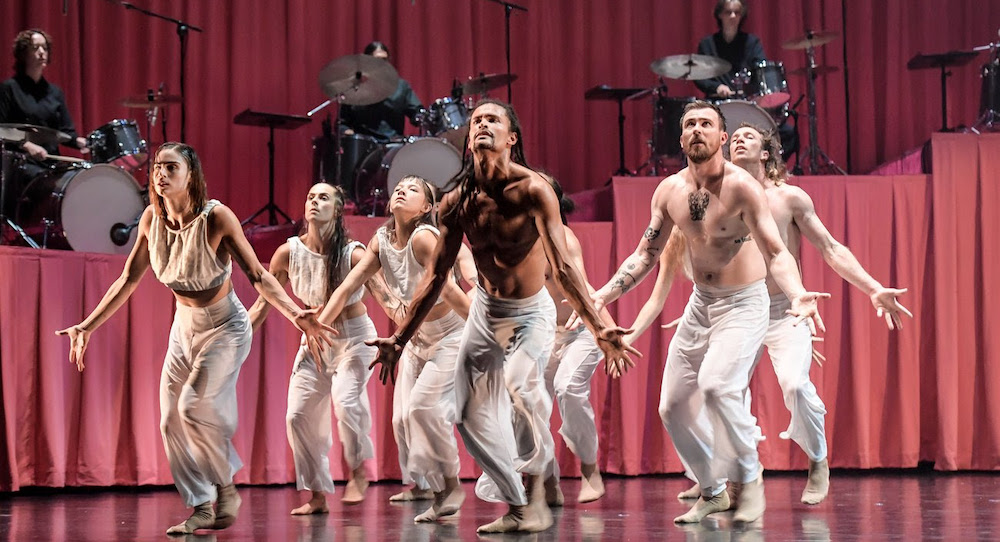
Nine musicians with a selection of drums, cymbals and bells ranged above a group of white clad dancers who sat,  calmly  facing the audience. But then the first burst of cymbals sent a shock wave through the dancers, followed ten seconds later by another explosive sound with a corresponding eruption of the dancers – and so it begins – torrents of sound which galvanized the dancers into hectic sequences of dance.as they responded to the changing tempo of the drumming. They seemed to be responding as though to electric shocks or the physical impact of the sound waves with their somersaults, kicks, lifts, throws and breakdance moves.

In one sequence one of the dancers took on the role of choreographer / director, controlling the chaotic assemblage with wild gestures.

As with all dance the there is a connection between music and movement but with Manifesto, they are for the most part inextricably linked, each beat corresponding to a jump, twist, leap or limb  gesture.

The performances are a mix of modern dance, aerobics, gym workout, athletic workout (one practicing their archery skills) and individual self-absorbed responses.

Some of the sequences are reminiscent of the stylish Cirque de Soliel routines, others are more poetic in their grace and line. There was even sequence which could have alluded to The Rite of Spring with tightly grouped bodies. Other times their movements were epileptic, militaristic or like that of clockwork figures.

One sequence saw the dancers performance a series of fast paced pas de due as they raced around the stage showing off various dynamic, dexterous, challenging , dangerous  and expressive moves. These actions and reactions had much in common with contemporary dance

There were a couple respites and in one of periods a Bob Marley look a like engaged briefly with each of the drummers as well as the audience before being assaulted by a thunderous attack from the combined drummers.

The show, choreographed by Melbourne-based Stephanie Lake was full of relentless energy and amazing invention and there is only two more shows on.

Categories
Reviews, News and Commentary

“The Effect”: A sizzling chemistry lesson coming to Auckland Theatre Company

John Daly-Peoples

Zoe Robbins (Connie) and Jayden Daniels (Tristan)

The Effect by Lucy Prebble

Auckland Theatre Company

ASB Waterfront Theatre

 April 16 –  May 11

John Daly-Peoples

Straight off a highly acclaimed season at London’s National Theatre, Auckland Theatre Company is presenting The Effect, written by BAFTA, Golden Globe and Emmy award-winning co-executive producer and writer Lucy Prebble of the HBO international hit series, Succession (2018-2023) in their 2024 line up.

“The Effect” will be directed by Benjamin Kilby-Henson (King Lear) and feature major stage and screen stars including; Jayden Daniels (Head High, Celebrity Treasure Island), Zoë Robins (Amazon’s The Wheel of Time), Jarod Rawiri (Long Day’s Journey into Night) and New Zealand screen legend Sara Wiseman (Under the Vines, Creamerie).

British playwright and producer Lucy Prebble shows all the razor-sharp flair that made her a star writer on Succession in this deft dissection of medical ethics and the nature of human attraction.

The review of the work in the New York Times gave it a strong recommendation.

“Are you in love, or are you merely experiencing a giddy dopamine rush? Are those two states even meaningfully different? Is there a true, innermost “you” that is distinguishable from your neurochemistry?

These are some of the tricky questions explored by Lucy Prebble’s thought-provoking play, “The Effect”

The play revolves around two young people, Tristan and Connie, who take part in a trial for a dopamine-based psychiatric drug with powerful antidepressant properties. Initially, they seem to have little in common — he’s a working class lad from East London; she’s a bougie psychology student from Canada — but as the trial progresses, a tender rapport develops.

Throughout the study, the participants are monitored by two psychiatric doctors, Lorna and Toby, who debate their findings: Is the drug pulling their subjects together, or are their feelings organic? And if one of the trial participants was actually receiving a placebo the whole time, what then? Prebble keeps us guessing.

Throughout, the pair’s gradual transition from wary awkwardness to intense mutual magnetism is convincingly rendered, in large part thanks to the actors’ terrific onstage chemistry.

Things get messy in the latter stages of the experiment, as both the doses and the emotional stakes increase, leading to a fraught and affecting denouement.

The stiltedly ambivalent friendship between the two middle-aged doctors provides an intriguing subplot. We learn that Lorna and Toby once romantically involved, many years ago. Lorna is prone to bouts of depression, but refuses to take medication; Toby, on the other hand, is a true pharmaceutical believer.

“The Effect” is healthily skeptical about scientifically deterministic approaches to emotional well-being, channeling a dissenting tradition that dates back to the anti-psychiatry movement of the 1960s; its moral sensibility recalls Ken Kesey’s  1962 novel, “One Flew Over the Cuckoo’s Nest.” The play’s revival is particularly timely as a new generation of wellness gurus have, in recent years, latched onto the idea that much of human behavior can be explained away as neurotransmitters or hormones simply doing their thing.

Prebble invites us to ponder the implications of such thinking. Connie is initially uncomfortable with the notion that two people can fall in love just like that (“It takes work,” she insists), and wary of her attraction to Tristan. He, in response, makes the case for mystery, and thus articulates the play’s key message: That a world in which all feeling is viewed as a matter of chemistry would be a bleak one indeed.”


Categories
Reviews, News and Commentary

In The Zone of Interest don’t mention The Jews

Reviewed by John Daly-Peoples

Rudolf Höss (Christian Friedel) in his backyard zone

The Zone of Interest

Directed by Jonathan Glazer,

In cinemas from February 22

Reviewed by John Daly-Peoples

“The Zone of Interest” is based on the Martin Amis novel of the same name. Written and directed by Jonathan Glazer, the movie focusses on the daily life  of Rudolf Höss (Christian Friedel) the S.S. commandant of  Auschwitz, his wife Hedwig (Sandra Hüller)  and their children. 

It’s a story about The Holocaust but one which is just out of sight and mind. Kept at a distance by  closed walls and closed minds.

Höss, who admitted at his trial of being responsible  for the death of at least a million and a half people at Auschwitz was not named in the Amis book which used three fictional characters to create a wide-ranging narrative about the camp and The Final Solution.

If you didn’t know about Höss  or The Holocaust, Glazer’s film might appear to be enigmatic or mystifying. We do not really see the camp only the surrounding wall which is capped with barbed wire, the roofs of the barracks, a watch tower, the occasional smokestack and smoke. We see no inmates, guards or dogs.

We do hear the distant rumblings of the camp, the low sounds of voices, occasional shouts, and barks as well as random shots.

This distancing from the horrors on the other side of the wall is emphasised with much of the filming in long shot and the film features the Höss’ lush garden where Hedwig spends her time and the backyard swimming pool with the frolicking children.

The film is full of contrasts between the two environments – the camp and the house. But that contrast is generated by the viewers knowledge. So, we know the food that the family eat is sumptuous compared with what those on the other side of the wall eat. That the clothes they wear are better, that the environment is calm and relaxing. That their life is simple and ordered.

In one long sequence the camera follows Höss as he tours the house at night, turning off the light, closing doors checking on the sleeping children, bringing the day to a peaceful close.

One of the few sequences set inside the camp is of Höss supervising the unloading of people from a train. All we are shown is a low shot of Höss framed against the smoke-filled sky with the sounds of barked commands, whips cracking, crying and confusion.

One of the other dramatic intrusions of the camp into the idyllic life of the family is seen in a sequence where Höss and his children are swimming in  river. The tranquillity is abruptly cut short when Hoss discovers a bone fragment floating in the water and sees a scum floating towards them – the result of ash from the crematorium scattered deposited upriver. The children are them vigorously scrubbed free of the physical and racial taint.

In another scene Höss’ wife swans around her bedroom in an expensive fur coat which she insists needs to be cleaned, without stating why.

When the business of extermination is talked about it is in euphemisms or oblique language. In a meeting Höss has with engineers to discuss the new crematorium no mention is made of the number bodies which could be incinerated rather they refer to the possible “load” the ovens are capable of dealing with.

While there is no reaction by the family to the horrors over the wall, one of the young girls in the family appears to do into catatonic state as though blotting out her reactions. This psychological denial is then represented by some thermal imaging black and white sequences of a young girl placing food around the camp, seemingly at night, in a dream.

The reality of The Holocaust and of Auschwitz is made clear in the final moments of the film where Höss wanders through the silent corridors, his gaze seeming to be drawn to other activities. Then the film cuts to the  present-day museum at Auschwitz and we see the piles of suitcase, the stacks of crutches and mounds of shoes, all that remains of extinguished lives.

To subscribe or follow New Zealand Arts Review site – www.nzartsreview.org.

The “Follow button” at the bottom right will appear and clicking on that button  will allow you to follow that blog and all future posts will arrive on your email.

Or go to https://nzartsreview.org/blog/, Scroll down and click “Subscribe”

Categories
Reviews, News and Commentary

Measure for Measure: intrigue, sex and plenty of laughs

Reviewed by Malcolm Calder

Nick Milnes (Angelo), Stuart Tupp (Duke), Stephen Ellis (Escalus) and Āria Harrison-Sparke (Isabella)

Auckland Shakespeare in the Park 2024

Measure for Measure

By William Shakespeare

A Shoreside Theatre production

Pumphouse Amphitheatre

(if wet – Pumphouse Theatre)

Jan 23, 24, 26, 28, 30, Feb 6, 9, 10, 11, 13, 15, 17

Reviewed by Malcolm Calder

Measure for Measure is one of the comedies that’s billed as a play for today.  Peopled by a typically diverse cast, it’s hilarious and increasingly convoluted mundane day-to-day content provides context and plenty of laughs.  Some of Shakespeare’s characters simply fill space but a core soon emerges and, with them, the not uncommon Shakespearean themes of intrigue, manipulation and resolution are revealed.

For openers, the rather wearisome Duke of Vienna (Stephen Tupp) decides to take an extended timeout leaving his deputy Angelo (Nick Milnes) in charge.  And that’s where things get interesting because Angelo takes a more hardline view of both public morals and the law, before revealing a worldview that is essentially flawed.  In particular, he is concerned about sex outside of marriage.  So he sets about closing all Vienna’s brothels and heavily penalising anyone who dares fornicate privately – with the penalty being death of course.

One of the first to feel his ire is a likeable young chap called Claudio (Chis Raven) who has very few words in the playscript, but whose situation and fate quickly become something of a fulcrum for what follows.  He must have been a sweet-talker in private though because he has somehow managed to impregnate his publicly mute fiancée Juliet (Alice Dibble). 

However, when Claudio’s sister, the novice nun Isabella (Āria Harrison-Sparke), learns of this she is outraged and thereby hangs the nub of Shakespeare’s play.  Echoing social mores that are sometimes as prevalent today as they were 400 years ago, Angelo says he’ll only do it if Isabella yields her own virginity to him.  The cad!

Thus comedy becomes context, and hypocracy, truthfulness and justice are revealed as what this play is about. 

Rather than a strong Duke who eventually returns from his sojourn as a Friar and comes up with a Plan B that sees Angelo’s jilted fiancée Mariana (Terri Mellender) substitute for Isabella, the key protagonist is revealed instead to be Isabella herself. 

Āria Harrison-Sparke handles this with aplomb, assuredness and maturity.  In particular her command of Shakespearean dialogue is of a considerable order.

Nick Milnes ties himself in knots at times as Angelo and Terri Mellender makes a delightful, if giggly, wronged fiancée.  Escalus, ever the civil servant is played very straight by Stephen Ellis and the lesser character-roles provide some big laughs.  Perhaps of note was Michelle Atkinson (Provost) who introduced both subtlety and nuance to her Provost.

The set is fairly stark and simple, as are the props.  Of particularly ghoulish note was the severed head of not-Claudio and brought directly from his beheading and I could swear it as still dripping blood!

Eventually the good Duke shucks off his Friar mantle, resumes his Duke-ness, sentences Angelo to wed Mariana, then threatens to kill him as well. But Mariana and Isabella plead for Angelo’s life, reveal that Claudio is alive, the Duke pardons Angelo and proposes to Isabella, while Claudio and Juliet presumably live happily ever after – even if their newborn bites Claudio’s finger.

As I said, very convoluted, but also very Shakespearean.

Most audible, even from his proper tongue,
“An Angelo for Claudio, death for death.”
Haste still pays haste, and leisure answers leisure;
Like doth quit like, and measure still for measure.

Unlike last year’s Shakespeare-in-the-Park season where winds blew and cheeks cracked, Shoreside Theatre is looking forward to better weather this summer.   Nonetheless, the white noise created by even the gentlest breeze in the trees surrounding this outdoor venue makes it sometimes difficult for a cast to project beyond it so seating in the forwards rows is recommended.  Rather surprisingly it got a tad chilly as the evening wore on and a good jacket, or even a blanket, is suggested.

This annual two-play season (although not reviewed here, the other is A Midsummer Night’s Dream) is now firmly established on the Auckland theatrical calendar in this, its 28th season.

Categories
Reviews, News and Commentary

An Arts Festival show which has the reviewers wondering

John Daly-Peoples

Auckland Arts Festival

Scott Silven “Wonders”  

March 19 – 24

One of the more intriguing acts on at the Auckland Arts Festival this year will be Scott Silven’s Wonders.  The clairvoyant, mentalist, and performance artist has dedicated his career to unique form of theatrical  illusionism which fascinates audiences.

He studied hypnosis in Milan at 15, gained recognition from the American illusionist David Blaine at 19, and headlined one of the United Kingdom’s most prestigious theatres at 21.

In Wonders, Silven invites the audience on a journey through his childhood memories in the lowlands of Scotland, connecting his participants with the myth and mystery of the landscapes that shaped him. This show is said to go beyond the traditional theatre experience, offering an interactive, audience led, performance that explores the power of connection through illusions.

What is extraordinary about his show is the response of reviewers who grapple with trying to explain what they have witnessed in seeing one of his shows

A Melbourne Time Out reviewer said of Silven, who talks to the audience about his early exploration of the family attic –  “he also explored the corners of his own mind, and he claims that he began to discover his ability to make mental connections to the world around him in weird and wonderful ways. Interspersed in this narrative are demonstrations of Silven’s extraordinary skill as a mentalist, which involves audience members at every turn. His ability to convince that he’s reading minds – and that random audience members are able to perform similar feats under his instruction – is absolutely dazzling. The complexity of his work is spectacular, and he draws together the threads of just about every “ta-dah” moment in the final moments of the show. Even non-believers, like myself, will be blown away by the artistry.”

A Sydney reviewer was also baffled  “Silven does not perform your typical brand of magic, using visual illusions and tricks to stun the audiences. Instead, he uses the power of language and of the imagination to draw the audience in, fostering magic out of the power of human connection. One by one, he brought members of the audience up and seemed to be reading their minds. In reality, a lot of the time he was actually guiding them as to what to think. That prepared monologue at the start that felt out of place was actually an ingenious way of planting motifs and ideas in the audience’s mind that they would bring back to him later. Every little bit of speech had a purpose.

Some moments felt scarcely believable. When an audience member said their prize possession as a child was a “Snoopy” dog, Silven reached under his chair and pulled out a billboard he had written earlier predicting that the prize possession of the audience member he called upon would be a “Snoopy” dog. Is this too much of a coincidence? Did he have plants in the audience? Did he have an assistant furiously typing up a billboard backstage and slipping it under the stage curtain to his chair when we weren’t watching?”

And The Guardian reviewer said of another of his shows  “Silven’s use of storytelling and setting creates something genuinely magical, and it’s a joy to willingly suspend disbelief and slide into a sense of wonder not experienced since childhood.

And with that comes connection. Not the psychic kind Silven suggests, but the kind forged by a shared sense of discovery. Across the table, eyes are shining, guards are down, and there’s the odd report of goosebumps. The childhood game of Chinese whispers, further confounded by whisky, brings things to a delightfully silly finish.

I emerge still a sceptic, but certainly not a cynic.”