Cirque du Soleil shows are always elaborate gymnastic displays, but they are always imbedded with a story or narrative which looslye holds all the characters and the events together. There is also a circus elemnst running through the shows, an element which recalls the mystery and delight of childhood and the surrealism of adult dreams.
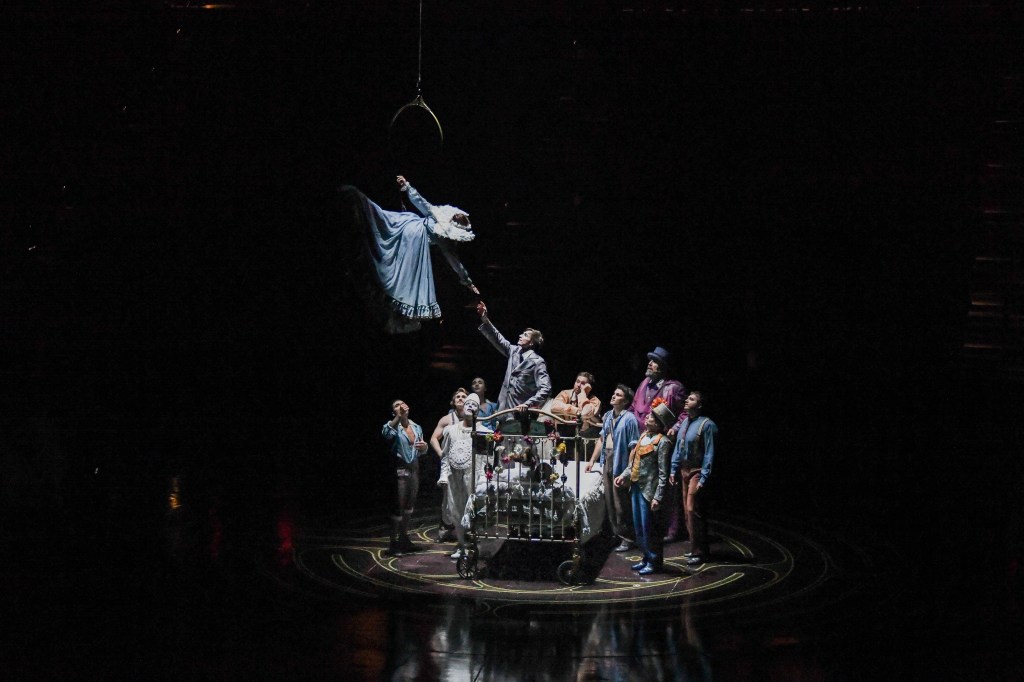
The story line for “Corteo” is that we are welcomed to the last minutes of the life of the famous clown Mauro and are then present as he reminiscences about his great days of his life on stage. He lies in his bed and his former colleagues visit him, bringing back memories and some of his acts which are repeated as the angles hover over his death bed.
After establishing the reason for being there the evening takes on a rather casual approach to the narrative which we are reminded of occasionally with angels making their appearance and in one scene providing Mauro with a set of wings and then, with a nod to the film ET Mauro also rode a bicycle up high, above the stage
The cast of circus characters that parade before Mauro are reminiscent of the closing scene in Fellin’s 8½ – a mixture of standard circus folk – ringmaster, clowns and acrobat along with the characters from Commedia dell’Arte.
This show, is one of the earliest of the Cirque shows, originally made in 2005 and since then has been performed to more than 12 million people and still has all the elements which make the shows impressive – world-class acrobatics, whimsical romanticism, some clever buffoonery and comedy all overseen by the angels floating on high.
Corteo, Cirque Du Soleil, Credit: Johan Persson
Unlike most other Cirque show which are set in a big tent the audience was seated on either side of the stage which featured amazing displays of ability and agility where technical expertise and extravagant design were woven together with fabulous costumes, amazing lighting, humour, and enchanting live music. The musicians tucked away at the sides of the stage displayed not only great musicianship but were remarkable performers themselves as they negotiate their various instruments – violin, drums, keyboard, bass, percussion and guitar.
Some of the performances were more spectacular than others with some not given the attention they deserved such as the Crystal Balls sequence where the subtly of the performance was probably lost on most. But there were more dramatic routines such as the young woman suspended from five balloons who floated around Spark Arena being helped by dozens of audience hands as drifted and bounced giving all her helpers a “thank, I love you”.
All the routines had something to offer whether the languid female performers swaying from the chandeliers, the beds transforming into trampolines where the performers didn’t try for height but rather split-second timing and there was the traditional balancing act which showed real agility as well as looking as though the body was being turned in on itself.
There was even a slightly confusing small theatrical work telling the Romeo and Juliet story which seemed to be closer to a Punch and Judy show full of the knock about comedy.
Then there was the clever duet between the Ringmaster and musicians with the Ringmaster whistling a Mozart melody before going into a ferocious duel with the violinist, backed by the orchestra.
This is a show packed with drama, comedy, colour and surprise to delight the whole family.
The Mischief Theatre Production of THE PLAY THAT GOES WRONG
By Henry Lewis, Jonathan Sayer and Henry Shields
GMG Productions & Stoddart Entertainment Group Associate director – Anna Marshall Resident director – Nick Purdie With Olivia Charalambous, Edmund Eramiha, Tom Hayward, Stephanie Astrid John, Joe Kosky, Jonathan Martin, Jack Buchanan, Anthony Craig and Kira Josephson
ASB Waterfront Theatre, Auckland
Until 1 June
Reviewer Malcolm Calder
The crew were frantically seeking a missing dog called Winston (I thought that was pretty funny from the outset), couldn’t find a missing CD, contending with a tricky door that wouldn’t latch, dealing with a floorboard that seemed have a mind of its own and contending with a mantlepiece wouldn’t mantle. All this before the show had even started.
Their crew’s efforts were entirely unsuccessful of course and the litany of woes continued once things got underway. But the teddibly English lads and lasses of the fictitious Cornley Polytechnic Drama Society struggled on in their efforts to ensure their eminently forgettable murder-mystery actually took place, with nowhere near understanding their own characters or, it seemed at times, even the plot. Not to mention a set that seemed intent on total disintegration. Their efforts certainly did go wrong and they eventually staggered to a dis-assembled conclusion.
However that’s not what The Play That Went Wrongis all about. Rather, it uses the context of an amateur theatre production to very quickly hit the spot demonstrating both subtle and in-your-face comic writing, exquisite nuance and a mature command of the farce-wrapped-in-slapstick idiom whilst totally demolishing the fourth wall.
Lewis, Sayer and Shields, formed Mischief Theatre in 2008 and created The Play That Went Wrong while still studying at the London Academy of Music and Dramatic Art. Originally titled The Murder Before Christmas, their production opened initially on the Edinburgh Fringe, enjoyed enormous success, moved to a pub on London and then quickly transferred to the West End. It has been winning accolades around the world ever sinceand has even spawned a range of not unrelated television spinoffs.
This cast is very much an ensemble. In performance they consummately demonstrate a broad-ranging set of physical theatre skills, demonstrate the importance of timing in making these work and do pretty well in convincing the audience that this is a collection of loosely-linked, impromptu standup snatches despite being a meticulously scripted work.
On Oening Night in Auckland I noticed a couple of rather precious looking luvvies in deep discussion during interval but they appeared to have missed the point entirely. Deep, thought-provoking, question-raising theatre this is not. Technique – yes! But, rather, if set in the context of a funeral parlour, not dissimilar gags, techniques and characters these writers could probably transmogrify it quite readily into The Funeral That Goes Wrong.
After any number of productions that occasionally take themselves a little too seriously, we seem to be on something of a comedy roll of late. Down at the water-side anyway. The Play That Goes Wrong is the second bout of hilarity in a row with another soon to follow.
With Bronwen Ensor (Greta Ohlsson), Sophie Henderson (Countess Andreyi), Jennifer Ludlam (Princess Dragomiroff), Mayen Mehta (Hector McQueen), Ryan O’Kane Col Arbuthnot/Samuel Ratchett), Mirabai Pease (Mary Debenham), Cameron Rhodes (Hercule Poirot), Jordan Selwyn (Michael/Head Waiter), Rima Te Wiata (Helen Hubbard), Edwin Wright (Monsieur Bouc)
ASB Waterfront Theatre
Until 10 May
Reviewer Malcolm Calder
Photo: Andi Crown
I’ve had a busy time of it lately. What with school holidays, two successive long weekends and a seemingly endless round of rather long and demanding days, I had half a mind to settle for a quiet glass of red, a good book and an early bedtime blithely avoiding any additional responsibilities that might involve going out to the theatre. Had to rush to make the 7pm start too!
Thank goodness I didn’t.
With this re-vamp of the original classic, Director Shane Bosher has turned in a blinder for Auckland Theatre Company and come up with something that is pure, unadulterated entertainment.
Adaptor Ken Ludwig’s cull of the original murder mystery, after having been approached by Agatha Christie’s grandson for the Christie Estate, was first performed in 2017. So if you are a Christie devotee looking for a simply stage-adaptation of her original go no further.
Ludwig adamantly insists that he is a writer of plays and not simply a ‘murder-mystery guy’. As a result he has redrawn, reduced and compacted the number of characters, enhanced the comedy and come up with a tightly-scripted and genuine ensemble piece that adds to the already enormous output that has made him arguably the most produced playwright of his generation.
It is sometimes suggested that more serious undertones may have underpinned aspects of Christie’s original but few are evident here. Bosher may have drawn some slight allusions to contemporary geo-political issues that underpin the entire structure but this may or may not be the case. What he has done however, is generate something that entertains big time.
The result is an actor’s piece to die for. And this cast do more than just deliver. Just as Auckland Theatre Company, CEO Jonathan Bielski has urged audiences to avoid spoilers about resolution of the murder, mystery and mayhem of the play itself, it would be churlish to single out any one cast member. The entire cast is let loose, projecting archetypes rather than convincing portrayals of real people. Each character is distinct, their backgrounds are as varied as their accents and the ensemble functions as a singular unit predominantly by using that essence of great comedy – precision timing and the credibility of relationships between them.
ATC is to be congratulated too on once again continuing to develop pathways for increasing numbers of younger actors and production people who we are seeing as first-time performers with ATC.
This is a consummate, professional ensemble and even a tiny glitch with a prop on opening night was more than successfully ad-libbed around, the comedy was sustained and the professionalism acknowledged by an audience who got it.
I am advised that ticket sales for MOTORE are already strong and ATC is to be congratulated on both the production itself and for hopefully hitting a jackpot.
The 7pm start time may have been a bit of a scramble but it had the bonus of my being home and abed well before 10pm. No book though – my head was still laughing inside itself.
With the Auckland Philharmonia conducted by Neil Thomson
Auckland Town Hall
March 15
Reviewed by John Daly-Peoples
It was billed as Gene Kelly; A life in Music but it could equally have been called Patricia Ward Kelly; A life in Music as the show which was written by his wife was brilliantly presented as she narrated the life of the dancer with the music played by the Auckland Philharmonia along with crisp remastered clips from his films.
The two met in the mid 1980s, when he was 73 and Patricia was a 31-year- expert on the works of Herman Melville who had never seen any of the actor/dancer’s films. He asked her if she would work with him on his autobiography which she did, for five years.
They married when he was 77 years, and each day she documented and recoded his life, This close association with him made her the most knowledgeable person about the dancer’s career.
Her knowledge, of Gene, the music and films all merge into a superb account of Kelly’s life as well as a snapshot of American dance movies of the mid twentieth century.
Most of his iconic films were shown including scenes from Singin’ in the Rain, An American in Paris, Brigadoon, Summer Stock, Les Girls and It’s Always Fair Weather.
We saw him perform with Ginger Rogers, Leslie Caron, and Cyd Charisse as well as with an animated Jerry the Mouse getting a dance lesson from Gene Kelly in “Anchors Aweigh”.
We also get to hear the music of the great composers of the time as well -Andre Previn Lerner & Loewe, Cole Porter and the Gershwins.
We also get to appreciate the clever way in which realism and abstraction was used in the sets. This combination created some surreal dance sequences with vivid use of colour which highlights the spectacle of the dance routines and shows how Kelly helped change the nature of dance on film with a new mode of choreography and filming.
For the introduction to the second half which featured clips from Brigadoon she had a piper stride up the aisle and then in a surprise appearance she introduced Michael Crawford of Phantom of The Opera fame, who now lives in New Zealand and who acknowledged Kelly as a major influence in getting the role.
Patricia Kelly’s presentation brought clever showmanship and intimacy to the evening accompanied by the Auckland Philharmonia conducted Neil Thomson.
“Belle” had all the elements to make it a stand-out performance however it never quite managed to make it a truly thrilling show.
The all-female cast of skilled aerialist / dancers/ singers performed a range of acts with a touch of magic and their routines were all immersed in a riotous soundscape and a remarkable light and fog environment.
Sometimes it felt a though someone had told the musicians that they only needed to play loudly and that would cover any mistakes or lack of continuity.
There was also a lack of cohesion between the various sections or vignettes which was a major problem. Even though the acts were spectacular, there was no sense of narrative or trajectory.
Many of the sections had a sense of cavorting angels or goddesses and this could have related to the figures and Ranginui and Papatūānuku in the digital work “Ihi” by Lisa Reihana which is in the Aotea Centre foyer.
Most of the acts were performed in a half light, with the performers often seen in silhouette. Along with the dramatic use of light this added to the drama of the performance but it also meant the audience was often not able to appreciate the athleticism of the performers.
Some of the acts were brilliant conceived with figure rising and falling from the stage and disappearing into the enveloping fog of the stage. Other sequences saw the cast using elaborate equipment such as aerial wheels and large pivoting wheels.
But the lack of interconnection and lack of coordination between the sequences and music did a disservice to the acts and a disappointment to the audience.
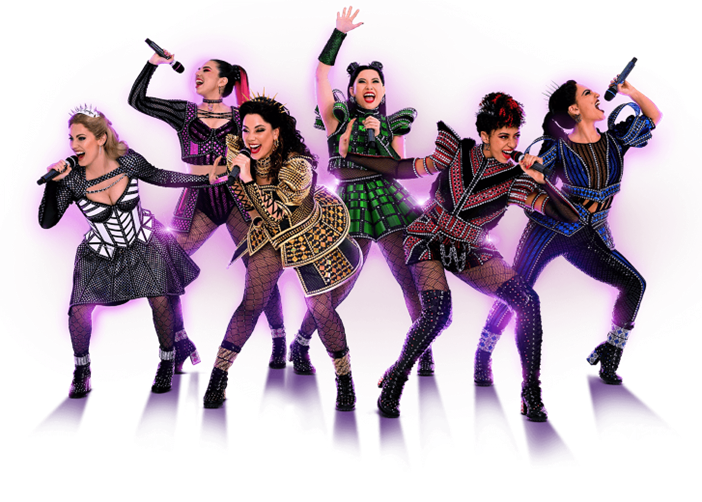
It would be easy to pigeon-hole SIX as a high energy show with lots of froth and bubble, and aimed fairly and squarely at the tiktok generation. But you would be wrong. It is rather more.
All things must change and musical theatre is no different. SIX is important enough to represent another of those significant change points in history – following in the footsteps trodden by Oklahoma or West Side Story or Cats or Hamilton.
On leaving, I overheard an audience member mutter something about SIX being really just a glossed up pub cabaret. And, to a certain extent, it is. Originally conceived by a couple of then relatively unknown Cambridge students in 2017, Moss and Marlow took it to the Edinburgh Fringe that year, was a huge success and soon wound up at the Arts Theatre in the West End before a Broadway opening almost immediately before Covid struck. There was a sort of relaunch in 2021 and SIX now enjoys semi-permanent residence in both London and New York and has gone on to world-wide success with multiple productions all over the anglosphere, as well as Europe and in Asia.
So what has driven this success? A well-known Australian commentator once suggested it resembles a Spice Girls concert directed by Baz Luhrman – but one where the girls can actually sing. Quite apt I thought at the time. But this show is a lot more than that. It is VERY much a significant part of the musical theatre tradition. In fact there are so many references, acknowledgments and subtle nuances running through SIX that enumerating all of them becomes difficult.
First and foremost, this is a NOW show. As such it reaches its target easily and then some. So, yes, to the tiktok generation. But it is bigger than that and, while it might help grow memberships of amateur music theatre organisations, that is rather simplistic view as it impact is considerably greater. Not to put too fine a point on it, the key fundamental of SIX is pure entertainment built around that old adage – a good story told well that enthrals its audience. And good entertainment knows no age boundaries – the grandmother in front of me was up and out-boogying her two grandchildren at the end. Underlying import counts too.
The stories of the six queens are told in the language of the second decade of the 21st century – not by the archival or even slanted recollections of historians about the politics and intrigue surrounding the first Tudor king. Most of whom were men, and of a fairly clearly-defined social class at that. Further, it is told from a women’s perspective. And remember, some of the queens were all exceptionally young when they married and the Royal Court revolved around power, politics and intrigue. So we leap immediately to empowerment for women – a rallying cry for millions – and a clear audience profile for SIX.
Structurally, as the fairly comprehensive promotional campaign has pointed out, SIX is built around a history lesson and a competition. OK. Thank you. Got that. It puts the six queens up against each other each other – an Eisteddfod if you will – or is that merely a device for something bigger?
The six queens never leave the stage and their individual songs merge into six-voice choral arrangements, complimentarily and contrapuntally at times, with occasional snatches of spoken dialogue (but not very much at all). The staging itself is outstandingly conceived by Emma Bailey and reflects a modern high-tech concert stage that integratesTim Deiling’s dynamic lighting and Paul Gastrehouses’s sound in a way that clearly works. The stage is also peopled by an astonishingly well-rehearsed, syncopathic and complimentary all-girl band for the entire show.
This primarily Australian cast comes well credentialled. Dancing skills are clearly in evidence with very tight routines throughout and, even if there were one or two very minor vocal wobbles, vocal strength was generally strong and led by the assurance of Loren Hunter (Jane Seymour). But let’s face it, this show is presented more like an eisteddfod or a competition and it doesn’t really matter – one voice will always overlap another. The tenderness of Heart Of Stone and the hilarious rap of Haus of Holbein were both standouts for me.
The primary focus of attention however is largely rivetted on Gabriella Slade’s award-winning costumes. Little wonder that her outfits have a dash of Spice Girls about them as she devised Spice World back in the 1990s. But now she has embellished some glittering and futuristic sequinned outfits in ways that not only catch the eye, but help tell each queen’s story. The ‘beheadeds’ have chokers for example, Jane Seymour’s black and white bodice echoes the half-timbered houses of Tudor England, the green of Anne Boleyn’s outfit references the popular myth that this evergreen was composed by the much-wedded Henry VIII himself (that’s factually incorrect, but let’s stick with the myth). It’s interesting that one interpretation of this song concerns the promiscuity in young women, something Henry’s henchman Archbishop Cranmer used in arranging divorce and subsequent beheading.
The references go on. In fact they are never ending. There are the pop divas found in the songs : I think I heard echoes of Beyonce, Ariana Grande and Alicia Keys and probably missed a few more.
The sense of fun and campness is constant. SIX takes neither itself, nor musical theatre in general, seriously and whimsy is everywhere. Phones in the theatre, for example, were quite correctly asked to be turned off pre-show and then during the encore (or more correctly the ‘finale’), encouraged the audience to light them up again. And they certainly did. It was another moment of sheer joy and made the audience a part of the show. I think that grandma in front of me got a pretty good video take.
Any good production simply tells a story. SIX does so with succinctness and very, very well. It is not a long show, but is pretty demanding on both voices and the attention-span of audiences.
I always relish a well written show that is objective and contemporary rather than one that delves into the introspective meanderings of L-plate writers. SIX is mature writing and very clever staging.
The filmed on-stage reunion of Six’s original West End queens will be released in cinemas next month and, rather ironically, Auckland’s Civic remains one of the larger in-theatre venues it has played. After here, it’s off to complete its second lap of Australia at the Civic’s sister in Newcastle, while Asia awaits
The “Follow button” at the bottom right will appear and clicking on that button will allow you to follow that blog and all future posts will arrive on your email.
Kiri Te Kanawa Theatre, Aotea Centre (until Dec 8)
Then Bruce Mason Theatre, Takapuna
OK, Shakespeare started all this theatrical fantasy stuff more than 4 centuries back when he developed some of the Greeks’ allegorical reflections on love and its mythical interpretations by writing A Midsummer Night’s.
It has a convoluted and fantastical plot that epitomises the suspension of disbelief and is perfectly suited to the meandering minds of creatives. So they did.
A young Felix Mendelssohn had an initial stab at expressing it musically before King William Frederick IV convinced him to enhance his music further as accompaniment to a theatrical staging where it became a favourite of the Prussian court.
I have no idea what William Blake was on when he expressed Shakespeare’s work visually a century later, nor the mindset of various theatre and even movie directors as the original was variously interpreted until eventually becoming a stock in trade for theatre over a couple of centuries. Little wonder then that it would evolve much later into a significant full-length ballet that is commonly attributed to Georges Ballanchine – apparently a fairly tame interpretation by contemporary standards. Eventually The Royal New Zealand Ballet was to be congratulated on collaborating in 2015 with the fairly progressive Queensland Ballet in a completely new interpretation devised by the even more weirdly wonderful and progressive mind of the late Liam Scarlett.
Mendelssohn’s original incidental music was skillfully re-arranged and expanded by former RNZB Music Director Nigel Gaynor and, with an innovative set and a costume design by the distinguishd Tracy Grant Lord, the result was a full-length two-act contemporary ballet that audiences greeted with joyous rapture.
A subsequent 2021 season was rudely interrupted by Covid and this Dream only played in Wellington. However it has finally toured nationally and reached Auckland where those earlier plaudits can ring even more true today. This Midsummer Night’s Dream is something that makes one wallow in pure enjoyment.
Yes, of course the threads of serious Greek allegory on humankind are not lost, but it is the telling of the tale that makes this production so outstanding and to marvel at what Liam Scarlett, and the team he headed, has produced.
Firstly, lets look at Tracy Grant Lord’s set. This combines colour and texture that, when coupled with Kendall Smith’s lighting, results almost as if an additional dimension has somehow been added to the stage. There is a depth and a height and a breadth that I could swear somehow exceed the theatre’s stage dimensions. This dimensionality is exploited to the fullest in the choreography and the costumes that somehow reinforce the set rather than the other way around. It is night. It is a woodland. It is ethereal. It is enchanted. It is a place where subtlety, confusion and a comedy of errors are rife. It is actually the inside of someone’s mind.
That is largely achieved and certainly enhanced by Nigel Gaynor’s sympathetic musical arrangement of Mendelsson’s sumptuous score and which itself defies traditional convention. Off-stage voices are introduced under Hamish McKeich’s baton and I could swear I heard someone humming along during the triumphal Wedding March.
The ballet opens with an imperious Oberon (Joshua Guillemot-Rodgerson) and his compellingly superior Queen Titania (Ana Gallardo Lobaina), assisted by his energetic and whimsical sprite Puck (Shaun James Kelly) who attempt to influence and even thwart the course of true love via the use of a supposedly magical pixie dust. When sprinkled this confuses things a bit and just about everyone on stage loses track of who is love with whom. There is whimsy and humour around each and every corner and the characterisations are superb – none more so than Bottom (Calum Gray) who magically develops a donkey’s head and tail.
The characterisations are superb, the detail in the dancing shows real connections and Liam Scarlett’s stunning choreography is built around fluidity and motion that blurs fantasy with reality and gives us something unexpected at each turn. Just as one is starting to relax after a particular marvellous pas de deux, for example, this Dream slides effortlessly into something equally ethereal albeit several feet in the air serving only to amplify, elevate and unify the whole.
Plotwise … no, I won’t bother you with the complexities … suffice to say it all becomes totally confusing but love wins out in the end. Of course. And the donkey is human underneath it all – a message for all of us.
This Midsummer Night’s Dream is indeed a sparkling, spectacular ballet of sheer theatrical magic that is a Christmas treat for audiences everywhere
One of the disappointing aspects of the NZSO’s recent “The Planets” concert was the short duration of the first work on the programme.
The Finnish composer Kaije Saariaho’s “Asteroid 4179: Toutatis” was performed for four minutes, but many in the audience would have been delighted if it had run for twice or three times that length.
“Asteroid 4179: Toutatis”, is named for an actual asteroid, a two-kilometre rock fragment which moves between Mars and Jupiter. The work is a confluence of science and art with the music sounding like music many composers have used for the soundtracks of science fiction movies or to create otherworldly sounds Her ethereal sounds which represent the movement of the asteroid were mysterious and saw her turning scientific notations into music.
The composer was trying to describe the pattern of Toutati’s movements, its chaotic orbit, its unfixed north pole and its complex pattern of rotation so we had music which described the various ellipses, parabolas and cosmic curves tracing out celestial journeys.
The work contained multiple combinations, of strings and huge sounds from the full orchestra . Many of the sounds were unusual with shimmering strings, eerie sounds from the wind instruments and even fleeting sounds from the harp.
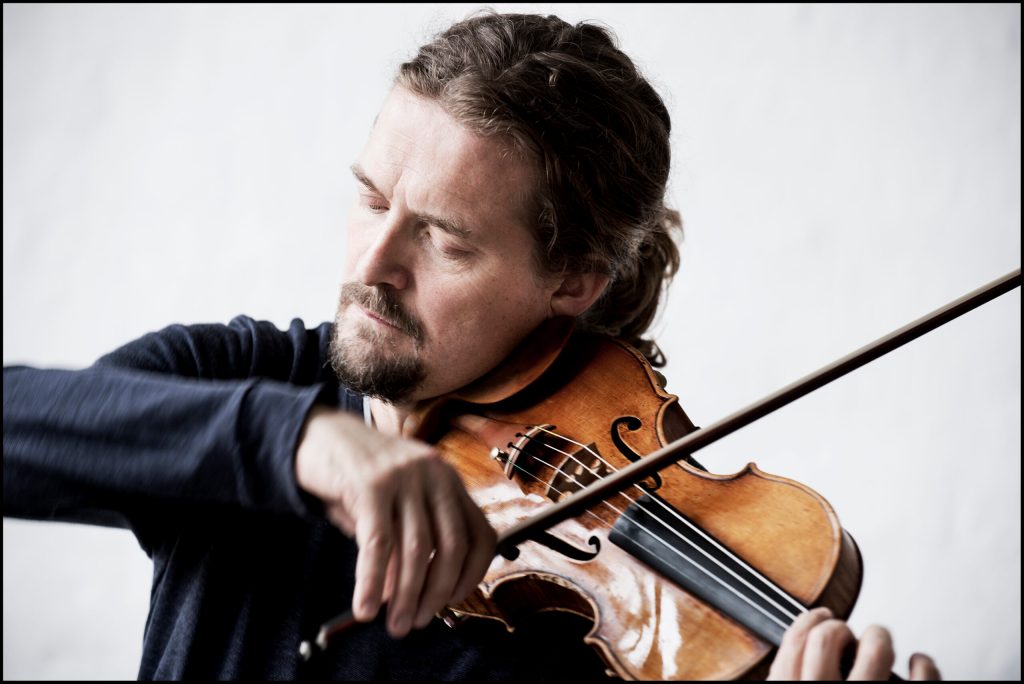
Christian Tetzlaff
Christian Tetzlaff gave an electrifying performance with his playing of Elgar’s Violin Concerto and he seemed to become one with the violin, It was not just his bowing arm but his whole body which appeared to be affected by the music.
He opened with some ferocious bowing but this soon morphed into playing which was not much more than a whisper with Tetzlaff gently rocking as though playing a lullaby, taking him into a state of reverie.
There were times when the bow met the strings with a piercing sound, while there were other passages when the bow barely touched the strings.
Several times his feverish playing was matched by Gemma New’s demonstrative conducting where she conducted with her body and not just baton and hands. Then there were times when violinist and conductor appeared to be linked in a dance, their bodies swaying in harmony.
There were many passages in the work which were extremely taxing for the violinist but Tetzlaff handled these with style and self-assurance. At times he was sharply focused with some aggressive playing, as though he was trying to outrun the orchestra before changing to a more serene mode, melding with the orchestra.
With the slower second movement he was like a different violinist, the torments of the first movement replaced by an engaging romanticism Before the spirited finale he effortlessly dashed off a spirited theme with some grand gestures.
That Gustav Holst composed his The Planets suite early on in the twentieth century saved a lot of problems later on. Pluto was not discovered until 1930 so was not one of the planets which the composer included in his work. So, with Pluto now being dropped as one of the planets his work doesn’t have to be seen as an oddity just one of the great British musical works of the early twentieth century.
Under the brilliant direction of Gemma New the orchestra managed to give each of the sequences a thrilling interpretation, exploring their emotional and narrative themes. At times New seemed carried away by the music performing little dances and jigs, her hands and arms tracing out the music as though replicating planetary arcs.
From the relentless marching sounds of Mars, The Bringer of War through to the almost spiritual Neptune there was an urgency and drama from the orchestra.
Jupiter featured an onslaught from the full strings along with an array of percussion including bells and triangle which added to the intense atmosphere.
Emotional and expressive playing by the violins, cellos, and double basses introduced Venus along with percussion instruments – gongs, triangles, bells, timpani, celesta and drums, which provided a serene and imposing atmosphere.
Saturn gave us the sombre sounds of the double basses and plucked cellos and this then changed with a nice contrast to harps and double bass.
The opening harps and organ of Neptune, created an enigmatic sound with the orchestra joined by Voice New Zealand Chamber Choir which was beautifully expressive, becoming another instrument to finish the work in style,
Louise Pōtiki Bryant’s In Transit imagines the links between Maori myth, ritual and their notion of the ancestors observing the nutuarl world and its cretasures. Here the shaping of the creation myths, are given narratuives and images which give meaning to the transition in human life paralleling those of the spirit world.
The work appears to dwell on several aspects of Māori myth such as the creation story of Ranginui and Papatūānuku, whose, children exist for a time in in the dark world until Tāne, separates their parents, bringing the children into light.
There is also reference to the evolution of the taiaha which Tū, the god of war asks Rūrūtangiākau, the weapon maker of the gods to create a weapon.
The dance opens with a low droning sounds as the sole figure, representing Tū or Rūrūtangiākau who dances through shafts of light with a branch balanced on his head., He moves from an underworld into light and is joined by five other dancers who perform with long sticks or the evolving taiaha. They dance to a soundscape which [provides a sense of the being under water along with bird sounds.
The dancers seemingly inspired by bird and reptile movement, move with short sharp steps id birds, strutting, foraging and pecking. These movements were accompanied by staccato like breath which add to the sense of existing n another dimension.
Some of the dancers entwine cresting manaia shapes suggesting the notion of messenger between the mortal and spirit worlds.
The slender taiaha are used to create a Papatūānuku womb-like shape out of which a figure emerges.
The work is full of robust dancing, flickering shafts of light along with a mesmerizing soundtrack along with relentless beats. It blends together sound, music, visual and movement describing the transitions between the physical world and the spirit dimensions.
Matter
Matter
Choreographer & Sets, Ross McCormack
Composer, Jason Wright
Lighting, Jo Kilgour
Costumes , Vicki Slow
“Matter” choreographed by Ross McCormack opens with a lone figure seemingly transfixed by one of the five post erected on the stage. He was joined by another figure and from their fitful movements it appears that they are inhabiting a world where they are seeking, discovering or being activated by lines of force or energy, possibly emanating from the poles.
Then they are joined by a group of dancers who move to a cacophony of sound, inching forward, creating a reptilian-like form with a nod to the work of the German choreographer Pina Bausch. Their erratic shuffling moves, driven by an inner tension and massive roars of music is by turns orderly as though responding to laws of Nature or manipulated by an unseen hand.
Two of the dancers appear to respond to other sounds as though out of their control and they engage in movements which area mix of tussle and dance, their movements hinting at forces which are attracting and repelling g them.
We get the sense that the poles are the xxx of these forces- electromagnetic, natural rhythms or xx. Other bodies separate and merge becoming alien creatures and the sounds and music we hear are the sound of massed bodies and the arms and legs becomes tentacles.
Throughout the work the dancers seemed to be either seduced or buffeted by the music and sounds, their movements at times urgent and sharp while at other times graceful and submissive.
In the latter part of the dance the poles / pou are moved taking on more symbolic meaning- the crucifixion, the triumphal Iwo Jima image of WWII.
There is a surreal beauty to the dancing which is created with a subtle mix of sound and lights while at one point the music takes on the rhythms of the Pacific with a hypnotic quality.
Another dramatic sequence involves first two dancers and ultimately all eight moving and dancing as mirror images of each other creating a dramatic frieze. This architectural aspect is also present in many of the other sequences, deriving from the five poles.
Much of the time the dancing could be likened to the movements of atoms and molecules in chemical and physical reactions, conforming to notions of particle physics and string theory.
Slip
Slip, Rebecca Jensen
We don’t often get to see true absurdist dance in the style of the absurdist dramatic works of the 1950s and ’60s. Nothing that suggest the human condition is essentially absurd and devoid of purpose.
Rebecca Jensen’s “The Slip” seemed to offer an absurdist dance which was set in a bizarre or surreal environment. The stage looked like an art installation – a step ladder, bucket, watering can, a table cluttered with apparatus, a sole cup and a large, directional microphone.
The opening minutes of the work continued the absurdist premise as we watched a couple of stagehands pouring water into containers and splashing it over the stage. It looked as though it was a work about sea level and climate change. This idea was reaffirmed throughout the production with images and the sounds of water.
After that opening sequence Rebecca Jensen appeared, dressed in a medieval gown, the first of her iterations. She sat, meditatively on the stage, performing simple gestures which were in marked contrast to her hectic movement in the latter part of the work.
“Slip” is a filled with precise and deliberate movements, mixed with moments of humour and provocation. It is an experimental work where the flaws and interventions that show up over the course of the performance add to its idiosyncratic quality.
It’s a work which can be interpreted as having surreal narratives, the themes of which will occur to the individual viewer as they come to grips with the many vignettes.
The focus of the work comes from the title, ”Slip”. There is a constant slippage between what we see and what we hear, between what is natural and what is fabricated between the role of the performer and the place of the technician.
While Jensen is the dancer/actor in “Slip” she is aided by Aviva Endean who acts as sound technician, participant and guide, controlling a table full of noise producing devices both physical and electronic.
When Jensen first appears, she dives into her backpack extracting various items such as a key, a bag of chips a bottle of water and a newspaper. But when she handles these items, it is not their natural sound we hear, it is Endean – shaking her own newspaper and pouring her own bottle of water, the sounds picked up and enhanced by the large microphone. When Jensen eats a chip, the crunch we hear is from Endean’s microphone enhancing the sound of her biting on a stick of celery.
This dislocation and enhancement occurs throughout the work in different forms. When Jensen walks around the stage we hear the sounds of Endean’s feet crunching on shells. At other times when Jensen walks, we hear the sounds of her body creaking as though she is robotic.
Jensen explores a range of movements from small gestures though fluid and dramatic balletic moves to the volatile actions which see her almost out of control.
The soundscape produced by Endean is similar to the enigmatic sounds created by the experimental group From Scratch and like that group she uses unlikely items to create the sounds.
An Auckland Theatre Company and Nightsong production
Directors, Ben Crowder and Carl Bland
Set, John Verryt
Lighting Sean Lynch
Costumes Elizabeth Whiting
Composer and Music Claire Cowan
Sound Max Scott
Choreography Dayna Pomare Pai
With Andrew Grainger, Jungwhi Jo, Tupe Lualua, Jennifer Ludlam, Anika Moa, Nova Moala-Knox, Lotima Nicholas Pome’e, Theo Shakes, Angus Stevens, Tess Sullivan, the Nightsong Youth Company and Roux the dog.
ASB Waterfront Theatre
Until 27 October
Review by Malcolm Calder
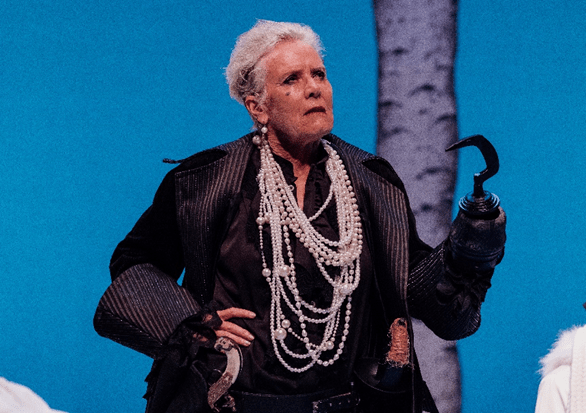
Whether as Captain Hook or the understated Mr Darling, Jennifer Ludlum commands the eyes, the ears and the senses every time she takes to the stage in this rather unique production. Striding around guiding, leading and even cueing other actors, she is totally in command. Her pedigree and experience is clear in her every nuanced action and clearly demonstrates why she is one of this country’s finest character actors.
However it seems she is not supported by any kind of control structure at all in this Peter Pan and that is a great pity.
Nightsong has developed a fine reputation over the years and its I Want To Be Happy remains one of my 2023 standouts. But this collaboration under the Auckland Theatre Company umbrella has confused me. It would be easy to dismiss it as a rather ginormous mishmash with no one in control. That is possibly true to a degree but there are clues as to what it is trying to do.
Writer Carl Bland pays homage to Barrie’s 1920s original. This is not a hi-tech show and he has kept it old-fashioned in many ways. However his work as a director is where things go a little awry – a good reason why writers who direct their own work sometimes incline towards the over-indulgent. Bland has tinkered with Barrie’s original and thrown in many asides, one-liners and loads of whimsy. Many of them work while others are wasted and become mere throwaways.
It is a bit like all those things got put in a bucket and then someone threw them at the stage. As a result things just sort of ‘happen’ in this Peter Pan rather than become magically ‘revealed’ after characters evolve, situations develop their own dynamic energy and tension has been drawn tighter and tighter.
Perhaps these things may have evolved after another week or two of rehearsal, but inter-character dynamics were all but absent and few did little more than appear onstage and utter their lines.
Some did their best. Theo Shakes developed a certain presence as Pan, especially in Act 2, Lotima Nicholas Pome’e sang with beauty towards the end of Act 1 and Andrew Grainger blustered about a lot.
Perhaps the whole thing could be summed up by the inclusion of Anika Moa. Apart from providing some, admittedly nuanced, contributions to the accompanying soundscape I have no idea why she was included. Her Mermaid Queen simply occupied a space, may have added an occasional vocal harmony and tickled a few percussion instruments. Poor Anika wound up a distracting sideshow. I felt sorry for her.
John Verryt’s set looked like it might possibly have been relocated from Barrie’s era, a beautifully-crafted wolf suit seemed to cover Tess Sullivan’s mic so we could barely hear her words, low-tech flying is a bit yawn-inducing these days and the whole thing looked under-rehearsed –at a production level too. Even the intelligently-included ATC Youth Company, making up numbers as pirates and Lost Boys, occasionally looked a little lost themselves.
Through all of this the missing element was command. One could almost sense Ludlum willing others in the cast to react, respond and become personalities matching the energy, effort and detail she put into her work – but this production allowed them to do so only rarely. As her Captain Hook met his demise I’ll swear I could hear her sigh of relief as the crocodile finally clamped its jaws around her and carted her off to who knows where.
And, while conceding that Barrie’s original has a dark side and may provide a few giggles for children I’m inclined to believe its moral about transitioning from childhood is somehow lost in translation for children anyway. On leaving the theatre I overheard a 10-year-old son respond to his father’s question about what he thought of the show. His response ‘too long but I liked the dog’ was his summation.
So, thank you ATC for your policy of diversifying your product range in 2023. However this Peter Pan raises other questions too. Not least its timing – one wonders why a show specifically targeting children and families should open at the very end of the school holidays. There have been many successes this year and I am sure this little blip does not negate the others.
But, finally, congratulations to Jennifer Ludlum for two finely-crafted characters. They commanded the stage.
The “Follow button” at the bottom right will appear and clicking on that button will allow you to follow that blog and all future posts will arrive on your email.






 New Zealand Arts Review