Reviewed by John Daly-Peoples
NZ Opera
Le Comte Ory by Gioachino Antonio Rossini
Kiri Te Kanawa Theatre, Auckland
May 30 & June 1
Reviewed by John Daly-Peoples
If Rossini was still writing operas today his pick for a librettists would have to be Simon Phillips. The original libretto was by Eugene Scribe and Charles Delestre-Poirson, adapted from a comedy they had first written in 1817. While traces of the original can be detected in NZ Opera’s latest version it is Phillips’ new translation, re-write and update which dominates.
This update is what makes the work entertaining and significant. Phillips has taken something of risk in filling the libretto with colloquial speech but it makes for a clearer understanding of the narrative and his contemporary references give the work an immediacy.
His new libretto avoids having to deal with the issues of misogyny which are always there in Rossini’s works. It also avoids the contentious issue in the original of having one group of men going off to fight the crusade in Palestine.
Examples of his language updates include someone being referred to as “not a happy camper” “Stuff this for a caper, I’m buggered” says The Coach after one adventure, “He really found my chi” exclaims of one ecstatic young woman and at the point when Ory is unmasked the entire cast gives a sustained “What the F…K”
There are lots of rugby references including mention of a John Eales award – this reinforces the idea that Ory’s team is Australian as New Zealand players would not engage in such dastardly undertakings.
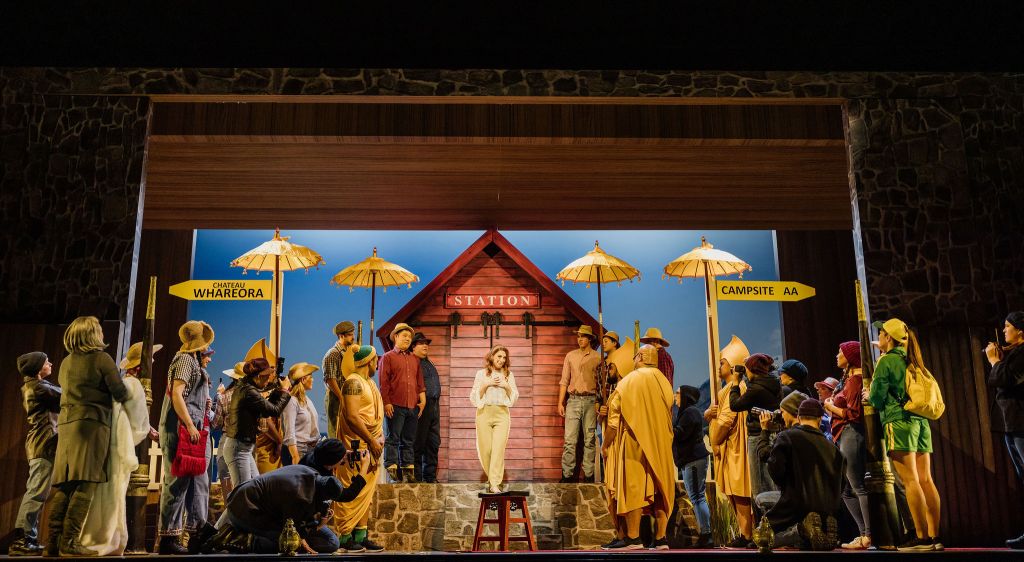
The setting for the opera is moved from medieval France to New Zealand, probably the Central Plateau where we find the wives of a rugby team who are off on an international tour staying at a wellness centre in the Chateau Whareora.
Adjacent to the wellness centre is a campsite where Ory and his rugby teammates have set themselves up with the dodgy intentions.
Ory uses this base to establish himself as a guru / advisor on matters of the heart in an attempt to woo Adele, the sister of the owner of the centre who is away on tour .The team’s personal physiotherapist, Isolier is also in love with Adele and tries to thwart Orys undertakings.
This conflict between pure love and the profane is actually more about a form of selfishness and narcissism which Ory shows in both words and deeds.
The opera revolves around lots of deception, disguises and sexual intrigue where the only character, Count Ory, seems to be in control, yet he is the one who constantly fails ,
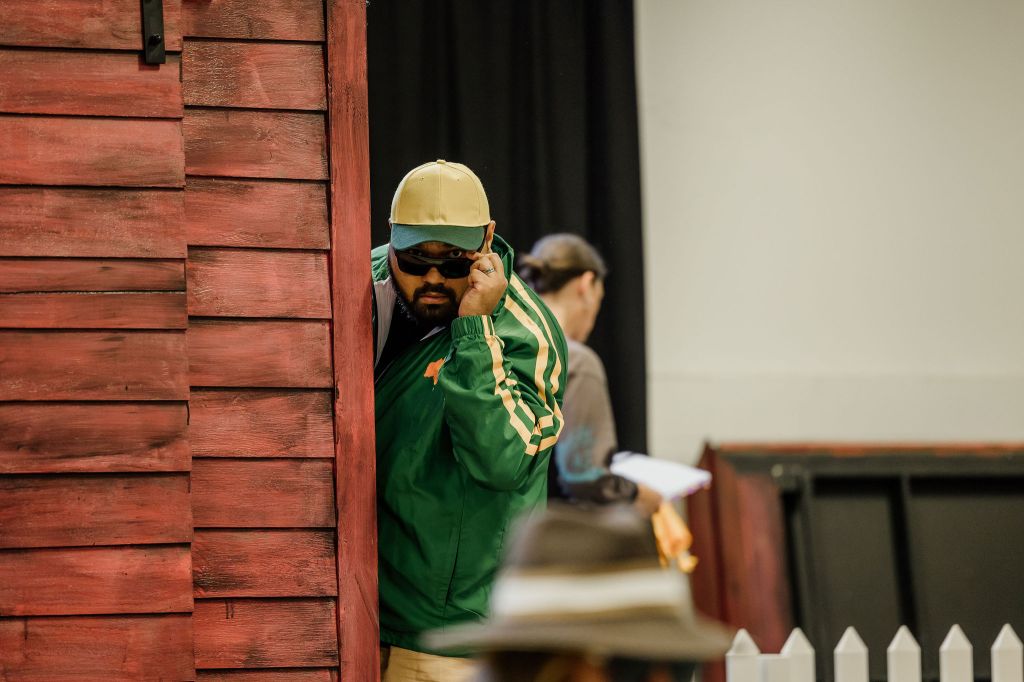
Manase Latu as Ory captures the characters inflated sense of self with a bravura performance, parading around the stage in his orange Buddhist robes, behaving like a faith healing tele evangelist.
His voice had the richness of the glib politician / priest with touches of both wit and seriousness, brilliantly captures the suave veneer. In the first act he was great as a Dalai Lama character. Partly his acting, partly the libretto but his character comes over as flawed and despite his belief in his charms and sexual prowess he is never in control of his endeavours.
Emma Pearson as Adele displayed a range of emotional responses with her iridescent voice which at time conveys a sense of rapture.
Hanna Hipp as Isolier played an ambivalent character in taking on the traditional ‘trouser role’ of female playing male as well as that of a bi-sexual woman in her relationship with Adele. Her duo with Ory was riveting with its mixture of the comic, and sexual friction.
The various duos are performed superbly while the septet at the end of Act I was a great showing off of their voices as they slowly morphed into what sounded like a delightful barbershop singing group.
Andrea Creighton’s Ragonde fulsome voice was a quiet force. Moses Mackay as Raimbaud displayed a fine sense of the comic and Wade Kernot as the Team Manager had a genial style with a nice flexibility of tone.
The sets and costumes by Tracy Grant Lord worked well in defining place and character but some of the costumes worn by the locals in Act I seem to have been borrowed from an amateur production of Oklahoma.
For a little-known opera this production offers originality, riotous performances with some of the country’s best voices. The APO conducted by Brad Cohen brought Rossini’s sparkling music to life, particularly the two overtures.
St James Theatre, Wellington June 13 & 15
Isaac Theatre Royal, Christchurch June 27 & 29
To subscribe or follow New Zealand Arts Review site – www.nzartsreview.org.
The “Follow button” at the bottom right will appear and clicking on that button will allow you to follow that blog and all future posts will arrive on your email.
Or go to https://nzartsreview.org/blog/, Scroll down and click “Subscribe”


 New Zealand Arts Review