Categories
Reviews, News and Commentary

N. Z. Opera’s La Boheme

Reviewed by John Daly-Peoples

La Boheme, The student garret / studio (Act I & IV) Image. Andi Crown

La Boheme

Composer Giacomo Puccini

Librettists Luigi Illica, Guiseppe Giacosa

N Z Opera

Kiri te Kanawa Theatre

Until June 6

Then

Wellington 18 – 22 June

Christchurch 2 – 6 July

Reviewed by John Daly-Peoples

There are no gods or fairies in La Boheme. There are no heroic figures in La Boheme. There are no evil or deeply flawed characters in La Boheme and there are no complicated plots or byzantine machinations in La Boheme.

All the characters we encounter are young and ordinary, all making their first steps into adulthood, living in a bohemian environment, full of possibilities.

This ordinariness is in contrast to many other great operas where characters face great moral dilemmas, battle tyrants or life’s injustices. This is one of the few great operas where we see characters on stage who we can recognize as very much like ourselves – or twenty year old versions of ourselves.

Four of the very ordinary characters live in a very ordinary student flat and the opera opens with Rodolfo, a writer and his artist friend Marcello struggling to create masterpieces while they battle the freezing temperature by burning one of Rodolfo’s plays to keep warm. Colline, a philosopher, and Schaunard enter with food and drink but instead of paying the rent they decide to celebrate Christmas at the Café Momus, where they encounter  Marcello’s girlfriend, Musetta who is with her sugar daddy Alcindora.

At the same time Rodolfo meets the frail seamstress Mimi, and they fall in love. But their tender romance is doomed, for Mimi is ill with consumption, and Rodolfo is too poor to help her. Through the opera they also have to confront the other aspects of life and love -jealousy, guilt and despair which comes with that love. As a contrast is Musetta whose love has a wider focus given to Marcello, Alcindora as well as others.

Ji-Min Park (Rodolfo) and Elena Perroni (Mimi) Image. Andi Crown

The slowly dying Mimi (Elena Perroni) who all but whispers in many of her arias gives memorable performances. While she presents a gentle voice often almost whispering while at other times she was able to sustain an expressive intensity as with her “Donde Lieta Usci”aria

Rodolfo and Mimi have a purity of soul which seems to bond them despite their Act 3 questioning of their relationship and this is reflected in their voices. Ji-Min Park (Rodolfo) is able to express an urgency with his rich voice while both Elena Perroni’s voice and demeanor coveys a sensitivity and frailty.

Rodolfo’s three friends  also contribute  some lively singing with their first act witty dialogue and humorous interchange with the landlord Benoit. Marcello  provides some brilliant duos with Mimi and Musetta, notably the third and fourth acts while the philosopher Colline ( Hadleigh Adams) provides an additional concept of love with his aria dwelling on his much-loved coat.

The musician Schaunard (Benson Wilson) contributes slightly to the singing in the opera but his main purpose seems is to always have some money and always has food or wine available as the hedonist of the group and a contrast to Rodolfo.

Emma Pearson (Musetta) Image. Andi Crown

The setting has been changed for Mid nineteenth century to Paris in in 1947 and the bohemian nature of the artist’s lives in seen ibn some huge paintings like those of Pierre Soulages in the studio / garret. The post war date also means the costume designer (Gabrielle  Dalton) have been able to give the Musetta and Mimi some contemporary fashion with Musetta being attired in some stylish Dior inspired outfits.

The simplicity and honesty of La Boheme  has meant it is always accessible with a story which is clear, immediate and romantic and universal. Director Bruno Ravella and Conductor Brad Cohen have ensured that the story and  the characters are brought to life with sensitivity, authenticity and joie de vivre.

Categories
Reviews, News and Commentary

Auckland Philharmonia’s “Tchaikovsky 5”

Reviewed by John Daly-Peoples

Alexander Gavrylyuk Image Adrian Malloch

Tchaikovsky 5

Auckland Philharmonia

Auckland Town Hall

April 15

Reviewed by John Daly-Peoples

First up on the Auckland Philharmonia’s “Tchaikovsky 5” programme was Kenneth Young’s “Douce Tristesse”, a work composed in 2012 in response to the composer’s final visit to the  long-time family holiday spot near Tauranga.

Strings and woodwind opened the work with a description of landscape, with swathes of colour conveying the changing light and textures of the land, sea and sky.

These vignettes were studded with musical highlights deftly conveyed by the small group of percussion instruments – cymbals, glockenspiel, crotales and harp suggesting the sparkles of light on water, the movement of clouds and the chirping of birdlife.

The work manages to suggest panoramic images from dawn to dusk suggesting the romanticism of the idyllic as well as a nostalgia for lost times and memories.

The composer says that the title ‘Douce Tristesse’ means ‘ sweer sadness and that the piece is about looking at a familiar scene for the last time, a view never to be seen again.

Prokofiev’s third Piano Concerto was written in 1921 during a period of self-imposed exile from Russia and a period when he did not feel oppressed by war or demands on his time and seems to have  more leisurely ambience . The work was first performed in Chicago with the composer playing. The audience and press raved over the music with The Chicago Daily Herald calling it the “the most beautiful modern concerto for piano,”

It opens with the sounds of a clarinet and strings playing a floating melody emblematic of his own more relaxed life. This led quickly to pianist Alexander Gavrylyuk racing into the first movement of the work with fiery sounds from both orchestra and  pianist who played as  though the piano were a percussion instrument

Hunched over the piano his playing was by turns delicate and ferocious as he grappled with the various sequences. There were times when his sounds were languid and romantic and other times when he took a delicate almost spiderly  approach to his playing.

In the second movement he turned the slow dance-like opening into a cacophony of jarring sounds and the intense finale of the third movement saw him in studious concentration.

He displayed a mastery of stylish playing, able to ignite the orchestra with his passion and drive.

His playing technique – changing tempos, charging through themes and varying the tonal qualities added to the excitement of the playing and appeared to enliven conductor Shiyeon Sung well as the orchestra.

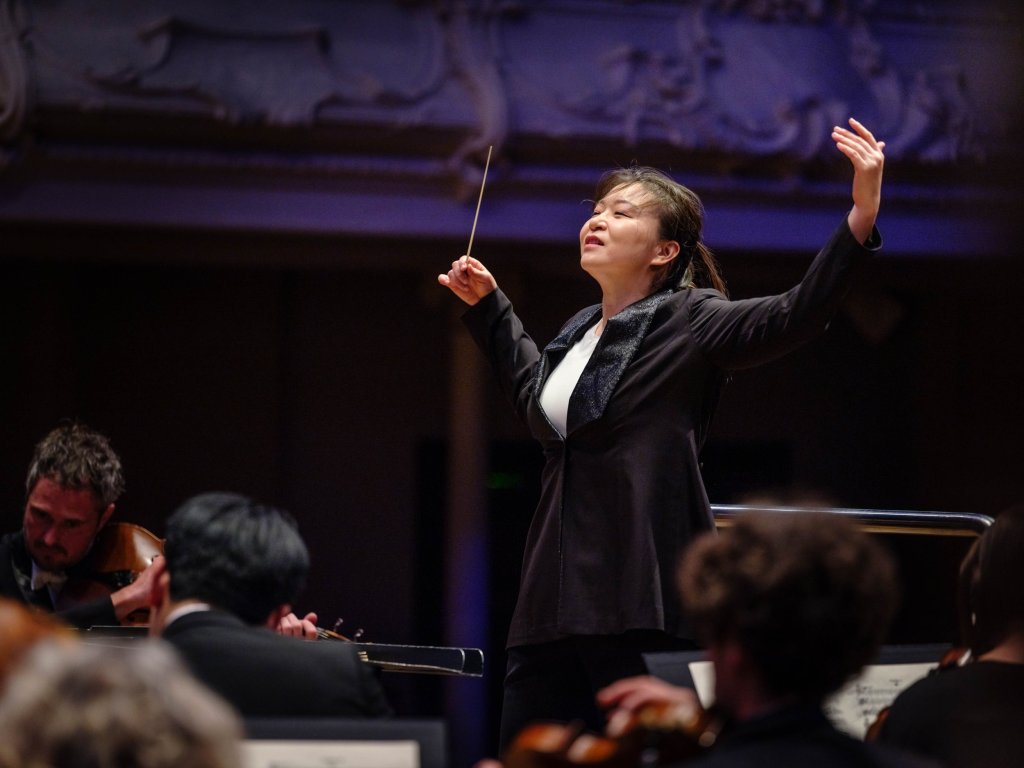
Shiyeon Sung Image Adrian Malloch

The major work on the programme was Tchaikovsky’s “Symphony No 5” which saw Shiyeon Sung and the APO deliver one of their outstanding performances. The work is full of sensuous melodies, intense emotions and dramatic climaxes which make it one of the composers more invigorating works.

Some of the sequences are monumental with music similar to his 1812 Overture while there were traces of his ballet music in others.

Sung deftly, guided the orchestra, building musical images, of landscapes, seasons and events creating a world of sensation and emotions.

There were joyous  moments throughout the work but these were set against contemplative sections with the composer finding redemption in the grandeur of the work.

From the anguish of the first movement through the graceful mid-section and onto the final tumultuous fourth movement the orchestra provided a rich and satisfying performance.

While the orchestra was expertly conducted and the players superbly coordinated there were some stand-out performances by the bassoons, flutes, clarinets and French horns.

Categories
Reviews, News and Commentary

Mozart’s Jupiter: Musical foothills and a mighty mountain

Reviewed by Peter Simpson

Genevieve Lacey Photo. Pia Johnson

Mozart’s Jupiter

Auckland Philharmonia Orchestra

Auckland Town Hall

May 1

Reviewed by Peter Simpson

Thursday’s Mayday concert by the Auckland Philharmonia Orchestra consisted of some pleasant foothills leading to a mighty mountain. The foothills were all acts of homage by different composers to a major predecessor: Tchaikovsky honouring Mozart; Australian composer Elena Kats-Cherwin (born 1957) honouring Bach, and British composer George Benjamin (born 1960) honouring Purcell. The mighty mountain was Mozart’s sublime ‘Jupiter Symphony’, No. 41.

The conductor, Leo Hussain (born 1978), is British and is currently Principal Guest Conductor of the George Enescu Philharmonic in Bucharest; he also worked with Simon Rattle at the Berlin Philharmonic and is probably He is best known as a conductor of opera. In Auckland he began the concert informally with a brief verbal introduction emphasising the linking theme of homage and describing the Mozart symphony as the summation not only of Mozart’s career but of the whole Classical period in music. His control of the orchestra was impeccable throughout and the whole concert was warmly received.

Tchaikovsky’s ‘Mozartiana’, dating from 1887, orchestrated what the composer called ‘gems of musical art, unpretentious in form, but containing incomparable beauties’. The first three movements are tasty miniatures; the final movement, a set of variations, based on Mozart after a theme by Gluck, is more extensive and includes some effects a million miles from Mozart; the variations fully explore the large orchestra’s resources, one being entirely for strings, another entirely for woodwind, and including solo turns by clarinet, flute, violin and glockenspiel. The performance was spirited.

Elena Kats-Chernin describes her six-part work as ‘Re-inventions (after Bach)’; they are based on some of the great composer’s inventions for keyboard. Scored for small string orchestra and solo recorders the performance featured entertaining solos on four different recorders (discount, tenor, bass, sopranino) by Australian virtuoso Genevieve Lacey who impressed the audience (especially in her bird-song imitation encore) with her skill and vivacity.

Composer George Benjamin was a pupil of Messiaen; his ‘Three Consorts’ responds particularly to the ‘mesmerising intersection of line and harmony’ in Henry Purcell’s 1680 Fantasias. The middle piece was especially sonorous and pleasing.

Mozart’s Jupiter symphony is an astonishing work which the composer himself probably never heard performed; it certainly owes its name to somebody else. One scholar described it as ‘the greatest orchestral work of the world which preceded the French Revolution’ and the APO played the work as if they agreed with that dizzy estimation. The way the symphony combines both clarity and complexity, especially in the last movement, was apparent throughout the orchestra’s sparkling rendition. Glorious music!

Categories
Reviews, News and Commentary

Delicacy and grandeur in nineteenth century masterworks

Inon Barnatan. Image. Sav Schulman

Romantic Brahms

Auckland Philharmonia

Auckland Town Hall

April 10

Reviewed by Peter Simpson

The April 10 concert of the Auckland Philharmonia headed ‘Romantic Brahms’, placed the audience squarely in the nineteenth century (where most audiences most like to be), with an overture from 1834, a concerto from 1881 and a symphony from 1888. The conductor was the Swiss-Australian Elena Schwarz who is currently with Klangforum, a chamber orchestra specialising in contemporary music based in Vienna; she is also a guest conductor with leading orchestras in Europe, America and Australia.  Elegant and agile in her dark trouser suit she seemed completely in command of these complex scores.

Louise Farrenc (1804-1975) was famous in her time (and is now undergoing recuperation) as a pianist, teacher and composer in Paris, earning the respect of Schumann and Berlioz for her compositions which included symphonies and chamber works as well as two orchestral overtures in 1834, the second of which played in Auckland demonstrates her confident control of the post-Beethoven orchestra and musical idioms.

Brahms’ Piano Concerto No. 2 is possibly his greatest orchestral work, at least I have thought so since the early 1960s when I first heard Sviatoslav Richter’s famous recording with the Chicago Symphony under Erich Leinsdorf made during Richter’s first tour of America. Israeli-pianist Inon Barnatan was well up to the demands of this heroic score ranging as it does from  extreme delicacy – as in the opening exchanges between piano and horn (the beginning slightly fluffed by APO’s horn soloist) – to full orchestral grandeur in the many climactic passages. For his encore the pianist unusually chose a graceful duet by Rachmaninov with a cellist instead of a solo piece, perhaps in recognition of the lovely ‘cello solo at the start of the third movement of the concerto.

According to Heath Lees’ programme notes, César Franck’s Symphony in D has somewhat lost favour with modern audiences compared to its earlier fame, but it still comes across as a noble and majestic piece, especially in its swelling major theme which recurs throughout the circular structure The texture of the work can sometimes seem a bit muddy but not in Elena Schwarz’s expert separating out of the separate layers of sound. It was a fitting conclusion to a stirring and satisfying evening of Romantic music.

Categories
Reviews, News and Commentary

Gene Kelly; A Life in Music

Reviewed by John Daly-Peoples

Gene Kelly; A Life in Music

With the Auckland Philharmonia conducted by Neil Thomson

Auckland Town Hall

March 15

Reviewed by John Daly-Peoples

It was billed as Gene Kelly; A life in Music but it could equally have been called Patricia Ward Kelly; A life in Music as the show which was written by his wife was brilliantly presented as she narrated the life of the dancer with the music played by the Auckland Philharmonia along with crisp remastered clips  from his films.

The two met in the mid 1980s, when he was 73 and Patricia was a 31-year- expert on the works of Herman Melville who had never seen any of the actor/dancer’s films. He asked  her if she would work with him on his autobiography which she did, for five years.

They married when he was 77 years, and each day she documented and recoded his life, This close association with him made her the most knowledgeable person about the dancer’s career.

Her knowledge, of Gene, the music and films all merge into a superb account of Kelly’s life as well as a snapshot of American dance movies of the mid twentieth century.

Most of his iconic films were shown including scenes from Singin’ in the Rain, An American in Paris, Brigadoon, Summer Stock, Les Girls and It’s Always Fair Weather.

We saw him perform with Ginger Rogers, Leslie Caron, and Cyd Charisse as well as with an animated Jerry the Mouse getting a dance lesson from Gene Kelly in “Anchors Aweigh”.

We also get to hear the music of the great composers of the time as well -Andre Previn Lerner & Loewe, Cole Porter and the Gershwins.

We also get to appreciate the clever way in which realism and abstraction was used in  the sets. This combination created some surreal dance sequences with vivid use of colour which highlights the spectacle of the dance routines and shows how Kelly helped change the nature of dance on film with a new mode of choreography and filming.

For the introduction to the second half which featured clips from Brigadoon she had a piper stride up the aisle and then in a surprise appearance she introduced Michael Crawford of Phantom of The Opera fame, who now lives in New Zealand and who acknowledged Kelly as a major influence in getting the role.

Patricia Kelly’s  presentation brought  clever showmanship and intimacy to the evening accompanied by the Auckland Philharmonia conducted Neil Thomson.

Categories
Reviews, News and Commentary

Lula Washington Dance Theatre

Reviewed by John Daly-Peoples

Lula Washington Dance Theatre

Aotea Centre

March 13 -16

Reviewed by John Daly-Peoples

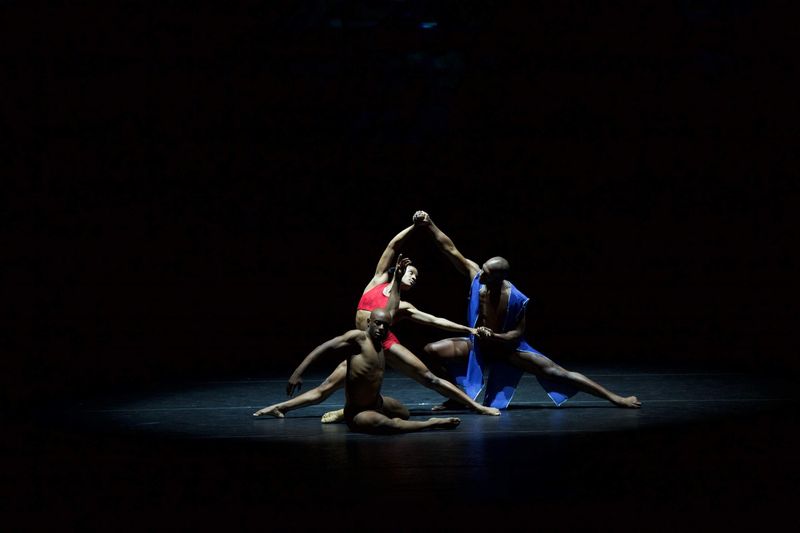
The Lula Washington Dance Theatre is a contemporary modern dance company  in Los Angeles which has performed across the United States and toured internationally. It was established forty years ago when Lula Washington realised there were few black dance institutions in America  .

They have a stylish approach to contemporary dance incorporating elements of African and Caribbean dance as well as contemporary modern dance and ballet. All these elements were seen in the opening number where three dancers – Love, Faith and Hope,  performed to  heavy beats, foot stomping and clapping with the audience encouraged to add to the heavy clapping to that of the dancers and he riotous drumming morphed from African beats to something closer to hip hop.

Three female dancers were joined by male dancers who became intertwined and there was a sense of the dancers and audience all part of a church service, street performance or gym workout.

Accompanying the hectic dancing were references to American segregation, slavery, lynchings and race riots – Charleston, Springfield, Watts and an image of George Floyd

Accompanying this dancing was some relentless drumming with and  intense energy more akin to that of a night club and each of the sequences was given multiple bursts of applause from the audience.

Throughout this sequence the woman danced like ghost or departed spirits, their dancing a combination of celebration and remembrance of the African roots of the movements and music.

Because of the emphasis on these aspects the dances all seemed to be something of a political force and the dancers’ political activists.

In a later sequence one of the dancers shouts out the repeated chant “America is killing me” and this was accompanied by a visceral scream, a dramatic event one would not encounter in a Royal New Zealand Ballet performance and shows the level of the political urgency behind the Lula Washington project.

There was an intensity to many  of the dances with a physically close to that of a Whirling Dervish. But alongside this there were elements of playfulness and whimsy which were all performed with a finesse close to that of classical ballet dancers.

The political or polemical aspects of the dances often felt to be less satisfying of the performance without a dance vocabulary which did not express the angst and anger which was conveyed in the words which accompanied the dance.

Categories
Reviews, News and Commentary

A Mixtape for Maladies:   Music and  Memories of a War

Ravikanth Gurunathan (Vishwanathan), Tiahli Martyn (Subbalaxmi), Ahilan Karunaharan (Rajan), Gemma-Jayde Naidoo (Sangeetha – past) Image – Andi Crown

A Mixtape for Maladies 

By Ahilan Karunaharan 

Director, Jane Yonge  

Auckland Theatre Company  

Until March 23

Reviewed by John Daly-Peoples

The Sri Lankan Civil War of the latter part of the 20th century provides the backdrop for Ahklan Karunaharan’s “A Mixtape for Maladies” which explores the lives of a Tamil family, who are caught up in the conflict, some of whom are killed or immigrate to New Zealand.

The play explores the reality of living in a different time and culture in a period of tension and transition and we identify and sympathize with the family’s trials of living through a war.

I was jolted back to another reality at the end of the show however. My Uber driver looked South Asian, so I mentioned about the show and how it combined politics and family. He was from Sri Lanka and acknowledged the tragedy of the war and its impact on the country. But his experience was very different from the family I had just witnessed on stage as he had been an air force pilot during the war contributing to the death and destruction, providing an alternative history of the period  

One of the few things that Sangeetha (Ambicka G.K.R.) one of the daughters has brought to New Zealand was a tape recording of songs she loved growing up. Her New Zealand born son, Deepan (Shaan Kesha) finds the tape and plays the songs during his online podcast which trigger personal and political memories for her. 

Through the course of the play Deepan plays these songs and Sangeetha remembers elements of the family’s life – hearing about the war, her and her sister hanging around the store where Anton (Bala Murali) works because he plays all the latest local and international songs as well as songs from the movies. 

Shaan Kesha (Deepan), Ambika (Sangeetha – present) Image Andi Crown

While some of the songs are played on the tape recorder others are sung by various members of the cast, accompanied by a duo (Ben Fernandez and Seyorn Arunagirinathan) playing a variety of instruments – keyboard, Carnatic violin and flute. Ahilan Karunaharan (Rajan), and Bala Murali give particularly fine vocal performances while Tiahli Martyn’s (Subbalaxmi) display of Tamil dance was skillful. These vocal and dance  performances had many of the Tamil audience singing and swaying along to the music.

Among the tunes were Doris Day singing” Que Sera Sera”. “La Bamba” and some Tamil songs. These songs act as a cultural glue which holds the family together but also reminds us that these songs had universal appeal listened to by Sri Lankans as well as New Zealanders at the time.

The play is a mixture of social history, family exploration, cabaret and personal journey with music playing a central role in the play as well as the instruments the family would have listened to the songs on – an old turntable, a hi-fi player and the tape recorder.

The simple set features Dareen and Sangeetha in his podcast studio on one side and musicians on the other, flanking the family home and Anton’s general store.

The exploration by Dareen is initially an innocent enquiry into his mother’s music choices but becomes a journey into Sri Lanka’s history as well as triggering memories of his mothers and her family’s past and the impact of the war on their lives.

To subscribe or follow New Zealand Arts Review site – www.nzartsreview.org.

The “Follow button” at the bottom right will appear and clicking on that button  will allow you to follow that blog and all future posts will arrive on your email.

Or go to https://nzartsreview.org/blog/, Scroll down and click “Subscribe”

Categories
Reviews, News and Commentary

BLACK GRACE TURNS 30

John Daly-Peoples

John Daly-Peoples

‘THIS IS NOT A RETROSPECTIVE’

Auckland Town Hall

Saturday March 22,  7.30

Neil Ieremia is one of Aotearoa’s most astonishing and prolific home-based creatives. His ever-growing body of work has easily and unselfconsciously graced stages in many parts of the world and he is rapidly becoming a one-man export machine. In part this is because of his perfectionism that never forgets the past, stands firmly rooted in the present and yet finds time to seriously address the future – sometimes simultaneously.

His works combine different personal histories, different body shapes and abilities, and different musical and dance backgrounds.

May of his works have a strong musical underpinning that ranges from pop to hip hop, traditional to church, coupled with soundscapes that underscore the everyday concerns of young people today. It leaps from recollections of things past to things that might have been and things that are very much of the present, uses the simplest of props and creates some beautiful moments.

His latest work celebrates the company’s 30th year milestone with ‘THIS IS NOT A RETROSPECTIVE’, the ultimate interactive dance party at the Auckland Town Hall, Saturday March 22

Joining Blackl Grace will be CHE FU and THA FEELSTYLE along with the many amazing friends of Black Grace already down to party including; DJ Manuel Bundy, drag queen diva Buckwheat and the NZ Trio, working alongside a stellar production team, with Artistic Direction by Neil Ieremia, ONZM, sound designer Faiumu Matthew Salapu aka Anonymouz, internationally respected NYC-based lighting designer JAX Messenger, along with the incredible Black Grace Dancers.

But the fun doesn’t stop there, Black Grace has a number of special events planned throughout their birthday year. To be in the know join them at blackgrace.co.nz

Main event 1hr 10min, followed by a party which  will continue after main event until late

Categories
Reviews, News and Commentary

Six The Musical: More Than Mere Glitz

Reviewed by Malcolm Calder

Photo : James D Morgan

SIX THE MUSICAL

by Toby Marlow and Lucy Moss

Directors Lucy Moss and Jamie Armitage

Choreography Carrie-Anne Ingrouille

Set Design Emma Bailey

Costume Design Gabriella Slade

Lighting Design Tim Deiling

Sound Design Paul Gatehouse

Orchestrator Tom Curran

Musical Director Beighton

Civic Theatre, Auckland (until 30 March)

Reviewed by Malcolm Calder

1 March 2025

It would be easy to pigeon-hole SIX as a high energy show with lots of froth and bubble, and aimed fairly and squarely at the tiktok generation.  But you would be wrong.  It is rather more.

All things must change and musical theatre is no different.  SIX is important enough to represent another of those significant change points in history – following in the footsteps trodden by Oklahoma or West Side Story or Cats or Hamilton.

On leaving, I overheard an audience member mutter something about SIX being really just a glossed up pub cabaret.  And, to a certain extent, it is.  Originally conceived by a couple of then relatively unknown Cambridge students in 2017, Moss and Marlow took it to the Edinburgh Fringe that year, was a huge success and soon wound up at the Arts Theatre in the West End before a Broadway opening almost immediately before Covid struck.  There was a sort of relaunch in 2021 and SIX now enjoys semi-permanent residence in both London and New York and has gone on to world-wide success with multiple productions all over the anglosphere, as well as Europe and in Asia.

So what has driven this success? A well-known Australian commentator once suggested it resembles a Spice Girls concert directed by Baz Luhrman – but one where the girls can actually sing.  Quite apt I thought at the time.  But this show is a lot more than that.  It is VERY much a significant part of the musical theatre tradition.  In fact there are so many references, acknowledgments and subtle nuances running through SIX that enumerating all of them becomes difficult.

First and foremost, this is a NOW show.  As such it reaches its target easily and then some. So, yes, to the tiktok generation.  But it is  bigger than that and, while it might help grow memberships of amateur music theatre organisations, that is rather simplistic view as it impact is considerably greater. Not to put too fine a point on it, the key fundamental of SIX is pure entertainment built around that old adage – a good story told well that enthrals its audience.  And good entertainment knows no age boundaries – the grandmother in front of me was up and out-boogying her two grandchildren at the end.  Underlying import counts too. 

The stories of the six queens are told in the language of the second decade of the 21st century – not by the archival or even slanted recollections of historians about the politics and intrigue surrounding the first Tudor king.  Most of whom were men, and of a fairly clearly-defined social class at that.  Further, it is told from a women’s perspective.  And remember, some of the queens were all exceptionally young when they married and the Royal Court revolved around power, politics and intrigue.  So we leap immediately to empowerment for women – a rallying cry for millions – and a clear audience profile for SIX.

Structurally, as the fairly comprehensive promotional campaign has pointed out, SIX is built around a history lesson and a competition.  OK.  Thank you.  Got that.  It puts the six queens up against each other each other – an Eisteddfod if you will – or is that merely a device for something bigger?

The six queens never leave the stage and their individual songs merge into six-voice choral arrangements, complimentarily and contrapuntally at times, with occasional snatches of spoken dialogue (but not very much at all).  The staging itself is outstandingly conceived by Emma Bailey and reflects a modern high-tech concert stage that integratesTim Deiling’s dynamic lighting and Paul Gastrehouses’s sound in a way that clearly works.  The stage is also peopled by an astonishingly well-rehearsed, syncopathic and complimentary all-girl band for the entire show.

This primarily Australian cast comes well credentialled.  Dancing skills are clearly in evidence with very tight routines throughout and, even if there were one or two very minor vocal wobbles, vocal strength was generally strong and led by the assurance of Loren Hunter (Jane Seymour).  But let’s face it, this show is presented more like an eisteddfod or a competition and it doesn’t really matter – one voice will always overlap another. The tenderness of Heart Of Stone and the hilarious rap of Haus of Holbein were both standouts for me.

The primary focus of attention however is largely rivetted on Gabriella Slade’s award-winning costumes. Little wonder that her outfits have a dash of Spice Girls about them as she devised Spice World back in the 1990s.  But now she has embellished some glittering and futuristic sequinned outfits in ways that not only catch the eye, but help tell each queen’s story.  The ‘beheadeds’ have chokers for example, Jane Seymour’s black and white bodice echoes the half-timbered houses of Tudor England, the green of Anne Boleyn’s outfit references the popular myth that this evergreen was composed by the much-wedded Henry VIII himself (that’s factually incorrect, but let’s stick with the myth). It’s interesting that one interpretation of this song concerns the promiscuity in young women, something Henry’s henchman Archbishop Cranmer used in arranging divorce and subsequent beheading.

The references go on.  In fact they are never ending.  There are the pop divas found in the songs : I think I heard echoes of Beyonce, Ariana Grande and Alicia Keys and probably missed a few more.

The sense of fun and campness is constant.  SIX takes neither itself, nor musical theatre in general, seriously and whimsy is everywhere.  Phones in the theatre, for example, were quite correctly asked to be turned off pre-show and then during the encore (or more correctly the ‘finale’), encouraged the audience to light them up again.  And they certainly did. It was another moment of sheer joy and made the audience a part of the show. I think that grandma in front of me got a pretty good video take.

Any good production simply tells a story.  SIX does so with succinctness and very, very well.  It is not a long show, but is pretty demanding on both voices and the attention-span of audiences.

I always relish a well written show that is objective and contemporary rather than one that delves into the introspective meanderings of L-plate writers.  SIX is mature writing and very clever staging.  

The filmed on-stage reunion of Six’s original West End queens will be released in cinemas next month and, rather ironically, Auckland’s Civic remains one of the larger in-theatre venues it has played.  After here, it’s off to complete its second lap of Australia at the Civic’s sister in Newcastle, while Asia awaits

To subscribe or follow New Zealand Arts Review site – www.nzartsreview.org.

The “Follow button” at the bottom right will appear and clicking on that button  will allow you to follow that blog and all future posts will arrive on your email.

Or go to https://nzartsreview.org/blog/, Scroll down and click “Subscribe”

Categories
Reviews, News and Commentary

Auckland Philharmonia’s Brahms 3 and a masterly James Ehnes

Reviewed by John daly-Peoples

James Ehnes Photo Sav Schulman

Brahms 3

Auckland Philharmonia

Auckland Town Hall

February 27

Reviewed by John Daly-Peoples

The “Brahms 3”concert began with Romanian composer Gyorgy Legeti’s “Concert Romanesc” written in 1951. The work opens with joyous images of landscape studded with hints of folk music. These passages combined humour and experimentation, qualities which inhabit much of his later music.

From the middle of the piece there were more sombre sounds, as though confronting the history of his country as well as the suffering and death of his parents in Auschwitz during World War II.

As the work became darker and bleaker there was a whirling dance of death moving to a finale where the whole orchestra exploded with lively, suffocating sounds.

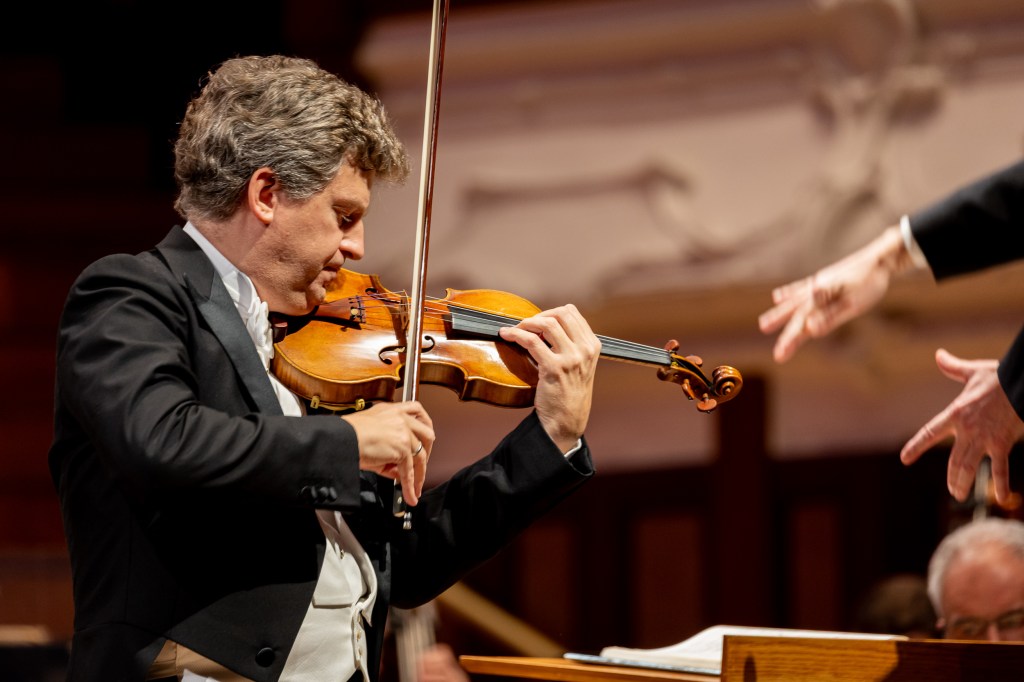
Following his performance last week James Ehnes’ performance of Bartok’s “Violin Concerto No 1” was highly anticipated. He did not disappoint. With the soulful opening movement he was initially joined by Andrew Beere and Lauren Bennett before others from the string section joined, adding to the density and complexity of Ehnes’ playing.

Following on from the strings, the woodwinds provided a slightly unsettling voice and even as the orchestra gained in intensity, Ehnes’ violin rose up , soaring above the sounds of the orchestra with some strident sounds which were reflected in Ehnes’ rigid  demeanour and exacting playing.

From the second movement on, his playing style changed, taking on a more passionate and expressive approach with some more hectic, gypsy-like playing as he battled against the sweep of the growling orchestra. However, even when he was frantically playing there was a sense of his being totally in control.

With his mastery of the violin, his skilful changes in pace, and tone the audience  was treated to a display by a consummate violinist.

While Ehnes received a rapturous ovation for the Bartok it was his encore, Eugene Ysaÿe’s “Violin Sonata No.3 ‘Ballade” .that got a tumultuous reception. The solo work dedicated to the Romanian violinist and composer George Enescu which was beautifully structured requires an intelligent and skilful player – all the qualities that Ehnes was able to bring to the piece.

The big work on the programme was the Brahms “Symphony No 3, a work which is full of marvellous melodies but which is something of an enigmatic work.

In many ways it is a forerunner of the impressionist works of Debussy and Ravel reflecting the interest of the Impressionist artists of the late nineteenth century. Much of the music is linked to visions of landscape, light and shade, colours and texture.

These images parallel a world of emotions and feelings, the composers inner and exterior worlds mingling. In building  a structure based on these links Brahms explores the nature if the human condition. This is very evident in the final movement with its passages of drama and tumult suggesting natural forces as well as the inner turmoil of love and passion.

The final works on the programme, three of Brahm’s Hungarian Dances had Conductor Bellincampi conducting at breakneck speed and while he spent much of his time dancing on the podium the orchestra were swept up by the music and carried along by its own impetus.

Bellincampi used the dances to book-end a farewell to the orchestra’s Music Librarian, Robert Johnson who has worked at the orchestra for over thirty years.

To subscribe or follow New Zealand Arts Review site – www.nzartsreview.org.

The “Follow button” at the bottom right will appear and clicking on that button  will allow you to follow that blog and all future posts will arrive on your email.

Or go to https://nzartsreview.org/blog/, Scroll down and click “Subscribe”