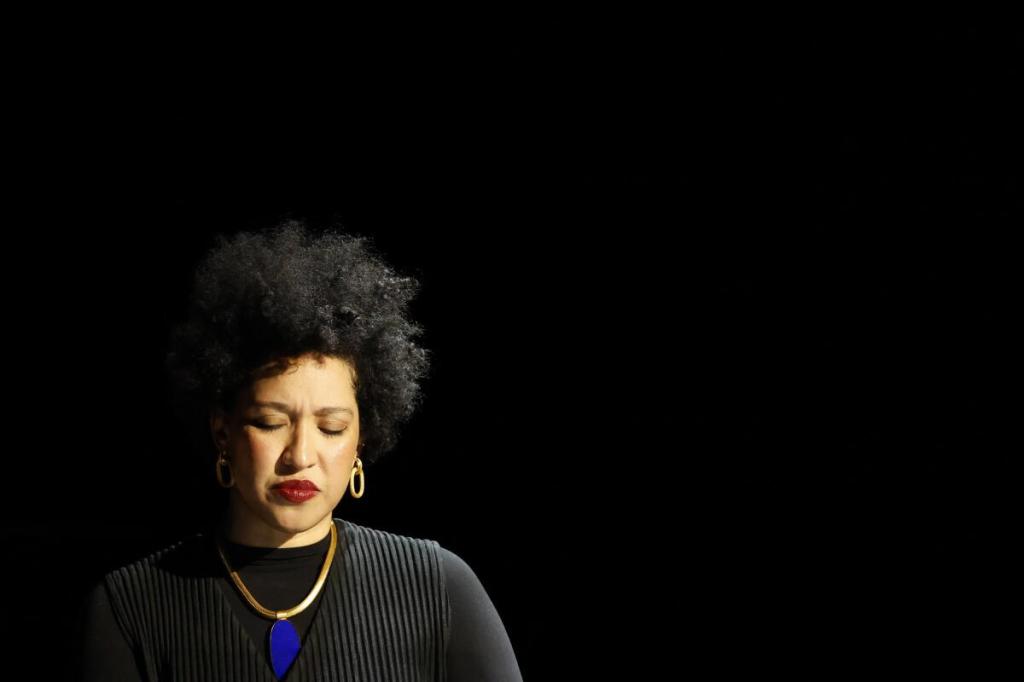
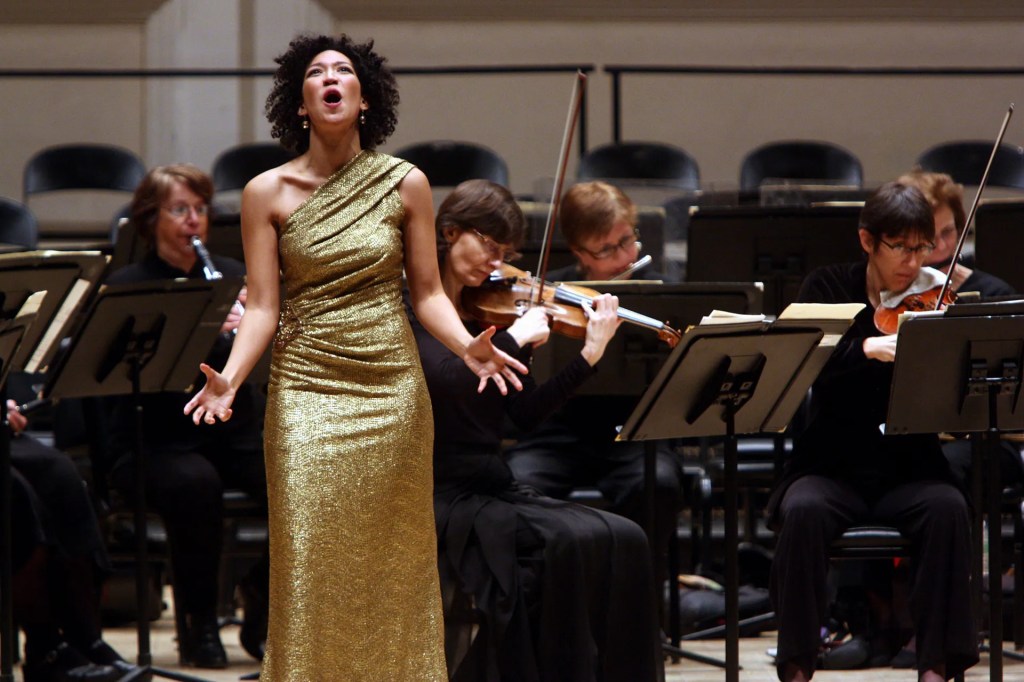
In her recent concert at the Auckland Town Hall Julia Bullock sang a group of songs which she considered as having an “American” sound. These included George Gershwin, Leonard Bernstein and Margaret Bonds. Bonds is a pianist / composer who Bullock has championed for several years a major black composer who was overlooked for many years primarily due to systemic racism and sexism in the classical music industry, exacerbated by the loss of her manuscripts and a lack of publication.
Bullock included three settings of poems by Langston Hughes – “The Negro speaks of Rivers”, “Winter Moon” and “Poeme D’Automne” which gave voice to black aspirations in the 1920’s. With Bullocks singing of “The Negro speaks of Rivers” she provided a fine sense of the Negro spiritual, the softness of her delivery veiling a strong, insistent voice and a slowly developing dramatic force. Her voice delivered an emotional and haunting tone capturing the essence of heritage and endurance.
“Poeme D’Automne” was an astonishing song in which images of falling leaves and the colours of autumn were linked to the human body. She sang this with a surging operatic voice providing and intense and emotional sound.
“Winter Moon” was a short piece, but it showed that Bond was not just writing music to accompany the words of the poem, she had the ability to write dramatic meaningful music.
She sang Stephen Sonfheim’s “Somewhere” as though it was an anthem for the displaced and disadvantaged – a piece very relevant today’s America. There was also the poem “To Julia de Burgos” by Bernstein, a vibrant piece of music which spoke of an angry revolutionary adventure in which she projected the words as though a personal statement.
She also sang a couple of George Gerswin songs, “Somebody from Somewhere” and “Summertime “from “Porgy and Bess”.
She also sang “La Conga Blicoti” a vibrant, Afro-Cuban jazz-influenced song performed by Josephine Baker with the Lecuona Cuban Boys, which features a distinctive conga rhythm.
She also sang Billy Taylor’s “I wish I knew how it feels to be free” like a requiem or funeral lament, very appropriate as a song for freedom.
There was also “I have Two Cities” by the French composer Henri Varna and lyricist Geo Koegar with lines such as
Manhattan is beautiful,
But why deny it.
What enchants me is Paris,
All of Paris
Which she sang as a hymn to Josephine Baker.
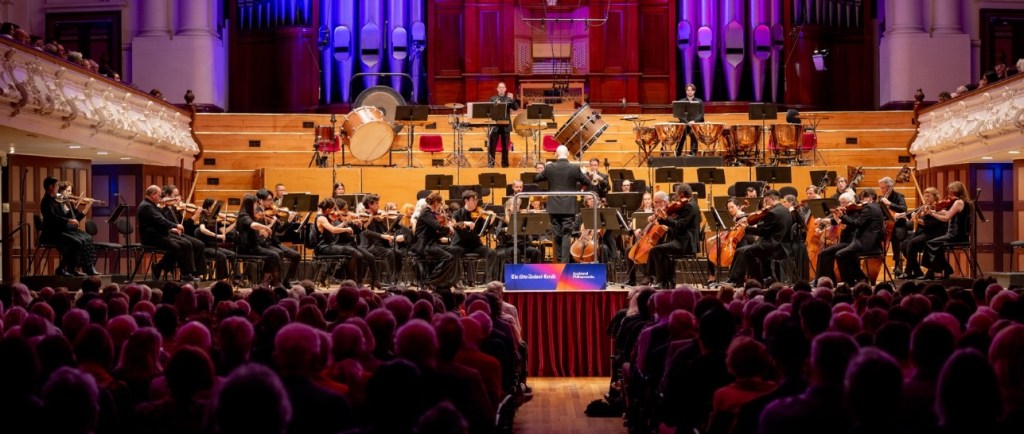
The concert opened with the Auckland Philharmonia playing Erich Korngolds “Theme and Variations” and closed with them playing Kurt Weill’s “Symphony No 2”.
Bullock has an affinity for the outsider artist which has led to her interest in Josephine Baker who made the journey from the US to Europe where she made her name while the two composers became outsiders under the Nazis and were forced to move from Europe to the US.
Korngold who was a major composer in Austria influenced the style of composition and singing in the 1920’s and 30’s with operas such as “Die Tote Stadt” while Weill was influential in bringing Bertolt Brecht’s work to the public with works including “The Threepenny Opera”.
In 1926 the iconic red telephone box which was designed by British architect Sir Giles Gilbert Scott first appeared in the UK making communication between individuals easier.
Now 100 years later as part of the Auckland Arts Festival telephone users can enter a modern telephone booth as participants in an art event which breaks down the boundary between artist and audience.
For the next three days on Level 3 of the Aotea Centre, you can be part of an art event where you become the actor in scenarios which you create.
Pick up your phone and you are connected to another random audience member or friend. You are confronted with a teleprompter which provides you a collection of scripts, including one by New Zealand playwright Victor Rodger.
You become part of an evolving dialogue which is part theatre and part social intervention. You become both performer and spectator, creating unique dialogues which will surprise, embarrass and entertain you.
Jay Dodge, one of the creators of Red Phone“When this project started, we had five or six local writers, and now we have representation from dozens of countries.
“We asked writers to connect and think about what they love about performance but in a creative way where they can be free and not obliged to reflect what is happening right now,” said Sherry Yoon another creator. “There is so much now going on right now, that we will see artists being both reflective and relevant to now, but also to engage in work that can continue on past our global pandemic. What really resonated with us and the presenters and artists we have engaged is to give audiences a work that isn’t here to replace theatre but is in essence of what we love about live performance — the emotional ride, the intimacy, etc.”
This free installation by Canadian interdisciplinary theatre company Boca del Lupo has toured Canada, Norway, and Latin America to critical acclaim. Now it is presented in Auckland for a strictly limited season.
Julia Bullock, Bluebeards Castle, Sincere Apologies
The New York Classic review last year featured a review of Julia Bullock by Rick Perdian
“It would have once been almost impossible to imagine a vocal recital by a major artist with songs by Alban Berg, Bob Dylan, and Rodgers & Hammerstein on the program. These are different times, however, and what once would have been dubious box-office is now perfectly attuned to the times.
Bullock opened the recital with songs by Samuel Barber, whose embrace of Romanticism put him at odds with the more progressive elements of the musical establishment in mid-twentieth-century America. The three songs which she sang—“My Lizard (Wish for a Young Love),” “Nuvoletta,” and “The Daisies”—outlined the wistful nostalgia, zaniness, and embrace of the bizarre that would course through the recital.
As with the Barber songs, Bullock performed songs by Kurt Weill which spanned the composer’s career from his collaboration with Bertolt Brecht in Germany to his Broadway hit, Lady in the Dark.
The outlier was the first, “Complainte de la Seine,” which Weill composed in Paris after fleeing Nazi Germany. This setting, like earlier songs dating from Weill’s collaboration with Brecht, “Ballade vom ertrunkenden Mädchen” and “Song of the Hard Nut,” show the composer at his most hard-edged and bleak. With crystalline tone, perfect pitch, and a delivery void of sentiment, Bullock sang of cadavers resting at the bottom of the Seine, the Marxist revolutionary Rosa Luxemburg’s decaying corpse in a Berlin canal, and the calculated transactions that fuel capitalism. With “The “Princess of Pure Delight,” Bullock switched gears, projecting a cool sophistication that evoked the era.
Bullock’s most sublime singing came with Berg’s Altenberg Lieder. Viennese audience’s greeted the songs with such derision in 1913 that Berg never permitted them to be performed during his lifetime. The five songs are settings of enigmatic verses by the poet Peter Altenberg which he sent to friends on postcards.
A substantial portion of the second half of the recital was devoted to songs by Richard Rodger and Oscar Hammerstein. Bullock told the audience that their music had been a part of her life from her earliest years growing up in St. Louis. “Dites-Mois” from South Pacific was the first song that she ever sang in public at the age of ten before an audience of thousands.
The audience was enthralled as Bullock sang some of the greatest hits from The Sound of Music and South Pacific. For the most part, these were straightforward renditions of beloved songs, but Bullock and Brown could be provocative, such as in “You’ve Got to Be Carefully Taught” from South Pacific. Bullock delivered the song’s message with a matter-of-fact directness which was intensified by Brown’s punctuation from the piano.
There were also songs linked to Odetta Holmes,who was known as the voice of the American civil rights movement in the Sixties. Bullock sang Bob Dylan’s “Masters of War” with a penetrating, unflinching directness. Odetta’s arrangement of “Going Home” and Elizabeth’s Cotten’s “Freight Train” followed.
Bullock ended the recital with Converse’s poignant ballad “How Sad, How Lovely,” a meditation on the loveliness and sadness of life.”
Bluebeards Castle
This version of Bluebeards Castel was previously performed in Wellington and Christchurch in 2023. Elizabeth Kerr reviewed the work in Five Lines.
“The dramatic trajectory of this contemporary production of Bluebeard’s Castle is vivid and deeply moving from its opening bars till the passionate conclusion. ..For me, its greatest wonder is the faithful use of the original text and music to tell a tragic story of today, a superb creative reimagining of Bartók ‘s only opera.
Bartók wrote Bluebeard’s Castle in 1911. He was 30 years old. The Gothic work, with a libretto by the composer’s friend, poet Béla Balázs, was based on the French folk tale published in the 17th century by Charles Perrault.
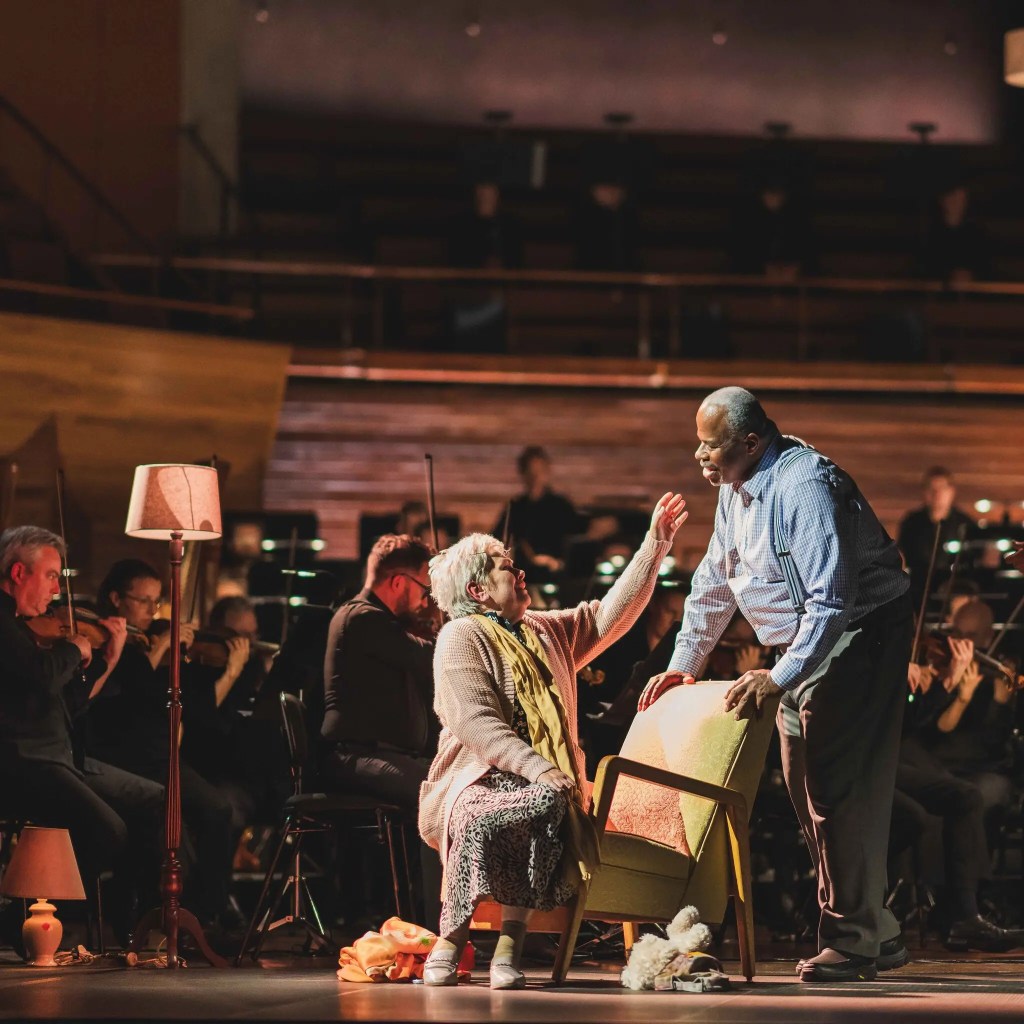
The opera has a singing cast of two with a full orchestra. The role of Bluebeard is sung in this New Zealand performance by US baritone Lester Lynch, and his wife Judith by UK soprano Susan Bullock. As the semi-staged production opens, the strings of the NZSO set a rather creepy mood. The couple arrive onstage, Judith appearing confused and troubled. “If you left me, I’d be lost and all alone here,” she sings.
In the original, Judith was Bluebeard’s very young wife, brought to his cold, dark castle and confronted by seven locked doors, which open in turn throughout the opera, revealing their disturbing contents. The locked doors are replaced by a suitcase, and from it are drawn contents representing memories of Judith’s life and their relationship.
Bluebeard’s Castle is often described as a Symbolist opera and symbolism remains strong in this production. ..This is the writing of a young Bartók, strongly influenced by Romantic composers and Debussy, and his score, including the challenging and chromatic vocal lines, is beautiful, colourful and lush. It is also highly dramatic and alongside the theatrical symbolism are meaningful musical motives, most noticeable the “blood” motive of a minor second, a semitone, appearing whenever Judith, remembering past losses and fears, refers to blood.
A final “door” brings the impassioned denouement. “When this door is opened, Judith, you will find my wife there waiting”, sings Bluebeard, handing her a mirror from the suitcase. The poetry in the libretto really blooms here, as Bluebeard sings of his former wives, the young lover, wife of the dawn, the young wife of his “noontime”, the mother, wife of his evening.
The younger wives return, also holding mirrors, and as Bluebeard sings of each, Judith offers a repetitive and sad little refrain from her chair. “Ah, compared to her, I am nothing.” But she is, he tells her, his wife of the night. Musically, Bartók brings the opera to its big romantic climax. “Eternal beauty!” sings Bluebeard. “Now, all turns to darkness.”
The mood in music and staging fades quietly. Tenderly, Bluebeard brings Judith a cup of tea. The lights also fade to blackness.”
Sincere Apologies
“Sincere Apologies” is an Australian production with relevance to New Zealand with a recent review of the production in “My Melbourne Arts” praising the low key, audience based play.
“Sincere Apologies” begins unassumingly: an envelope is handed to an audience member and it is passed from hand to hand. No words are exchanged, no introduction is made, no actors are present. It’s just a low-key game of “pass the parcel” that opens the door to a chorus of voices and a world of regret.
Fifty real apologies are sealed inside fifty envelopes that are distributed to the audience. These span from 1990 all the way into the future, each one factual and collected from documented expressions of remorse by public figures, private correspondence, and personal moments by the shows three creators, Dan Koop, Jamie Lewis and David Williams. One by one, in numerical order, audience members step up to a microphone and read them aloud.
Some are weighty and political – a Prime Minister’s apology to the Stolen Generation or BP’s statement following an oil spill. Others tap into pop culture’s hall of infamy – like Kanye West and Taylor Swift. Then, there are the apologies from the creators themselves, adding a deeper intimate layer to the mix. There are no actors in Sincere Apologies. No one introduces the show or welcomes the audience. Even at the end, when we clap, it’s not for performers on stage, but for each other, and the three tech staff quietly stationed in the corner. The audience is the cast, and in that shared vulnerability something almost communal forms. Strangers stumble over words, laugh nervously, or surprisingly choke up. You start to listen differently, not as a spectator, but as part of a temporary community bound by confession.
As the reading unfolds, you find yourself unexpectedly drawn in, paying attention not only to the words themselves, but to the way they are spoken. Stripped of power, fame, and PR polish, these words take on new meanings. When random people speak them, they can come across as absurd, hollow, or even heartbreaking and genuine. The performance asks: what happens when we remove status from an apology? Can tone, delivery, and intent make any acknowledgment register as authentic – or insincere?
A carefully crafted score heightens the work, as subtle sound effects and rhythmic pulses heighten particular instances, building a hypnotic rhythm that pulls the audience into this collective act of reckoning.
By the end, this experience is strangely moving. There’s humour and absurdity, yes, but there is a weight to hearing the people in the room attempt to make things right. It’s exhausting and cathartic, and a reminder that “sorry” is both universal and endlessly complicated.”
We are surrounded by music every day, in our houses, in the public space in shopping malls and with our audio devices and through this soundscape to our lives which we build up a huge sound bank of songs and music. Often, we are not aware of how this music is created but we are conscious of its components such as melody, harmony, rhythm, tempo, dynamics, timbre, texture, and form, which work together to create a piece of music. But we rarely investigate them, they are magically and mysteriously assembled, providing enjoyment and diversion There are many though who become obsessed by what a composer, band or singer have created and how these creators have seemingly produced something which touches on our psyche, our emotions and our way of seeing the world. There are some writers, composers and philosophers who try and understand this fascination with what music is and what it does.
Roger Horrocksm is deeply interested in this world of music and his new book “Music Without End; A book of listening” which follows on from his 2022 book “A book of Seeing” delves into areas of music which will resonate with readers as well as offering new perspectives and insights.
As the author says in his preface “I take a very broad approach … since I am interested in popular music, jazz, classical music contemporary classical sounds and music form non-Western traditions (including, Indian, African and Māori).
This very catholic approach has resulted in a book which covers the musical landscapes which most readers will be aware of but also presents new landscapes which will be new, novel and intriguing sending readers off in a quest for these often unknown composers, musicians and compositions.
The four chapters of the book are Music and Listening: A personal History, On Listening, Interviews and Music without End: A History of Western Classical Music
The opening chapter reads very much like the account many music lovers would write- early encounters with music which stimulated great interest in listening and collecting music. For Horrocks this has led to a very wide interest in both classical and popular music. He recounts his exploration of music with its various interwoven strands such as hearing Vivaldi’s “Four Season as the soundtrack to Kenneth Angers 1953 short film “Eaux d’Artifice” filmed at the Villa d’Este.
His music education really developed when he spent time in the1960’s is the US One encounter meant that he saw the Merce Cunningham dance groups performing to music by John Cage and David Tudor and also got to talk with John Cage. An encounter with Arab / Andalusian music in a taxi in Paris as well as exposure to the experimental jazz of the of the 1960’s hearing musicians such as Ornette Coleman and archie Shepp
He also includes miscellany of musical events such as a performance of Handel’s “Messiah” at Crystal Palace in 1857 which had an orchestra of 500 and 2000 singers. Providing a New Zealand context, he notes that two years before the concert the infant Auckland Choral Society had performed the work in Auckland.
For the third chapter the author interviewed ten contemporary musicians who offer different perspectives on the Importance of listening, inspiration and process in the creation of music. These include contemporary composers Eve De Castro Robinson and Annea Lockwood, conductor / composer /performer, Petere Scholes and singer Caitlin Smith,
“Music Without End: A history of Western Classical Music”, is the final chapter in the book takes a broad approach to the history of Western Music. As the author notes, ‘What interests me is the constant evolution of styles and genres, along with development of instruments, venues and technologies.
Here he follows the course of the Western music over 800 years looking at the major periods – Baroque, Romanticism, Late Romanticism, Modernism, as well Atonal Music Serialism and Minimalism, He also devotes space to many of the Russian composers. including Sofia Gubaidulina, Alfred Schnittke and Valentin Silvestrov.
As well as looking at various aspects of music he devotes much of the book in tracing out the historical threads of Western Music he interested is in trying to understand how the music got to be written and the changes in approaches to composition.
In his exploration of the nature of listening he broadens out his enquiry, looking (and listening) at music from various perspectives such as the compositions of John Cage where the music is close to a theoretical or philosophical model.
This exceptional book not only introduces readers to many specialist areas of music, but it does so using an accessible language, providing interesting anecdotes and providing readers with a way of understanding their own approaches to music.
The “Follow button” at the bottom right will appear and clicking on that button will allow you to follow that blog and all future posts will arrive on your email.
The message came though just a short time before the NZSO’s “Summer Nights” concert – “Due to the global grounding of Airbus aircraft today, the NZSO can’t fly enough players from Wellington to Auckland to perform Bruckner’s Seventh Symphony in tonight’s programme. It has been replaced by Mozart’s Symphony No.41 Jupiter
The change does not impact on American mezzo-soprano Joyce DiDonato’s debut with the NZSO in Auckland tonight.
So, it was the Mozart symphony No 21 which opened the “Summer Nights” concert with Berlioz’s “Les Nuits de ete” becoming the major work of the concert featuring Joyce DiDonato’s.
The song cycle is a setting of six poems by Theophile Gautier which Berlioz began in 1841. The work which began as a piece for soloist and piano accompaniment was later orchestrated with an additional song in 1856. It is now one of the composer’s most popular works.
The theme of the work is the progress of love, from youthful innocence to loss and finally renewal.
The opening “Villanelle” invites the beloved to wander through the forest in springtime and features a simple, melody above a chirping accompaniment but there were intimations of darker forces hovering above the surface.
There followed the evocative “The Spectre of the Rose”, the lament “On the lagoon”, the chilling “In the Cemetery” and onto the surreal “Unknown Sea”, depicting a lover steering a ship into the unknown future.
Along with her expressive voices DiDonato conjured up the notion of the lover with gestures which reinforced the text.
Between the songs she appeared to enter a period of repose in which she contemplated the sounds of the orchestra as well as apparitions in the hall as though taking inspiration from them
Her ravishing voice, full of depth flowed effortlessly around the hall, along with the inventive music – the soft pizzicato of the strings or the almost whispering sequences of the strings where the orchestra played what seemed like the soft rumour of a voice.
Then her voice would be increasingly dramatic, singing with an intensity which hovered over the orchestra like cloudburst, a voice which could shatter glass as well as hearts.
She was very attentive to Conductor New, the orchestra as well as the audience and with many of the sequences her forceful gestures and demeanour meant that her singing took on a more operatic dimension, her singing drenched with power and emotion which almost overwhelmed the orchestra.
After rapturous applause she delivered two powerful encores. The first a stunning interpretation of Bizet’s “Habanera” from Bizet’s Carmen which she delivered in true operatic style. This was followed by “Somewhere over the Rainbow” a song which was personally relevant to be sung by a gal from Kansas.
Opening the concert was Mozart’s Jupiter Symphony, a remarkable work which the composer himself probably never heard performed; it certainly owes its name to somebody else. One scholar described it as ‘the greatest orchestral work of the world which preceded the French Revolution’ and the NZSO played the work as if they agreed with that dizzy estimation.
Gemma New reinforced the dance-like qualities of the music with some of her gesture and dance movements. She also was able to explore the qualities of the music bringing out the elegance of the music. So, the opening had an operatic quality much like the opening of “Don Giovani” (which he composes at the same time as the symphony) and many parts of the music had a sense of a conversation, the music often sounding soto voce.
She also highlighted some of the instruments notably the flute playing of Bridget Douglas and the double basses.
The way the symphony combines both clarity and complexity, especially in the last movement, was apparent throughout the orchestra’s sparkling rendition. We may not have got to hear Bruckner’s great work we were well compensated by one of Mozart’s last symphonies.
The “Follow button” at the bottom right will appear and clicking on that button will allow you to follow that blog and all future posts will arrive on your email.
Black Grace, If there ever was a time Image: Jinki Cabronero
Black Grace: Celebrating 30 years
Civic Theatre, Auckland
November 21
Then Isaac Theatre Royal, Christchurch
November 25 & 26
Reviewed by John Daly-Peoples
For their thirtieth anniversary finale Black Grace presented two works, one a new piece by Neil Ieremia and a work by the legendary American choreographer Paul Taylor, created in 1975.
Of the first work on the programme “If there ever was a time” Ieremia notes, “I was raised in the church, carried along by its stories, its hymns, its promises. I have been losing my religion for the last forty years. This work is my response to what I see as the weaponisation of faith”.
The work takes an ambivalent approach to his dilemma with the music he uses to propel the dancers a mixture of traditional Pacific music – Samoa Sila Sila and contemporary music including “Voodoo in my Blood” from Massive Attack & Young Fathers and “Monolith” featuring DJ Krush with their anti-capitalist rages.
The set featured a large image of the moon which slowly moved across the rear of the stag while above the stage was cloud form of wispy fabric which ultimately collapses, a metaphor for the failure of the old order and religion.
The music was a mixture of traditional Pacific music – Samoa Sila Sila and contemporary music including “Voodoo in my Blood” from Massive Attack & Young Fathers and “Monolith” featuring DJ Krush.
The work is like a series of rituals with repeated movements and sequences of action and reaction where the physical exertion of the dancers reflect idea about passion and emotion.
Like a lot of contemporary dance, the work owes much to the Stravinsky / Nijinsky ballet “The Rite of Spring” with its rituals and confrontations.
“If there ever was a time” used some of these ideas in addressing issues around religion, colonialism and Ieremia’s ambivalence about religio and its effects on the Pacic Island communities.
The dancers’ gestures and movements are those which have often been used by the company for many years – signalling with the hand, arm and leg displays which are strongly angular and abrupt. Some of the movements are close to rap moves with sharp slides, leaps and pivots, the agitated movements mirroring the frantic sounds of the music.
At one point group of dancers form an elaborate multi-faceted form – a parasite or insect which inches across the stage menacing the sole dancer who skips relentlessly.
The image of this confrontation evokes the imagery of Franz Kafka’s “Metamorphosis” where an individual struggles to find identity and break from conformity.
In another sequence two figures – a betrothed couple, one holding a wedding bouquet enter from either side of the stage, their heads wrapped in cloth, restrained by straining figures. Their anonymity and desperation seem to have been taken from the Magritte painting “The Lovers” where two figures, their heads wrapped in cloth attempt to kiss, suggesting the complexities of love and intimacy.
The choreography was endlessly original and interesting where simple dance steps evolve into unusual and unsettling movements and as the music changes the forms, dynamics and energy evolve.
Black Grace , Esplanade Image; Jinki Cambronero
The second work on the programme was Paul Taylor’s 1975 work “Esplanade”, a piece Ieremia had been wanting to present for many years. It was inspired by the sight of a young woman running to catch a bus. This notion of using everyday movement and elevating it to dance has been a central concept of Black Grace dance since its inception.
The work links ballet, court dance and contemporary movement danced to Bach violin concertos providing a mix of elegance and simplicity.
Much of the time the dancers walk, run, slide, and whirl around the stage seeming to follow some predetermined paths in fluid and orderly formations. Elizabethan court dance refashioned in a modern form.
There were elements of energy and drama when the women took giant leaps into the male dancers’ arms as they rotated around the stage. These bolds moves contrasted with the more tender sequences which emphasised weightlessness and where the dancers met casually, touched lightly, bracing and gesturing in languid movements.
While much of the dancing was at frenetic pace there were also times when the dancers seemed to slow their movements to become more like stop motion sequences highlighting the nature of movement
While the work is based on the movement of the street there is a vibrancy and energy to the work with its combination of rushing and motionless dancers giving the work a visual and emotional power.
The “Follow button” at the bottom right will appear and clicking on that button will allow you to follow that blog and all future posts will arrive on your email.
Auckland Philharmonia, Deborah Humble, Kirstin Middle School Singers and Women of Choirs Aotearoa Photo: Thomas Hamill
Mahler 3
Auckland Philharmonia (in association with the Australian Academy of Music)
Auckland Town Hall
November 20
Reviewed by John Daly-Peoples
With the last of the Auckland Philharmonia Premier Series concerts for the year the orchestra presented Mahler’s Symphony No3. This is Mahler’s longest work of six movements and close to an hour and three quarters long. It also features over one hundred musicians, two choirs, (Women of Choirs Aotearoa and Kirstin Middle School Singers) and mezzo-soprano Deborah Humble.
It was described by Mahler as a gigantic musical poem and offers one of the most complete statements of the Austrian composer’s world view. Each of the movements represents an element of the universe – plants, animals, people, angels – culminating in a tranquil deeply felt finale, the celebration of divine love and the culmination of the works giant structure. Mahler once said “A symphony must be like the world. It must contain everything”. This performance certainly had everything with a huge range of instrument including four flutes, four oboes, four bassoons, eight horns, four trumpets, post horn, three trombones, bass and contrabass tuba, timpani, glockenspiel, and a large string section.
Where many great nineteenth century composers explored the nature of Man, in this symphony however it was the composer’s relationship with Nature which was his focus.
The massed sounds of the orchestra were impressive, notably the opening of the first movement with its two march-like themes which can be seen as a description and reflection on Nature and the evolutionary theories of Darwin.
There were several other sequences which featured the delicate and nuanced playing of individual instruments such as Andrew Beer’s violin solo and the sounds of birds brought to life by the woodwinds.
Deborah Humble and Giordano Bellincampi Image Thomas Hamill
Mezzo-soprano Deborah Humble sang Nietzsche’s Midnight Song from Thus Spoke Zarathustra, her mournful voice soaring above the plaintive orchestra, expressing sadness and frailty, suggested the words of a requiem.
The choirs gave a bright, simple delivery of one of the composer’s songs, “Kling! Glocken hell kling!” (Ring! Bells, ring!). Here, the choir imitating sounds of bells and a female chorus joined by the soloist represent the voice of angels in a joyous and innocent depiction of a heavenly scene.
Mahler’s used the instrument to create a sense of life evolving which along with the relentless march tunes which suggest the progress of Man. Throughout the work the massed instrument, often led by the horns sounded like the breathing of a huge entity.
Conductor Giordano Bellincampi generally took a precise and measured approach, balancing the various parts of the orchestra and ensuring that even the quietest of moments made an impression. However, with the more dramatic sequences he seemed to be imbued with the same fervour as the music.
This was an intense and rewarding performance by an orchestra which could take its place in any great concert chamber in the world with an astounding performance filled with profound emotion.
The “Follow button” at the bottom right will appear and clicking on that button will allow you to follow that blog and all future posts will arrive on your email.
The Auckland Philharmonia’s Schumann’s “Cello Concerto” concert opened with Schubert’s “Rosamunde Overture”, a work which was written at a time when all of Beethoven’s symphonies (apart from his final – the Ninth) had been performed and composers made attempts at homages to the composer.
The opening features much of the drama typical of Beethoven with the dance-like passages caried along by the woodwinds. The joyous melodies are an ideal introduction to the play Rosamunde which tells of the adventures of a shepherdess in some idyllic settings.
Some of the dance-like music sounds like precursor of the later Viennese dance music which would come several years later. Conductor Giordano Bellincampi seemed to be inspired by the music, his arms performing arabesques as he responded to the passionate dance-like melodies.
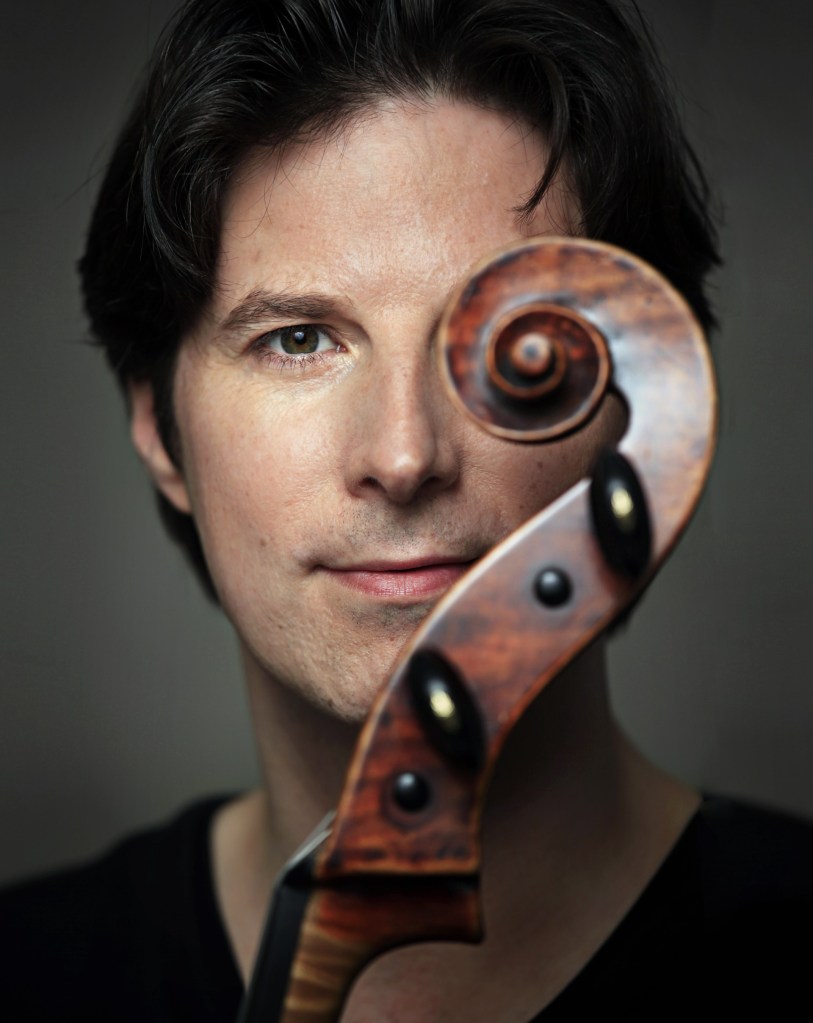
The major work on the programme was Schumann’s “Cello Concerto”, a work which has some funereal tones throughout and is often thought of as foreshadowing his death. Cellist Daniel Muller-Schott opened the work with some melancholic sounds which slowly evolved into playing which was more ethereal and meditative with sequence which were supported by the strings.
With much of his playing he took a serious and studious approach as he explored some of the darker elements of the work which then morphed into more uplifting passages.
The second movement saw Muller-Schott playing in a more cautious manner and there was sense of apprehension before returning to the earlier theme as both he and the orchestra engaged in dramatic interchanges.
Muller-Schott played with a range of approaches. At times he was lethargic while at other times dramatic and towards the conclusion he took a more tentative approach as through trying to rediscover the main theme before producing a dramatic conclusion.
Overall Muller-Schott gave an elegant and expressive performance which showed him to be totally in control but also that he had an awareness of the orchestra and the emotional qualities of the music.
The final work on the programme was one of Beethoven earliest major works, “The Creation of Prometheus”, written for a ballet at the imperial court of Austria choreographed by Calvatore Vigano. The work has a similar theme to that which Mary Shelley explored in her “Frankenstein – a Modern Prometheus” – the implication s of man attempting to create life.
The ballet tells of Promethea creating a man and woman from stone statues, but they have no souls. Apollo helps Prometheus teaching them music, dance and drama. Through the series of dances Beethoven’s provides music which explores the qualities which make humans more knowledgeable and spiritual.
Each of the sections featured one of the orchestral sections – delicate music with strings harp and woodwinds, a brilliant cello sequence played by Ashley Brown, flute playing for a court dance sequence and a country dance by strings and woodwind. Beethoven seemed to have allocated certain instruments to characters in the ballet – Apollo the harp, Melpomene the oboe, the Male Creature the oboe bassoon.
While the music serves the ballet well it can also be seen as something of a calling card for Beethoven who had only written two of his symphonies at the time. With this work he showed his mastery of composition, his knowledge of the orchestra’s instruments.
With the various sections Beethoven also provided himself with melodies which he used in some of his later work with one of the sequences being used for his Eroica symphony.
The “Follow button” at the bottom right will appear and clicking on that button will allow you to follow that blog and all future posts will arrive on your email.
Next year’s Auckland Arts Festival brings together an inspiring collection of works from New Zealand’s major performing arts organizations as well as an impressive lineup of Māori and Pacific individuals and international performers from Australia, China and America.
The festival opens with a free, all ages celebration in Aotea Square Sau Fiafia! Boogie Down!, brings together the infectious rhythms of nine-piece Pacific funk collective Island Vibes.
La Ronde
The intoxicating, lavish and seductive La Ronde will take over The Spiegeltent for 21 performances, with a mixture of circus, live music and comedy. From the creators of Blanc de Blanc and Limbo, La Ronde exclusively premieres in New Zealand after a sell-out season in Australia.
The Samoan musician Fonoti Pati Umaga will present an honest and unapologetic humourous story, Music Portrait of a Humble Disabled Samoan. Created with Oscar Kightley, Nathaniel Lees, Neil Ieremia and Sasha Gibb, this is a world premiere production of powerful and unfiltered reflection on resilience, identity and transformation.
Auckland Theatre Company and Tawata Productions, will premiere Waiora Te Ūkaipō The Homeland, a powerful story of family, culture and belonging. Written and directed by Hone Kouka, with waiata and haka composed by Hone Hurihanganui.
From acclaimed collective Binge Culture comes Werewolf, a thrilling, darkly funny horror-comedy exploring how we respond to crises. Theatre Scotland gave it a positive review “Werewolf does very well in setting the scene early and vividly. The audience truly feel a part of the experience and like we are trapped in a “safe house”. Impeccable performances from our three “wardens”, brilliant lighting and some incredible sound design create a perfect hour of interactive and immersive theatre.
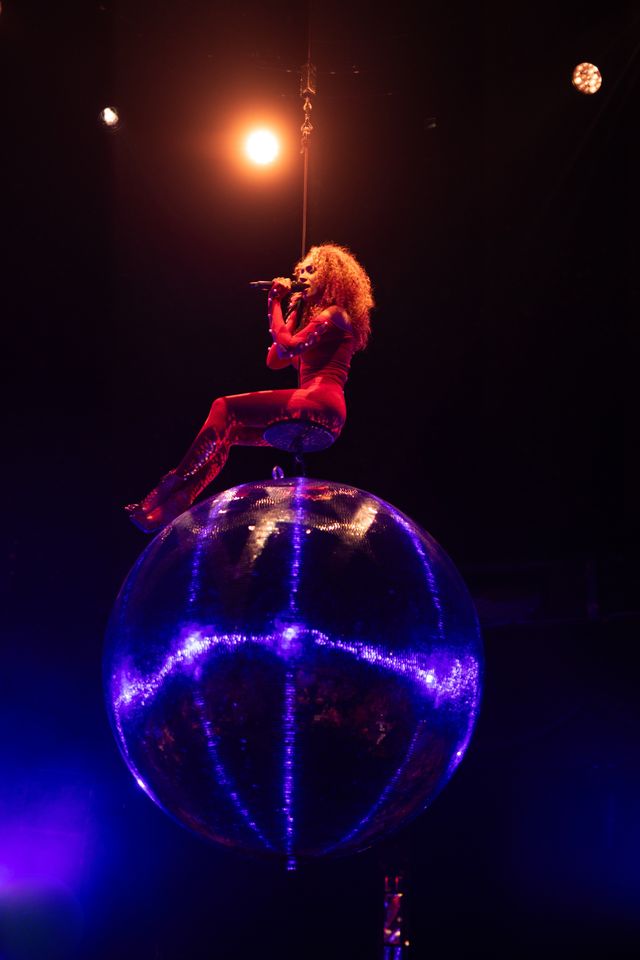
For one night only, internationally acclaimed American soprano Julia Bullock will be performing with the Auckland Philharmonia conducted by Christian Reif showcasing a repertoire blending classical masterworks, jazz and The Great American Songbook. A recent review noted “Bullock’s meditative mixtape ends in safe haven, with Odetta’s bluesy arrangement of “Going Home,” a song rooted in Dvorak’s “New World” Symphony. Bullock reaches into her burgundy lower register, and pianist Christian Reif depresses the soft pedal, to achieve maximum comfort.”
“These songs refract love in various colours and further illustrate why Bullock is one of today’s most discerning and expressive singers. Contemporary composers are particularly enamoured, including John Adam’s new opera Antony and Cleopatra.”
In celebration of International Women’s Day, Moana & The Tribe present ONO, a powerful live performance and video work honouring six Indigenous women worldwide – a stirring journey of hope and unity through te reo Māori, kapa haka and electronic-dub beats.
A flagship free event, Whānau Day brings together music, performance, kai and hands-on arts experiences in a vibrant celebration of community.
Duck Pond
Circa’s production of Duck Pond, reimagines Swan Lake as a spectacular circus, full of physicality and cheeky humour. In A Place in the Sultan’s Kitchen, theatre-maker and musician Joshua Hinton weaves song, memory and mouth-watering aromas as he recreates his grandmother’s curry live on stage. Fresh off mesmerising Australian audiences and completing a 23-show season in Edinburgh, is The Butterfly Who Flew into the Rave, this award-laden crowd favourite returns home for a triumphant encore.
The Butterfly Who Flew into the Rave,
The Australian company Gravity & Other Myths, will present Ten Thousand Hours, with eight acrobats and one musician paying homage to the discipline and the joy of movement. 27 Club delivers a blistering rock concert celebrating the legends lost too soon – Janis Joplin, Amy Winehouse, Jimi Hendrix, Kurt Cobain, Jim Morrison and Robert Johnson.
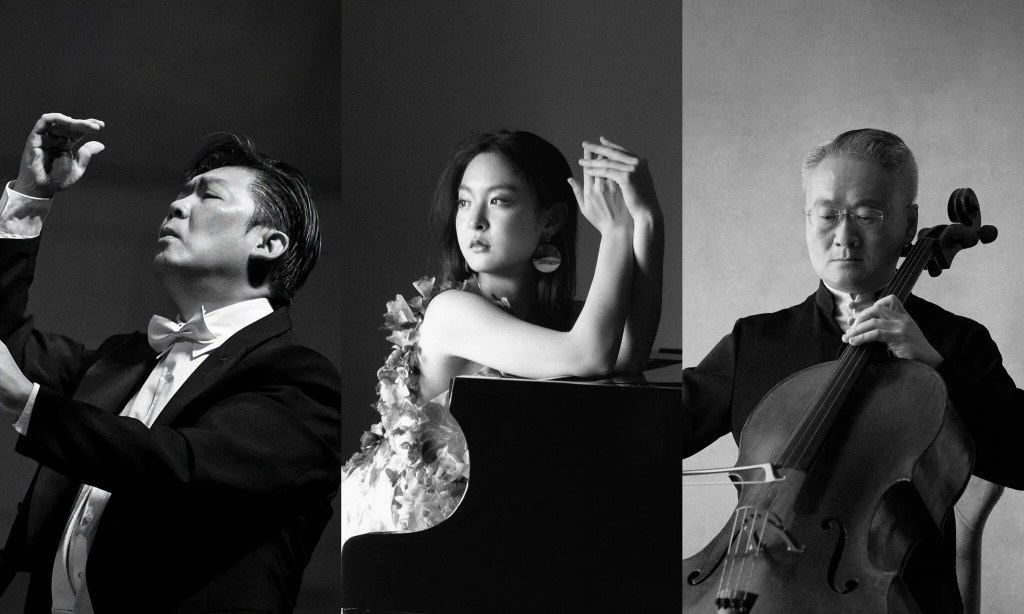
Long Yu, Serena Wand and Jian Wang
The Shanghai Symphony Orchestra, under the baton of its renowned Music Director, Long Yu, comes to New Zealand from China in an extraordinary cross-cultural celebration of Eastern and Western symphonic traditions featuring celebrated soloists Jian Wang (cello) and Serena Wang (piano). Across two evenings, the orchestra performs classical works by Tchaikovsky and Rachmaninov alongside selections from Elliot Leung’s Chinese Kitchen: A Feast of Flavours.
Jane Harrison’s multi-award-winning play The Visitors reimagines the arrival of the First Fleet through the eyes of seven First Nations Elders. Directed by Wesley Enoch, this Sydney Theatre Company and Moogahlin Performing Arts production is a sharply written, deeply resonant piece of speculative historical theatre that challenges and educates.
Built from the world’s apologies – famous, absurd and deeply personal – Sincere Apologies is a funny, awkward and unexpectedly moving participatory performance exploring how we say sorry and what we really mean.
Ihi. Wehi. Mana. reunites past and present members of Te Waka Huia with esteemed choral musician Karen Grylls and a bespoke invitational choir, for a stirring, celebratory event combining kapa haka, waiata and vocal talent.
Additionally featured in the festival is a double bill of bold new writing, He Kākano showcases Becoming Jeff Bezos by Kai Tahu playwright Alex Medlan, a razor-sharp satire on capitalism and chaos, and Marmite & Honey by Rainton Oneroa (Te Aupōuri), a moving family drama unfolding over 24 hours at a tangi. Both works will be developed with Jason Te Kare.
Ten Thousand Hours,
The acclaimed Australian company Gravity & Other Myths, will perform Ten Thousand Hours, with eight acrobats and one musician pay homage to the discipline of mastery and the joy of movement. 27 Club delivers a blistering rock concert celebrating the legends lost too soon – Janis Joplin, Amy Winehouse, Jimi Hendrix, Kurt Cobain, Jim Morrison and Robert Johnson.
Closing the Festival with pure brass swagger, Big Horns is a high-octane, homegrown funk collective redefining the modern big band, led by guitarist Dixon Nacey. Featuring Jordyn with a Why, MOHI and Muroki, He Manu Tīoriori gathers the next generation of soulful voices for an uplifting evening of waiata in the Spiegeltent. Inspired by Dame Hinewehi Mohi’s Waiata Anthems project, this showcase of original te reo Māori compositions celebrates the beauty, depth and contemporary vitality of Aotearoa’s music.
2026’s programme also includes Bluebeard’s Castle which sees New Zealand Opera and Auckland Philharmonia reimagine Bartók’s haunting masterpiece as an intimate portrait of a couple confronting dementia. Royal New Zealand Ballet’s Macbeth, choreographed by Alice Topp, transforms Shakespeare’s tragedy into a gripping modern study of ambition and power.
Set in the heart of the Festival Garden, Rova Sound Stage offers a relaxed, social space to discover fresh talent and genre-crossing performances from neo-soul and alt-pop to hip hop, jazz and electronic music. Audiences can grab a beanbag and a drink, soak up the summer sun, and dance into the night with the resident Festival DJ.
The three works on the Auckland Philharmonia’s “Fantastique” programme to a lesser or greater extent reflected on the religious teachings and practices of the Christian churches many of which confused, condemned and persecuted people. These in turn resulted in isolation, banishment and often death.
Opening the programme was New Zealand composer Louise Webster’s “Proof against Burning” which was inspired by the historical witch trials and the tests used to judge the accused.
The four sections – Cauldron and Stone, Floating on Water, Spectral Evidence and Ordeal of the Cross all related to methods of judging, condemning and execution of those charged with the practice of witchcraft. These would be boiling, drowning, crucifixion and evidence of magical or supernatural appearance.
The opening movement had a sense of oppression provided by the portentous sounds of wailing strings, sharp percussion and screaming brass where the second having a more contemplative sounds from the strings and wind instruments which suggest the notion of dunking of witches into water, the placid image of flowing water ends with some apprehensive sounds which suddenly stopped, as though death had come quickly.
In the third movement, the concept of the spiritual or spectral is suggested by the various instruments shifting tones and sounds, transforming the aural landscape. The Ordeal of the Cross section was introduced by blaring horns along with drumbeat accompanying the condemned in their final walk. Strings produced heart rending sounds of torment along with hints of birdsong including the sounds of a crow, the messengers of death.
Liszt’s piano work “Totentanz” was inspired by both “The Comedy of Death” a series of woodcut by Hans Holbein and “The Triumph of Death” a monumental fresco by Andrea Orcagna in the Camposanto in Pisa both of which depict religious myths concerning the fate of the damned and the saved at the end of the world.
Sylvia Jiang Image Sav Schulman
The work was played by Sylvia Jiang a Chinese born New Zealander who has previously played with the Auckland l Philharmonia. Last year she performed Prokofiev’s “Piano Concerto” and previously Liszt’s “Second Piano Concerto”
Liszt himself was fascinated by ideas of death and he incorporated variation on the Dies Irae throughout the work. The work transitioned from Webster’s work with more sounds of oppression. The heavy brass and piano opened with a dance of death which introduced us immediately to the sounds of a nightmare.
With Jiang hovering over the piano, she attacked the keyboard with a series of arpeggios and runs based of the Dies Irae while the orchestra contributed savage bursts of sound.
At times it seemed as though Jiang’s feverish playing was creating a vortex of sound replicating the idea of bodies spiraling in their descent into Hell. Conductor Pierre Bleuse was equally feverish in some of his conducting, leading the orchestra with dramatic gestures. Generally, Bleuse was curt and crisp in his conducting, attentive to all the players in the orchestra, managing to bring out the subtleties of the music from them.
While much of the time Jiang’s playing was vivid and intense, she was also able to produce more delicate and nuanced sounds showing a pianist with a true understanding of the music and the composer’s intention.
Her assaults on the piano became more intense at the finale of the work where she joined with the violent percussion display.
For her encore she played a minimalist work by the Chinese composer Gao Ping.
The major work on the programme was Hector Berlioz’s “Symphonie Fantastique”, which through its five movements tells the story of an artist’s self-destructive passion for a beautiful woman. The work describes his obsession and dreams, moments of anguish and tenderness along with visions of suicide and murder, ecstasy, and despair.
Berlioz was obsessed with the Irish actress Harriet Smithson, and the symphony was his mating call to the actress. The music attempts to render the story of his own life intertwined with that of The Artist, musically and emotionally.
The piece begins with an impressive percussion sequence and the sounds of a reverie as though embarking on a spiritual journey. The orchestra’s free flowing melodies were a mixture of the dramatic and Romantic creating both dreams and nightmares.
There was also a description of The Artist and the object of his love with an elusive theme which recurs through the work. Then we encounter him at a ball, trying to gain the attention of his love and then in a pastoral setting possibly seeing his beloved with another suitor. This ballroom scene with its opening waltz also seemed to affect the sprightly conductor as he swayed to the music. However, even in this ballroom sequence there was tense undertone of tension beneath the jollity
The serenity of the countryside was introduced by the woodwinds and strings with ecstatic sounds of dawn before darker sounds of the strings herald a stormy period before we return to sunnier moments with the sounds of birds returning to rest and sleep.
A fourth movement is a narcotic dream sequence where he sees himself led to the scaffold in the belief that his love has been rejected.
The final movement is another dreamscape, this time a vision of hell where The Artist is carried into the underworld watched over by the object of his craving.
Under the direction of an agile Pierre Bleuse the orchestra provided an energetic performance of the work ensuring the drama and intensity was expertly delivered. There were the thrilling violins and flutes which conjured up the image of The Artist’s beloved through the two harps leading the delicate ballroom scene to the military band escorting the prisoner to the scaffold and onto the final ominous bassoons and tubas roaring out the funeral chant of the Dies Irae.
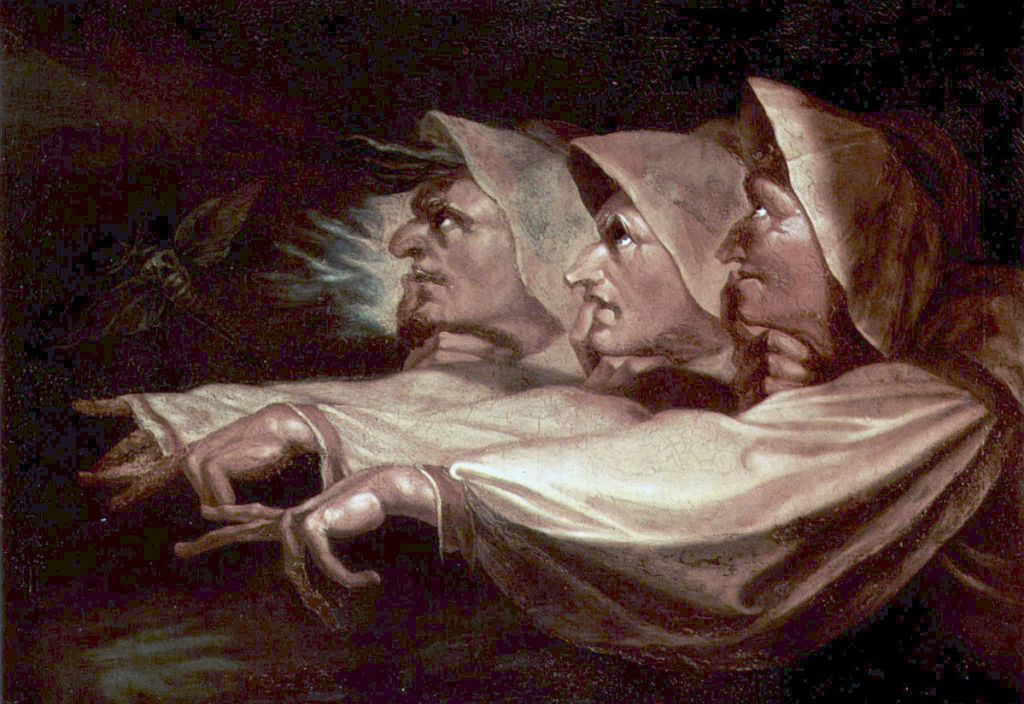
The final Dream of the Witches Sabbath has much in common with the Swiss Romantic painter Henry Fuseli with their shared interest in demonological fantasies, Gothic atmosphere of and a fascination with the supernatural.
Frightening outbursts alternated with moments of the greatest tenderness. Massive onslaughts by the percussion and timpani contrasted with the delicacy and melancholia of the ballroom and pastoral scenes








 New Zealand Arts Review