Auckland Art Gallery Toi o Tāmaki will present the first solo exhibition in Aotearoa New Zealand of Louise Bourgeois (1911–2010), one of the most intriguing and influential artists of the last century.
Opening 27 September, Louise Bourgeois: In Private View brings together a selection of works from an international private collection, exhibited publicly for the first time. The exhibition spans over six decades of Bourgeois’s career, from early paintings made in 1945 to a fabric work from the final year of her life
Auckland Art Gallery Senior Curator, Global Contemporary Art, Natasha Conland, says, “Bourgeois remains a defining figure in late twentieth-century art with the ripples of her influence still being felt today. She is known for her highly personal and idiosyncratic sculptural practice which has lent her a special place in the history of art.” “The works in the exhibition are from a private collection lived with over many years, reflecting a deep and personal appreciation of her practice.”
Widely celebrated for her psychologically charged and bold sculptural practice, Bourgeois explored themes of memory, family, the body and the subconscious, often drawing from personal experiences.
She is best known for her series of large spider sculptures, which have been installed in many major international cities.
Highlights include paintings and her first series of sculptures, the Personages, from the 1940s and early ‘50s; Lair sculptures from the early 1960s; and significant later works, such as textile-based sculptures and sculptural enclosures.
Louise Bourgeois. Spider VI
Spider VI (2002) is a wall-mounted example of her internationally acclaimed series of spider sculptures, which she began in the mid-1990s. Also featured is her extraordinary hanging sculpture, The Couple, and late outdoor piece, Eyes.
A series of curator tours and talks, open lates, as well as family-friendly activities has been programmed with the exhibition. The Gallery Shop has also launched a new range of Bourgeois inspired products which includes socks, brooches, books and more.
The paintings in Aroha Gossage’s new exhibition “Into the Light” are grounded in her connection to the whenua of Pakiri, north of Auckland where she lives.
They continue Gossage’s exploration of land, light, and ancestry, the paintings serving as links between observation of her environment and reflections on her connections to the land and to her ancestors.
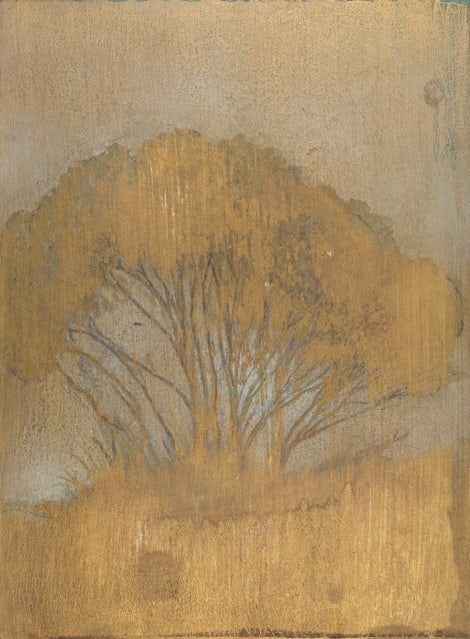
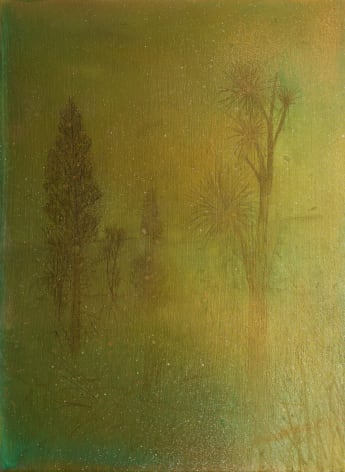
Several of the works are titled after their subject matter, simple renderings of native trees – Nikau, Macrocarpa and Manuka. These works follow in the tradition of botanical artists such as Sir Joseph Banks who identified Manuka in 1769 during his time with Captain Cook on his first voyage aboard the Endeavour and many artists have depicted trees and their flowers since then notably Emily Cumming Harris and Shane Cotton.
Aroha Gossage, Manuka
Gossage’s “Manuka” ($2700) is painted in golden tones giving it an enigmatic quality where earth and foliage are connected, creating an image which transcends the physical. ”Manuka” is part of group of four small works which have distinctive colouring, due to the earth pigments the artist has collected from sites around her local environment.
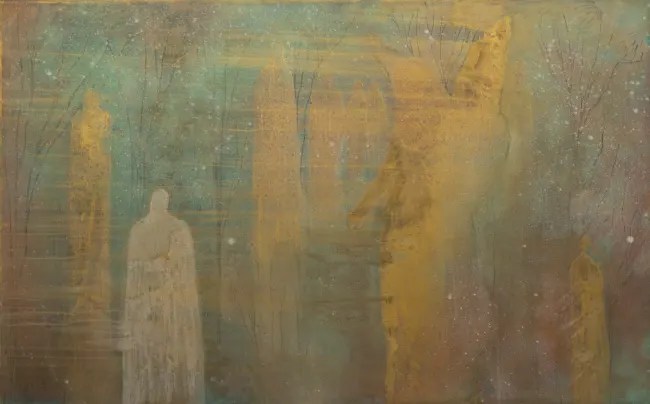
While most of her works are of botanical subjects there are a few which include figures, or at least the spirits or manifestations of figures. Rather than earthly figures they suggest ancestral presence. As the title of the show suggest these figures are journeying towards the light of a new place or a new understanding.
In the large ”Anahera” ($9800) a caped / shrouded figure inhabits an abstract environment with traces of foligare snaking through the work. There is a sense of another world in which ancestors dwell, the paintings connecting the physicality of this world with the spirituality of the other-world .
Aroha Gossage, Light
This can also be seen in “Light” ($2700) with one indistinct form and “Tupuna” ($9800) with several shapes inhabiting a forest of trees. With the works that include figures it is noticeable that while the trees are painted with distinctive realism the figures are indistinct and ethereal.
Some of her works such as “Witi” ($4750) have a quiet drama to them like Rita Angus’ “Tree”. ”Witi” is also impressive because of its deep red earth pigment which seems to it refer to bush fires, destruction and renewal.
Works such as “Hine” ($2700) and “Macrocarpa” with their dark tones seem to be ghost-like images of the trees rather than mere depictions, as though inhabiting another dimension.
The suggestion of another world is created in many of these painting by veils of overlapping colour where the air around the foliage and figures in infused with earthy tones.
There are a couple of works which are pure landscape “Pakiri Dunes” ($9800) and “Kaitaki” ($9800).These do not have the same density or richness as the others works being descriptive with fewer allusions to another dimension.
The Art of Banksy, is a major exhibition of the artist’s work which has now been seen by 1.5 million visitors in 18 cities around the world.
The collection of 150 original and authenticated works features more than 150 pieces, including prints, canvases, unique works, and ephemera.
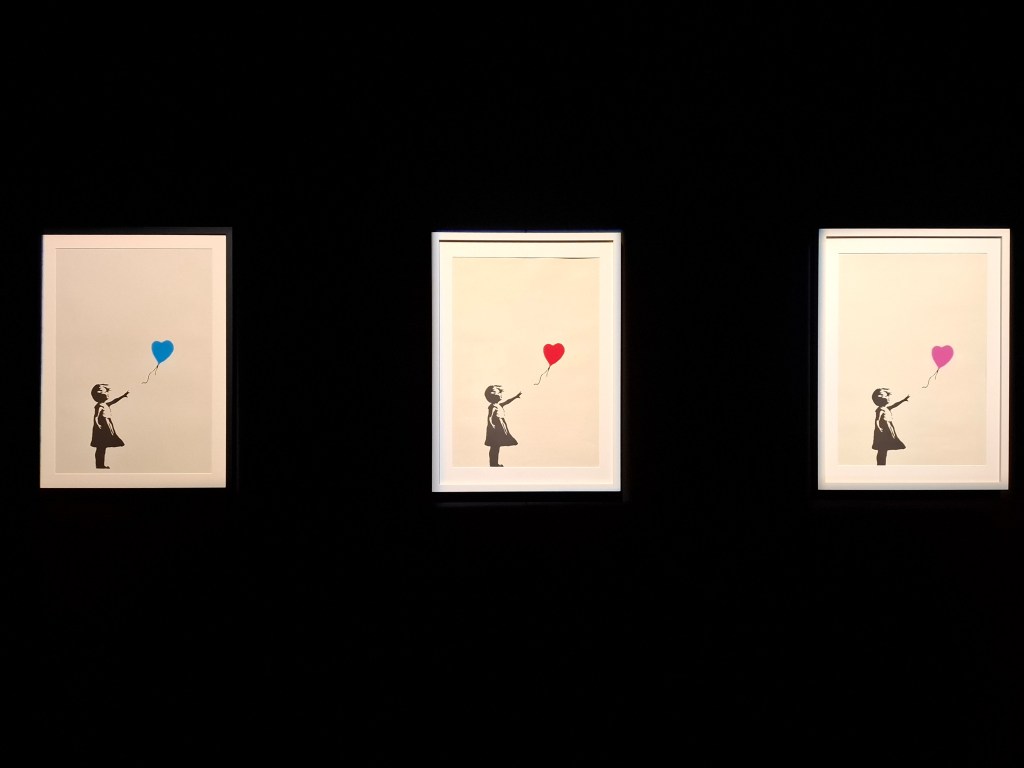
There are several versions of his well-known pieces such as the “Girl with a balloon” and “Flower Thrower,” also known as “Love is in the Air,”
As with many of his works Banky borrows from other sources, changing the original intention, subverting the original meaning as well as trawling the world for the symbols and highlights in other artworks.
So, there are references, adaptations and reworkings of Christian iconography, news photographs, Disney images along with the work of Andy Warhol, Keith Harring and even Degas.
Banksy, Ballerina with Action Man parts
It is the clever borrowing of images which appeals to adult audiences as well as well as children and his images which undermine capitalism will bring a smile to both to the conservative as well as the revolutionary.
The exhibition spans his output from the 1990’s to the present-day showing examples of his satirical and subversive output often appearing in public places around the world.
His iconic artwork depicting a masked figure or rioter, about to throw a bunch of flowers is taken for a newspaper image of a rioter throwing a projectile. This substitution is an obvious message advocating for love and peace over conflict and war.
Banksy, Trolley Hunters
There are other works like “Trolley Hunters” that satirize consumerism by depicting cavemen hunting shopping trolleys instead of wild animals. As well as being a clever juxtaposition of elements it is also a commentary on how modern society has become overly reliant on mass-produced goods and detached from nature.
Banksy, Souvenirs
Some of his work has more immediacy such as the several works related to his Walledoff Hotel in Bethlehem including some hand painted souvenirs. There are also images of his “Dismaland”, his take on Disney World ,creating a dystopian “bemusement park” located at the Tropicana in Weston-Super-Mare in 2015.
The exhibition also helps expand our understanding of the artist with numerous quotes by the artist about his history and approach to his work along with commentary by some of his collaboratives.
While here are many of his famous work there are also some of his original pencil sketches for the finished works
The works in the exhibition show that Banksy can be viewed from various perspectives – a cartoonist, a comic, a satirist, an agent provocateur or an advertising guru,
The current exhibition “Mark Adams: A Survey | He Kohinga Whakaahua” is the artists first comprehensive exhibition of his work and features more than 65 works spanning his 50-years as a photographer. documenting the land, the people and its history. These photographs are of places across the Pacific, the United Kingdom and Europe.
Much of his practice documenting sites of significance across the country, include places where Captain James Cook and his crew came ashore on their visits in 1769 and the 1770s, as well as locations where Te Tiriti o Waitangi was signed in 1840.
Over the decades, Adams has sustained a deep and ongoing engagement with subjects of interest. He has photographed whakairo Māori (Māori carving) both here and overseas and the work of, Samoan master tattoo artists, Māori–Pākehā interactions in Rotorua, carved meeting houses, locations of significance for Ngāi Tahu in Te Waipounamu and the place of museums and photography in the area of cross-cultural exchange.
It includes photographs taken across the Pacific, the United Kingdom and Europe that explore the migration of artistic and cultural practices across the globe, and examine the role of museums, and photography itself, in the ongoing area of cross-cultural exchange.
The various sections of the book show Adams’ range of work from his early works, his focus on Rotorua, tatau, Treaty Signing Sites, Museums, Cooks Sites Māori meeting house in overseas locations, Te Waipounamu and his more recent interest in Photograms.
Several of his multi-image work are fascinating in their scope and production but the book does not do them credit, even when spread across several pages. With these works the exhibition at the Auckland Art Gallery make an impression in some cases filling an entire wall of the gallery. “0 degrees” is such a work, a panoramic 360-degree set of images taken at Greenwich Park which includes the Royal Observatory, the home of Greenwich Mean Time and Prime Meridian.
Other works on a grand scale include his “Nine Fathoms Passage”, the photographers view replicating William Hodges view of Dusky Sound, and his panorama of the meeting house, Hinemihi in the grounds of Clandon Park in Surrey, England as well as the magnificent meeting house Rauru in the Museum am Rothenbaum in Hamburg.
Mark Adams, 13.11.2000. Hinemihi. Clandon Park. Surrey. England. Ngā tohunga whakairo: Wero Tāroi, Tene Waitere, 2000, colour inkjet prints, Auckland Art Gallery Toi o Tāmaki, gift of the Patrons of the Auckland Art Gallery, 2014.
Author of the book Sarah Farrar says “You could say that, in many respects, Mark has been ahead of his time as a Pākehā and Palagi artist. But what does that really mean — to be ‘early’ or ‘ahead of one’s time’? It’s all relative and I’m sure many people would view a respectful approach to tangata whenua and tangata o le moana as seriously overdue.”
Adams’ photographs are of exceptional quality and intriguing in their distinctive approach to subject matter. The viewer is challenged to interpret , question and reflect on them. One commentator, Damian Skinner has noted that Adams photographs “offer no resolution, only problems. They patiently track the material traces of various forces that coalesce in specific sites”.
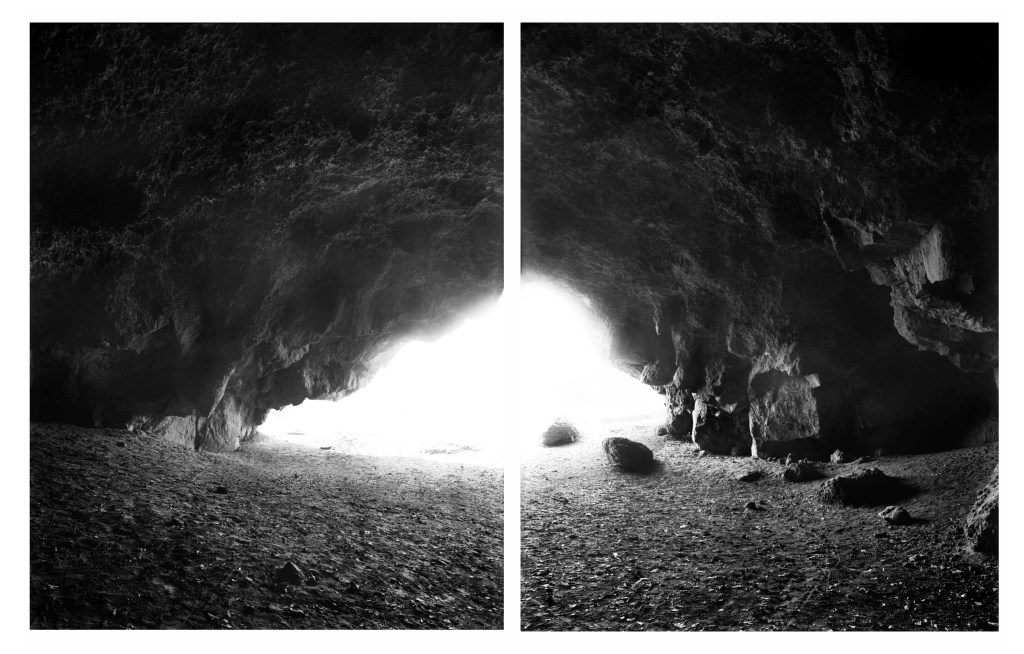
Mark Adams, 19.05.1989. Te Ana o Hineraki. Moa Bone Point Cave. Redcliffs. Ōtautahi Christchurch. Te Waipounamu South Island, 1989, gold-toned silver bromide fibre-based prints, Auckland Art Gallery Toi o Tāmaki, gift of the Patrons of the Auckland Art Gallery, 2014.
Generally, with photographs of important sites the photographer is essentially saying – “I was here – this is how it looks”. However, with many of Mark Adams photographs of historical sites, the land seems of little interest, often devoid of figures. With these the photographer seems to be saying “this is how it looked”. The photographs require the viewer to transport themselves back to that place but in another time.
Sarrah Farrar notes “His photographs of museums and art galleries remind me of the artifice and stagecraft that we are actively involved in as curators and museum professionals. Every decision we make communicates something to audiences. We construct meaning through the selection of objects (even those that are absent), their placement and their interpretation. Mark’s photographs remind me of the power dynamics and knowledge systems that are inscribed in museum, library and art gallery experiences — even embedded into the design of the buildings themselves. A great example of this is Mark’s panorama of the science-fiction-like modernist design of Berlin’s Staatsbibliothek, which feels so at odds with the fact that it’s the home of the journals of Georg Forster, the naturalist who travelled with James Cook on his second voyage.”
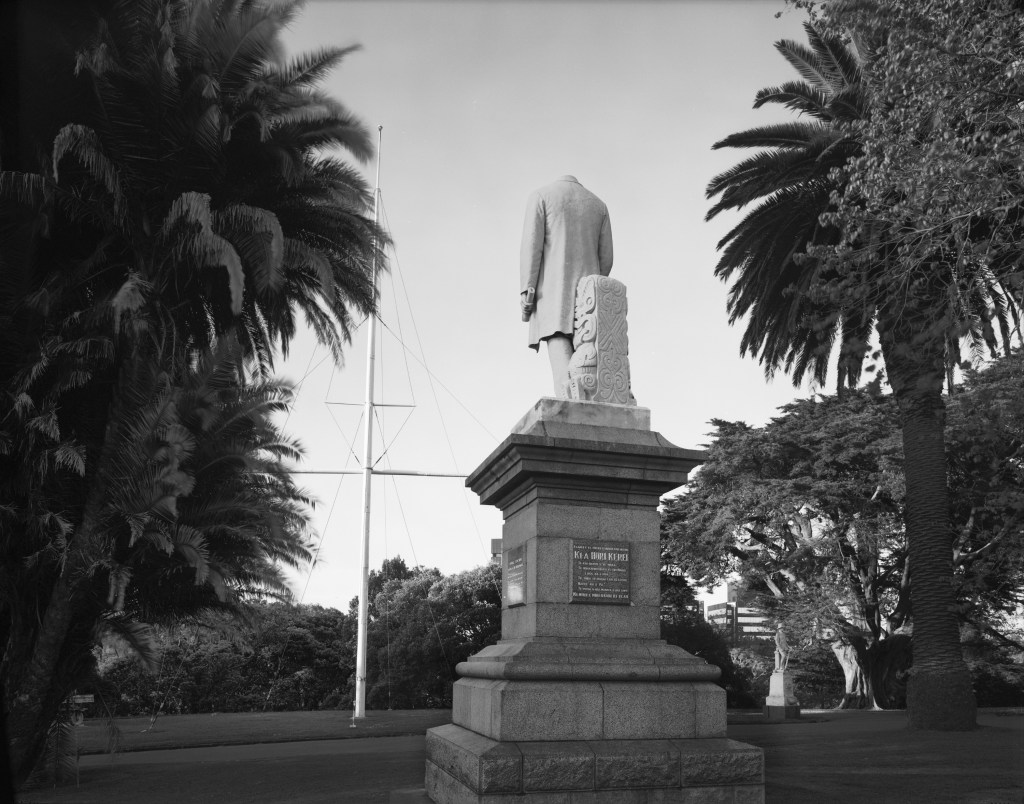
Mark Adams, 1988. Hori Korei. George Grey monument. Albert Park. Tāmaki Makaurau Auckland, 1988, silver bromide print, courtesy of the artist.
The book is a stylish, superbly-designed production with over 200 images, mainly black and white. It features an excellent text by Sarah Farrar as well as a forward by Ngahuia te Awekotuku and afterword by Nichlos Thomas
Martin Creed, Work No 3769, Work No 3764, Work No 2053
Three exhibitions K Rd – Palmer, Creed, Parekōwhai.
Stanley Palmer, New Work
Melanie Roger Gallery
Until February 22
Martin Creed, Like Favourite Socks in a Drawer
Michael Lett
Until March 1
Michael Parekōwhai, The Indefinite Article
Artspace Aotearoa
Until April 17
Reviewed by John Daly-Peoples
Current exhibitions along Karangahape Rd offers a range of art works from the realist depictions of the landscape to abstract paintings and conceptual construction.
With his latest exhibition at Melanie Roger Gallery Stanley Palmer continues his depictions of the New Zealand landscape. Like many of his previous exhibition he has painted views of the New Zealand coastline featuring dramatic vistas of headlands and offshore islands.
With this new series of works he has revisited many of his previous subjects including depictions of Karamea, Great Barrier Island, Chathams, Great Mercury Island and Matauiri. While these are mainly landscape there are a few which also feature other element in the landscape which add a visual drama as in “Akiaki – Chathams” ($30,000) where he has included windswept trees and grazing sheep.
Stanley Palmer, “Akiaki – Chathams”
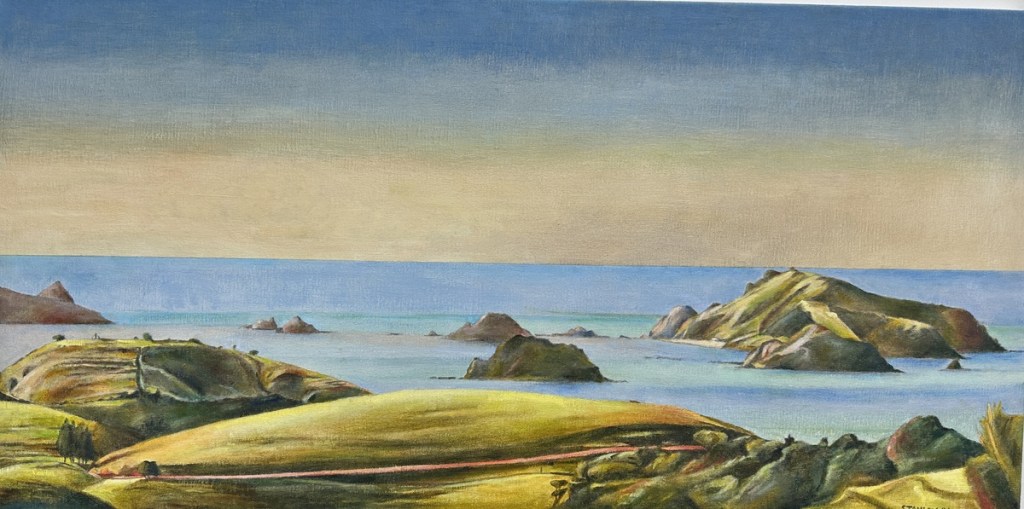
These paintings seem to be less detailed than some of his previous work and there is a simplicity which gives these works an added drama. Part of this drama comes from the artists shrewd use of paint, so that in “Awana- Aotea Great Barrier” ($22,000) the eroded cliffs are highlighted by the gash of earthy colours and in “Mataurui” ($28,000) the red line of a track is like an abstract slash through the landscape.
Stanley Palmer “Mataurui”
In most of the works the background of sea meeting sky shows a clever juxtaposition of shimmering abstract blues with subtle variations between each of the paintings
Also included in the exhibition are some of the artist’s earlier bamboo prints of the early 1970’s including “Hillside Town Kohukohu” ($2250).
Stanley Palmer “Hillside Town Kohukohu”
Martin Creed’s minimalist works have always played with the definition of art and art making starting with his Turner winning installation “Work No. 227: The lights going on and off: an empty room” in which the gallery lights switched on and off at 5-second intervals.
His work is a mixture of the witty, poetic and philosophical, making use of a range of everyday materials and approaches which challenge traditional views of art.
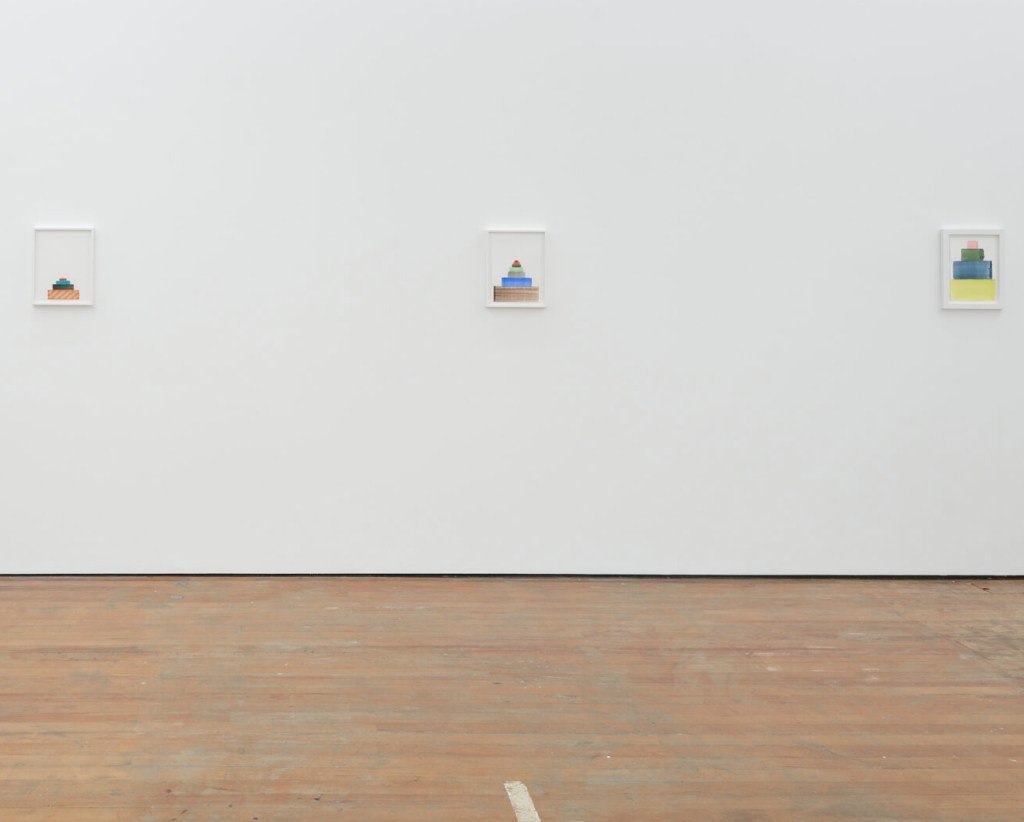
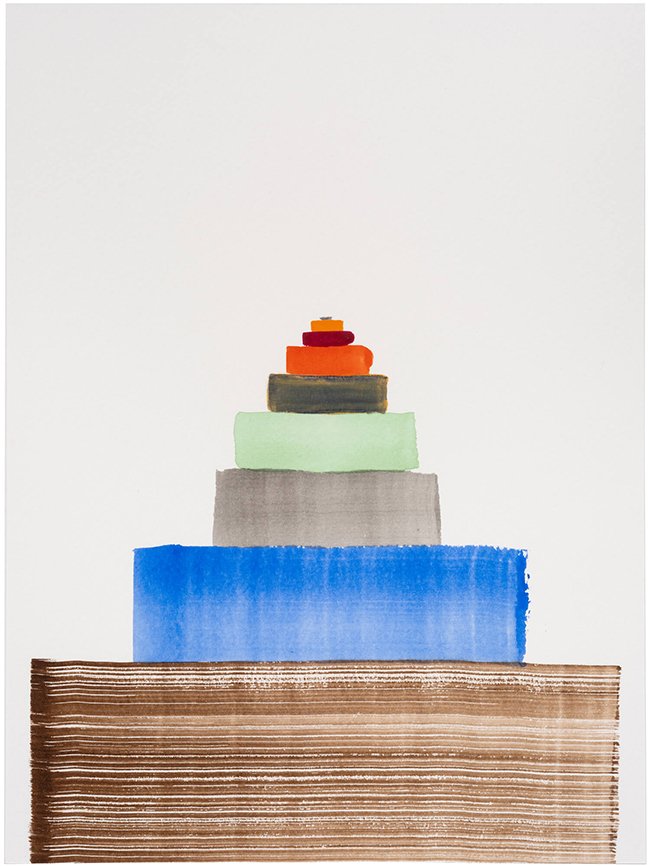
His current show “Like Favourite Socks in a Drawer” brings together elements of chance, time and structure with a series of ziggurat shaped works. The works started with his decision to buy an ordinary multi pack of commercial paint brushes.
Martin Creed, Work No 3764
With these he applied paint in different colours with the varying brush sizes, stacking the colours one above the other to create stepped, random bands of colour.
The paintings/designs can be seen as referencing the ziggurat forms of ancient Mesopotamia and Mexico as well as more recent brutalist constructions and has connections with Rewi Thompson’s block-like house in Kohimarama. There are also hints of Frank Stella, Donald Judd and Cuisenaire rods.
Creed says of the works “A step pyramid is solid and easy to understand. It is a safe structure that is not going to fall down. It is trustworthy. You can see how it is built. The steps are hopefully leading to the top, and you can enjoy the colours on the way up. In a blobby, soupy, ill-defined world it can be helpful to put your ducks in a row.”
The works have a sense of the structure to them with their build-up of coloured shapes and in works such as “Work No 3764” (USD $22,000 plus GST) there is sense of the artist gestural involvement where the striations of the brown / sepia are visible as a single calligraphic stroke. With others there is the notion of time with the various strokes of colour measuring out the time taken to complete each work
Martin Creed, Work No 3766
Some of the work display additions to the quick gesture with Creed scumbling the yellow band in “Work No 3766” (USD $22,000 plus GST). This work like some other has a humorous element with the painting looking like a celebratory, multi-layered birthday cake.
The works all convey Creed’s minimalism of means, notions of time along with the structuring and ordering of objects shapes and colours.
Michael Parekōwhai, The Indefinite Article
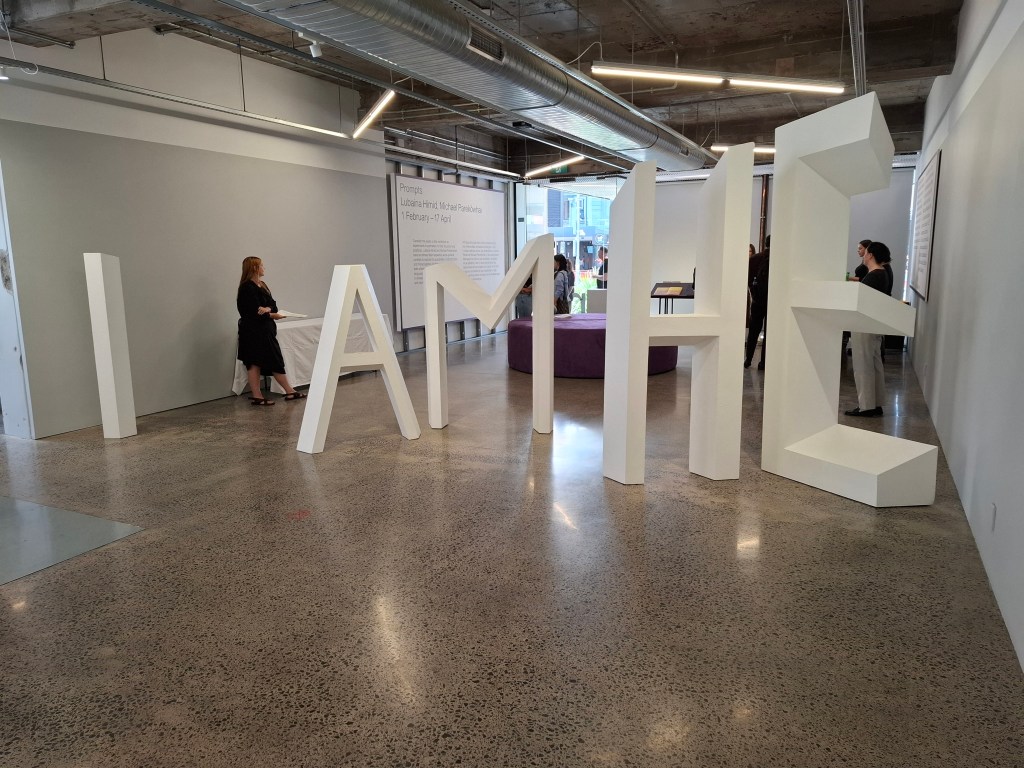
Artspace is exhibiting Michael Parekōwhai’s sculptural object, “The Indefinite Article (1990) which had previously been shown at Artspace in 1990 in the show “Choice” curated by George Hubbard
The large letters based on McCahon’s cubist stylised letters constructed of MDF spell out the words “I AM HE”. Which references some of the McCahon paintings featuring the words “I Am”.
While borrowing from McCahon the work can also be seen as creating a bilingual pun linking the words to te reo where “HE” can be read as the indefinite article where the word can be defined as -a, an, some – or it can also mean something is wrong, mistaken or incorrect.
Other linguistic variations can be identified with the words. During the ”Cultural Safety” exhibition in Frankfort in 1995 where the work was shown this reviewer noted at the time – “His large word sculpture using the words of the Colin McCahon painting I AM HE was quickly identified by one perceptive German journalist as coming from the pen of John Lennon in “I Am the Walrus” [I am he as you are he, as you are me and we are all together] rather than the Bible or McCahon.
The “Follow button” at the bottom right will appear and clicking on that button will allow you to follow that blog and all future posts will arrive on your email.
Whanganui’s Serjeant Gallery has just reopened after having been closed for ten years with an opening season entitled “Nō Konei | From Here” (Until 11 May 2025). The exhibition features over 200 artworks, spanning four centuries of European and New Zealand art history. Filling the gallery’s newly expanded exhibition spaces, works range from traditional gilt-framed paintings to contemporary practice in a variety of media.
Coinciding with the opening is the publication of “Te Whare o Rehua Sarjeant Gallery” which tells the gallery’s 100-year history.
Written by Martin Edmond the book charts the Sarjeant Gallery’s early years and its development as a collecting and exhibiting institution that is now recognised as one of the major New Zealand’s art galleries.
The gallery which is one of the most elegant and imposing buildings in the country is located at a central point in the city and has been of significance to the development of the city.
Henry Sarjeant whom the gallery is named after had lived in the area since the 1860’s and had a lifelong interest in the arts, visiting the major galleries of Europe during a number of trips abroad. When he died in 1912, aged 82, he left property valued at £30,000 in trust to the Wanganui Borough Council for the purpose of building and maintaining an art gallery. The design of the gallery was won by Dunedin architect Edmund Anscombe and the building was constructed in the shape of a Greek Cross and faced with Oamaru stone.
The Governor General, the earl of Liverpool, laid the foundation stone on 20 September 1917, and on 6 September 1919 the Prime Minister, W. F. Massey, officially opened the gallery.
Frank Denton, The Sarjeant Gallery, 1926. Collection of Te Whare o Rehua Sarjeant Gallery.
While the gallery was the dream of Henry Serjeant Martin Edmond notes that it was Sergeant’s wife, Ellen who was the driving force after his death.
“Ellen Sarjeant was a remarkable woman and without her we probably wouldn’t have the gallery we do today. She was almost 40 years younger than her first husband, Henry Sarjeant, the benefactor of the gallery; the eldest daughter of one of his close friends. It would be interesting to have some insight into the dynamics of their marriage but they were very discreet. It’s possible that he had the money and she had everything else: the drive and enthusiasm, the artistic insight, the business sense and the administrative skills. He would have seen this and I suspect their partnership was intended to transform the city the way the Sarjeant has. Ellen was among those who oversaw the building of the gallery; she was, with her second husband, John Neame, the initiator of its first acquisitions, both in New Zealand and overseas.”
The importance of Bill Millbank (Director 1978 – 2006) in developing the galleries status in his time at the gallery was a period when the institution became an important institution in developing a major programme as well as curating exhibition of national importance.
Edmond notes that the while Millbank initially had no real interest in the arts this changed with his travels overseas.
“crisscrossing Europe in a Kombi van, visiting galleries and churches, looking at art ‘all the time’. There was a revelation in Toledo, in front of an El Greco, when Milbank understood a hitherto obscure (to him) connection between these works and a painting he had admired on his weekly visits to the Sarjeant. He wondered, naively, if the Sarjeant painting was in fact by El Greco. It turned out to be the aforementioned Gethsemane by New Zealand artist Lois White.
Among the significant exhibitions that Millbank was responsible for was the first exhibition of “The Given as an Art-Political Statement” by Billy Apple in 1979. The exhibition included a controversial intervention by Apple, where he removed the sculpture “The Wrestlers” (Raffaello Romanelli) from its prominent position and replaced it with photographs of the sculpture on the surrounding walls.
He also initiated Te Ao Marama: Seven Māori Artists which showcased contemporary Māori art and travelled to Sydney.
Millbank was also responsible for the development of the Tylee Cottage residency which has seen over sixty artists make use of the programme including Laurence Aberhart, Mervyn Williams, Bronwynne Cornish, Adrian Jackman, Anne Noble and Jade Townsend
Edmond also writes of the pivotal role of Gordon Brown who was the first full time director between 1974 and 1977).
The book has the subtitle of “A Whanganui biography” and Edmond rounds out both history of the gallery and its place in the city’s history as well as the directors of the institution. He includes many incidental aspects of the city’s history both of artistic as well as general interest.
He includes the D’Arcy Cresswell drama where the poet was shot and injured by the Mayor Charles Mackay who had made homosexual advances towards him in the mayoral office. The incident brought Mackay’s 11-year career as mayor of Whanganui and as a major supporter of the gallery to a shocking end.
While the galleries new extension has been many years in planning and execution it was hampered early on by the mayor Michale Laws. He had Goebbels-like approach to culture, seeing the “arts community consisting mainly as bludgers and elitists”. His attempts to stop the building was a low point in the city’ s artistic history.
Threaded through the gallery’s history are accounts of the developing collection including donations, European buying sprees and local acquisitions. Over its 100 year the gallery has acquired a number of important works as well as establishing a fine collection of local artists including Edith Collier.
It is a compelling read full of lively, far sighted and dubious characters along with interesting accounts of the development of a public institution.
The book is generously illustrated with many works from the Sarjeant’s rich, varied and important collection. It also provides a full list of all the staff since the gallery’ inception as well as all the artists who have been Tylee Cottage residents.
Shane Cotton has progressively mined the history and myth of Māori along with its intersection with European colonisation, featuring images which recall stories, along with references to historical and mythical figures and locations.
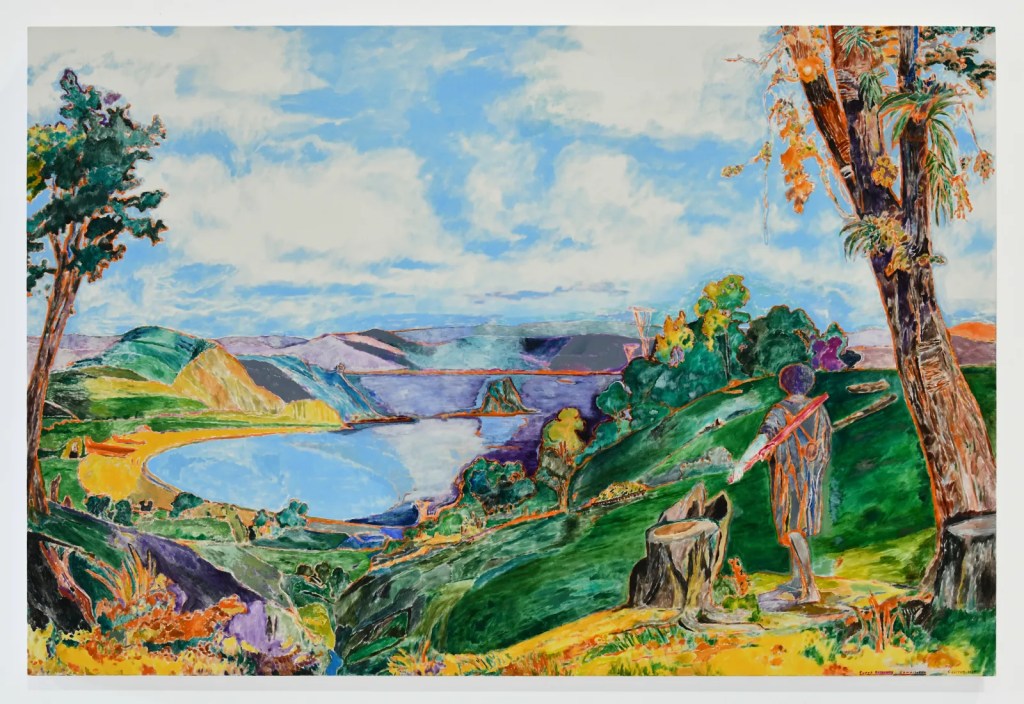
With his latest exhibition of “New Paintings” the artist could be seen as entering his Fauvist period with many of the paintings having the features of the Fauves. Those painters of the early part of the twentieth century employed simplified shapes along with intense and juxtaposed colours.
The “He Waka Karaka” ($9000) featuring a small Pacific craft with a sail exemplifies this aspect with intense blues, purples and green while the large, colourful “Super Radiance” ($90,000) is an example of one of the new directions of Cottons painting – more traditional landscape painting. Even though his previous works have featured landscape forms these were generally refined and abstracted.
There are several works of Cotton’s Toi Moko works where the tattooed and preserved ‘shrunken’ Māori heads reference conflict, trade, and repatriations. In works such as “The Great Attractors” ($55,000) the tattoo lines tracing out genealogy are linked to the notion of neural connections, knowledge links and computer networks.
Shane Cotton, The Great Attractors
Apart from the shrunken heads Cotton has rarely included figures in his work but in this show, there are several which connect with his living in Northland and revisiting some of his earlier work and the notions of colonialism and cultural exchange.
Shane Cotton, The Walker
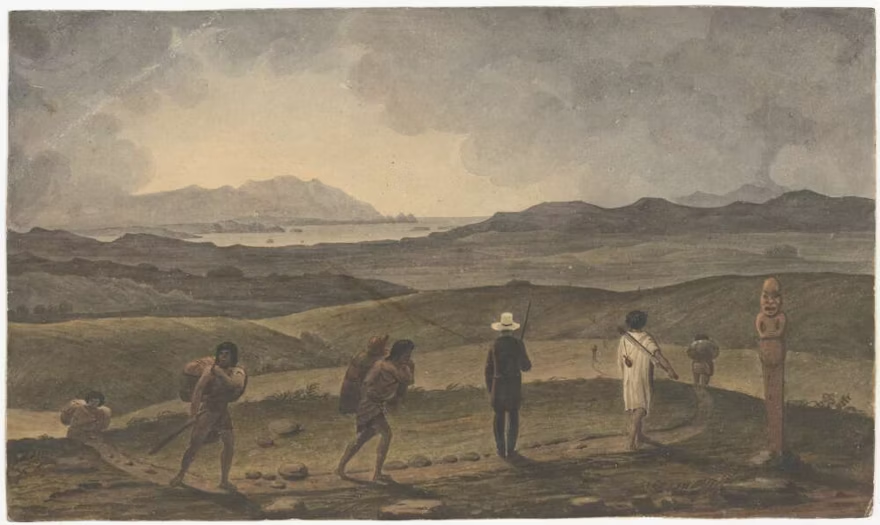
In “The Walker” ($8500) he has replicated the self portrait of the early explorer/artist Augustus Earle taken from Earle ‘s painting “Distant view of the Bay of Island”. Cotton has also appropriated another figure from the work , A Māori with a taiaha who is leading Earle . This figure is also present in “Super Radiance”, “Sunset Gate” ($48,000) and “He tangata hikoi” ($8500) acting as a guide through the landscapes of the North.
Augustus Earle, Distant view of the Bay of Island
Cotton has also used an image of missionary and publisher of Māori works Thomas Kendall taken from the painting “Hongi Hika and Waikato” with Thomas Kendall in England in 1820” by James Barry.
James Barry, Hongi Hika and Waikato” with Thomas Kendall in England in 1820
This image is used in the small portrait “Internal Visions” ($8750) and “The Visitation” ($8500) where Cotton has depicted him contemplating a colourful, modernist manaia form where in the original painting he is looking at Hongi Hika and Waikato.
Shane Cotton, The Visitation
There are also a few of the artists flower painting such as “Insert” ($12,500) which have developed over the years for his early plant paintings.
There are a number of the artist’s three panel works most of which feature a manaia figure flanked by delicate foliage while others have landscape/vegetation panels or in the case of ”Ahuaiti’s Cave” ($130,000) images of the sea. This work refers to the Ahuaiti who was rejected by her husband, forcing her to live in a cave on the Northland coast with her son Uenuku Kuare who is depicted at the base of the painting as a tiny figure, the same image as Earle’s guide in “Distant view of the Bay of Island”.
Shane Cotton, Ahuaiti’s Cave
This linking of mythic figure to historical figure to an invented guide inhabiting some the paintings is an example of Cottons ability to transition across myth, history, time and location.
The “Follow button” at the bottom right will appear and clicking on that button will allow you to follow that blog and all future posts will arrive on your email.
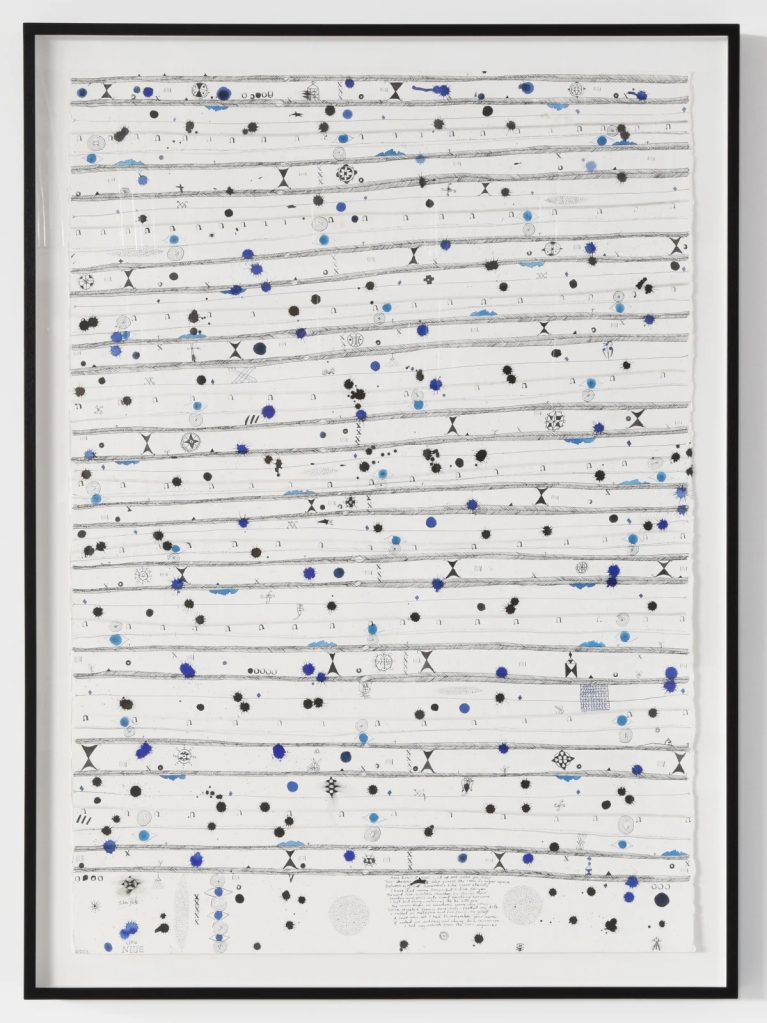
John Pule. As we stood one misty morning near the ocean the desire the solitude gone gone forever
Haia
John Pule
Gow Langsford, Onehunga
Until June 8
Vai Manino
Fatu Feu’u
Artis Gallery
Until June 9
Reviewed by John Daly-Peoples
Two recent exhibition by Pacific artists focus on the ways in which artists draw on the physical and topographic and historic , merging them, with social, political and personal insight and visions.
John Pule’s latest exhibition “Haia” was the result of a nine-month residency in Niue provided by the government in 2023. The work contains much of the artist previous iconography but have a greater immediacy given the artists response to in his ancestral land.
The works are in a sense both a discovery and rediscovery of the land and its mythologies as well as the artists own journeys.
As he says in his notes to the exhibition
“For nine months I rode my bike each day through the canopy forest from Liku to Alofi [around 15 kilometres]. Through rain or shine, winds, storm, or calm. The road is bordered with plantations, forests, tracks into the interior. Big blue skies and clouds, shadows of trees stretch across the makatea (limestone) road. Returning to Liku every evening, the sun is warm on my back. These paintings and drawings are about that particular time.”
His works have often dealt with his growing up in New Zealand, his discovery of traditional Niuean art, the islands history, flora and fauna and developing his own iconography. This had led to him dealing with wider issues of colonialism, the impact of Christianity as well as the mythology and spirituality of Niue.
John Pule. Many times at night I sit up and watch you sleep
Works such a “Many times at night I sit up and watch you sleep” with their strips of images – symbols, shapes and figures are like the trails that that the artist has ridden on his bike but also the pathways which reach back in time. They are analogous to the songlines of aboriginal art as well as the lines of musical compositions, imagining the way the sounds evolve, carrying a narrative expressing joy. sorrow and wonderment.
In the more dramatic paintings such as “As we stood one misty morning near the ocean the desire the solitude gone gone forever” a road snakes into the distance and there are several figures depicted recalling tales of the Bible and other mythological histories.
The foliage depicted is at once colourful and local as well as surreal and mythological – a portrays of Pule’s Niue as well as an imagined paradise.
The pathways and journeys depicted in his paintings are metaphors for the artist’s own physical, spiritual and aesthetic journeys.
John Pule. Foulua Pukenamo Tau Misi
Other works such as “Foulua Pukenamo Tau Misi” feature plans, grids and designs – locating islands, stars, measuring winds and sea currents, all ways of comprehending the environment
Fatu Feu’u. The Golden Age
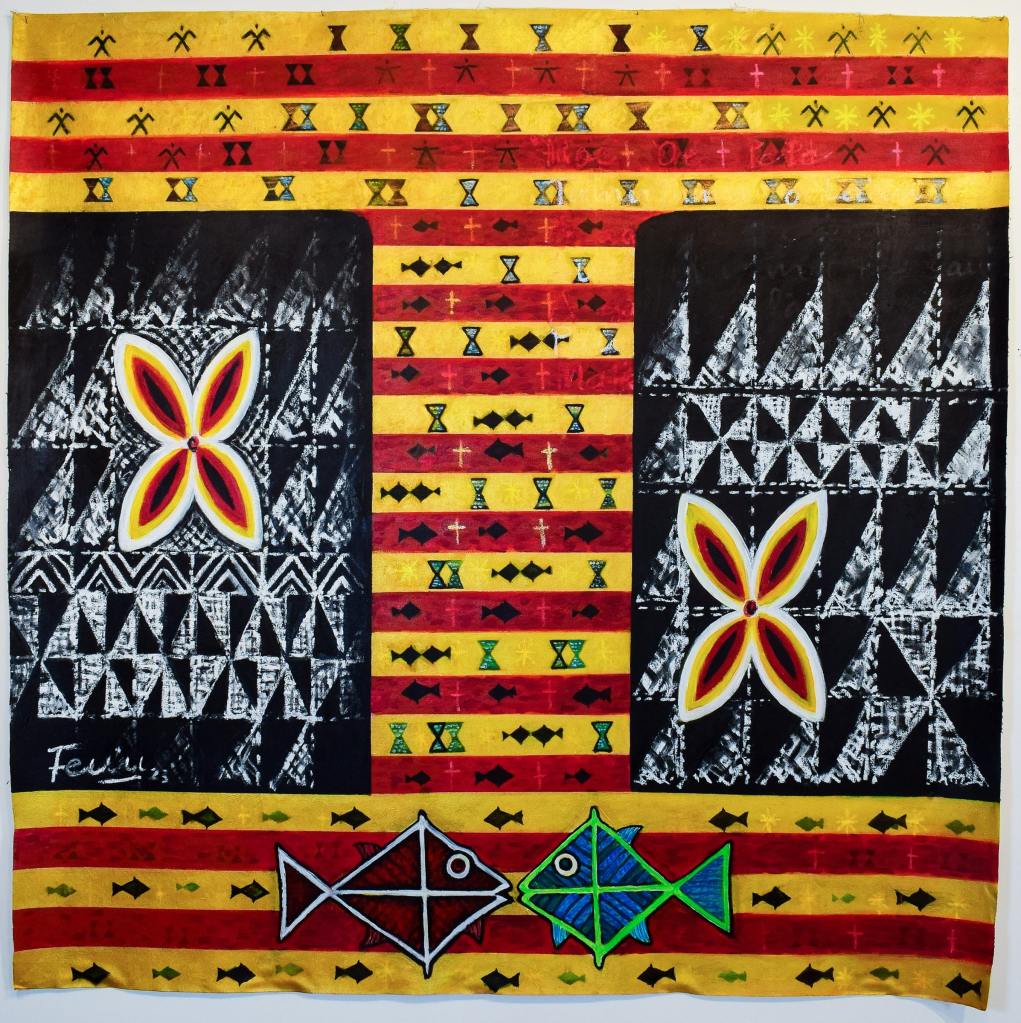
In his latest exhibition “Vai Manino” (Clear Water) Fatu Feu’u focusses on the social political and historical aspects of Samoan fisheries with works that follow on from his previous exhibitions which have addressed social, political and environmental issues which are confronting Samoan society. Several are based on the Samoan tradition of ‘ifoga’ or reconciliation/rebuilding with the dominating central letter ‘I’ as a motif captures this, with different colours coalescing. The large “I” which he has used many times before also references Colin McCahons use of the letter / symbol.
His work draws inspiration from ancient designs and patterns – from tapa cloth. siapo, lapita pottery and tattoo along with contemporary Samoan design. There are also the influences of abstract art and that of other artists such as Colin McCahon and Tony Fomison. The artist has employed shapes and symbols that he has developed over many years – masks, fish, birds and sails along with hints of human figures and landscape. Many of the siapo patterns themselves are derived from insects, leaves, shells, animals and fish.
Fatu Feu’u First Ritual
In many of the works such as “First Ritual” there are swirls of colours which seem to reference shoals of fish and the ocean currents along with curving lines which can indicate the trawling nets used by fisherman.
Works such as “Pacific Conference II” have more complex structures with reference to the historical and mythological past pf the Pacific with an Easter Island monolith. The swarms of fish which morph into humans and birds refence journeys, distance and the dependence on the sea.
Fatu Feu’u. “Pacific Conference II”
Like the works of John Pule several of the paintings feature bands of colour representing journeys and histories. And with both artists there are gridded area which are related to cartography, structure and measurement
The “Follow button” at the bottom right will appear and clicking on that button will allow you to follow that blog and all future posts will arrive on your email.
Ans Westra, who died in 2023 was probably the most prolific contemporary photographer who focussed on recording the life and times of New Zealanders.
With a career spanning over sixty years, she took hundreds of thousands of photographs of people, places and events.
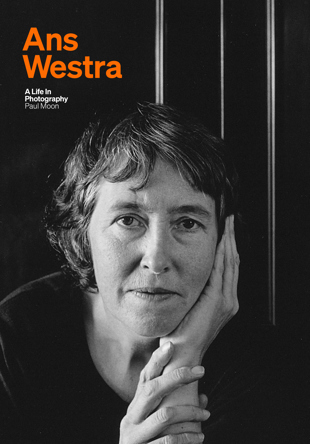
Now a new book “Ans Westra: A life in photography” by cultural historian Paul Moon documents her life and her contribution to the cultural life of the country.
The book charts her photographic career from her early involvement with the Wellington Camera Club in the 1960’s and her first sale of a work to the quarterly journal Te Ao Hou, a publication she would continue to provide images for,
She also gained early recognition in 1961 winning a prize in a photographic competition run by Arts Committee of the Festival of Wellington.
Much of her work was commissioned for publications originated with the Department of Education and several of her books were for educational publishers as well. One of her earliest publications was ”Viliami of the Friendly Isles” based on her travels to Tonga, Fiji and Samoa in 1962. As well as taking the pictures she wrote the text which describes the dramas, tragedies and excitement of the various locations and events she encountered.
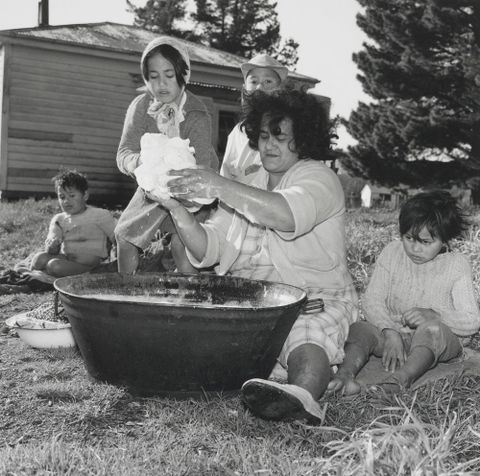
Then there was the controversial booklet “Washday at the Pa” which was a school bulletin published in 1964 by the Education Department’s School Publications section. Ans Westra wrote the text and took the photographs during a visit to Ruatōria.
Ans Westra, Ruatoria, 1963 (from ‘Washday at the Pa’), courtesy of {Suite} Gallery
The bulletin followed a day in the life of a rural Māori family with nine children. Her images of the family’s living conditions caused enormous controversy, notably from The Māori Women’s Welfare League and the work was subsequently removed from schools and destroyed. Only latterly was the work republished by her Wellington gallery Suite.
Her more substantial publication “Māori” was published by Alistair Taylor in 1967 which was co-produced with James Ritchie and designed by Gordon Walters.
Her motive for participating in the project was the misguided notion, held by many pakeha writers that Māori were likely to become extinct at some time in the future and their culture needed to be recorded.
She was also involved with another controversial publication “Down Under the Plumtree” published by Alistair Taylor. Published in 1972, the book openly discussed sex, sexuality and drugs at a time when there was very little reliable information on these issues for young people.
Moon writes about all her major bodies of work such as “Notes on the Country I live in” and “We Live by a lake” which was written by Noel Hilliard.
He also outlines the rational and impetus for the various projects, the political and social climate at the time and the reactions to them.
The 84 images used to illustrate the book show the various aspect of her photographic approach which changes over the years. One is conscious of her ability to frame an image, capture the sense of a person or place and find the drama of the moment.
Ans Westra, Wellington, 1974 courtesy of {Suite} Gallery
This ability to capture the sense of place can be seen in her “Wellington” of 1974 with the wet streets of the capital by the cenotaph.
She also shows an understanding of architectural space with an image of the dam structure in “We Live by a Lake” and she is aware of the possibilities of contrast through light and shade as well as means of creating drama and movement as shown in her image of a policeman and dog confronting a protestor during the anti-Springboks tour campaign.
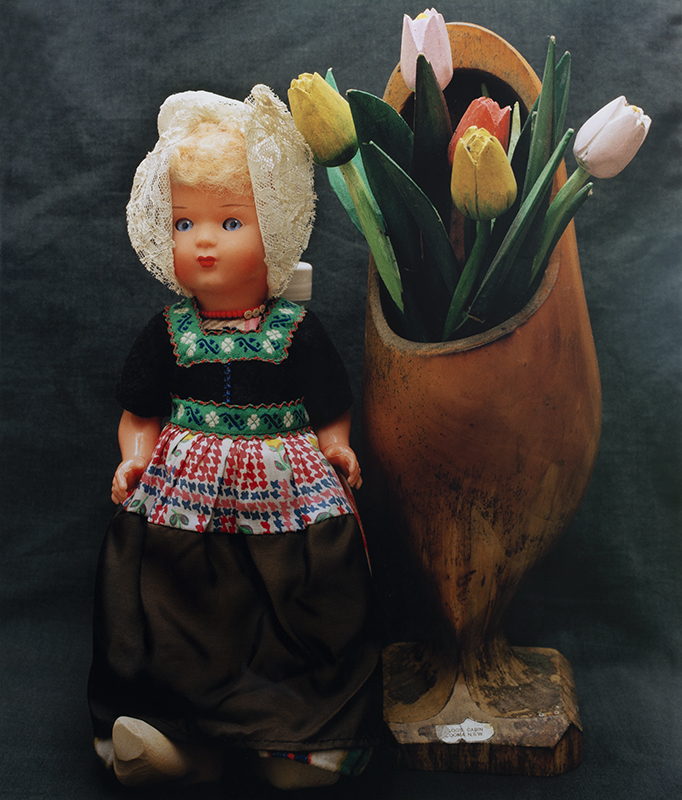
While she did not photograph all that much in colour, when she did, she was able to use colour to great effect as in her image of a Dutch doll from her Toyland series.
Ans Westra, Dutch Doll, 2004, courtesy of {Suite} Gallery
The book not only documents Westra’s immense contribution to our history in documenting social change but also reveals an enthusiastic and dedicated artist.
The book deals with several of the important events in her own life from her move from Holland in her youth, the brief return to Holland in the late 1960’s and her short-lived affair with the writer Barry Crump and the resulting son, Erik.
Dr Paul Moon ONZM is professor of history at Auckland University of Technology’s Te Ara Poutama, the Faculty of Māori Development, where he has taught since 1993. He is the prolific author of many books, including biographies of William Hobson, Robert FitzRoy, and the Ngāpuhi rangatira Hone Heke and Hone Heke Ngapua. He is a Fellow of both the Royal Historical Society at University College London and of the Royal Society of Arts.
All Images extracted from Ans Westra: A Life In Photography by Paul Moon, published by Massey University Press,
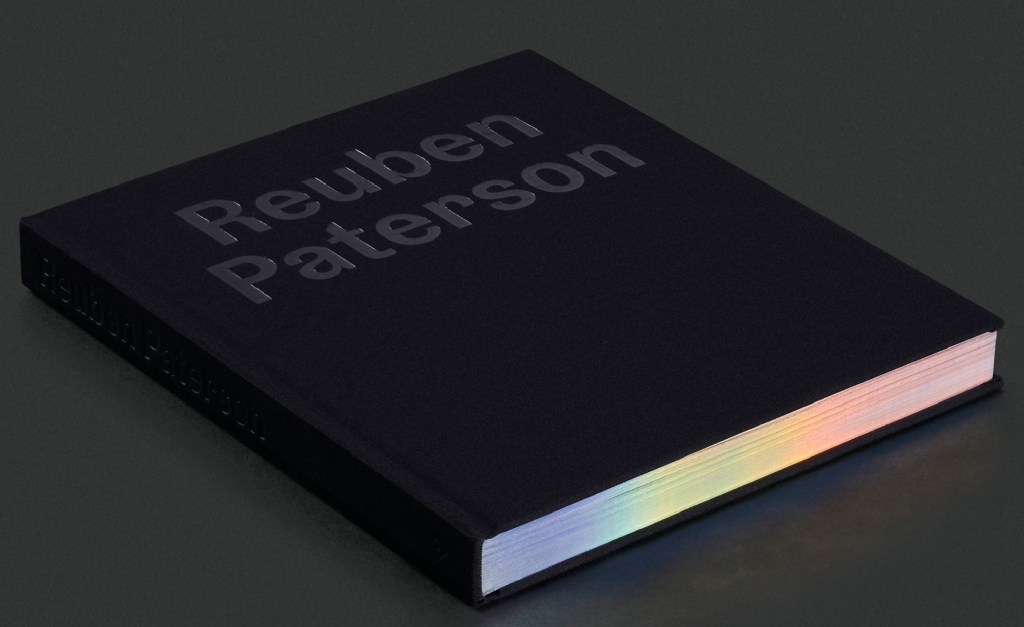
City Gallery Wellington has recently published a stunning monograph on Reuben Paterson which follows on from his exhibition Reuben Paterson: The Only Dream Left which was exhibited at the gallery last year.
The book is lavishly illustrated with works covering his thirty years of art practice and features writings by Witi Ihimaera, curator and writer Geraldine Barlow, and the exhibition’s curators Aaron Lister and Karl Chitham.
Reuben Paterson, Pounamu and The Jade Cat
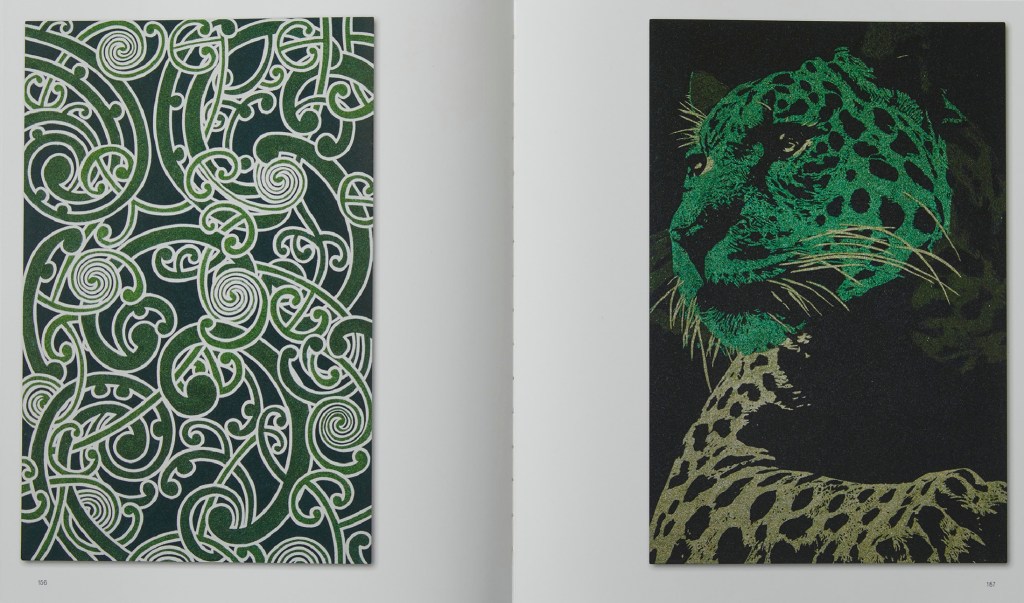
There are over 100 full colour illustrations as well as some ”booklet” inserts which captures the unique range and depth of Paterson’s art from his early glitter paintings to his recent major sculptural commissions.
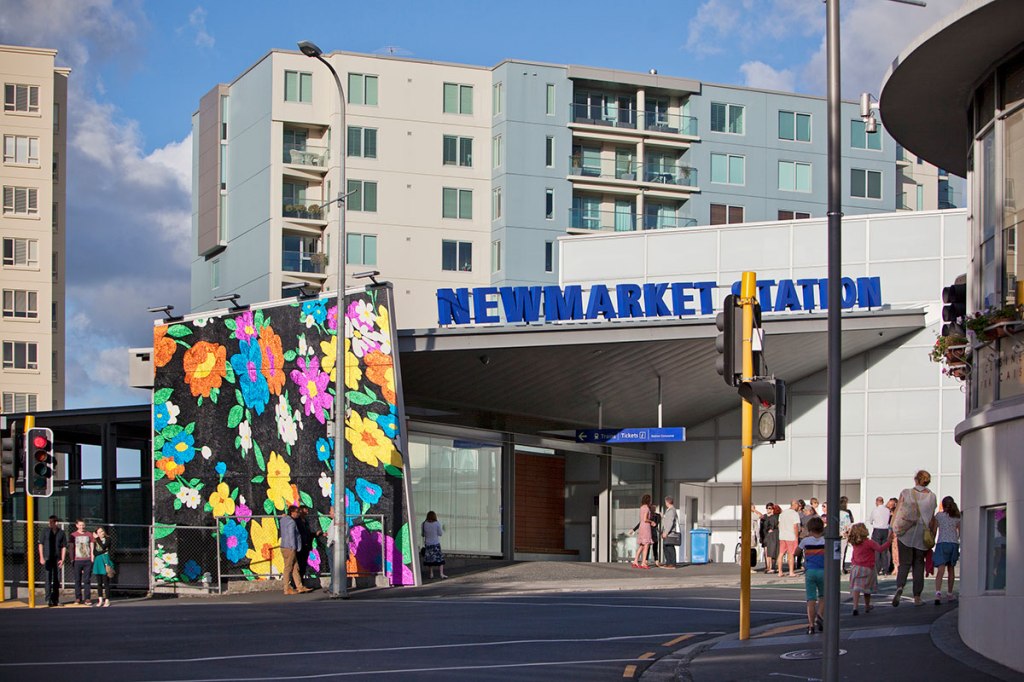
There are images of several of his monumental works such as the “Get Down Upon Your Knees”, the 8-metre square work shown at the Asia Pacific Triennial in Brisbane as well as the mural work “Andale, Andale” at Auckland’s Newmarket Railway Station. There are also the “The Golden Promise” at the Massey University Albany campus as well as the controversial ”Freedom Flowers”, the ANZ cash point terminal on Ponsonby Road commissioned for the 2015 Pride Festival.
His use of glitter and diamond dust on canvas or paper of stereotypical images are manipulated and transformed by his individual treatment of colour, design, pattern and texture. His images often referenced botanical, op art, or Māori iconography along with images which are commercial or kitsch. The sparkling surfaces create an ambivalent visual description with works such as the “Take my hand and off we stride” featuring the idyllic Pacific Island palm tree landscape.
Underneath the seductive images there are more complex ideas and viewpoints which take the viewer into the artist’s view of nature, the tangible and the symbolic as well as his own whakapapa referencing his Ngati Rangitihi, Ngai Tuhoe, Tuhourangi and Scottish descent.
Paterson’s political or social messages are also referenced in some of the works where he has used animal images such as the tiger in “Blessing”, conveying the sense of power, sexuality and fear. These works were motivated by his efforts to highlight the inequality of the ‘gay panic’ provocation defence for murder that was in place before a repeal of the Crimes Act in 2009.
A culmination of many of his ideas and technical expertise has been “Guide Kaiārahi” the major commission for the Auckland Art Gallery. The idea for the ten-metre-high waka which is made from hundreds of shimmering crystals, originated in the legend of a phantom waka that appeared at Lake Tarawera ten days before the eruption of Mt Tarawera in 1886. Combining references to natural and supernatural realms, the sculpture draws upon Māori cosmology and creation narratives.
Reuben Paterson, “Guide Kaiārahi” (detail)
The book shows the extent of his influences and interests apart from his use of cheesy imagery – Dutch still life painting, elements of Greek and Roman art, Op art and Rorschach patterns. The essays also reveal some of his interests in scientific, political and social ideas along with the spiritual aspects of his work.
Nature and botanical subjects are central to the artists life and many of the artist works His father was a landscape gardener and he has a garden himself which can be seen as an influence on his work with its emphasis on colour, seasons, birth and transformation.
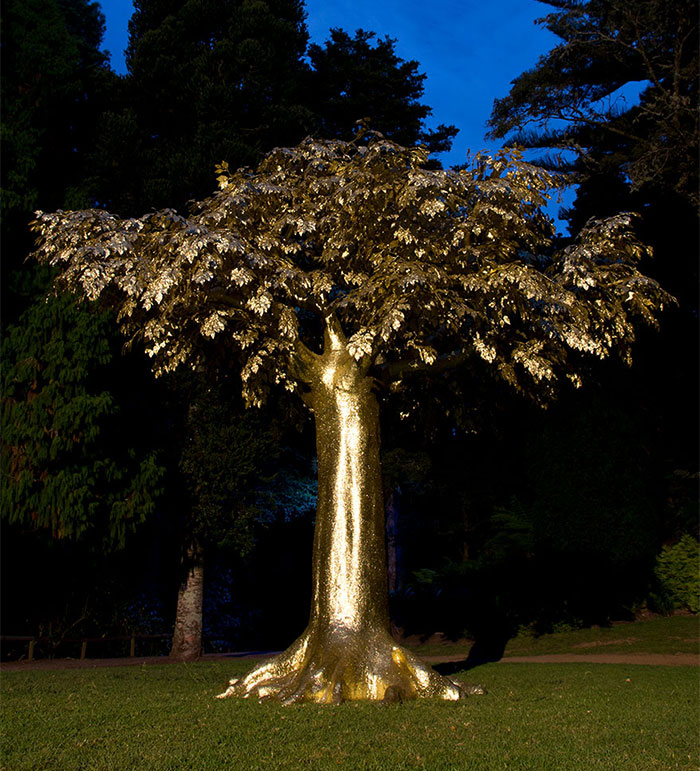
One major work which focusses on Nature is “The Golden Bearing”, a life size golden tree which links to the various emblematic trees over history, from George Fraziers “The Golden Bough”, Eastern and Mayan ideas of creation as well as that of Maori.
Reuben Paterson, The Golden Bearing
As Witi Ihimaera says of the work “In Paterson’s garden the tree is a promise of the legacy of nature for a humankind that appears hellbent on destroying the planet. It is an achingly awe-inspiring way point from which we can orient ourselves to a future if we wish it to become a paradise regained rather than lost”.
The book itself is an elegant and lavish production with designers Extended Whānau ensuring that Paterson’s work is presented in a way which allows for an appreciation and understanding of his paintings and sculptural work.
The images and texts manage to not only show the development of the artist’s work but link the poetic, the political and the personal to show an artist who is deeply committed to exploring the many threads which make up contemporary New Zealand culture.
The “Follow button” at the bottom right will appear and clicking on that button will allow you to follow that blog and all future posts will arrive on your email.