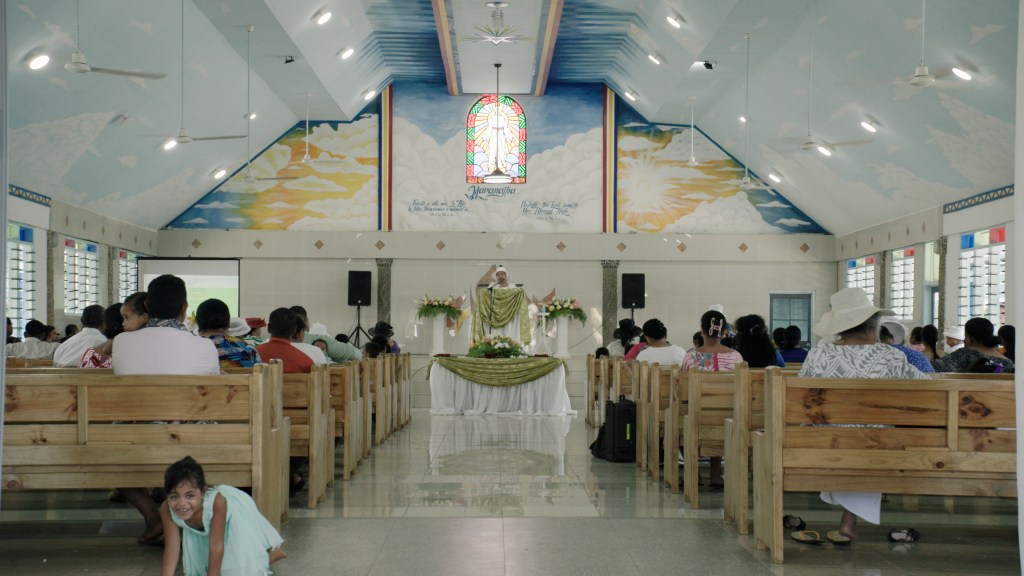
Image credit: Edith Amituanai, Vaimoe (video still), 2024. Digital video, sound. Cinematographer: Ralph Brown. Photo credit: Ralph Brown
Held every three years, the Walters Prize is widely regarded as Aotearoa New Zealand’s most prestigious award for contemporary art. Over its 24-year history, the prize has helped elevate contemporary New Zealand art, both nationally and internationally. Conceived as a platform to showcase excellence in the visual arts, it has bolstered careers, stimulated critical debate and enriched the cultural life of Tāmaki Makaurau and wider New Zealand.
Four artists have been selected by an independent jury for works exhibited between February 2023 and February 2026.
In making their selection, the jury made the following comments: “These artists have made an outstanding contribution to contemporary art in Aotearoa over the last three years, a period marked by political unrest, escalating conflicts, and environmental devastation. Rather than amplifying this turbulence through spectacle, they each respond to the disorientation of our times by turning an acute attention toward local and personal narratives, while expanding the material and conceptual possibilities of their practices.”
Edith Amituanai (born 1980, Tāmaki Makaurau Auckland) is a New Zealand-born Samoan lens-based artist based in Tāmaki Makaurau Auckland. Amituanai was nominated for Vaimoe, 2024, first exhibited in Edith Amituanai and Sione Tuívailala Monū: Toloa Tales, Christchurch Art Gallery Te Puna Waiwhetū, 2024, which demonstrates the artist’s recent shift into moving image while maintaining the gracious, lucid enquiry that has defined her practice over the last two decades. Vaimoe gently pushes against conventional ideals of home and belonging, exploring the ways relationships are upheld and maintained through proximity and distance, while acknowledging the challenges of change, disconnection, and communication.
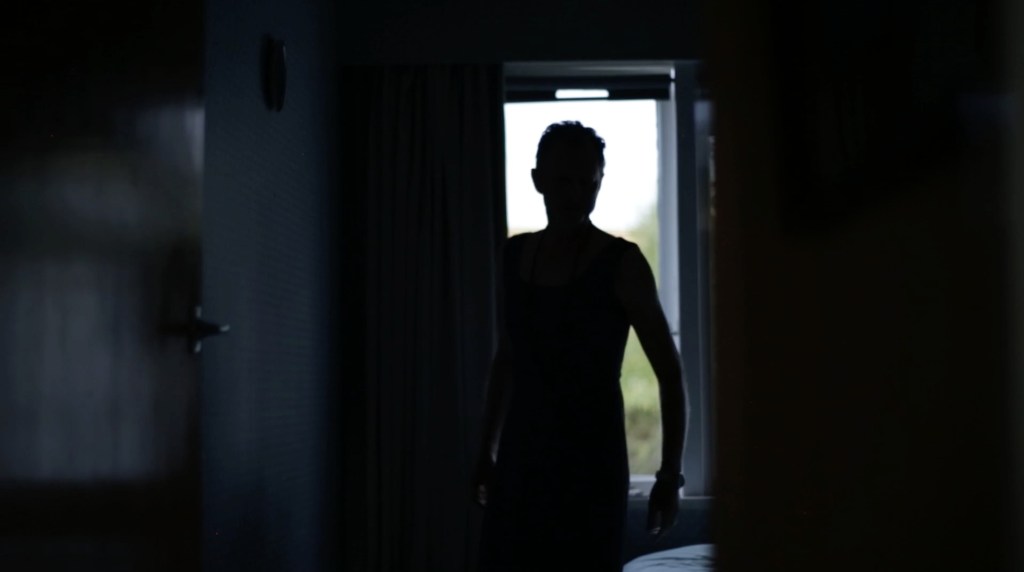
Image credit: Richard Frater, Nicky’s conversion (video still), 2025. HD video, colour, sound. Lett Thomas, Auckland. Image supplied by the artist
Richard Frater (born 1984, Te Whanganui-a-Tara Wellington) lives and works in Berlin. Frater was nominated for Nicky’s conversion, 2024, first exhibited at Klosterruine Berlin, 2024 and Lett Thomas, Auckland, 2025, a work that tenderly records the rehearsal of a sermon by an Anglican priest, articulating the challenges of reconciling the interior self with the structures through which we have come to understand the exterior world. With dignity and grace, the work describes a changing gender identity and offers a path through the Anglican tradition towards acceptance and love of ourselves and others.
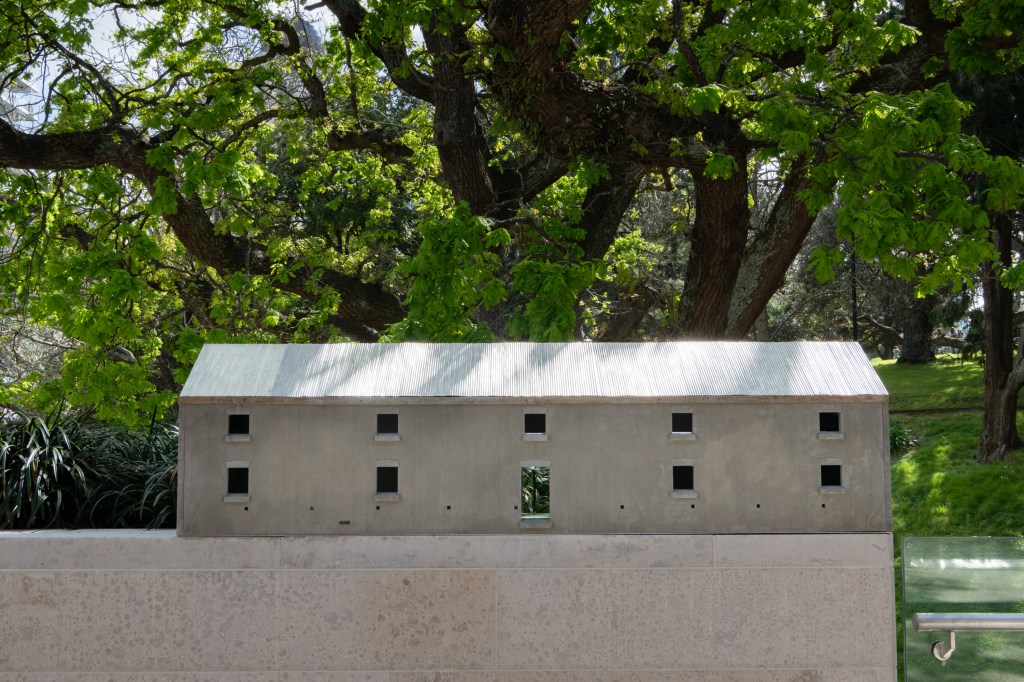
Image credit: Ammon Ngakuru, Three Scenes (installation detail), 2025. Mixed media sculptural installation. Commissioned by Auckland Art Gallery Toi o Tāmaki, with support from the Chartwell Trust and the Contemporary Benefactors of the Auckland Art Gallery, 2025.
Ammon Ngakuru (born 1993, Tāmaki Makaurau Auckland) lives and works in Tāmaki Makaurau Auckland. Ngakuru was nominated for Three Scenes, commissioned for Auckland Art Gallery Toi o Tāmaki in 2025, a work that responds to the Gallery’s outdoor terrace and its site on Albert Park with an elegant restraint characteristic of his practice. Implicating the audience in its field of sculptural references, the work establishes a stage on which uncertain interpretation is acted out.
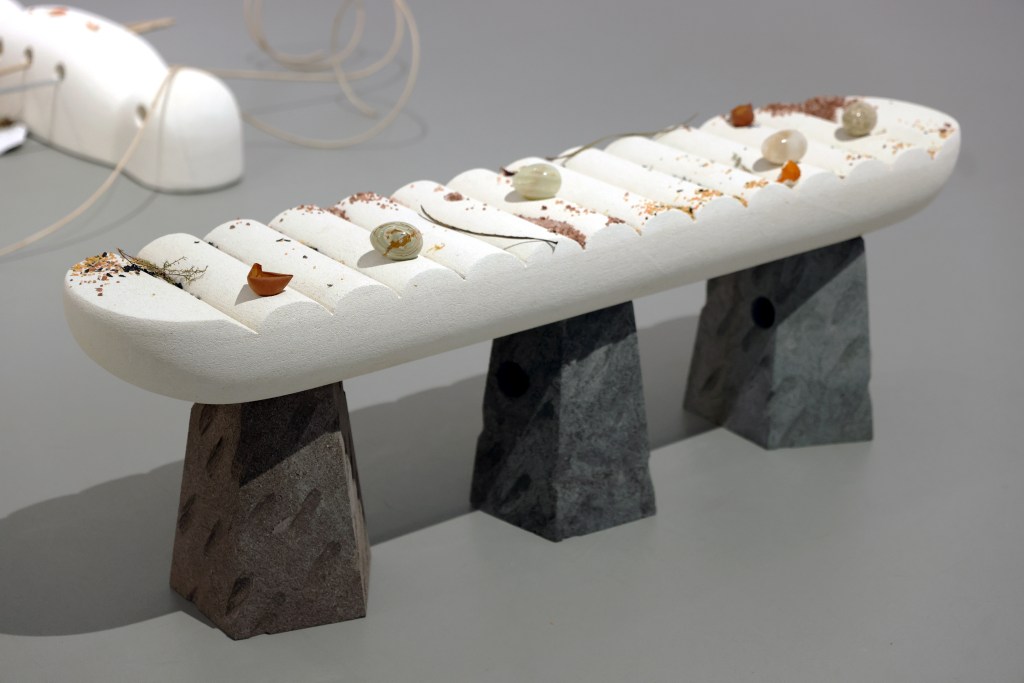
Image credit: Sorawit Songsataya, Ranad detail from the exhibition Fibrous Soul, 2024. Taranaki andesite, Ōamaru limestone, onyx, dried plant. Taranaki andesite carving by Donald Buglass. Photo courtesy of the artist and Govett- Brewster Art Gallery
Sorawit Songsataya (born 1986, Chiang Mai, Thailand) is a Thai-New Zealand artist currently based in Bangkok. Songsataya was nominated for the exhibition Fibrous Soul, presented at Govett-Brewster Art Gallery, 2024, for its exploration of processes of accumulation, regeneration and transformation. Across moving image and sculpture, and including work made by the late weaver and kaitiaki of Te Niho o Te Ātiawa Maata Wharehoka, Fibrous Soul draws together organic and artificial materials, and customary and contemporary practices, to elucidate slippages between human and more-than-human worlds and the possibility of communication across them.
Tātaki Auckland Unlimited Director of Auckland Art Gallery Toi o Tāmaki Dr Zara Stanhope says, “It has been a privilege to begin my term as Director of the Gallery welcoming in the jurors and artists for the 2027 Walters Prize. Their selection is a poignant reminder of the breadth and range of art across Aotearoa New Zealand and of the activity currently shaping the visual arts as a healthy and vital part of the cultural sector.”
The finalists are invited to present new work or their nominated work at the Gallery in a public exhibition, scheduled to open in March 2027.
Auckland Art Gallery’s Senior Curator, Global Contemporary Art, Natasha Conland, who works closely with the artists to realise the prize exhibition and says, “These finalists express materially rich works with unique, often humorous and intellectually rewarding content. It’s not surprising that they each carry a large following of supporters who are looking to ask new questions of art, and to explore its potential,” says Conland.
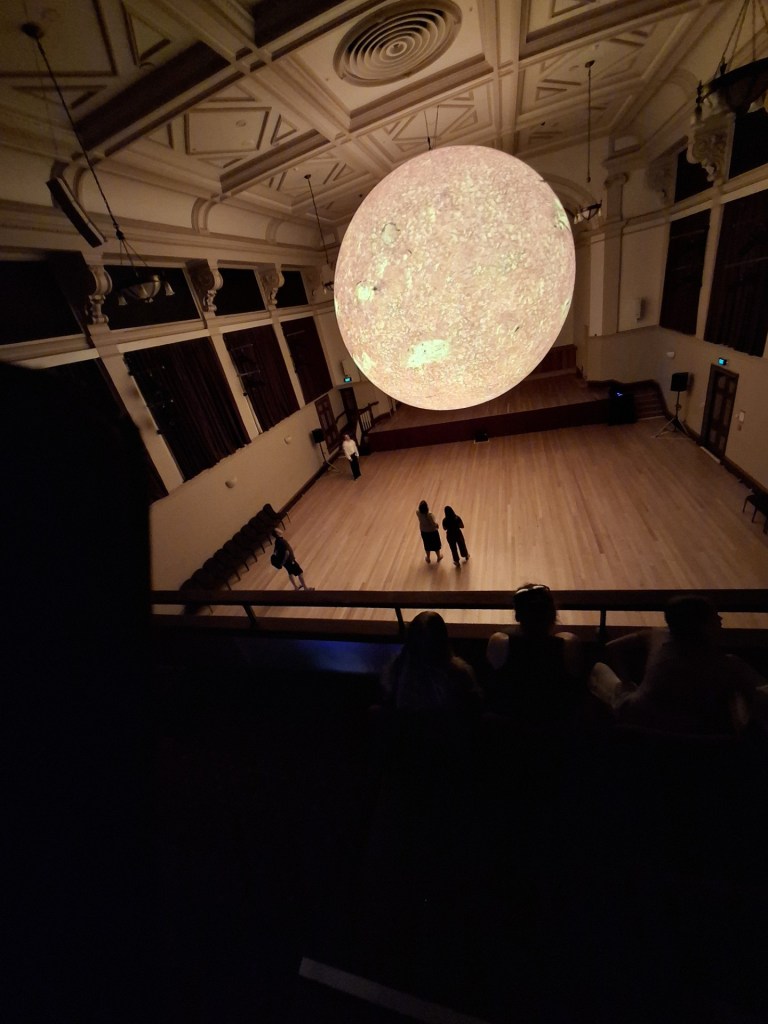
This week you can experience Helios, a breathtaking, larger-than-life artwork created by renowned UK artist Luke Jerram. Arriving in New Zealand for the first time, Helios is both a scientific wonder and a multi-sensory artwork, offering a rare opportunity to visualise the beauty and complexity of our closest star.
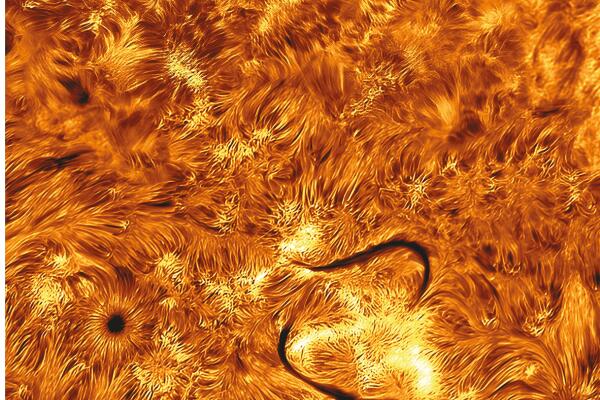
The globe measures six metres in diameter and was created at a scale of 1:230 million, it is constructed from approximately 400,000 images of the Sun’s surface. These images combine photography by astrophotographer Dr Stuart Green with data from NASA solar observations. Internally lit, this spherical installation allows for a safe yet awe-inspiring examination of the Sun’s extraordinarily detailed surface, revealing features such as sunspots, spicules, and filaments.
Named after the ancient Greek and Roman sun god – symbolic of time and life. Helios blends real solar imagery with animated lighting accompanied with an immersive surround-sound composition by Duncan Speakman and Sarah Anderson, creating a powerful and unforgettable experience.
Luke Jerram’s multidisciplinary arts practice involves the creation of sculptures, installations and live artworks. Living in the UK, but working internationally, Jerram creates art projects which excite and inspire people around the world.
One of his recent projects Echo Wood is a collaboration between the artist and charity Avon Needs Trees It is an extensive new artwork made from 365 living trees.
The native trees will slowly grow into a vast 110-metre-wide design. Blossoming at different times of year, pathways and avenues will be created to guide visitors on a journey through the forest towards a central circular gathering space, formed from 12 English oak trees. Echo Wood will take a century to fully emerge – but will endure for generations.
Co-commissioned by National Trust, Cork Midsummer Festival, Liverpool Cathedral, Old Royal Naval College and University College London.
Learning from Venice: A Workshop for Early-Career Artists, Curators and Writers, 25-29 May 2026, Venice Italy
John Daly-Peoples
The Office for Contemporary Art Aotearoa (OCAA) has announced a new initiative “Learning from Venice”, a new professional development opportunity for seven early-career Aotearoa New Zealand artists, curators and writers to take part in an intensive five-day research workshop at the Venice Biennale, between 25 and 29 May 2026.
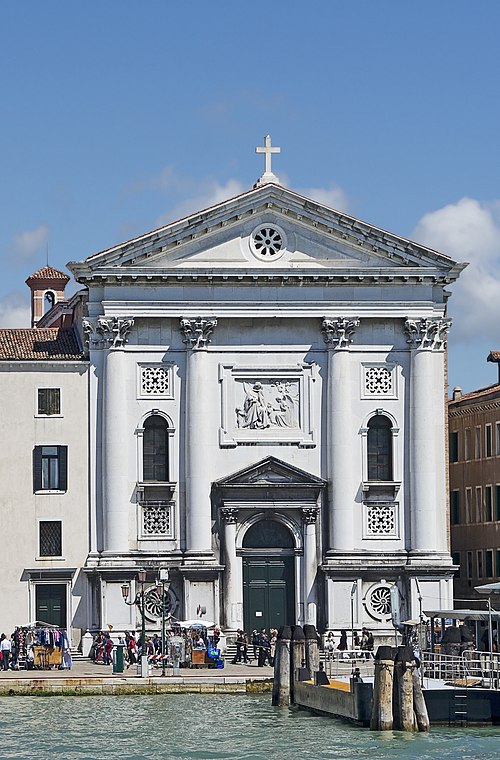
Timed to coincide with the 61st Biennale of Venice, “Learning from Venice” will take advantage of the of multiple exhibitions mounted across Venice, including the NZ exhibition, Taharaki Skyside by Fiona Pardington mounted at Istituto Santa Maria della Pietà (La Pietà) the site of Bill Culbert’s Front Door Out Back exhibition in 2013
This immersion in contemporary art will be led by curator, writer, editor and educator, Christina Barton, and Curator Contemporary Art at Te Papa, Hanahiva Rose.
The workshop will consist of readings, conversations, visits, and talks, and there will be opportunities to meet artists, curators and individuals involved in the Biennale’s realisation.
Participants will collaborate to produce a publication reflecting on their findings, which will be published and distributed after the workshop concludes.
This initiative will enable a cohort of committed individuals to gain a sharper understanding of how the art world works in the context of one of its highest[1]profile occasions. Participants will gain a stronger grasp of the key issues at stake in current practice, testing their reactions and impressions with peers, and learning together to catalyse future thinking about Aotearoa’s place in and contribution to the global art world.
Applications will be accepted from early-career artists, curators and writers based in or from Aotearoa New Zealand who can demonstrate their commitment to pursuing a career in the visual arts. Applications will be assessed by a panel including the co-leaders, a representative from Creative New Zealand, and artist Judy Millar.
Selected participants will be fully funded to attend (including flights, accommodation and a per diem).
Partners
The Learning from Venice workshop has been made possible through the generous support of multiple partners, including Creative New Zealand, Te Papa and the Te Papa Foundation, Elam Fine Arts at the University of Auckland, Naveya & Sloane, Barbara Blake and the Gow Family Foundation. The Chartwell Trust have generously supported the Aotearoa-based elements of the project.
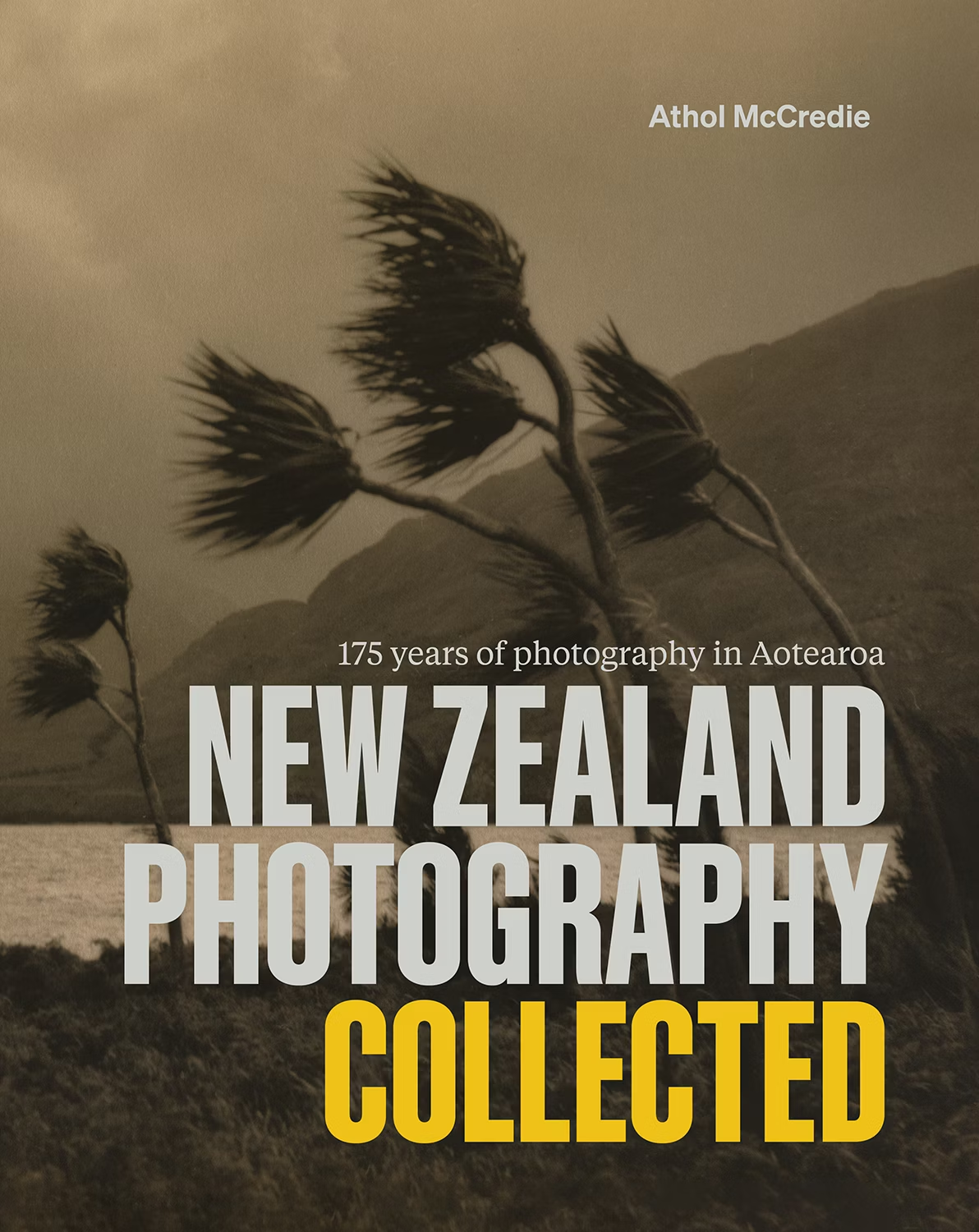
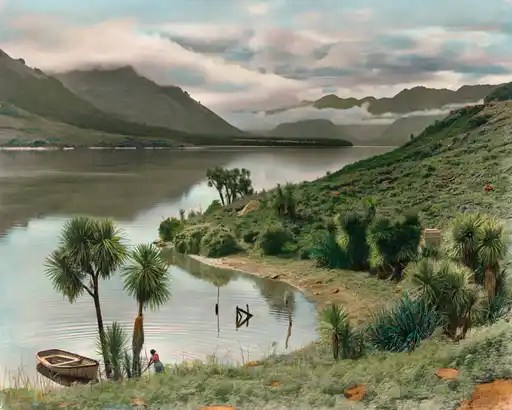
Cover image, George Chance – The Storm, Wanaka (c1940)
New Zealand Photography Collected
175 Years of Photography in Aotearoa
Te Papa Press
Written by Athol McCredie
RRP $90.00
Reviewed by John Daly-Peoples
New Zealand Photography Collected illuminates New Zealand’s photographic history, from the earliest nineteenth-century portraits of Māori and local ‘scenic views’ to the latest contemporary art photography. The previous edition of the book published in 2015 went into two editions and this expanded version featuring 400 images from Te Papa’s collection of 400,000 works.
From the iconic to the previously unpublished, the selection includes outstanding photographs by the Burton Brothers, Leslie Adkin, Spencer Digby, John Pascoe, Brian Brake, Frank Hofmann, Ans Westra, Eric Lee-Johnson, Marti Friedlander, Laurence Aberhart, Ann Shelton, Glenn Jowitt, Anne Noble, Yvonne Todd – and many more.
The book not only provides a wide selection of images, it also introduces the reader to the photographic artists who have used photography to explore our history and environment. The photographs of the nineteenth century makes us realise that these images are often our only reference point for how the country, its people and events looked in the past.
Author and curator Athol McCredie provides a wide-ranging selection of images across portraiture, landscape, science, documentary photography and art with informative notes.
Ellis Dudgeon Lake Hawea, c.1947 Hand-coloured gelatin silver print, coloured by Elaine Watson, 1962, 404 × 500 mm Purchased 2023, O.051365 It is almost unknown for a hand-colourist to be identified on a photograph, but this one has a handwritten label on the back reading ‘Hand painted photograph by Elaine Watson, July 1962.’ This records that Watson hand-coloured it, not that she took it, for we know from a 1947 book in which it was reproduced in black and white that it was taken by Ellis Dudgeon, a photographer who ran a studio in Nelson from 1930 to 1970. Dudgeon’s scenic hand-coloured photographs were widely seen. Indeed, this image appears in colour on the cover of the upmarket magazine Mirror: New Zealand’s national home journal in 1955. In that version, the colouring is quite different: there is much more yellow in the tī kouka (cabbage trees), there are red flowers on the bushes by the lakeside, and it is much brighter and sunnier throughout. It is a more upbeat, holiday image than Watson’s subdued and uniformly toned version, showing just how much interpretive room there was for colourists, who were rarely present when the photograph was taken.
Together these photographs tell stories about life in this country from almost the earliest days of European colonisation and about how the practice of photography has evolved here, reflecting the dynamic and increasingly diverse nature of the collection, allowing for previously unseen treasures, and enabling familiar works to be recontextualised with fresh insights.
In making the selection, McCredie, says “I looked for photographs that were evocative, resonant, ambiguous, entertaining, and most especially, that might say something about the nature of photography itself.”
Whie no collection of photographs can be comprehensive the book offers many threads which weave together a sense of the nation’s history and culture. It is more than a history of photography tracing out our responses to the landscape, the built environment, events and people.
Through the book we see the taming and changing of the landscape, the changing domestic and commercial architecture, the way we dress and there are images of the citizens we valued for their contribution to our civic and cultural life.
There are portraits of Māori such as Tomika Te Mutu, as well as other history makers such as Peter Fraser, Ed Hillary and Mike Moore along with artists such as Kiri Te Kanawa, Tony Fomison and Yuki Kihara.
We also can see the way in which the photograph has changed from the need to simply record the landscape and people through to experimentation as well as viewing photography as a means of social and political change.
While there no comparative before and after images the book does have images of the changing face of the land as well as images of the major cities and the built environment from the nineteenth century and the twentieth which show the development of the urban areas. We are also able to see the changing nature of clothes, particularly those worn by females.
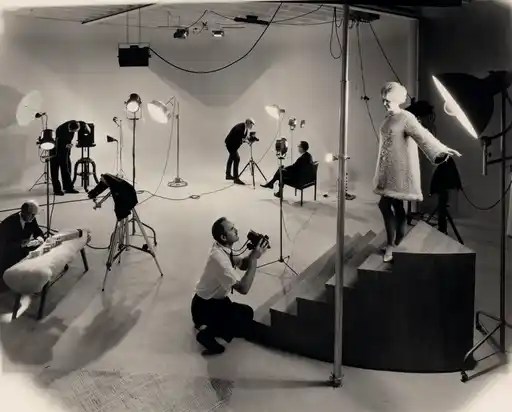
The inclusion of Frank Hofmann, one of the major modernist photographers is an example of the multi-talented artist who worked across the media providing many of the important modernist photographs as well as portraits. A photograph of the Christopher Bede Studio, which he founded also shows his ability to work across the commercial as well as experimental genres.
Frank Hofmann Christopher Bede Studios, 1967 Gelatin silver print, 418 × 578 mm Purchased 2016, O.044647 Christopher Bede Studios was formed by Frank Hofmann and Bill Doherty around 1950. It focused on home portraiture but also operated a studio, and this photograph was probably taken to promote its new premises being opened in Auckland in 1967. The image clearly sets out to demonstrate the varieties of photography the studio could undertake, from fashion and product photography to portraiture. It is pure advertising though, for it would be fanciful to imagine four photographers actually working simultaneously in the same studio space. The studio had branches in other centres, and in 1970 it claimed to be New Zealand’s largest photographic organisation. In 1975 it became Bede Photography.
There are number of images of individual Māori and Māori society which changes over the course of time from initially being of an ethnographic nature with images by John Nicol Crombuie and Alfred Burton through to seeing Māori as an integral part of society with photos by Ans Westra as well as seeing the inclusion of Māori photographers such as Tia Ranginui and Fiona Pardinton.
There are several small suites of work such as Eric Lee-Johnson images of Opo taken at Opononi in 1956, Gordon Burt’s commercial works mainly of automobiles and the Burton Brothers for their extensive images of the country.
Then there are individual images such as Frede Brockett’s dramatic image of the wreck of La Bella, Theo Schoon’s Geothermal studies or Eric Lee Johnson’s image of a bike wheel and shadow which predate similar work by Bill Culbert who, surprisingly, has no images in the book.
The landscape work in the book range from the nineteenth century images of the Burton Brothers through the NZ Tourism images, the myth-like work “Peter Pan on Mt Eden” by J. W. Chapman-Taylor through to the revisionist work of Mark Adams.
Les Wallace Napier after Hawke’s Bay earthquake, 1931 Gelatin silver print, 158 × 386 mm Gift of Holden New Zealand Limited, 1998, O.005635 The Hawke’s Bay earthquake of 3 February 1931 remains New Zealand’s deadliest natural disaster: 256 lost their lives, and the region was devastated. With limited water to fight the fires that ignited after the quake, eleven blocks of central Napier were completely gutted. According to an eyewitness, by evening the town ‘looked as if it had been subjected to a severe bombardment’: The centre of it for over a mile was a mass of flames. Every concrete and brick building had collapsed. It was like an upheaval and there was a terrible number of deaths . . . A number of people were lying in the streets and buried under the debris. Some were terribly injured and some were dead. The town was all in darkness and that added to the horror of the situation.
While there are not a lot of photographs of dramatic historical events like Les Wallace’s “Napier after the earthquake” there are a few, like Paul Simei Barton’s images of the demonstrations about the Springbok 1982 tour as well as the Covid 19 demonstration in Wellington by Adrian Lambert.
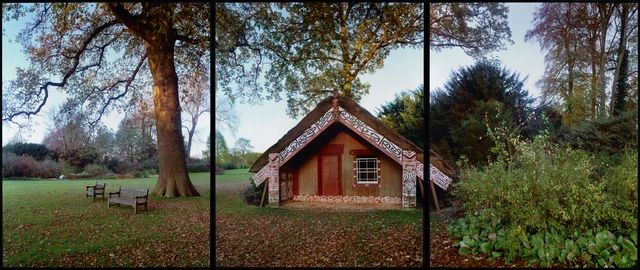
Mark Adams 13.11.2000 Hinemihi, ClandonPark, Surrey, England. Nga Tohunga:Wero Taroi, Tene Waitere, 2000 Chromogenic prints, 1200 × 3200 mm Purchased 2020, O.049055/A-C to C-C Mark Adams has often highlighted cultural incongruities in his photographs, and nowhere more so than in this triptych of the meeting house Hinemihi o te Ao Tawhito standing in a corner of an English country estate. The 1881 house was originally situated at Te Wairoa, the gateway village to the Pink and White Terraces. When Mount Tarawera erupted in 1886, the house was partially buried and subsequently abandoned. In 1891, the Earl of Onslow and Governor of New Zealand purchased Hinemihi and had it dismantled and reinstalled on his English estate as a sort of folly — something he probably didn’t see as incongruous himself, as he bought it as a reminder of his affection for New Zealand. Adams took another equally dissonant triptych that pairs with this photograph. It shows the site where Hinemihi originally stood — now just a forlorn patch of empty land covered in long grass and thistles. Hinemihi will be returned to New Zealand (though probably not to this site), placing Adams’s photograph in dialogue with the future as well as the past.
The “Follow button” at the bottom right will appear and clicking on that button will allow you to follow that blog and all future posts will arrive on your email.
Dick Frizzell’s latest show “Weight of the World,” at Gow Langsford could well be a reference to Ringo Starr’s 1998 comeback single of the same name which uses the phrase to describe the struggle of letting go of the past and embracing the future.
The exhibition is ambivalent in terms of the artist’s own life and work, linking the past with his history of breaking new ground. At times his work has seemed to be conservative, borrowing art of the past and outdated advertising images. But this reworking or appropriating images of the past can also be a way of charting new directions for his art.
The exhibition also alludes to his recently published autobiography “Hastings” with its references to growing up in small town New Zealand and the rural landscapes of Central North Island in which the young Frizzell’s encounters with the world of Hastings provide an almost heroic account of his life.
As the artist says “My landscapes occupy a special place in my affections because they define, more than any other of my endeavours, the most solid manifestation of my philosophy. Both the subjects and their manner of representation are chosen to emphasise my eternally optimistic faith in the physical universe that I believe we are ultimately destined to define. I hope… through my piles of hills, stumps, trees and land… to literally convey ‘the gravity of the situation’.”
While his paintings can be seen as simple descriptive works there is a complexity to their construction as well as their context and history. creating dense works about observation, contemplation and significance.
Dick Frizzell, Dirt Road
Several of the landscape images from the exhibition could have been illustrations to his autobiography such as “Dirt Road” ($27,500) and “Backtrack” ($45,000), images that are quintessential New Zealand scenes which link past and present with images which are both descriptive and metaphoric.
There is one work with the same title of the exhibition, “The Weight of the World” ($163,000). It depicts a large tree stump, a reference both to his own tree stump works of the 1980’s as well as those by artists such as Mervyn Taylor and Eric Lee-Johnson. These dead trees were both a symbol of modernism and change as well as an emblematic of the past and loss of identity.
Much of the artist’s work is imbued with this sense of nostalgia and Frizzell has regularly depicted aspects of New Zealand – a series of local businesses, the huts at Scott base and the controversial series of hei tiki works which all helped define the nature of New Zealand culture.
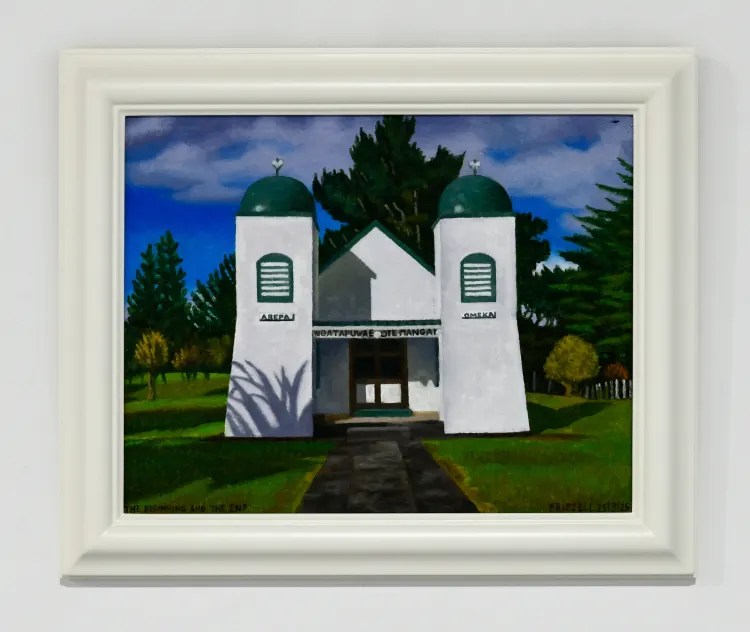
There are a few signs of habitation or figures in his works mainly small insignificant buildings, “Whitebaiter’s Huts” ($27,500) and “Leaning Toilet” ($27,500) but there is also a painting of a Ratana Chapel “The Beginning and the End” $27,500) displaying the words ārepa (alpha) ōmeka (omega), and the large panoramic “Autumn Morning Alexandra” $185,000).
Dick Frizzell, The Beginning and the End
The only paintings of a settlement in the exhibition are “Autumn Morning Alexandra, 2023 “($185,000) and “Alexandra Morning 2019” ($65,000) where the emphasis is on the natural aspects of the view, the distant hills, the colours of the sky and Autumn leaves as well as the surrounding vegetation. The largest work in the exhibition is “Milling Whakaangiangi” ($225,000), a celebration and recognition of the ever-changing face of the land.
As well as taking inspiration from the New Zealand artists of the early twentieth century there are acknowledgment of other artists – such as his Monet-like “Winter, Earnscleugh Road” ($55,000) and a nod to Winslow Homer’s lighthouse with his “Castlepoint”.
Dick Frizzell, Winter, Earnscleugh Road
As with much of the artist’s work there is a wry humour in many of the paintings both in terms of the subject and the titles. A small painting of a pie is titled 27/3/2025” where English and mathematics merge, similar to his Greek / English word play in “The Beginning and the End”.
The exhibition reveals an artist addressing conflicted personal and national histories around land, seeing the land as both a record of our history and a metaphor for our changing identity, seeing the future looming out of the past.
Auckland Art Gallery Toi o Tāmaki will present the first solo exhibition in Aotearoa New Zealand of Louise Bourgeois (1911–2010), one of the most intriguing and influential artists of the last century.
Opening 27 September, Louise Bourgeois: In Private View brings together a selection of works from an international private collection, exhibited publicly for the first time. The exhibition spans over six decades of Bourgeois’s career, from early paintings made in 1945 to a fabric work from the final year of her life
Auckland Art Gallery Senior Curator, Global Contemporary Art, Natasha Conland, says, “Bourgeois remains a defining figure in late twentieth-century art with the ripples of her influence still being felt today. She is known for her highly personal and idiosyncratic sculptural practice which has lent her a special place in the history of art.” “The works in the exhibition are from a private collection lived with over many years, reflecting a deep and personal appreciation of her practice.”
Widely celebrated for her psychologically charged and bold sculptural practice, Bourgeois explored themes of memory, family, the body and the subconscious, often drawing from personal experiences.
She is best known for her series of large spider sculptures, which have been installed in many major international cities.
Highlights include paintings and her first series of sculptures, the Personages, from the 1940s and early ‘50s; Lair sculptures from the early 1960s; and significant later works, such as textile-based sculptures and sculptural enclosures.
Louise Bourgeois. Spider VI
Spider VI (2002) is a wall-mounted example of her internationally acclaimed series of spider sculptures, which she began in the mid-1990s. Also featured is her extraordinary hanging sculpture, The Couple, and late outdoor piece, Eyes.
A series of curator tours and talks, open lates, as well as family-friendly activities has been programmed with the exhibition. The Gallery Shop has also launched a new range of Bourgeois inspired products which includes socks, brooches, books and more.
The paintings in Aroha Gossage’s new exhibition “Into the Light” are grounded in her connection to the whenua of Pakiri, north of Auckland where she lives.
They continue Gossage’s exploration of land, light, and ancestry, the paintings serving as links between observation of her environment and reflections on her connections to the land and to her ancestors.
Several of the works are titled after their subject matter, simple renderings of native trees – Nikau, Macrocarpa and Manuka. These works follow in the tradition of botanical artists such as Sir Joseph Banks who identified Manuka in 1769 during his time with Captain Cook on his first voyage aboard the Endeavour and many artists have depicted trees and their flowers since then notably Emily Cumming Harris and Shane Cotton.
Aroha Gossage, Manuka
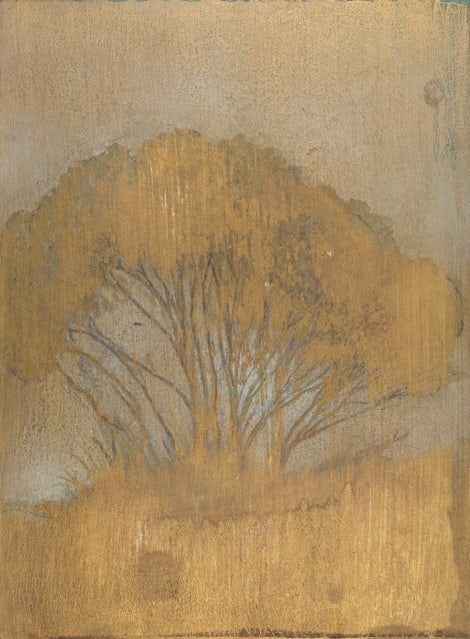
Gossage’s “Manuka” ($2700) is painted in golden tones giving it an enigmatic quality where earth and foliage are connected, creating an image which transcends the physical. ”Manuka” is part of group of four small works which have distinctive colouring, due to the earth pigments the artist has collected from sites around her local environment.
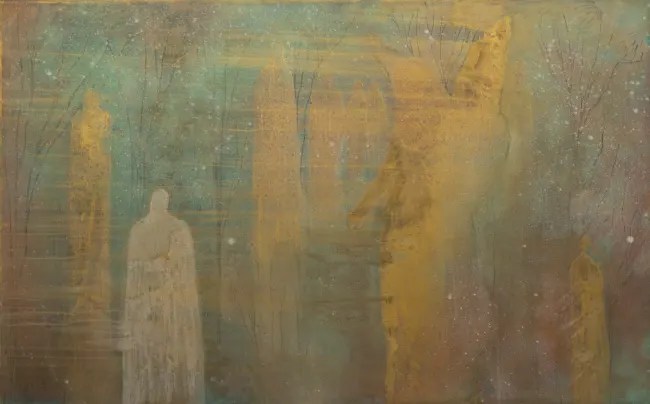
While most of her works are of botanical subjects there are a few which include figures, or at least the spirits or manifestations of figures. Rather than earthly figures they suggest ancestral presence. As the title of the show suggest these figures are journeying towards the light of a new place or a new understanding.
In the large ”Anahera” ($9800) a caped / shrouded figure inhabits an abstract environment with traces of foligare snaking through the work. There is a sense of another world in which ancestors dwell, the paintings connecting the physicality of this world with the spirituality of the other-world .
Aroha Gossage, Light
This can also be seen in “Light” ($2700) with one indistinct form and “Tupuna” ($9800) with several shapes inhabiting a forest of trees. With the works that include figures it is noticeable that while the trees are painted with distinctive realism the figures are indistinct and ethereal.
Some of her works such as “Witi” ($4750) have a quiet drama to them like Rita Angus’ “Tree”. ”Witi” is also impressive because of its deep red earth pigment which seems to it refer to bush fires, destruction and renewal.
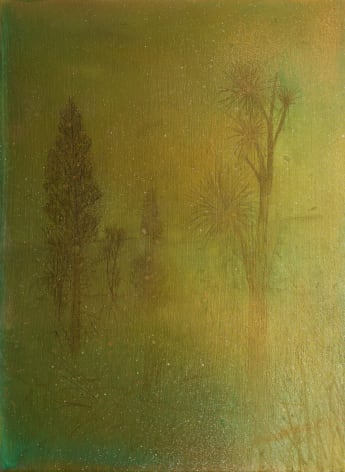
Works such as “Hine” ($2700) and “Macrocarpa” with their dark tones seem to be ghost-like images of the trees rather than mere depictions, as though inhabiting another dimension.
The suggestion of another world is created in many of these painting by veils of overlapping colour where the air around the foliage and figures in infused with earthy tones.
There are a couple of works which are pure landscape “Pakiri Dunes” ($9800) and “Kaitaki” ($9800).These do not have the same density or richness as the others works being descriptive with fewer allusions to another dimension.
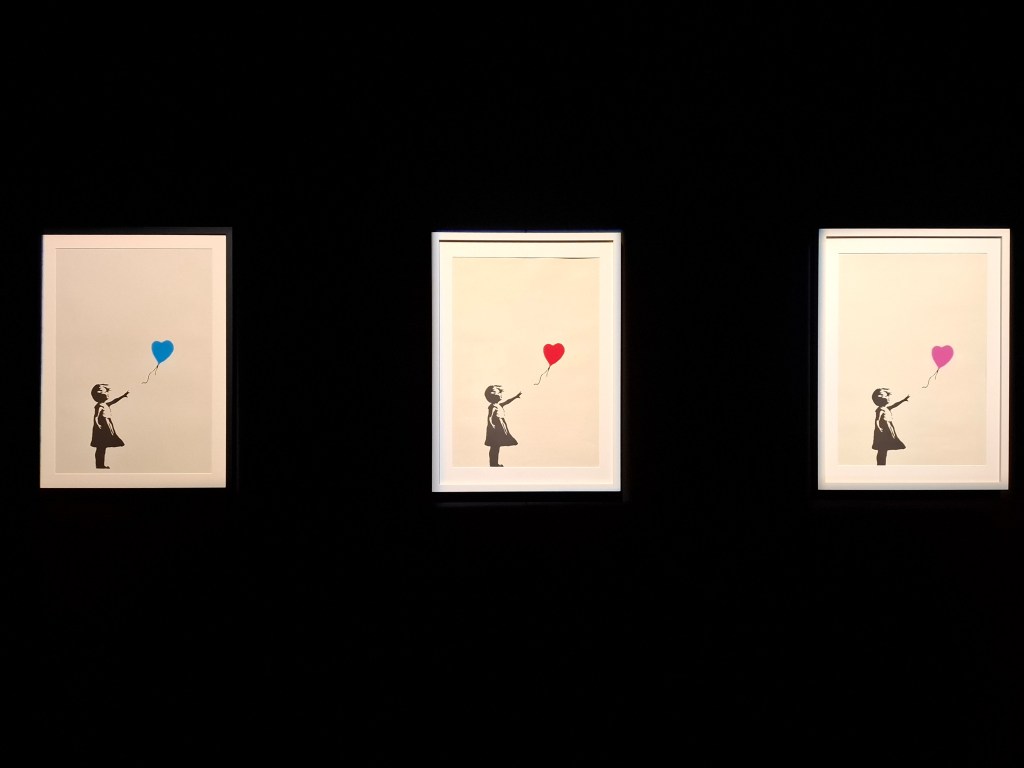
The Art of Banksy, is a major exhibition of the artist’s work which has now been seen by 1.5 million visitors in 18 cities around the world.
The collection of 150 original and authenticated works features more than 150 pieces, including prints, canvases, unique works, and ephemera.
There are several versions of his well-known pieces such as the “Girl with a balloon” and “Flower Thrower,” also known as “Love is in the Air,”
As with many of his works Banky borrows from other sources, changing the original intention, subverting the original meaning as well as trawling the world for the symbols and highlights in other artworks.
So, there are references, adaptations and reworkings of Christian iconography, news photographs, Disney images along with the work of Andy Warhol, Keith Harring and even Degas.
Banksy, Ballerina with Action Man parts
It is the clever borrowing of images which appeals to adult audiences as well as well as children and his images which undermine capitalism will bring a smile to both to the conservative as well as the revolutionary.
The exhibition spans his output from the 1990’s to the present-day showing examples of his satirical and subversive output often appearing in public places around the world.
His iconic artwork depicting a masked figure or rioter, about to throw a bunch of flowers is taken for a newspaper image of a rioter throwing a projectile. This substitution is an obvious message advocating for love and peace over conflict and war.
Banksy, Trolley Hunters
There are other works like “Trolley Hunters” that satirize consumerism by depicting cavemen hunting shopping trolleys instead of wild animals. As well as being a clever juxtaposition of elements it is also a commentary on how modern society has become overly reliant on mass-produced goods and detached from nature.
Banksy, Souvenirs
Some of his work has more immediacy such as the several works related to his Walledoff Hotel in Bethlehem including some hand painted souvenirs. There are also images of his “Dismaland”, his take on Disney World ,creating a dystopian “bemusement park” located at the Tropicana in Weston-Super-Mare in 2015.
The exhibition also helps expand our understanding of the artist with numerous quotes by the artist about his history and approach to his work along with commentary by some of his collaboratives.
While here are many of his famous work there are also some of his original pencil sketches for the finished works
The works in the exhibition show that Banksy can be viewed from various perspectives – a cartoonist, a comic, a satirist, an agent provocateur or an advertising guru,
The current exhibition “Mark Adams: A Survey | He Kohinga Whakaahua” is the artists first comprehensive exhibition of his work and features more than 65 works spanning his 50-years as a photographer. documenting the land, the people and its history. These photographs are of places across the Pacific, the United Kingdom and Europe.
Much of his practice documenting sites of significance across the country, include places where Captain James Cook and his crew came ashore on their visits in 1769 and the 1770s, as well as locations where Te Tiriti o Waitangi was signed in 1840.
Over the decades, Adams has sustained a deep and ongoing engagement with subjects of interest. He has photographed whakairo Māori (Māori carving) both here and overseas and the work of, Samoan master tattoo artists, Māori–Pākehā interactions in Rotorua, carved meeting houses, locations of significance for Ngāi Tahu in Te Waipounamu and the place of museums and photography in the area of cross-cultural exchange.
It includes photographs taken across the Pacific, the United Kingdom and Europe that explore the migration of artistic and cultural practices across the globe, and examine the role of museums, and photography itself, in the ongoing area of cross-cultural exchange.
The various sections of the book show Adams’ range of work from his early works, his focus on Rotorua, tatau, Treaty Signing Sites, Museums, Cooks Sites Māori meeting house in overseas locations, Te Waipounamu and his more recent interest in Photograms.
Several of his multi-image work are fascinating in their scope and production but the book does not do them credit, even when spread across several pages. With these works the exhibition at the Auckland Art Gallery make an impression in some cases filling an entire wall of the gallery. “0 degrees” is such a work, a panoramic 360-degree set of images taken at Greenwich Park which includes the Royal Observatory, the home of Greenwich Mean Time and Prime Meridian.
Other works on a grand scale include his “Nine Fathoms Passage”, the photographers view replicating William Hodges view of Dusky Sound, and his panorama of the meeting house, Hinemihi in the grounds of Clandon Park in Surrey, England as well as the magnificent meeting house Rauru in the Museum am Rothenbaum in Hamburg.
Mark Adams, 13.11.2000. Hinemihi. Clandon Park. Surrey. England. Ngā tohunga whakairo: Wero Tāroi, Tene Waitere, 2000, colour inkjet prints, Auckland Art Gallery Toi o Tāmaki, gift of the Patrons of the Auckland Art Gallery, 2014.
Author of the book Sarah Farrar says “You could say that, in many respects, Mark has been ahead of his time as a Pākehā and Palagi artist. But what does that really mean — to be ‘early’ or ‘ahead of one’s time’? It’s all relative and I’m sure many people would view a respectful approach to tangata whenua and tangata o le moana as seriously overdue.”
Adams’ photographs are of exceptional quality and intriguing in their distinctive approach to subject matter. The viewer is challenged to interpret , question and reflect on them. One commentator, Damian Skinner has noted that Adams photographs “offer no resolution, only problems. They patiently track the material traces of various forces that coalesce in specific sites”.
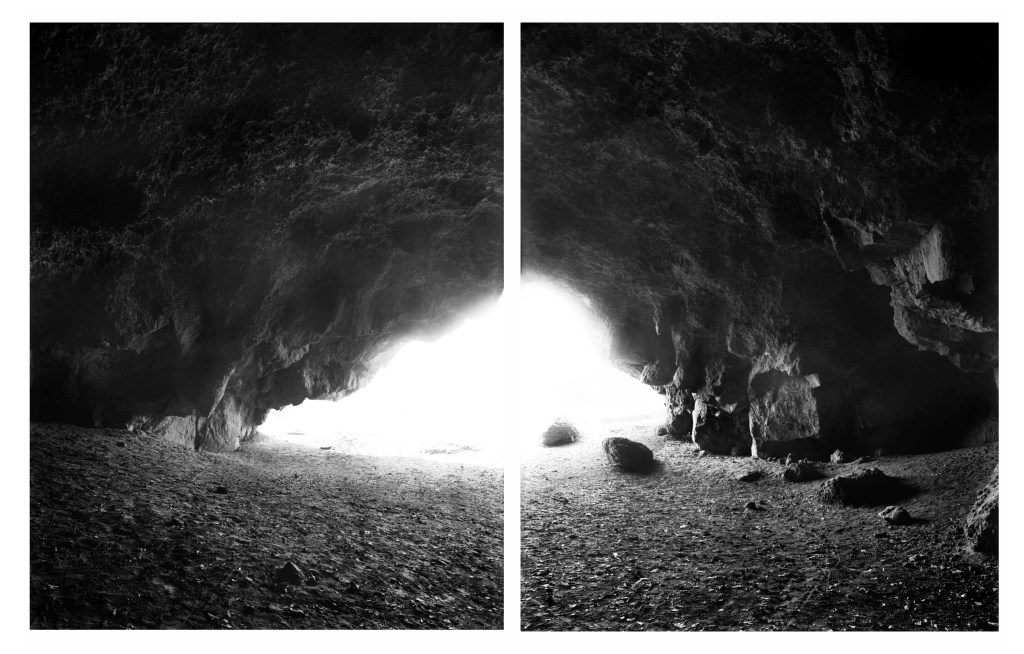
Mark Adams, 19.05.1989. Te Ana o Hineraki. Moa Bone Point Cave. Redcliffs. Ōtautahi Christchurch. Te Waipounamu South Island, 1989, gold-toned silver bromide fibre-based prints, Auckland Art Gallery Toi o Tāmaki, gift of the Patrons of the Auckland Art Gallery, 2014.
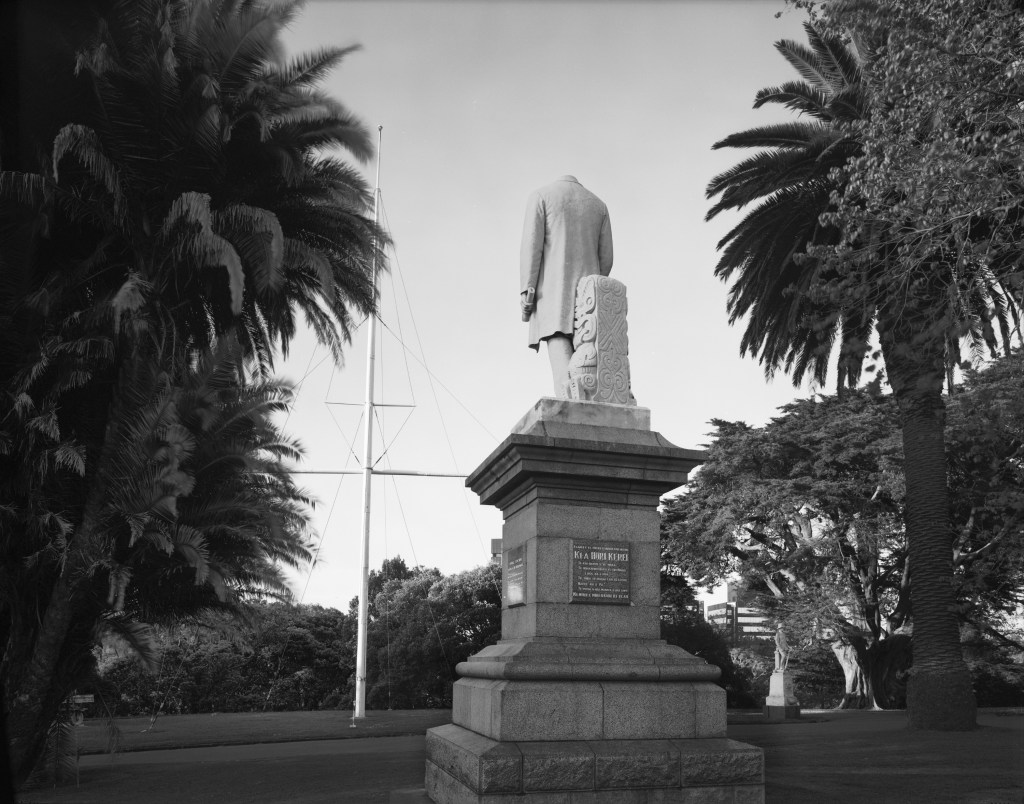
Generally, with photographs of important sites the photographer is essentially saying – “I was here – this is how it looks”. However, with many of Mark Adams photographs of historical sites, the land seems of little interest, often devoid of figures. With these the photographer seems to be saying “this is how it looked”. The photographs require the viewer to transport themselves back to that place but in another time.
Sarrah Farrar notes “His photographs of museums and art galleries remind me of the artifice and stagecraft that we are actively involved in as curators and museum professionals. Every decision we make communicates something to audiences. We construct meaning through the selection of objects (even those that are absent), their placement and their interpretation. Mark’s photographs remind me of the power dynamics and knowledge systems that are inscribed in museum, library and art gallery experiences — even embedded into the design of the buildings themselves. A great example of this is Mark’s panorama of the science-fiction-like modernist design of Berlin’s Staatsbibliothek, which feels so at odds with the fact that it’s the home of the journals of Georg Forster, the naturalist who travelled with James Cook on his second voyage.”
Mark Adams, 1988. Hori Korei. George Grey monument. Albert Park. Tāmaki Makaurau Auckland, 1988, silver bromide print, courtesy of the artist.
The book is a stylish, superbly-designed production with over 200 images, mainly black and white. It features an excellent text by Sarah Farrar as well as a forward by Ngahuia te Awekotuku and afterword by Nichlos Thomas
Martin Creed, Work No 3769, Work No 3764, Work No 2053
Three exhibitions K Rd – Palmer, Creed, Parekōwhai.
Stanley Palmer, New Work
Melanie Roger Gallery
Until February 22
Martin Creed, Like Favourite Socks in a Drawer
Michael Lett
Until March 1
Michael Parekōwhai, The Indefinite Article
Artspace Aotearoa
Until April 17
Reviewed by John Daly-Peoples
Current exhibitions along Karangahape Rd offers a range of art works from the realist depictions of the landscape to abstract paintings and conceptual construction.
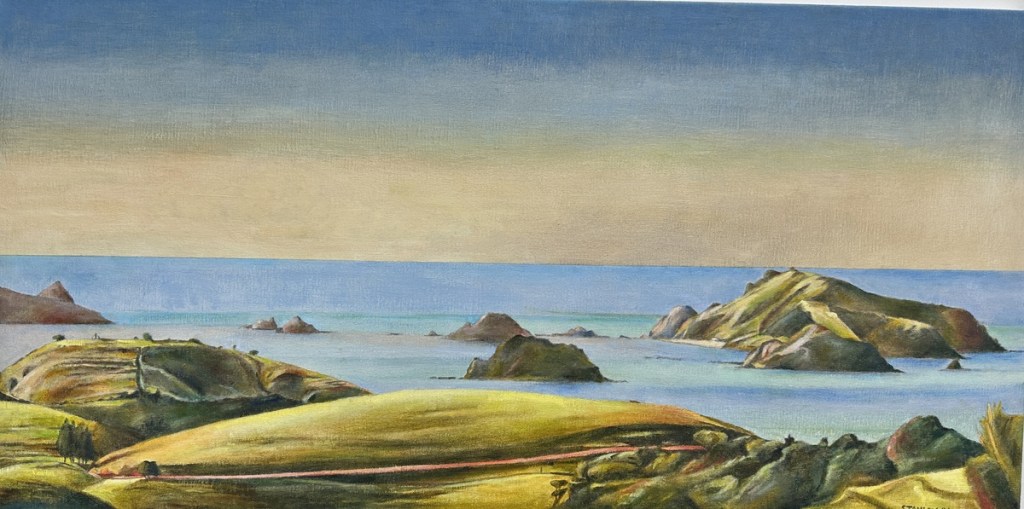
With his latest exhibition at Melanie Roger Gallery Stanley Palmer continues his depictions of the New Zealand landscape. Like many of his previous exhibition he has painted views of the New Zealand coastline featuring dramatic vistas of headlands and offshore islands.
With this new series of works he has revisited many of his previous subjects including depictions of Karamea, Great Barrier Island, Chathams, Great Mercury Island and Matauiri. While these are mainly landscape there are a few which also feature other element in the landscape which add a visual drama as in “Akiaki – Chathams” ($30,000) where he has included windswept trees and grazing sheep.
Stanley Palmer, “Akiaki – Chathams”
These paintings seem to be less detailed than some of his previous work and there is a simplicity which gives these works an added drama. Part of this drama comes from the artists shrewd use of paint, so that in “Awana- Aotea Great Barrier” ($22,000) the eroded cliffs are highlighted by the gash of earthy colours and in “Mataurui” ($28,000) the red line of a track is like an abstract slash through the landscape.
Stanley Palmer “Mataurui”
In most of the works the background of sea meeting sky shows a clever juxtaposition of shimmering abstract blues with subtle variations between each of the paintings
Also included in the exhibition are some of the artist’s earlier bamboo prints of the early 1970’s including “Hillside Town Kohukohu” ($2250).
Stanley Palmer “Hillside Town Kohukohu”
Martin Creed’s minimalist works have always played with the definition of art and art making starting with his Turner winning installation “Work No. 227: The lights going on and off: an empty room” in which the gallery lights switched on and off at 5-second intervals.
His work is a mixture of the witty, poetic and philosophical, making use of a range of everyday materials and approaches which challenge traditional views of art.
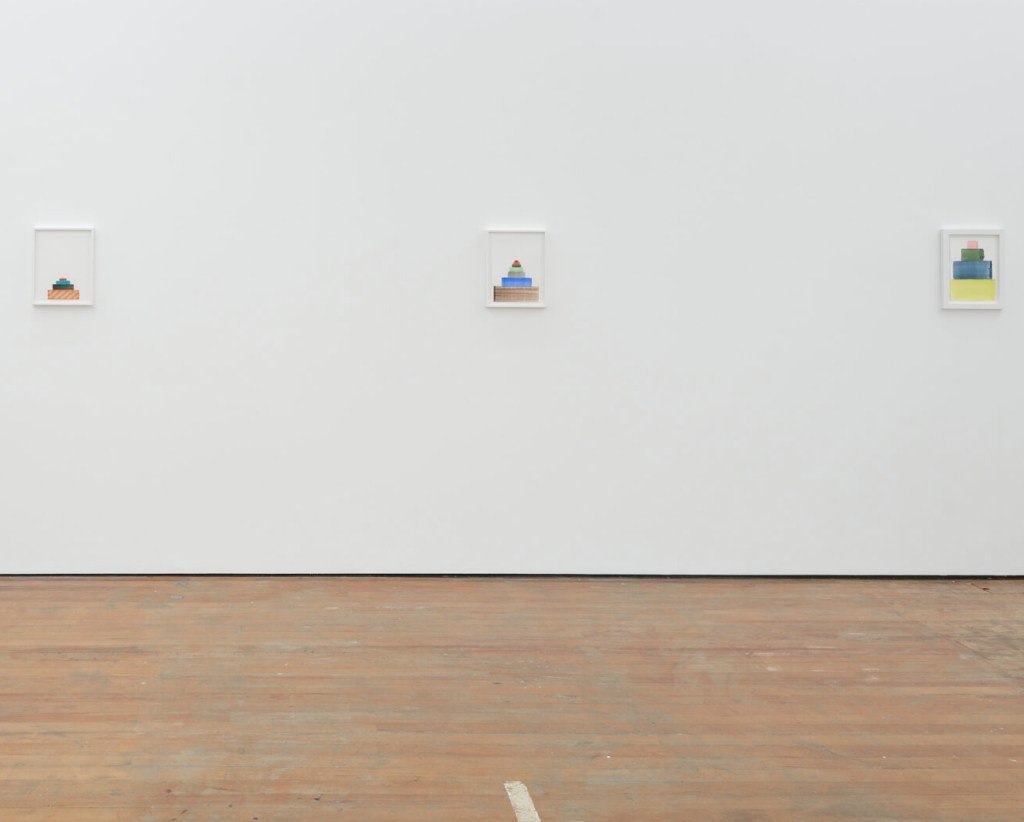
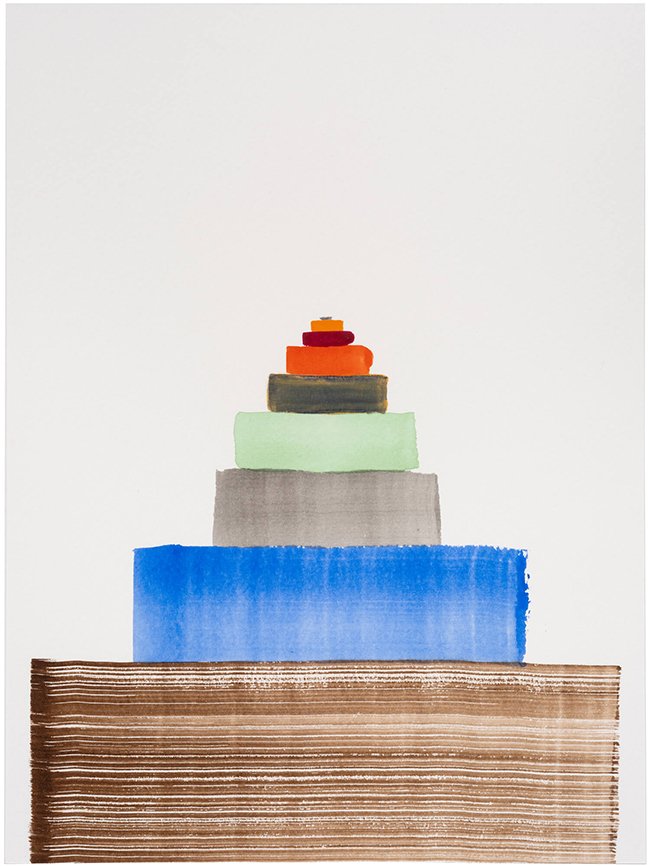
His current show “Like Favourite Socks in a Drawer” brings together elements of chance, time and structure with a series of ziggurat shaped works. The works started with his decision to buy an ordinary multi pack of commercial paint brushes.
Martin Creed, Work No 3764
With these he applied paint in different colours with the varying brush sizes, stacking the colours one above the other to create stepped, random bands of colour.
The paintings/designs can be seen as referencing the ziggurat forms of ancient Mesopotamia and Mexico as well as more recent brutalist constructions and has connections with Rewi Thompson’s block-like house in Kohimarama. There are also hints of Frank Stella, Donald Judd and Cuisenaire rods.
Creed says of the works “A step pyramid is solid and easy to understand. It is a safe structure that is not going to fall down. It is trustworthy. You can see how it is built. The steps are hopefully leading to the top, and you can enjoy the colours on the way up. In a blobby, soupy, ill-defined world it can be helpful to put your ducks in a row.”
The works have a sense of the structure to them with their build-up of coloured shapes and in works such as “Work No 3764” (USD $22,000 plus GST) there is sense of the artist gestural involvement where the striations of the brown / sepia are visible as a single calligraphic stroke. With others there is the notion of time with the various strokes of colour measuring out the time taken to complete each work
Martin Creed, Work No 3766
Some of the work display additions to the quick gesture with Creed scumbling the yellow band in “Work No 3766” (USD $22,000 plus GST). This work like some other has a humorous element with the painting looking like a celebratory, multi-layered birthday cake.
The works all convey Creed’s minimalism of means, notions of time along with the structuring and ordering of objects shapes and colours.
Michael Parekōwhai, The Indefinite Article
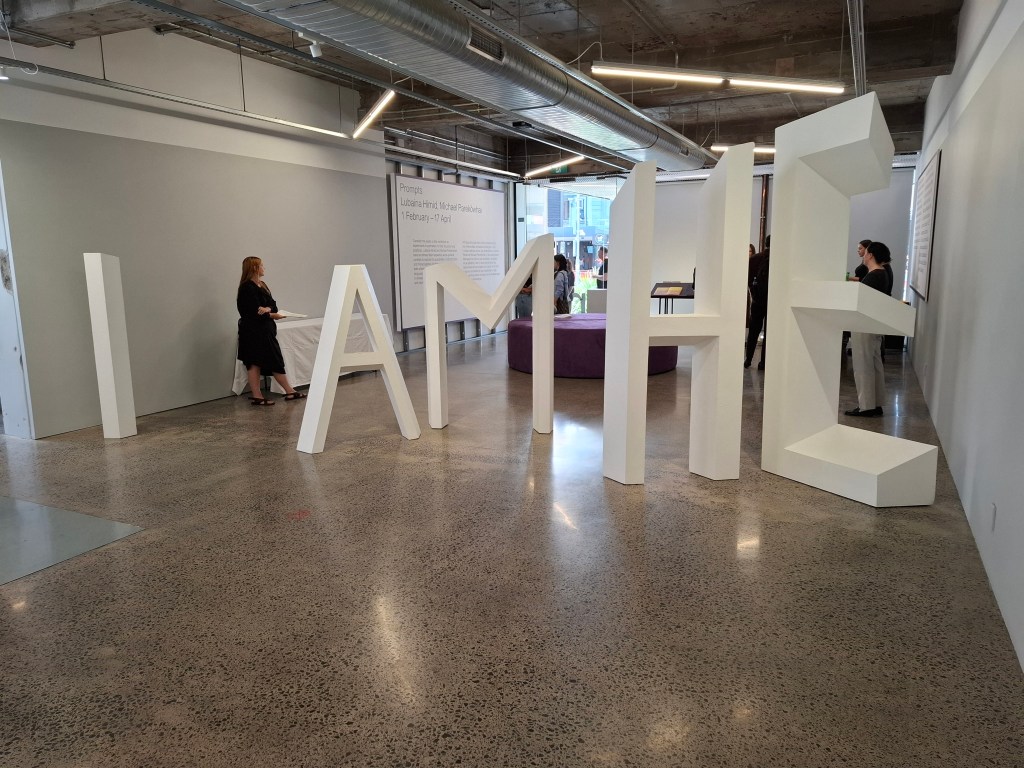
Artspace is exhibiting Michael Parekōwhai’s sculptural object, “The Indefinite Article (1990) which had previously been shown at Artspace in 1990 in the show “Choice” curated by George Hubbard
The large letters based on McCahon’s cubist stylised letters constructed of MDF spell out the words “I AM HE”. Which references some of the McCahon paintings featuring the words “I Am”.
While borrowing from McCahon the work can also be seen as creating a bilingual pun linking the words to te reo where “HE” can be read as the indefinite article where the word can be defined as -a, an, some – or it can also mean something is wrong, mistaken or incorrect.
Other linguistic variations can be identified with the words. During the ”Cultural Safety” exhibition in Frankfort in 1995 where the work was shown this reviewer noted at the time – “His large word sculpture using the words of the Colin McCahon painting I AM HE was quickly identified by one perceptive German journalist as coming from the pen of John Lennon in “I Am the Walrus” [I am he as you are he, as you are me and we are all together] rather than the Bible or McCahon.
The “Follow button” at the bottom right will appear and clicking on that button will allow you to follow that blog and all future posts will arrive on your email.




 27/3/2025” where English and mathematics merge, similar to his Greek / English word play in “The Beginning and the End”.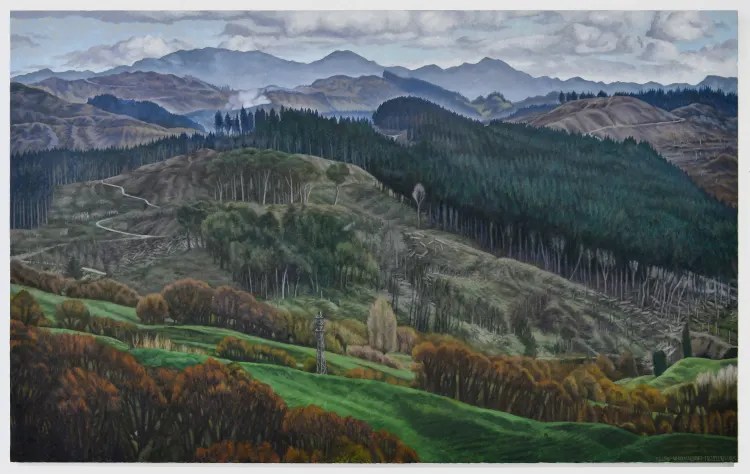







 New Zealand Arts Review