In the hands of the Australian company Circe the world’s most romantic ballet is re-imagined as a circus spectacular, full of Circa’s signature physicality and shot through with cheeky humour and a thoroughly contemporary energy.
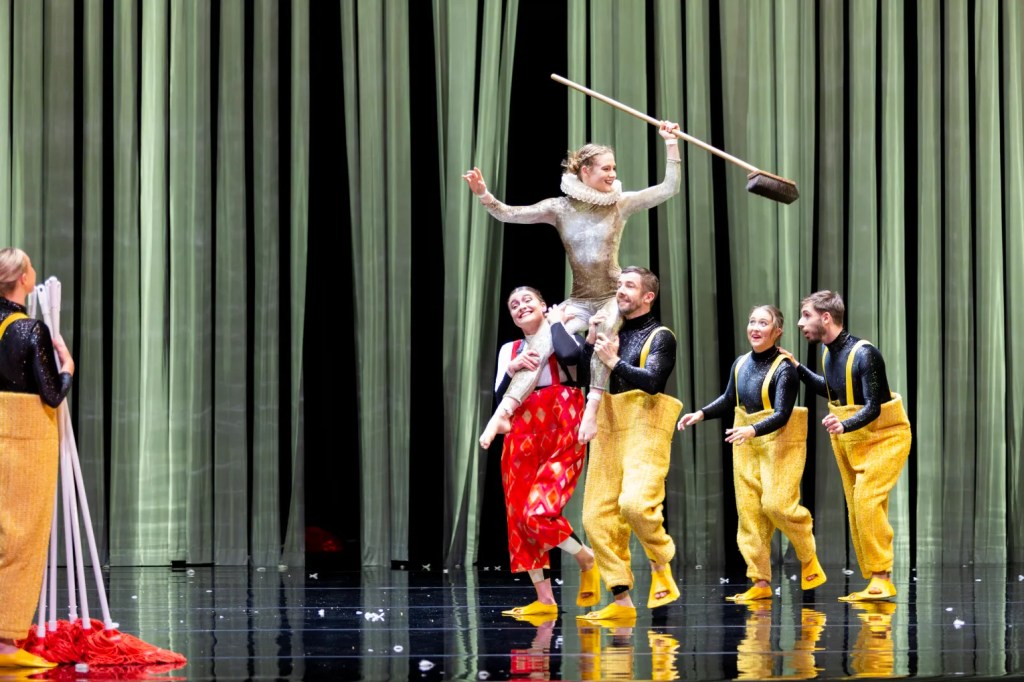
The audience is swept away by this tale of swans and hapless princes sparkling with quirky touches like the sequinned flipper-wearing duck army and a burlesque black swan. There are sumptuous aerials performances, jaw-dropping acrobatics and many feathers.
The show has been seen around the world and a review of Duck Pond in The Guardian by Lindsey Winship was enthusiastic.
“Australian company Circa are masters of modern circus, often eschewing obvious exhibitionism, and instead weaving acrobatic skills with a dance and theatre sensibility to make mood pieces.
The name is a parody of Swan Lake and it borrows from the famous ballet – shards of Tchaikovsky’s score feed into Jethro Woodward’s soundtrack – and also from another fairytale, the Ugly Duckling. So we get a love triangle of sorts between a prince, an ugly duck and a vivacious black swan. The conceit might seem to promise a more conventional narrative, but it delivers something a little different. The mood is understated, classy, colours of black and gold, a clan of performers in shimmering velvet catsuits. The music is a constant underscore rather than a game of set-ups and climaxes.
There is a lot of beautiful skill on show. Acrobats climb up human towers; flyers somersault between bases. Their formations of three are especially inventive: ornate arrangements of bodies in fine-tuned equilibrium, toes anchored on hips, lower backs, shoulders, anywhere they can get a foothold. There are some lovely moments of flow between couples who lift and fling, curl and unfurl, balance and counterbalance. Bodies tie themselves in knots on the trapeze; others soar on the silks. The ugly duck is revealed to be a swooping swan; the black swan has a dominatrix moment walking over a man’s bare back in red stilettos. But there are lulls too, such as a pillow fight that turns into an anticlimax.
Story-wise, director Yaron Lifschitz puts a couple of nice twists on the Swan Lake narrative but it lacks a big emotional payoff. Low-key lyricism, rather than transactional tricks for applause is Circa’s way and Duck Pond is a lovely show, with warmth, skill and some wow moments.”
Brandon Reiners and Ana Gallardo Bobainaw Photo credit: Stephen A’Court.
Macbeth
Auckland Arts Festival
Royal New Zealand Ballet
Co-production with West Australian Ballet
Kiri Te Kanawa Theatre, Aotea Centre
4-7 March
CREATIVE TEAM:
Choreography – Alice Topp Set & Lighting Design – Jon Buswell
Costume Design – Aleisa Jelbart
Dramaturgy – Ruth Little
Music – Christopher Gordon
Conductor – Hamish McKeich
String Ensemble – Musicians of the New Zealand Symphony Orchestra
Then
Dunedin, The Regent, 13-14 March
Christchurch, Isaac Theatre Royal, 18-21 March
Reviewed by John Daly-Peoples
The Royal New Zealand Ballet ‘s new Macbeth, is a contemporary interpretation of one of Shakespeare’s most ruthless tragedies which is as relevant now as it was four hundred years ago. As in many of his plays Shakespeare explores the intense, often tragic tension between the individual and the state, showcasing how personal identity, ambition, and morality clash with political power and societal duty. In his plays state authority and sovereignty, demand conformity, yet individuals seek autonomy or challenge the status quo, navigating complex power structures.
He explores the Machiavellian rise to power and the devastation that two individuals can inflict on the state.
This is all achieved in this production through the choreography, the sets and the music.
The sets designed by Jon Buswell are essentially minimalist while the lighting, also by Buswell is more complex. At some points the lighting is focused on the main characters, at other times shadows and darkness dominate.
Created by internationally director / choreographer Alice Topp the ballet unfolds in a ruthless modern world shaped by political ambition, media manipulation and the fatal seduction of power.
She says, “Macbeth is one of Shakespeare’s great tragedies, exploring themes as current today as they were when first written,” says Alice Topp. “An epic story fuelled by political ambition, passion, desire for power and the burden of guilt, its potency endures. Our Macbeth is set in a hierarchy-hungry, high-society city, where political storms, media frenzy and personal ambition collide.”
The music for the work has been composed by Christopher Gordon and features both recorded and live music. One hundred and twenty-nine musicians contributed to the recorded music while an octet of strings from the New Zealand Symphony Orchestra provide live music. The musical landscape provides full orchestral sound with driving, unrelenting tempo that echoes the character’s anxieties.
Gordon created a series of musical themes designed to reflect the characters as well as the mood of the various sequences of the ballet. His complex music consisted of big band music, electric dance music, funk, film music and references to composers such as Phillip Glass.
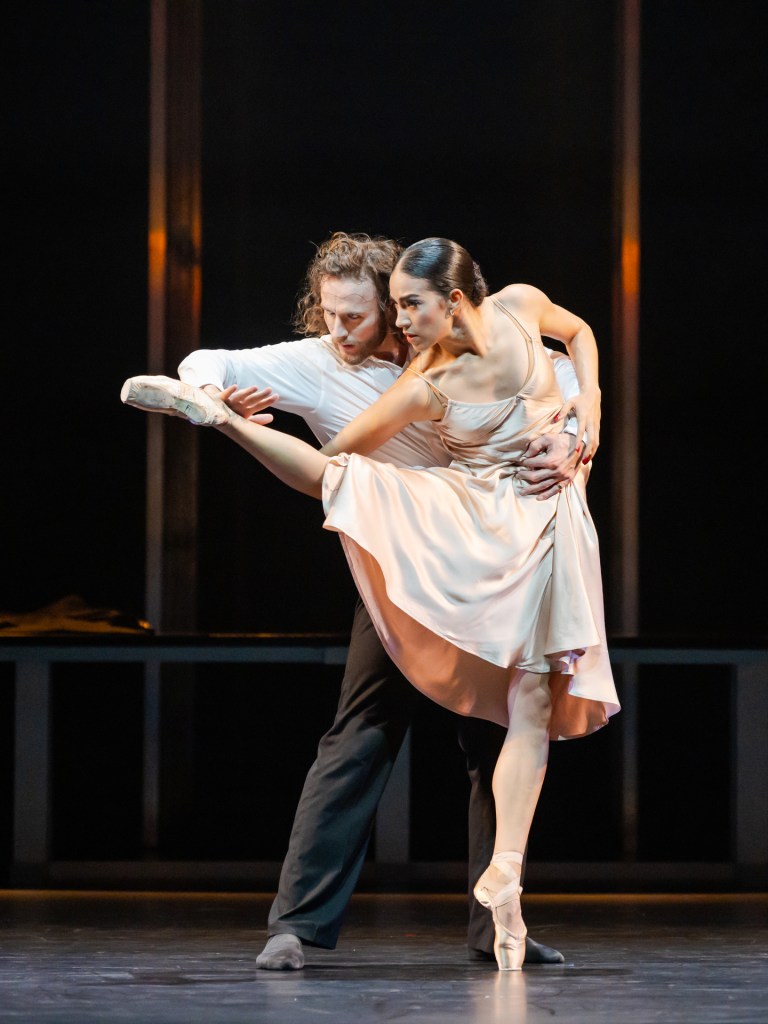
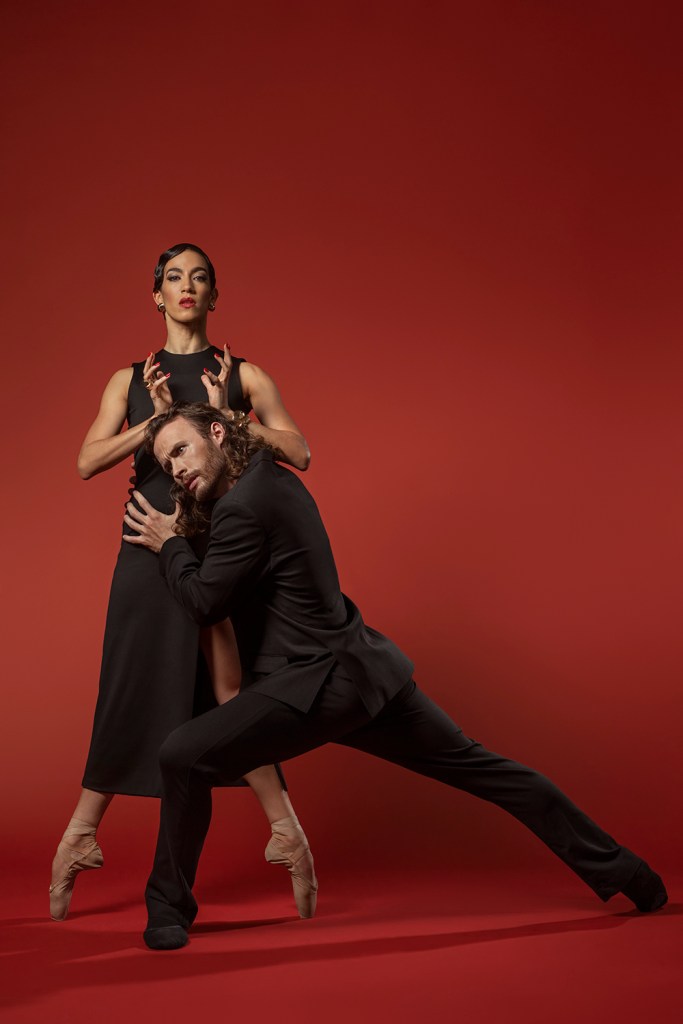
At the centre of the ballet are the two malevolent Macbeths (Brandon Reiners and Ana Gallardo Bobainaw) who dance their solos, pas de deux with moves which indicate corruption and self-centeredness.
The visceral language of the choreography is used to explore the characters psychological pursuit of power and duplicity.
The classical poses and movements which are normally used to display romantic connections were subverted so that these movements create a disquiet which reflects their own inner turmoil. When the two of them dance their elaborate almost ritualistic dances they seem to be abusing each other in erotic displays.
While the sets are minimal, they are often dominated by tables surrounded by protagonists who engage in discussion and planning. These balletic movements around the table recall Canadian choreographer Crystal Pite’s “The Scenario”, her witty take on a boardroom meeting,
As the three witches / influencers Kirby Selchow, Ruby Ryburn, and Shaun James Kelly are an excellent melding of the comic, the supernatural and the intruding media with the endless writhing, gesturing and guttural sounds.
Laurynas Vėjalis as Duncan, Dane Head as Malcolm, and Kihiro Kusukami as Banquo gave strong displays which contrasted with the spikey dancing of Reiners and Bobainaw.
There were a few occasions when the audience was given some indication of the story with texts projected onto screens, including a few lines form the play itself but there were other times when the audience could have been given more useful indications of location and event.
Branden Reiners (Macbeth), Ana Gallardo Lobaina (Lady Macbeth) Image: Ross Brown
The Royal New Zealand Ballet
Macbeth
Wellington, Auckland and Christchurch
March 2026
John Daly-Peoples
The Royal New Zealand Ballet open its 2026 season with a contemporary reimagining of Macbeth, Shakespeare’s most brutal tragedy. Created by internationally acclaimed choreographer Alice Topp (Aurum, Logos, High Tide), the ballet unfolds in a ruthless modern world shaped by political ambition, media manipulation and the fatal seduction of power.
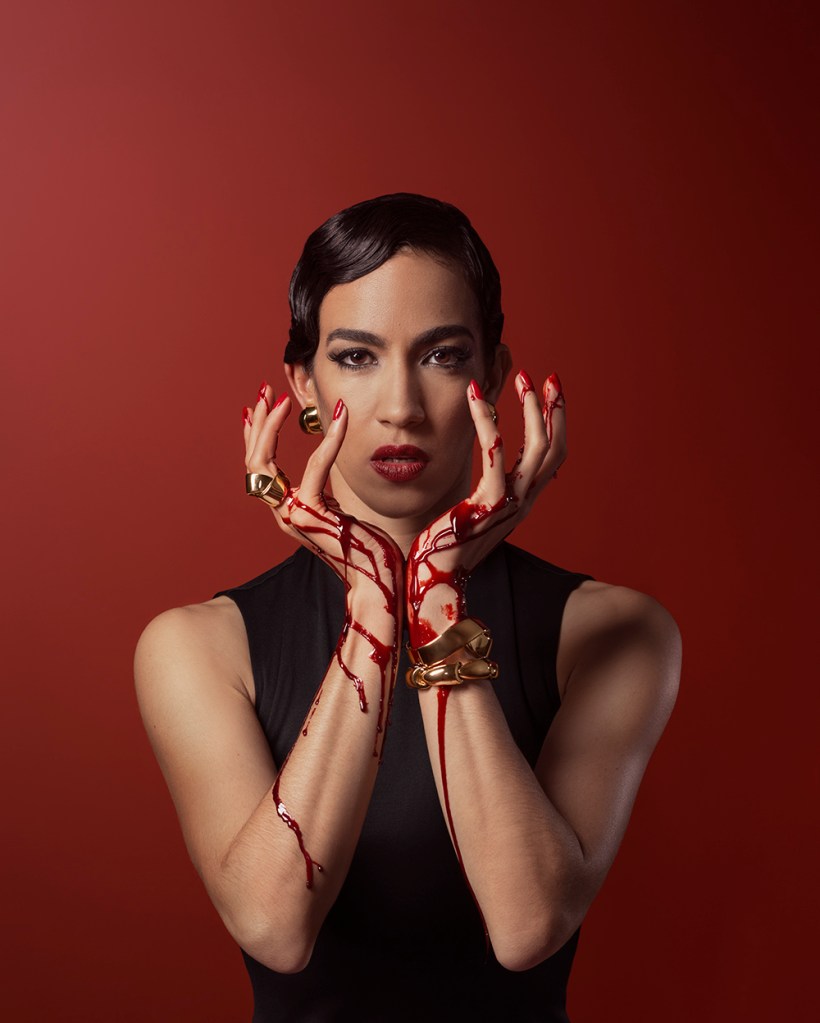
The production will feature Ana Gallardo Lobaina as Lady Macbeth and Branden Reiners as Macbeth.
“Macbeth is one of Shakespeare’s great tragedies, exploring themes as current today as they were when first written,” says Alice Topp. “An epic story fuelled by political ambition, passion, desire for power and the burden of guilt, its potency endures. Our Macbeth is set in a hierarchy-hungry, high-society city, where political storms, media frenzy and personal ambition collide.”
While ballet companies across the world regularly perform “Romeo and Juliet” and “A Midsummers Night Dream” based on Shakespeare’s plays very few of his other works are performed. “A Winter’s Tale”, “Hamlet”, “Othello” and “The Tempest” are occasionally performed.
Just in the last couple of years there have been other productions of Macbeth with the National Ballet of Japan performing “The Tragedy of Macbeth” by British choreographer and director Will Tuckett in 2023 and last year the Dutch National Ballet presented a “Lady Macbeth” choreographed by Helen Pickett.
This new co-production with West Australian Ballet will see Macbeth premiere as part of the Aotearoa New Zealand Festival of the Arts in Wellington and the Auckland Arts Festival, before touring to Christchurch and Dunedin. Presented in association with Avis, this ambitious new work places Shakespeare’s iconic story of ambition, power and moral collapse into a volatile modern world shaped by political manoeuvring and relentless media scrutiny.
At the centre of the ballet is the rise and fall of Macbeth and his formidable wife – a dazzling power couple whose ascent to influence is as intoxicating as it is catastrophic. Propelled by ambition and fanned by public adulation, the Macbeths scale extraordinary heights, only to find themselves consumed by guilt, paranoia and violence. Through the visceral language of contemporary ballet, their psychological unravelling is laid bare in an explosive portrait of power gained and power lost.
For Topp, the translation of Shakespeare’s dense, language-driven tragedy into movement is not an act of reduction, but of revelation. “Shakespeare’s text might be dense, but it also has movement written into the language,” she says. “The story is a psychological drama, full of behaviours, emotions and atmosphere. All the movement is right there in his words, and my role is to find where those emotions land in the body and let them speak physically.”
Award-winning designer Jon Buswell, a long-time RNZB collaborator, will create both set and lighting, shaping a darkly glamorous world that reflects the ballet’s volatile political landscape. Costumes are by Sydney-based designer Aleisa Jelbart, renowned for her bold contemporary designs across ballet, opera and theatre, bringing a sharp modern aesthetic that underscores the work’s themes of power, status and image.
The production will also feature a newly commissioned contemporary score by composer Christopher Gordon, performed with a live string ensemble from the New Zealand Symphony Orchestra. Layering full orchestral textures with driving, heavy-metal influences, the music provides an unrelenting pulse that mirrors the characters’ accelerating descent.
Ana Gallardo Lobaina (Lady Macbeth) Image: Ross Brown
Ana Gallardo Lobaina has danced numerous roles for the RNZB including Cinderella and Stepmother in Loughlan Prior’s Cinderella. and she featured roles in Alice Topp’s Aurum and Logos.
Branden Reiners joined the Royal New Zealand Ballet in 2023 and his roles to date include Siegfried and Rothbart in Swan Lake, Tybalt and Lord Capulet in Romeo & Juliet, Serenade, the ‘Clay’ pas de deux in Alice Topp’s Logos.
Artistic Director Ty King-Wall says the new production showcases the RNZB at its most daring and expansive. “Macbeth is the Royal New Zealand Ballet as you’ve never seen us before,” says King-Wall. “Alice is bringing a world of bloodshed, betrayal and intrigue to our stages, in a cutting-edge production which draws upon the versatility of our dancers, the skill of our technical team, and demonstrates our incredible artistic range as a company.”
Macbeth stands as one of the most ambitious new works in the company’s recent history. A bold and bloody retelling of Shakespeare’s tragedy, it promises audiences a searing, high-octane theatrical experience – one that speaks urgently to the contemporary world while honouring the enduring power of the original story.
2026 TOUR DATES Wellington, St James Theatre, 25-28 February
Auckland, Kiri Te Kanawa Theatre, Aotea Centre, 4-7 March
Black Grace, If there ever was a time Image: Jinki Cabronero
Black Grace: Celebrating 30 years
Civic Theatre, Auckland
November 21
Then Isaac Theatre Royal, Christchurch
November 25 & 26
Reviewed by John Daly-Peoples
For their thirtieth anniversary finale Black Grace presented two works, one a new piece by Neil Ieremia and a work by the legendary American choreographer Paul Taylor, created in 1975.
Of the first work on the programme “If there ever was a time” Ieremia notes, “I was raised in the church, carried along by its stories, its hymns, its promises. I have been losing my religion for the last forty years. This work is my response to what I see as the weaponisation of faith”.
The work takes an ambivalent approach to his dilemma with the music he uses to propel the dancers a mixture of traditional Pacific music – Samoa Sila Sila and contemporary music including “Voodoo in my Blood” from Massive Attack & Young Fathers and “Monolith” featuring DJ Krush with their anti-capitalist rages.
The set featured a large image of the moon which slowly moved across the rear of the stag while above the stage was cloud form of wispy fabric which ultimately collapses, a metaphor for the failure of the old order and religion.
The music was a mixture of traditional Pacific music – Samoa Sila Sila and contemporary music including “Voodoo in my Blood” from Massive Attack & Young Fathers and “Monolith” featuring DJ Krush.
The work is like a series of rituals with repeated movements and sequences of action and reaction where the physical exertion of the dancers reflect idea about passion and emotion.
Like a lot of contemporary dance, the work owes much to the Stravinsky / Nijinsky ballet “The Rite of Spring” with its rituals and confrontations.
“If there ever was a time” used some of these ideas in addressing issues around religion, colonialism and Ieremia’s ambivalence about religio and its effects on the Pacic Island communities.
The dancers’ gestures and movements are those which have often been used by the company for many years – signalling with the hand, arm and leg displays which are strongly angular and abrupt. Some of the movements are close to rap moves with sharp slides, leaps and pivots, the agitated movements mirroring the frantic sounds of the music.
At one point group of dancers form an elaborate multi-faceted form – a parasite or insect which inches across the stage menacing the sole dancer who skips relentlessly.
The image of this confrontation evokes the imagery of Franz Kafka’s “Metamorphosis” where an individual struggles to find identity and break from conformity.
In another sequence two figures – a betrothed couple, one holding a wedding bouquet enter from either side of the stage, their heads wrapped in cloth, restrained by straining figures. Their anonymity and desperation seem to have been taken from the Magritte painting “The Lovers” where two figures, their heads wrapped in cloth attempt to kiss, suggesting the complexities of love and intimacy.
The choreography was endlessly original and interesting where simple dance steps evolve into unusual and unsettling movements and as the music changes the forms, dynamics and energy evolve.
Black Grace , Esplanade Image; Jinki Cambronero
The second work on the programme was Paul Taylor’s 1975 work “Esplanade”, a piece Ieremia had been wanting to present for many years. It was inspired by the sight of a young woman running to catch a bus. This notion of using everyday movement and elevating it to dance has been a central concept of Black Grace dance since its inception.
The work links ballet, court dance and contemporary movement danced to Bach violin concertos providing a mix of elegance and simplicity.
Much of the time the dancers walk, run, slide, and whirl around the stage seeming to follow some predetermined paths in fluid and orderly formations. Elizabethan court dance refashioned in a modern form.
There were elements of energy and drama when the women took giant leaps into the male dancers’ arms as they rotated around the stage. These bolds moves contrasted with the more tender sequences which emphasised weightlessness and where the dancers met casually, touched lightly, bracing and gesturing in languid movements.
While much of the dancing was at frenetic pace there were also times when the dancers seemed to slow their movements to become more like stop motion sequences highlighting the nature of movement
While the work is based on the movement of the street there is a vibrancy and energy to the work with its combination of rushing and motionless dancers giving the work a visual and emotional power.
The “Follow button” at the bottom right will appear and clicking on that button will allow you to follow that blog and all future posts will arrive on your email.
Royal New Zealand Ballet & The New Zealand Dance Company
Kiri te Kanwa Theatre, Aotea Centre, Auckland
July 31
Reviewed by John Daly-Peoples
Choreography: Stephen Baynes, Shaun James Kelly, Moss Te Ururangi Patterson Music: Pyotr Ilyich Tchaikovsky, Philip Glass, Shayne P. Carter Set Design: Jon Buswell (Home, Land and Sea) Costume Design: Stephen Baynes with RNZB Costume Department, Rory William Docherty, Moss Te Ururangi Patterson with RNZB Costume Department Lighting Design: Jon Buswell, Daniel Wilson
“Home, Land and Sea”, The Royal New Zealand Ballet’s Triple Bill featured three very different works each with a distinctive mood and choreography, all had links to the land with styles ranging from the abstract to the deeply connected.
The opening work, Stephen Baynes’ “The Way Alone” was originally performed in Hong Kong in 2008 for a Tchaikovsky programme and is a response to some of the composers lesser-known music included some of his choral works. Firmly in the classical tradition the dancing was a direct response to the textures and rhythms of the music. the choreography emphasising the qualities of weightiness, graceful movements and subtle gestures as well as accentuating the dancer’s integration with aspects of light and shadow.
The work owed much to concepts of ritual with an elegance and refinement to the dancing which featured some beautifully articulated pas de deux and pas de trios.
The only problem with this sequence was that the recorded sound lacked the refinement of the dancing and created a disconnection between audio and visual. It was an issue that did not affect the other two works.
Chrysalis, Kate Kadow and Calum Gray Photo credit: Stephen A’Court.
After the first interval was the premiere of Shaun James Kelly’s “Chrysalis” set to the Phillip Glass music “Metamorphosis” which was inspired by the Franz Kafka short story of a man who wakes up to find his body has been changed to that of a large insect or chrysalis.
The setting for the dance also gave a nod to Kafka’s other work “The Trial” with various figures, some in trench coats roaming the stage, divesting themselves of items of clothing , an act which provided a clever metaphor for transformation – the shedding of skin and the emergence of the butterfly from the chrysalis.
The music features Glass at his minimalist best with repeated phrases and eerie looping sequences. There were also long, enigmatic silences which were as expressive as the music and emphasised the notions of the dream, the surreal and the transformation.
The musical landscape with its abrupt, stark sounds was echoed by the dancers with their carefully choreographed movements, rapid changes and tense interactions.
Home, Land and Sea Photo credit: Stephen A’Court
The third work on the programme was “Home, Land and Sea” choreographed by Moss Te Ururangi Patterson’s (Ngāti Tūwharetoa), the Artistic Director of The New Zealand Dance Company. This was the first the Royal New Zealand Ballet has partnered with The New Zealand Dance Company with members from both companies performing.
The stage featured five panels on which were projected images linked to the dance – tāniko, vegetation, clouds and sea.
The work combined contemporary dance and kapa haka suggesting elements of journey, history and tradition.
The music for the work composed by Shayne P. Carter had a harsh quality to it which was emphasised by the dancing where there was much angularity in the gestures and movements, combining the sinuous quality of contemporary dance with the intensity and athleticism of kapa haka.
The element of sound often associated with kapa hake -was also much in evidence – slapping, stamping and breathing, all adding to the physicality of the work.
In the latter part of the dance when the dancers became more dynamic and the music more aggressive, the roiling mass of dancers seemed to become a force of nature transcending their human condition to become god-like in their expression.
For Black Grace’s “Rage Rage” the Aotea Centre’s Hunua Room was set up with a high catwalk built through the centre of the space.
Was this nod to Dylan Thomas’s “Rage rage against the dying of the light” or a personal rage of Neil Ieremias. His work has always had an element of the personal and the political with works which are confrontational both between the performers themselves and between performers and audience.
Up to a couple of dozen performers race around the stage, in waves of massed groups, performing a series of linked dances to a range of music from traditional Samoan to contemporary rap.
Like all Ieremia’s shows this was a high energy and relentless performance combining many of the elements of his previous explorations in dance.
There is the hand clapping, foot stomping, the falls / collapses, hand movements like a form of deaf signing and arms used as a kind of semaphore.
The various sequences are introduced by Strictly Brown founders Leki Jackson-Bourke and Saale Ilaua who reminisce about their time at school, favourite TV and films and playground games. These reminiscences lead the company into surges of movement.
The sounds are a mixture of the traditional and the modern as the dancers negotiate issues of the present which are rooted in the past. Some of these are addressed in the latter part – Covid, climate change and the future of Tuvalu.
Many of routines seem based on the schoolyard ‘game’ of Rush, some of which morph into fights or just dissipate.
The final sequence is a mix of despair and celebration danced to a nihilistic vocal soundtrack-
“I don’t belong here
I’m a weirdo
What the hell am I doing here”
With the refrain
You don’t belong here
Which encapsulates so .much feeling and emotion focused on the emptiness of contemporary life.
Like much of Black Grace dances there is a tension and drama created by the action and reaction, between rapid movement and calm, between a zombie-like state and intense animation.
Throughout the performances there is an awareness of the beauty and intensity of the dance and the strange conflicting visceral and abstract nature of the dancing which underlines Ieremia’s ability to create dance which is focused and potent
The “Follow button” at the bottom right will appear and clicking on that button will allow you to follow that blog and all future posts will arrive on your email.
The Lula Washington Dance Theatre is a contemporary modern dance company in Los Angeles which has performed across the United States and toured internationally. It was established forty years ago when Lula Washington realised there were few black dance institutions in America .
They have a stylish approach to contemporary dance incorporating elements of African and Caribbean dance as well as contemporary modern dance and ballet. All these elements were seen in the opening number where three dancers – Love, Faith and Hope, performed to heavy beats, foot stomping and clapping with the audience encouraged to add to the heavy clapping to that of the dancers and he riotous drumming morphed from African beats to something closer to hip hop.
Three female dancers were joined by male dancers who became intertwined and there was a sense of the dancers and audience all part of a church service, street performance or gym workout.
Accompanying the hectic dancing were references to American segregation, slavery, lynchings and race riots – Charleston, Springfield, Watts and an image of George Floyd
Accompanying this dancing was some relentless drumming with and intense energy more akin to that of a night club and each of the sequences was given multiple bursts of applause from the audience.
Throughout this sequence the woman danced like ghost or departed spirits, their dancing a combination of celebration and remembrance of the African roots of the movements and music.
Because of the emphasis on these aspects the dances all seemed to be something of a political force and the dancers’ political activists.
In a later sequence one of the dancers shouts out the repeated chant “America is killing me” and this was accompanied by a visceral scream, a dramatic event one would not encounter in a Royal New Zealand Ballet performance and shows the level of the political urgency behind the Lula Washington project.
There was an intensity to many of the dances with a physically close to that of a Whirling Dervish. But alongside this there were elements of playfulness and whimsy which were all performed with a finesse close to that of classical ballet dancers.
The political or polemical aspects of the dances often felt to be less satisfying of the performance without a dance vocabulary which did not express the angst and anger which was conveyed in the words which accompanied the dance.
Kiri Te Kanawa Theatre, Aotea Centre (until Dec 8)
Then Bruce Mason Theatre, Takapuna
OK, Shakespeare started all this theatrical fantasy stuff more than 4 centuries back when he developed some of the Greeks’ allegorical reflections on love and its mythical interpretations by writing A Midsummer Night’s.
It has a convoluted and fantastical plot that epitomises the suspension of disbelief and is perfectly suited to the meandering minds of creatives. So they did.
A young Felix Mendelssohn had an initial stab at expressing it musically before King William Frederick IV convinced him to enhance his music further as accompaniment to a theatrical staging where it became a favourite of the Prussian court.
I have no idea what William Blake was on when he expressed Shakespeare’s work visually a century later, nor the mindset of various theatre and even movie directors as the original was variously interpreted until eventually becoming a stock in trade for theatre over a couple of centuries. Little wonder then that it would evolve much later into a significant full-length ballet that is commonly attributed to Georges Ballanchine – apparently a fairly tame interpretation by contemporary standards. Eventually The Royal New Zealand Ballet was to be congratulated on collaborating in 2015 with the fairly progressive Queensland Ballet in a completely new interpretation devised by the even more weirdly wonderful and progressive mind of the late Liam Scarlett.
Mendelssohn’s original incidental music was skillfully re-arranged and expanded by former RNZB Music Director Nigel Gaynor and, with an innovative set and a costume design by the distinguishd Tracy Grant Lord, the result was a full-length two-act contemporary ballet that audiences greeted with joyous rapture.
A subsequent 2021 season was rudely interrupted by Covid and this Dream only played in Wellington. However it has finally toured nationally and reached Auckland where those earlier plaudits can ring even more true today. This Midsummer Night’s Dream is something that makes one wallow in pure enjoyment.
Yes, of course the threads of serious Greek allegory on humankind are not lost, but it is the telling of the tale that makes this production so outstanding and to marvel at what Liam Scarlett, and the team he headed, has produced.
Firstly, lets look at Tracy Grant Lord’s set. This combines colour and texture that, when coupled with Kendall Smith’s lighting, results almost as if an additional dimension has somehow been added to the stage. There is a depth and a height and a breadth that I could swear somehow exceed the theatre’s stage dimensions. This dimensionality is exploited to the fullest in the choreography and the costumes that somehow reinforce the set rather than the other way around. It is night. It is a woodland. It is ethereal. It is enchanted. It is a place where subtlety, confusion and a comedy of errors are rife. It is actually the inside of someone’s mind.
That is largely achieved and certainly enhanced by Nigel Gaynor’s sympathetic musical arrangement of Mendelsson’s sumptuous score and which itself defies traditional convention. Off-stage voices are introduced under Hamish McKeich’s baton and I could swear I heard someone humming along during the triumphal Wedding March.
The ballet opens with an imperious Oberon (Joshua Guillemot-Rodgerson) and his compellingly superior Queen Titania (Ana Gallardo Lobaina), assisted by his energetic and whimsical sprite Puck (Shaun James Kelly) who attempt to influence and even thwart the course of true love via the use of a supposedly magical pixie dust. When sprinkled this confuses things a bit and just about everyone on stage loses track of who is love with whom. There is whimsy and humour around each and every corner and the characterisations are superb – none more so than Bottom (Calum Gray) who magically develops a donkey’s head and tail.
The characterisations are superb, the detail in the dancing shows real connections and Liam Scarlett’s stunning choreography is built around fluidity and motion that blurs fantasy with reality and gives us something unexpected at each turn. Just as one is starting to relax after a particular marvellous pas de deux, for example, this Dream slides effortlessly into something equally ethereal albeit several feet in the air serving only to amplify, elevate and unify the whole.
Plotwise … no, I won’t bother you with the complexities … suffice to say it all becomes totally confusing but love wins out in the end. Of course. And the donkey is human underneath it all – a message for all of us.
This Midsummer Night’s Dream is indeed a sparkling, spectacular ballet of sheer theatrical magic that is a Christmas treat for audiences everywhere
Choreography: Russell Kerr ONZM QSM after Marius Petipa and Lev Ivanov Staging: Turid Revfeim
Set & Costume Design: Kristian Fredrikson
Lighting: Jon Buswell
Music: Pyotr Ilyich Tchaikovsky
Auckland Philharmonia, Conductor Hamish McKeich
Kiri Te Kanawa Theatre, Aotea Centre, Auckland until 12 May
Review by Malcolm Calder
Swan Lake is a classic. And rightly so.
This production, originally choreographed by the legendary late Russell Kerr, lives on and will continue to remain something of a benchmark for the company.
Swan Lake is a work of staggering beauty and power. The magic of the swans, the sumptuous costuming and the elaborately subtle set changes continue to captivate.
Mesmeric and somehow timeless, it truly suspends disbelief, draws on both imagination and emotion and eventually ushers its audience homeward shrouded in an inner warmth and secure in the knowledge that tradition is something to be both valued and prized.
The work itself is as familiar as old boots, is far removed from the concept of a ‘hackneyed standby’ as occasionally perceived by some, and showcases the traditions, skills and techniques that are such an essential part of the artform. Drawing on sets and costumes nearly 30 years old, this RNZB Swan Lake remains lush, vibrant and very, very satisfying. Assiduous attention to detail has resulted in a restoration job to be applauded,
giving Wardrobe a more than gentle workout and Staging with a restoration that is far from counterfeit.
Other commitments prevented this reviewer from attending Opening Night in Auckland, and I was delighted to be able to see the second night cast with the alternate principals and some shuffles in the corp.
Under maestro Hamish McKeich, the Auckland Philharmonia brought the much-loved and thoroughly familiar Tchaikovsky score to life establishing and maintaining the atmospheric and at times mesmeric tone that marries brilliantly well with Turid Revfeim’s staging. Special mention too to the work of harpist Ingrid Bauer.
I found Joshue Guillemot-Rodgerson to be rivettingly imperious as Prince Siegfried in Act 1 – outstanding control and very much a Prince among his subjects. Then I delighted further as he smoothly grew into the smitten and then the confused, before finally leaving us with a feeling of hope for the future. It was a remarkably well-conveyed journey of maturation and growth perhaps drawing from his own journey from the one I first saw in Romeo and Juliet a couple of years back.
However, I found Ana Gallardo Lobaina initially a little aloof, daunting and even ice-like at times as Odette. Her technique was flawlessly detailed and her control immaculate but her connection with Siegfried only really flowered for me after she had slid seamlessly into her alter ego of Odile. However I soon stopped fretting as the two came breathtakingly together in their two pas de deux in Act 3.
Dane Head was delightfully cheeky as the athletic Jester and Zacharie Dun gave us a sleek and demonically insidious Rothbart we all love to hate. But Swan Lake is about swans after all. At a lake. And swans, being swans, are something of pack animals. In turn it follows that they move in unison, think in unison and breathe in unison. And these swans did so with only the slightest of occasional nerves from newcomers, conjuring images that personify Swan Lake. My only disappointment was that, despite their three multi-cultural scenes and significant overall contribution, for some reason the boys did no final bow at the performance I attended. What a pity – I would have applauded them too.
This Swan Lake is a rather mammoth production and RNZB is to be congratulated. It has an enormous energy, is fabulously presented and attracted an audience representing pretty much every age-group. It presents few intellectual challenges, only aesthetic ones and has many, many talking points.
As more than one writer has suggested, this alone may be responsible for drawing more children into dance than any other. That this work will tour regionally will no doubt assist this process.
RNZB Touring to:
Napier, Municipal Theatre, May 17-18 Christchurch, Isaac Theatre Royal, May 23-26 Dunedin, Regent Theatre, May 30 Invercargill, Civic Theatre, June 2
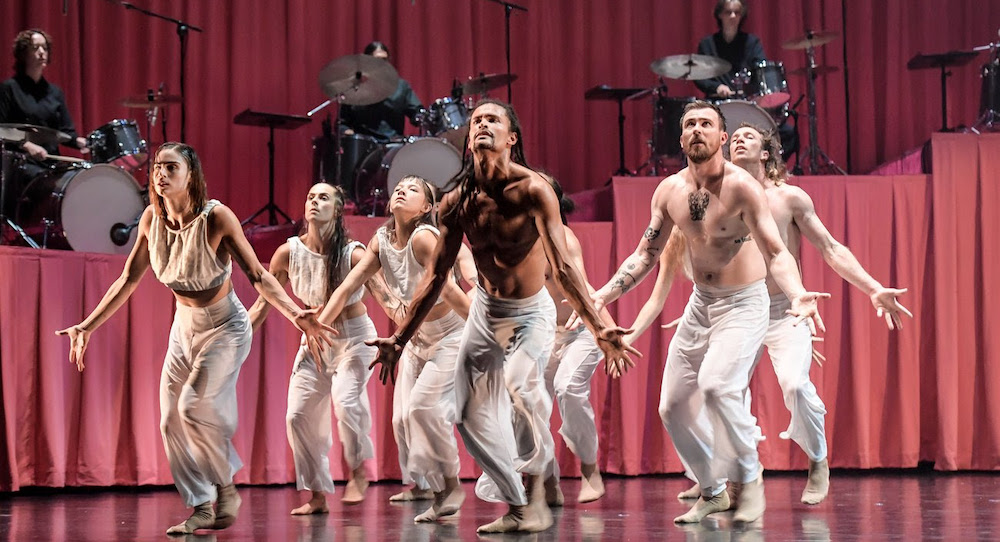
Thankfully Manifesto didn’t have a manifesto, any sort of declaration of the intent or views on issues, but they did make manifest their intention to entertain, amaze and transport the audience.
Nine musicians with a selection of drums, cymbals and bells ranged above a group of white clad dancers who sat, calmly facing the audience. But then the first burst of cymbals sent a shock wave through the dancers, followed ten seconds later by another explosive sound with a corresponding eruption of the dancers – and so it begins – torrents of sound which galvanized the dancers into hectic sequences of dance.as they responded to the changing tempo of the drumming. They seemed to be responding as though to electric shocks or the physical impact of the sound waves with their somersaults, kicks, lifts, throws and breakdance moves.
In one sequence one of the dancers took on the role of choreographer / director, controlling the chaotic assemblage with wild gestures.
As with all dance the there is a connection between music and movement but with Manifesto, they are for the most part inextricably linked, each beat corresponding to a jump, twist, leap or limb gesture.
The performances are a mix of modern dance, aerobics, gym workout, athletic workout (one practicing their archery skills) and individual self-absorbed responses.
Some of the sequences are reminiscent of the stylish Cirque de Soliel routines, others are more poetic in their grace and line. There was even sequence which could have alluded to The Rite of Spring with tightly grouped bodies. Other times their movements were epileptic, militaristic or like that of clockwork figures.
One sequence saw the dancers performance a series of fast paced pas de due as they raced around the stage showing off various dynamic, dexterous, challenging , dangerous and expressive moves. These actions and reactions had much in common with contemporary dance
There were a couple respites and in one of periods a Bob Marley look a like engaged briefly with each of the drummers as well as the audience before being assaulted by a thunderous attack from the combined drummers.
The show, choreographed by Melbourne-based Stephanie Lake was full of relentless energy and amazing invention and there is only two more shows on.






 New Zealand Arts Review