Categories
Reviews, News and Commentary

Rarely seen American and European art at the Auckland Art Gallery

Reviewed by John Daly-Peoples
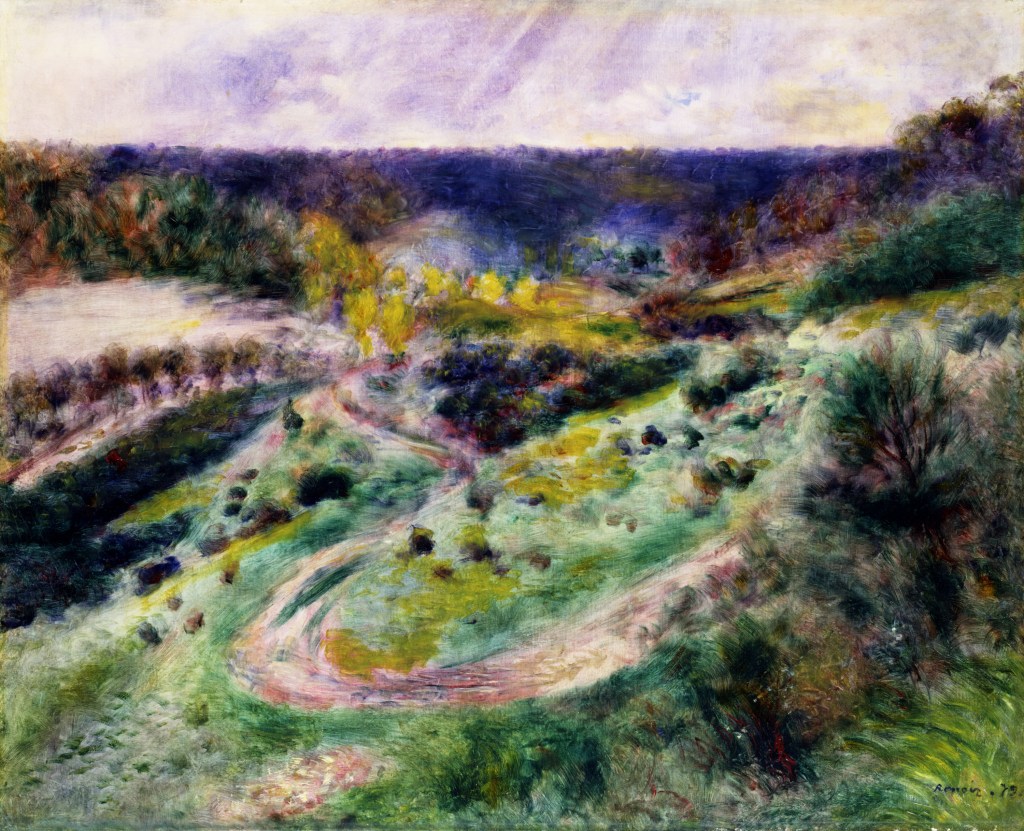
Auguste Renoir, Road at Wargemont, 1879, Toledo Museum of Art, Purchased with funds from the Libbey Endowment, Gift of Edward Drummond Libbey

A Century of Modern Art

Auckland Art Gallery  

June 7 – September 28

John Daly-Peoples

A Century of Modern Art which has just opened at the Auckland Art Gallery is one of the most significant exhibitions mounted by the gallery in the last few years. It is on loan from the Toledo Museum of Art, Ohio, and provides  a survey of the major artists who transformed modern art  from the mid nineteenth century to the mid twentieth century.

The exhibition features 57 works by 53 artists, including Paul Cezanne, Edgar Degas, Helen Frankenthaler, Édouard Manet, William Merritt Chase, Amedeo Modigliani, Berthe Morisot, Claude Monet, Pablo Picasso, Camille Pissarro, Robert Rauschenberg, Pierre-Auguste Renoir, Vincent van Gogh, James McNeill Whistler, among others.

The Toledo Art Museum was established and funded by Edward Drummond Libby and still has a substantial Endowment Trust in his name . The endowment has some $330 million and a budget of more than $20 million a year,. Many of the works in the exhibition were gifted by Libby or acquired through the Libbey Endowment.
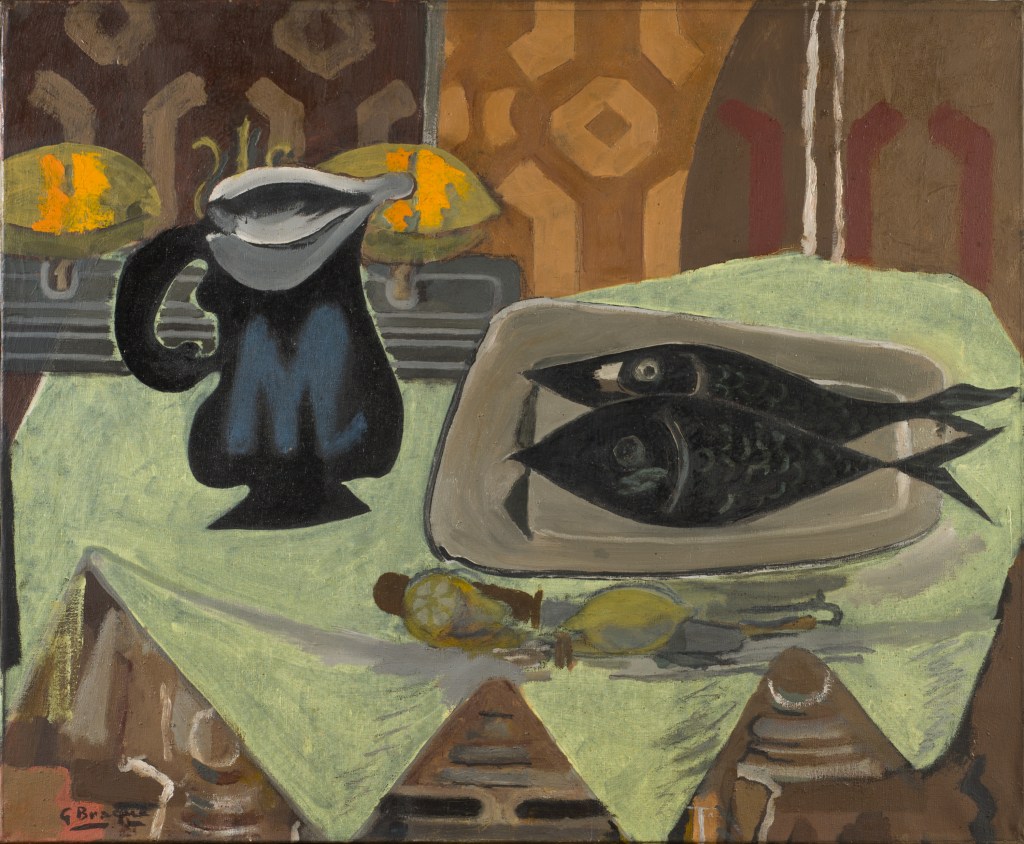
Georges Braque, Still Life with Fish, 1941, Toledo Museum of Art, Purchased with funds from the Libbey Endowment, Gift of Edward Drummond Libbey

Some of the Impressionist / Post Impressionist works by artists such as Renoir, van Gogh, Morisot and Gauguin are major works whle some of them are of unfamiliar subjects such as Renoir’s ”Road at Wargemont”

Several of the works are excellent examples of their work such as van Gogh’s “Wheat Fields with Reaper, Auvers” and Monet’s Water Lilies of 1922, one of the many images of the flower he created in his later years.

The show also features some unfamiliar names of American artists such as Luther Emerson van Gorder whose “Flower Market, Paris” (late 19ht century) could be mistaken for a Pissarro.

Flower Market, PLuther Emerson, Van Gorder, Flower Market, Paris, late 19th century- early 20th century. Toledo Museum of Art, Gift of the artist

The small Whistler work ”Crepuscule in Opal, Trouville” of 1865 is an interesting inclusion in the show, the landscape with its slash of colour is an almost abstract work

Among the more contemporary work is Helen Frankenthaler “Blue Jay” painted at a transition time between paintings of organic forms and colour field paintings. There is also a Morris Louis whose work has not been seen in Auckland since his large exhibition at the gallery in 1971

Helen Frankenthaler, Blue Jay, 1963, Toledo Museum of Art, Gift of The Woodward Foundation

There are also works by artists who we rarely see but whose work shows high level of sophistication such as Piet Mondrian’s Composition with Red, Blue, Yellow, Black, and Gray”, László Moholy-Nagy’s ”Am2”, and Max Beckmann’s “The Trapeze”.

Max Beckmann, German, 1884-1950; The Trapeze; 1923; oil on canvas;H: 77 3/8 in. (196.5 cm); W: 33 1/8 in. (84 cm);Toledo Museum of Art; 1983.20;

There are a few important American artists  as Stanton Macdonald-Wright who was one of the early American abstract artists and his  “Synchromy, Blue-Green”, of  1916 is  an example of the abstraction which developed in America in the early twentieth century.

Other American artists in the show include Gertrude Glass Green  who was an important constructivist artist and Grace Hartigan who was a  member of the New York School in the 1950’s and 60’s.

To subscribe or follow New Zealand Arts Review site – www.nzartsreview.org.

The “Follow button” at the bottom right will appear and clicking on that button  will allow you to follow that blog and all future posts will arrive on your email.

Or go to https://nzartsreview.org/blog/, Scroll down and click “Subscribe”
Categories
Reviews, News and Commentary

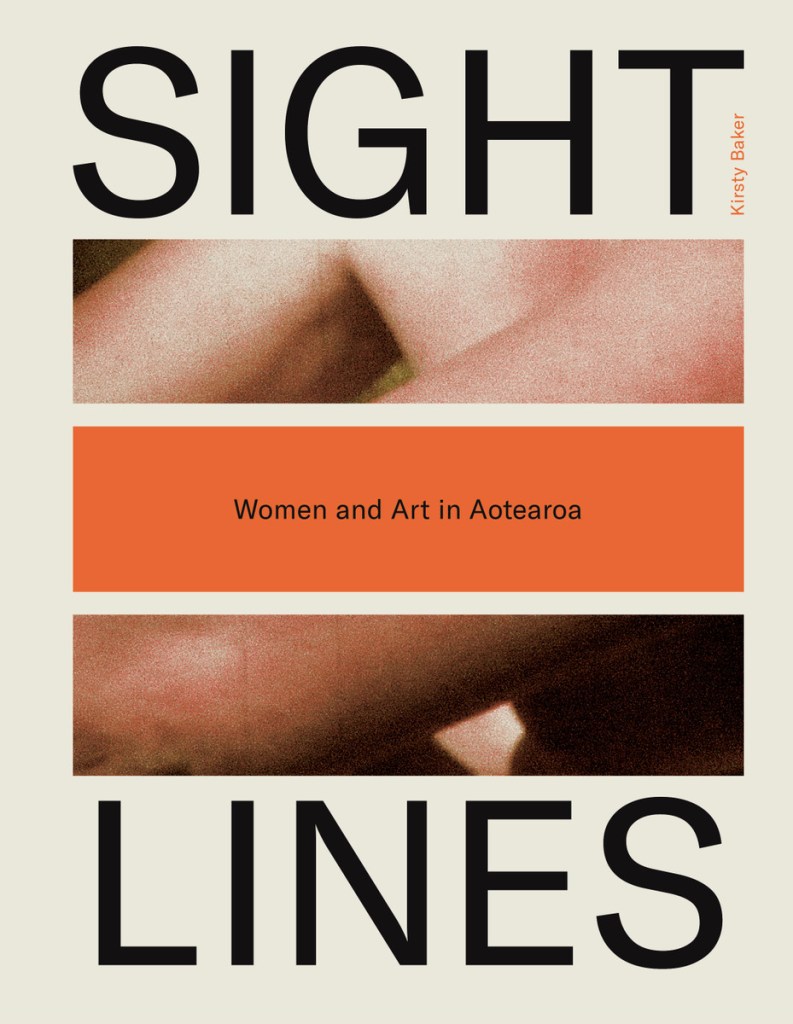
Sight Lines: Women and Art in Aotearoa

Reviewed by John Daly-Peoples

Sight Lines: Women and Art in Aotearoa

By Kirsty Baker

Auckalnd University Press

RRP $69.99

Reviewed by John Daly-Peoples

Sight Lines: Women and Art in Aotearoa is a bold and timely book exploring various threads of women’s  art  of the past as well as those creating art for our times. Editor and writer Kirst Baker acknowledges the complexity of bringing together writings for  such a book in her introduction  where she notes “It should come as no surprise that this book does not attempt to offer a complete history of women’s artmaking in this country. Such a project is doomed to fail… Instead, the book winds its way along a path that is both fragmented and politicised”.

Within that winding journey it is the through the fragments that we see ideas and revelations and make connections. It is through the practice of many of these artists and their working within a social and political context that we see the importance and ramifications of art.

Lisa Reihana, in Pursuit of Venus [infected], Auckland Art Gallery. single channel UHD video

The dozen chapters in the book have been written by Kirsty Baker along with  Chloe Cull, Ngarino Ellis, Ioana Gordon-Smith, Rangimarie Sophie Jolley, Lana Lopesi, Hanahiva Rose, Huhana Smith and Megan Tamati-Quennell.

The essays are all thought-provoking with a mix of biography, narrative, interviews, observations and reflections. These offer new ways at looking at the art created by women but also the nature of art and art institutions.

Baker notes that there are a number of themes running through the book which are indicative of the often different world in which many female artists exist and work.

There is the way that women artists have interrogated their relationship with the land and place and the way they have pushed against gendered limitations.

There is also the way that artists have used their practice to comment on art history and arts institutions and the way that art making plays a role in the care and transmission of knowledge.

In not being a contiguous history of women’s art, the gaps and exclusions are often apparent. These gaps mean at times the book is less satisfying without the linkages of history and context.

While not a history the book covers over two hundred years of art making in New Zealand and includes painters, photographers, performers, sculptors,  textile artists and writers. The work of these artists spans whatu kākahu through to the recent work of the Mataaho Collective. Along the away there are chapters on a diverse range of artists –  Frances Hodgkins, Rita Angus, Rangimārie Hetet, Pauline Rhodes, Teuane Tibbo, Yuki Kihara and Ruth Buchanan.

With over 150 illustrations the books also provide a visual history of women’s art which is well integrated with the texts.

Julia Morison, Quiddities 1-10. Auckland Art Gallery, Cibachrome transparencies

The essay on Frances Hodgkins provides a succinct overview of her life and work while highlighting the issues which impacted on women artists of the early part of the twentieth century.

The essay on Kura Te Waru-Rewiri reveals the way in which Māori artists have addressed issues of mythology. history  and land using abstraction as a means of conveying ideas.

Many of the chapters focus on the issues around the land, whānau and wāhine which is seen in the work of artists such as Robyn  Kahukiwa so it is surprising that  Robin White, Sylvia Siddell and Jaqueline Fahey who have documented the family and domesticity for several decades are not mentioned.

The other area of exclusion is around abstraction for while the work  of Vivian Lynn, Kura Te Waru-Rewiri and Imogen Taylor is included artists such as Phillipa Blair and Gretchen Albrecht are omitted.

Maureen Lander, Ko nga puna waiora o Maunga Taranaki (detail), Govett-Brewster Gallery, mixed media

The final chapter in the book concerns the  work by the Mataaho Collective, a group which has recently won the prestigious Golden Lion Award at the Venice Biennale. The chapter predates the win but much of what is written is relevant to the work which has generated more column  inches than any previous New Zealand exhibition at the Venice event.

Here there seems to be a disconnection because of the six previous New Zealand female artists to exhibit at the Biennale. only Lisa Reihana and Yuki Kihara are mentioned. That the four other women selected over a twenty yar period to represent New Zealand at the world’s most high-profile event seems puzzling.

Despite this oversight and others, the book is still one which offers much in understanding the developing history of women’s art in New Zealand as well as way that they have been impacted  by  social acceptance and cultural institutions.

To subscribe or follow New Zealand Arts Review site – www.nzartsreview.org.

The “Follow button” at the bottom right will appear and clicking on that button  will allow you to follow that blog and all future posts will arrive on your email.

Or go to https://nzartsreview.org/blog/, Scroll down and click “Subscribe”