Categories
Reviews, News and Commentary

Wellington Architecture: A Walking Guide

Reviewed by John Daly-Peoples
Wellington Architecture: A Walking Guide

John Walsh and Patrick Reynolds

Massey University Press

RRP $37.00

Reviewed by John Daly-Peoples

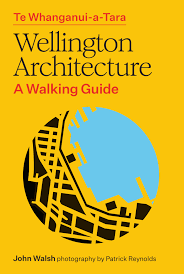
John Walsh and photographer Patrick Reynolds have just launched “Wellington Architecture, A Walking Guide”  a revised edition of the book first published in 2022. This is their third book in the series of architectural walking tours following on from their books on Auckland and Christchurch. It is a great addition to books which explore and explain our built environment.

 John Walsh in the introduction notes that he was born in Wellington which was as “compact and confined as a medieval city-state, intensely impressed itself on me, in the most impressionable part of my life. I remember the Freyberg Pool, where I learned to swim; the summer lights strung on the Norfolk pines along Oriental Parade; and the council yard where my father worked, next to the Herd Street Post and Telegraph Building. My high school was near the old National Art Gallery and Dominion Museum; we’d be sent to mass at St Mary of the Angels and, in blazers and ties, despatched from Wellington Railway Station on rugby expeditions into the hinterlands of the Hutt Valley.”

A building with a dome on the top

AI-generated content may be incorrect.Public Trust Building

This reviewer also grew up in Wellington, living in the National Hotel across from the corner of Stout St and Lambton Quay. From our front room we had an impressive architectural vista including The Public Trust Building, The Government Departmental Building and The State Insurance Building. Further down the street was the Wellington Railway Station.

On my way to school I passed Ernst Plischke’s Massey House, The Old Supreme Court, The Old Government Building, The Beehive, Parliament building, the General Assembly Library, Turnbull House and the rather unfortunate Cathedral of St Paul. These were the background to my life at the time and it was only when I moved to suburban Karori that I noticed the difference in my daily environment.

A building with a dome top

AI-generated content may be incorrect.Shed 7, Wellington Harbour Board

The place of architecture in our environment and in our personal and social history is important often more noticeable when we are in foreign cities. A city’s buildings are important in defining the nature of a place. When visiting a place for the first time the visitor will map a city through its buildings. The materials, the orientation, the colours, the decoration and the forms all help create the language of the way the city is perceived.

The buildings of Auckland Wellington and Christchurch have many similarities but the accumulation of the various periods of construction and styles in each of those places has created very individual environments.

“Wellington Architecture, A Walking Guide” features more than 126 significant buildings describing their purpose and history as well as providing a background on the architects who designed them. The buildings are grouped into five self-guided walking routes, each with a map together with itineraries which collectively create a portrait of the city.

A church with a tall steeple

AI-generated content may be incorrect.St John’s

The building are a mix of colonial, nineteenth century Gothic, mid-century modernism and buildings of the last fifty years illustrating the changing nature of the architecture along with the changing nature of New Zealand and the city. The buildings are banks, businesses, government departments, churches, apartment buildings libraries, hotels, apartments, and a few private houses.

One of the tours features several of the government institutions surrounding Parliament including the Old Government Building (now the Victoria University Law School) and one on the largest wooden buildings in the world, all those other buildings I passed on the way to school along with the more recent  brutalist National Library and the modernist Freyberg Building.

Several architects feature with a number of buildings such as Gummer & Ford, Thomas Turnbull and Ian Athfield who is represented by the Wellington Library (soon to be reopened) and his Oriental Parade flats as well as a few, often controversial,  additions he made to existing buildings.

Asked which building he regarded as the most interesting nee building in Wellington he has stated that it is Heke Rua the new building for New Zealand’s Archive beside the National library, both for its architecture as well its signaling a commitment to preserving the nations documentary heritage..

Categories
Reviews, News and Commentary

NZ Rustic: The NZ Dream

Reviewed by John Daly-Peoples

New Zealand Rustic

By Kate Coughlan with Tessa Crisp & Yolanta Woldendorp

Bateman Books

RRP $59.99

Publication Date October 1

Reviewed by John Daly-Peoples

One of the dreams of many New Zealanders is of a return to nature, living in a house in sympathy with the environment, possibly living off the land, even living off grid.

For many that dream has become a reality and a new book “New Zealand Rustic” highlights that reality with a focus on six houses.

There are a few introductory sections on lighting, texture, colour, natura light and air and styling which help define the formal aspects of good design which are seen in the houses. The major part of the book is devoted to six significant houses from the North and South Islands. There is Manukaru in Queenstown, Ginkgo Point in Omaha, Rumble Bay in Marlborough, Waiau Homestead at Gisborne’s Wainui Beach, Raggedy Ridge House between Alexandra and Omakau, Te Au Homestead near Mahia and Manukard Gard at Glenorchy.

Raggedy Ridge House Image. Tessa Crisp

Each of the houses has a history. The Waiau Homestead at Gisborne’s Wainui Beach began life as a double bay villa on a farm on the East Coast before being moved to its current location, and the severe Raggedy Ridge House which is built among the rocky outcrops of schist seems to made of the local stone forced out of the ground, both an alien intrusion and an almost  organic design connected to the landscape.

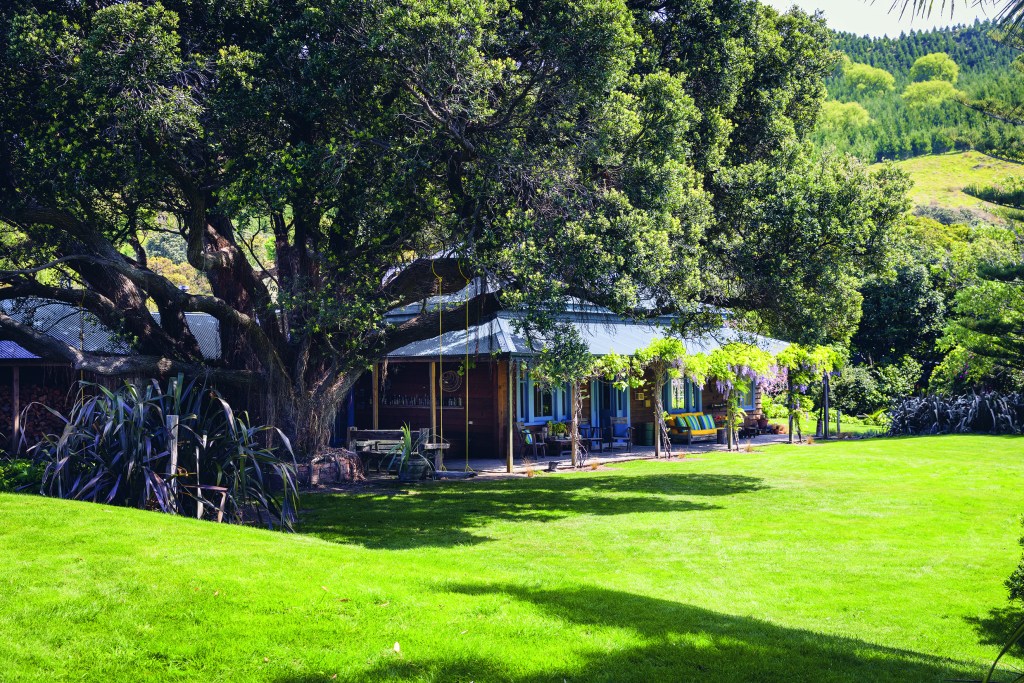
Where The Raggedy Ridge House is built of concrete many others are constructed from natural materials. Ginkgo Point has no concrete and the interior use of unpainted timber and recycled material gives the interior spaces a simplicity and warmth which is enhanced by the clever use of light.

The earth house concept is centuries old but more recent ecological concerns have seen many built in the last fifty years. Such homes as Jimma Dillon’s self-built Rumble Bay house. offer excellent insulation, providing stable temperatures that keep them cool in summer and warm in winter. As the author notes of the house “This is a world without the 4×2 rule of conventional building”. It is a house where floors, walls and ceilings blend into a continuous flowing surface like a Hundertwasser creation. the whole building sheltering under 150 tonnes of earth.

Te Au Homestead Image. Brent Darby

Tessa Crisp’s photography captures the drama and isolation of the houses and the landscape they are set in. There are views of rock formations, the sea and mountain ranges, all of them emphasising the both the rugged beauty and the serenity which the New Zealand landscape can offer. She also manages to capture the sense of the intimacy of the interiors where objects give the houses their own individuality. In some cases there are art works which add interest such as Gingko Point House with works by Michael Smither and Tony Lane.

Yolanta Woldendorp has designed stylish book where photographs and text combine to provide an appreciation of the houses – their construction, details of surfaces, decoration and orientation to the surrounding environment.

The book allows the reader / viewer to vicariously enjoy what the owners have enjoyed in their designing, building and decorating of these homes.

To subscribe or follow New Zealand Arts Review site – www.nzartsreview.org.

The “Follow button” at the bottom right will appear and clicking on that button  will allow you to follow that blog and all future posts will arrive on your email.

Or go to https://nzartsreview.org/blog/, Scroll down and click “Subscribe”

Categories
Reviews, News and Commentary

Sculpture on the Gulf: Waiheke’s great art exhibition

Reviewed by John Daly-Peoples

Brett Graham “Wakefield Dreaming”

Sculpture on the Gulf

Waiheke Island

Until April 1

Reviewed by John Daly-Peoples

A few years ago Waiheke’s Sculpture on the Gulf was included in the New York Times top things to do and the event is regarded by many as one of the great outdoor sculpture exhibitions, not just for the standard of the sculpture but also for the experience of the two kilometre walk with a backdrop of  bush, hills, sea and headlands as well as  panoramic  views of distant Auckland and  the islands of the gulf.

The event attracts tens of thousands of people for the five week show which features over twenty-one works, down from the twenty-seven of the last show two years ago.

There is a bit of a surprise mid-way through sculpture walk seeing  Jorge Wright’s monumental Corten steel work “Head Within” standing only a few metres from where it was two years. It was bought by the owner of the property which abuts the sculpture walk.

Many of the works in this years exhibition have strong architectural and historical connections, reflecting on the changing built environment and the congruent changes to the natural environment.

Turumeke Harrington “Stumped I-XII”

Turumeke Harrington slices of  native trees in “Stumped I-XII” reference the trees which once covered Tamaki Makura while  Chevron Hassett’s “Te Kupenga” welcoming entranceway with its 19th century fretwork would have been built with that cut timber.

Chevron Hassett “Te Kupenga”

There is Ana Iti’s “Whakaruruhau”, a deconstructed work of structural elements which is also similar to the more elaborate work of Lonnie Hutchinson’s “Moemoea – A model for Dreaming”  where her designs in turn relate to Chevron Hassett’s “Te Kupenga”.

Yona Lee’s “Fountain in Transit” uses the steel tubing she often uses to construct interior space with her to create a shower nestled in the bush.

Oliver Stretton-Pow’s marooned lighthouse “Hard Graft” links architecture to plant growth, timber and the tendrils of ocean creatures, referencing the country’s maritime history.

There are references to international architecture and art with  Natalie Guy’s “The Staircase” a homage to Carla Scarpa’s innovative use of materials and designs. Another reference to international art can be seen in Seung Yul Oh’s “Cycloid I, II, III, IV, V, and VI” which mimic Alexander Calder’s lively and colourful shapes . Here the works are like abstract bushes  growing alongside the path.

Seung Yul Oh “Cycloid I, II, III, IV, V, and VI”

There is an architectural component to Nicholas Galanin’s “An Unmarked Grave Deep Enough to Bury Colony and Empire” which uses the outline of Queen Victorias statue as a template for the grave he has dug on the headland.

The most powerful of the architectural works is Brett Graham’s “Wakefield Dreaming” which dominates the headland with his references to the justice system and the overreach of surveillance

Gavin Hipkins’ “Hotel Flag”  evolved from the nautical flag representing the letter H, the first letter of the artists name, it also references the abstract geometric art of Malevich or Stephen Bambury.

Steve Carr’s bronze tires “In Bloom (Waiheke)” can be seen as a sort of self-portrait while Eddie Clemens’ “Cognitive Reorientation” also references his interest in cars as a defining aspect.

Combing aspects of rural farm architecture and religious iconography is Ralph Hotere’s “Taranaki Gate Stations”. The work is based on the Passion of Jesus Christ and originally conceived for Easter 1981

Ralph Hotere “Taranaki Gate Stations”

The work consists of  a cruciform-shaped pen using fourteen standard pipe-and-mesh farm-fence units, with fourteen numbered sheep in.  The gates are marked with Roman numerals (I–XIV) and the sheep painted with Arabic ones (1–14), both in a spectrum of fourteen colours. The various shapes and numbers relate to the stations of the cross and other religious concepts. The work also links back twenty years  to Gregor Kregar’s “Mathew 12/12” shown St  at SOTG in 2003 where he displayed 12 live sheep linked to the biblical text.

Zac Langdon-Pole “Chimera”

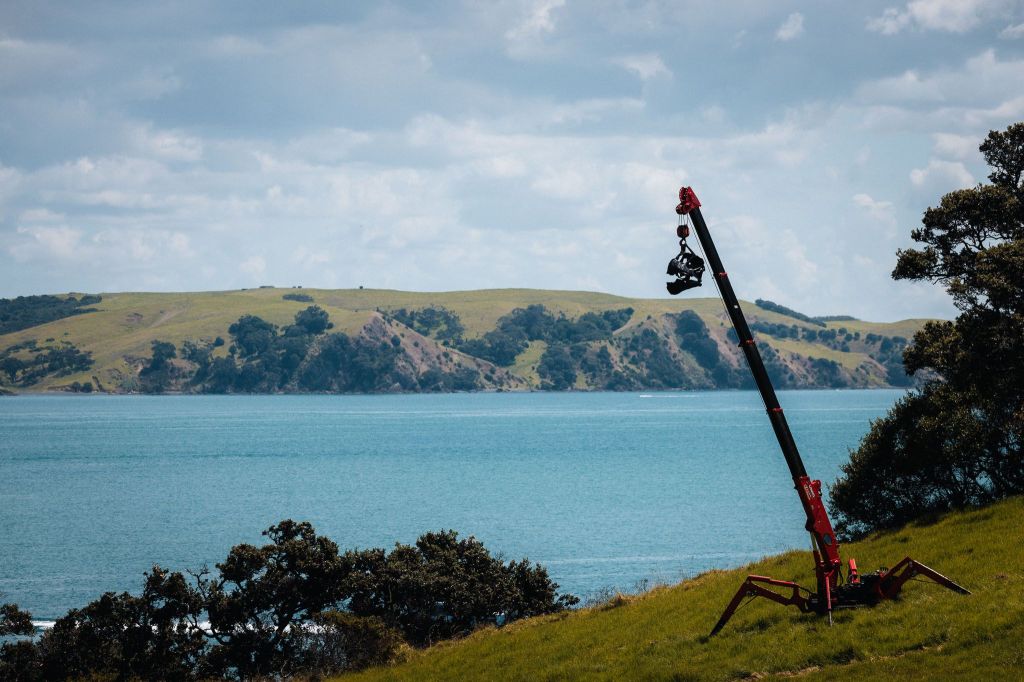
Probably the strangest work in the show is Zac Langdon-Pole’s “Chimera”, a dinosaurs skull hanging from a crane which could have been unearthed from the Queen Victoria excavation in a quirky reference to the country’s past.