Categories
Reviews, News and Commentary

Tony Fomison : Life of the Artist

Reviewed by John Daly-Peoples
Tony Fomison : Life of the Artist

By Mark Forman

Auckland University Press

RRP $59.99

Reviewed by John Daly-Peoples

Mark Forman’s new book on Tony Fomison is a superb piece of scholarship which adds to our understanding of the life of one of the great New Zealand artists of the late twentieth century.  His writing is particularly informative as there are no images of Fomison’s work in the book. The trustees of his estate, his three daughters, withheld permission to use his work because of assumptions and inaccuracies.

Forman has made up for this with perceptive descriptions of many of the artists important works as well as providing an understanding of the artist and the environment in which he developed his work

Forman’s detailed research, obvious from his bibliography along with the numerous interviews he had with other artists, family members and friends enabled him to give the reader insights into Fomison life and thoughts. He has also included a number of quotes from newspapers and magazines of reviews of the artist’s work and there are also accounts of Fomison irritation at unfavourable reviews.

Fomison had been to Ilam Art School at Canterbury University where he had met  a number of artists who he would be friends for the rest of his life including Quentin McFarlane and Des Helmore, Later he would meet Philip Clairmont, Allen Maddox and Colin McCahon. He was also influenced by some of the tutors at Ilam notably Bill Sutton and Rudi Gopas.

In the chapters covering his later life Forman has accounts of his involvement with his various gallerists including Elva Bett, Tina and Kees Hos, Peter McLeavey as well as John Gow and Gary Langsford. There were also other important figures who helped and supported him such as Charles Brasch and Jim and Mary Barr

In the 1960s, Fomison began painting and exhibiting portraits that were, even then very different from many of the other portraits by his peers. His were often distorted, maniacal and tapped into his own troubled life.

Also in the 1960’s as well as pursuing an art career he studied and recorded a number of the Māori rock drawings in Canterbury which became part of his art references

The 1970s was a particularly troubled period in Fomison’s life  after he had returned from  Europe which had included a spell in a mental institution.

He was down and out, grappling with drug addiction, and he began producing  work which was contemptuous and cynical about society.

Many of these artists he identified with were ‘outsider artists’ which Fomison identified with and his dark figures and landscape  began to emerge in his paintings. His monsters, misfits, and medical deformities challenged polite society, and explored what it means to be an outsider. Fomison began to paint people on the edges of society, such as prisoners and the disfigured.

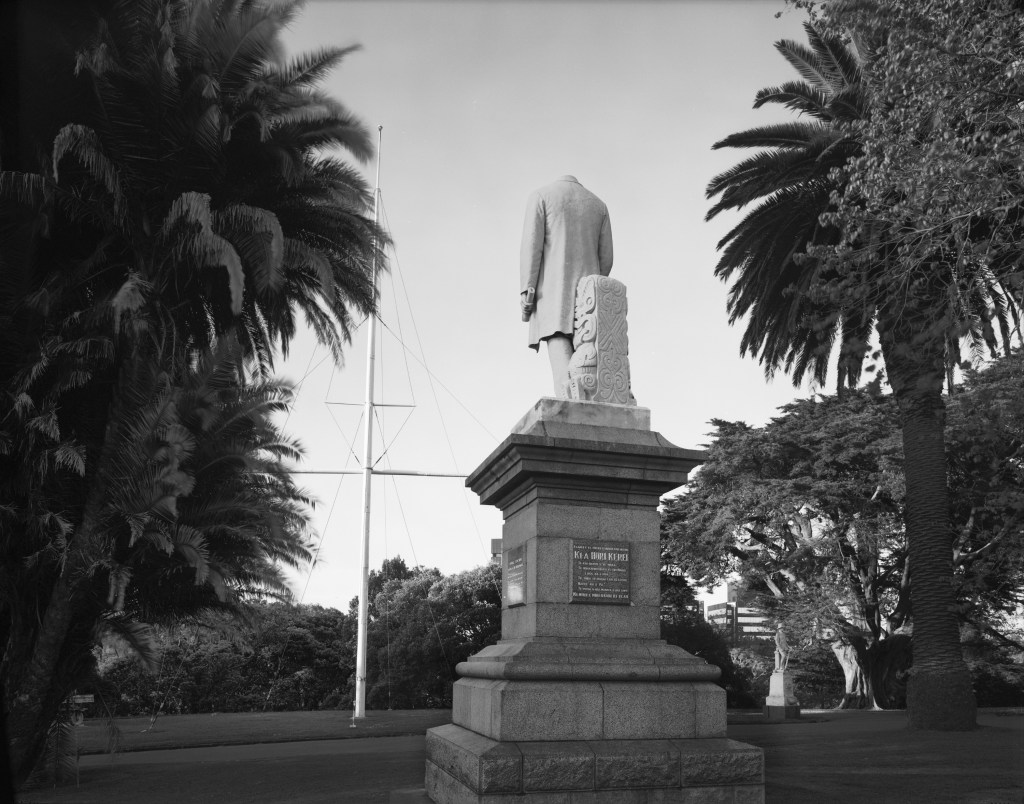
Tony Fomison Grotto Road, Onehunga, Auckland. Image Mark Adams

Living in Auckland for much of his life, he had a strong connection to the local Samoan community and in 1980 made the decision to be tattooed with a Samoan pe’a.  This and his response to the Springbok tour of 1981was part of the artists unconventional or subversive approach to social and political issues

Forman includes numerous quotes from friends and fellow artists along with reviews which allude to Fomison’ s art as being related to distant periods rather than addressing contemporary issues  so that Francis Pound said of his work that it was “akin to that of a seventeenth century primitive” while Hamish Keith wrote that his figures were “sinister and unpleasant… giving of an Old Master complex” and Peter Simpson said he “has something of the impoverished yet eloquent beauty of late Michelangelo”

Fomison led a challenging personal life, which often could be seen in his paintings. As Ian Wedde says, ‘Fomison persisted with thinking and with making art out of his thoughts.’ Following a trip to Europe in the mid 1960s, and a short stint in institutions, Fomison began to paint people on the edges of society, such as prisoners and the disfigured. He would repeatedly return to the theme of the ‘outsider’. Fomison’s work was also often ‘socially committed’, protest the state of the world.

In his career spanning three decades, Fomison produced some of New Zealand’s most significant paintings and drawings, which seemed to incorporate elements of his own  physical journey as well as the spiritual and aesthetic journey, linking ideas that he developed along with his whimsical and dark attitude to life.

To subscribe or follow New Zealand Arts Review site – www.nzartsreview.org.

The “Follow button” at the bottom right will appear and clicking on that button  will allow you to follow that blog and all future posts will arrive on your email.

Or go to https://nzartsreview.org/blog/, Scroll down and click “Subscribe”

Categories
Reviews, News and Commentary

Gene Kelly; A Life in Music

Reviewed by John Daly-Peoples

Gene Kelly; A Life in Music

With the Auckland Philharmonia conducted by Neil Thomson

Auckland Town Hall

March 15

Reviewed by John Daly-Peoples

It was billed as Gene Kelly; A life in Music but it could equally have been called Patricia Ward Kelly; A life in Music as the show which was written by his wife was brilliantly presented as she narrated the life of the dancer with the music played by the Auckland Philharmonia along with crisp remastered clips  from his films.

The two met in the mid 1980s, when he was 73 and Patricia was a 31-year- expert on the works of Herman Melville who had never seen any of the actor/dancer’s films. He asked  her if she would work with him on his autobiography which she did, for five years.

They married when he was 77 years, and each day she documented and recoded his life, This close association with him made her the most knowledgeable person about the dancer’s career.

Her knowledge, of Gene, the music and films all merge into a superb account of Kelly’s life as well as a snapshot of American dance movies of the mid twentieth century.

Most of his iconic films were shown including scenes from Singin’ in the Rain, An American in Paris, Brigadoon, Summer Stock, Les Girls and It’s Always Fair Weather.

We saw him perform with Ginger Rogers, Leslie Caron, and Cyd Charisse as well as with an animated Jerry the Mouse getting a dance lesson from Gene Kelly in “Anchors Aweigh”.

We also get to hear the music of the great composers of the time as well -Andre Previn Lerner & Loewe, Cole Porter and the Gershwins.

We also get to appreciate the clever way in which realism and abstraction was used in  the sets. This combination created some surreal dance sequences with vivid use of colour which highlights the spectacle of the dance routines and shows how Kelly helped change the nature of dance on film with a new mode of choreography and filming.

For the introduction to the second half which featured clips from Brigadoon she had a piper stride up the aisle and then in a surprise appearance she introduced Michael Crawford of Phantom of The Opera fame, who now lives in New Zealand and who acknowledged Kelly as a major influence in getting the role.

Patricia Kelly’s  presentation brought  clever showmanship and intimacy to the evening accompanied by the Auckland Philharmonia conducted Neil Thomson.

Categories
Reviews, News and Commentary

HEDY! The Life & Inventions of Hedy Lamar

Reviewed by John Daly-Peoples

HEDY! The Life & Inventions of Hedy Lamar

Written and performed by Heather Massie

Q Theatre

March 13- 16

Reviewed by John Daly-Peoples

While she never got an Oscar, Hedy Lamarr was considered the most beautiful woman in the world and was one of the great movie stars of the mid twentieth century. She starred in many films including “Samsom and Delilah and the Czech film “Ecstasy” which featured a controversial orgasm scene which was banned in many countries.

She was divorced six times, making her one of the most divorced women of the twentieth century, a distinction beaten only by Elizabeth Taylor with seven.

But, in many ways, her greatest distinction was her invention (along with George Antheil} of  a “Secret Communication System,” which was a radio-guided device with anti-jamming frequencies which would have had the capacity to interfere with torpedo guidance systems during WWI. The US Navy declined to make use of it.

This device is a component of present-day satellite technology and cellular phone technology.

Her work as an inventor was eventually recognized in 1997 with the Sixth Annual Pioneer Award bestowed on her by the Electronic Frontier Foundation.

These are some of the highlights of her career which were revealed in Heather Massie’s one-woman autobiographical show, “Hedy Lamarr”.

Lamarr reminisces about her life, her father, her time in Vienna and later her career in Hollywood. There are her relationships with the various men in her life – an armaments producer, a count, Louis B Meyer and various director and actors.

Many of them were presented by Heather Massie using a of range voices to create to give depth to her performance, although she gave most of the men pretty much the same clichéd accent. Her account of Jimmy Stewart, however, was a delightfully, breathless portrait of the actor.

The various events and activities referred to showed the range of Lamarr’s interests and encounters with her quotes indicating a shrewd mind and a keen observer of life.

Massie managed to turn Lamarr into a remarkable complicated but simple figure who seems to know a lot about life, men and the workings of the world as well as making shrewd observation about her life and her inventions.

However, Massie galloped through her “tutorial” about her guidance system with not much time to appreciate just how important the invention could have been to the war effort.

Massie’s presentation has Lamarr engage the various people in her life over the phone or in having on stage conversations so effectively that in retrospect it seems they were with there on stage.

She also engaged with the audience as a whole and in many cases with individual audience members, a technique which worked as a means of creating Lamarr as well as providing a classy example of how to create a character.

To subscribe or follow New Zealand Arts Review site – www.nzartsreview.org.

The “Follow button” at the bottom right will appear and clicking on that button  will allow you to follow that blog and all future posts will arrive on your email.

Or go to https://nzartsreview.org/blog/, Scroll down and click “Subscribe”

Categories
Reviews, News and Commentary

Lula Washington Dance Theatre

Reviewed by John Daly-Peoples

Lula Washington Dance Theatre

Aotea Centre

March 13 -16

Reviewed by John Daly-Peoples

The Lula Washington Dance Theatre is a contemporary modern dance company  in Los Angeles which has performed across the United States and toured internationally. It was established forty years ago when Lula Washington realised there were few black dance institutions in America  .

They have a stylish approach to contemporary dance incorporating elements of African and Caribbean dance as well as contemporary modern dance and ballet. All these elements were seen in the opening number where three dancers – Love, Faith and Hope,  performed to  heavy beats, foot stomping and clapping with the audience encouraged to add to the heavy clapping to that of the dancers and he riotous drumming morphed from African beats to something closer to hip hop.

Three female dancers were joined by male dancers who became intertwined and there was a sense of the dancers and audience all part of a church service, street performance or gym workout.

Accompanying the hectic dancing were references to American segregation, slavery, lynchings and race riots – Charleston, Springfield, Watts and an image of George Floyd

Accompanying this dancing was some relentless drumming with and  intense energy more akin to that of a night club and each of the sequences was given multiple bursts of applause from the audience.

Throughout this sequence the woman danced like ghost or departed spirits, their dancing a combination of celebration and remembrance of the African roots of the movements and music.

Because of the emphasis on these aspects the dances all seemed to be something of a political force and the dancers’ political activists.

In a later sequence one of the dancers shouts out the repeated chant “America is killing me” and this was accompanied by a visceral scream, a dramatic event one would not encounter in a Royal New Zealand Ballet performance and shows the level of the political urgency behind the Lula Washington project.

There was an intensity to many  of the dances with a physically close to that of a Whirling Dervish. But alongside this there were elements of playfulness and whimsy which were all performed with a finesse close to that of classical ballet dancers.

The political or polemical aspects of the dances often felt to be less satisfying of the performance without a dance vocabulary which did not express the angst and anger which was conveyed in the words which accompanied the dance.

Categories
Reviews, News and Commentary

Dick Frizzell’s picaresque memoir of the artist as a young man

Reviewed by John Daly-Peoples

Hastings. A boy’s own adventure

Dick Frizzell

Massey University Press

RRP $37.00

Reviewed by John Daly-Peoples

Many geniuses are recognized early on in their lives. Mozart had written 10 symphonies by the time he was 14, Pablo Picasso was turning out some skilful nudes when he was 14 and  Dick Frizzell did a drawing of Christopher Lee as Frankenstein’s monster at the same age.

However, neither Mozart nor Picasso wrote a decent autobiography about growing up which is where Frizzell has the edge over the other two.

His new book recounting his early years, “Hastings, A boy’s own adventure” is an entertaining set of stories which probably mirrors the life and times of many young men growing up in provincial New Zealand in the 1950’s and 60’s. It was a time of complete freedom when young men like Frizzell were learning the first of life’s lessons and enjoying life’s experiences.

In thirty chapters Frizzell recounts his adventures which provide  portraits of his family, descriptions of Hastings and sketches of his encounters with the day-to-day activities he was immersed in. Through these he  manages to provide an insight into his growing awareness and understanding of the world around him, conjuring up the experience of most young boys of his age, encountering the world of adults – aunts, uncles, family friends and  teachers.

We also get a sense of how he became Dick Frizzell the artist  with a mother who had been to art school  and taught him some artistic skills and a father who was well read and a technically accomplished engineer with his own enquiring and adventurous nature.  There are also his experiences of the landscape – Te Mata Peak and the farms of relatives where he worked or holidayed  There is also his love of  comics and movies, his interest in working environments and workmen It’s what we see in his artwork – a celebration of landscape and culture, history and everyday objects.

Frizzell says of these early years “I felt that I had the town covered: our Parkvale kingdom, Uncle George’s market gardens, Aunty Molly’s frock shop, Dad’s freezing works, my high school . . . the town was pretty much ring fenced by Frizzell’s! And I was there growing up with it. Rock ’n’ roll came along, the town became a city, Fantasyland was built, hoodlums trashed the Blossom festival, I learnt the Twist in the Labour and Trades Hall . . . everything I took within me towards adulthood came from Hastings.”

‘If I’d been asked to vote on it I would’ve said I’d landed at the centre of the universe. Standing on our corner of Sylvan Road and Victoria Street, with Te Mata Peak, the Tukituki River and the mad wilderness of Windsor Park to the back of me and the distinctly non-wilderness of Cornwall Park and the misty vista of the Ruahines in front of me, I was the master of all I could barely survey.”

We learn about his jobs, the same that probably every youth got living in Hastings – spells at the Tomoana Freezing Works (where his father worked) and at the Wattie’s canning factory.

But while his portraits of his mother and father and the likes  of his aunts Molly and Nora the figure which we most appreciate is the author with his achievements, blunders, successes and failures.

While the artist may have gained the image as the suave man about town. his early encounters with the opposite sex by his own accounts were less prepossessing. He recounts his inauspicious attempt at the seduction of Bunny as well as his fleeing from the amorous advances of the older Trixie.

It’s a coming-of-age book which will resonate with many older readers with its half-remembered tales of family life, friendships  and growing awareness of one’s place in the world.

To subscribe or follow New Zealand Arts Review site – www.nzartsreview.org.

The “Follow button” at the bottom right will appear and clicking on that button  will allow you to follow that blog and all future posts will arrive on your email.

Or go to https://nzartsreview.org/blog/, Scroll down and click “Subscribe”

Categories
Reviews, News and Commentary

You are Here: linking language, memories and landscape

Reviewed by John Daly-Peoples

You Are Here

Whiti Hereaka and Peata Larkin

Massey University Press

RRP $45.00

Reviewed by John Daly-Peoples

Most stories have a beginning, a middle  and an end. Most stories have a central idea, a kernel from which the tale expands like a sinuous river which follows a plot or a life. Other books can have a very different structure as with the new book “You Are Here”.

“You Are Here” which is the  sixth book in the “kōrero series”, edited by Lloyd Jones, features Jann Medlicott Acorn Fiction Prize winner Whiti Hereaka and artist Peata Larkin, cousins who share the same whakapapa. in a collaboration. Unlike the previous stories in the collection Larkin’s images are not merely illustrations of the text but rather complementary representations of similar ideas.

Here the story line is cyclical, expanding and contracting. Like James Joyce’s  “Finnegans Wake” the work begins and ends at the same point but with an elaborate structure in between  

The poem  starts with the line “You are here” and ends with the line – “Return to where you belong”, seemingly following the mathematical notions of the Fibonacci number sequence.

In tracing out the narrative the  narrator recalls their youth and their experiences of life. Threaded through this personal journey are images of water and the stones of a lake as well as  images of birds and journeys. like the  symbolic use of the Piwakawaka by Colin McCahon.

Language, memories and landscape are seen as linked in the development of the narrator, their memories of school and the shaping of the person through language and experiences. the physical and the metaphorically linked in this journey.

Parallel to Hereaka’s storyline are Peata Larkin’s multi-layered visual images in which ideas inherent in the structure of the story are the linked to her exploration of the DNA structure as well as images of Māori design. Drawings of tāniko and whakairo on gridded shapes are linked to European notions of embroidery and mathematical structures.

Peata Larkin says of the work “Working on this project has been very special to me …Being cut from the same cloth enables the threads of the fabric to shine through and hopefully we achieved that.

Hereaka says. ‘It is my hope that by the time you have walked that path that you are now a different reader and will read those words in a new way,’

To subscribe or follow New Zealand Arts Review site – www.nzartsreview.org.

The “Follow button” at the bottom right will appear and clicking on that button  will allow you to follow that blog and all future posts will arrive on your email.

Or go to https://nzartsreview.org/blog/, Scroll down and click “Subscribe”

Categories
Reviews, News and Commentary

A Mixtape for Maladies:   Music and  Memories of a War

Ravikanth Gurunathan (Vishwanathan), Tiahli Martyn (Subbalaxmi), Ahilan Karunaharan (Rajan), Gemma-Jayde Naidoo (Sangeetha – past) Image – Andi Crown

A Mixtape for Maladies 

By Ahilan Karunaharan 

Director, Jane Yonge  

Auckland Theatre Company  

Until March 23

Reviewed by John Daly-Peoples

The Sri Lankan Civil War of the latter part of the 20th century provides the backdrop for Ahklan Karunaharan’s “A Mixtape for Maladies” which explores the lives of a Tamil family, who are caught up in the conflict, some of whom are killed or immigrate to New Zealand.

The play explores the reality of living in a different time and culture in a period of tension and transition and we identify and sympathize with the family’s trials of living through a war.

I was jolted back to another reality at the end of the show however. My Uber driver looked South Asian, so I mentioned about the show and how it combined politics and family. He was from Sri Lanka and acknowledged the tragedy of the war and its impact on the country. But his experience was very different from the family I had just witnessed on stage as he had been an air force pilot during the war contributing to the death and destruction, providing an alternative history of the period  

One of the few things that Sangeetha (Ambicka G.K.R.) one of the daughters has brought to New Zealand was a tape recording of songs she loved growing up. Her New Zealand born son, Deepan (Shaan Kesha) finds the tape and plays the songs during his online podcast which trigger personal and political memories for her. 

Through the course of the play Deepan plays these songs and Sangeetha remembers elements of the family’s life – hearing about the war, her and her sister hanging around the store where Anton (Bala Murali) works because he plays all the latest local and international songs as well as songs from the movies. 

Shaan Kesha (Deepan), Ambika (Sangeetha – present) Image Andi Crown

While some of the songs are played on the tape recorder others are sung by various members of the cast, accompanied by a duo (Ben Fernandez and Seyorn Arunagirinathan) playing a variety of instruments – keyboard, Carnatic violin and flute. Ahilan Karunaharan (Rajan), and Bala Murali give particularly fine vocal performances while Tiahli Martyn’s (Subbalaxmi) display of Tamil dance was skillful. These vocal and dance  performances had many of the Tamil audience singing and swaying along to the music.

Among the tunes were Doris Day singing” Que Sera Sera”. “La Bamba” and some Tamil songs. These songs act as a cultural glue which holds the family together but also reminds us that these songs had universal appeal listened to by Sri Lankans as well as New Zealanders at the time.

The play is a mixture of social history, family exploration, cabaret and personal journey with music playing a central role in the play as well as the instruments the family would have listened to the songs on – an old turntable, a hi-fi player and the tape recorder.

The simple set features Dareen and Sangeetha in his podcast studio on one side and musicians on the other, flanking the family home and Anton’s general store.

The exploration by Dareen is initially an innocent enquiry into his mother’s music choices but becomes a journey into Sri Lanka’s history as well as triggering memories of his mothers and her family’s past and the impact of the war on their lives.

To subscribe or follow New Zealand Arts Review site – www.nzartsreview.org.

The “Follow button” at the bottom right will appear and clicking on that button  will allow you to follow that blog and all future posts will arrive on your email.

Or go to https://nzartsreview.org/blog/, Scroll down and click “Subscribe”
Categories
Reviews, News and Commentary

Belle: Spectacular and disjointed

Reviewed by John Daly-Peoples

Belle Image. Andi Crown

Belle

A Performance of Air

Movement of the Human (MOTH)

Director / Producer, Malia Johnston

Kiri te Kanawa Theatre, Aotea Centre

March 6 – 9

Reviewed by John Daly-Peoples

“Belle” had all the elements to make it a stand-out performance however it never quite managed to make it a truly  thrilling show.

The all-female cast of skilled aerialist / dancers/ singers performed a range of acts with a touch of magic and their routines were all immersed in a riotous soundscape and a remarkable light and fog environment.

Sometimes it felt a though someone had told the musicians that they only needed to play loudly and that would cover any mistakes or lack of continuity.

There was also a  lack of cohesion between the various sections or vignettes which was a major  problem. Even though the acts were spectacular, there was no sense of narrative or trajectory.

Many of the sections had a sense of cavorting angels or goddesses and this could have related to the figures and Ranginui and Papatūānuku in the digital work “Ihi” by Lisa Reihana which is in the Aotea Centre foyer.

Most of the acts were performed in a half light, with the performers often seen in silhouette. Along with the dramatic use of light this added to the drama of the performance but it also meant the audience was often not able to appreciate the athleticism of the performers.

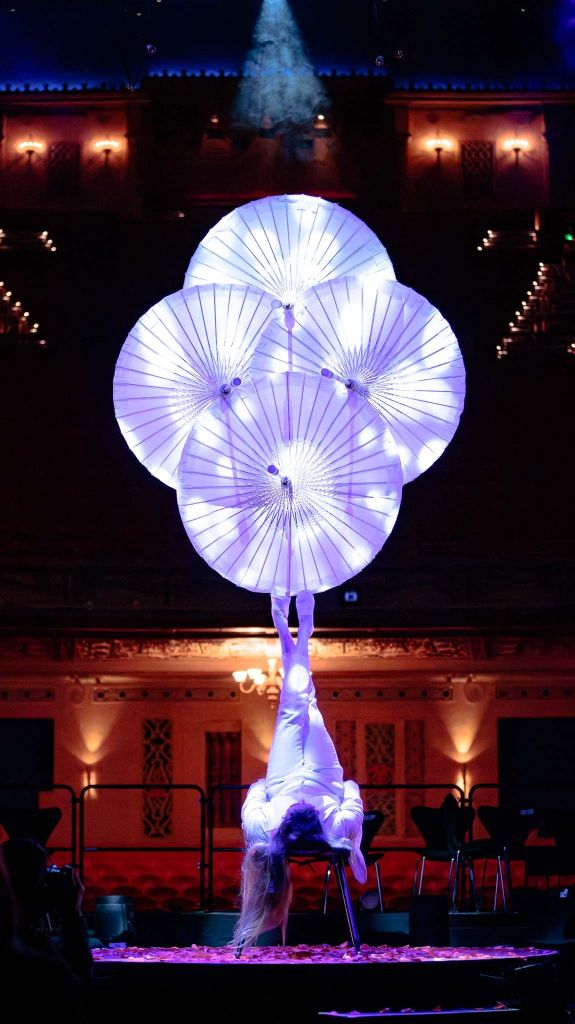
Some of the acts were brilliant conceived with figure rising and falling from the stage and disappearing into the enveloping fog of the stage. Other sequences saw the cast using elaborate equipment such as aerial wheels and large pivoting wheels.

But the lack of interconnection and lack of coordination between the sequences and music did  a disservice to the acts and a disappointment to the audience.

Categories
Reviews, News and Commentary

BLACK GRACE TURNS 30

John Daly-Peoples

John Daly-Peoples

‘THIS IS NOT A RETROSPECTIVE’

Auckland Town Hall

Saturday March 22,  7.30

Neil Ieremia is one of Aotearoa’s most astonishing and prolific home-based creatives. His ever-growing body of work has easily and unselfconsciously graced stages in many parts of the world and he is rapidly becoming a one-man export machine. In part this is because of his perfectionism that never forgets the past, stands firmly rooted in the present and yet finds time to seriously address the future – sometimes simultaneously.

His works combine different personal histories, different body shapes and abilities, and different musical and dance backgrounds.

May of his works have a strong musical underpinning that ranges from pop to hip hop, traditional to church, coupled with soundscapes that underscore the everyday concerns of young people today. It leaps from recollections of things past to things that might have been and things that are very much of the present, uses the simplest of props and creates some beautiful moments.

His latest work celebrates the company’s 30th year milestone with ‘THIS IS NOT A RETROSPECTIVE’, the ultimate interactive dance party at the Auckland Town Hall, Saturday March 22

Joining Blackl Grace will be CHE FU and THA FEELSTYLE along with the many amazing friends of Black Grace already down to party including; DJ Manuel Bundy, drag queen diva Buckwheat and the NZ Trio, working alongside a stellar production team, with Artistic Direction by Neil Ieremia, ONZM, sound designer Faiumu Matthew Salapu aka Anonymouz, internationally respected NYC-based lighting designer JAX Messenger, along with the incredible Black Grace Dancers.

But the fun doesn’t stop there, Black Grace has a number of special events planned throughout their birthday year. To be in the know join them at blackgrace.co.nz

Main event 1hr 10min, followed by a party which  will continue after main event until late

Categories
Reviews, News and Commentary

Six The Musical: More Than Mere Glitz

Reviewed by Malcolm Calder

Photo : James D Morgan

SIX THE MUSICAL

by Toby Marlow and Lucy Moss

Directors Lucy Moss and Jamie Armitage

Choreography Carrie-Anne Ingrouille

Set Design Emma Bailey

Costume Design Gabriella Slade

Lighting Design Tim Deiling

Sound Design Paul Gatehouse

Orchestrator Tom Curran

Musical Director Beighton

Civic Theatre, Auckland (until 30 March)

Reviewed by Malcolm Calder

1 March 2025

It would be easy to pigeon-hole SIX as a high energy show with lots of froth and bubble, and aimed fairly and squarely at the tiktok generation.  But you would be wrong.  It is rather more.

All things must change and musical theatre is no different.  SIX is important enough to represent another of those significant change points in history – following in the footsteps trodden by Oklahoma or West Side Story or Cats or Hamilton.

On leaving, I overheard an audience member mutter something about SIX being really just a glossed up pub cabaret.  And, to a certain extent, it is.  Originally conceived by a couple of then relatively unknown Cambridge students in 2017, Moss and Marlow took it to the Edinburgh Fringe that year, was a huge success and soon wound up at the Arts Theatre in the West End before a Broadway opening almost immediately before Covid struck.  There was a sort of relaunch in 2021 and SIX now enjoys semi-permanent residence in both London and New York and has gone on to world-wide success with multiple productions all over the anglosphere, as well as Europe and in Asia.

So what has driven this success? A well-known Australian commentator once suggested it resembles a Spice Girls concert directed by Baz Luhrman – but one where the girls can actually sing.  Quite apt I thought at the time.  But this show is a lot more than that.  It is VERY much a significant part of the musical theatre tradition.  In fact there are so many references, acknowledgments and subtle nuances running through SIX that enumerating all of them becomes difficult.

First and foremost, this is a NOW show.  As such it reaches its target easily and then some. So, yes, to the tiktok generation.  But it is  bigger than that and, while it might help grow memberships of amateur music theatre organisations, that is rather simplistic view as it impact is considerably greater. Not to put too fine a point on it, the key fundamental of SIX is pure entertainment built around that old adage – a good story told well that enthrals its audience.  And good entertainment knows no age boundaries – the grandmother in front of me was up and out-boogying her two grandchildren at the end.  Underlying import counts too. 

The stories of the six queens are told in the language of the second decade of the 21st century – not by the archival or even slanted recollections of historians about the politics and intrigue surrounding the first Tudor king.  Most of whom were men, and of a fairly clearly-defined social class at that.  Further, it is told from a women’s perspective.  And remember, some of the queens were all exceptionally young when they married and the Royal Court revolved around power, politics and intrigue.  So we leap immediately to empowerment for women – a rallying cry for millions – and a clear audience profile for SIX.

Structurally, as the fairly comprehensive promotional campaign has pointed out, SIX is built around a history lesson and a competition.  OK.  Thank you.  Got that.  It puts the six queens up against each other each other – an Eisteddfod if you will – or is that merely a device for something bigger?

The six queens never leave the stage and their individual songs merge into six-voice choral arrangements, complimentarily and contrapuntally at times, with occasional snatches of spoken dialogue (but not very much at all).  The staging itself is outstandingly conceived by Emma Bailey and reflects a modern high-tech concert stage that integratesTim Deiling’s dynamic lighting and Paul Gastrehouses’s sound in a way that clearly works.  The stage is also peopled by an astonishingly well-rehearsed, syncopathic and complimentary all-girl band for the entire show.

This primarily Australian cast comes well credentialled.  Dancing skills are clearly in evidence with very tight routines throughout and, even if there were one or two very minor vocal wobbles, vocal strength was generally strong and led by the assurance of Loren Hunter (Jane Seymour).  But let’s face it, this show is presented more like an eisteddfod or a competition and it doesn’t really matter – one voice will always overlap another. The tenderness of Heart Of Stone and the hilarious rap of Haus of Holbein were both standouts for me.

The primary focus of attention however is largely rivetted on Gabriella Slade’s award-winning costumes. Little wonder that her outfits have a dash of Spice Girls about them as she devised Spice World back in the 1990s.  But now she has embellished some glittering and futuristic sequinned outfits in ways that not only catch the eye, but help tell each queen’s story.  The ‘beheadeds’ have chokers for example, Jane Seymour’s black and white bodice echoes the half-timbered houses of Tudor England, the green of Anne Boleyn’s outfit references the popular myth that this evergreen was composed by the much-wedded Henry VIII himself (that’s factually incorrect, but let’s stick with the myth). It’s interesting that one interpretation of this song concerns the promiscuity in young women, something Henry’s henchman Archbishop Cranmer used in arranging divorce and subsequent beheading.

The references go on.  In fact they are never ending.  There are the pop divas found in the songs : I think I heard echoes of Beyonce, Ariana Grande and Alicia Keys and probably missed a few more.

The sense of fun and campness is constant.  SIX takes neither itself, nor musical theatre in general, seriously and whimsy is everywhere.  Phones in the theatre, for example, were quite correctly asked to be turned off pre-show and then during the encore (or more correctly the ‘finale’), encouraged the audience to light them up again.  And they certainly did. It was another moment of sheer joy and made the audience a part of the show. I think that grandma in front of me got a pretty good video take.

Any good production simply tells a story.  SIX does so with succinctness and very, very well.  It is not a long show, but is pretty demanding on both voices and the attention-span of audiences.

I always relish a well written show that is objective and contemporary rather than one that delves into the introspective meanderings of L-plate writers.  SIX is mature writing and very clever staging.  

The filmed on-stage reunion of Six’s original West End queens will be released in cinemas next month and, rather ironically, Auckland’s Civic remains one of the larger in-theatre venues it has played.  After here, it’s off to complete its second lap of Australia at the Civic’s sister in Newcastle, while Asia awaits

To subscribe or follow New Zealand Arts Review site – www.nzartsreview.org.

The “Follow button” at the bottom right will appear and clicking on that button  will allow you to follow that blog and all future posts will arrive on your email.

Or go to https://nzartsreview.org/blog/, Scroll down and click “Subscribe”