Reviewed by John Daly-Peoples
Helen Clark in Six Outfits
By Fiona Samuel
ATC
Until April 26
Reviewed by John Daly-Peoples
Helen Clark in Six Outfits uses the notion of tracking Helen Clark’s career through reference to the clothing she wore at various stages of her life. It is a concept which even the stage version of Clark rejects going on a rant about how she has always been judged by appearance – her hair, her teeth, her voice and her marriage. All those notions which are rarely used to demean male parliamentarians.
The play traces the life of Helen Clark from school kid through to the present as she climbs both the academic and the parliamentary ladders to her unsuccessful bid at becoming the Secretary General of the UN.
Along the way we/she remember the fluctuating fortunes of National and Labour governments as well as encountering the major political figures of the time – Phil Goff, Jim Anderton, David Lange, Jonathan Hunt, Jenny Shipley, Judith Tizard and even Winston Peters -is he still alive.
We also hear the voice of Brian Edwards who acts as a voice-over Narrator and was one of her early media advisors / image consultants. We also get to encounter her more recent media consultant, Maggie Eyre.
Studded though her career we get the major achievements of her and her governments – paid parental leave, free early childcare, the New Zealand Superannuation Fund. legalized prostitution and civil unions for same-sex couples.
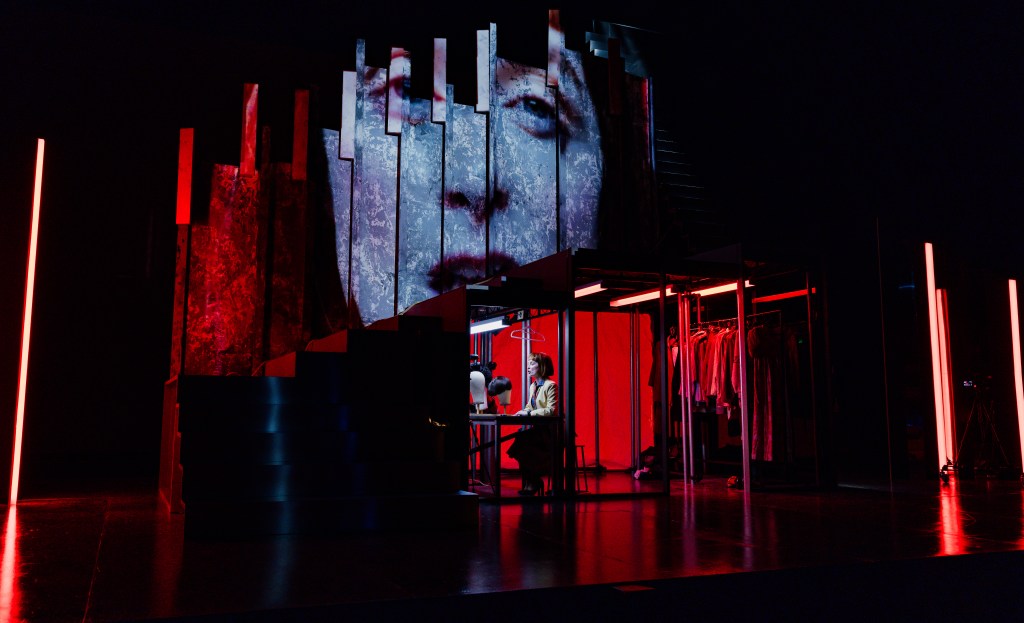
Loooming over the stage is a clever set designed by Dan Williams which features a mountain-side which Clark ascends from time to time. It acts a a metaphor for her ascent to power as well as her physical/ mental / political struggles to reach the summit of her career.
As the older Clark Jennifer Te Atamira Ward-Lealand gives an impressive account of the politician, at time managing to capture the sound and intonation of her voice as well as her stare. Lauren Gibson as the younger Clark while not quite getting the voice manges to give an astute sense of the earlier Clark with her aspirations and self belief.
Ward Lealand also does a reasonable job of some walk-on parts such as Clark’s father a farmer who was at the other end of the political spectrum but still supported his daughter.
While this play is about serous stuff of politics Fiona Samuel takes a comic approach to the material which had the audience appreciating the political and personal witticisms such as the reference to Clark’s early page boy haircut – her “Joan of Arc” look
The play concluded with Ward-Lealand delivering a Clark speech. I couldn’t remember it all, but it went somewhere along the lines of –
“Let me note now the great importance of empowering women, including through education, to be part of leadership at every level. Equality between women and men at decision-making tables ensures that the perspectives of both get full consideration. As women, we are fully justified in asserting that there should be no decisions made about us without us.
When women are at those decision-making tables, they have the power to change priorities to what matters for the health and well-being of families and communities.
Empowered women become the architects of better health and well-being, making informed decisions for themselves and their communities.”

 New Zealand Arts Review