Reviewed by John Daly-Peoples
Bluebeards Castle
By Bela Bartok
NZ Opera & Auckland Arts Festival
Aotea Centre
March 13th & 14th
Reviewed by John Daly-Peoples
In Bela Bartok’s original staging of Bluebeards Castle, the newlywed Judith enters her husband’s dark, foreboding castle where she is faced with seven locked doors that she is forbidden to open. In this version by Daisy Evans, it is a single trunk which holds the memories of the couples past lives which Bluebeard remembers while Judith herself seems to become lost to him.
For this production director Daisy Evens created a new Judith who is somewhere between an older woman with dementia and a woman facing her own psychological breakdown and who along with her husband can be seen as displaying the Freudian concepts of sexual trauma.
The castle can be seen as symbolic of Bluebeard’s soul; a dark mind filled with secrets that threaten to reveal his true nature. The opera itself can be seen as an allegory for the loneliness of the human soul, the impossibility of truly knowing another person, or the conflict between rational and emotional.
Bartok was writing the opera at the same time that Freud was engaged in studies into psychoanalysis and elements of this have seeped into Bartok’s thinking which aligns with Freud’s theories of exploring the unconscious mind, hidden sexual desires, and psychological trauma.
Bluebeards Castle like other Symbolist art works, replaced traditional dramatic narratives with dark, subjective internal journeys, mirroring the Freudian focus on repressed emotions and dreams.
Despite Bluebeards protests she removes the symbolic items from the chest and in doing so she discovers events from Bluebeards past, events she needs to recognise if she is to fully understand him. He also needs to acknowledge these events if they are to be a truly understanding, loving couple.
In opening the chest for the seventh time she discovers the three women of his past, one found in the morning, one at noon and one at sunset, Then with Judith, his fourth, the bride he found at night, having fully understood her husband she joins the women leaving Bluebeard in perpetual darkness.
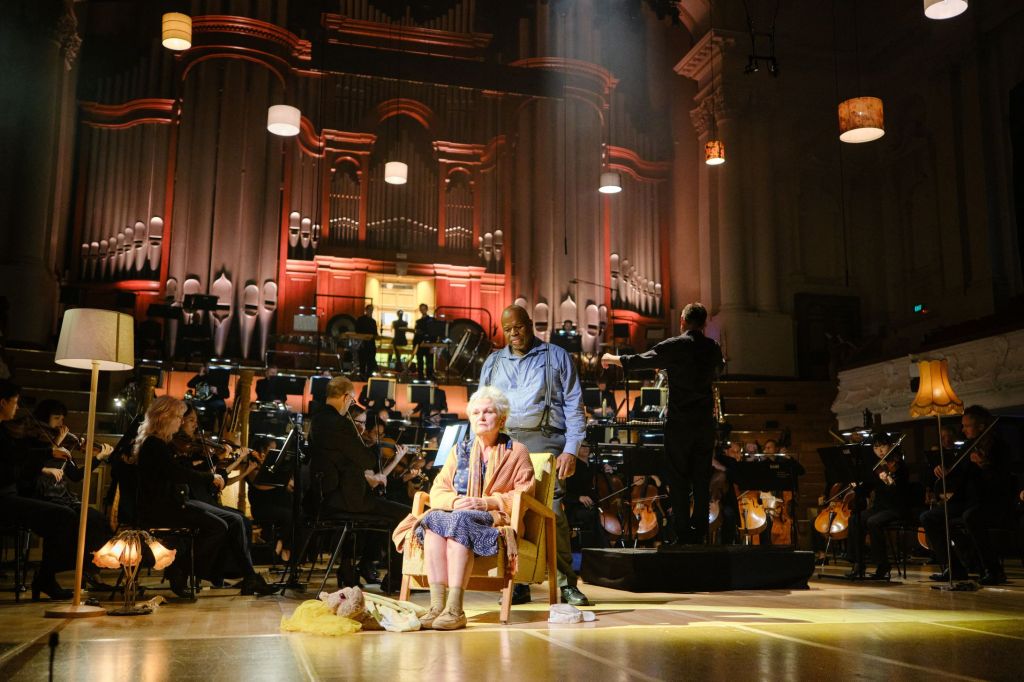
The seven memories in the trunk contain the relics of the couples past that Lester Lynch’s Bluebeard remembers with joy and anguish, while Susan Bullock’s Judith emotionally engages with her former self, as lover, bride and mother.
References are made throughout the opera about the power of light to overcome darkness and symbolic of this the stage was studded with two dozen domestic lamps which flickered on and off at various points.
Like the story of Bluebeards Castle, the music is mysterious and riveting, providing a background soundscape which seems to continually shift as the various events of the opera are revealed.
Throughout the work there were sequences where the music provided particularly unsettling sounds, while there were other times when the orchestra was able to symbolise the idea of light flooding into the darkness of the castle. There were some exquisite passages particularly the blaring drama of the organ which was like a palpable force and the swelling of the strumming harps.
It was the emotional richness provided by the two singers which helped maintain the tension along with their creation of character though their acting. Bullock displayed a voice of amazing power while Lynch plumbed great depths as he revealed his inner thoughts.
This production was a stunning display of acting and singing along with an inspiring performance by the Auckland Philharmonia under the direction of conductor Brad Cohen.

 New Zealand Arts Review