Reviewed by John Daly-Peoples

Rigoletto
Music by Giuseppe Verdi
Libretto by Francesco Maria Piave
NZ Opera, by arrangement with Opera Australia
Kiri Te Kanawa Aotea Centre
Until September 25
Reviewed by John Daly-Peoples
From the opening doom-laden chords through to the anguished sounds of the final moments of Rigoletto the audience was carried along by the glorious music which conjured up feelings of love, despair, anger and malevolence as we follow one mans destiny, overcome by the deceitful and immoral world he lives in.
Tyrants, and corrupt leaders have always had the ability to corrupt other people and surround themselves with equally corrupt yes men. Rigoletto takes us into that world of, deceit and amorality. It is a bleak world where the occasional flicker of light and love is quickly extinguished
The first act opens with the Duke of Mantua and his courtiers cavorting in an impressive reception room with references to La dolce Vita of the 1950’s. It is a world where the dinner suits and fabulous dresses disguise the lecherous goings on.
We also encounter Rigoletto dressed as the court jester – a mixture of Ronald McDonald and Joaquin Phoenix’s Joker as he peels off his make up surrounded by his various costumes. He is an actor who must play many parts, just as the other members of the Dukes court play out their roles.
The first act’s dramatic opening is just the start of probably one of the most mature and intelligent productions of the opera and one which kept the audience enthralled.
One of the problems I have always had with the opera is the curse with which Monterone damns Rigoletto and the duke early on. The notion that he has been cursed preys on Rigoletto mind throughout the opera and when his daughter dies in his arms, he shrieks about the curse has been fulfilled. Of course, the evil Duke still lives, so the curse has not affected him.
In fact, Rigoletto himself is the reason his daughter has been killed, Rigoletto himself is the curse and she dies because of his deceit and immorality rather than anyone else’s.
The Duke and his various courtiers are not particularly evil. They act as many men of business or politicians, using or skirting the law in an amoral fashion. It is Rigoletto who embarks on a course of revenge with the decision to hire an assassin to kill the Duke.
The courtiers and the Duke are also upfront about what they do. It is Rigoletto who presents a façade at court as well as to his daughter, withholding the truth of his relationship with the Duke and his early life even from her.
This veneer which he presents is his undoing. His pretense of an irritating, sycophantic fool at court hides a deep-seated resentment. His lack of awareness of his involvement with amoral activities as well as presenting as a cloying and over protective father is his weakness, his flaw, his curse.
James Clayton in the role of Rigoletto has to convey Rigoltto’s complex set of attributes and flaws. His character never becomes over demonstrative, there is always a sense of him holding back in his expression of love, hate, contempt. It is too easy to have Rigoletto portrayed as a twisted character who is obviously deformed physically as well as mentally and Clayton carefully avoids this.
His “Pari siama” (How alike we are) when singing of the assassin Sparafucile is haunting in its exposure of Rigoletto’s awareness of his own wretchedness, his voice catches with shuddering emotion at just the right point. Then he superbly transitions to his singing as devoted father of Gilda. This ability to capture his two personalities, the heartless and the warm showed in just a couple minutes showed a singer with able to convey deep psychological states with exquisite refinement.
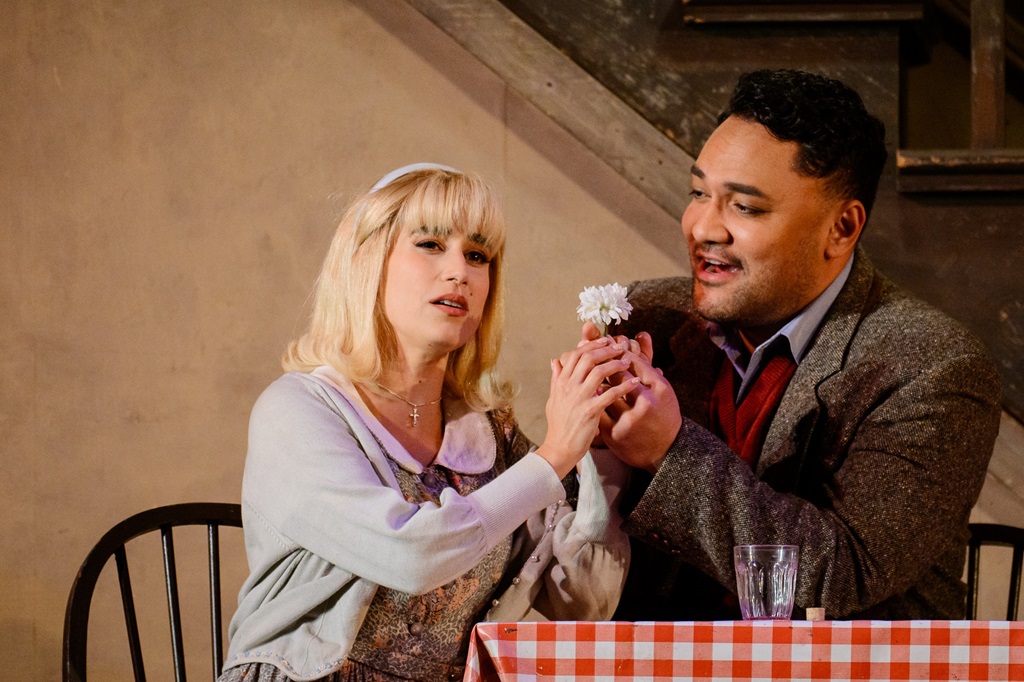
As Gilda, Elena Perroni created a character which expressed all the conflicting emotions of a young woman exposed to the ache and desperation of love, the terror of kidnap, the embarrassment of talking to her father about her seduction and the confusion of being dragged into the adult world.
Her voice soars with emotional expression in arias such as “Care nome” (Dear name) where effervescent and passion erupt.
Amitai Pati sang gloriously as the hedonist Duke with just the right mix of bravado and self-awareness. In his role as Gilda’s lover his voice took on an elegant combination of romanticism and cynicism which helped create a fully rounded, disreputable character.
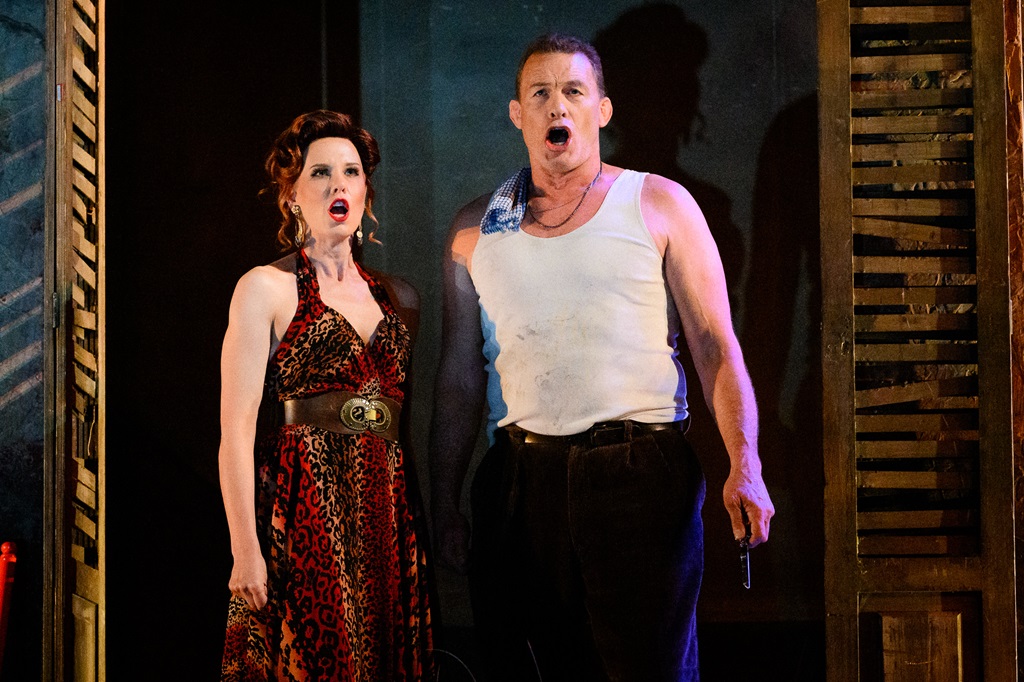
Jud Arthur’s Sparafucile was suitably threatening with his mundane approach to killing,. His silky voice resonated with darkness and menace, his body tense with suppressed nervous energy.
Sian Sharp was impressive as Maddalena, Sparafucile’s sister and she added a sensual dimension to the final quartet when she sings with the Duke, Rigoletto and Gilda in a profound “Bella figlia” (Lovely woman).
The set designs by Michael Yeargan are impressive from the lavish palace interior to the brilliantly detailed house/ bar interior constructed on a revolving stage which helps concentrate the action.
This is a restaging of the work originally directed by Elijah Moshinsky and rehearsed by Shane Placentino who has done a splendid job in realizing the work.
As ever the New Zealand Opera Chorus was in great form and conductor James Judd deftly led the Auckland Philharmonia ensuring that the music added to the overall dramatic effect, dominating when it needed to but always allowing the singers the space to let their voices shine.
With this production director, designers, soloists chorus and musicians have brought together a seamless tale of brilliantly rounded characters with vivid emotions and contemporary relevance.
To subscribe or follow New Zealand Arts Review site – www.nzartsreview.org.
The “Follow button” at the bottom right will appear and clicking on that button will allow you to follow that blog and all future posts will arrive on your email.
Or go to https://nzartsreview.org/blog/, Scroll down and click “Subscribe”


 New Zealand Arts Review