Categories
Reviews, News and Commentary

NZSO’s Ascension: three contemplations of Nature

Reviewed by John Daly-Peoples

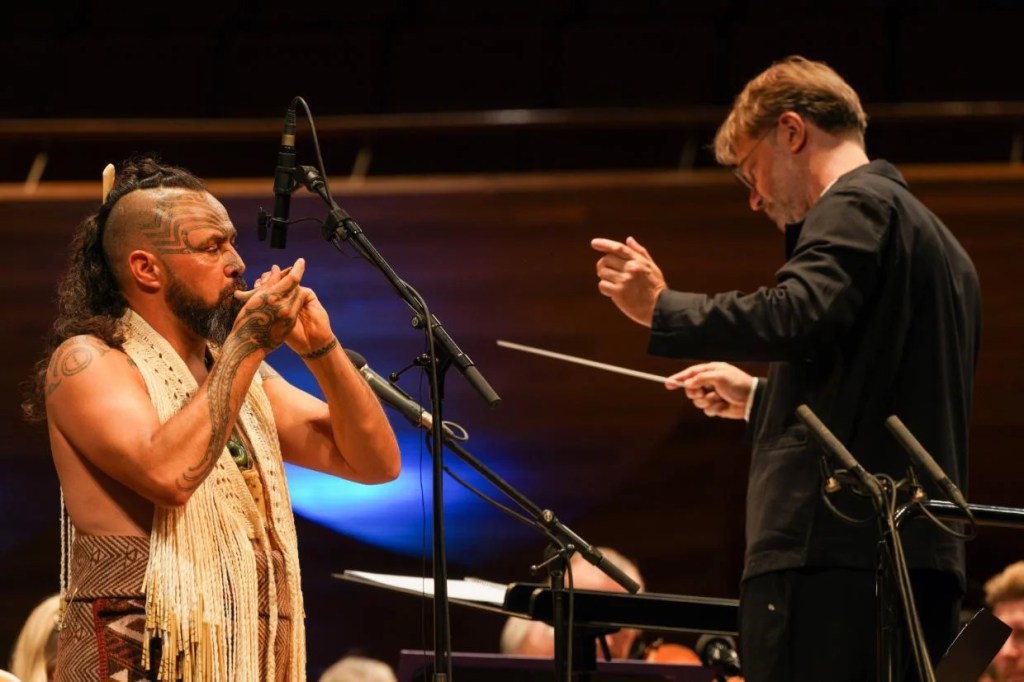
Jerome Kavanagh Poutama and André De Ridder

Ascension

NZSO

Auckland Town Hall

August 9

Reviewed by John Daly-Peoples

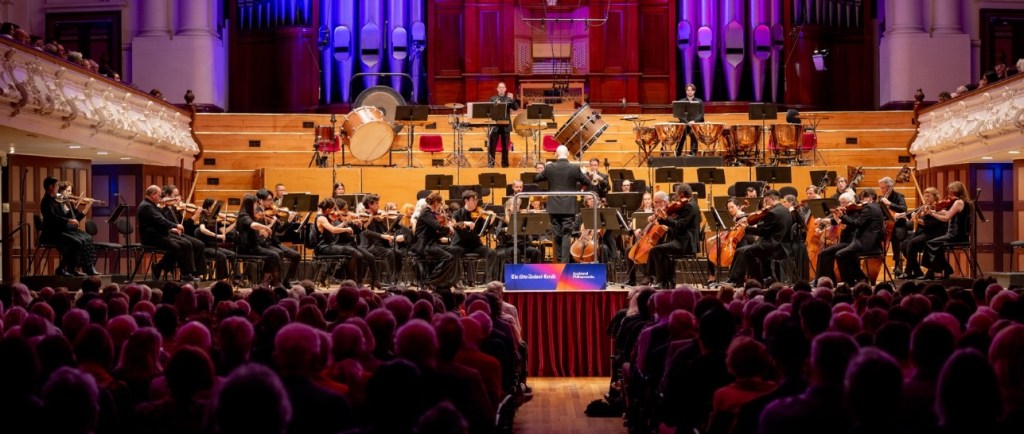
The three works on the  NZSO’s “Ascension” programme featured  the responses of the composers to Nature with responses that ranged from encounters with the  small incident to contemplation of its vastness and complexity.

Ralph Vaughan Williams’ observation and reflection on the simple action of a bird taking flight is turned into a metaphor for Spring and the awakening  of consciousness in his “The Lark Ascending”.

The work opens with both  bird and orchestra being roused from their slumber, the sounds of the orchestra capturing the notion of bird flight while the woodwinds and brass build a picture of the forest and bush

Inspired by the poem of the same name by George Meredith, the poem’s imagery of water and nature conveys a sense of fluidity and renewal, while the bird’s song inspires a profound sense of harmony and contentment.

Lines sauch as

For singing till his heaven fills,
’T is love of earth that he instils,

Show that Merdith and Williams saw their works as metaphors for both the simplicity and drama of Nature.

The orchestra’s brooding tones depicting a landscape blended well with the solo violin of Vesa-Matti Leppänen, the concert master of the NZSO. He managed  to evoke a spirit of celebration tinged with a  sense of the  melancholic.

The central work on the programme was “Papatūānuku”, a joint collaboration by composer Salina Fisher and taonga pūoro   specialist Jerome Kavanagh Poutama. It was a work honouring the Earth Mother, Papatūānuku and featured a number of instruments played by Jerome which produced music  which  replicated sounds of the natural world.

The musical landscape featured an intertwining of the orchestra’s instruments with the taonga pūoro which including pūtātara and pōrutu pounamu. Throughout  the work the two groups of instruments called to each other with both sets of instruments replicating bird sounds. The percussion instruments of the orchestra, including the piano  responded to the taonga pūoro, often mimicking their sounds. As well as bird calls Jerome’s instruments also captured the sounds of sea shore and bush. The work becomes a dreamscape of drifting sounds.

As the work progressed, we seemed to drift further  and further into the bush, some of the instruments sounding like voices enhanced by the breathing of Jerome himself.

Jerome had laid out his instruments on a table covered with a Palestinian keffiyeh so his performance took on a reflective mood referencing Gaza where no birds sing.

The major work on the programme was Schumann’s “Symphony No 1 (Spring)”. It opened with a  dramatic introduction ,something of a welcome to Persephone, the Goddess  of spring, acknowledging her return from the underworld each spring, a symbol of renewal and  immortality.

After the sprightly first movement there was the softness to the second movement which morphed into an heroic sequence featuring a vibrant dance. Here conductor André de Ridder took a few tentative dance steps to the music which flicked between the languorous and the dramatic. This-was followed by the Scherzo with its rapid tempo creating a sense of liveliness. before the  final movement’s farewell to Spring.

Throughout the work the composer celebrated aspect of spring – the blossom erupting, the sounds of birds and animals and the cries of children at play.

André De Ridder has been announced as the NZSO’s next Music Director, and will take  up the position in 2027.

Categories
Reviews, News and Commentary

The Auckland Philharmonia’s Daphnis et Chloé

Reviewed by John Daly-Peoples

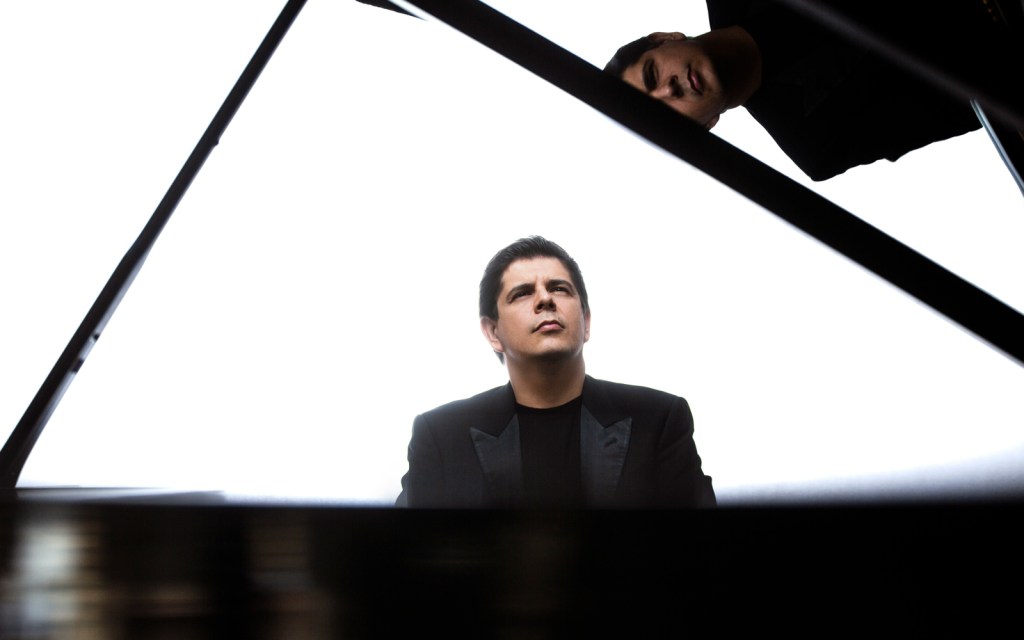
Javier Perianes

Daphnis et Chloé

Conductor – Jun Märkl
Piano – Javier Perianes
Choir – Sydney Philharmonia Choirs

Saint-Saëns, Piano Concerto No.5 ‘Egyptian’
Ravel, Daphnis et Chloé  (complete ballet)

Auckland Town Hall

August 7

Reviewed by John Daly-Peoples

While Camille  Saint-Saëns composed much of his music at the same time as Debussy, he rejected the idea that he was an impressionist composer however, with his Piano Concerto No 5 which is rooted in the romantic tradition he does display some  impressionist ideas.

The work is referred to as “The Egyptian” as he wrote in Luxor during a holiday in Egypt, incorporated some  Impressionist and other exotic elements. These include images of clouds, sky and sea in the first movement, the croaking sounds of frogs in the central movement and the the sounds of a ship’s propeller in the third.

Despite his traditionalism, Saint-Saëns’s use of colourful harmonies provided a foundation that influenced the French Impressionist composers who came after him.

The piano concerto is a  light drenched work with pianist Javier Perianes picking out colour flecked details, contributing ot the sense of landscape and history referencing the French fascination with Orientalism particularly in the late nineteenth century.

Perianes played with an assurance and was also very aware of conductor Jun Märkl. He handled the dramatic changes as well as the many runs and trills without being overly demonstrative playing with a restrained elegance manging to discover subtle nuances in the work.

Many of the passages  were very  descriptive and Perianes handled these effectively notably in the second movement with its changing  exotic tonal qualities replicating the sounds of Arabic  stringed and wind instrument. The orchestra also depicted the gentle flowing Nile with the oriental themes woven into the musical landscape.

The work has many passages of experimental and novel sounds for both the orchestra and piano with some dark and mysterious sounds as well as effervescent and graceful passages.

In the third movement which has hints of a return journey across the Mediterranean both the orchestra and piano were more  energetic with a tranquil passage from the piano before the orchestra’s massive finale.

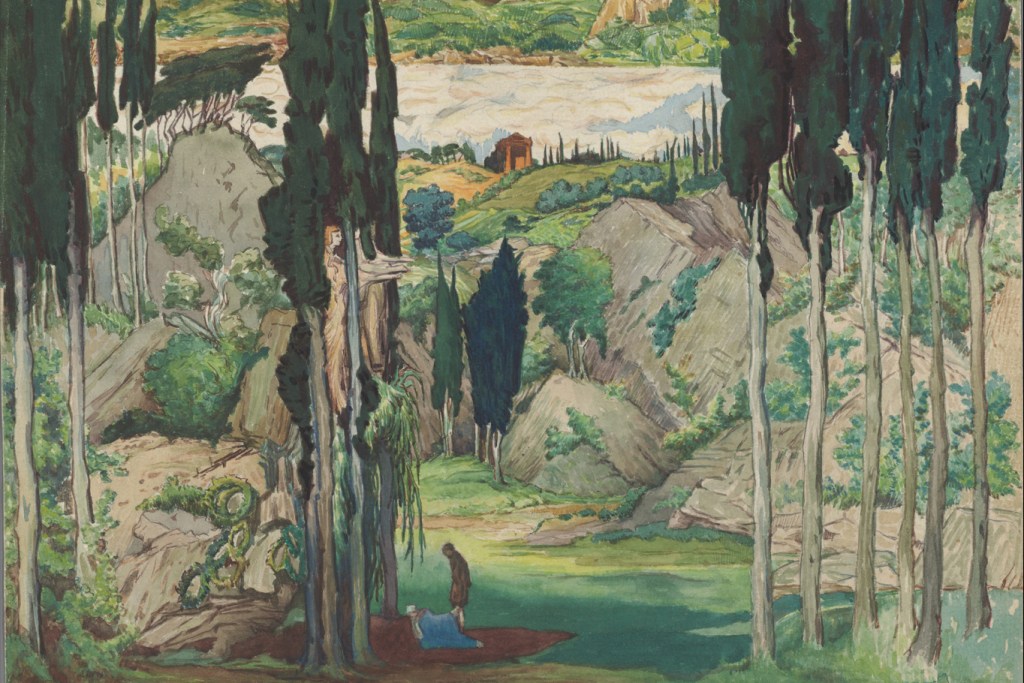
Leon Bakst. Set design for Daphnis and Chloe

Ravel’s ballet “Daphnis and Chloé is set  in the rural, idyllic landscape of Lesbos where myth and legend combine.  The original set design by Léon Bakst reflected that setting as well as the idealised Grecian style costumes for the dancers. Ravel’s music has a sensuous flow to suit the ballet as well underscore the lover’s adventures. The music provided elements  of drama and description as well as atmosphere for the evolving narrative.

The work is Ravel’s longest composition, lasting nearly an hour, and includes  a wordless chorus which was sung  by the Sydney Philharmonia Choir as well as a range of percussion instruments – harps, harpsichord, castanets and wind machine.

Ravel referred to the composition as a “choreographic symphony” and it  has a complex narrative built around several recurring themes and a number of dance sequences which gives the work a sense of ritual.

The Sydney Philharmonia Choir which was integrated into the orchestral work gave a sumptuous performance. It performed at the opening of the work and at various points throughout. Its ethereal sounds provided a rich musical texture adding to the expressive quality of the work. They also provided some intriguing, choral work for the Pirate Camp war dance.

Some of the music for the  dance sequences was tense and abrupt while other were more sinuous and graceful. The orchestra also highlighted some of the dramatic moments in the ballet such as Chloes kidnapping  and Daphnis’s despair at the thought of losing Chloe.

Categories
Reviews, News and Commentary

Violinist Arabella Steinbacher shines in Auckland Philharmonia’s “Beethoven 5” concert

Reviewed by John Daly-Peoples

Arabella Steinbacher image: Sav Schulman

Beethoven 5

Auckland Philharmonia

June 26

Reviewed by John Daly-Peoples

It is rare for a New Zealand orchestra to perform the  same concert twice  in a week, something which is common with European orchestras and even Australian ones. However, this week the Auckland Philharmonia performed its Beethoven programme on a Wednesday and Thursday, both to sold out audiences.

The orchestra’s “Beethoven 5” concert opened and closed with two very different compositions composed within ten years of each other. The first, Rossini’s Overture to La Cenerentola, composed in 1817 is an effervescent work based on a fairy / folk story while Beethoven’s Symphony No 5 of 1808 is a dramatic work reflecting the composers view of the political climate of the time as well as a growing awareness of his own fate.

Between those two pieces was an elegant display of violin playing by Arabella Steinbacher

The Rossini opened with an engaging display by the woodwinds and brass evolving into a dance-like piece.

The woodwinds held much of this musical adventure together which captures the essence of the opera, its comedy and convoluted storyline.

The Auckland Philharmonia manages to attract some of the world’s great soloists and with the Japanese / German violinist Arabella Steinbacher the audience was treated to a stunning performance of Mozart’s “Violon Concerto No 5”.

She opened the work with some silky playing, slowly revealing the intricacies of the work. At times her playing flowed along with the orchestra while at other times she appeared to add new musical themes to which the orchestra responded.

With the cadenza she showed a skill and insistence which gave the work a very contemporary and adventurous sound.

Throughout the piece she seemed to be perfectly in control of her playing, never trying to outdo the orchestra preferring to let her exquisite, often restrained  playing  shine. In the second movement some of her playing was almost ethereal while at other times her deft and refined.

In the third movement as the orchestra became more dynamic, she seemed to revel in their playing adding an urgency to her own playing.

Having heard Beethoven’s “Symphony No 5” several times it is still rewarding to hear another orchestral performance. The drama, the nuance, the intensity of the conductor and the players, all add the spectacle. As well as appreciating the music there is also a sense of the composer himself grasping for musical ideas, responding to the momentous events of his  times and seeing his own political and spiritual condition connected to those events.

No section of the work is irrelevant or unnecessary, it can can be loud and dramatic with rousing sequences but also gentle, soothing. delicate and  sprightly. Beethoven certainly knew how to create drama, mystery and atmosphere.

Apart from the symphony’s well-known dynamic opening and other dramatic sequence the symphony also has superb moments provided by individual instruments  such as the clarinet and flutes in the opening minutes or the mass pizzicato of the strings.

Conductor  Bellincampi guided the orchestra  brilliantly showing his ability to reveal the drama, tension, and revolution within the work. He also highlighted the nuances of the work, emphasising the  contrasts and  moods of the piece.

To subscribe or follow New Zealand Arts Review site – www.nzartsreview.org.

The “Follow button” at the bottom right will appear and clicking on that button  will allow you to follow that blog and all future posts will arrive on your email.

Or go to https://nzartsreview.org/blog/, Scroll down and click “Subscribe”

Categories
Reviews, News and Commentary

Auckland Philharmonia’s “Tchaikovsky 5”

Reviewed by John Daly-Peoples

Alexander Gavrylyuk Image Adrian Malloch

Tchaikovsky 5

Auckland Philharmonia

Auckland Town Hall

April 15

Reviewed by John Daly-Peoples

First up on the Auckland Philharmonia’s “Tchaikovsky 5” programme was Kenneth Young’s “Douce Tristesse”, a work composed in 2012 in response to the composer’s final visit to the  long-time family holiday spot near Tauranga.

Strings and woodwind opened the work with a description of landscape, with swathes of colour conveying the changing light and textures of the land, sea and sky.

These vignettes were studded with musical highlights deftly conveyed by the small group of percussion instruments – cymbals, glockenspiel, crotales and harp suggesting the sparkles of light on water, the movement of clouds and the chirping of birdlife.

The work manages to suggest panoramic images from dawn to dusk suggesting the romanticism of the idyllic as well as a nostalgia for lost times and memories.

The composer says that the title ‘Douce Tristesse’ means ‘ sweer sadness and that the piece is about looking at a familiar scene for the last time, a view never to be seen again.

Prokofiev’s third Piano Concerto was written in 1921 during a period of self-imposed exile from Russia and a period when he did not feel oppressed by war or demands on his time and seems to have  more leisurely ambience . The work was first performed in Chicago with the composer playing. The audience and press raved over the music with The Chicago Daily Herald calling it the “the most beautiful modern concerto for piano,”

It opens with the sounds of a clarinet and strings playing a floating melody emblematic of his own more relaxed life. This led quickly to pianist Alexander Gavrylyuk racing into the first movement of the work with fiery sounds from both orchestra and  pianist who played as  though the piano were a percussion instrument

Hunched over the piano his playing was by turns delicate and ferocious as he grappled with the various sequences. There were times when his sounds were languid and romantic and other times when he took a delicate almost spiderly  approach to his playing.

In the second movement he turned the slow dance-like opening into a cacophony of jarring sounds and the intense finale of the third movement saw him in studious concentration.

He displayed a mastery of stylish playing, able to ignite the orchestra with his passion and drive.

His playing technique – changing tempos, charging through themes and varying the tonal qualities added to the excitement of the playing and appeared to enliven conductor Shiyeon Sung well as the orchestra.

Shiyeon Sung Image Adrian Malloch

The major work on the programme was Tchaikovsky’s “Symphony No 5” which saw Shiyeon Sung and the APO deliver one of their outstanding performances. The work is full of sensuous melodies, intense emotions and dramatic climaxes which make it one of the composers more invigorating works.

Some of the sequences are monumental with music similar to his 1812 Overture while there were traces of his ballet music in others.

Sung deftly, guided the orchestra, building musical images, of landscapes, seasons and events creating a world of sensation and emotions.

There were joyous  moments throughout the work but these were set against contemplative sections with the composer finding redemption in the grandeur of the work.

From the anguish of the first movement through the graceful mid-section and onto the final tumultuous fourth movement the orchestra provided a rich and satisfying performance.

While the orchestra was expertly conducted and the players superbly coordinated there were some stand-out performances by the bassoons, flutes, clarinets and French horns.

Categories
Reviews, News and Commentary

Mozart’s Jupiter: Musical foothills and a mighty mountain

Reviewed by Peter Simpson

Genevieve Lacey Photo. Pia Johnson

Mozart’s Jupiter

Auckland Philharmonia Orchestra

Auckland Town Hall

May 1

Reviewed by Peter Simpson

Thursday’s Mayday concert by the Auckland Philharmonia Orchestra consisted of some pleasant foothills leading to a mighty mountain. The foothills were all acts of homage by different composers to a major predecessor: Tchaikovsky honouring Mozart; Australian composer Elena Kats-Cherwin (born 1957) honouring Bach, and British composer George Benjamin (born 1960) honouring Purcell. The mighty mountain was Mozart’s sublime ‘Jupiter Symphony’, No. 41.

The conductor, Leo Hussain (born 1978), is British and is currently Principal Guest Conductor of the George Enescu Philharmonic in Bucharest; he also worked with Simon Rattle at the Berlin Philharmonic and is probably He is best known as a conductor of opera. In Auckland he began the concert informally with a brief verbal introduction emphasising the linking theme of homage and describing the Mozart symphony as the summation not only of Mozart’s career but of the whole Classical period in music. His control of the orchestra was impeccable throughout and the whole concert was warmly received.

Tchaikovsky’s ‘Mozartiana’, dating from 1887, orchestrated what the composer called ‘gems of musical art, unpretentious in form, but containing incomparable beauties’. The first three movements are tasty miniatures; the final movement, a set of variations, based on Mozart after a theme by Gluck, is more extensive and includes some effects a million miles from Mozart; the variations fully explore the large orchestra’s resources, one being entirely for strings, another entirely for woodwind, and including solo turns by clarinet, flute, violin and glockenspiel. The performance was spirited.

Elena Kats-Chernin describes her six-part work as ‘Re-inventions (after Bach)’; they are based on some of the great composer’s inventions for keyboard. Scored for small string orchestra and solo recorders the performance featured entertaining solos on four different recorders (discount, tenor, bass, sopranino) by Australian virtuoso Genevieve Lacey who impressed the audience (especially in her bird-song imitation encore) with her skill and vivacity.

Composer George Benjamin was a pupil of Messiaen; his ‘Three Consorts’ responds particularly to the ‘mesmerising intersection of line and harmony’ in Henry Purcell’s 1680 Fantasias. The middle piece was especially sonorous and pleasing.

Mozart’s Jupiter symphony is an astonishing work which the composer himself probably never heard performed; it certainly owes its name to somebody else. One scholar described it as ‘the greatest orchestral work of the world which preceded the French Revolution’ and the APO played the work as if they agreed with that dizzy estimation. The way the symphony combines both clarity and complexity, especially in the last movement, was apparent throughout the orchestra’s sparkling rendition. Glorious music!

Categories
Reviews, News and Commentary

Delicacy and grandeur in nineteenth century masterworks

Inon Barnatan. Image. Sav Schulman

Romantic Brahms

Auckland Philharmonia

Auckland Town Hall

April 10

Reviewed by Peter Simpson

The April 10 concert of the Auckland Philharmonia headed ‘Romantic Brahms’, placed the audience squarely in the nineteenth century (where most audiences most like to be), with an overture from 1834, a concerto from 1881 and a symphony from 1888. The conductor was the Swiss-Australian Elena Schwarz who is currently with Klangforum, a chamber orchestra specialising in contemporary music based in Vienna; she is also a guest conductor with leading orchestras in Europe, America and Australia.  Elegant and agile in her dark trouser suit she seemed completely in command of these complex scores.

Louise Farrenc (1804-1975) was famous in her time (and is now undergoing recuperation) as a pianist, teacher and composer in Paris, earning the respect of Schumann and Berlioz for her compositions which included symphonies and chamber works as well as two orchestral overtures in 1834, the second of which played in Auckland demonstrates her confident control of the post-Beethoven orchestra and musical idioms.

Brahms’ Piano Concerto No. 2 is possibly his greatest orchestral work, at least I have thought so since the early 1960s when I first heard Sviatoslav Richter’s famous recording with the Chicago Symphony under Erich Leinsdorf made during Richter’s first tour of America. Israeli-pianist Inon Barnatan was well up to the demands of this heroic score ranging as it does from  extreme delicacy – as in the opening exchanges between piano and horn (the beginning slightly fluffed by APO’s horn soloist) – to full orchestral grandeur in the many climactic passages. For his encore the pianist unusually chose a graceful duet by Rachmaninov with a cellist instead of a solo piece, perhaps in recognition of the lovely ‘cello solo at the start of the third movement of the concerto.

According to Heath Lees’ programme notes, César Franck’s Symphony in D has somewhat lost favour with modern audiences compared to its earlier fame, but it still comes across as a noble and majestic piece, especially in its swelling major theme which recurs throughout the circular structure The texture of the work can sometimes seem a bit muddy but not in Elena Schwarz’s expert separating out of the separate layers of sound. It was a fitting conclusion to a stirring and satisfying evening of Romantic music.

Categories
Reviews, News and Commentary

Auckland Philharmonia’s Brahms 3 and a masterly James Ehnes

Reviewed by John daly-Peoples

James Ehnes Photo Sav Schulman

Brahms 3

Auckland Philharmonia

Auckland Town Hall

February 27

Reviewed by John Daly-Peoples

The “Brahms 3”concert began with Romanian composer Gyorgy Legeti’s “Concert Romanesc” written in 1951. The work opens with joyous images of landscape studded with hints of folk music. These passages combined humour and experimentation, qualities which inhabit much of his later music.

From the middle of the piece there were more sombre sounds, as though confronting the history of his country as well as the suffering and death of his parents in Auschwitz during World War II.

As the work became darker and bleaker there was a whirling dance of death moving to a finale where the whole orchestra exploded with lively, suffocating sounds.

Following his performance last week James Ehnes’ performance of Bartok’s “Violin Concerto No 1” was highly anticipated. He did not disappoint. With the soulful opening movement he was initially joined by Andrew Beere and Lauren Bennett before others from the string section joined, adding to the density and complexity of Ehnes’ playing.

Following on from the strings, the woodwinds provided a slightly unsettling voice and even as the orchestra gained in intensity, Ehnes’ violin rose up , soaring above the sounds of the orchestra with some strident sounds which were reflected in Ehnes’ rigid  demeanour and exacting playing.

From the second movement on, his playing style changed, taking on a more passionate and expressive approach with some more hectic, gypsy-like playing as he battled against the sweep of the growling orchestra. However, even when he was frantically playing there was a sense of his being totally in control.

With his mastery of the violin, his skilful changes in pace, and tone the audience  was treated to a display by a consummate violinist.

While Ehnes received a rapturous ovation for the Bartok it was his encore, Eugene Ysaÿe’s “Violin Sonata No.3 ‘Ballade” .that got a tumultuous reception. The solo work dedicated to the Romanian violinist and composer George Enescu which was beautifully structured requires an intelligent and skilful player – all the qualities that Ehnes was able to bring to the piece.

The big work on the programme was the Brahms “Symphony No 3, a work which is full of marvellous melodies but which is something of an enigmatic work.

In many ways it is a forerunner of the impressionist works of Debussy and Ravel reflecting the interest of the Impressionist artists of the late nineteenth century. Much of the music is linked to visions of landscape, light and shade, colours and texture.

These images parallel a world of emotions and feelings, the composers inner and exterior worlds mingling. In building  a structure based on these links Brahms explores the nature if the human condition. This is very evident in the final movement with its passages of drama and tumult suggesting natural forces as well as the inner turmoil of love and passion.

The final works on the programme, three of Brahm’s Hungarian Dances had Conductor Bellincampi conducting at breakneck speed and while he spent much of his time dancing on the podium the orchestra were swept up by the music and carried along by its own impetus.

Bellincampi used the dances to book-end a farewell to the orchestra’s Music Librarian, Robert Johnson who has worked at the orchestra for over thirty years.

To subscribe or follow New Zealand Arts Review site – www.nzartsreview.org.

The “Follow button” at the bottom right will appear and clicking on that button  will allow you to follow that blog and all future posts will arrive on your email.

Or go to https://nzartsreview.org/blog/, Scroll down and click “Subscribe”
Categories
Reviews, News and Commentary

A thrilling “The Planets” from the NZSO

Reviewed by John Daly-Peoples

The Planets

New Zealand Symphony Orchestra

Auckland Town Hall

November 23

Reviewed by John Daly-Peoples

One of the disappointing aspects of the NZSO’s recent “The Planets” concert was the short duration of the first work on the programme.

The Finnish composer Kaije Saariaho’s  “Asteroid 4179: Toutatis” was performed for four minutes, but many in the audience would have been delighted if it had run for twice or three times that length.

“Asteroid 4179: Toutatis”, is named for an actual asteroid, a two-kilometre rock fragment which moves between Mars and Jupiter. The work is a confluence of science and art with the music sounding like music many composers have used for the soundtracks of science fiction movies or to create otherworldly sounds Her ethereal sounds which represent the movement of the asteroid were mysterious and saw her turning scientific notations into music.

The composer was trying to describe the pattern of Toutati’s movements, its chaotic orbit, its unfixed north pole and its complex pattern of rotation so we had music which described the various ellipses, parabolas and  cosmic curves tracing out celestial journeys.

The work contained  multiple combinations, of strings and huge sounds from the full orchestra . Many of the sounds were unusual with shimmering strings, eerie sounds  from  the wind instruments  and even fleeting sounds from the harp.

Christian Tetzlaff

Christian Tetzlaff gave an electrifying performance with his playing of Elgar’s Violin Concerto and he seemed to become one with the violin, It was not just his bowing arm but his whole body which appeared to be affected by the music.

He opened with some  ferocious bowing but this soon morphed into playing which was not much more than a whisper with Tetzlaff gently rocking as though playing a lullaby, taking him into a state of reverie.

There were times when the bow met the strings with a piercing sound,  while there were other passages when the bow barely touched the strings.

Several times his feverish playing was matched by Gemma New’s demonstrative conducting where she conducted with her body and not just baton and hands. Then there were times when violinist and conductor appeared to be linked in a dance, their bodies  swaying in harmony.

There were many passages in the work which were extremely taxing for the violinist but Tetzlaff handled these with style and self-assurance. At times he was sharply focused with some aggressive playing, as though he was trying  to outrun the orchestra  before changing to a more serene mode, melding with the orchestra.

With the slower second movement he was like a different violinist, the torments of the first movement replaced by an  engaging romanticism  Before the spirited finale he effortlessly dashed off a spirited theme with some grand gestures.

That Gustav Holst composed his The Planets suite early on in the twentieth century saved a lot of problems later on. Pluto was not discovered until 1930 so was not one of the planets which the composer included in his work. So, with Pluto now being dropped as one of the planets his work doesn’t have to be seen as an oddity just one of the great British musical works of the early twentieth century.

Under the brilliant direction of Gemma New the orchestra managed to give each of the sequences a thrilling interpretation, exploring their emotional and narrative themes. At times New seemed carried away by the music performing little dances and jigs, her hands and arms tracing out the music as though replicating planetary arcs.

From the relentless marching sounds of Mars, The Bringer of War through to the almost spiritual Neptune there was an urgency and  drama from the orchestra.

Jupiter featured an onslaught from the full strings along with an array of percussion including bells and triangle which added to the intense atmosphere.

Emotional and expressive playing by the violins, cellos, and double basses introduced Venus along with percussion instruments – gongs, triangles, bells, timpani, celesta and drums, which provided a serene and imposing atmosphere.

Saturn gave us the sombre sounds of the double basses  and  plucked cellos and  this then changed with a nice contrast to harps and double bass.

The opening harps and organ of Neptune, created an enigmatic sound with the  orchestra joined by Voice New Zealand Chamber Choir which was beautifully expressive, becoming another instrument  to finish the work in style,

Categories
Reviews, News and Commentary

APO’s Romantic Journeys

Reviewed by John Daly-Peoples

Johannes Moser

Auckland Philharmonia

Romantic Journeys

Auckland Town Hall

November 21

Reviewed by John Daly-Peoples

The opening and closing works on the APO’s Romantic Journeys programme featured travelogues from Tchaikovsky and Schumann. Tchaikovsky Capriccio Italien is a record of one of his  trips to Italy whileSchumann’s Symphony No.3 ‘Rhenish’ was written in response to a journey along the Rhine and a visit to Cologne.

Tchaikovsky travelled many times to Italy, partly to escape the Russian winter and it was on one of these trips that he was inspired to compose his Capriccio Italien partly inspired by Carnivale, of which he wrote – “seeing the public raging on the Corso, you are convinced that no matter how strangely the joy of the local crowd manifests itself, it is nevertheless sincere and unconstrained,”

A  blaze of horns opens the work,like a curtain being lifted to reveal a colourful panorama of landscape, cities and spectacle. There are some slow and precise passages before we hear traces of folk music which introduce a sense of Italian life with lively  and charming dance melodies and bugle calls.

This was followed by a fast-paced tarantella-like sequence with the lively strings and woodwinds allowing the composer to capture the ebullient moods of the people as they danced through Carnivale  from dawn to dusk.

Throughout the work with its changing, colours and tempos there is a sense of the composer delighting in parading these sounds which would be new to a Northern European  audience

Schumann’s Symphony No 3 (Rhenish) is a portrait of the Rhine but it can be seen as part of the nationalist ethos which had been developing since the end of the Napoleonic  Wars and was particularly strong in the Rhineland.

From the opening fanfare, there is a sense of celebration of the land, the buildings and the people. The Rhine is central to this depiction and the music paints a picture of the flowing river indicated by the sinuous sounds and overlapping melodies of the orchestra.

The work is like a musical diary depicting the changing landscape as the composer passes through towns and villages capturing his changing impressions.

The voluptuous second movement also has landscape images – clouds, fields and activity, all highlighted with bursts of dramatic brass while the third continues with descriptive passages which are increasingly jaunty.

The fourth movement is  full of majestic sounds and is a description of the composers visit to Cologne Cathedral, the largest in Germany. The building was still in its unfinished state, surrounded by scaffolding, the two massive spires yet to be installed. It would still have provided an impressive scene and the music conveys that sense of size and grandeur, with traces of liturgical and choral music. The full range of the brass instruments provided  the orchestral texture and the movement climaxed in a massive, repeated fanfare for brass and winds.

With the finale, the vibrancy of the first movement was revisited emphasising the rhythms, giving the music a headlong movement that drove the Symphony to its thrilling, conclusion.

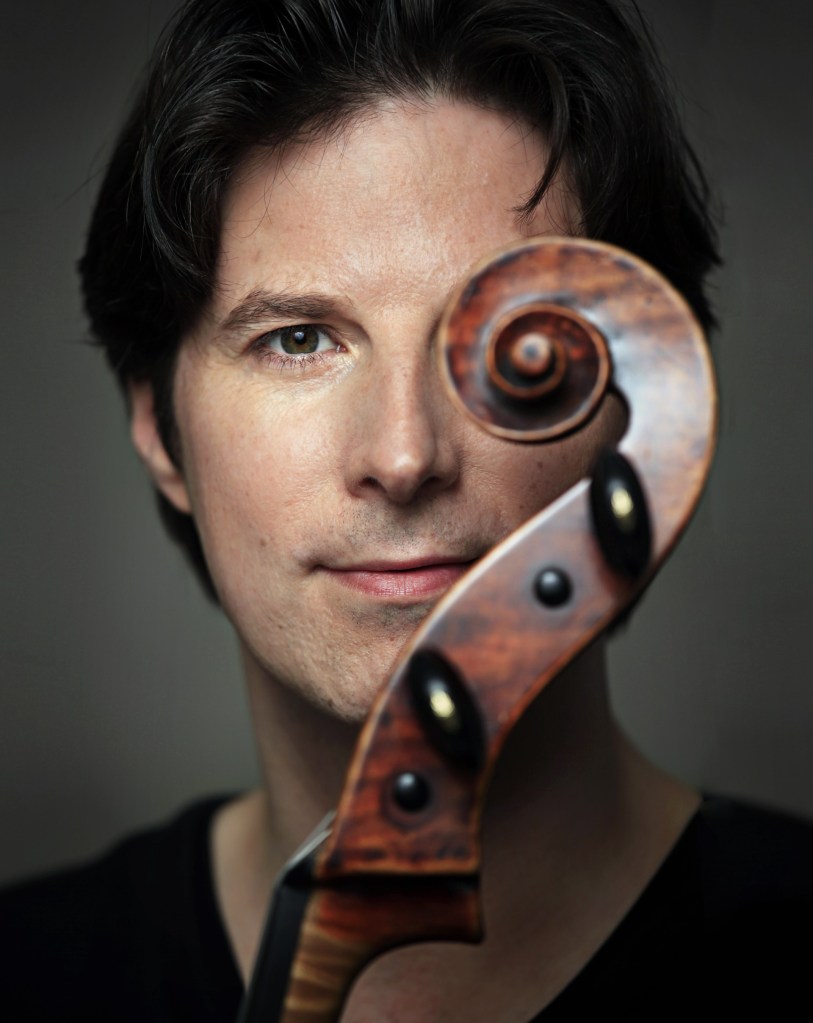
Between the two descriptive works the orchestra played Tchaikovsky’s Variations on a Rococo Theme with German / Canadian cellist Johannes Moser who replaced Edgar Moreau.

Moser glided  effortlessly through the work revelling in the interplay with the orchestra in a tantalising display which emphasised aspects of the sophisticated composition. He made use of the various solo sections  to show an understanding of the work as well  displaying his extraordinary technical skills.

He was able to combine, as did Tchaikovsky, an understanding of the romanticism of the Rococo theme as well as debt to Mozart which gives the work its spectacle in the way that cello and orchestra intertwine. The theme was dissected and re-formed in different guises with Moser seemingly finding new opportunities in the melodies as well as exploring its tones, and textures.

Categories
Reviews, News and Commentary

NZ Trio’s Untamed Hope

Reviewed by John Daly-Peoples

NZ Trio. Amalia Hall, Somi Kim and Ashley Brown

NZ Trio

Triptych 3: Untamed Hope

Auckland Concert Chamber

November 17

Reviewed by John Daly-Peoples

NZ Trio as well as being one of the finest groups of players in Australasia are also one of the most innovative and inspiring with their stimulating programmes. This was clear in their latest concert, “Untamed Hope” which featured four women composers from New Zealand, England, Germany and the USA with works spanning three centuries.

The title of the concert, “Untamed Hope”: probably alludes to the fact that at least three of the  women were constrained in some way by the environments in which they began their musical careers. Their hopes of being able to be in the concert hall on equal terms with their male counterparts was largely tamed by that environment.

The opening work was English composer  Ethel Smyth’s Trio  in D minor, a work  written when she was twenty-two having left the England to study in Leipzig.  At the time she met many contemporary composers including Clara Schumann and Brahms.

The first movement could even have been written by Brahms, which was apparent in the  sinuous playing of Somi Kim who was accompanied by delicate melodies from the strings. Initially violin and cello were in harmony with the piano but then their playing began to diverge, with each of the instruments developing their own musical themes.

Parts  of the second movement seem to be based on a folk song (French or English) with theme passed between the three instruments, all suggesting a soulful introspection as well as displaying the composers sophisticated writing.

Third movement entitled “Leid” had many aspects of the “song without word” with hints of a Scottish dance melody played by Amalia Hall

The dramatic finale saw a long  passage by the piano with the strings entering, playing a Hungarian-like tragic theme.

Eve Bedggood’s Ukiyo 浮世 –The Floating World relates to the Japanese concept of “the floating world” which evokes an imagined universe of wit, stylishness, and extravagance, a state which was often experienced through theatre, song, stories  and pictures.

Bedggood says of the notion of “the simplicity of just existing  and immersing yourself in the floating world or sense of calm is something I think music and other art forms can evoke”.

Much of the work had musical images of floating, flowing and meditation states with the work opened with dark rumbles from the piano suggesting sombre depths with strains of the violin and cello making interventions .

We heard exciting glissando from the Amelia Hall’s violon and careful, controlled repetition from Ashley Brown cello, while many of the sequences  saw an almost minimalist backing with the scudding sounds of the strings hovering above.

The work was like a reverie, the various themes creating dreamlike images much like those of many Japanese prints of an earlier period.

The American Joan Tower’s “Trio Cavny” opened with some tingling high notes from the piano with the violin and cello responding with equally high-pitched sounds creating a taut musical mood.  A following sequence saw Somi Kim creating crashing waves of sound leading to a tension between the three instruments which then played independently of each other before arriving at a point of intense harmonisation.

The music ranged from the soundtrack of a horror movie to a musical version of the Doppler Effect to the sounds of sympathetic voices in  minimalist mediation.

The final work on the program was Fanny Mendelssohn’s Piano Trio in D Minor. It is a beautifully conceived work with the violin and cello flowing around the energetic displays of Somi Kim

Amalia Hall provided both a delicacy and sharpness with her playing, contrasting with Ashley Browns sedate cello.

The introspective and reflective  second movement which opens with  a romantic  sequence from the piano contained elements of waltz tunes  while the third suggested elements of German folk song.

In the final movement the three players displayed a vigorous drive and energy, beginning with some  mesmerising playing by Kim before Hall and Brownjoined in creating an eloquent dialogue, leading to repeated motifs to end the work with an optimistic conclusion

The group announced that cellist Ashley Brown will be leaving the group to take an appointment as Principal Cellist with the Auckland Philharmonia Orchestra next year. He  has been involved with the trio since its founding twenty-three years ago and his presence with the trio will be greatly missed.