Categories
Reviews, News and Commentary

Tempo Dance Festival: In Transit, Matter and Slip

Reviewed by John Daly-Peoples

In Transit

Te Rerenga o Tere | Tempo Dance Festival 2024

Rua, – In Transit & Matter

Q Theatre

October18

Slip , Rebecca Jensen

October 20

Reviewed by John Daly-Peoples

In Transit

Choreographer, Louise Pōtiki Bryant

Sound / Av, Paddy Free

Lighting, Jo Kilgour

Costumes , Kasia Pol

Slip, Rebecca Jensen

Louise Pōtiki Bryant’s In Transit imagines the links between Maori  myth, ritual and their notion of the ancestors observing the nutuarl  world and its cretasures. Here the shaping of the creation myths, are given narratuives and images which give meaning to the transition in human life  paralleling those of the spirit world.

The work appears to dwell on several aspects of Māori myth such as the creation story of Ranginui and Papatūānuku, whose, children exist for a time in  in the dark world until Tāne, separates their parents, bringing the children into light.

There is also reference to the evolution of the  taiaha which Tū, the god of war asks Rūrūtangiākau, the weapon maker of the gods to create a weapon.

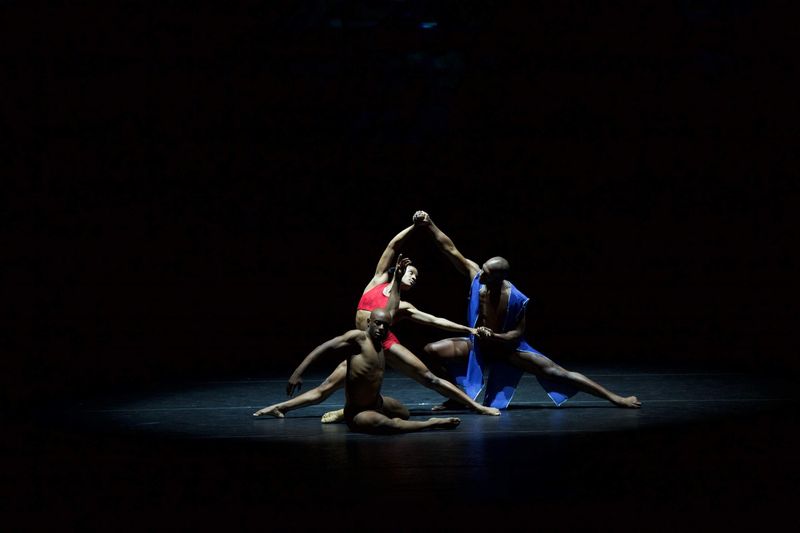
The dance opens with a low droning sounds as the sole figure, representing Tū or Rūrūtangiākau who dances through shafts of light with a  branch balanced on his head., He moves from an underworld into light and is joined by five other dancers who perform with long sticks or the evolving taiaha. They dance to a soundscape which [provides a sense of the being under water along with bird sounds.

The dancers seemingly inspired by bird and reptile  movement, move with short sharp steps id birds, strutting, foraging and pecking. These  movements were accompanied by staccato like breath which add to the sense of existing n another dimension.

Some of the dancers entwine cresting manaia shapes suggesting the notion of messenger between the mortal and spirit worlds.

The slender taiaha are used to create a Papatūānuku womb-like shape out of which  a figure emerges.

The work is full of robust dancing, flickering shafts of light along with a mesmerizing soundtrack along with relentless beats. It blends together sound, music, visual and movement describing the transitions between the physical world and the spirit dimensions.

Matter

Matter

Choreographer & Sets, Ross McCormack

Composer, Jason Wright

Lighting, Jo Kilgour

Costumes , Vicki Slow

“Matter” choreographed by Ross McCormack opens with a lone figure seemingly transfixed by one of the five post erected on the stage. He was joined by another figure and from their fitful movements it appears that they are inhabiting a world where they are seeking, discovering or being activated by lines of force or energy, possibly emanating from the poles.

Then they are joined by a group of dancers who move to a cacophony of sound, inching forward, creating a reptilian-like form with a nod to the work of the German choreographer Pina Bausch. Their erratic shuffling moves, driven by an inner tension and massive roars of music is by turns orderly as though responding to laws of Nature or manipulated by an unseen hand.

Two of the dancers appear to respond to other sounds as though out of their control and they engage in movements which area mix of tussle and dance, their movements  hinting at forces which are attracting and repelling g them.

We get the sense that the poles are the xxx of these forces-  electromagnetic, natural rhythms or xx.  Other bodies separate and merge becoming alien creatures and the sounds and music we hear are the sound of  massed bodies  and the arms and legs becomes tentacles.

Throughout the work the dancers seemed to be either seduced or buffeted by the music and sounds, their movements at times urgent and  sharp while at other times graceful and submissive.

In the latter part of the dance the poles /  pou are moved taking on more symbolic meaning- the crucifixion, the triumphal Iwo Jima image  of WWII.

There is a surreal beauty to the dancing which is created with a subtle mix of  sound and lights while at one point the music takes on the rhythms of the Pacific with a hypnotic quality.

Another dramatic sequence involves first two dancers and ultimately all eight moving and dancing as mirror images of each other creating a dramatic frieze. This architectural aspect is also present in many of the other sequences, deriving from the five poles.

Much of the time the dancing could be likened to the movements of atoms and molecules in chemical and physical reactions, conforming to notions of particle physics and string theory.

Slip

Slip, Rebecca Jensen

We don’t often get to see true absurdist dance in the style of the absurdist dramatic works of the 1950s and ’60s. Nothing that suggest the human condition is essentially absurd and devoid of purpose.

Rebecca Jensen’s “The Slip” seemed to offer an absurdist dance which was set in a bizarre or surreal environment. The stage looked like an art installation  – a step ladder, bucket, watering can, a table cluttered with apparatus, a sole cup and a large, directional microphone.

The opening minutes of the work continued the absurdist premise as we watched a couple of stagehands pouring water into containers and splashing it over  the stage. It looked as though it was a work about sea level and climate change. This idea was reaffirmed throughout  the production with images and the sounds of water.

After that opening  sequence Rebecca Jensen appeared, dressed in a medieval gown, the first of her iterations. She sat, meditatively  on the stage, performing simple gestures which were  in marked contrast to her hectic movement in the latter part of the work.

“Slip” is a filled with precise  and deliberate movements, mixed with moments of humour and provocation. It is an experimental work where the  flaws and interventions that show up over the course of the performance add to its idiosyncratic quality.

It’s a work which can be interpreted as having  surreal narratives, the themes of which will occur to the individual viewer as they come to grips with  the many vignettes.

The focus of the work comes from the title, ”Slip”. There is a constant slippage between what we see and what we hear, between what is natural and what is fabricated between the  role of the performer and the place of the technician.

While Jensen is the dancer/actor in “Slip” she is aided by Aviva Endean who acts as sound technician, participant and  guide,  controlling a table full of noise producing devices both physical and electronic.

When Jensen first appears, she dives into her backpack extracting various items such as a key, a bag of chips a bottle of water and a newspaper. But when she handles these items, it is not their natural sound we hear, it is Endean – shaking her own newspaper and pouring her own bottle of water, the sounds picked up and enhanced by the large microphone. When Jensen eats a chip, the crunch we hear is from Endean’s microphone enhancing the sound of her biting on a stick of celery.

This dislocation and enhancement occurs throughout the work in different forms. When Jensen walks around the stage we hear the sounds of Endean’s feet crunching on shells. At other times when Jensen walks, we hear the sounds of her body creaking as though she is robotic.

Jensen explores a range of movements from small gestures though fluid and dramatic balletic moves to the volatile actions which see her almost out of control.

The soundscape produced by Endean is similar to the enigmatic sounds created by the experimental group From Scratch and like that group she uses unlikely items to create the sounds.

Categories
Reviews, News and Commentary

The APO’s 2025 Season revealed

John Daly-Peoples

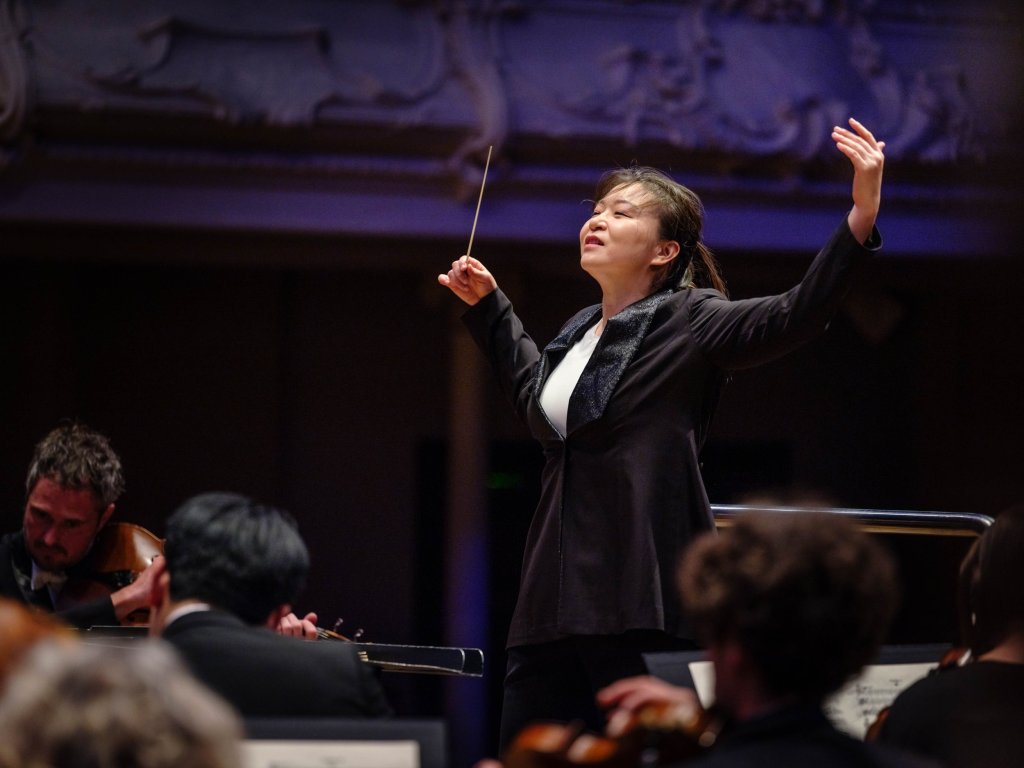
Principal Guest Conductor, Shiyeon Sung Credit Yongbin Park

Auckland Philharmonia Orchestra 2025

John Daly-Peoples

The  Auckland Philharmonia has just released its 2025 Season, of forty concerts featuring some of the world’s most-important artists including violinist James Ehnes, Spanish pianist Javier Perianes, guitarist JIJI, cellist Daniel Müller-Schott, and conductor Pierre Bleuse.

Javier Perianes Credit Julia Severinsen

The opening concert will feature New Zealander Claire Cowan’s “My Alphabet of Life”, Beethoven’s ‘Emperor’ Piano Concerto and  Strausstone-poem,Ein Heldenleben. All of the following concerts will provide a similar mixture of the great classics along with new and surprising works from the classical period and more recent compositions.

There will be a complete performance of Ravel’s ballet, Daphnis et Chloé.as well as  a selection from The Creatures of Prometheus, Beethoven’s only published ballet.

Other major works will include performances of Beethoven’s  Symphony No.5, Tchaikovsky’s Symphony No 5 and Mahler’s Symphony No 3 with mezzo-soprano Deborah Humble.

Principal Guest Conductor, Shiyeon Sung will conduct fellow Korean Clara-Jumi Kang, playing Tchaikovsky’s Violin Concerto, and Mozart’s Piano Concerto No.21 performed by British pianist Benjamin Grosvenor, who was recently named in Gramophone magazine’s list of the 50 greatest all-time pianists.  

The New Zealand Herald Premier Series will include major symphonic works by Elgar, Brahms, Shostakovich, Wagner, Mozart, and Tchaikovsky, as well as some rarely programmed gems by Ravel, Respighi, Liszt, Schoenberg and Grieg, complemented by music from leading New Zealand composers Claire Cowan, Kenneth Young and Louise Webster.

There will also be the New Zealand premiere of Sir James MacMillan’s newest concerto ‘Ghosts’, an Auckland Philharmonia co-commission with the London Symphony Orchestra, Melbourne Symphony Orchestra, Singapore Symphony Orchestra, Royal Stockholm Philharmonic Orchestra and St. Louis Symphony Orchestra.

The Canadian violinist James Ehnes will return for a two-week residency, performing two of the most demanding works in the violinist’s arsenal –  Bartók’s Violin Concerto No.1 and Brahms’ Violin Concerto.

Pierre Bleuse

Other soloists include Korean guitarist JIJI, German cellist Daniel Müller-Schott, Sylvia Jiang and Alexander Gavrylyu. There will also be several visiting conductors leading the orchestra including Pierre Bleuse, Karl-Heinz Steffens and Jun Märkl.

The Classic Series of five concerts will feature major masterpieces, such as Mendelssohn’s ‘Scottish’ Symphony, Haydn’s Symphony No.93, Tchaikovsky’s Violin Concerto and Brahms’ Piano Concerto No.2.

The Pub Charity Opera in Concert production of Verdi’s La traviata will see Giordano Bellincampi exploring the raw dramatic power of this sublime score with a celebrated New Zealand and Australian cast; including Amina Edris as Violetta, Oliver Sewell, as her lover Alfredo, and Phillip Rhodes as Germont.

The multifaceted Baroque & Beyond series will be returning with two concerts directed by Concertmaster Andrew Beer that celebrate the masters of the Baroque era from Handel’s Water Music to works by Sir Michael Tippett along with Baroque masters Biber and Corelli and 20th century composers Bloch and Respighi.

In 2025 the music of the movies will be heard  in Art of the Score: The Music of Hans Zimmer. Hans Zimmer is one the most influential film composers of all time and is behind the iconic scores for Interstellar, Inception, The Dark Knight Trilogy and themes from Pirates of the Caribbean and Gladiator. Audiences will be taken on a journey through Zimmer’s music, presented by Australian Art of the Score podcasters and film buffs, Andrew Pogson and Dan Golding, with Nicholas Buc on the podium.

Matariki with Ria Hall will be a popular night to celebrate the Māori New Year. One of Aotearoa’s most compelling and thoughtful voices, Ria Hall, will join forces with the the orchestra to recreate her evocative songs ‘They Come Marching’, ‘Te Ahi Kai Pō’, and ‘Black Light’, with a magnificent symphonic soundscape.   

Bic Runga Credit Tom Grut

Bic Runga with Auckland Phil will feature Runga performing such classics as ‘Something Good’, ‘Precious Things’ and ‘Bursting Through’, reimagined together with a full orchestra, this will be an extraordinary evening of musical fusion.

There will be a  fun-filled interactive show featuring New Zealand’s beloved canine icon, Hairy Maclary’s Greatest Hits presented by Jackie Clarke, and a captivating show for the whole family starring everyone’s favourite duo, Wallace & Gromit, at Wallace & Gromit in Concert. including The Wrong Trousers screened in full.

Season brochures are available online from aucklandphil.nz or by phoning Auckland Philharmonia Ticketing on (09) 623 1052

Categories
Reviews, News and Commentary

The NZSO’s Copland, Cresswell and Mozart concert

Reviewed by John Daly-Peoples

Gemma New

Jupiter: Mozart & Copland

New Zealand Symphony Orchestra

Auckland Town Hall

September 21

Reviewed by John Daly-Peoples

Aaron Copland’s Appalachian Spring which opened the NZSO’s latest concert featured music the composer originally wrote for Martha Graham’s ballet of the same name. The work has a simple narrative  following aBride and Husband as they get married and celebrate with the community. The work contains  various themes – faith, love and the joys of a new life.

The work is a celebration of the American West as well as an acknowledgement of the country’s past times of violence, referencing both the Civil War and World War II (the work was written in the midst of the war).

Copland used American folk music for melodies, harmonies and textures, that he had used in previous works such as Billy the Kid and  Rodeo and he also  included a theme and variations on the Shaker tune “Simple Gifts”.

Like those other two ballets the composer has responded to the notion of fluidity, representing the dancer’s movements.

The piece starts off with one of the great descriptions of the dawning day but with it is also the couple’s wedding day. This is described with soft chords from the strings, followed by soaring woodwinds with the flute and clarinet sketching out the storyline.

Quiet and wistful vistas and activity merge into cheery dance-like passages echoing the early American folk tunes and Conductor Gemma New responded with a little dance, caught up in these lively  rhythms

The work was punctuated by dramatic use of the percussion and horns which contrasted with the lively, dancing strings.

The finale with its grand statement along with Copland’s others works added a new dimension to the idea of rural America and the West elevating them to a sophisticated and iconic level.

The second work on the programme was Lyell Cresswell’s Piano Concerto No 3  which was given its world  premiere, played by Stephen De Pledge, a long-term admirer and advocate of the composer’s work.

The concerto is full of contrasts, between the instruments  themselves as well as the musical colours and textures which are all bound together with innovative instrumentation.

It opened much like the Copland with a dawning with suggestions of Nature, the stillness of landscape and the sounds of the forest. This was soon followed by the aggressive orchestra which merged with De Pledge’s piano where shimmering clouds hovered over the raucous strings.

Throughout the work there were musical suggestions of observations of his environment linked to a strange, abstract realm of sound with De Pledge and the orchestra contributing a range of textures – delicate, frenzied, lush and meticulous.

The brutal sounds of the orchestra were often matched by the equally brutal sounds of the piano, orchestra and piano creating interweaving and inventive sounds. These included the pianist using the instrument as a percussion instrument, knocking on the piano keys or playing long passages of a repeated single note.

Much of the piano work was sparse but there were occasional energetic bursts of sound accompanied by the orchestra  with the whispering strings at time sounding like the gentle wind in the trees or a breath slowly exhaled.

The final work in the programme was Mozart’s Symphony No 42 , The Jupiter one of his last symphonic works and one in which the composer is producing work which is at the centre of the transition of music form the classical to the Romantic…

With this work Gemma New seemed to be interested discovering nuance and depth in the composer’s work.

Even in the opening sequence which is full of drama she created contrasts so that the great melodies took on a more impressive sound with New seeing possibilities in the music that even Mozart  may not have been  aware of.

Her approach was obvious in the intensity of many passages, reducing some to more of a sigh while the dramatic moments featured immense surges of sounds.

The mysterious quality of the second movement featured  some beautiful balance between the woodwinds and orchestra while the energetic final movement with multiple themes and intricate playing  demonstrated the orchestra’s superior musicality.

To subscribe or follow New Zealand Arts Review site – www.nzartsreview.org.

The “Follow button” at the bottom right will appear and clicking on that button  will allow you to follow that blog and all future posts will arrive on your email.

Or go to https://nzartsreview.org/blog/, Scroll down and click “Subscribe”

Categories
Reviews, News and Commentary

NZ Opera’s Rigoletto: a tale of love, despair, anger and corruption

Reviewed by John Daly-Peoples

Rigoletto (James Clayton) Image Jinki Cambronero

Rigoletto

Music by Giuseppe Verdi

Libretto by Francesco Maria Piave

NZ Opera, by arrangement with Opera Australia

Kiri Te Kanawa Aotea Centre

Until September 25

Reviewed by John Daly-Peoples

From the opening doom-laden chords through to the anguished sounds of the  final moments of Rigoletto the audience was carried along by the glorious music which conjured up feelings of love, despair, anger and malevolence as we follow one mans destiny, overcome by the deceitful and immoral world he lives in.

Tyrants, and  corrupt leaders have always had the ability to corrupt other people and surround themselves with equally corrupt yes men. Rigoletto takes us into that world of, deceit and amorality. It is a bleak world where the  occasional flicker of light and love is quickly extinguished

The first act opens with the Duke of Mantua and his courtiers cavorting in an impressive reception room with references to La dolce Vita of the 1950’s. It is a world where the dinner suits and fabulous dresses disguise the lecherous goings on.

We also encounter Rigoletto dressed as the court jester – a mixture of Ronald McDonald and Joaquin Phoenix’s Joker as he peels off his make up surrounded by his various costumes. He is an actor who must play many parts, just as the other members of the Dukes court play  out their roles.

The first act’s dramatic opening is just the start of probably one of the most mature and intelligent productions of the opera and one which kept the audience enthralled.

One of the problems I have always had with the opera is the curse with which Monterone damns Rigoletto and the duke early on. The notion that he has been cursed preys on Rigoletto mind throughout the opera and when his daughter dies in his arms, he shrieks about the curse has been fulfilled. Of course, the evil Duke still lives, so the curse has not affected him.

In fact, Rigoletto himself is the reason his daughter has been killed, Rigoletto himself is the curse and she dies because of his deceit and immorality rather than anyone else’s.

The Duke and his various courtiers are not particularly evil. They act as many men of business or politicians, using or skirting the law in an amoral fashion. It is Rigoletto who embarks on a course of revenge with the decision to hire an assassin to kill the Duke.

The courtiers and the Duke are also upfront about what they do. It is Rigoletto who presents a façade at court as well as to his daughter, withholding the truth of his relationship with the Duke and his early life even from her.

This veneer which he presents is his undoing. His pretense of an irritating, sycophantic fool at court hides a deep-seated resentment. His lack of awareness of his involvement with amoral activities as well as presenting as a cloying and over protective father is his weakness, his flaw, his curse.

James Clayton in the role of Rigoletto has to convey Rigoltto’s complex set of attributes and flaws. His character never becomes over demonstrative, there is always a sense of him holding back in his expression of love, hate, contempt. It is too easy to have Rigoletto portrayed as a twisted character who is obviously deformed physically as well as mentally and Clayton carefully avoids this.

His “Pari siama” (How alike we are) when singing of the assassin Sparafucile is haunting in its exposure of Rigoletto’s awareness of his own wretchedness, his voice catches with shuddering emotion at just the right point. Then he superbly transitions to his singing as devoted father of Gilda.  This ability to capture his two personalities, the heartless and the warm showed in just a couple minutes showed a singer with able to convey deep psychological states with exquisite refinement.

Gilda (Elena Perroni and the Duke (Amitai Pati) Image Jinki Cambronero

As Gilda, Elena Perroni created a character which expressed all the conflicting emotions of a young woman exposed to the ache and desperation of love, the terror of kidnap, the embarrassment of talking to her father about her seduction and the confusion of being dragged into the adult world.

Her voice soars with emotional expression in arias such as “Care nome” (Dear name) where effervescent and passion erupt.

Amitai Pati sang gloriously as the hedonist Duke with just the right mix of bravado and self-awareness. In his role as Gilda’s lover his voice took on an elegant combination of romanticism and cynicism which helped create a fully rounded, disreputable character.

Maddalena (Sian Sharp) and Sparafucile (Jud Arthur) Image Jinki Cambronero

Jud Arthur’s Sparafucile was suitably threatening with his mundane approach to killing,. His silky voice resonated with darkness and menace, his body tense with suppressed nervous energy.

Sian Sharp was impressive as Maddalena, Sparafucile’s sister and she added a sensual dimension to the final quartet when she sings with the Duke, Rigoletto and Gilda in a profound “Bella figlia” (Lovely woman).

The set designs by Michael Yeargan are impressive from the lavish palace interior to the brilliantly detailed house/ bar interior constructed on a revolving stage which helps concentrate the action.

This is a restaging of the work originally directed by Elijah Moshinsky and rehearsed by Shane Placentino who has done a splendid job in realizing the work.

As ever the New Zealand Opera Chorus was in great form and conductor James Judd deftly led the Auckland Philharmonia ensuring that the music added to the overall dramatic effect, dominating when it needed to but always allowing the singers the space to let their voices shine.

With this production director, designers, soloists chorus and musicians have brought together a seamless tale of brilliantly rounded characters with vivid emotions and contemporary relevance.

To subscribe or follow New Zealand Arts Review site – www.nzartsreview.org.

The “Follow button” at the bottom right will appear and clicking on that button  will allow you to follow that blog and all future posts will arrive on your email.

Or go to https://nzartsreview.org/blog/, Scroll down and click “Subscribe”

Categories
Reviews, News and Commentary

Resetting the Coordinates of Performance art in NZ

Reviewed by John Daly-Peoples

Resetting the Coordinates

An anthology of performance art in Aotearoa New Zealand

Edited by Christopher Braddock, Ioana Gordon-Smith, Layne Waerea and Victoria Wynne-Jones

Massey University Press

Published September 2024

RRP $65.00

Reviewed by John Daly-Peoples

In 2014 The Walters Prize  included a work by Kalisolaite ‘Uhila where the artist inhabited the Auckland Art Gallery precinct for several months, living as a homeless person – eating sleeping and communicating with visitors, staff and other destitute  people. The work  was intended to draw attention to the plight of the homeless.

However, going to the gallery to find the ”art” and the artist necessitated searching the art gallery, the nearby park and streets until I found him wedged into an overhang on the gallery’s roof.

This search seemed more like a game of hide and seek rather than being immersed in a social /political experience /experiment. At the time It seemed to only involve me and the artist, reflecting on an encounter.

That encounter is what can loosely be called an example of  post-object art or performance art which has been evolving in New Zealand since the 1970’s.

With that encounter and many others one can see that performance  art requires an audience as well as documentation as many of the events are transient.

Now an  anthology/reader of performance art in New Zealand, ”Resetting the Coordinateshas been published,providing an in-depth survey of the artists and artworks in the  performance area which have happened over the past fifty years.

At the core of performance art  is the audience and the performer/artist,  the works having a theatrical element to them in which artist often draw attention to time, space, and body,

The  goal of these actions is to generate a reaction with themes which are commonly linked to life experiences of the artist themselves along with social and political criticism.

Darcell Apelu:, New Zealand Axemens Association: Womens subcommittee president
2 August 2014, documentation of performance.
Courtesy Artspace, Auckland. Photo by Peter Jennings

The book records a number of the activities which occurred as described in the introduction by editor Christiopher Braddock,

“If, on 2 April 1971, you had journeyed out across the unsealed metal roads to the west coast of the Tāmaki Makaurau Auckland region of the North Island of Aotearoa New Zealand, venturing as far as the remote Karekare Beach, to the north of Whatipu Beach and the great Manukau Harbour and south of Piha Beach, you would have come across the mystifying scene of ten people arduously sweeping the beach with long-handled yard brooms. “

Organised by Phil Dadson and colleagues this was the first in a series of purposeless works of which Dadson said : ‘This was work for the sake of the work, no particular purpose, no rewards’ across a ‘pointless-to-sweep stretch of beach’ in ‘communion with the elements and the place’.

These activities often existed outside the confines of the mainstream contemporary art scene  and were often undocumented. Many of the names included in the anthology will be recognisable because of their wide-ranging practice, others however have had lower profiles.

Central figures have been Phil Dadson, Jim Allen, Annea Lockwood, Peter Roche & Linda Buis, Andrew Drummond, Daniel Malone, Shannon Te Ao and Lonnie Hutchinson. There have also been numerous other practitioners who are included in the book.

Christopher Braddock, one of the editors says “Mainstream art history tends to prioritise static forms of art that are more commodifiable and saleable such as painting and sculpture. Anthologies often prioritise these artforms, such as Michael Dunn’s “New Zealand Painting: A Concise History| published in 2004. Furthermore, large-scale anthologies can cement these institutional prejudices, such as Hamish Keith’s The Big Picture: The History of New Zealand Art from 1642 (2007) which largely ignores performance art.”

The book underlines the fact that performance art is a distinctive part of recent art history, with its activities presenting  social and political  approaches which  emphasises the  connections between artist, audience and art critic /  historian.

These events often combined elements of anarchy,  humour, spirituality, repetition, the unplanned and unexpected.

There are a several chapters which examine the  history and development of performance art, some which look at the aspects of woman’s art practice, the development of Māori and Pacific based works, queer performance art and performance art in post -quake Christchurch.

There are numerous photographs and records of the activities which only give a limited appreciation of the performances such as Annae Lockwood piano burning while the multiple images of Andrew Drummond’s projects give some sense of the scale of his work.

CardboardConfessional_
Audrey Baldwin, Oscar Bannan, Bridget Harris, NeilMacLeod, Annemieke Montagne, Pat Parkin, Jennifer. Katherine Shield
2016, documentation of performance for the Centre of Contemporary Art Toi Moroki programme,Ōtautahi Christchurch.
Courtesy Centre of Contemporary Art Toi Moroki. Photo by Janneth Gi

Among the other projects included are the documentation project of the Christchurch “Cardboard Confessional” (2016) developed by Audrey Baldwin et al, Louise Potiki Bryant’s dance work “Te Taki o te Ua / The Sound of Rain” (2001), Jeremy Leatinu’u’s Queen Victoria (2013) where the artist contemplated statues of the queen,  Juliet Batten’s Women’s Project of 1985 at Te Henga Beach and Bruce Barber’s “Mt Eden Crater Performance  (1973) which was a collaboration with Solar Plexus as part of the drumming event initiated by Phil Dadson..

It is a fascinating book with lots of performances which have been rarely written about, seemingly lost to history but which tell us much about the social, political and spiritual examinations and soundings which artists have made.

The writers include  Natasha Conland, Gregory Burke, Ioana Gordon-Smith, Khye Hitchcock, Audrey Baldwin, Bruce E Phillips and Heather Galbraith

To subscribe or follow New Zealand Arts Review site – www.nzartsreview.org.

The “Follow button” at the bottom right will appear and clicking on that button  will allow you to follow that blog and all future posts will arrive on your email.

Or go to https://nzartsreview.org/blog/, Scroll down and click “Subscribe”

Categories
Reviews, News and Commentary

Mt Eden Chamber Music Festival

Reviewed by John Daly-Peoples

James Jin (violin), Xing Wang (piano) and Dominic Lee (cello)

Mt Eden Chamber Music Festival

Eden Arts

Mt Eden Village Centre Church

September 6 – 8

Reviewed by John Daly-Peoples

Now in its ninth year the Mt Eden Chamber Music Festival organised  by the local community arts group, Eden Arts has presented high quality performances by some of the country’ s leading musical groups and major talent including NZ Trio and NZ Barok.

These concerts have been programmed by Simeon Broom, the Festival’s Artistic Director who is a violinist with the New Zealand Symphony Orchestra  and Cathy Manning of Eden Arts.

Its most recent concert series featured Shostakovich’s Piano Trio No 2, Dvorak’s Piano Concerto No 3, Debussy’s Sonata in G Minor for violin and Piano, Brahms’ Piano Quartet No 3 as well as a concert of works for trombone quartet including pieces by Beethoven, Bruckner, Chaulk, Webern Apon and Seroki.

The four major works on the programme all see composers responding to major crisis in their lives – personal, domestic  and political, using music as a means of self-expression as well as communicating their ideas and emotions.

The Shostakovich Piano Trio and Dvorak Piano Concerto were both played by Xing Wang (piano), James Jin (violin) and Dominic Lee (cello) giving each of the works a very different tone.

The Shostakovich was written in 1944 following on from his Symphony No 7 which was his reaction to the horrors of the Second World War and the Siege of Leningrad and which was his personal expression of his  resistance to fascism.

Some of these same aspects are to be found in the Piano Trio along with reference to his friend Ivan Sollertinsky who had recently died and who is credited with introducing Shostakovich to new music including the work of Mahler.

The opening, chilling tomes of the Lee’s cello  were followed by the lamenting sounds of Jin’s violin and the dignified piano of Wang. The trio became more animated with the anguished conversation between  the strings set against the ruthless tones of the piano. Here the strings seemed to be particularly raw expressing anger and torment.

The second movement began with a slightly more joyful tone with its dance-like melody but this soon became more excited with a harsh pizzicato sequence from the strings, soaring above the pianos more restrained sounds.

There followed a death knell, the cello paying homage to Sollertinsky with a passionate voice.

In the final section Shostakovich used a Jewish melody but the celebratory nature of the work was played as a dirge, full of an increasingly frantic distress.

The undertones of the mournful cello and the tense violin become something  of a metaphor for the lost and abandoned. Here Lee took on an active performance role lifting himself out of his seat in an agitated manner.

There is also a dark and brooding element in Dvorak’s Piano Trio  which may be a reflection of the composer’s grief over the recent death of his mother and the early death of  three of his children.

The group displayed an understanding of the work with its subtle nuances of tone and its dramatic chiaroscuro giving the work  an alternating drama, liveliness and introspection.

 The opening of the work was filled with swirling eddies of sound conjuring up images of landscape  that he evoked in many of his previous works. Here the , the grandeur of the vision expressed a contemplative mood.

The work was full of passage of tight  precision and the trio was able to  express the   passion in music with some delightful passages such as  the springlike opening of the second movement as well as some unexpected inflections and intricate rhythms.

The three instrument  developed and expanded these early melodies creating some languorous vistas  with some of the melodies beautifully expressed  by Lees’s cello which led to an unexpected conclusion.

Much of the playing of the violin and cello took on an elegance  which saw  the two  instruments  interweaving in a conversation which alternated between the formal and the combative.

Simeon Broom (violin), Katherine Austin (piano), James Tennant (cello)Helen Lee (viola)

Debussy wrote the Sonata in G Minor for violin and Piano in 1917 at a time when France was grieving its losses in The Great War and at a time when the composer was aware of his imminent death,

Simeon Broom’s violin soared and floated above Katherine Austin’s piano which went from the dramatic to the lethargic, her intrusions like  a scudding cloud and Broom’s violin explored some rapturous melodies.

The second movement brought some colourful and sprightly dancing  melodies from Broom with some jittery playing from Austin, the instruments vying for innovation and spectacle.

Austin delivered brilliant passages of insistent piano into which Broom inserted a bird-like romanticism and then some  marvellous playing involving double stopping and intricate playing.

For the Brahms Piano Quartet No 3 Austin and Broom were joined with Helen Lee (viola) and James Tennant (cello). The work  is filled with drama, yearning  and reflection as he was close to Robert Schumann and  was shocked by his mentors attempted suicide. But he was also drawn to Schumann’s wife Clara and probably felt conflicted about that relationship.

The work also captures much of his romantic angst which can also be seen in Goethe’s “Young Werther” and the paintings of Caspar Friedrich.

The opening sobbing sounds of the instruments and the plucked sounds of the viola suggesting tears set the scene for the work  with frantic strings morphing into a more contemplative mood.

There were passages where the piano alluded to joyful times as well as distant love. Then the strings erupted is waves of sound suggesting the turbulent life and mind of the young composer. There were also passionate outbursts creating an image of the lonely hero caught in a storm.

Many of the passage see Brahms creating a sense of light and dark, joy and sadness with soulful conversations between the cello and violin as well as a delicate romanticism  carefully outlined by Austins piano.

The work ends with some robust playing as the instruments seemed to spiral out of control with some  dynamic connections between the four players before  moving onto a reflective sequence and terse conclusion.

To subscribe or follow New Zealand Arts Review site – www.nzartsreview.org.

The “Follow button” at the bottom right will appear and clicking on that button  will allow you to follow that blog and all future posts will arrive on your email.

Or go to https://nzartsreview.org/blog/, Scroll down and click “Subscribe”

Categories
Reviews, News and Commentary

APO’s Tristan and Isolde a magnificent musical experience

Reviewed by John Daly-Peoples

Tristan (Simon O’Neill) and Isolde (Ricarda Merbeth) Image – Sav Schulman

Auckland Philharmonia

Richard Wagner

Tristan and Isolde

Auckland Town Hall

August 10

Reviewed by John Daly-Peoples

The Auckland Philharmonia’ s recent production of Tristan and Isolde was probably the highlight of this year’s programme. The opera, lasting over five hours is a marathon for audience, singers and orchestra and requires exceptional singers and players which this performance delivered.

With Tristan and Isolde Wagner began moving opera in a new direction  away from the traditional love story format, using opera to express ideas about the nature of love, sex. death and existence.

While Wagner may have been influenced by Schopenhauer’s ideas about love and the links between love, sex, and death the composer was probably more interested in providing some sort of rational for his infatuation and possible  adulterous  relationship with his patron’s wife – Mathilde Wesedonck.

The opera has a simple plot line – Tristan who had previously killed Isolde’s fiancé is taking her to England to marry King Marke but they become attracted to each other (partly due to having drunk a love potion). The king is told of their relationship and seeks to kill Tristan but who dies from wounds and Isolde expired from a broken heart. They presumably become immortal just as all Wagner’s later gods and enter Valhalla.

The opera really only needs the two main characters as well as  the music but Wagner gives it a narrative structure and a few other characters who provide contrast and  tension.

Johan Reuter as Kurwenal, Simon O’Neill as Tristan, Ricarda Merbeth as Isolde and Katarina Karnéus as Brangäne. Image – Sav Schulman

The music describes the emotions and drama emanating from the two characters with the opening Prelude  and the closing  Liebestad or “love death song” sung divinely by Isolde over Tristan’s body.

The music of the  Prelude was used extensively by Lars van Trier in his film Melancholia expressing something of the same ethos as Tristan and Isolde with ideas about the nature of love, knowledge of our death and the end of civilization.

With Tristan and Isolde the two lovers embody different aspects of love  and this is expressed through their singing and their acting.

Act II which takes place over a single night presents an emotional landscape where we experience their unfolding  relationship with its deep emotional conflicts,

Their   duo “O eternal Night”, touches on a number of aspects of their love and the urgency of their singing  conveys a sense of bliss and transcendence.

O’Neill gave an impressive account of Tristan with potent stage presence enhanced by his stance and gestures. He was able to convey a sense of the nobility of love while  Merbeth’s Isolde expressed  the passion and emotion. With much of her singing her ferocious voice seemed to effortlessly express the conflicting emotions of anger and passion.

This was a semi-staged performance but Frances Moore’s clever staging  gave the performance some added drama with several of the cast making use of the various parts of the Town Hall.

Isolde made her final sensational entrance in walking up the centre aisle of the hall, Andrew Goodwin’s ship’s captain made a dramatic appearance singing from the Circle in Act I  and Katarina Karneus singing an elegant Brangane sang from the Circle, looking down on the couple in Act II.

Albert Dohmen gave a forceful performance as King Marke singing from up by the organ, towering about the orchestra and Jared Holt as Melot, Tristan’s one-time friend turned villain gave a nuanced performance with his long denunciation.

Johan Reuter gave an impressive account as Kurwenal, Tristan’s servant capturing the close ties between the two men with his sympathetic voice.

The orchestra provided the backbone for the opera and under the skilful direction of Giordano Bellincampi  provided sustained emotional and dramatic music, particularly  the opening Prelude which made for a magnificent  musical experience.

Categories
Reviews, News and Commentary

Opera Australia’s “Tosca”

Reviewed by John Daly-Peoples

Tosca. The Te Deum sequence Image. Keith Saunders

Opera Australia

Tosca by Giacomo Puccini

Libretto by Luigi Illica and Giuseppe Giacosa

Sydney Opera House

July 13

Performances until August 16

Reviewed by John Daly-Peoples

Last Saturday’s performance of Tosca at the Sydney Opera House  didn’t go quite as planned. The role of Tosca which had been played by a now ill Giselle Allen  was to be replaced with Natalia Aroyan

Allen’s Tosca had previously been reviewed in Limelight where her performance  was described as “a wonderfully capricious creation; a haughty, self-absorbed prima donna one minute and tragic heroine the next”.

This was to be Aroyan’s first outing in the role but she has had several roles in other Australian Opera productions and has previously even performed with Dame Kiri te Kanawa.

From the first moment we hear Tosca calling her lover’s name from offstage to her bursting onto the stage any concerns about her abilities vanished. She revealed the power and lyricism the role requires immediately. We also heard the notes of the recurring love theme, sometimes calm, at other times agitated, mirroring Tosca’s changing moods. In this opening scene she also revealed other aspects of her complex nature, playfulness egotism, jealousy and romanticism, giving the audience one of the crucial aspects of the opera – a believable character who, she says “lives for art”.

Her voice in Act II traversed a huge range of emotion, – pure love, pain  and yearning while her soaring rendition of the aria“ Vissi d’arte ” captured an almost ethereal dimension.

In a sense she is the alter ego of Puccini who saw the opera a political work which had a strong political thread with a plot that revolved around the historical and political narrative of Italian nationalism. While the opera was originally set in Rome in the early part of the nineteenth century, Director Edward Dick has set the work firmly in the twenty-first century with laptops, CCTV and earpieces. All this provides a very clear reference to the growth of contemporary fascism.

The story , set in Rome still revolves around the tragic love triangle between Floria Tosca , the famous opera singer ; Mario Cavaradossi , a painter ; and Baron Scarpia , the sadistic chief of police .

The opera opens with the escaped revolutionary Angelotti (David Parkin) making a dramatic descent by a rope from the opening in a painted dome in the ceiling of a church. This oculus can be seen as a reference to the ceiling opening of the Patheon in Rome. Cavaradossi comes to his aid and in so doing implicates himself and Tosca in his escape and that knowledge is exploited by  Scarpia in order  to capture the escaped Angelotti, punish Cavaradossi and seduce Tosca.

From the first mention of Scarpia’s name we hear the ominous sequence of three, strident chords that represent the evil character. Sung by Gevorg Hakobyan he emanates ruthlessness and amorality with a sinister voice and the actions of a disturbed man. This is highlighted in the powerful Te Deum sequence at the end of Act I where the power of the state is linked to that of the church and the choir sings along with Scarpia as he fantasises about his seduction of Tosca.

Giselle Allen (Tosca) and Gevorg Hakobyan (Scarpia) Image. Keith Saunders

While Hakobyan conveys a narcissism and cruelty with a searing, caustic voice it is Young Woo Kim singing the role of Cavaradossi who was the standout performer of the opera with a powerful voice with which he conveyed a range of rich emotions along with a very honest portrayal of character.

The set in each of the acts is dominated by a large dome shape with an image of the virgin which works effectively and the oculus in the final act becomes the space from which Tosca plunges to her death.

In Act II the central feature of the set is Scarpia’s four poster bed which becomes the site of seduction as well as acting as a cage within which much of the strugglers between Scarpia and Tosca take place

The work really relies on its wonderful, evocative music, emotionally charged  with some poignant orchestral passages which requires a conductor who is aware of that emotional and dramatic range. In Johannes Fritzsch and the Opera Australia Orchestra all the great qualities of the music were delivered. 

With ten performances to go Tosca is one great reason for a short holiday across to Sydney.

Future operas at the Sydney Opera House

Brett Dean/ Matthew  Jocelyn, Hamlet, July 20 – August 9

Mozart, Cosi van Tutte, August 1 – 17

Categories
Reviews, News and Commentary

Sylvia Jiang’s lively and energetic performance of Prokofiev’s Piano Concerto

Reviewed by John Daly-Peoples

Sylvia Jiang

Auckland Philharmonia Orchestra

Scheherezade

Auckland Town Hall

July 4

Reviewed by John Daly-Peoples

The first half of the APO’s Scheherezade concert featured two works composed a century apart with Melody Eötvös’ “The Saqqara Bird” of 2016 and Prokofiev’s “Piano Concerto No 2 of 1913/1923.”

The highlight of the concert was the Prokofiev Piano Concerto played by Sylvia Jiang. She is a Chinese born New Zealander and Juilliard graduate  who was ranked as a Rising Star in the Asialaw Profiles of 2023.

Last year she performed Liszt’s Second Piano Concerto with the Auckland Philharmonia and later in the year she will also be making her debut national tour as a soloist with Chamber Music New Zealand playing seven concerts.

Prokofiev’s second Piano Concerto is considered to be one of the most difficult piano concertos to play. Thankfully Jiang appears to have not been told that and she never faltered in her exploration of the work even when she was faced  with the massive solo cadenza of the first movement.

This section saw Jiang playing vigorously for over 4 minutes before the orchestra joins in again.

She opened the work delicately creating  gentle, magical sounds along with the woodwinds and strings which hinted at a shimmering watery setting with the orchestra developing the theme and Jiang providing streaks of colour and drama.

This quiet lyricism didn’t last long and was soon interrupted by menacing sounds from the orchestra and a darkness emerged which overpowered the piano which then responded with some ferocious sounds.

This early interaction of orchestra and pianist highlighted the emphasis of the concerto. This was the sense of competition between player and orchestra. With most  concerti there is a collaboration between soloist and orchestra but with this work there was more of an antagonism and intervention.

This is in part due to Prokofiev s music where we hear a clash between romanticism and modernism which is an indication of the composer struggling with his own idea.

In playing the first movement solo cadenza Jiang seemed to be physically attacking the keys and her playing eventually revealed an emerging theme and she was rejoined with the orchestra which enveloped her with the gentler music which had preceded the cadenza.

The short second movement saw Jiang playing  with a  lively energy, butting up against the  savage and insistent tones of the orchestra.

The third movement which opens with huge swells of brass and percussion and a rustic theme where Jiang dashed off flashes bright notes inserting herself into the orchestral themes. Here again the pianist and orchestra were in competition, with the orchestra seeming to overpower Jiang who fought back with a relentless energy finishing the movement with a few quiet  notes of victory.

She opened the fourth movement with a rapid-fire assault on the piano followed by a lethargic sequence where her fingers seemed to wander across the keyboard in search of a theme. Then as she managed to discover the theme the orchestra joined in, expanding and enhancing it.

Her playing at times seemed to be urged on by the energetic orchestra while at other times she seemed to strive against the orchestra.

In the final minutes of the work her playing returned to a simple romanticism before morphing into some frantic playing matched by an equally frenetic orchestra which overpowered the piano before the  final race to the climatic conclusion.

The “Saqqara Bird” refers to a bird/plane shaped relic found at Saqqara in Egypt in the late nineteenth century whose function was unknown. Melody Eötvös’ work explores the imagined reasons behind its creations and purposes and envisages it in search of its identity.

The work opens with the sounds of bird-like twittering from the woodwinds and strings which seem to be emerging from a dark forest of sounds conveyed by the blasts of brass and thumping drums.

Several of the instruments appeared to have been adapted or employed to create eerie sounds as though a backdrop to a fairy tale filled with shadowy beings.

In the middle section the woodwinds replicate  the sounds and movement of birds along with the ghostly forms leading to enigmatic encounters and discoveries.

The intriguing music ranged from sequences of unruly and strident sounds to the use of the simple single note which ends the work.

Categories
Reviews, News and Commentary

The APO’s “Brahms and Bellincampi”

Reviewed by John Daly-Peoples

Alexander Melnikov and Giordano Bellincampi Image. Sav Schulman

Auckland Philharmonia Orchestra

Brahms and Bellincampi

Auckland Town Hall

June 6

Reviewed by John Daly-Peoples

The opening of Brahms’ Piano Concerto No 1 is dramatic with the timpani delivering a tumultuous sound accompanied by ferocious strings. The intense opening  was intended by the composer to be a depiction and reflection on  Robert Schumann’s attempted suicide in leaping into the Rhine at Dusseldorf few years earlier.

For the first few minutes it was the orchestra which dominated  as pianist Alexander Melnikov waited for his entry. Showing what would be his intense approach to playing he seemed  restless as he contemplated the piano – leaning into it and caressing its surface as though communing with the instrument.

Following the stormy performance of the orchestra Melnikov made his entrance, referencing the orchestras’ dramatic themes but with simple and deliberate playing as though reflecting on the drama which had just occurred.

Much of the first movement saw him responding to the themes that the orchestra had explored with a bravura performance where he developed  the main theme, playing with a relentless  insistence.

Melnikov’s relationship with the piano continued, at times he appeared to be praying and at other times conducting. All the time he appeared to physically respond to the performance of the orchestra, his body moving reflectively in time to the music.

In the second movement his playing was almost lethargic inserting some delicate passages into the orchestras brooding sounds. Then in the third movement the music seemed to electrify him with some relentless playing which was  almost  Byronic, of the individual confronting his demons, loves and destiny.

His Brahms encore finished as a cell phone call came through in the hall, so when he was leaving the stage, he put his hand to his ear with the universal sign of “I’ll call you”, eliciting  further applause from the audience.

The other work on the programme was Brahms’s symphony No 2, a glorious pastoral work inspired by a holiday at the resort of Lake Worth in Austria. The work is full of images of nature and the heightened drama of the alpine  environment.

While it is a captivating depiction of the landscape there are  undertones of melancholy with the strings, timpani and brass creating a sense of disquiet.

The more reflective second movement conveys a sense of an emotional  journey and the delights of life. all leading to enlightenment.

Then in the third movement there were charming dance-like seqcnces followed by the dramatic fourth movement with its big crescendos punctuated by idyllic interludes, the audience kept in suspense as the work raced to its fiery conclusion.

To subscribe or follow New Zealand Arts Review site – www.nzartsreview.org.

The “Follow button” at the bottom right will appear and clicking on that button  will allow you to follow that blog and all future posts will arrive on your email.

Or go to https://nzartsreview.org/blog/, Scroll down and click “Subscribe”