Categories
Reviews, News and Commentary

A Midsummer Night’s Dream: A Triumph Returns

Image. Stephen ACourt

Reviewed by Malcolm Calder

A Midsummer Night’s Dream

Royal New Zealand Ballet

Choreography – Liam Scarlett

Music – Felix Mendelssohn

Music Arranger – Nigel Gaynor

Set & Costume Design – Tracy Grant Lord

Lighting Design – Kendall Smith

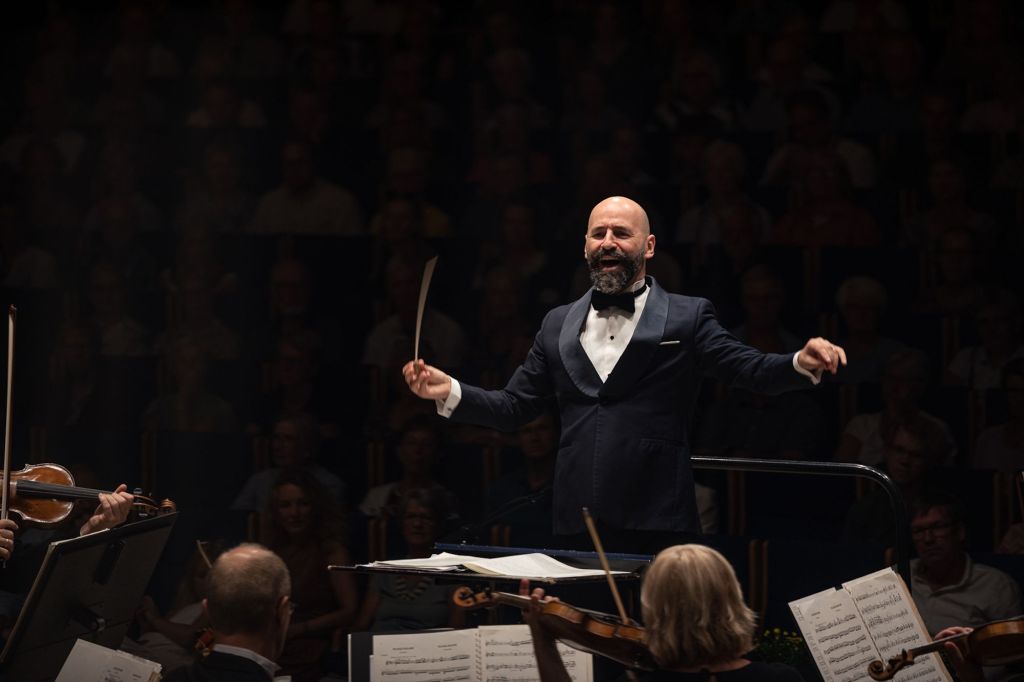
Conductor – Hamish McKeich

Orchestra – Auckland Philharmonia

Kiri Te Kanawa Theatre, Aotea Centre (until Dec 8)

Then Bruce Mason Theatre, Takapuna

OK, Shakespeare started all this theatrical fantasy stuff more than 4 centuries back when he developed some of the Greeks’ allegorical reflections on love and its mythical interpretations by writing A Midsummer Night’s.

It has a convoluted and fantastical plot that epitomises the suspension of disbelief and is perfectly suited to the meandering minds of creatives.   So they did.

A young Felix Mendelssohn had an initial stab at expressing it musically before King William Frederick IV convinced him to enhance his music further as accompaniment to a theatrical staging where it became a favourite of the Prussian court.

I have no idea what William Blake was on when he expressed Shakespeare’s work visually a century later, nor the mindset of various theatre and even movie directors as the original was variously interpreted until eventually becoming a stock in trade for theatre over a couple of centuries.   Little wonder then that it would evolve much later into a significant full-length ballet that is commonly attributed to Georges Ballanchine – apparently a fairly tame interpretation by contemporary standards.  Eventually The Royal New Zealand Ballet was to be congratulated on collaborating in 2015 with the fairly progressive Queensland Ballet in a completely new interpretation devised by the even more weirdly wonderful and progressive mind of the late Liam Scarlett. 

Mendelssohn’s original incidental music was skillfully re-arranged and expanded by former RNZB Music Director Nigel Gaynor and, with an innovative set and a costume design by the distinguishd Tracy Grant Lord, the result was a full-length two-act contemporary ballet that audiences greeted with joyous rapture.

A subsequent 2021 season was rudely interrupted by Covid and this Dream only played in Wellington.   However it has finally toured nationally and reached Auckland where those earlier plaudits can ring even more true today.  This Midsummer Night’s Dream is something that makes one wallow in pure enjoyment.

Yes, of course the threads of serious Greek allegory on humankind are not lost, but it is the telling of the tale that makes this production so outstanding and to marvel at what Liam Scarlett, and the team he headed, has produced.

Firstly, lets look at Tracy Grant Lord’s set.  This combines colour and texture that, when coupled with Kendall Smith’s lighting, results almost as if an additional dimension has somehow been added to the stage. There is a depth and a height and a breadth that I could swear somehow exceed the theatre’s stage dimensions.  This dimensionality is exploited to the fullest in the choreography and the costumes that somehow reinforce the set rather than the other way around.  It is night.  It is a woodland.  It is ethereal.  It is enchanted.  It is a place where subtlety, confusion and a comedy of errors are rife.  It is actually the inside of someone’s mind.

That is largely achieved and certainly enhanced by Nigel Gaynor’s sympathetic musical arrangement of Mendelsson’s sumptuous score and which itself defies traditional convention.  Off-stage voices are introduced under Hamish McKeich’s baton and I could swear I heard someone humming along during the triumphal Wedding March.

The ballet opens with an imperious Oberon (Joshua Guillemot-Rodgerson) and his compellingly superior Queen Titania (Ana Gallardo Lobaina), assisted by his energetic and whimsical sprite Puck (Shaun James Kelly) who attempt to influence and even thwart the course of true love via the use of a supposedly magical pixie dust.  When sprinkled this confuses things a bit and just about everyone on stage loses track of who is love with whom.  There is whimsy and humour around each and every corner and the characterisations are superb – none more so than Bottom (Calum Gray) who magically develops a donkey’s head and tail.

The characterisations are superb, the detail in the dancing shows real connections and Liam Scarlett’s stunning choreography is built around fluidity and motion that blurs fantasy with reality and gives us something unexpected at each turn.  Just as one is starting to relax after a particular marvellous pas de deux, for example, this Dream slides effortlessly into something equally ethereal albeit several feet in the air serving only to amplify, elevate and unify the whole.

Plotwise … no, I won’t bother you with the complexities … suffice to say it all becomes totally confusing but love wins out in the end.  Of course.  And the donkey is human underneath it all – a message for all of us.

This Midsummer Night’s Dream is indeed a sparkling, spectacular ballet of sheer theatrical magic that is a Christmas treat for audiences everywhere

Categories
Reviews, News and Commentary

A thrilling “The Planets” from the NZSO

Reviewed by John Daly-Peoples

The Planets

New Zealand Symphony Orchestra

Auckland Town Hall

November 23

Reviewed by John Daly-Peoples

One of the disappointing aspects of the NZSO’s recent “The Planets” concert was the short duration of the first work on the programme.

The Finnish composer Kaije Saariaho’s  “Asteroid 4179: Toutatis” was performed for four minutes, but many in the audience would have been delighted if it had run for twice or three times that length.

“Asteroid 4179: Toutatis”, is named for an actual asteroid, a two-kilometre rock fragment which moves between Mars and Jupiter. The work is a confluence of science and art with the music sounding like music many composers have used for the soundtracks of science fiction movies or to create otherworldly sounds Her ethereal sounds which represent the movement of the asteroid were mysterious and saw her turning scientific notations into music.

The composer was trying to describe the pattern of Toutati’s movements, its chaotic orbit, its unfixed north pole and its complex pattern of rotation so we had music which described the various ellipses, parabolas and  cosmic curves tracing out celestial journeys.

The work contained  multiple combinations, of strings and huge sounds from the full orchestra . Many of the sounds were unusual with shimmering strings, eerie sounds  from  the wind instruments  and even fleeting sounds from the harp.

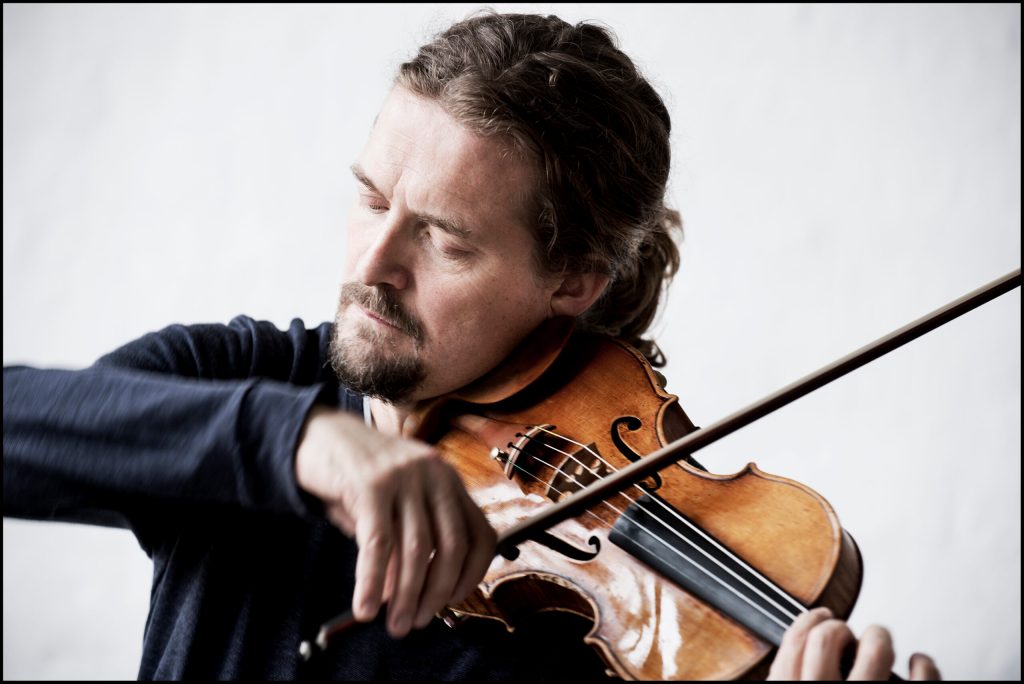
Christian Tetzlaff

Christian Tetzlaff gave an electrifying performance with his playing of Elgar’s Violin Concerto and he seemed to become one with the violin, It was not just his bowing arm but his whole body which appeared to be affected by the music.

He opened with some  ferocious bowing but this soon morphed into playing which was not much more than a whisper with Tetzlaff gently rocking as though playing a lullaby, taking him into a state of reverie.

There were times when the bow met the strings with a piercing sound,  while there were other passages when the bow barely touched the strings.

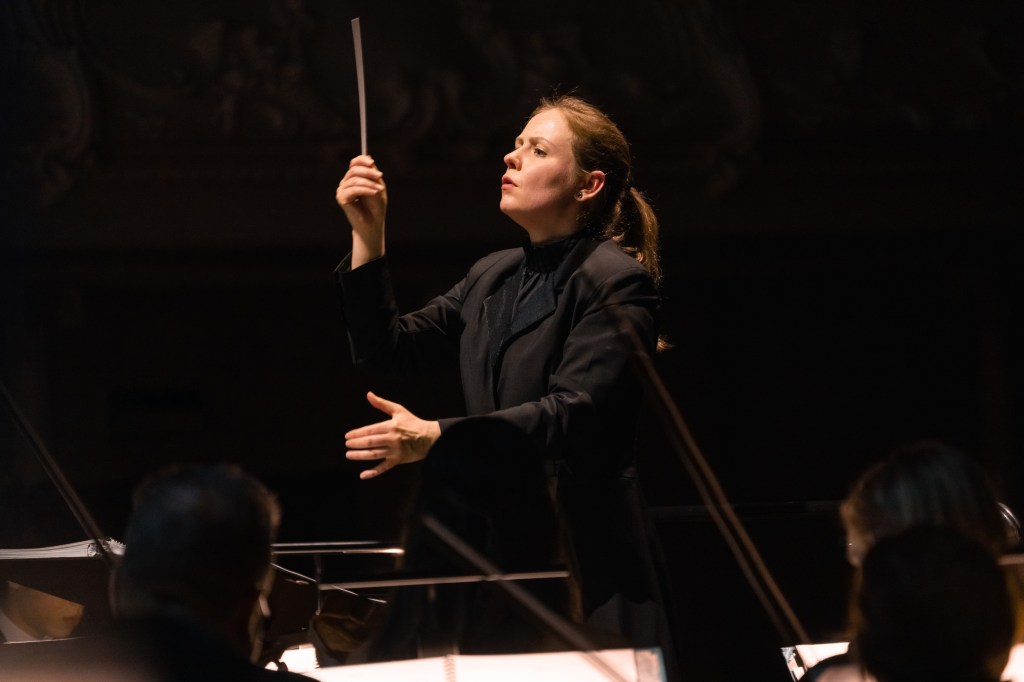
Several times his feverish playing was matched by Gemma New’s demonstrative conducting where she conducted with her body and not just baton and hands. Then there were times when violinist and conductor appeared to be linked in a dance, their bodies  swaying in harmony.

There were many passages in the work which were extremely taxing for the violinist but Tetzlaff handled these with style and self-assurance. At times he was sharply focused with some aggressive playing, as though he was trying  to outrun the orchestra  before changing to a more serene mode, melding with the orchestra.

With the slower second movement he was like a different violinist, the torments of the first movement replaced by an  engaging romanticism  Before the spirited finale he effortlessly dashed off a spirited theme with some grand gestures.

That Gustav Holst composed his The Planets suite early on in the twentieth century saved a lot of problems later on. Pluto was not discovered until 1930 so was not one of the planets which the composer included in his work. So, with Pluto now being dropped as one of the planets his work doesn’t have to be seen as an oddity just one of the great British musical works of the early twentieth century.

Under the brilliant direction of Gemma New the orchestra managed to give each of the sequences a thrilling interpretation, exploring their emotional and narrative themes. At times New seemed carried away by the music performing little dances and jigs, her hands and arms tracing out the music as though replicating planetary arcs.

From the relentless marching sounds of Mars, The Bringer of War through to the almost spiritual Neptune there was an urgency and  drama from the orchestra.

Jupiter featured an onslaught from the full strings along with an array of percussion including bells and triangle which added to the intense atmosphere.

Emotional and expressive playing by the violins, cellos, and double basses introduced Venus along with percussion instruments – gongs, triangles, bells, timpani, celesta and drums, which provided a serene and imposing atmosphere.

Saturn gave us the sombre sounds of the double basses  and  plucked cellos and  this then changed with a nice contrast to harps and double bass.

The opening harps and organ of Neptune, created an enigmatic sound with the  orchestra joined by Voice New Zealand Chamber Choir which was beautifully expressive, becoming another instrument  to finish the work in style,

Categories
Reviews, News and Commentary

APO’s Romantic Journeys

Reviewed by John Daly-Peoples

Johannes Moser

Auckland Philharmonia

Romantic Journeys

Auckland Town Hall

November 21

Reviewed by John Daly-Peoples

The opening and closing works on the APO’s Romantic Journeys programme featured travelogues from Tchaikovsky and Schumann. Tchaikovsky Capriccio Italien is a record of one of his  trips to Italy whileSchumann’s Symphony No.3 ‘Rhenish’ was written in response to a journey along the Rhine and a visit to Cologne.

Tchaikovsky travelled many times to Italy, partly to escape the Russian winter and it was on one of these trips that he was inspired to compose his Capriccio Italien partly inspired by Carnivale, of which he wrote – “seeing the public raging on the Corso, you are convinced that no matter how strangely the joy of the local crowd manifests itself, it is nevertheless sincere and unconstrained,”

A  blaze of horns opens the work,like a curtain being lifted to reveal a colourful panorama of landscape, cities and spectacle. There are some slow and precise passages before we hear traces of folk music which introduce a sense of Italian life with lively  and charming dance melodies and bugle calls.

This was followed by a fast-paced tarantella-like sequence with the lively strings and woodwinds allowing the composer to capture the ebullient moods of the people as they danced through Carnivale  from dawn to dusk.

Throughout the work with its changing, colours and tempos there is a sense of the composer delighting in parading these sounds which would be new to a Northern European  audience

Schumann’s Symphony No 3 (Rhenish) is a portrait of the Rhine but it can be seen as part of the nationalist ethos which had been developing since the end of the Napoleonic  Wars and was particularly strong in the Rhineland.

From the opening fanfare, there is a sense of celebration of the land, the buildings and the people. The Rhine is central to this depiction and the music paints a picture of the flowing river indicated by the sinuous sounds and overlapping melodies of the orchestra.

The work is like a musical diary depicting the changing landscape as the composer passes through towns and villages capturing his changing impressions.

The voluptuous second movement also has landscape images – clouds, fields and activity, all highlighted with bursts of dramatic brass while the third continues with descriptive passages which are increasingly jaunty.

The fourth movement is  full of majestic sounds and is a description of the composers visit to Cologne Cathedral, the largest in Germany. The building was still in its unfinished state, surrounded by scaffolding, the two massive spires yet to be installed. It would still have provided an impressive scene and the music conveys that sense of size and grandeur, with traces of liturgical and choral music. The full range of the brass instruments provided  the orchestral texture and the movement climaxed in a massive, repeated fanfare for brass and winds.

With the finale, the vibrancy of the first movement was revisited emphasising the rhythms, giving the music a headlong movement that drove the Symphony to its thrilling, conclusion.

Between the two descriptive works the orchestra played Tchaikovsky’s Variations on a Rococo Theme with German / Canadian cellist Johannes Moser who replaced Edgar Moreau.

Moser glided  effortlessly through the work revelling in the interplay with the orchestra in a tantalising display which emphasised aspects of the sophisticated composition. He made use of the various solo sections  to show an understanding of the work as well  displaying his extraordinary technical skills.

He was able to combine, as did Tchaikovsky, an understanding of the romanticism of the Rococo theme as well as debt to Mozart which gives the work its spectacle in the way that cello and orchestra intertwine. The theme was dissected and re-formed in different guises with Moser seemingly finding new opportunities in the melodies as well as exploring its tones, and textures.

Categories
Reviews, News and Commentary

NZ Trio’s Untamed Hope

Reviewed by John Daly-Peoples

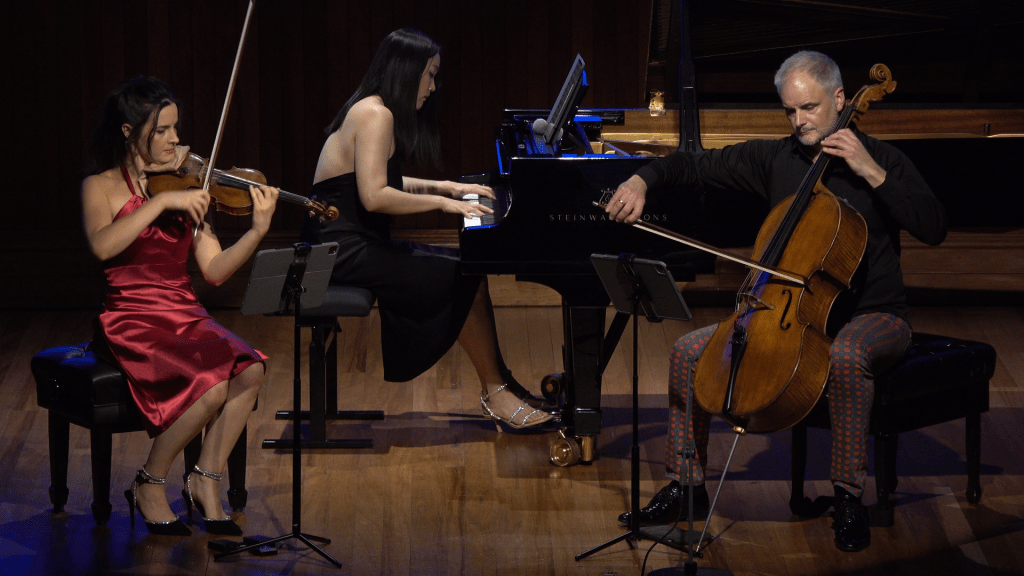
NZ Trio. Amalia Hall, Somi Kim and Ashley Brown

NZ Trio

Triptych 3: Untamed Hope

Auckland Concert Chamber

November 17

Reviewed by John Daly-Peoples

NZ Trio as well as being one of the finest groups of players in Australasia are also one of the most innovative and inspiring with their stimulating programmes. This was clear in their latest concert, “Untamed Hope” which featured four women composers from New Zealand, England, Germany and the USA with works spanning three centuries.

The title of the concert, “Untamed Hope”: probably alludes to the fact that at least three of the  women were constrained in some way by the environments in which they began their musical careers. Their hopes of being able to be in the concert hall on equal terms with their male counterparts was largely tamed by that environment.

The opening work was English composer  Ethel Smyth’s Trio  in D minor, a work  written when she was twenty-two having left the England to study in Leipzig.  At the time she met many contemporary composers including Clara Schumann and Brahms.

The first movement could even have been written by Brahms, which was apparent in the  sinuous playing of Somi Kim who was accompanied by delicate melodies from the strings. Initially violin and cello were in harmony with the piano but then their playing began to diverge, with each of the instruments developing their own musical themes.

Parts  of the second movement seem to be based on a folk song (French or English) with theme passed between the three instruments, all suggesting a soulful introspection as well as displaying the composers sophisticated writing.

Third movement entitled “Leid” had many aspects of the “song without word” with hints of a Scottish dance melody played by Amalia Hall

The dramatic finale saw a long  passage by the piano with the strings entering, playing a Hungarian-like tragic theme.

Eve Bedggood’s Ukiyo 浮世 –The Floating World relates to the Japanese concept of “the floating world” which evokes an imagined universe of wit, stylishness, and extravagance, a state which was often experienced through theatre, song, stories  and pictures.

Bedggood says of the notion of “the simplicity of just existing  and immersing yourself in the floating world or sense of calm is something I think music and other art forms can evoke”.

Much of the work had musical images of floating, flowing and meditation states with the work opened with dark rumbles from the piano suggesting sombre depths with strains of the violin and cello making interventions .

We heard exciting glissando from the Amelia Hall’s violon and careful, controlled repetition from Ashley Brown cello, while many of the sequences  saw an almost minimalist backing with the scudding sounds of the strings hovering above.

The work was like a reverie, the various themes creating dreamlike images much like those of many Japanese prints of an earlier period.

The American Joan Tower’s “Trio Cavny” opened with some tingling high notes from the piano with the violin and cello responding with equally high-pitched sounds creating a taut musical mood.  A following sequence saw Somi Kim creating crashing waves of sound leading to a tension between the three instruments which then played independently of each other before arriving at a point of intense harmonisation.

The music ranged from the soundtrack of a horror movie to a musical version of the Doppler Effect to the sounds of sympathetic voices in  minimalist mediation.

The final work on the program was Fanny Mendelssohn’s Piano Trio in D Minor. It is a beautifully conceived work with the violin and cello flowing around the energetic displays of Somi Kim

Amalia Hall provided both a delicacy and sharpness with her playing, contrasting with Ashley Browns sedate cello.

The introspective and reflective  second movement which opens with  a romantic  sequence from the piano contained elements of waltz tunes  while the third suggested elements of German folk song.

In the final movement the three players displayed a vigorous drive and energy, beginning with some  mesmerising playing by Kim before Hall and Brownjoined in creating an eloquent dialogue, leading to repeated motifs to end the work with an optimistic conclusion

The group announced that cellist Ashley Brown will be leaving the group to take an appointment as Principal Cellist with the Auckland Philharmonia Orchestra next year. He  has been involved with the trio since its founding twenty-three years ago and his presence with the trio will be greatly missed.

Categories
Reviews, News and Commentary

The passion and drive of Alexander Gavrylyuk

Reviewed by John Daly-Peoples

Alexander Gavrylyuk

New Zealand Symphony Orchestra

Alexander Gavrylyuk

Auckland Town Hall

November 16

Reviewed by John Daly-Peoples

Opening the NZSO’s latest concert “Alexander Gavrylyuk”, conductor Vasily Petrenko spoke about the three works on the programme and what he saw as the  links between them. The three composers had all left their native homes – Lera Auerbach and Sergie Rachmaninov from Soviet Russia and Bela Bartok from Hungary to escape the Nazis. He also noted the three composers search for freedom of expression and the nature of transformation in the three works.

The major work on the programme was Rachmaninov’s “Rhapsody on a Theme of Paganini” which has some interesting history or mythology to it  . The nineteenth  century violinist Nicolò Paganini was such a virtuoso, that many believed he had made a pact with the devil. Rachmaninov seems to have subscribed to that view as he  includes a reference to  the medieval melody Dies Irae (Day of Wrath) and some of the darker elements in the music reflect those diabolic aspects.

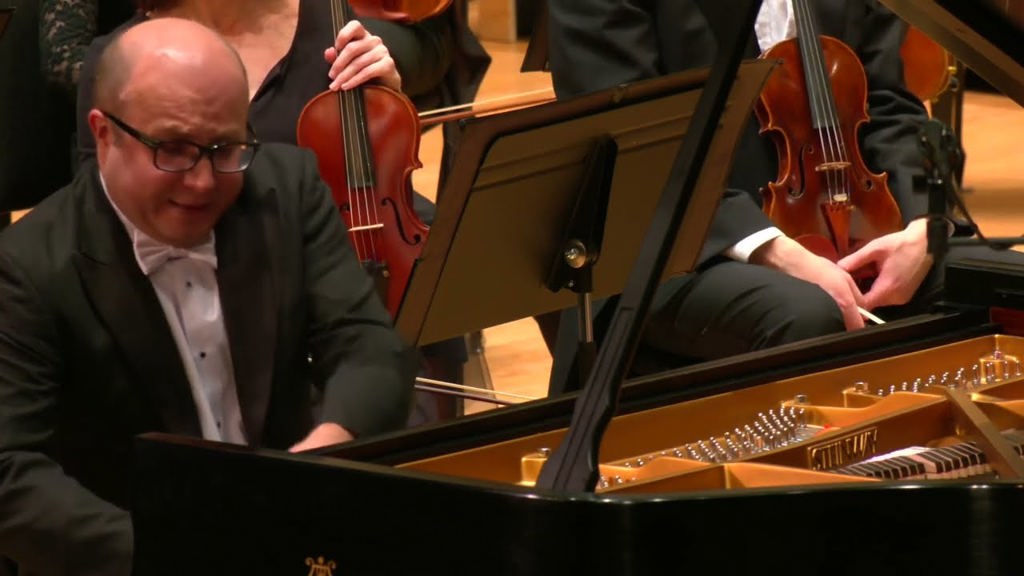
This drama and other elements were highlighted by pianist Alexander Gavrylyuk in a perfect performance that showed a perceptive approach to the music

He displayed a mastery of stylish playing, able to ignite the orchestra with his passion and drive.

His playing technique: changing tempos, charging through themes and varying the tonal qualities added to the excitement of the playing and appeared to enliven conductor Vasily Petrenko well as the orchestra.

Hunched over the piano his playing was by turns delicate, whimsical and ferocious. There were times when his sounds were like rippling water while at other times they were more like gushing torrents.

This was brazen and adventurous playing which slowly revealed the technical and emotional depths of the work moving from the childlike to the theatrical and  onto the grand and funereal.”

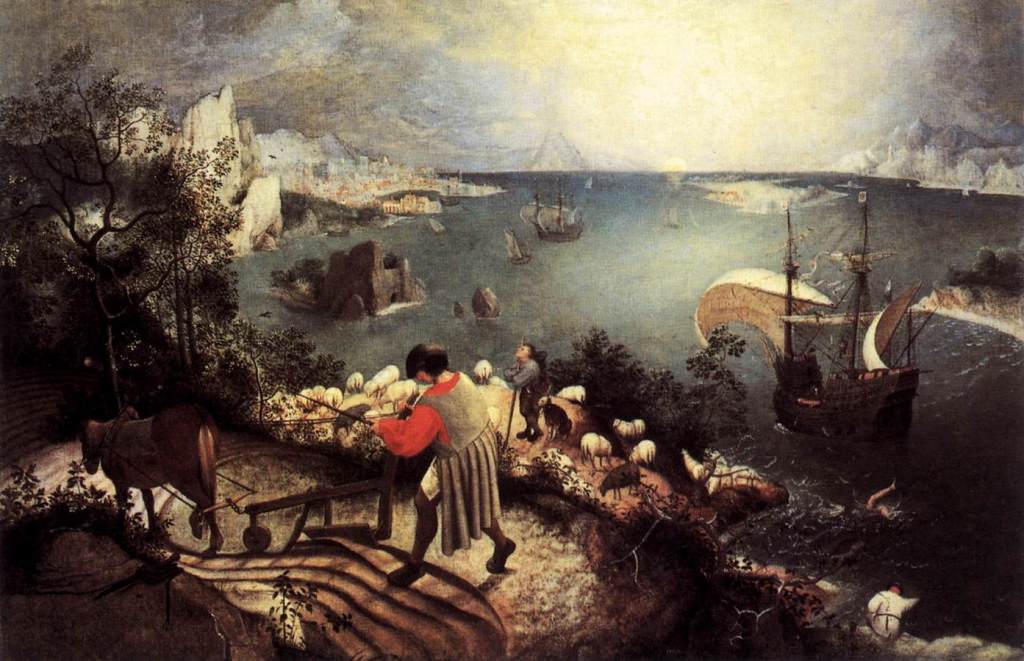
Breugel “The Fall of Icarus

The first work on the programme had been Lera Auerbach’s “Icarus” which tells of the myth of Icarus who ignored his father Daedalus and flew too close to the sun, causing the beeswax securing his wings to melt and him to fall into the sea.

The composer said of the work “What makes this myth so touching is Icarus’s impatience of the heart, his wish to reach the unreachable, the intensity of the ecstatic brevity of his flight and inevitability of his fall.”

The opening strings and brass provided a sense of take-off and the exhilaration of Icarus. This was followed by a galvanised orchestra and flutes suggesting flight. Sounds of alarm from  the orchestra signalled the coming disater  and Concertmaster  Vesa-Matti Leppanen brilliant little solo took a dreamlike diversion which became increasingly tense. This led to the insistent brass heralding Icarus’ fall.

The final sequences could be seen as the composer’s response to Bruegel’s painting “The Fall of Icarus” where the action of the event is reduced to a leg just visible, poking up  from the water . The pulsing strings suggested the vibrancy of the sun which is a counterpoint to the disaster, the quivering sounds a refence to Icarus’ fall into the water and the scattering of feathers. The work ends with a gentle requiem suggesting Icarus becoming a mythic hero.

The final work on the programme was Bartok’s five movement Concerto for Orchestra

It was his last major work and can be seen as some sort of musical autobiography of his last few years having had to leave his native Hungary and settle in the US

Composed a couple of years after his escape from Hungary it traces out his journeying from a bleak Europe to a new life, moving from a dark period in his life to one of  freedom and light. The music reflects this moving with ominous and threatening sounds through to lively and energetic melodies.

The work opened with sombre music punctuated by the flutes and raucous brass. Anguished strings confronted by ferocious brass, woodwind and percussion and the continued presence of the flutes sounded out the call for  freedom.

There was a sense of evolving events and narrative and about remembrance and loss with whimsical passages as well as a constant sense of oppression and mystery.

While there were references to horrors and drama of WWII the work is filled with inventive  music which was constantly evolving with a carnival-like sequence, playful sounds as well as hints of folk melodies  and strains of Eastern music.

The success of the work was in part due to the focused conducting of Vasily Petrenko with his lively and energetic approach and his precise direction in shaping the music’s dramatic sounds

Categories
Reviews, News and Commentary

Tempo Dance Festival: In Transit, Matter and Slip

Reviewed by John Daly-Peoples

In Transit

Te Rerenga o Tere | Tempo Dance Festival 2024

Rua, – In Transit & Matter

Q Theatre

October18

Slip , Rebecca Jensen

October 20

Reviewed by John Daly-Peoples

In Transit

Choreographer, Louise Pōtiki Bryant

Sound / Av, Paddy Free

Lighting, Jo Kilgour

Costumes , Kasia Pol

Slip, Rebecca Jensen

Louise Pōtiki Bryant’s In Transit imagines the links between Maori  myth, ritual and their notion of the ancestors observing the nutuarl  world and its cretasures. Here the shaping of the creation myths, are given narratuives and images which give meaning to the transition in human life  paralleling those of the spirit world.

The work appears to dwell on several aspects of Māori myth such as the creation story of Ranginui and Papatūānuku, whose, children exist for a time in  in the dark world until Tāne, separates their parents, bringing the children into light.

There is also reference to the evolution of the  taiaha which Tū, the god of war asks Rūrūtangiākau, the weapon maker of the gods to create a weapon.

The dance opens with a low droning sounds as the sole figure, representing Tū or Rūrūtangiākau who dances through shafts of light with a  branch balanced on his head., He moves from an underworld into light and is joined by five other dancers who perform with long sticks or the evolving taiaha. They dance to a soundscape which [provides a sense of the being under water along with bird sounds.

The dancers seemingly inspired by bird and reptile  movement, move with short sharp steps id birds, strutting, foraging and pecking. These  movements were accompanied by staccato like breath which add to the sense of existing n another dimension.

Some of the dancers entwine cresting manaia shapes suggesting the notion of messenger between the mortal and spirit worlds.

The slender taiaha are used to create a Papatūānuku womb-like shape out of which  a figure emerges.

The work is full of robust dancing, flickering shafts of light along with a mesmerizing soundtrack along with relentless beats. It blends together sound, music, visual and movement describing the transitions between the physical world and the spirit dimensions.

Matter

Matter

Choreographer & Sets, Ross McCormack

Composer, Jason Wright

Lighting, Jo Kilgour

Costumes , Vicki Slow

“Matter” choreographed by Ross McCormack opens with a lone figure seemingly transfixed by one of the five post erected on the stage. He was joined by another figure and from their fitful movements it appears that they are inhabiting a world where they are seeking, discovering or being activated by lines of force or energy, possibly emanating from the poles.

Then they are joined by a group of dancers who move to a cacophony of sound, inching forward, creating a reptilian-like form with a nod to the work of the German choreographer Pina Bausch. Their erratic shuffling moves, driven by an inner tension and massive roars of music is by turns orderly as though responding to laws of Nature or manipulated by an unseen hand.

Two of the dancers appear to respond to other sounds as though out of their control and they engage in movements which area mix of tussle and dance, their movements  hinting at forces which are attracting and repelling g them.

We get the sense that the poles are the xxx of these forces-  electromagnetic, natural rhythms or xx.  Other bodies separate and merge becoming alien creatures and the sounds and music we hear are the sound of  massed bodies  and the arms and legs becomes tentacles.

Throughout the work the dancers seemed to be either seduced or buffeted by the music and sounds, their movements at times urgent and  sharp while at other times graceful and submissive.

In the latter part of the dance the poles /  pou are moved taking on more symbolic meaning- the crucifixion, the triumphal Iwo Jima image  of WWII.

There is a surreal beauty to the dancing which is created with a subtle mix of  sound and lights while at one point the music takes on the rhythms of the Pacific with a hypnotic quality.

Another dramatic sequence involves first two dancers and ultimately all eight moving and dancing as mirror images of each other creating a dramatic frieze. This architectural aspect is also present in many of the other sequences, deriving from the five poles.

Much of the time the dancing could be likened to the movements of atoms and molecules in chemical and physical reactions, conforming to notions of particle physics and string theory.

Slip

Slip, Rebecca Jensen

We don’t often get to see true absurdist dance in the style of the absurdist dramatic works of the 1950s and ’60s. Nothing that suggest the human condition is essentially absurd and devoid of purpose.

Rebecca Jensen’s “The Slip” seemed to offer an absurdist dance which was set in a bizarre or surreal environment. The stage looked like an art installation  – a step ladder, bucket, watering can, a table cluttered with apparatus, a sole cup and a large, directional microphone.

The opening minutes of the work continued the absurdist premise as we watched a couple of stagehands pouring water into containers and splashing it over  the stage. It looked as though it was a work about sea level and climate change. This idea was reaffirmed throughout  the production with images and the sounds of water.

After that opening  sequence Rebecca Jensen appeared, dressed in a medieval gown, the first of her iterations. She sat, meditatively  on the stage, performing simple gestures which were  in marked contrast to her hectic movement in the latter part of the work.

“Slip” is a filled with precise  and deliberate movements, mixed with moments of humour and provocation. It is an experimental work where the  flaws and interventions that show up over the course of the performance add to its idiosyncratic quality.

It’s a work which can be interpreted as having  surreal narratives, the themes of which will occur to the individual viewer as they come to grips with  the many vignettes.

The focus of the work comes from the title, ”Slip”. There is a constant slippage between what we see and what we hear, between what is natural and what is fabricated between the  role of the performer and the place of the technician.

While Jensen is the dancer/actor in “Slip” she is aided by Aviva Endean who acts as sound technician, participant and  guide,  controlling a table full of noise producing devices both physical and electronic.

When Jensen first appears, she dives into her backpack extracting various items such as a key, a bag of chips a bottle of water and a newspaper. But when she handles these items, it is not their natural sound we hear, it is Endean – shaking her own newspaper and pouring her own bottle of water, the sounds picked up and enhanced by the large microphone. When Jensen eats a chip, the crunch we hear is from Endean’s microphone enhancing the sound of her biting on a stick of celery.

This dislocation and enhancement occurs throughout the work in different forms. When Jensen walks around the stage we hear the sounds of Endean’s feet crunching on shells. At other times when Jensen walks, we hear the sounds of her body creaking as though she is robotic.

Jensen explores a range of movements from small gestures though fluid and dramatic balletic moves to the volatile actions which see her almost out of control.

The soundscape produced by Endean is similar to the enigmatic sounds created by the experimental group From Scratch and like that group she uses unlikely items to create the sounds.

Categories
Reviews, News and Commentary

The APO’s 2025 Season revealed

John Daly-Peoples

Principal Guest Conductor, Shiyeon Sung Credit Yongbin Park

Auckland Philharmonia Orchestra 2025

John Daly-Peoples

The  Auckland Philharmonia has just released its 2025 Season, of forty concerts featuring some of the world’s most-important artists including violinist James Ehnes, Spanish pianist Javier Perianes, guitarist JIJI, cellist Daniel Müller-Schott, and conductor Pierre Bleuse.

Javier Perianes Credit Julia Severinsen

The opening concert will feature New Zealander Claire Cowan’s “My Alphabet of Life”, Beethoven’s ‘Emperor’ Piano Concerto and  Strausstone-poem,Ein Heldenleben. All of the following concerts will provide a similar mixture of the great classics along with new and surprising works from the classical period and more recent compositions.

There will be a complete performance of Ravel’s ballet, Daphnis et Chloé.as well as  a selection from The Creatures of Prometheus, Beethoven’s only published ballet.

Other major works will include performances of Beethoven’s  Symphony No.5, Tchaikovsky’s Symphony No 5 and Mahler’s Symphony No 3 with mezzo-soprano Deborah Humble.

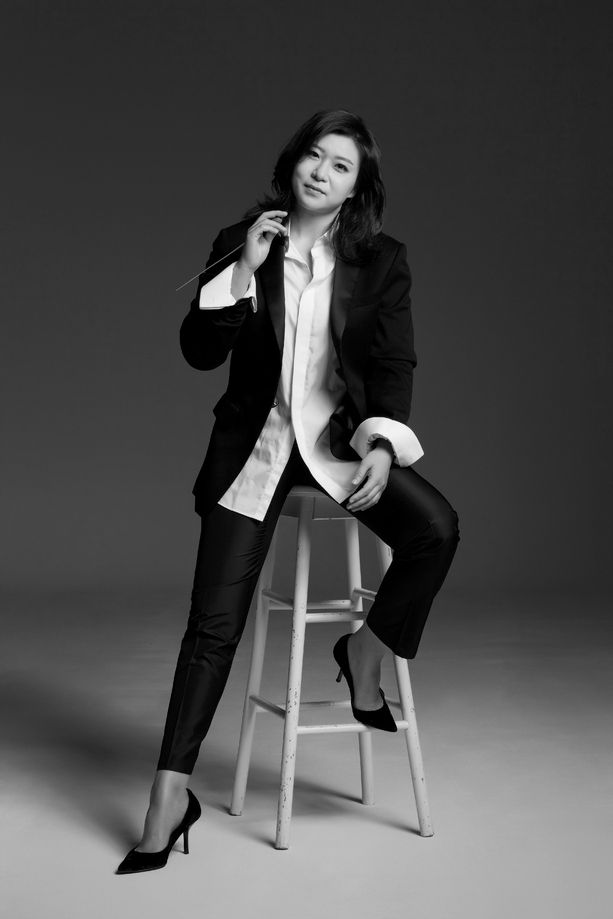
Principal Guest Conductor, Shiyeon Sung will conduct fellow Korean Clara-Jumi Kang, playing Tchaikovsky’s Violin Concerto, and Mozart’s Piano Concerto No.21 performed by British pianist Benjamin Grosvenor, who was recently named in Gramophone magazine’s list of the 50 greatest all-time pianists.  

The New Zealand Herald Premier Series will include major symphonic works by Elgar, Brahms, Shostakovich, Wagner, Mozart, and Tchaikovsky, as well as some rarely programmed gems by Ravel, Respighi, Liszt, Schoenberg and Grieg, complemented by music from leading New Zealand composers Claire Cowan, Kenneth Young and Louise Webster.

There will also be the New Zealand premiere of Sir James MacMillan’s newest concerto ‘Ghosts’, an Auckland Philharmonia co-commission with the London Symphony Orchestra, Melbourne Symphony Orchestra, Singapore Symphony Orchestra, Royal Stockholm Philharmonic Orchestra and St. Louis Symphony Orchestra.

The Canadian violinist James Ehnes will return for a two-week residency, performing two of the most demanding works in the violinist’s arsenal –  Bartók’s Violin Concerto No.1 and Brahms’ Violin Concerto.

Pierre Bleuse

Other soloists include Korean guitarist JIJI, German cellist Daniel Müller-Schott, Sylvia Jiang and Alexander Gavrylyu. There will also be several visiting conductors leading the orchestra including Pierre Bleuse, Karl-Heinz Steffens and Jun Märkl.

The Classic Series of five concerts will feature major masterpieces, such as Mendelssohn’s ‘Scottish’ Symphony, Haydn’s Symphony No.93, Tchaikovsky’s Violin Concerto and Brahms’ Piano Concerto No.2.

The Pub Charity Opera in Concert production of Verdi’s La traviata will see Giordano Bellincampi exploring the raw dramatic power of this sublime score with a celebrated New Zealand and Australian cast; including Amina Edris as Violetta, Oliver Sewell, as her lover Alfredo, and Phillip Rhodes as Germont.

The multifaceted Baroque & Beyond series will be returning with two concerts directed by Concertmaster Andrew Beer that celebrate the masters of the Baroque era from Handel’s Water Music to works by Sir Michael Tippett along with Baroque masters Biber and Corelli and 20th century composers Bloch and Respighi.

In 2025 the music of the movies will be heard  in Art of the Score: The Music of Hans Zimmer. Hans Zimmer is one the most influential film composers of all time and is behind the iconic scores for Interstellar, Inception, The Dark Knight Trilogy and themes from Pirates of the Caribbean and Gladiator. Audiences will be taken on a journey through Zimmer’s music, presented by Australian Art of the Score podcasters and film buffs, Andrew Pogson and Dan Golding, with Nicholas Buc on the podium.

Matariki with Ria Hall will be a popular night to celebrate the Māori New Year. One of Aotearoa’s most compelling and thoughtful voices, Ria Hall, will join forces with the the orchestra to recreate her evocative songs ‘They Come Marching’, ‘Te Ahi Kai Pō’, and ‘Black Light’, with a magnificent symphonic soundscape.   

Bic Runga Credit Tom Grut

Bic Runga with Auckland Phil will feature Runga performing such classics as ‘Something Good’, ‘Precious Things’ and ‘Bursting Through’, reimagined together with a full orchestra, this will be an extraordinary evening of musical fusion.

There will be a  fun-filled interactive show featuring New Zealand’s beloved canine icon, Hairy Maclary’s Greatest Hits presented by Jackie Clarke, and a captivating show for the whole family starring everyone’s favourite duo, Wallace & Gromit, at Wallace & Gromit in Concert. including The Wrong Trousers screened in full.

Season brochures are available online from aucklandphil.nz or by phoning Auckland Philharmonia Ticketing on (09) 623 1052

Categories
Reviews, News and Commentary

The NZSO’s Copland, Cresswell and Mozart concert

Reviewed by John Daly-Peoples

Gemma New

Jupiter: Mozart & Copland

New Zealand Symphony Orchestra

Auckland Town Hall

September 21

Reviewed by John Daly-Peoples

Aaron Copland’s Appalachian Spring which opened the NZSO’s latest concert featured music the composer originally wrote for Martha Graham’s ballet of the same name. The work has a simple narrative  following aBride and Husband as they get married and celebrate with the community. The work contains  various themes – faith, love and the joys of a new life.

The work is a celebration of the American West as well as an acknowledgement of the country’s past times of violence, referencing both the Civil War and World War II (the work was written in the midst of the war).

Copland used American folk music for melodies, harmonies and textures, that he had used in previous works such as Billy the Kid and  Rodeo and he also  included a theme and variations on the Shaker tune “Simple Gifts”.

Like those other two ballets the composer has responded to the notion of fluidity, representing the dancer’s movements.

The piece starts off with one of the great descriptions of the dawning day but with it is also the couple’s wedding day. This is described with soft chords from the strings, followed by soaring woodwinds with the flute and clarinet sketching out the storyline.

Quiet and wistful vistas and activity merge into cheery dance-like passages echoing the early American folk tunes and Conductor Gemma New responded with a little dance, caught up in these lively  rhythms

The work was punctuated by dramatic use of the percussion and horns which contrasted with the lively, dancing strings.

The finale with its grand statement along with Copland’s others works added a new dimension to the idea of rural America and the West elevating them to a sophisticated and iconic level.

The second work on the programme was Lyell Cresswell’s Piano Concerto No 3  which was given its world  premiere, played by Stephen De Pledge, a long-term admirer and advocate of the composer’s work.

The concerto is full of contrasts, between the instruments  themselves as well as the musical colours and textures which are all bound together with innovative instrumentation.

It opened much like the Copland with a dawning with suggestions of Nature, the stillness of landscape and the sounds of the forest. This was soon followed by the aggressive orchestra which merged with De Pledge’s piano where shimmering clouds hovered over the raucous strings.

Throughout the work there were musical suggestions of observations of his environment linked to a strange, abstract realm of sound with De Pledge and the orchestra contributing a range of textures – delicate, frenzied, lush and meticulous.

The brutal sounds of the orchestra were often matched by the equally brutal sounds of the piano, orchestra and piano creating interweaving and inventive sounds. These included the pianist using the instrument as a percussion instrument, knocking on the piano keys or playing long passages of a repeated single note.

Much of the piano work was sparse but there were occasional energetic bursts of sound accompanied by the orchestra  with the whispering strings at time sounding like the gentle wind in the trees or a breath slowly exhaled.

The final work in the programme was Mozart’s Symphony No 42 , The Jupiter one of his last symphonic works and one in which the composer is producing work which is at the centre of the transition of music form the classical to the Romantic…

With this work Gemma New seemed to be interested discovering nuance and depth in the composer’s work.

Even in the opening sequence which is full of drama she created contrasts so that the great melodies took on a more impressive sound with New seeing possibilities in the music that even Mozart  may not have been  aware of.

Her approach was obvious in the intensity of many passages, reducing some to more of a sigh while the dramatic moments featured immense surges of sounds.

The mysterious quality of the second movement featured  some beautiful balance between the woodwinds and orchestra while the energetic final movement with multiple themes and intricate playing  demonstrated the orchestra’s superior musicality.

To subscribe or follow New Zealand Arts Review site – www.nzartsreview.org.

The “Follow button” at the bottom right will appear and clicking on that button  will allow you to follow that blog and all future posts will arrive on your email.

Or go to https://nzartsreview.org/blog/, Scroll down and click “Subscribe”

Categories
Reviews, News and Commentary

NZ Opera’s Rigoletto: a tale of love, despair, anger and corruption

Reviewed by John Daly-Peoples

Rigoletto (James Clayton) Image Jinki Cambronero

Rigoletto

Music by Giuseppe Verdi

Libretto by Francesco Maria Piave

NZ Opera, by arrangement with Opera Australia

Kiri Te Kanawa Aotea Centre

Until September 25

Reviewed by John Daly-Peoples

From the opening doom-laden chords through to the anguished sounds of the  final moments of Rigoletto the audience was carried along by the glorious music which conjured up feelings of love, despair, anger and malevolence as we follow one mans destiny, overcome by the deceitful and immoral world he lives in.

Tyrants, and  corrupt leaders have always had the ability to corrupt other people and surround themselves with equally corrupt yes men. Rigoletto takes us into that world of, deceit and amorality. It is a bleak world where the  occasional flicker of light and love is quickly extinguished

The first act opens with the Duke of Mantua and his courtiers cavorting in an impressive reception room with references to La dolce Vita of the 1950’s. It is a world where the dinner suits and fabulous dresses disguise the lecherous goings on.

We also encounter Rigoletto dressed as the court jester – a mixture of Ronald McDonald and Joaquin Phoenix’s Joker as he peels off his make up surrounded by his various costumes. He is an actor who must play many parts, just as the other members of the Dukes court play  out their roles.

The first act’s dramatic opening is just the start of probably one of the most mature and intelligent productions of the opera and one which kept the audience enthralled.

One of the problems I have always had with the opera is the curse with which Monterone damns Rigoletto and the duke early on. The notion that he has been cursed preys on Rigoletto mind throughout the opera and when his daughter dies in his arms, he shrieks about the curse has been fulfilled. Of course, the evil Duke still lives, so the curse has not affected him.

In fact, Rigoletto himself is the reason his daughter has been killed, Rigoletto himself is the curse and she dies because of his deceit and immorality rather than anyone else’s.

The Duke and his various courtiers are not particularly evil. They act as many men of business or politicians, using or skirting the law in an amoral fashion. It is Rigoletto who embarks on a course of revenge with the decision to hire an assassin to kill the Duke.

The courtiers and the Duke are also upfront about what they do. It is Rigoletto who presents a façade at court as well as to his daughter, withholding the truth of his relationship with the Duke and his early life even from her.

This veneer which he presents is his undoing. His pretense of an irritating, sycophantic fool at court hides a deep-seated resentment. His lack of awareness of his involvement with amoral activities as well as presenting as a cloying and over protective father is his weakness, his flaw, his curse.

James Clayton in the role of Rigoletto has to convey Rigoltto’s complex set of attributes and flaws. His character never becomes over demonstrative, there is always a sense of him holding back in his expression of love, hate, contempt. It is too easy to have Rigoletto portrayed as a twisted character who is obviously deformed physically as well as mentally and Clayton carefully avoids this.

His “Pari siama” (How alike we are) when singing of the assassin Sparafucile is haunting in its exposure of Rigoletto’s awareness of his own wretchedness, his voice catches with shuddering emotion at just the right point. Then he superbly transitions to his singing as devoted father of Gilda.  This ability to capture his two personalities, the heartless and the warm showed in just a couple minutes showed a singer with able to convey deep psychological states with exquisite refinement.

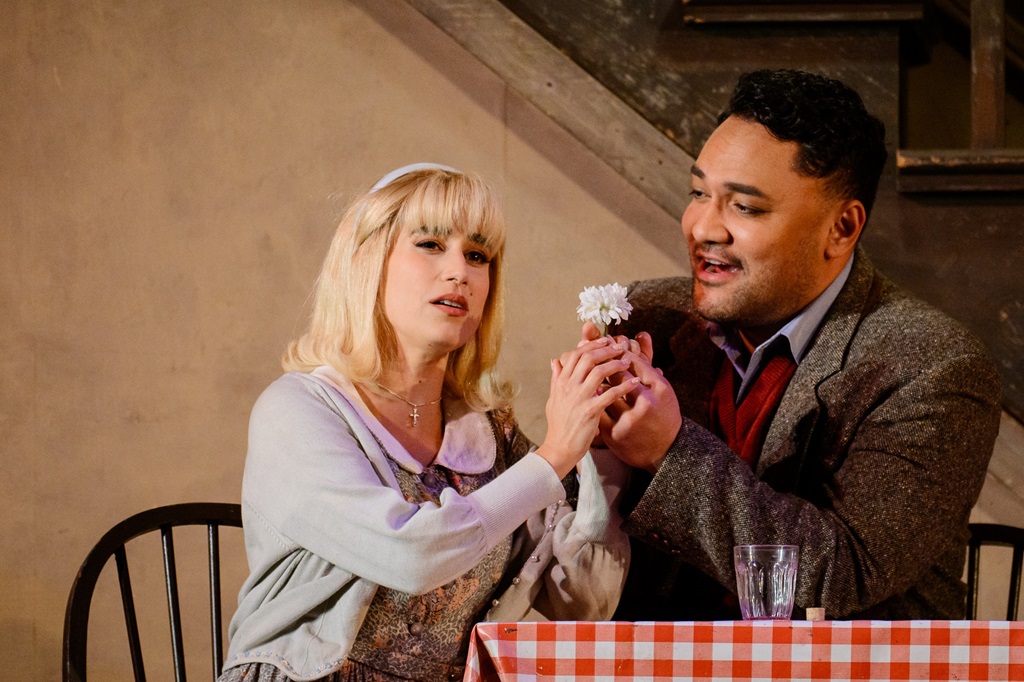
Gilda (Elena Perroni and the Duke (Amitai Pati) Image Jinki Cambronero

As Gilda, Elena Perroni created a character which expressed all the conflicting emotions of a young woman exposed to the ache and desperation of love, the terror of kidnap, the embarrassment of talking to her father about her seduction and the confusion of being dragged into the adult world.

Her voice soars with emotional expression in arias such as “Care nome” (Dear name) where effervescent and passion erupt.

Amitai Pati sang gloriously as the hedonist Duke with just the right mix of bravado and self-awareness. In his role as Gilda’s lover his voice took on an elegant combination of romanticism and cynicism which helped create a fully rounded, disreputable character.

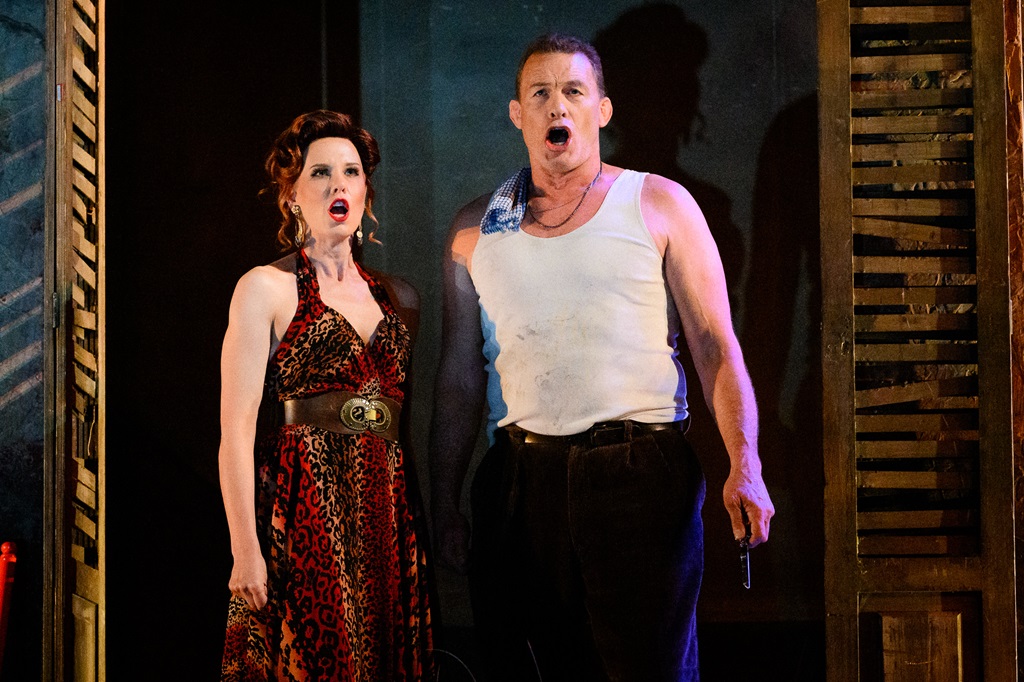
Maddalena (Sian Sharp) and Sparafucile (Jud Arthur) Image Jinki Cambronero

Jud Arthur’s Sparafucile was suitably threatening with his mundane approach to killing,. His silky voice resonated with darkness and menace, his body tense with suppressed nervous energy.

Sian Sharp was impressive as Maddalena, Sparafucile’s sister and she added a sensual dimension to the final quartet when she sings with the Duke, Rigoletto and Gilda in a profound “Bella figlia” (Lovely woman).

The set designs by Michael Yeargan are impressive from the lavish palace interior to the brilliantly detailed house/ bar interior constructed on a revolving stage which helps concentrate the action.

This is a restaging of the work originally directed by Elijah Moshinsky and rehearsed by Shane Placentino who has done a splendid job in realizing the work.

As ever the New Zealand Opera Chorus was in great form and conductor James Judd deftly led the Auckland Philharmonia ensuring that the music added to the overall dramatic effect, dominating when it needed to but always allowing the singers the space to let their voices shine.

With this production director, designers, soloists chorus and musicians have brought together a seamless tale of brilliantly rounded characters with vivid emotions and contemporary relevance.

To subscribe or follow New Zealand Arts Review site – www.nzartsreview.org.

The “Follow button” at the bottom right will appear and clicking on that button  will allow you to follow that blog and all future posts will arrive on your email.

Or go to https://nzartsreview.org/blog/, Scroll down and click “Subscribe”

Categories
Reviews, News and Commentary

Resetting the Coordinates of Performance art in NZ

Reviewed by John Daly-Peoples

Resetting the Coordinates

An anthology of performance art in Aotearoa New Zealand

Edited by Christopher Braddock, Ioana Gordon-Smith, Layne Waerea and Victoria Wynne-Jones

Massey University Press

Published September 2024

RRP $65.00

Reviewed by John Daly-Peoples

In 2014 The Walters Prize  included a work by Kalisolaite ‘Uhila where the artist inhabited the Auckland Art Gallery precinct for several months, living as a homeless person – eating sleeping and communicating with visitors, staff and other destitute  people. The work  was intended to draw attention to the plight of the homeless.

However, going to the gallery to find the ”art” and the artist necessitated searching the art gallery, the nearby park and streets until I found him wedged into an overhang on the gallery’s roof.

This search seemed more like a game of hide and seek rather than being immersed in a social /political experience /experiment. At the time It seemed to only involve me and the artist, reflecting on an encounter.

That encounter is what can loosely be called an example of  post-object art or performance art which has been evolving in New Zealand since the 1970’s.

With that encounter and many others one can see that performance  art requires an audience as well as documentation as many of the events are transient.

Now an  anthology/reader of performance art in New Zealand, ”Resetting the Coordinateshas been published,providing an in-depth survey of the artists and artworks in the  performance area which have happened over the past fifty years.

At the core of performance art  is the audience and the performer/artist,  the works having a theatrical element to them in which artist often draw attention to time, space, and body,

The  goal of these actions is to generate a reaction with themes which are commonly linked to life experiences of the artist themselves along with social and political criticism.

Darcell Apelu:, New Zealand Axemens Association: Womens subcommittee president
2 August 2014, documentation of performance.
Courtesy Artspace, Auckland. Photo by Peter Jennings

The book records a number of the activities which occurred as described in the introduction by editor Christiopher Braddock,

“If, on 2 April 1971, you had journeyed out across the unsealed metal roads to the west coast of the Tāmaki Makaurau Auckland region of the North Island of Aotearoa New Zealand, venturing as far as the remote Karekare Beach, to the north of Whatipu Beach and the great Manukau Harbour and south of Piha Beach, you would have come across the mystifying scene of ten people arduously sweeping the beach with long-handled yard brooms. “

Organised by Phil Dadson and colleagues this was the first in a series of purposeless works of which Dadson said : ‘This was work for the sake of the work, no particular purpose, no rewards’ across a ‘pointless-to-sweep stretch of beach’ in ‘communion with the elements and the place’.

These activities often existed outside the confines of the mainstream contemporary art scene  and were often undocumented. Many of the names included in the anthology will be recognisable because of their wide-ranging practice, others however have had lower profiles.

Central figures have been Phil Dadson, Jim Allen, Annea Lockwood, Peter Roche & Linda Buis, Andrew Drummond, Daniel Malone, Shannon Te Ao and Lonnie Hutchinson. There have also been numerous other practitioners who are included in the book.

Christopher Braddock, one of the editors says “Mainstream art history tends to prioritise static forms of art that are more commodifiable and saleable such as painting and sculpture. Anthologies often prioritise these artforms, such as Michael Dunn’s “New Zealand Painting: A Concise History| published in 2004. Furthermore, large-scale anthologies can cement these institutional prejudices, such as Hamish Keith’s The Big Picture: The History of New Zealand Art from 1642 (2007) which largely ignores performance art.”

The book underlines the fact that performance art is a distinctive part of recent art history, with its activities presenting  social and political  approaches which  emphasises the  connections between artist, audience and art critic /  historian.

These events often combined elements of anarchy,  humour, spirituality, repetition, the unplanned and unexpected.

There are a several chapters which examine the  history and development of performance art, some which look at the aspects of woman’s art practice, the development of Māori and Pacific based works, queer performance art and performance art in post -quake Christchurch.

There are numerous photographs and records of the activities which only give a limited appreciation of the performances such as Annae Lockwood piano burning while the multiple images of Andrew Drummond’s projects give some sense of the scale of his work.

CardboardConfessional_
Audrey Baldwin, Oscar Bannan, Bridget Harris, NeilMacLeod, Annemieke Montagne, Pat Parkin, Jennifer. Katherine Shield
2016, documentation of performance for the Centre of Contemporary Art Toi Moroki programme,Ōtautahi Christchurch.
Courtesy Centre of Contemporary Art Toi Moroki. Photo by Janneth Gi

Among the other projects included are the documentation project of the Christchurch “Cardboard Confessional” (2016) developed by Audrey Baldwin et al, Louise Potiki Bryant’s dance work “Te Taki o te Ua / The Sound of Rain” (2001), Jeremy Leatinu’u’s Queen Victoria (2013) where the artist contemplated statues of the queen,  Juliet Batten’s Women’s Project of 1985 at Te Henga Beach and Bruce Barber’s “Mt Eden Crater Performance  (1973) which was a collaboration with Solar Plexus as part of the drumming event initiated by Phil Dadson..

It is a fascinating book with lots of performances which have been rarely written about, seemingly lost to history but which tell us much about the social, political and spiritual examinations and soundings which artists have made.

The writers include  Natasha Conland, Gregory Burke, Ioana Gordon-Smith, Khye Hitchcock, Audrey Baldwin, Bruce E Phillips and Heather Galbraith

To subscribe or follow New Zealand Arts Review site – www.nzartsreview.org.

The “Follow button” at the bottom right will appear and clicking on that button  will allow you to follow that blog and all future posts will arrive on your email.

Or go to https://nzartsreview.org/blog/, Scroll down and click “Subscribe”