Categories
Reviews, News and Commentary

NZ Rustic: The NZ Dream

Reviewed by John Daly-Peoples

New Zealand Rustic

By Kate Coughlan with Tessa Crisp & Yolanta Woldendorp

Bateman Books

RRP $59.99

Publication Date October 1

Reviewed by John Daly-Peoples

One of the dreams of many New Zealanders is of a return to nature, living in a house in sympathy with the environment, possibly living off the land, even living off grid.

For many that dream has become a reality and a new book “New Zealand Rustic” highlights that reality with a focus on six houses.

There are a few introductory sections on lighting, texture, colour, natura light and air and styling which help define the formal aspects of good design which are seen in the houses. The major part of the book is devoted to six significant houses from the North and South Islands. There is Manukaru in Queenstown, Ginkgo Point in Omaha, Rumble Bay in Marlborough, Waiau Homestead at Gisborne’s Wainui Beach, Raggedy Ridge House between Alexandra and Omakau, Te Au Homestead near Mahia and Manukard Gard at Glenorchy.

Raggedy Ridge House Image. Tessa Crisp

Each of the houses has a history. The Waiau Homestead at Gisborne’s Wainui Beach began life as a double bay villa on a farm on the East Coast before being moved to its current location, and the severe Raggedy Ridge House which is built among the rocky outcrops of schist seems to made of the local stone forced out of the ground, both an alien intrusion and an almost  organic design connected to the landscape.

Where The Raggedy Ridge House is built of concrete many others are constructed from natural materials. Ginkgo Point has no concrete and the interior use of unpainted timber and recycled material gives the interior spaces a simplicity and warmth which is enhanced by the clever use of light.

The earth house concept is centuries old but more recent ecological concerns have seen many built in the last fifty years. Such homes as Jimma Dillon’s self-built Rumble Bay house. offer excellent insulation, providing stable temperatures that keep them cool in summer and warm in winter. As the author notes of the house “This is a world without the 4×2 rule of conventional building”. It is a house where floors, walls and ceilings blend into a continuous flowing surface like a Hundertwasser creation. the whole building sheltering under 150 tonnes of earth.
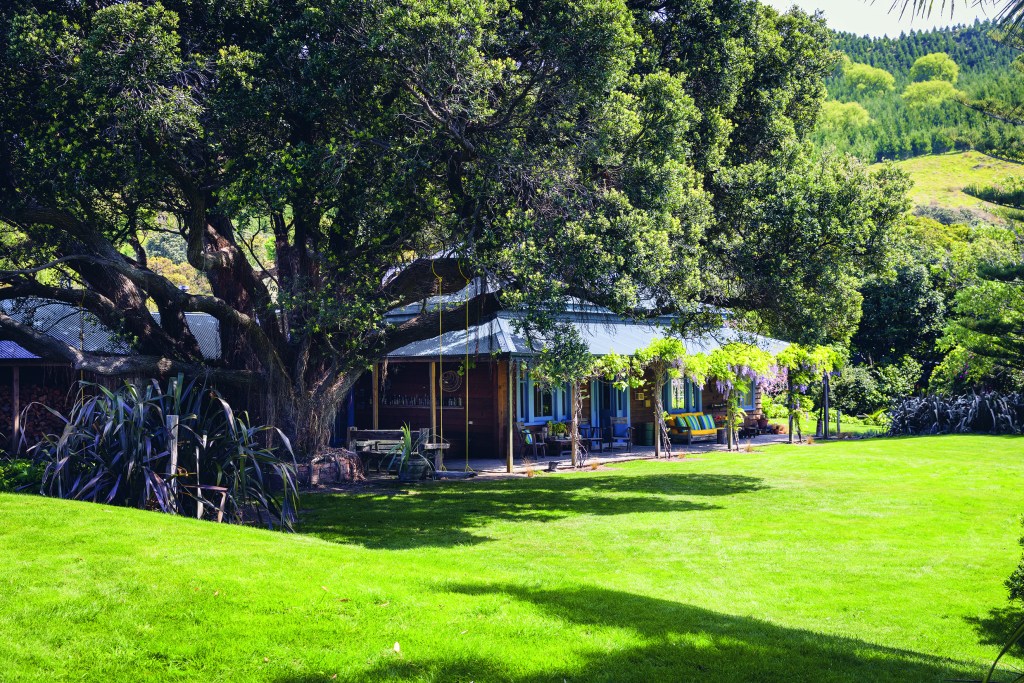
Te Au Homestead Image. Brent Darby

Tessa Crisp’s photography captures the drama and isolation of the houses and the landscape they are set in. There are views of rock formations, the sea and mountain ranges, all of them emphasising the both the rugged beauty and the serenity which the New Zealand landscape can offer. She also manages to capture the sense of the intimacy of the interiors where objects give the houses their own individuality. In some cases there are art works which add interest such as Gingko Point House with works by Michael Smither and Tony Lane.

Yolanta Woldendorp has designed stylish book where photographs and text combine to provide an appreciation of the houses – their construction, details of surfaces, decoration and orientation to the surrounding environment.

The book allows the reader / viewer to vicariously enjoy what the owners have enjoyed in their designing, building and decorating of these homes.

To subscribe or follow New Zealand Arts Review site – www.nzartsreview.org.

The “Follow button” at the bottom right will appear and clicking on that button  will allow you to follow that blog and all future posts will arrive on your email.

Or go to https://nzartsreview.org/blog/, Scroll down and click “Subscribe”

Categories
Reviews, News and Commentary

Roger Hall’s “End of Summer Time”: sparkling dialogue and consummate acting

Reviewed by John Daly-Peoples

Andrew Grainger as Dickie Hart Image Andi Crown

End of Summer Time by Sir Roger Hall

Auckland Theatre Company

ASB Waterfront Theatre

Until July 5

Reviewed by John Daly-Peoples

What are we going to do without Roger Hall? Is this really the end of a theatrical era? Will regional theatre companies  collapse?

These are some of the questions which theatre lovers, theatre companies and Creative New Zealand will be addressing over the next few years.

With the retirement  of Roger Hall from playwriting New Zealand theatre scene will be dealt something of a body blow.

But those questions and their answers are for next week, next year. In the meantime, we have another Roger Hall play, probably his last  production with “End of Summer Time.”

With his latest play Hall gives a nod to one of the important milestones in New Zealand theatre history, Bruce Mason “End of the Golden Weather”. Even the publicity material features images of Rangitoto and Takapuna Beach which was the site of Masons play.

The play charts the problems of older people thrust into a new social  environment as well as discovering the joys and drawbacks of living in a new town.

We have met Dickie Hart before in two of Halls plays “C’mon Black” and “You Gotta be Joking”. Hart has moved to the big smoke from Wellington, moving into an apartment on the North Shore.

Dickie (Andrew Grainger) is confronted by a lot of problems in his transition to Auckland and apartment living and Hall has exploited all these situations. Dickie has to manage his wife Glenda’s new interests in the library and yoga  and he has to deal with issues around the body corporate and the South African block manager.

He also has to manage more personal issues such as getting a health check from the doctor for his driving license, particularly the cognitive test as well as trying to fill in the census form and its questions on gender. identity

There is a scary account of the Dickie’s-first time visit to inner Auckland, navigating the motorway system, the bridge and the netherworld of the Aotea Centre carpark.

Dickie has moved to Auckland partly to spend time with his grandkids – a task that is which is not all that simple but he manages educational outings to Auckland volcanic cones brilliantly by combining these trips with visits to Auckland’s great dining establishments – MacDonalds, KFC and Subway.

The play is essentially in two halves– pre and post Covid , the second half being a bit more reflective.

Hall has developed a clever approach to his characters and their comments on life politics and relationship, a style  somewhere between the misogynistic and woke, it’s a tenuous area but Hall negotiates it skilfully and Andrew Grainger pulls it off with a breezy, nonchalant style.

Hall is able to assemble his string of one-liners into a coherent, monologue which acts as political and social commentary of issues of the present day as well as providing a compelling portrait of a typical New Zealand character.

The play is a brilliant and sustained piece of comedy throughout, But at one point play turns  into tragedy with a few lines and some convincing acting which demonstrates Halls consummate writing, Quigan’s directorial skill and Grainger’s intelligent acting.

Much of Dickie’s identity is linked to rugby and throughout the play there are mentions of the Rugby world Cup as well as images of Rugby games on the TV which dominated the apartment. The local library also gets a favourable mention as Dickie manages to find a copy of Brian Turners book on  Colin Meads

Grainger  takes on Roger Halls monologue with an energetic enthusiasm, the conservative cow cocky only just managing to adjust to a new life as he prowls  the pared back apartment-cum-prison set designed by John Parker.

As with all Hall’s work this is an engaging play with sparkling dialogue and consummate acting.

To subscribe or follow New Zealand Arts Review site – www.nzartsreview.org.

The “Follow button” at the bottom right will appear and clicking on that button  will allow you to follow that blog and all future posts will arrive on your email.

Or go to https://nzartsreview.org/blog/, Scroll down and click “Subscribe”