Categories
Reviews, News and Commentary

End of Summer Time: Unexpected Ode to Auckland

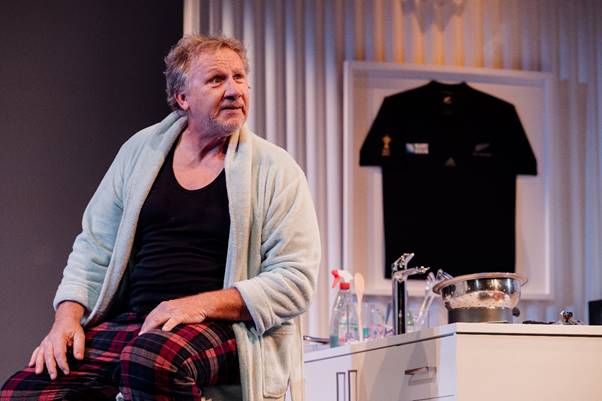
Andrew Grainger as Dickie Hart Image Andi Crown

END OF SUMMER TIME 

By Roger Hall

Auckland Theatre Company

Director – Alison Quigan

Set/Costume – John Parker

Lighting – Phillip Dexter

Sound – Sean Lynch

With Andrew Grainger as Dickie Hart

ASB Waterfront Theatre, Auckland

Until 5 July

Reviewer Malcolm Calder

Andrew Grainger as Dickie Hart     Photo Andi Crown

Gidday Dickie,

Great to see you last night.  I think we last met when you’d just moved up to Wellington and I was still milking in the ‘naki after our African adventure.  Then you moved again.  Up north.  

After Glenda pretty neatly convinced you both to take that Takapuna joint with a sea view, you never stopped grumbling and grouching about the place.  For years.  Y’know – its humidity, traffic, its prices, its pretentious people and so on.  Not to mention its upsy-downsy football team of course.  As for natural disasters, lockdowns, etc … I won’t go on.

But, bluddy hell mate, since then it’s almost like you’ve had what that Ayckbourne mate of yours would call a car-thar-sis.  Family disruptions aside, it seems that you’ve stopped moaning and fallen in love with the place.  Auckland!  Never thought I’d see the day. 

Blow me down, you seem to have become an advocate for just about everything and everyone.  From Auckland’s buses to its ferries, from its oddball characters to its libraries.  To lots of its bits too – from Riverhead to Moolfud even if the grandkids are your excuse to explore lots of Maccas and KFCs. 

Quite honestly, mate, it seems like you’ve discovered some sort of extra-special non-energetic energy in your post-Covid life.   Part of me thinks you have somehow grown an extra leg.  Or at least grown up.  And good on ‘yer. 

Never even dreamed I’d see such a contented, reflective and accepting Dickie.  I can see you now sitting on that playwright feller’s beach gazing contentedly at Rangitoto.

Nice looking apartment too and that ever-helpful sheila deserved the flowers as well.

Probably a few lessons in there for me.  Perhaps, after 50 years – yes FIFTY years – it’s time for me to stop getting irate about suss hotel food, Mendela, Pienaar and 747s.

Yes it was pretty definitely good to see you again.  Might even visit sometime.

Cheers mate

Jock

To subscribe or follow New Zealand Arts Review site – www.nzartsreview.org.

The “Follow button” at the bottom right will appear and clicking on that button  will allow you to follow that blog and all future posts will arrive on your email.

Or go to https://nzartsreview.org/blog/, Scroll down and click “Subscribe”

Categories
Reviews, News and Commentary

The amazing Jacob Rajan returns in Guru of Chai

Reviewed by John Daly-Peoples

Guru of Chai

Indian Ink Productions

Q Theatre

Until June 22

Reviewed by John Daly-Peoples

Jacob Rajan is an amazing actor and Guru of Chai is an amazing play

For many years Rajan has been presenting us with engaging stories with a hint of India. Over that time, he has moved his characters from the Krishna’s corner dairy to the streets of Bangalore and Delhi, to America and back to New Zealand and now returns to Bangalore.

Even though the geography has changed, the stories still have a universality about them with themes of love, tragedy, death and renewal.

Guru of Chai is told mainly through the eyes of the tea seller Kutisar who encounters seven abandoned sisters in the Bangalore Central Railway Station. In order to survive they sing on the station platform but the local mafia in the form of Thumby and the mysterious Fakir demand protection money.

The local policeman, officer, Punchkin, intervenes and becomes their protector with a particular concern for Balna.


Six of the seven sisters marry but Balna, having rejected Punchkin marries the poet Imran who later disappears, presumed killed. Balna, now pregnant, has to flee Bangalore and with the help of Punchkin, who has been rising through the ranks, starts a new life.

The story come to a head several years later when the young son, Imran who, after being brought up by his six aunts meets with Kutisar in his search for his mother in order to find out about the tragic events around the time of his  birth , It a quest which leads to further tragic events.

Jacob Rajan plays all the half dozen roles, but not has he has previously done by using masks. Now he conveys the demeanor and emotions of the characters by subtle nuances of the body generally but particularly his expressive face and hands. He also manages to capture the essence of the characters through the use of different voices. It is his remarkable combination of acting and mime skills which helps him carry off the undertaking.

He sketches in a portrait of India’s underclass and some of the social issues such as the place of women, the ever-present gods who inform and dominate all stages of life as well the weaknesses, joys and sorrows of everyday life such Kutisar’s fascination with the banned practice of cockfighting.

He is supported by Adam Ogle playing Dave, a mute musician, who contributes with a brilliant sound landscape as well as providing the back up on a couple of songs of the street..

He cleverly sets the evening up as a play within a play which he has been instructed to perform by the theatre management to entertain and enlighten the audinece whose lives are empty and lonely.

He also uses the audience as one of his many props, engaging with individuals – don’t sit in the front row as well as the wider audience in an extended version of a Monty Python parrot joke.

The Guru of Chai also owes much to co-writer and director Justin Lewis as well as dramaturge Murray Edmond and the charming, sets and costumes designed by John Verryt

Guru of Chai also at:

Coastlands Theatre, Te Raukura ki Kapiti, Kapiti
4 – 6 July
 
Hannah’s Playhouse, Wellington
1 – 11 August

To subscribe or follow New Zealand Arts Review site – www.nzartsreview.org.

The “Follow button” at the bottom right will appear and clicking on that button  will allow you to follow that blog and all future posts will arrive on your email.

Or go to https://nzartsreview.org/blog/, Scroll down and click “Subscribe”

Categories
Reviews, News and Commentary

The Insane and the Sane-for-Now

Zoë Robins (Connie Hall) and Jayden Daniels (Tristan Frey) Photo: Andi Crown

The Effect
By Lucy Prebble
Director, Benjamin Kilby-Henson
An Auckland Theatre Company Production
With Jayden Daniels, Jarod Rawiri, Zoë Robins, Sara Wiseman


Production Design, Dan Williams
Lighting Design, Jane Hakaraia
Sound Design, Chelsea Jade


ASB Waterfront Theatre
Until 11 May
Review by Malcolm Calder

Suggested in some quarters as a revival, Lucy Prebble’s The Effect could almost be described as a work in progress.

Its context is the clinical trial of a new anti-depressant drug featuring two young people. Very simply, the two fall in quite-possibly dopamine-fuelled love and this play tracks the development of their relationship while questioning the role of psychopharmacology and the intricate relationship between the heart and the brain. Is their love a meaningful long-term thing, or mere drug-inspired infatuation? All of this is observed through the eyes of a supervising psychologist and is overseen by a singularly focussed psychiatrist whose self-espoused objectivity is on the process and on the future.

But The Effect is more than this. While studying (what may be) his heart surgeon father’s brain, Dr Toby Sealey (Jarrod Rawiri) reflects that while traditional medical practices may have once referred to ‘the sane and the insane’, more recent treatment might instead refer to ‘the insane and the sane-for-now’! And therein lies the nub of Lucy Prebble’s The Effect.

Now 12 years old this play has been adapted and updated by its author taking on board increasingly complex and debateable practices about depression within the medical profession and the impact of Big Pharma and chemical treatments. Quite simply, it is about medical ethics. One wonders where this play may go to in another 12 years time.

Nonetheless, Prebble’s script is script-heavy, delightfully structured and demands close attention from its audience. It has light and shade, appropriate localisations and even unexpected flashes of comedy allowing director Ben Kilby-Henson to give full reign to an exceptionally strong cast.

Two ATC newcomers provide standout performances on their respective emotional roller coasters. Both Zoë Robins (Connie Hall) and Jayden Daniels (Tristan Frey) are driven with energy showing us blinding flashes of brilliance at times, while being riven with uncertainty at others. They are a wonderful example of younger actors coming to our stages.

Sara Wiseman (Dr Lorna James) and Jarod Rawiri (Dr Toby Sealey) counter balance them with assuredness and maturity and their respective disintegrations are handled with sensitivity, subtlety and a deftness that comes with experience. They watch and listen to each others’ arguments, articulate the core sense of The Effect with both passion and logic and leave the audience questioning – well, everything really.

No doubt echoing the somewhat scrambled state of its characters brains, Dan Williams’ set and presentation is high tech and another good example of the high production values we expect from ATC. At times this could almost have been a distraction but, on the other hand, it could also be a quite deliberate choice. Even when the younger actors struggled to find a light at times – they were struggling to find themselves.

So does The Effect work ? Emphatically yes

Prebble uses the situation to explore some big questions. It is contemporary. It is dynamic. And I resolutely agree with her ultimate truism – the future is unfinished.