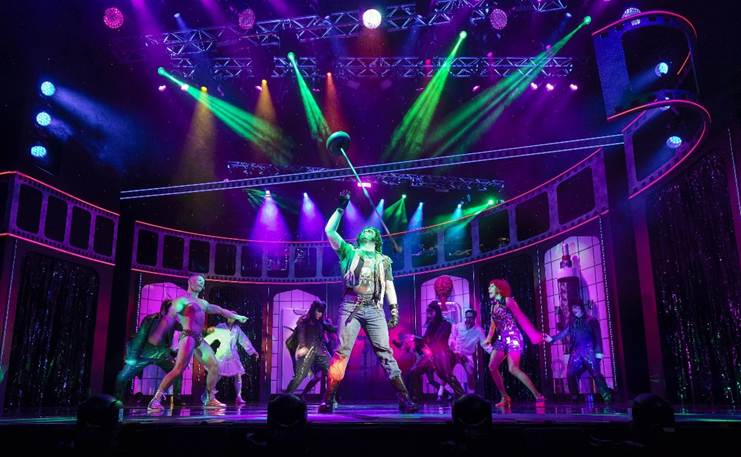
Rocky Horror Show
By Richard O’Brian
GMG and Trafalgar Entertainment
Director Christopher Luscombe
Set Hugh Durrant
Costumes Sue Blane
Choreographer Nathan M Wright
Lighting Nick Richings
Sound Gareth Owen
With (alphabetical) Laura Bird, Haley Flaherty, James Bisp, Kristian Lavercombe, Ryan Carter-Wilson, Daisy Steer, Stephen Webb, Morgan Jackson, Edward Bullingham, Jesse Chidera, Nathan Zach Johnson, Tyla Dee Nurden, Bethany Amber Perrins
Civic Theatre, Auckland 26 Feb – 9 Mar 2026
Then Isaac Theatre Royal, Christchurch
St James Theatre, Wellington
Reviewer Malcolm Calder
27 Feb 2026
Many words have been spilled detailing the Rocky Horror story, some with a little licence, so I won’t reiterate them here. Rather, what follows are a couple of more personal anecdotal recollections. Well, maybe a couple of reflections towards the end.
When in my early teens I joined a bikie gang hooning around the streets of Hamilton and haunting bars on weekends. A pushbike gang. In milk bars. And most Saturdays we would go to the ‘pitchers’ at the Embassy ‘pitcher’ Theatre – especially for the b&w serials which updated and changed weekly. The Phantom, The Lone Ranger, The Roy Rogers Show with Trigger, etc. Our parents were not exactly supportive of our adventures but tolerated them mainly after trotting out the usual parental missives of the day … you know, smarten yourself up son, wash your face, get a haircut, and taking the mudguards off does NOT necessarily make your bike go faster! But we did. And maybe even managed the very occasional haircut from the apprentice barber next to the Embassy (remember, these were pre- Beatles days.
Fast forward a dozen or more years, by which time I was living in the UK and had developed something of an interest in ‘legit’ theatre. A friend convinced me to accompany him to the ‘veddy, veddy proper’ Royal Court Theatre in Chelsea’s Sloan Square. Apparently a budding youngish Australian theatrical tyro named Jim Sharman, already with productions of Hair and Jesus Christ Superstar to his name, was putting together an experimental and very avant garde piece called They Came from Denton High. It had been originally devised by an actor no one had heard of called Richard O’Brien, and was planned as only a very brief season at the tiny, semi-round, and recently-renovated roof space of the Royal Court known affectionately as simply ’The Upstairs’.
There were heaps of improvisation, script changes, musical variations, some additions, some deletions and, just prior to opening, Sharman felt that Rocky Horror Show better aligned with its intermeshed themes of transvestism, a satirical take on horror movies and science fiction all built around a full-on rock score. My friend and I were both becoming enamoured of the new, the daring and the provocatively different and to say we were blown away would be an understatement. This show ventured where theatre had rarely been before. It was rough, raw and totally outrageous. I remember being particularly enthralled by the pure power and presence of Tim Curry and a by the omnipresence of a rather scrawny little bloke playing Riff Raff. Richard O’Brien we discovered later.
Many others were similarly excited of course. Rocky Horror Show had somehow struck exactly the right chord at exactly the right time in 1970s Britain. Fairly rapidly, various eminent British producers saw its commercial potential, it was upscaled to a more proscenium-arch staging and the rest, as they say, is history.
Subsequently I moved onto various humble roles in the industry and have been fortunate to have either seen, or hosted, many productions of the Rocky Horror Show across the US, Australia and New Zealand as well as Europe. In several different languages.
Fast forward a few more years and I even recall convincing a couple of rather cynical American friends to accompany me to the recently-released Rocky Horror Picture Show at a drive-in near Philadelphia in 1976. Unfortunately, that particular screening cooincided with a rather heavy snowstorm and both wipers and the plug-in heater-on-a-pole had to work overtime. Needless to say, the car bounced up and down more than a bit and my American friends enrolled on the spot as members of the international Rocky Horror Show cheer squad.
Or, a few years on again, an Australian colleague’s costume hire business in Adelaide avoided bankruptcy only as a direct result of seemingly endless late-night, dress-up singalongs at the Goodwood (‘pitcher’) Theatre.
I even recall seeing a stage production in Barcelona where the audience knew all the words. In English!
Anyway, I digress. Fast forward quite a few more years and I returned to Hamilton where, celebrating Rocky Horror’s 50th anniversary, the Hamilton Operatic Society staged a remarkably workmanlike pro-am production under the capable guidance of David Sidwell. Initially I felt the bronze statue of Riff Raff in Victoria Street sort of acknowledged this and I thought how kind of the city fathers to allow some well-made street art. However, a little research revealed, only then, that Richard O’Brien hailed from Hamilton. I had previously known of him only as an actor chasing his dream in London and had always presumed him to be English. I had no idea.
However … there’s more. The Embassy Theatre is now long gone and so is part of the block adjacent – which used to be a barbershop. That is where statue stood … on the very spot where the apprentice barber had cut my hair, and that of the entire bikie gang, all those years ago!
Today my understanding is that Richard is now a Patron of HOS and the statue has been relocated to the recently- opened new BNZ Waikato Regional Theatre. How appropriate.
This Rocky Horror Show has a crispness and a professionalism that will linger. It extended from before the house lights went down, right through to when they went up again.
This was a cast of strong experienced actors rather than one padded out with soap stars, rock singers and ‘personalities’ as has sometimes been the case elsewhere.
Laura Bird’s opening Science Fiction – Double Feature. backed by a strong, tight and semi-visible band under Adam Smith, sets the scene and made one immediately sit up and think ‘wow this is serious stuff’. She was followed by the Brad and Janet’s Damnit Janet with a Janet (Haley Lafferty) who bore an uncanny (if unintentional) resemblance to a certain Deputy Mayor!
From there it … well it just flowed. James Bisp gave us a surprisingly strong Brad, Stephen Webb an even stronger Frank N Furter, and Kristian Lavercombe (Welsh-born but we’ll claim him as ‘ours’) a Narrator that was deliciously nuanced, through to the dynamically scene-stealing Eddie (Edward Bullingham) and a truly professional ensemble. That showed everywhere. In spades.
This current production of Rocky Horror Show goes on to Christchurch and Wellington after its Auckland season and that is to be applauded. In fact the Civic, and perhaps other venues too, has been looking and feeling a little forlorn of late and to see a full-on high-calibre British music-theatre production on its stage is something to be savoured. So congratulations to the producers on this venture. Let’s hope there’s more to come.
A delightful ending to the evening too when elder statesman Richard O’Brien was introduced to the stage post-curtain to rapturous applause, and who then brought on Little Nell Campbell, the original Columbine back in 1973.
I can return my outfit to the costume hire now.


 New Zealand Arts Review