Categories
Reviews, News and Commentary

Beyond Words: a lament, a reflection and a celebration

Reviewed by John Daly-Peoples

Oum with conductor Fawzi Haimor and the NZSO Image Jono Tucker

Auckland Arts Festival

Beyond Words

New Zealand Symphony Orchestra

Auckland Town Hall

March 10

Reviewed by John Daly-Peoples

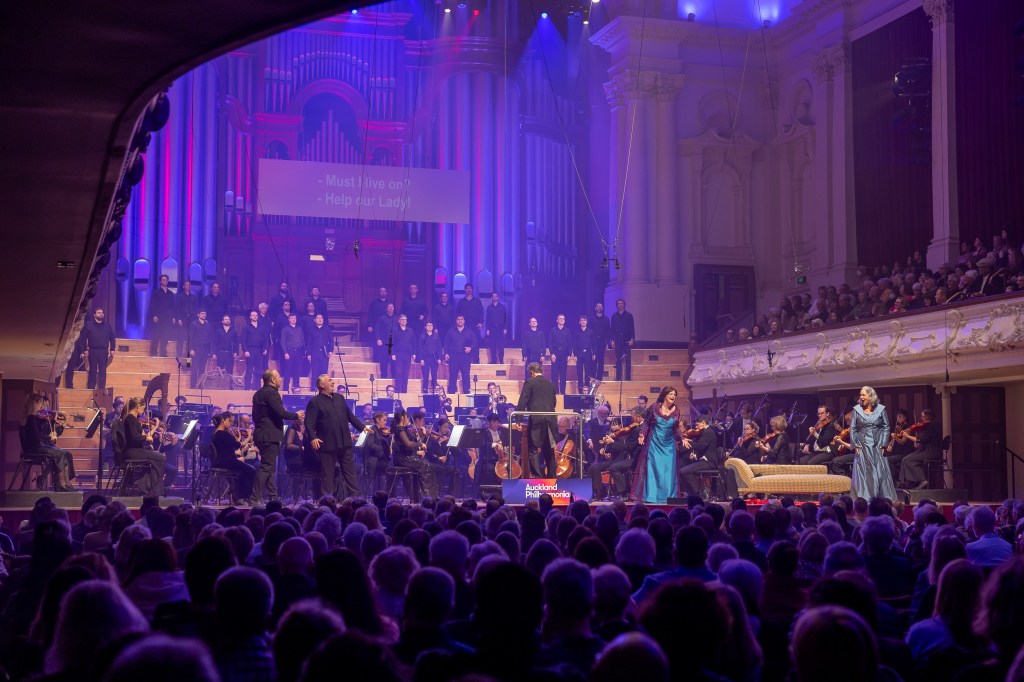
The “Beyond Words” concert which had its third performance following its premiere in Christchurch and a performance in Wellington was a collaboration to promote unity and peace through music and to honour the lives lost in Ōtautahi Christchurch on 15 March 2019.

Conducted by Fawzi Haimor the concert featured the Moroccan vocalist OUM  El Ghait Benessahraoui and Cypriot/Greek oud player Kyriakos Tapakis.

Vocalist Abdelilah Rharrabti, saz player Liam Oliver, vocalist and daf player Esmail Fathi, oud player Kyriakos Tapakis, vocalist Oum and composer John Psathas [From Wellington concert] image Jono Tucker

The concert also featured  works by the American Valerie Coleman, Reza Vali, Arvo Pärt and the world premiere of a new work by the New Zealand composer John Psathas.

Psathas’ “Ahlan wa Sahlan, composed in collaboration with OUM and Tapakis, uses the Arabic welcome to let people know they are in a place where they belong. The work fused together musical styles from Eastern and Western music traditions.

The work features energetic and dramatic sounds with subtle changes of texture and moods, providing a background for the two soloists OUM  El Ghait Benessahraoui and Kyriakos Tapakis.

The composer as previously demonstrated his ability to compose celebratory anthems having written works for the ceremonies at 2004 Athens Olympics and with this work there is sense of the music being both a lament, a reflection and a celebration. With waves of shifting percussive and evocative sounds

OUM was resplendent in her shimmering gown and elaborate head covering  Her voice with its roots in Morocco  and in the tradition of Egyptian singers of the 1930’s like Umm Kulthum drifted and soared above the orchestra’s tapestry of eastern sounds along with answering voice of Tapakis’s oud.

Her singing and movements at times suggested she was in a trance-like state while at other times she exuded an emotional intensity  and in her singing  “Hijra” she sounded like a French chaunteuse. Later there were passages where her voice was close to over-elaborate crooning.

Tapakis provided a riveting performance where he played together with Xylophone and timpani in a filmic sounding section filled with percussive sounds

The other major work in the programme was Arvo Pärt‘s Silouan’s Song which is  fine example of the composer’s low-key minimalism with simple repetition and contemplation sequences of notes.

This was a reflective piece which connected contemporary music with Medieval plainchant and Eastern mystical  music and the various sections were stressed by the meditative silences between them giving the work a ritualistic feel.

In the first part of the programme there were five shorter works including a traditional work sung by Hasbi Rabbi and Molle Mamad Jan which had an achingly unsettling melodic line as well as a beguiling performance by OUM.

There was also  contemplative, work by the Iranian Reza Vali which was filled with despondency and funeral sounds hinting at a vision of paradise.

Kyriakos Tapakis performed his own work “Mantilatos” which was filled with extraordinary sounds and rhythms. While the NZSO accompanied  him, emphasising much of the work it would have been more interesting if he had been able to play as a soloist.

A major disappointment with the programme was the lack of English translations for the various vocal segments. Presumably the lyrics were relevant to the spirit of the event and even though the concert was one that was “beyond words”  with the music conveying emotional and spiritual dimensions it was pity the audience was not able to  appreciate the greater depth which would have come from a knowledge of the word.

To subscribe or follow New Zealand Arts Review site – www.nzartsreview.org.

The “Follow button” at the bottom right will appear and clicking on that button  will allow you to follow that blog and all future posts will arrive on your email.

Or go to https://nzartsreview.org/blog/, Scroll down and click “Subscribe”

Categories
Reviews, News and Commentary

The APO’s colourful “Italian Style”

Reviewed by John Daly-Peoples

Franz Schubert View of Florence

In the Italian Style

Auckland Philharmonia Orchestra

Auckland  Town Hall

February 29

Reviewed by John Daly-Peoples

In the early nineteenth century it was fashionable to do a Grand Tour with Italy as the prime destination. Artists, writers and composers all sought to travel there to find inspiration.

The APO’s “In The Italian Style” presented works by three composers who were themselves were enthralled by various aspects of Italian music, history and landscape.

The first work on the programme was Schubert’s Overture in C “In the Italian Style” which was not a response to Italy itself but rather to the interest in Italian music at the time , notably the exoticism  of Rossini.  Schubert’s impressionist depiction of Italy conveys images of street life, dances and the leisurely stroll through classical  ruins captures the energy, colours and contrasts of his invented Italy which is a measure of the composer’s ability to convey images and sight he had never seen. The work also shows the young eighteen-year-old trying to move his compositions out of the traditions of Viennese music  of the time.

Mendelssohn was twenty-one when he travelled to Italy where he was captivated  by the art, architecture and landscape. When he was given a commission, he used his impressions of the country as the basis of his Symphony No 4 “The Italian”. While he had been despairing of Italian concert music, he was taken with local Neapolitan folk dance styles like the saltarello. This influence is seen in the final wild, breakneck movement which captures the drama of the dance and Mendelssohn’s vision of Italy.

The first three movements were filled with dramatic contrasts,-  massive sounds  which suggested the grandeur of the Alps as well as softer sounds which evoked contemplation  of art works and architecture.

Conductor Giordana Bellincampi displayed his astute conducting skills throughout the concert, at times creating dynamic waves of sound while at other times having orchestra whisper as in the opening of the second movement which depicts dawn breaking with bursts of sunlight. 

The major work on the programme was Hector Berlioz’s Harold in Italy with Robert Ashworth and his viola taking on the  character of Harold, the heroic figure based loosely on Byron’s Childe Harold, a wanderer who observes scenes of Italian life.

The four movements depicting outdoor scenes from various parts of the country were all derived from the composer’s experiences while travelling in Italy.

While the work is the composer’s personal response to Italy there seem to be reference to Byron’s epic poem throughout the work as in the references to Florence, its landscape and history.

A softer feeling for her fairy halls.

   Girt by her theatre of hills, she reaps

   Her corn, and wine, and oil, and Plenty leaps

   To laughing life, with her redundant horn.

   Along the banks where smiling Arno sweeps,

   Was modern Luxury of Commerce born,

And buried Learning rose, redeemed to a new morn.

Berlioz infuses his music with evocative imagery – the drama of the mountains, the softness of the light and the richness of the country’s art and history.

Robert Ashworth’s muted viola sounds helped paint an initial picture of the world-weary traveller but there were also touches of wonderment, solitude and merriment conveyed by his instrument.

Much of the time Ashworth played as though part of the orchestra, his sounds nestling in the luxurious colours of the orchestra but then there would come passages of sheer exuberance and his playing would rise above the orchestra akin to the emotional outbursts of  Harlod himself in his reactions to scenes and events.

Ashworth himself was attentive to the conductor but also the orchestra and he followed their playing intensely, as though he were Harold witnessing a new spectacle.

There was a clever bit theatricality at the close of the work as Ashworth exited the stage to reappear a few minutes later up by the organ where he was joined by a string trio to play the final moments of the work.

To subscribe or follow New Zealand Arts Review site – www.nzartsreview.org.

The “Follow button” at the bottom right will appear and clicking on that button  will allow you to follow that blog and all future posts will arrive on your email.

Or go to https://nzartsreview.org/blog/, Scroll down and click “Subscribe”

Categories
Reviews, News and Commentary

On the cusp: a trio of masterworks

Review by Peter Simpson

Yeol Eum Son Photo: Marco Borggreve

Beethoven 7

Auckland Philharmonia

Auckland Town Hall

February 22

Reviewed by Peter Simpson

The three works in the second APO concert of the Premier Series for 2024: Mozart’s Piano Concerto No. 24 in C Minor, Beethoven’s Symphony No. 7, and the Overture to Rossini’s The Barber of Seville were all written within a thirty year period, 1786-1816: the Mozart in 1785-86, the Beethoven in 1812, and the Rossini in 1816. This period, on the cusp between the ‘classical’ and ‘Romantic’ periods, is one of the most consequential in the history of music. Each of these works is a masterwork in its own right; collectively they made for a supremely enjoyable and satisfying evening. The APO under Giordano Bellincampi, with South Korean soloist Yeol Eum Son in the Mozart, were in fine fettle.

Rossini just missed out on being a contemporary of  Mozart’s by being born in the year after Mozart’s death in 1791; Beethoven was twenty when Mozart died, just on the brink of his great career.

The Overture to The Barber of Seville scurries along entertainingly in Rossini’s instantly recognisable and ingratiating style. It is ‘feel good’ music, clearly enjoyed by the musicians, and bound to put listeners into a receptive frame of mind.

With her pale skin and flamboyant scarlet gown, Yeol Eum Son made a striking visual contrast to the pervasive black-and-white of the orchestra. She proved to be an elegant and forceful soloist plunging instantly and confidently into the minor-key depths and mysteries of one of Mozart’s greatest scores.

One of only two piano concertos in a minor key (the other is No. 20), this work has the most elaborate instrumentation of any of Mozart’s concertos, being scored for one flute, two oboes, two clarinets, two bassoons, two horns, two trumpets, timpani and strings: it is especially rare in Mozart for oboes and clarinets to be used simultaneously. One of the great pleasures of seeing this work performed live is to be able to witness as well as hear the subtle and intricate interplay between the wind instruments and strings so important in the emotional ambience of the music. After the rapt complexities of the long opening movement, the limpid simplicity of the slow movement was ravishing; the deft variations of the finale, too, were finely executed.

Apparently the young Beethoven once witnessed a rehearsal of this concerto (presumably with Wolfgang Amadeus at the keyboard) and remarked to his companion: “We shall never be able to do anything like that’. His own break-through piano concerto No. 3 written in 1800, four years later, shares the same C-minor key. Twelve years later Beethoven’s grand Seventh Symphony was one of the triumphs of his career. It was performed with the composer conducting in Vienna in 2013 at a charity concert for soldiers wounded in a battle with the forces of Napoleon (Beethoven’s fallen hero). The first audience apparently demanded an immediate repeat of the second movement allegretto. While not going quite so far as that, the shouts of acclamation from Auckland’s Town Hall audience registered genuine excitement at the conclusion of this electrifying performance. From the solemn and sonorous opening bars to the disciplined frenzy of the finale this marvellous music engaged both musicians and audience alike.

To subscribe or follow New Zealand Arts Review site – www.nzartsreview.org.

The “Follow button” at the bottom right will appear and clicking on that button  will allow you to follow that blog and all future posts will arrive on your email.

Or go to https://nzartsreview.org/blog/, Scroll down and click “Subscribe”

Categories
Reviews, News and Commentary

IMPASSIONED MUSIC ACROSS THREE CENTURIES.

Reviewed by Peter Simpson

Julian Steckel

Passion & Mystery

Auckland Philharmonia

Auckland Town Hall

February 15th

Reviewed by Peter Simpson

This was a concert of impassioned music across three centuries. Or four if you count the exquisite Bach encore played by Julian Steckel after his commanding performance of Shostakovich’s Second Cello Concerto (representing the twentieth century), which was preceded by Gemma Peacock’s sonorous White Horses, representing the 21st century and followed by Tchaikovsky’s mighty Symphony No. 6, The Pathétique, representing the nineteenth century.

‘Passion & Mystery’ was the opening concert of the Auckland Philarmonia Orchestra’s 2024 Premier Series, under its capable conductor Giordano Bellincampi.

I am not a musician; I can’t read a musical score or play a musical instrument, so am incapable of informed discrimination when it comes to performances, though I can point to more than half a century of avidly listening to concerts, radio and records as a dedicated consumer of music.

I found this an absorbing and enjoyable concert. All three works are emotionally intense, as was to be expected given the concert’s moniker, ‘Passion and Mystery’, though sufficiently various in musical idiom to avoid monotony. So far as I could tell the orchestra played splendidly throughout and was well directed by the resident conductor. The house was nearly full and the applause was deservedly prolonged.

Gemma Peacocke’s White Horses is a kind of orchestral tone poem, inspired by an extraordinary event in 1937 when a pioneer female New Zealand aviator, Waud Farmar, fell to her death in the ocean. In the words of the composer – a New Zealander working in the United States – ‘Farmar leapt without warning from a bi-plane above Cook Strait…The pilot saw her hit the sea and disappear.’ The pilot said: ‘The sea was pretty rough, with white horses everywhere’. These words provide the clue for Peacocke’s music treatment with lots of ominous rumblings of percussion, and intermittent sharp accents from strings and wind instruments. The sonic range is impressive, from a poignant violin solo to thunderous orchestral climaxes.

German cellist Julian Steckel was at his best in the intense opening Largo of Shostakovich’s sinewy concerto dating from 1966, the year of the composer’s 60th birthday. Like its predecessor, the concerto was written for the great Mistislav Rostropovich. How fortunate the Russian composer was to have such sublime musicians as Rostropovich, David Oistrakh and Svatoslav Richter for whom to write his concerti! Unsurprisingly the score exploits to the full the virtuosic capacities of the instrument, demands which the soloist was clearly capable of meeting with ease and polish.

Tchaikovsky’s last symphony was first performed just nine days after his death in 1893, and it is hard to avoid inferring that he poured his heart and soul into it as a kind of final testament. The music is remarkably various, from the achingly lovely melody of the opening movement, through the delicacy and fire of the middle movements to the surging, sobbing melancholia of the final Adagio. The orchestra sounded magnificent throughout every nuance of sentiment wrung from the composer’s feelings. A cathartic experience altogether for the satisfied audience.