Categories
Reviews, News and Commentary

NZ Trio’s Untamed Hope

Reviewed by John Daly-Peoples

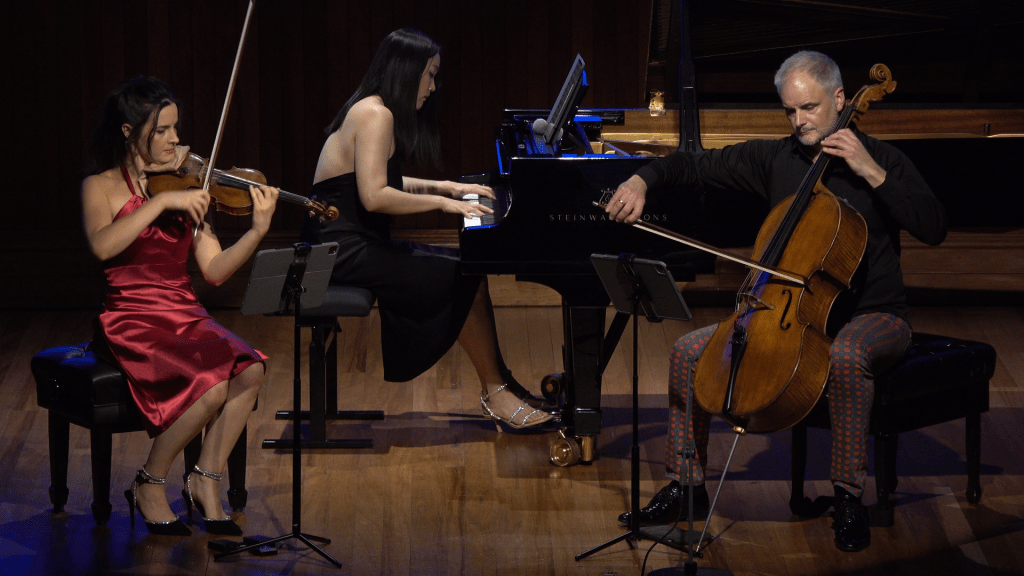
NZ Trio. Amalia Hall, Somi Kim and Ashley Brown

NZ Trio

Triptych 3: Untamed Hope

Auckland Concert Chamber

November 17

Reviewed by John Daly-Peoples

NZ Trio as well as being one of the finest groups of players in Australasia are also one of the most innovative and inspiring with their stimulating programmes. This was clear in their latest concert, “Untamed Hope” which featured four women composers from New Zealand, England, Germany and the USA with works spanning three centuries.

The title of the concert, “Untamed Hope”: probably alludes to the fact that at least three of the  women were constrained in some way by the environments in which they began their musical careers. Their hopes of being able to be in the concert hall on equal terms with their male counterparts was largely tamed by that environment.

The opening work was English composer  Ethel Smyth’s Trio  in D minor, a work  written when she was twenty-two having left the England to study in Leipzig.  At the time she met many contemporary composers including Clara Schumann and Brahms.

The first movement could even have been written by Brahms, which was apparent in the  sinuous playing of Somi Kim who was accompanied by delicate melodies from the strings. Initially violin and cello were in harmony with the piano but then their playing began to diverge, with each of the instruments developing their own musical themes.

Parts  of the second movement seem to be based on a folk song (French or English) with theme passed between the three instruments, all suggesting a soulful introspection as well as displaying the composers sophisticated writing.

Third movement entitled “Leid” had many aspects of the “song without word” with hints of a Scottish dance melody played by Amalia Hall

The dramatic finale saw a long  passage by the piano with the strings entering, playing a Hungarian-like tragic theme.

Eve Bedggood’s Ukiyo 浮世 –The Floating World relates to the Japanese concept of “the floating world” which evokes an imagined universe of wit, stylishness, and extravagance, a state which was often experienced through theatre, song, stories  and pictures.

Bedggood says of the notion of “the simplicity of just existing  and immersing yourself in the floating world or sense of calm is something I think music and other art forms can evoke”.

Much of the work had musical images of floating, flowing and meditation states with the work opened with dark rumbles from the piano suggesting sombre depths with strains of the violin and cello making interventions .

We heard exciting glissando from the Amelia Hall’s violon and careful, controlled repetition from Ashley Brown cello, while many of the sequences  saw an almost minimalist backing with the scudding sounds of the strings hovering above.

The work was like a reverie, the various themes creating dreamlike images much like those of many Japanese prints of an earlier period.

The American Joan Tower’s “Trio Cavny” opened with some tingling high notes from the piano with the violin and cello responding with equally high-pitched sounds creating a taut musical mood.  A following sequence saw Somi Kim creating crashing waves of sound leading to a tension between the three instruments which then played independently of each other before arriving at a point of intense harmonisation.

The music ranged from the soundtrack of a horror movie to a musical version of the Doppler Effect to the sounds of sympathetic voices in  minimalist mediation.

The final work on the program was Fanny Mendelssohn’s Piano Trio in D Minor. It is a beautifully conceived work with the violin and cello flowing around the energetic displays of Somi Kim

Amalia Hall provided both a delicacy and sharpness with her playing, contrasting with Ashley Browns sedate cello.

The introspective and reflective  second movement which opens with  a romantic  sequence from the piano contained elements of waltz tunes  while the third suggested elements of German folk song.

In the final movement the three players displayed a vigorous drive and energy, beginning with some  mesmerising playing by Kim before Hall and Brownjoined in creating an eloquent dialogue, leading to repeated motifs to end the work with an optimistic conclusion

The group announced that cellist Ashley Brown will be leaving the group to take an appointment as Principal Cellist with the Auckland Philharmonia Orchestra next year. He  has been involved with the trio since its founding twenty-three years ago and his presence with the trio will be greatly missed.

Categories
Reviews, News and Commentary

The passion and drive of Alexander Gavrylyuk

Reviewed by John Daly-Peoples

Alexander Gavrylyuk

New Zealand Symphony Orchestra

Alexander Gavrylyuk

Auckland Town Hall

November 16

Reviewed by John Daly-Peoples

Opening the NZSO’s latest concert “Alexander Gavrylyuk”, conductor Vasily Petrenko spoke about the three works on the programme and what he saw as the  links between them. The three composers had all left their native homes – Lera Auerbach and Sergie Rachmaninov from Soviet Russia and Bela Bartok from Hungary to escape the Nazis. He also noted the three composers search for freedom of expression and the nature of transformation in the three works.

The major work on the programme was Rachmaninov’s “Rhapsody on a Theme of Paganini” which has some interesting history or mythology to it  . The nineteenth  century violinist Nicolò Paganini was such a virtuoso, that many believed he had made a pact with the devil. Rachmaninov seems to have subscribed to that view as he  includes a reference to  the medieval melody Dies Irae (Day of Wrath) and some of the darker elements in the music reflect those diabolic aspects.

This drama and other elements were highlighted by pianist Alexander Gavrylyuk in a perfect performance that showed a perceptive approach to the music

He displayed a mastery of stylish playing, able to ignite the orchestra with his passion and drive.

His playing technique: changing tempos, charging through themes and varying the tonal qualities added to the excitement of the playing and appeared to enliven conductor Vasily Petrenko well as the orchestra.

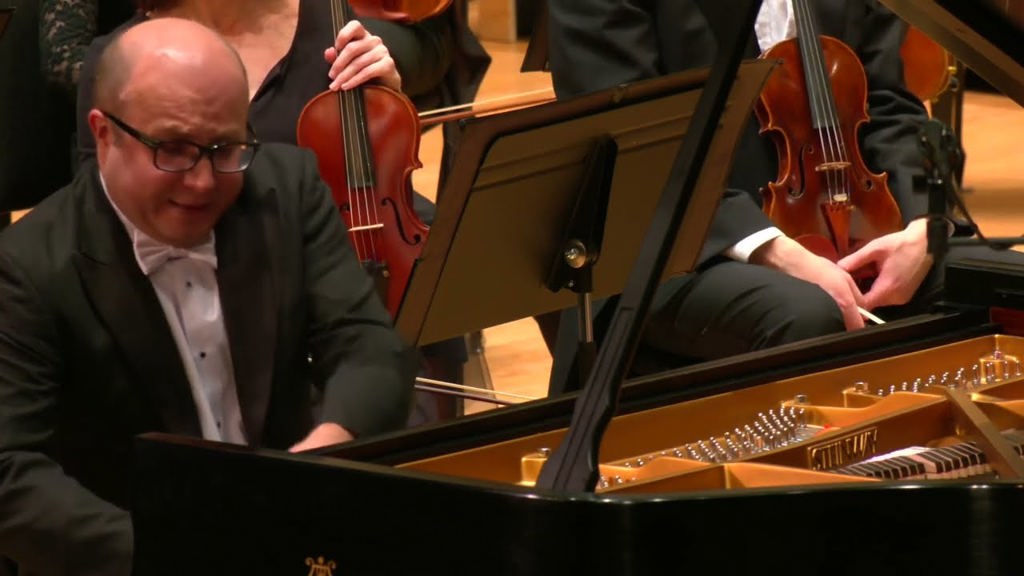
Hunched over the piano his playing was by turns delicate, whimsical and ferocious. There were times when his sounds were like rippling water while at other times they were more like gushing torrents.

This was brazen and adventurous playing which slowly revealed the technical and emotional depths of the work moving from the childlike to the theatrical and  onto the grand and funereal.”

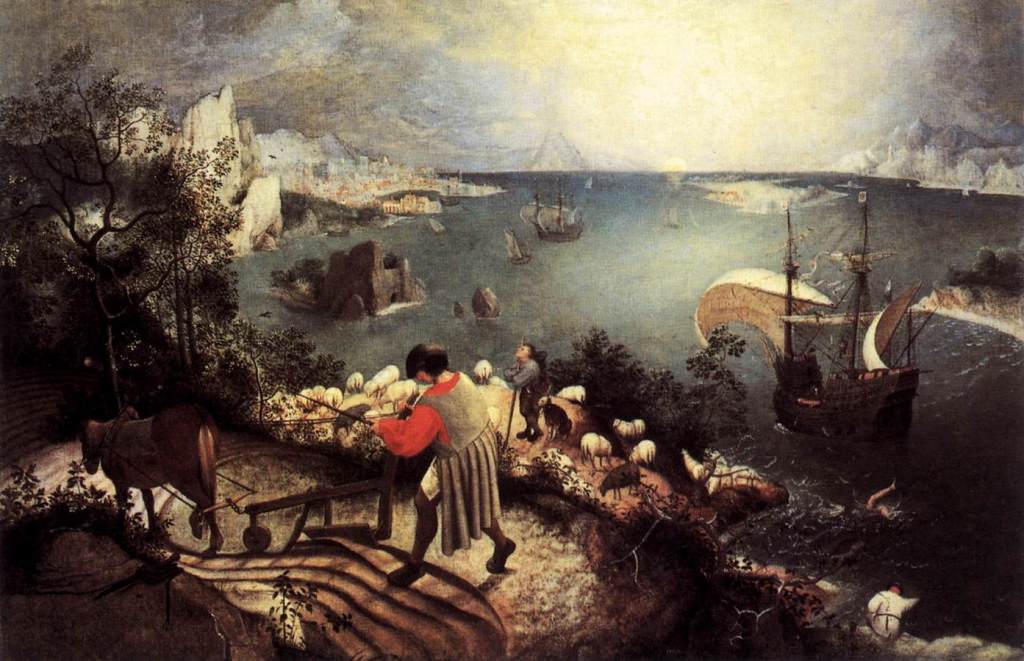
Breugel “The Fall of Icarus

The first work on the programme had been Lera Auerbach’s “Icarus” which tells of the myth of Icarus who ignored his father Daedalus and flew too close to the sun, causing the beeswax securing his wings to melt and him to fall into the sea.

The composer said of the work “What makes this myth so touching is Icarus’s impatience of the heart, his wish to reach the unreachable, the intensity of the ecstatic brevity of his flight and inevitability of his fall.”

The opening strings and brass provided a sense of take-off and the exhilaration of Icarus. This was followed by a galvanised orchestra and flutes suggesting flight. Sounds of alarm from  the orchestra signalled the coming disater  and Concertmaster  Vesa-Matti Leppanen brilliant little solo took a dreamlike diversion which became increasingly tense. This led to the insistent brass heralding Icarus’ fall.

The final sequences could be seen as the composer’s response to Bruegel’s painting “The Fall of Icarus” where the action of the event is reduced to a leg just visible, poking up  from the water . The pulsing strings suggested the vibrancy of the sun which is a counterpoint to the disaster, the quivering sounds a refence to Icarus’ fall into the water and the scattering of feathers. The work ends with a gentle requiem suggesting Icarus becoming a mythic hero.

The final work on the programme was Bartok’s five movement Concerto for Orchestra

It was his last major work and can be seen as some sort of musical autobiography of his last few years having had to leave his native Hungary and settle in the US

Composed a couple of years after his escape from Hungary it traces out his journeying from a bleak Europe to a new life, moving from a dark period in his life to one of  freedom and light. The music reflects this moving with ominous and threatening sounds through to lively and energetic melodies.

The work opened with sombre music punctuated by the flutes and raucous brass. Anguished strings confronted by ferocious brass, woodwind and percussion and the continued presence of the flutes sounded out the call for  freedom.

There was a sense of evolving events and narrative and about remembrance and loss with whimsical passages as well as a constant sense of oppression and mystery.

While there were references to horrors and drama of WWII the work is filled with inventive  music which was constantly evolving with a carnival-like sequence, playful sounds as well as hints of folk melodies  and strains of Eastern music.

The success of the work was in part due to the focused conducting of Vasily Petrenko with his lively and energetic approach and his precise direction in shaping the music’s dramatic sounds

Categories
Reviews, News and Commentary

The APO’s 2025 Season revealed

John Daly-Peoples

Principal Guest Conductor, Shiyeon Sung Credit Yongbin Park

Auckland Philharmonia Orchestra 2025

John Daly-Peoples

The  Auckland Philharmonia has just released its 2025 Season, of forty concerts featuring some of the world’s most-important artists including violinist James Ehnes, Spanish pianist Javier Perianes, guitarist JIJI, cellist Daniel Müller-Schott, and conductor Pierre Bleuse.

Javier Perianes Credit Julia Severinsen

The opening concert will feature New Zealander Claire Cowan’s “My Alphabet of Life”, Beethoven’s ‘Emperor’ Piano Concerto and  Strausstone-poem,Ein Heldenleben. All of the following concerts will provide a similar mixture of the great classics along with new and surprising works from the classical period and more recent compositions.

There will be a complete performance of Ravel’s ballet, Daphnis et Chloé.as well as  a selection from The Creatures of Prometheus, Beethoven’s only published ballet.

Other major works will include performances of Beethoven’s  Symphony No.5, Tchaikovsky’s Symphony No 5 and Mahler’s Symphony No 3 with mezzo-soprano Deborah Humble.

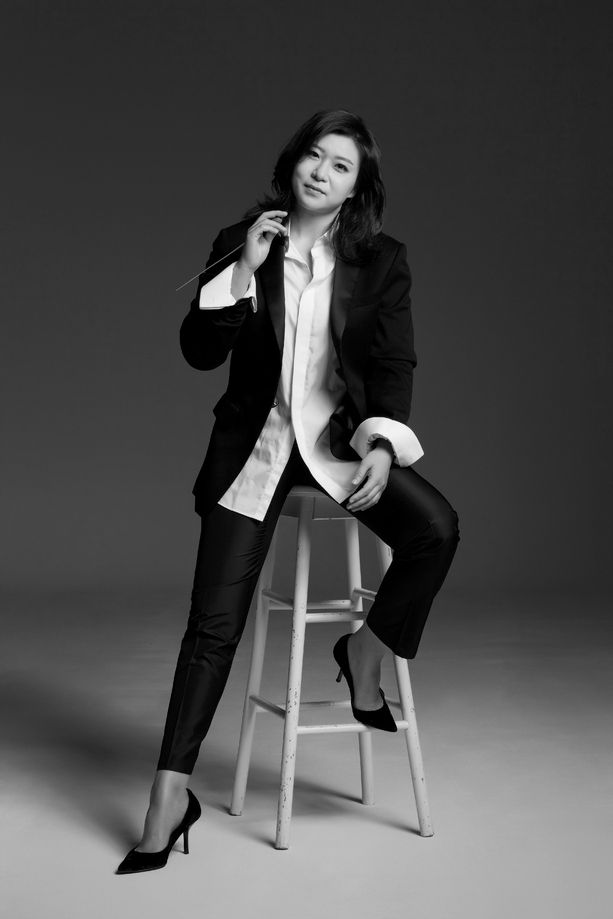
Principal Guest Conductor, Shiyeon Sung will conduct fellow Korean Clara-Jumi Kang, playing Tchaikovsky’s Violin Concerto, and Mozart’s Piano Concerto No.21 performed by British pianist Benjamin Grosvenor, who was recently named in Gramophone magazine’s list of the 50 greatest all-time pianists.  

The New Zealand Herald Premier Series will include major symphonic works by Elgar, Brahms, Shostakovich, Wagner, Mozart, and Tchaikovsky, as well as some rarely programmed gems by Ravel, Respighi, Liszt, Schoenberg and Grieg, complemented by music from leading New Zealand composers Claire Cowan, Kenneth Young and Louise Webster.

There will also be the New Zealand premiere of Sir James MacMillan’s newest concerto ‘Ghosts’, an Auckland Philharmonia co-commission with the London Symphony Orchestra, Melbourne Symphony Orchestra, Singapore Symphony Orchestra, Royal Stockholm Philharmonic Orchestra and St. Louis Symphony Orchestra.

The Canadian violinist James Ehnes will return for a two-week residency, performing two of the most demanding works in the violinist’s arsenal –  Bartók’s Violin Concerto No.1 and Brahms’ Violin Concerto.

Pierre Bleuse

Other soloists include Korean guitarist JIJI, German cellist Daniel Müller-Schott, Sylvia Jiang and Alexander Gavrylyu. There will also be several visiting conductors leading the orchestra including Pierre Bleuse, Karl-Heinz Steffens and Jun Märkl.

The Classic Series of five concerts will feature major masterpieces, such as Mendelssohn’s ‘Scottish’ Symphony, Haydn’s Symphony No.93, Tchaikovsky’s Violin Concerto and Brahms’ Piano Concerto No.2.

The Pub Charity Opera in Concert production of Verdi’s La traviata will see Giordano Bellincampi exploring the raw dramatic power of this sublime score with a celebrated New Zealand and Australian cast; including Amina Edris as Violetta, Oliver Sewell, as her lover Alfredo, and Phillip Rhodes as Germont.

The multifaceted Baroque & Beyond series will be returning with two concerts directed by Concertmaster Andrew Beer that celebrate the masters of the Baroque era from Handel’s Water Music to works by Sir Michael Tippett along with Baroque masters Biber and Corelli and 20th century composers Bloch and Respighi.

In 2025 the music of the movies will be heard  in Art of the Score: The Music of Hans Zimmer. Hans Zimmer is one the most influential film composers of all time and is behind the iconic scores for Interstellar, Inception, The Dark Knight Trilogy and themes from Pirates of the Caribbean and Gladiator. Audiences will be taken on a journey through Zimmer’s music, presented by Australian Art of the Score podcasters and film buffs, Andrew Pogson and Dan Golding, with Nicholas Buc on the podium.

Matariki with Ria Hall will be a popular night to celebrate the Māori New Year. One of Aotearoa’s most compelling and thoughtful voices, Ria Hall, will join forces with the the orchestra to recreate her evocative songs ‘They Come Marching’, ‘Te Ahi Kai Pō’, and ‘Black Light’, with a magnificent symphonic soundscape.   

Bic Runga Credit Tom Grut

Bic Runga with Auckland Phil will feature Runga performing such classics as ‘Something Good’, ‘Precious Things’ and ‘Bursting Through’, reimagined together with a full orchestra, this will be an extraordinary evening of musical fusion.

There will be a  fun-filled interactive show featuring New Zealand’s beloved canine icon, Hairy Maclary’s Greatest Hits presented by Jackie Clarke, and a captivating show for the whole family starring everyone’s favourite duo, Wallace & Gromit, at Wallace & Gromit in Concert. including The Wrong Trousers screened in full.

Season brochures are available online from aucklandphil.nz or by phoning Auckland Philharmonia Ticketing on (09) 623 1052

Categories
Reviews, News and Commentary

The NZSO’s Copland, Cresswell and Mozart concert

Reviewed by John Daly-Peoples

Gemma New

Jupiter: Mozart & Copland

New Zealand Symphony Orchestra

Auckland Town Hall

September 21

Reviewed by John Daly-Peoples

Aaron Copland’s Appalachian Spring which opened the NZSO’s latest concert featured music the composer originally wrote for Martha Graham’s ballet of the same name. The work has a simple narrative  following aBride and Husband as they get married and celebrate with the community. The work contains  various themes – faith, love and the joys of a new life.

The work is a celebration of the American West as well as an acknowledgement of the country’s past times of violence, referencing both the Civil War and World War II (the work was written in the midst of the war).

Copland used American folk music for melodies, harmonies and textures, that he had used in previous works such as Billy the Kid and  Rodeo and he also  included a theme and variations on the Shaker tune “Simple Gifts”.

Like those other two ballets the composer has responded to the notion of fluidity, representing the dancer’s movements.

The piece starts off with one of the great descriptions of the dawning day but with it is also the couple’s wedding day. This is described with soft chords from the strings, followed by soaring woodwinds with the flute and clarinet sketching out the storyline.

Quiet and wistful vistas and activity merge into cheery dance-like passages echoing the early American folk tunes and Conductor Gemma New responded with a little dance, caught up in these lively  rhythms

The work was punctuated by dramatic use of the percussion and horns which contrasted with the lively, dancing strings.

The finale with its grand statement along with Copland’s others works added a new dimension to the idea of rural America and the West elevating them to a sophisticated and iconic level.

The second work on the programme was Lyell Cresswell’s Piano Concerto No 3  which was given its world  premiere, played by Stephen De Pledge, a long-term admirer and advocate of the composer’s work.

The concerto is full of contrasts, between the instruments  themselves as well as the musical colours and textures which are all bound together with innovative instrumentation.

It opened much like the Copland with a dawning with suggestions of Nature, the stillness of landscape and the sounds of the forest. This was soon followed by the aggressive orchestra which merged with De Pledge’s piano where shimmering clouds hovered over the raucous strings.

Throughout the work there were musical suggestions of observations of his environment linked to a strange, abstract realm of sound with De Pledge and the orchestra contributing a range of textures – delicate, frenzied, lush and meticulous.

The brutal sounds of the orchestra were often matched by the equally brutal sounds of the piano, orchestra and piano creating interweaving and inventive sounds. These included the pianist using the instrument as a percussion instrument, knocking on the piano keys or playing long passages of a repeated single note.

Much of the piano work was sparse but there were occasional energetic bursts of sound accompanied by the orchestra  with the whispering strings at time sounding like the gentle wind in the trees or a breath slowly exhaled.

The final work in the programme was Mozart’s Symphony No 42 , The Jupiter one of his last symphonic works and one in which the composer is producing work which is at the centre of the transition of music form the classical to the Romantic…

With this work Gemma New seemed to be interested discovering nuance and depth in the composer’s work.

Even in the opening sequence which is full of drama she created contrasts so that the great melodies took on a more impressive sound with New seeing possibilities in the music that even Mozart  may not have been  aware of.

Her approach was obvious in the intensity of many passages, reducing some to more of a sigh while the dramatic moments featured immense surges of sounds.

The mysterious quality of the second movement featured  some beautiful balance between the woodwinds and orchestra while the energetic final movement with multiple themes and intricate playing  demonstrated the orchestra’s superior musicality.

To subscribe or follow New Zealand Arts Review site – www.nzartsreview.org.

The “Follow button” at the bottom right will appear and clicking on that button  will allow you to follow that blog and all future posts will arrive on your email.

Or go to https://nzartsreview.org/blog/, Scroll down and click “Subscribe”

Categories
Reviews, News and Commentary

Mt Eden Chamber Music Festival

Reviewed by John Daly-Peoples

James Jin (violin), Xing Wang (piano) and Dominic Lee (cello)

Mt Eden Chamber Music Festival

Eden Arts

Mt Eden Village Centre Church

September 6 – 8

Reviewed by John Daly-Peoples

Now in its ninth year the Mt Eden Chamber Music Festival organised  by the local community arts group, Eden Arts has presented high quality performances by some of the country’ s leading musical groups and major talent including NZ Trio and NZ Barok.

These concerts have been programmed by Simeon Broom, the Festival’s Artistic Director who is a violinist with the New Zealand Symphony Orchestra  and Cathy Manning of Eden Arts.

Its most recent concert series featured Shostakovich’s Piano Trio No 2, Dvorak’s Piano Concerto No 3, Debussy’s Sonata in G Minor for violin and Piano, Brahms’ Piano Quartet No 3 as well as a concert of works for trombone quartet including pieces by Beethoven, Bruckner, Chaulk, Webern Apon and Seroki.

The four major works on the programme all see composers responding to major crisis in their lives – personal, domestic  and political, using music as a means of self-expression as well as communicating their ideas and emotions.

The Shostakovich Piano Trio and Dvorak Piano Concerto were both played by Xing Wang (piano), James Jin (violin) and Dominic Lee (cello) giving each of the works a very different tone.

The Shostakovich was written in 1944 following on from his Symphony No 7 which was his reaction to the horrors of the Second World War and the Siege of Leningrad and which was his personal expression of his  resistance to fascism.

Some of these same aspects are to be found in the Piano Trio along with reference to his friend Ivan Sollertinsky who had recently died and who is credited with introducing Shostakovich to new music including the work of Mahler.

The opening, chilling tomes of the Lee’s cello  were followed by the lamenting sounds of Jin’s violin and the dignified piano of Wang. The trio became more animated with the anguished conversation between  the strings set against the ruthless tones of the piano. Here the strings seemed to be particularly raw expressing anger and torment.

The second movement began with a slightly more joyful tone with its dance-like melody but this soon became more excited with a harsh pizzicato sequence from the strings, soaring above the pianos more restrained sounds.

There followed a death knell, the cello paying homage to Sollertinsky with a passionate voice.

In the final section Shostakovich used a Jewish melody but the celebratory nature of the work was played as a dirge, full of an increasingly frantic distress.

The undertones of the mournful cello and the tense violin become something  of a metaphor for the lost and abandoned. Here Lee took on an active performance role lifting himself out of his seat in an agitated manner.

There is also a dark and brooding element in Dvorak’s Piano Trio  which may be a reflection of the composer’s grief over the recent death of his mother and the early death of  three of his children.

The group displayed an understanding of the work with its subtle nuances of tone and its dramatic chiaroscuro giving the work  an alternating drama, liveliness and introspection.

 The opening of the work was filled with swirling eddies of sound conjuring up images of landscape  that he evoked in many of his previous works. Here the , the grandeur of the vision expressed a contemplative mood.

The work was full of passage of tight  precision and the trio was able to  express the   passion in music with some delightful passages such as  the springlike opening of the second movement as well as some unexpected inflections and intricate rhythms.

The three instrument  developed and expanded these early melodies creating some languorous vistas  with some of the melodies beautifully expressed  by Lees’s cello which led to an unexpected conclusion.

Much of the playing of the violin and cello took on an elegance  which saw  the two  instruments  interweaving in a conversation which alternated between the formal and the combative.

Simeon Broom (violin), Katherine Austin (piano), James Tennant (cello)Helen Lee (viola)

Debussy wrote the Sonata in G Minor for violin and Piano in 1917 at a time when France was grieving its losses in The Great War and at a time when the composer was aware of his imminent death,

Simeon Broom’s violin soared and floated above Katherine Austin’s piano which went from the dramatic to the lethargic, her intrusions like  a scudding cloud and Broom’s violin explored some rapturous melodies.

The second movement brought some colourful and sprightly dancing  melodies from Broom with some jittery playing from Austin, the instruments vying for innovation and spectacle.

Austin delivered brilliant passages of insistent piano into which Broom inserted a bird-like romanticism and then some  marvellous playing involving double stopping and intricate playing.

For the Brahms Piano Quartet No 3 Austin and Broom were joined with Helen Lee (viola) and James Tennant (cello). The work  is filled with drama, yearning  and reflection as he was close to Robert Schumann and  was shocked by his mentors attempted suicide. But he was also drawn to Schumann’s wife Clara and probably felt conflicted about that relationship.

The work also captures much of his romantic angst which can also be seen in Goethe’s “Young Werther” and the paintings of Caspar Friedrich.

The opening sobbing sounds of the instruments and the plucked sounds of the viola suggesting tears set the scene for the work  with frantic strings morphing into a more contemplative mood.

There were passages where the piano alluded to joyful times as well as distant love. Then the strings erupted is waves of sound suggesting the turbulent life and mind of the young composer. There were also passionate outbursts creating an image of the lonely hero caught in a storm.

Many of the passage see Brahms creating a sense of light and dark, joy and sadness with soulful conversations between the cello and violin as well as a delicate romanticism  carefully outlined by Austins piano.

The work ends with some robust playing as the instruments seemed to spiral out of control with some  dynamic connections between the four players before  moving onto a reflective sequence and terse conclusion.

To subscribe or follow New Zealand Arts Review site – www.nzartsreview.org.

The “Follow button” at the bottom right will appear and clicking on that button  will allow you to follow that blog and all future posts will arrive on your email.

Or go to https://nzartsreview.org/blog/, Scroll down and click “Subscribe”

Categories
Reviews, News and Commentary

APO’s Tristan and Isolde a magnificent musical experience

Reviewed by John Daly-Peoples

Tristan (Simon O’Neill) and Isolde (Ricarda Merbeth) Image – Sav Schulman

Auckland Philharmonia

Richard Wagner

Tristan and Isolde

Auckland Town Hall

August 10

Reviewed by John Daly-Peoples

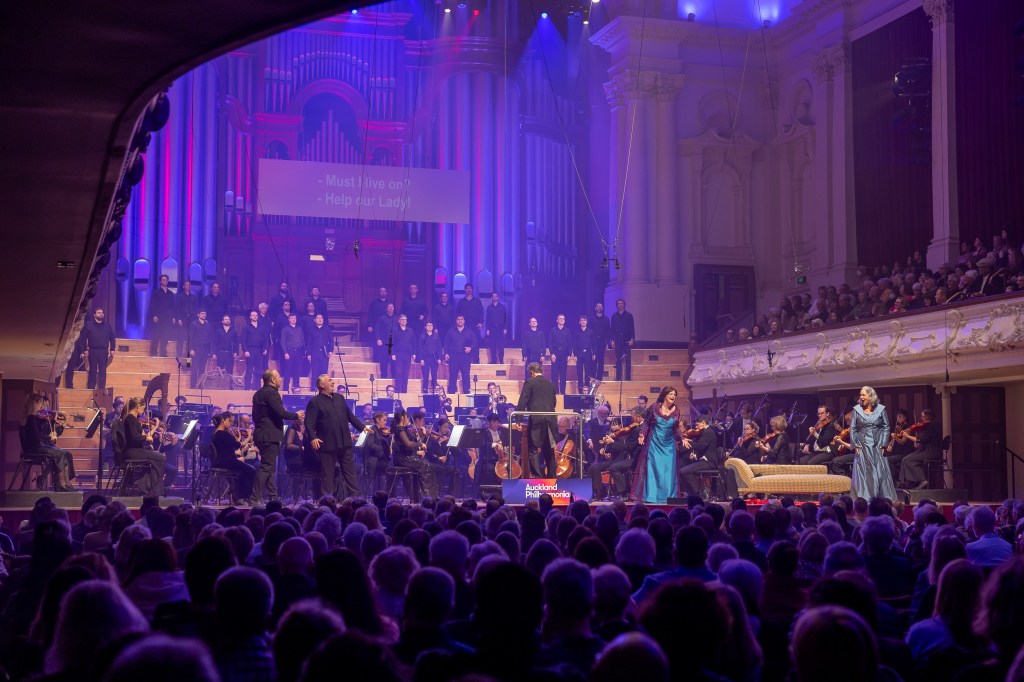
The Auckland Philharmonia’ s recent production of Tristan and Isolde was probably the highlight of this year’s programme. The opera, lasting over five hours is a marathon for audience, singers and orchestra and requires exceptional singers and players which this performance delivered.

With Tristan and Isolde Wagner began moving opera in a new direction  away from the traditional love story format, using opera to express ideas about the nature of love, sex. death and existence.

While Wagner may have been influenced by Schopenhauer’s ideas about love and the links between love, sex, and death the composer was probably more interested in providing some sort of rational for his infatuation and possible  adulterous  relationship with his patron’s wife – Mathilde Wesedonck.

The opera has a simple plot line – Tristan who had previously killed Isolde’s fiancé is taking her to England to marry King Marke but they become attracted to each other (partly due to having drunk a love potion). The king is told of their relationship and seeks to kill Tristan but who dies from wounds and Isolde expired from a broken heart. They presumably become immortal just as all Wagner’s later gods and enter Valhalla.

The opera really only needs the two main characters as well as  the music but Wagner gives it a narrative structure and a few other characters who provide contrast and  tension.

Johan Reuter as Kurwenal, Simon O’Neill as Tristan, Ricarda Merbeth as Isolde and Katarina Karnéus as Brangäne. Image – Sav Schulman

The music describes the emotions and drama emanating from the two characters with the opening Prelude  and the closing  Liebestad or “love death song” sung divinely by Isolde over Tristan’s body.

The music of the  Prelude was used extensively by Lars van Trier in his film Melancholia expressing something of the same ethos as Tristan and Isolde with ideas about the nature of love, knowledge of our death and the end of civilization.

With Tristan and Isolde the two lovers embody different aspects of love  and this is expressed through their singing and their acting.

Act II which takes place over a single night presents an emotional landscape where we experience their unfolding  relationship with its deep emotional conflicts,

Their   duo “O eternal Night”, touches on a number of aspects of their love and the urgency of their singing  conveys a sense of bliss and transcendence.

O’Neill gave an impressive account of Tristan with potent stage presence enhanced by his stance and gestures. He was able to convey a sense of the nobility of love while  Merbeth’s Isolde expressed  the passion and emotion. With much of her singing her ferocious voice seemed to effortlessly express the conflicting emotions of anger and passion.

This was a semi-staged performance but Frances Moore’s clever staging  gave the performance some added drama with several of the cast making use of the various parts of the Town Hall.

Isolde made her final sensational entrance in walking up the centre aisle of the hall, Andrew Goodwin’s ship’s captain made a dramatic appearance singing from the Circle in Act I  and Katarina Karneus singing an elegant Brangane sang from the Circle, looking down on the couple in Act II.

Albert Dohmen gave a forceful performance as King Marke singing from up by the organ, towering about the orchestra and Jared Holt as Melot, Tristan’s one-time friend turned villain gave a nuanced performance with his long denunciation.

Johan Reuter gave an impressive account as Kurwenal, Tristan’s servant capturing the close ties between the two men with his sympathetic voice.

The orchestra provided the backbone for the opera and under the skilful direction of Giordano Bellincampi  provided sustained emotional and dramatic music, particularly  the opening Prelude which made for a magnificent  musical experience.

Categories
Reviews, News and Commentary

Sylvia Jiang’s lively and energetic performance of Prokofiev’s Piano Concerto

Reviewed by John Daly-Peoples

Sylvia Jiang

Auckland Philharmonia Orchestra

Scheherezade

Auckland Town Hall

July 4

Reviewed by John Daly-Peoples

The first half of the APO’s Scheherezade concert featured two works composed a century apart with Melody Eötvös’ “The Saqqara Bird” of 2016 and Prokofiev’s “Piano Concerto No 2 of 1913/1923.”

The highlight of the concert was the Prokofiev Piano Concerto played by Sylvia Jiang. She is a Chinese born New Zealander and Juilliard graduate  who was ranked as a Rising Star in the Asialaw Profiles of 2023.

Last year she performed Liszt’s Second Piano Concerto with the Auckland Philharmonia and later in the year she will also be making her debut national tour as a soloist with Chamber Music New Zealand playing seven concerts.

Prokofiev’s second Piano Concerto is considered to be one of the most difficult piano concertos to play. Thankfully Jiang appears to have not been told that and she never faltered in her exploration of the work even when she was faced  with the massive solo cadenza of the first movement.

This section saw Jiang playing vigorously for over 4 minutes before the orchestra joins in again.

She opened the work delicately creating  gentle, magical sounds along with the woodwinds and strings which hinted at a shimmering watery setting with the orchestra developing the theme and Jiang providing streaks of colour and drama.

This quiet lyricism didn’t last long and was soon interrupted by menacing sounds from the orchestra and a darkness emerged which overpowered the piano which then responded with some ferocious sounds.

This early interaction of orchestra and pianist highlighted the emphasis of the concerto. This was the sense of competition between player and orchestra. With most  concerti there is a collaboration between soloist and orchestra but with this work there was more of an antagonism and intervention.

This is in part due to Prokofiev s music where we hear a clash between romanticism and modernism which is an indication of the composer struggling with his own idea.

In playing the first movement solo cadenza Jiang seemed to be physically attacking the keys and her playing eventually revealed an emerging theme and she was rejoined with the orchestra which enveloped her with the gentler music which had preceded the cadenza.

The short second movement saw Jiang playing  with a  lively energy, butting up against the  savage and insistent tones of the orchestra.

The third movement which opens with huge swells of brass and percussion and a rustic theme where Jiang dashed off flashes bright notes inserting herself into the orchestral themes. Here again the pianist and orchestra were in competition, with the orchestra seeming to overpower Jiang who fought back with a relentless energy finishing the movement with a few quiet  notes of victory.

She opened the fourth movement with a rapid-fire assault on the piano followed by a lethargic sequence where her fingers seemed to wander across the keyboard in search of a theme. Then as she managed to discover the theme the orchestra joined in, expanding and enhancing it.

Her playing at times seemed to be urged on by the energetic orchestra while at other times she seemed to strive against the orchestra.

In the final minutes of the work her playing returned to a simple romanticism before morphing into some frantic playing matched by an equally frenetic orchestra which overpowered the piano before the  final race to the climatic conclusion.

The “Saqqara Bird” refers to a bird/plane shaped relic found at Saqqara in Egypt in the late nineteenth century whose function was unknown. Melody Eötvös’ work explores the imagined reasons behind its creations and purposes and envisages it in search of its identity.

The work opens with the sounds of bird-like twittering from the woodwinds and strings which seem to be emerging from a dark forest of sounds conveyed by the blasts of brass and thumping drums.

Several of the instruments appeared to have been adapted or employed to create eerie sounds as though a backdrop to a fairy tale filled with shadowy beings.

In the middle section the woodwinds replicate  the sounds and movement of birds along with the ghostly forms leading to enigmatic encounters and discoveries.

The intriguing music ranged from sequences of unruly and strident sounds to the use of the simple single note which ends the work.

Categories
Reviews, News and Commentary

The APO’s “Brahms and Bellincampi”

Reviewed by John Daly-Peoples

Alexander Melnikov and Giordano Bellincampi Image. Sav Schulman

Auckland Philharmonia Orchestra

Brahms and Bellincampi

Auckland Town Hall

June 6

Reviewed by John Daly-Peoples

The opening of Brahms’ Piano Concerto No 1 is dramatic with the timpani delivering a tumultuous sound accompanied by ferocious strings. The intense opening  was intended by the composer to be a depiction and reflection on  Robert Schumann’s attempted suicide in leaping into the Rhine at Dusseldorf few years earlier.

For the first few minutes it was the orchestra which dominated  as pianist Alexander Melnikov waited for his entry. Showing what would be his intense approach to playing he seemed  restless as he contemplated the piano – leaning into it and caressing its surface as though communing with the instrument.

Following the stormy performance of the orchestra Melnikov made his entrance, referencing the orchestras’ dramatic themes but with simple and deliberate playing as though reflecting on the drama which had just occurred.

Much of the first movement saw him responding to the themes that the orchestra had explored with a bravura performance where he developed  the main theme, playing with a relentless  insistence.

Melnikov’s relationship with the piano continued, at times he appeared to be praying and at other times conducting. All the time he appeared to physically respond to the performance of the orchestra, his body moving reflectively in time to the music.

In the second movement his playing was almost lethargic inserting some delicate passages into the orchestras brooding sounds. Then in the third movement the music seemed to electrify him with some relentless playing which was  almost  Byronic, of the individual confronting his demons, loves and destiny.

His Brahms encore finished as a cell phone call came through in the hall, so when he was leaving the stage, he put his hand to his ear with the universal sign of “I’ll call you”, eliciting  further applause from the audience.

The other work on the programme was Brahms’s symphony No 2, a glorious pastoral work inspired by a holiday at the resort of Lake Worth in Austria. The work is full of images of nature and the heightened drama of the alpine  environment.

While it is a captivating depiction of the landscape there are  undertones of melancholy with the strings, timpani and brass creating a sense of disquiet.

The more reflective second movement conveys a sense of an emotional  journey and the delights of life. all leading to enlightenment.

Then in the third movement there were charming dance-like seqcnces followed by the dramatic fourth movement with its big crescendos punctuated by idyllic interludes, the audience kept in suspense as the work raced to its fiery conclusion.

To subscribe or follow New Zealand Arts Review site – www.nzartsreview.org.

The “Follow button” at the bottom right will appear and clicking on that button  will allow you to follow that blog and all future posts will arrive on your email.

Or go to https://nzartsreview.org/blog/, Scroll down and click “Subscribe”

Categories
Reviews, News and Commentary

NZ Opera’s Le Comte Ory

Reviewed by John Daly-Peoples

Le Comte Ory (Act I) Image Andi Crown

NZ Opera

Le Comte Ory by Gioachino Antonio Rossini

Kiri Te Kanawa Theatre, Auckland

May 30 & June 1

Reviewed by John Daly-Peoples

If Rossini was still writing operas today his pick for a librettists would have to be Simon Phillips. The original libretto was by Eugene Scribe and Charles Delestre-Poirson, adapted from a comedy they had first written in 1817. While traces of the original can be detected in NZ Opera’s latest version it is Phillips’ new translation, re-write and update which dominates.

This update is what makes the work entertaining and significant. Phillips has taken something of risk in filling the libretto with colloquial speech but it makes for  a clearer understanding of the narrative and his contemporary references give the work an immediacy.

His new libretto avoids having to deal with  the issues of misogyny which are always there in Rossini’s works. It also avoids the contentious issue in the original of having one group of men going off to fight the crusade in Palestine.

Examples of his language updates include someone being referred to as “not a happy camper” “Stuff this for  a caper, I’m buggered” says The Coach after  one adventure, “He really found my chi”  exclaims of one ecstatic young woman  and at the point when Ory is unmasked the entire cast gives a sustained  “What the F…K”

There are lots of rugby references including mention of a John Eales award – this reinforces the idea that Ory’s team is Australian as New Zealand players would not engage in such dastardly undertakings.

The setting for the opera is moved from medieval France to New Zealand, probably the Central Plateau where we find the wives of a rugby team who are off on an international tour staying at a wellness centre in the Chateau Whareora.

Adjacent to the wellness centre is a campsite where Ory and his rugby teammates have set themselves up with the dodgy intentions.

Ory uses this base to  establish himself as a guru / advisor on matters of the heart in an attempt to woo Adele, the sister of the owner of the centre who is away on tour .The team’s personal physiotherapist, Isolier is also in love with Adele and tries to thwart Orys undertakings.

This conflict between pure love and the profane is actually more about a form of selfishness and narcissism which Ory shows in both words and deeds.

The opera revolves around lots of deception, disguises and sexual intrigue where the only character, Count Ory, seems to be in control, yet he is the one who constantly fails ,

Manase Latu as Ory captures the characters inflated sense of self with a bravura performance, parading around the stage in his orange Buddhist robes, behaving like a faith healing tele evangelist.

His voice had the richness of the glib politician / priest with touches of both wit and seriousness, brilliantly captures the suave veneer. In the first act he was great as a Dalai Lama character. Partly his acting, partly the libretto but his character comes over as flawed and despite his belief in his charms and sexual prowess he is never in control of his endeavours.

Emma Pearson as Adele displayed a range of emotional responses with her iridescent voice which at time conveys a sense of rapture.

Hanna Hipp as Isolier played an ambivalent character in taking on  the traditional ‘trouser role’ of female playing male as well as that of a bi-sexual woman in her relationship with Adele. Her duo with Ory was riveting with its mixture of the comic, and sexual friction.

The various duos are performed superbly while the septet at the end of Act I was a great showing off of their voices as they slowly morphed into what sounded like a delightful barbershop singing group.

Andrea Creighton’s Ragonde fulsome voice was a quiet force. Moses Mackay as Raimbaud displayed a fine sense of the comic and Wade Kernot as the Team Manager had a genial style with a nice flexibility of tone.

The sets and costumes by Tracy Grant Lord worked well in defining place and character but some of the costumes worn by the locals in Act I seem to have been borrowed from an amateur production of Oklahoma.

For a little-known opera this production offers originality, riotous performances  with  some of the country’s best voices. The APO conducted by  Brad Cohen brought Rossini’s sparkling music to life, particularly the two overtures.

St James Theatre, Wellington June 13 & 15

Isaac Theatre Royal, Christchurch June 27 & 29

To subscribe or follow New Zealand Arts Review site – www.nzartsreview.org.

The “Follow button” at the bottom right will appear and clicking on that button  will allow you to follow that blog and all future posts will arrive on your email.

Or go to https://nzartsreview.org/blog/, Scroll down and click “Subscribe”

Categories
Reviews, News and Commentary

NZ Opera’s “Le comte Ory” to tour three centres

John Daly-Peoples

Manase Latu as The Count in rehearsal Image: Andi Crown

NZ Opera

Le comte Ory by Gioachino Antonio Rossini

Kiri Te Kanawa Theatre, Auckland May 30 & June 1

St James Theatre, Wellington June 13 & 15

Isaac Theatre Royal, Christchurch June 27 & 29

John Daly-Peoples

Rossini’s penultimate comic opera, Le Comte Ory has many of the qualities of his other operas with great melodies virtuosic singing and an anarchic plot. However it has  generally been overshadowed by his other works such as The Barber of Seville and La Cenerentola and has not attracted contemporary audiences. Recently however it has had a revival and been produced by a number of the international companies including the MET and Garsington Opera.

The gloriously ribald work was first performed in Paris in 1828, when it ran for over 400 performances. Rossini amalgamated some of his previous work  and  vaudeville components were altered and expanded into the two-act comic libretto with six extended musical numbers from his “Il Viaggio” recycled into the new score. At the time it was hailed as one of his wittiest and most seamless and sophisticated works.

The operas tells of  a libidinous aristocrat attempting to seduce the virtuous Countess Adele and other women while their menfolk are away. In his various attempts, he dons outrageous disguises but continues to fail in his amorous endeavours. .

The work was originally set in  medieval France, but this new production of Le comte Ory is relocated to New Zealand, which allows for more local humour.

Director Simon Phillips says “I have always believed that if you want people to laugh, the closer you bring something to a contemporary era, the more chance you’ll have. We can recognise ourselves, and elements of our society in what we’re watching – and it gives the satire more zing. This production felt like a brilliant opportunity to make a new version of this bonkers, madcap rom-com of an opera – unapologetic, irreverent and funny, just as Rossini intended it to be.”

Emma Pearson as Countess Adele in rehearsal Image: Andi Crown

The cast features some great talents including Manase Latu as The Count, Emma Pearson as Countess Adele,  Hannah Hipp as Isolier  as well as Moses Mackay, Wade Kernot, Andrea Creighton and Tayla Alexander.