Categories
Reviews, News and Commentary

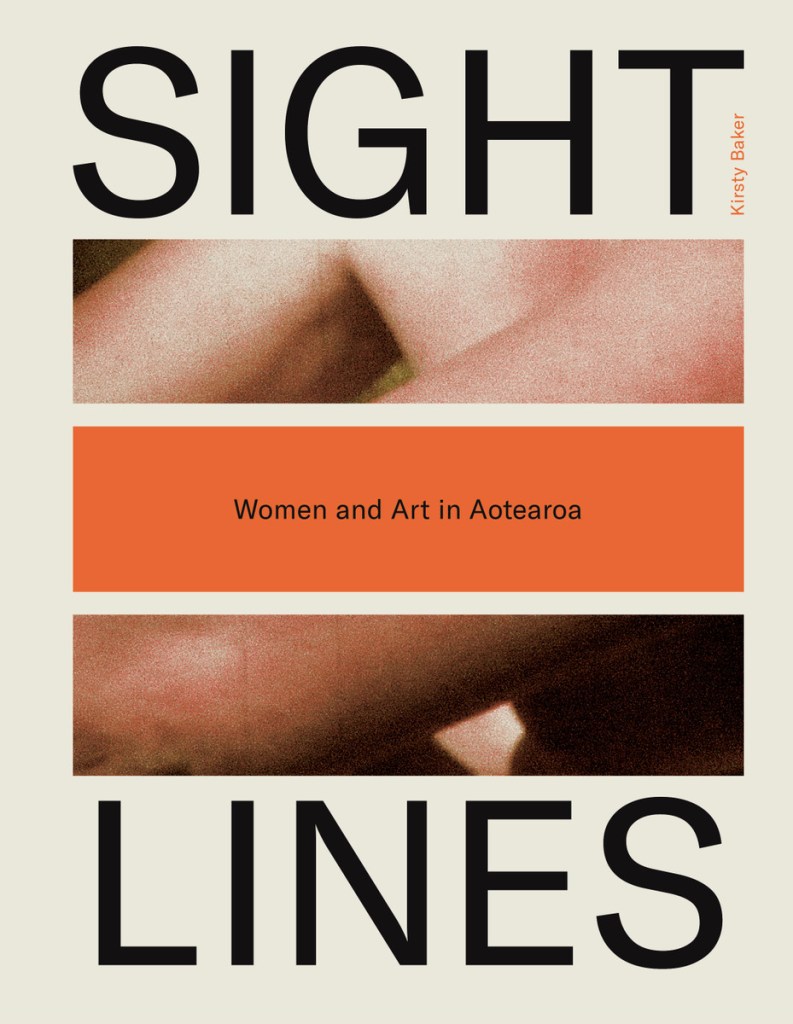
Sight Lines: Women and Art in Aotearoa

Reviewed by John Daly-Peoples

Sight Lines: Women and Art in Aotearoa

By Kirsty Baker

Auckalnd University Press

RRP $69.99

Reviewed by John Daly-Peoples

Sight Lines: Women and Art in Aotearoa is a bold and timely book exploring various threads of women’s  art  of the past as well as those creating art for our times. Editor and writer Kirst Baker acknowledges the complexity of bringing together writings for  such a book in her introduction  where she notes “It should come as no surprise that this book does not attempt to offer a complete history of women’s artmaking in this country. Such a project is doomed to fail… Instead, the book winds its way along a path that is both fragmented and politicised”.

Within that winding journey it is the through the fragments that we see ideas and revelations and make connections. It is through the practice of many of these artists and their working within a social and political context that we see the importance and ramifications of art.

Lisa Reihana, in Pursuit of Venus [infected], Auckland Art Gallery. single channel UHD video

The dozen chapters in the book have been written by Kirsty Baker along with  Chloe Cull, Ngarino Ellis, Ioana Gordon-Smith, Rangimarie Sophie Jolley, Lana Lopesi, Hanahiva Rose, Huhana Smith and Megan Tamati-Quennell.

The essays are all thought-provoking with a mix of biography, narrative, interviews, observations and reflections. These offer new ways at looking at the art created by women but also the nature of art and art institutions.

Baker notes that there are a number of themes running through the book which are indicative of the often different world in which many female artists exist and work.

There is the way that women artists have interrogated their relationship with the land and place and the way they have pushed against gendered limitations.

There is also the way that artists have used their practice to comment on art history and arts institutions and the way that art making plays a role in the care and transmission of knowledge.

In not being a contiguous history of women’s art, the gaps and exclusions are often apparent. These gaps mean at times the book is less satisfying without the linkages of history and context.

While not a history the book covers over two hundred years of art making in New Zealand and includes painters, photographers, performers, sculptors,  textile artists and writers. The work of these artists spans whatu kākahu through to the recent work of the Mataaho Collective. Along the away there are chapters on a diverse range of artists –  Frances Hodgkins, Rita Angus, Rangimārie Hetet, Pauline Rhodes, Teuane Tibbo, Yuki Kihara and Ruth Buchanan.

With over 150 illustrations the books also provide a visual history of women’s art which is well integrated with the texts.

Julia Morison, Quiddities 1-10. Auckland Art Gallery, Cibachrome transparencies

The essay on Frances Hodgkins provides a succinct overview of her life and work while highlighting the issues which impacted on women artists of the early part of the twentieth century.

The essay on Kura Te Waru-Rewiri reveals the way in which Māori artists have addressed issues of mythology. history  and land using abstraction as a means of conveying ideas.

Many of the chapters focus on the issues around the land, whānau and wāhine which is seen in the work of artists such as Robyn  Kahukiwa so it is surprising that  Robin White, Sylvia Siddell and Jaqueline Fahey who have documented the family and domesticity for several decades are not mentioned.

The other area of exclusion is around abstraction for while the work  of Vivian Lynn, Kura Te Waru-Rewiri and Imogen Taylor is included artists such as Phillipa Blair and Gretchen Albrecht are omitted.

Maureen Lander, Ko nga puna waiora o Maunga Taranaki (detail), Govett-Brewster Gallery, mixed media

The final chapter in the book concerns the  work by the Mataaho Collective, a group which has recently won the prestigious Golden Lion Award at the Venice Biennale. The chapter predates the win but much of what is written is relevant to the work which has generated more column  inches than any previous New Zealand exhibition at the Venice event.

Here there seems to be a disconnection because of the six previous New Zealand female artists to exhibit at the Biennale. only Lisa Reihana and Yuki Kihara are mentioned. That the four other women selected over a twenty yar period to represent New Zealand at the world’s most high-profile event seems puzzling.

Despite this oversight and others, the book is still one which offers much in understanding the developing history of women’s art in New Zealand as well as way that they have been impacted  by  social acceptance and cultural institutions.

To subscribe or follow New Zealand Arts Review site – www.nzartsreview.org.

The “Follow button” at the bottom right will appear and clicking on that button  will allow you to follow that blog and all future posts will arrive on your email.

Or go to https://nzartsreview.org/blog/, Scroll down and click “Subscribe”
Categories
Reviews, News and Commentary

My Brilliant Divorce

Reviewed by Malcolm Calder

Jackie Clarke in My Brilliant Divorce                     Photo: Darren Meredith

My Brilliant Divorce

By Geraldine Aron

Dir Janice Finn

With Jackie Clarke

Tadpole Productions

Pumphouse Theatre, Takapuna

to 25 May

Review by Malcolm Calder

16 May 2024

As a mere male, I feel something of a fraud attempting to review something that tackles its subject entirely from a woman’s perspective.  But, rest assured, I have sought the opinions of female friends, so plough on (in truth ARE thoughts for menfolk in the work too).

Geraldine Aron’s play tracks one woman’s three-year path through a pending divorce after 20 or so years of marriage.  It is ripe for many emotional, social and potentially dangerous situations and that’s no bad thing.  In fact Aron’s script largely treats them as a self-deprecatingly comedic and the twinkling sparkle and dry self-observations of Jackie Clarke helps ensure this is the case – although not without some truly heart-rending moments along the way.

There is occasional recognition of Aron’s truths, but the laughter flows, there are giggles galore and  it is these spoonfuls of sugar that help ease the shock, the pain, the anxiety and the self-doubt – embarrassingly so at times. 

While Aron’s stereotypically deserted wife reflects with shredded self-esteem, loneliness and self-induced neuroses, she finds little support around her.  Older family members prefer to look to their own future with generational glee, children don’t look back too hard because they are focussed on other things, while men wish to pursue their new path clearly preferring glitz and glam (and youth of course, now THERE’S a stereotype).  And when the loyalty of her hitherto best friend the delightful Dexter wavers, she hits rock bottom.

In sum, My Brilliant Divorce portrays a women who has thought of herself as ‘provided for’ until she isn’t.  And then discovers her own future right in front of her.

Initially Jackie Clarke’s Angela Kennedy Lipsky came across as a little tense and a tad overly-quick with her delivery on Opening Night, but she soon grew into the character, quickly found her comic timing and really started to make the most of some of Aron’s delicious lines.  In fact, the way her girl-koala demolished her boy-koala (both longtime gifts from her ex), there was real venom behind it and even Dexter looked startled.  Even the audience lapped it up when she crawled off-stage looking for the bits.

Self-doubt is at the core of this play.  In one or two places it seemed a little dated and some of the localisations didn’t quite work, but that didn’t matter.  The audience intuitively knew it would all work out for the best in the long run.  Far be it for me provide a spoiler alert though.

Finally, congratulations once again to Tadpole, a company that knows and understands its audience rather well, and keeps coming up with productions to which they can relate.  That’s not to suggest the opening night audience for My Brilliant Career was stacked with divorcees.  Far from it.  In fact I have a feeling that many were there largely because of Jackie Clarke’s presence on stage.

Categories
Reviews, News and Commentary

Mansfield Park: The Future Looks Bright

Review by Malcolm Calder

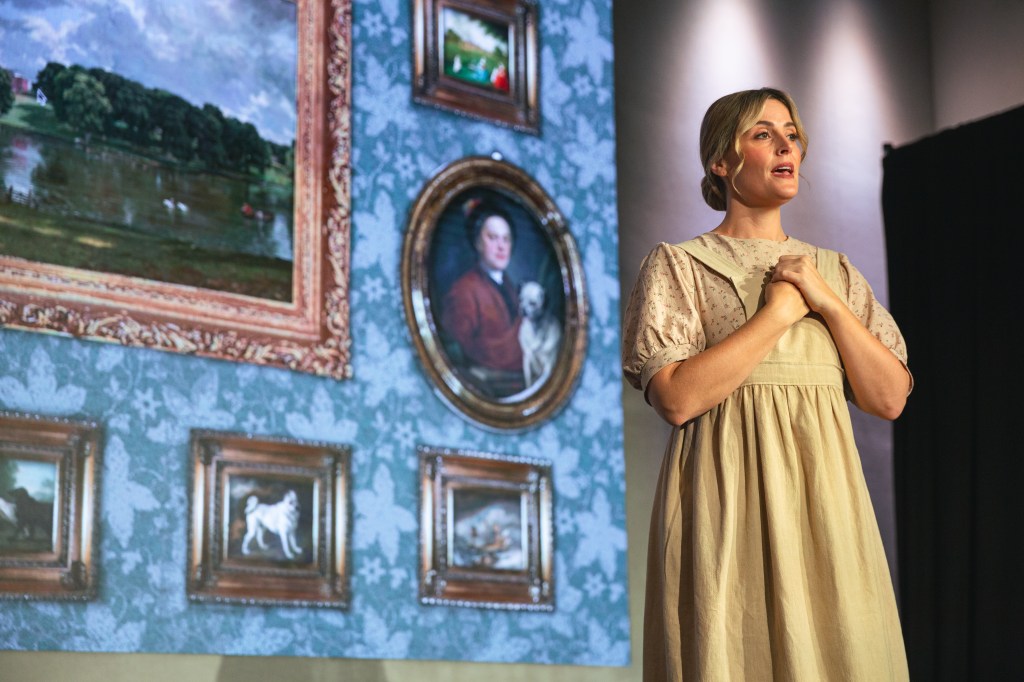
Ashlyn Tymms (Fanny Price in Mansfield Park) Photo Lewis Ferris

Mansfield Park
Music by Jonathan Dove
Libretto by Alasdair Middleton
Based on the novel Mansfield Park by Jane Austen
Director, Rebecca Meltzer
Maestro Concertatore, Brad Cohen
A New Zealand Opera production
Settlers Country Manor, Waimauku
Sunday, 21 April
With
Ashlyn Tymms (Fanny Price)
Kristin Darragh (Lady Bertram)
Robert Tucker (Sir Thomas Bertram)
Sarah Mileham (Maria Bertram)
Michaela Cadwgan (Julia Bertram)
Joel Amosa (Edmund Bertram)
Andrea Creighton (Aunt Norris)
Joanna Foote (Mary Crawford)
Taylor Wallbank (Henry Crawford)
Andrew Grenon (Mr Rushworth)
And
Soomin Kim and David Kelly (piano for four hands)

The incoming General Director of New Zealand Opera Brad Cohen has described Mansfield Park as a touchstone for the future. And judging by this offering of Mansfield Park, opera-lovers have a rather
fascinating future to look forward to.

Jonathan Dove’s score is contemporary, which may prove difficult for some but it points to an operatic future that is to be lauded and, unlike last year’s perhaps controversial Unruly Tourists, retains some links to literary tradition.


Mansfield Park is a two-act, 18 chapters adaptation of Jane Austen’s early 19th century novel. It takes a few liberties with the original but retains the essential context of the Crawford family and their grand old country pile in which familial mores, social positioning and aspirations are played out. Alasdair Middleton’s libretto deftly and succinctly summarises these in the very first chapter as being about ‘profit, pride, position, posterity and prestige’.


Remote niece, Fanny Price, is recently fostered into this social setting ‘for her betterment’ before patriarch Sir Henry soon departs for the family’s sugar plantation in Antigua. It soon becomes apparent that a simmering undercurrent of familial disputes, bad-mouthing, marital intrigues and
backstabbing are revealed before eventual resolution is reached. Through all this the quiet, reserved and subservient Fanny, grows with increasing maturity to become a shining example of all that is good, honest and true.


Mounted in semi-rural splendour of the main reception room at Settlers Country Manor at Waimauku near Kumeu, this initial offering is a chamber opera in the true sense of the word. There is no purpose-built stage as such and it is performed on and around a tiny elevated space measuring
perhaps 5m x 4m. Importantly for the future, this production is readily portable, relatively inexpensive to produce and could be easily mounted in a wide range of suitable spaces all over the
country.


Director Rebecca Meltzer copes with the questionable acoustics and difficult shape of the room by tossing out any hint of grand opera and uses the tiny performance space to elicit performances of nuance and subtlety from a 10-strong ensemble supported only by a single piano played by four hands. The entire reception hall (set up with rows of chairs for about 300) is used for entrances, exits and even voices from the rear of the room. Meltzer even allows more than just hints of that
actor’s stock in-trade – improvisation.


The effect is to offer a new and vibrantly different connection for audiences who are almost invited to become a part of the Crawford family either as flies on the wall, or perhaps imagining themselves as auxiliary staff or even just as close observers. Proximity to the performers induces intimacy and connection, something hammered home at one point when an audience member becomes part of the action on the stage.


This is a genuine and uniformly strong ensemble cast that feeds off, balances and enhances each other so it is no surprise that, as a unit, it was genuinely strong. Some of the lyrics were occasionally lost in the acoustics but these were readily overcome through the availability of a QR code enabling the audience to read them if required.


But it was Sydney-based mezzo Ashlyn Tymms who captured the room especially when Fanny’s low-key presence in the first act grows to increasing prominence in the second. Tymm’s delivered two strong arias at the top of the second act and then seemed to go from strength to strength leaving us in no doubt whatsoever that Fanny Price was unquestionably good, honest and true.

As such, it certainly affords NZ Opera opportunity to connect with new audiences in new ways and perhaps in new locations.