Categories
Reviews, News and Commentary

HEDY! The Life & Inventions of Hedy Lamar

Reviewed by John Daly-Peoples

HEDY! The Life & Inventions of Hedy Lamar

Written and performed by Heather Massie

Q Theatre

March 13- 16

Reviewed by John Daly-Peoples

While she never got an Oscar, Hedy Lamarr was considered the most beautiful woman in the world and was one of the great movie stars of the mid twentieth century. She starred in many films including “Samsom and Delilah and the Czech film “Ecstasy” which featured a controversial orgasm scene which was banned in many countries.

She was divorced six times, making her one of the most divorced women of the twentieth century, a distinction beaten only by Elizabeth Taylor with seven.

But, in many ways, her greatest distinction was her invention (along with George Antheil} of  a “Secret Communication System,” which was a radio-guided device with anti-jamming frequencies which would have had the capacity to interfere with torpedo guidance systems during WWI. The US Navy declined to make use of it.

This device is a component of present-day satellite technology and cellular phone technology.

Her work as an inventor was eventually recognized in 1997 with the Sixth Annual Pioneer Award bestowed on her by the Electronic Frontier Foundation.

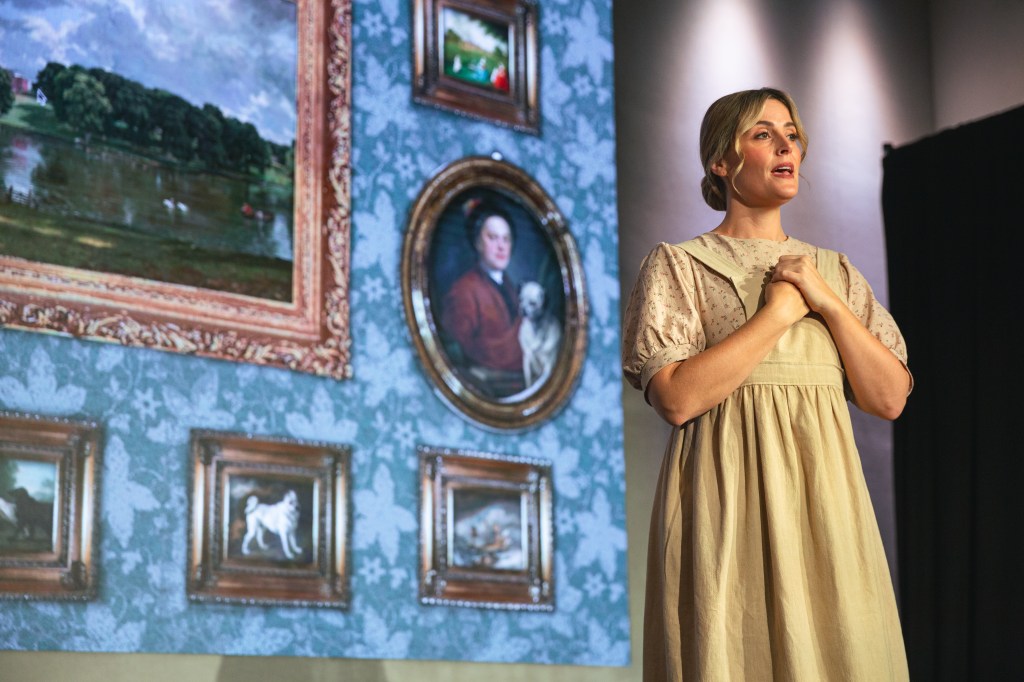
These are some of the highlights of her career which were revealed in Heather Massie’s one-woman autobiographical show, “Hedy Lamarr”.

Lamarr reminisces about her life, her father, her time in Vienna and later her career in Hollywood. There are her relationships with the various men in her life – an armaments producer, a count, Louis B Meyer and various director and actors.

Many of them were presented by Heather Massie using a of range voices to create to give depth to her performance, although she gave most of the men pretty much the same clichéd accent. Her account of Jimmy Stewart, however, was a delightfully, breathless portrait of the actor.

The various events and activities referred to showed the range of Lamarr’s interests and encounters with her quotes indicating a shrewd mind and a keen observer of life.

Massie managed to turn Lamarr into a remarkable complicated but simple figure who seems to know a lot about life, men and the workings of the world as well as making shrewd observation about her life and her inventions.

However, Massie galloped through her “tutorial” about her guidance system with not much time to appreciate just how important the invention could have been to the war effort.

Massie’s presentation has Lamarr engage the various people in her life over the phone or in having on stage conversations so effectively that in retrospect it seems they were with there on stage.

She also engaged with the audience as a whole and in many cases with individual audience members, a technique which worked as a means of creating Lamarr as well as providing a classy example of how to create a character.

To subscribe or follow New Zealand Arts Review site – www.nzartsreview.org.

The “Follow button” at the bottom right will appear and clicking on that button  will allow you to follow that blog and all future posts will arrive on your email.

Or go to https://nzartsreview.org/blog/, Scroll down and click “Subscribe”

Categories
Reviews, News and Commentary

Dick Frizzell’s picaresque memoir of the artist as a young man

Reviewed by John Daly-Peoples

Hastings. A boy’s own adventure

Dick Frizzell

Massey University Press

RRP $37.00

Reviewed by John Daly-Peoples

Many geniuses are recognized early on in their lives. Mozart had written 10 symphonies by the time he was 14, Pablo Picasso was turning out some skilful nudes when he was 14 and  Dick Frizzell did a drawing of Christopher Lee as Frankenstein’s monster at the same age.

However, neither Mozart nor Picasso wrote a decent autobiography about growing up which is where Frizzell has the edge over the other two.

His new book recounting his early years, “Hastings, A boy’s own adventure” is an entertaining set of stories which probably mirrors the life and times of many young men growing up in provincial New Zealand in the 1950’s and 60’s. It was a time of complete freedom when young men like Frizzell were learning the first of life’s lessons and enjoying life’s experiences.

In thirty chapters Frizzell recounts his adventures which provide  portraits of his family, descriptions of Hastings and sketches of his encounters with the day-to-day activities he was immersed in. Through these he  manages to provide an insight into his growing awareness and understanding of the world around him, conjuring up the experience of most young boys of his age, encountering the world of adults – aunts, uncles, family friends and  teachers.

We also get a sense of how he became Dick Frizzell the artist  with a mother who had been to art school  and taught him some artistic skills and a father who was well read and a technically accomplished engineer with his own enquiring and adventurous nature.  There are also his experiences of the landscape – Te Mata Peak and the farms of relatives where he worked or holidayed  There is also his love of  comics and movies, his interest in working environments and workmen It’s what we see in his artwork – a celebration of landscape and culture, history and everyday objects.

Frizzell says of these early years “I felt that I had the town covered: our Parkvale kingdom, Uncle George’s market gardens, Aunty Molly’s frock shop, Dad’s freezing works, my high school . . . the town was pretty much ring fenced by Frizzell’s! And I was there growing up with it. Rock ’n’ roll came along, the town became a city, Fantasyland was built, hoodlums trashed the Blossom festival, I learnt the Twist in the Labour and Trades Hall . . . everything I took within me towards adulthood came from Hastings.”

‘If I’d been asked to vote on it I would’ve said I’d landed at the centre of the universe. Standing on our corner of Sylvan Road and Victoria Street, with Te Mata Peak, the Tukituki River and the mad wilderness of Windsor Park to the back of me and the distinctly non-wilderness of Cornwall Park and the misty vista of the Ruahines in front of me, I was the master of all I could barely survey.”

We learn about his jobs, the same that probably every youth got living in Hastings – spells at the Tomoana Freezing Works (where his father worked) and at the Wattie’s canning factory.

But while his portraits of his mother and father and the likes  of his aunts Molly and Nora the figure which we most appreciate is the author with his achievements, blunders, successes and failures.

While the artist may have gained the image as the suave man about town. his early encounters with the opposite sex by his own accounts were less prepossessing. He recounts his inauspicious attempt at the seduction of Bunny as well as his fleeing from the amorous advances of the older Trixie.

It’s a coming-of-age book which will resonate with many older readers with its half-remembered tales of family life, friendships  and growing awareness of one’s place in the world.

To subscribe or follow New Zealand Arts Review site – www.nzartsreview.org.

The “Follow button” at the bottom right will appear and clicking on that button  will allow you to follow that blog and all future posts will arrive on your email.

Or go to https://nzartsreview.org/blog/, Scroll down and click “Subscribe”

Categories
Reviews, News and Commentary

You are Here: linking language, memories and landscape

Reviewed by John Daly-Peoples

You Are Here

Whiti Hereaka and Peata Larkin

Massey University Press

RRP $45.00

Reviewed by John Daly-Peoples

Most stories have a beginning, a middle  and an end. Most stories have a central idea, a kernel from which the tale expands like a sinuous river which follows a plot or a life. Other books can have a very different structure as with the new book “You Are Here”.

“You Are Here” which is the  sixth book in the “kōrero series”, edited by Lloyd Jones, features Jann Medlicott Acorn Fiction Prize winner Whiti Hereaka and artist Peata Larkin, cousins who share the same whakapapa. in a collaboration. Unlike the previous stories in the collection Larkin’s images are not merely illustrations of the text but rather complementary representations of similar ideas.

Here the story line is cyclical, expanding and contracting. Like James Joyce’s  “Finnegans Wake” the work begins and ends at the same point but with an elaborate structure in between  

The poem  starts with the line “You are here” and ends with the line – “Return to where you belong”, seemingly following the mathematical notions of the Fibonacci number sequence.

In tracing out the narrative the  narrator recalls their youth and their experiences of life. Threaded through this personal journey are images of water and the stones of a lake as well as  images of birds and journeys. like the  symbolic use of the Piwakawaka by Colin McCahon.

Language, memories and landscape are seen as linked in the development of the narrator, their memories of school and the shaping of the person through language and experiences. the physical and the metaphorically linked in this journey.

Parallel to Hereaka’s storyline are Peata Larkin’s multi-layered visual images in which ideas inherent in the structure of the story are the linked to her exploration of the DNA structure as well as images of Māori design. Drawings of tāniko and whakairo on gridded shapes are linked to European notions of embroidery and mathematical structures.

Peata Larkin says of the work “Working on this project has been very special to me …Being cut from the same cloth enables the threads of the fabric to shine through and hopefully we achieved that.

Hereaka says. ‘It is my hope that by the time you have walked that path that you are now a different reader and will read those words in a new way,’

To subscribe or follow New Zealand Arts Review site – www.nzartsreview.org.

The “Follow button” at the bottom right will appear and clicking on that button  will allow you to follow that blog and all future posts will arrive on your email.

Or go to https://nzartsreview.org/blog/, Scroll down and click “Subscribe”
Categories
Reviews, News and Commentary

Mansfield Park: The Future Looks Bright

Review by Malcolm Calder

Ashlyn Tymms (Fanny Price in Mansfield Park) Photo Lewis Ferris

Mansfield Park
Music by Jonathan Dove
Libretto by Alasdair Middleton
Based on the novel Mansfield Park by Jane Austen
Director, Rebecca Meltzer
Maestro Concertatore, Brad Cohen
A New Zealand Opera production
Settlers Country Manor, Waimauku
Sunday, 21 April
With
Ashlyn Tymms (Fanny Price)
Kristin Darragh (Lady Bertram)
Robert Tucker (Sir Thomas Bertram)
Sarah Mileham (Maria Bertram)
Michaela Cadwgan (Julia Bertram)
Joel Amosa (Edmund Bertram)
Andrea Creighton (Aunt Norris)
Joanna Foote (Mary Crawford)
Taylor Wallbank (Henry Crawford)
Andrew Grenon (Mr Rushworth)
And
Soomin Kim and David Kelly (piano for four hands)

The incoming General Director of New Zealand Opera Brad Cohen has described Mansfield Park as a touchstone for the future. And judging by this offering of Mansfield Park, opera-lovers have a rather
fascinating future to look forward to.

Jonathan Dove’s score is contemporary, which may prove difficult for some but it points to an operatic future that is to be lauded and, unlike last year’s perhaps controversial Unruly Tourists, retains some links to literary tradition.


Mansfield Park is a two-act, 18 chapters adaptation of Jane Austen’s early 19th century novel. It takes a few liberties with the original but retains the essential context of the Crawford family and their grand old country pile in which familial mores, social positioning and aspirations are played out. Alasdair Middleton’s libretto deftly and succinctly summarises these in the very first chapter as being about ‘profit, pride, position, posterity and prestige’.


Remote niece, Fanny Price, is recently fostered into this social setting ‘for her betterment’ before patriarch Sir Henry soon departs for the family’s sugar plantation in Antigua. It soon becomes apparent that a simmering undercurrent of familial disputes, bad-mouthing, marital intrigues and
backstabbing are revealed before eventual resolution is reached. Through all this the quiet, reserved and subservient Fanny, grows with increasing maturity to become a shining example of all that is good, honest and true.


Mounted in semi-rural splendour of the main reception room at Settlers Country Manor at Waimauku near Kumeu, this initial offering is a chamber opera in the true sense of the word. There is no purpose-built stage as such and it is performed on and around a tiny elevated space measuring
perhaps 5m x 4m. Importantly for the future, this production is readily portable, relatively inexpensive to produce and could be easily mounted in a wide range of suitable spaces all over the
country.


Director Rebecca Meltzer copes with the questionable acoustics and difficult shape of the room by tossing out any hint of grand opera and uses the tiny performance space to elicit performances of nuance and subtlety from a 10-strong ensemble supported only by a single piano played by four hands. The entire reception hall (set up with rows of chairs for about 300) is used for entrances, exits and even voices from the rear of the room. Meltzer even allows more than just hints of that
actor’s stock in-trade – improvisation.


The effect is to offer a new and vibrantly different connection for audiences who are almost invited to become a part of the Crawford family either as flies on the wall, or perhaps imagining themselves as auxiliary staff or even just as close observers. Proximity to the performers induces intimacy and connection, something hammered home at one point when an audience member becomes part of the action on the stage.


This is a genuine and uniformly strong ensemble cast that feeds off, balances and enhances each other so it is no surprise that, as a unit, it was genuinely strong. Some of the lyrics were occasionally lost in the acoustics but these were readily overcome through the availability of a QR code enabling the audience to read them if required.


But it was Sydney-based mezzo Ashlyn Tymms who captured the room especially when Fanny’s low-key presence in the first act grows to increasing prominence in the second. Tymm’s delivered two strong arias at the top of the second act and then seemed to go from strength to strength leaving us in no doubt whatsoever that Fanny Price was unquestionably good, honest and true.

As such, it certainly affords NZ Opera opportunity to connect with new audiences in new ways and perhaps in new locations.