Reviewed by Malcolm Calder
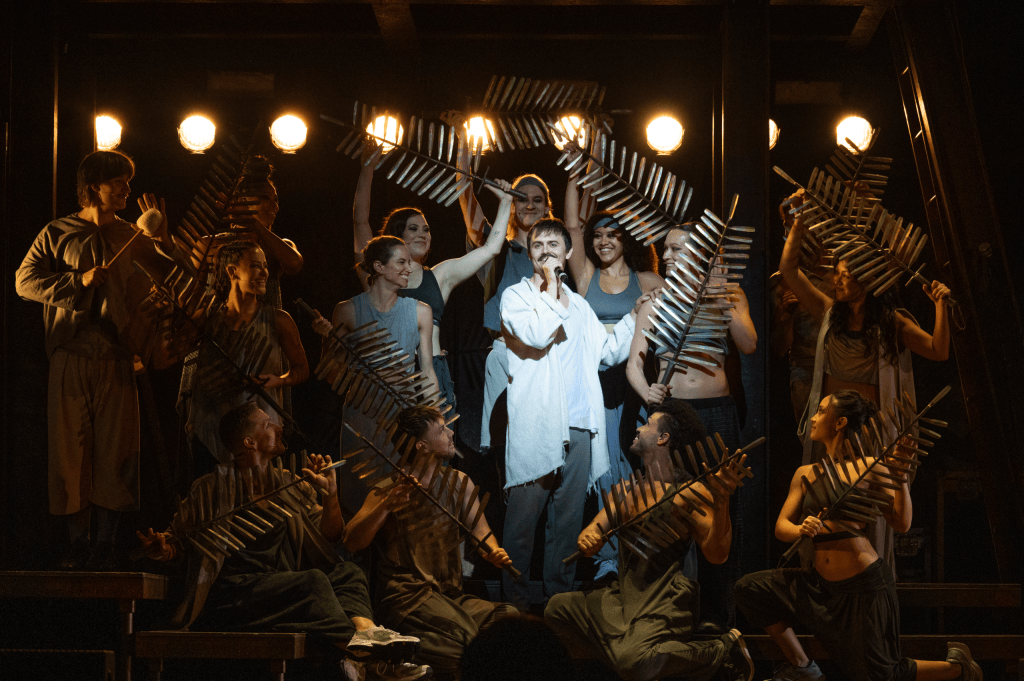
Photo Zeus Martinez
Jesus Christ Superstar
Lyrics by Tim Rice, music by Andrew Lloyd Webber
GMG Productions, Crossroads Live and Worklight Productions
Director Timothy Sheader
Set and Costume Design Tom Scutt
Choreography Drew McOnie
Music Director Hugh Hayden-Brown
Asst Choreography Courtney Arango
Assoc Director Alli Coyne
Sound Design Nick Lidster
Music Supervision Tom Deering
Lighting Design Lee Curran
With (Principals) Luke Street, Javon King, Hannah Richardson, Ethan Hardy Benson, Grant Hodges, Kodiak Thompson, Thomas McFerran, Eric W Scheeck, Will Silver
(Ensemble) Joshua Bess, Ashley Chafer, Filippo Coffano, Kalei Cotecson, Joshua Dormor, Savannah Fisher, Elizabeth Fullalove, Icis Hammond, Dominick Hubbard, Jake MacPhee, Thoman McFerran. Jessica Meegan, Caroline Perry, Sandy Redd, Henry Rollo, Erich W Schleck, Will Silver, Jordan Michael Todd
Civic Theatre, Auckland
Booking to 15 November
St James Theatre, Wellington, 18-21 November
Isaac Theatre Royal, Christchurch, 2-6 December
Familiarity Breeds Endearment
Someone once argued that being both familiar and comfortable can induce conflict so they counter each other out.
They were wrong. This Jesus Christ Superstar is both. It doesn’t judge. It doesn’t editorialise. And its basic premise isn’t even debatable. It simply entertains.
As such its very familiarity brings only a very welcome endearment.
Jesus Christ Superstar tells a story about a man and the legend that has shaped civilisations for more than two millenia – whether myth or not. And that’s what good productions are all about – telling a simple story (in this case a fairly well-known one), telling it well and leaving its audiences with happy, satisfied smiles on their faces. It succeeds.
This cast is rather well-credentialled, is drawn from many different parts of the globe, some going right back to this production’s birthplace at the Regent’s Park Open Air Theatre in London a few years ago now.
Rather than Jesus, JCS, presents Judas as the fulcrum. NYC and Melbourne based Javon King gives us a Judas of loyalty, happiness, greed, conviction and then ultimately confusion and even regret before his own death. He has light. He has shade. And, as an anti-hero, he shows us an awful lot in between.
He shares influence over Jesus with what I felt was a slightly under-played Mary Magdalene (London-based Hannah Richardson) although her carefully nuanced ‘I don’t Know how to Love Him’ was well-received.
Offsetting them is the humble, confused and, at times, angry central figure of Jesus (fellow-Londoner Luke Street). While Street has played Judas in other iterations, it wasn’t until Jesus’ big song (‘Gethsemane’ in Act 2) that I found him more convincing. So did this audience.
Supporting roles were everywhere. Standouts for me included the Annas-Caiaphus duo and their Pharisees as well as the brief appearance of the deliciously faux-cabaret Pilate. Don’t ask me why, but I found his idiotic and nonchalant antics to somehow echo a certain orange-haired contemporary American politician.
Above all though, it was a joy to see such a well-rehearsed cast laden with slick professionalism eliciting a wide range of emotional responses not to mention a final scene though it would be unfair to detail here.
The set is brilliantly conceived, the costumes fit the purpose and some of the choreography memorably outstanding. However, this IS a gritty rock concert rather than a vaudeville-inspired glammed-up musical and the band, cunningly buried in various parts of an industrial-quality set show it to be just that. An Australian colleague mentioned to me that some audiences across the ditch found this production unduly loud. Not so me ! This IS a rock-musical after all – the hand-held mics tell us that! Yet the strong baseline only managed to kick me in the sternum a couple of times towards the end.
Using the well-documented final days of Christ’s life, JCS of course uses music to connect with a generation that now has grey hair, along with many of their children and more than a sprinkling of grandchildren.
However, it is something of a shock to realise it is now more than fifty years since JCS was birthed. With Andrew Lloyd Webber’s driving rock score it broke new ground at the time and was eagerly awaited – but not entirely.
By the early 1970s we were a decade on from the Beatles and the Stones and a decade where popular music had taken a new direction. For some there were even more serious directions to take. It was a time for concept albums.
And just like The Kinks’s Arthur (or the Decline and Fall of the British Empire), or the Who’s Tommy, or Jethro Tull’s Thick As a Brick or even Sergeant Pepper’s Lonely Hearts Club Band, creative musicians had paved the way for Andrew Lloyd Webber and Tim Rice to tell a well-established story from a book pretty much everyone knows, and found a new way to retell it – bringing Judas more into the scheme of things.
This particular concept album was eagerly awaited. I fondly remember sitting with a group of friends in a rather dingy flat just behind Sydney’s Kings Cross in 1971 and playing it over and over through the night when the long-due LP (remember them?) finally arrived.
But a staged production took a little longer. The Americans had a go but fell foul of dissenting voices – primarily over religious and racial divides (funny how some things don’t change) – and a rage of licensing issues. It took Australian impressario Robert Stigwood to take a punt, lock in the world-wide rights with the creators and convince fellow-Australian Jim Sharman to wave his magic director’s wand over things before it bounced onto the stage at the Westend’s Palace Theatre in 1972.
So while most other rock operas would tell the story of Jesus from the perspective of the man himself (the crossover between lead singer and preacher was a fairly well-trodden area even in 1970), JCS takes Judas’s point of view and throws some sympathetic light upon Mary Magdalene too.
Jesus might have been a charismatic leader, wise beyond his experience and adored by his sychophants. But they are only human. And it is Judas, manipulatively loyal and true, who misguidedly accepts the thirty pieces of silver, while Jesus becomes well aware of what is about to happen to him and resigns himself near-passively to his fate.
Perhaps cynically, I must admit I have always loved the closest thing Webber and Rice got to editorialising when the Apostles sing …
Always hoped that I’d be an apostle,
Knew that I would make it if I tried.
Then when we retire we can write the gospels,
So they’ll still talk about us when we’ve died
Go see it.

