Ray Ching is one of the world’s outstanding wildlife artists who has been producing paintings, drawings and and publication for over sixty years. While having lived in the UK for many years his work has largely focussed on antipodean birds. These have included exhibitions and publications such as “Aesop’s Outback Fables” and “Aesop’s Kiwi Fables”. His most successful book was “The Reader’s Digest Book of British Birds”. Published in 1969 it became the world’s most successful and biggest selling book of bird paintings, translated into over ten European languages and appearing in many editions.
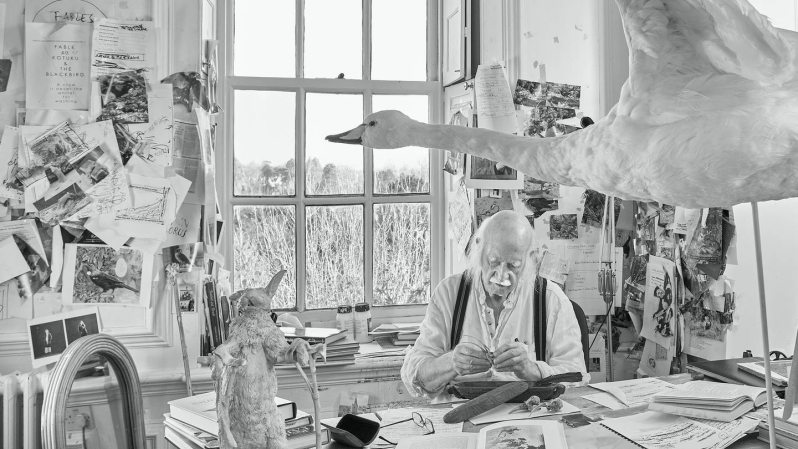
Ray Ching in his studio
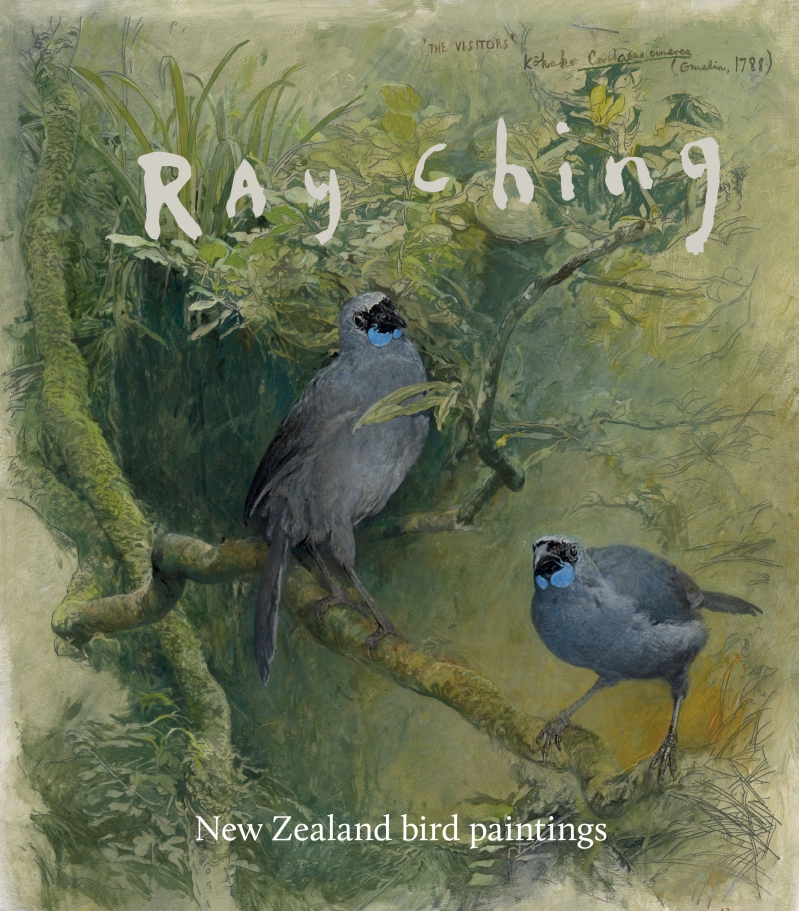
His latest publication is simply titled “New Zealand Bird Paintings. This mundane title belies the sumptuous visual record he has produced and his paintings are as important as the illustrations by J.G. Keulemans in the nineteenth century publication “Buller’s Birds of New Zealand”.
The book features about seventy different birds all rendered in extraordinary detail along with preparatory drawings and texts.
His wide-ranging passages of writing provide both a personal and ornithological approach to each of the birds. The artist writes about his early encounters with the birds, their history, references to other writers and ornithologists which helps give a greater understanding of the birds and their place in New Zealand history and landscape.
Ching notes that the impact of colonialism, pasteurism and deforestation has had a major impact on the habitats of many of our birds such as the flightless kakapo nearly hunted to extinction by rats, stoats and dogs.
On the other hand, the Kahu or swamp Harrier which is essentially an open marsh, scrub or pastureland bird was aided by the destruction of forests which gave way to grassland and thus extra habitat for the bird.
Writing about the Kiwi he notes that early illustrators had great difficulty in describing the bird from the skin of the first birds sent back to England as it did not conform to the structure of other birds and he notes that the bird is still a challenge to depict
His paintings of each of the birds vary. Some are painted in the almost standard ornithologic manner with strict attention to detail and colouring while with other he provides environmental setting.
Kea
In many of his paintings over the years he has attempted to anthropomorphise his birds and in Dawn Chorus he depicts a group of kakapo surrounding the sheet music of Pokare kare ana signifying their melodious call and Ching provides interesting information about the special way the bird builds sound reflectors to aid in its mating call.
In the section on the Tui eight of the birds are illustrated each of them has a different pose and personality
Some of the birds perch as with the Korimako (bellbird) some are animated like the two fighting North Island Kiwi while other are depicted in flight such the Haast’s Eagle and the Pipiwharauroa (Shining Cuckoo).
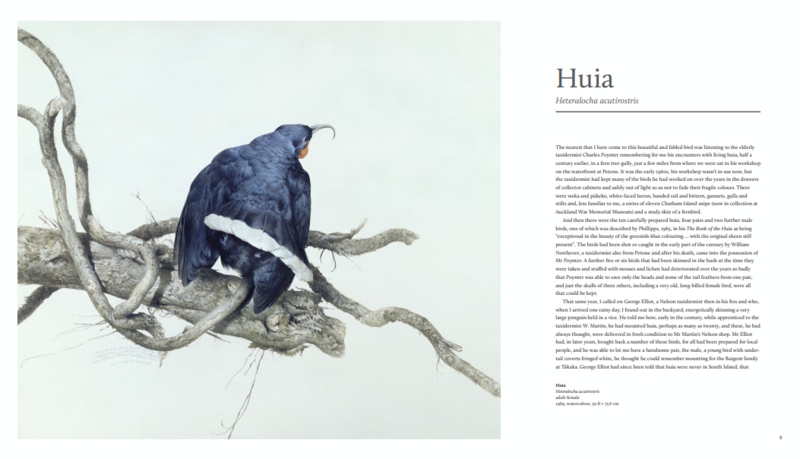
Huia
His Huia sits with its back to the viewer on an almost abstract branch all the better to show of the bird’s white tail feathers while the two Kea are illustrated in an alpine environment behind them. The Toutouwai (North Island robin) is shown in the forest undergrowth and the Tauhou (Silvereye) almost obscured by the yellow kowhai they are feeding on and the Kaka is shown eying some puriri berries.
Kaka
The paintings in the book are interspersed with studies drawn by the artist showing his ability to capture not only the shape and textures of the birds. The various paintings and drawings done over a number of years also illustrate the artist changing approaches to the depiction of the birds.
The works combine the artist’s extraordinary attention to detail of the birds as well as well astute rendering of foliage and landscape which help give context to the birds and their environments.
Next year will see the return of live performances including several musicals. Already announced has been Opera New Zealand’s “Carousel” which will be performed on the water at the Viaduct Harbour. Now there are another three great productions – “Chess” one of the great classic musicals, “Come Away From” an inspirational new musical and “Shrek” which will appeal to the whole family
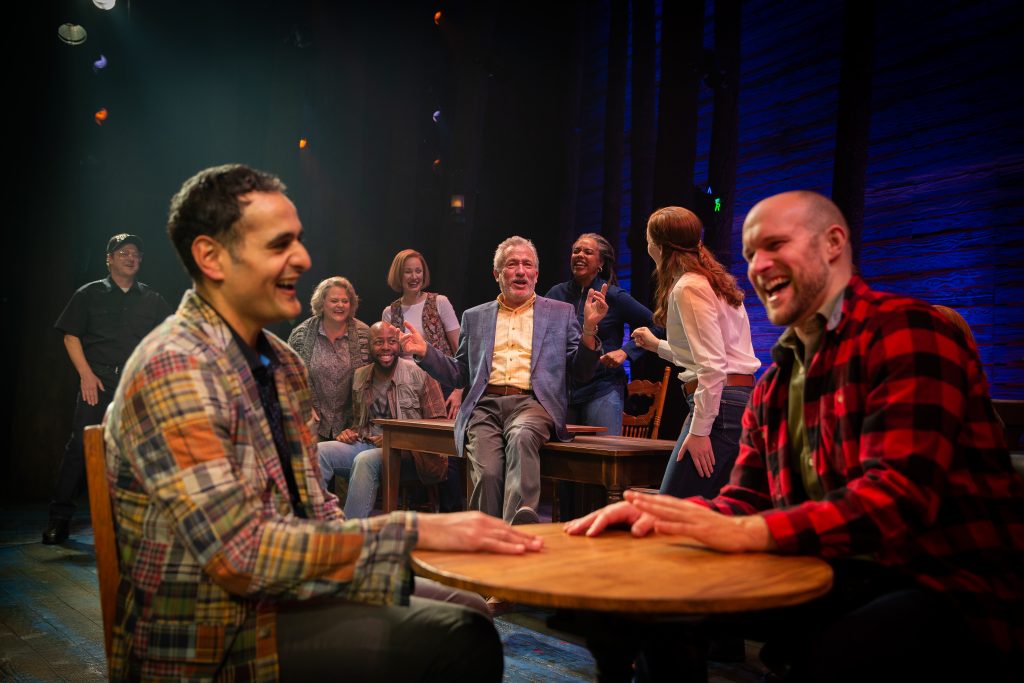
“Come From Away”byDavid Hein and Irene Sankoff
The Civic, Auckland. From 20 April,.
St James Theatre, Wellington. From 20 May, 2022.
This year marks the 20th Anniversary of 9/11, when terrorist attacks on Washington and New York closed US airspace for the first time in history. It was then that 38 planes carrying nearly 7,000 people from over 100 countries were diverted to the small island of Gander, known to locals as ‘The Rock’.
The Tony and Olivier Award-winning musical, “Come From Away” tells the remarkable real-lifejourney of 7,000 air passengers who became grounded in Gander, Newfoundland in Canada in the wake of the September 11 tragedy. The small community that welcomed the ‘come from aways’ into their lives provided hope and compassion to those in need. Award-winning husband and wife duo David Hein and Irene Sankoff (book, music and lyrics), travelled to Newfoundland and interviewed thousands of locals, compiling their stories.
The kindness and spirit of humanity that ensued in the face of crisis; the indelible friendships forged and the anguish of not knowing what had happened to their loved ones, together with a Celtic-inspired soundtrack, make this musical one of the most celebrated to emerge from Broadway in recent history.
“Come From Away”has won numerous awards including the Tony Award for Best Direction of a Musical (Christopher Ashley), and four Olivier Awards including Best New Musical, Best Theatre Choreography (Kelly Devine), Best Sound Design and Outstanding Achievement in Music.
The recent Australian season saw more accolades for the production, becoming the most successful musical ever staged at Melbourne’s Comedy Theatre, breaking box office records across the country, winning numerous awards.
The show had a return season this year in Melbourne and the Sydney morning Herald’s reviewer Cameron Woodhead wrote about the production,
“For expositional brilliance and strength of ensemble performance, there is no musical quite like it. I’ve seen it four times now and am yet to be bored: there isn’t a dead moment.”
“It is marvellous to see an entire town, not to mention the crowd of international visitors stranded there, brought to life, and it’s done with such pace and vigour, such stirring music and movement, such finely judged humour, such poignancy and pathos, such warmth and welcome, that you start to feel like a Newfoundlander yourself.”
Chess – The Musical
Chess – The Musical by Benny Andersson and Björn Ulvaeus, and Sir Tim Rice Kiri
Te Kanawa Theatre, Aotea Centre, Auckland. From 16 June.
One of the world’s best-loved musicals, Chess – The Musical will have a limited season in Auckland.
This semi-staged production, will feature an array of New Zealand musical theatre talent, the Auckland Philharmonia Orchestra, and a choir of 30 was written in 1984 by ABBA’s Benny Andersson and Björn Ulvaeus, and Sir Tim Rice (Jesus Christ Superstar, Evita), Chess – The Musical features hits including “I Know Him So Well” – recognised in the Guinness Book of Records as the biggest selling UK chart single ever by a female duo – and the upbeat pop favourite “One Night in Bangkok”.
Chess – The Musical tells the story of a complex love triangle combined with dramatic political intrigue, set against the background of the Cold War in the early 1980s, where Soviet and American forces attempt to manipulate an international chess championship for political gains.
Two of the world’s greatest chess masters, one American, one Russian, are in danger of becoming the pawns of their governments as their battle for the world title gets underway. Simultaneously, their lives are thrown into further confusion by a Hungarian refugee, a remarkable woman who becomes the centre of their emotional triangle. This mirrors the heightened passions of the political struggles that threaten to destroy lives and loves.
The musical originally premiered in London’s West End in 1986 (where it was revived in 2018) starring the Elaine Paige. The season ran for three years, resulting in a BBC listener poll ranking Chess – The Musical seventh in a list of ‘Number One Essential Musicals’ of all time.
Chess the boardgame, has become the world’s most popular sport, with 605 million fans and now enjoying even more popularity following the Netflix series “The Queen’s Gambit”, which drew a record audience of 62 million households. In the first three weeks after the TV series’ debut, sales of chess sets in the US went up by 87% and sales of chess books leaped 603%.
Chess – The Musical is produced by the makers of this year’s Jersey Boys and is directed by Jeremy Hinman (Jersey Boys, Priscilla, Queen of the Desert). Musical direction is by Penny Dodd (Chicago, Evita, Cats, Anything Goes, 42nd Street and The Phantom of the Opera) and vocal direction is by Jane Horder.
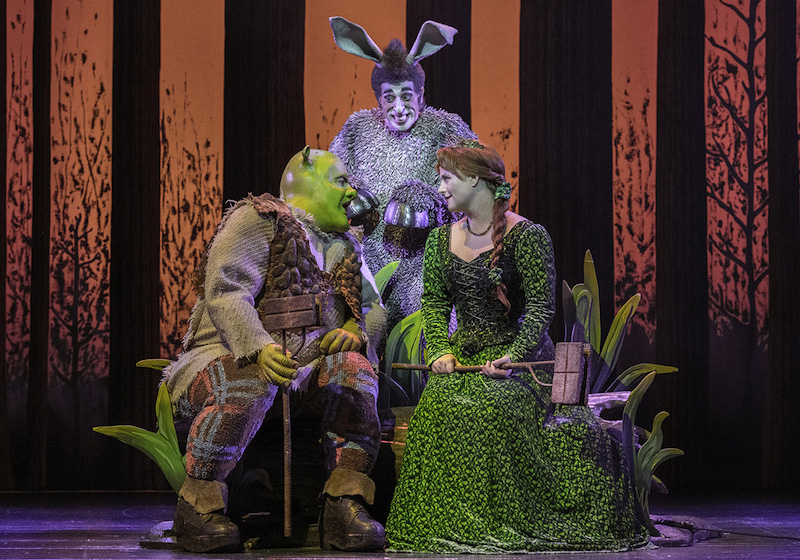
Shrek, The Musical Kiri Te Kanawa Theatre, Auckland From 19 April Hamilton – Clarence St Theatre, Hamilton From26 April Isaac Theatre Royal, Christchurch From4 October St James Theatre, Wellington From 11 October
The Broadway’s monster smash-hit production Shrek The Musical based on The Academy Award-winning animated film “Shrek” is the story of everyone’s favourite ogre is a lavish multi-million-dollar musical part romance, part twisted fairy-tale and all irreverent fun that brings all the beloved characters from the film to life on stage. The antisocial Shrek lives alone in a swamp, until pint-sized dictator Lord Farquaad banishes all fairytale creatures from his realm. Soon Shrek’s home is overrun with refugees, from Pinocchio to The Three Little Pigs, and if he’s to regain his solitude the ogre must embark on a quest for Farquaad, rescuing Princess Fiona from a dragon-guarded tower. Along the way, he reluctantly befriends an annoying Donkey and falls in love with the princess. Just when he thinks he’s too ugly, fearsome and freakish for a happy ending, Shrek discovers Fiona hides her own green secret.
Producer Layton Lillas says ‘All of my productions are designed to be accessible for as many people as possible. I love to see kids being introduced to theatre at a really high level, but I also know being a dad to a 7-year-old that asking them to sit through two and a half hours is just too much.
“Our version of Shrek The Musical features a talented professional cast of 14 actors,” he says, “the set alone is worth over $1 million and was used on both the UK and Australian tours, and a dragon that has its own 40 foot shipping container. Believe me everyone who comes will be blown away!”
The Limelight review of the production in Sydney this year noted “Shrek is a show that relies fundamentally on two things: humour and heart. The version at Sydney’s Lyric Theatre (produced by John Frost and Glass Half Full Productions … has plenty of the former and loads of the latter.” “This script requires performers who can send it up but also express the emotional truth of the central relationships: Shrek’s outsider status and how he deals with loneliness, the nature of friendship and loyalty, and the truism that beauty is only skin deep. Also, it doesn’t hurt if Tesori’s snappy but often complex music is sung by confident, experienced voices, and played by a band that relishes the traditional Broadway references.”
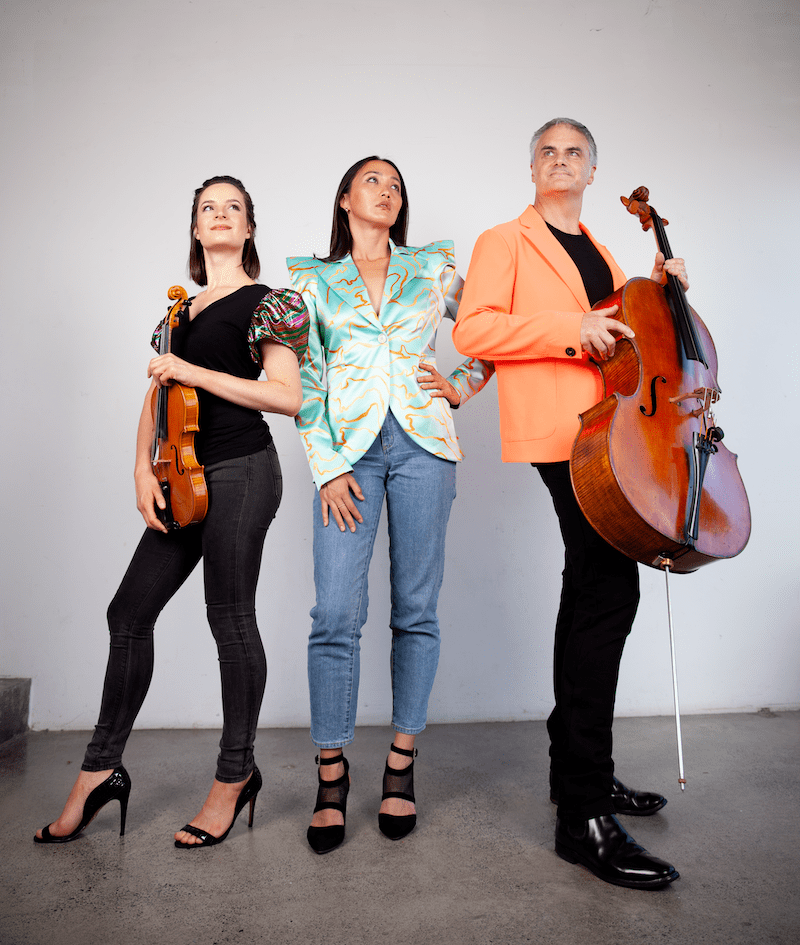
The final concert of the year for the New Zealand Trio and one of the final classical concerts for Auckland was the last in their Dramatic Skies series. It was presented under Red Level in the Concert Chamber with a socially distanced audience of just one hundred.
While the concert was titled Cirrus, the overcast skies that evening were more Nimbus but the concert featuring work from the early nineteenth century till the present brought welcome sounds into the hall to an audience starved of concerts.
It was a typical NZ Trio concert combining classical compositions with more adventurous contemporary works challenging and for the players as well as the audience
Franz Schubert was only fifteen when he wrote his “Sonatensatz in B flat Major” and there is a youthful enthusiasm to the work but one can hear the composer searching for more complex structures and layered themes which hint at the greater works that were to follow.
Pianist Somi Kim provided the initial themes which were expanded on with violinist Amelia hall providing a soaring voice and cellist Ashley Brown a more sober and at times sombre accompaniment.
Kim’s playing could be seen as painting a landscape into which Hall and Brown interposed images of fleeting clouds, and looming storm clouds
Gillian Whitehead’s newly commissioned work “Ka maranga ngā kapua” follows on the cloudscape theme translating as ‘the clouds will lift’ and was something of a metaphor coming at a time of hope in the lifting of Covid restrictions.
There are allusions to changing landscape and moods with shimmering sounds conveying various vistas along with whispers of bird song, heralding abating storms, clearing weather and a new day.
The other New Zealand work on the programme was Rachael Clement’s “Shifting States” which consisted of five short pieces inspired by the processes of glassmaking – freezing, melting, vaporization, condensation and sublimation.
The work was full of tentative crisp sounds which created a sense of shimmering flecks of light and colour with each of the instruments conveying concepts of fragility, mystery and fluidity.
Playing the Schubert, the three instrumentalists had been focussed on collaboration, watching each other and responding to the musical connection. With Clement’s work they played their individual components in a more technical manner focussed on precision, assembling the various elements with the audience observing these various elements being dissected and combined.
In the final movement “sommerso (submerged)” Somi Kim leant into the piano to play directly on the strings, complementing the two other players. This movement was an elegant sound portrayal of the wonders of glass, seeing the swirls and flecks of colour shimmering through solid or blown glass.
Andrzej Panufnik’s “Piano Trio Op. 1” was written when he was a nineteen-year-old student but he revised it from memory in 1944 after it had been destroyed in the Warsaw Uprising. The work is something of a reflection on the tumultuous ten years between the the original and the revised version.
The opening movement was romantic leading to a more haunting second movement tinged with sadness. The final movement featured a manic dance theme with some particularly insistent playing by Amelia Hall.
Throughout the work the violin and cello were engaged in a musical conversation which ranged from the nostalgic and contemplative to the aggressive and tempestuous.
Much of the time Somi Kim measured out the music with a methodical almost mechanical approach with the accompanying strings alternatively pleading, terrified, witty and hectic.
The major work on the programme was Rachmaninov’s “Trio elegiaque No 2” written when he was nineteen in response to the death of Tchaikovsky. While it honours the composer it also celebrates the great romantic piano tradition with music rich in drama and emotion.
Somi Kim opened the first movement with a mournful exploration, displaying some virtuoso playing filled with intensity and anguish. Amelia Hall and Ashley Brown wrapped a sympathetic accompaniment of melancholic voices around her playing providing funereal decoration. The three players generated a raw passion in attempting to convey the sense of despair, wonder the inexpressible.
In the second movement Kim’s playing was initially elegiac but this soon became more frenetic aided by the dazzling performances of violin and cello with some inspired duos of piano and violin and cello and piano.
The finale featured some ferocious playing by Kim and some equally intense displays by Brown and Hall as they referenced Tchaikovsky’s Pathétique and offering a glimpse of joy amidst the pathos.
Sydney Theatre Company’s production of “Grand Horizons”
ATC 2022 Season
John Daly-Peoples
The first three productions of the Auckland Theatre Company for next year offer a good range of work from overseas and local dramatists with three very accessible works.
“Grand Horizons” by Bess Wohl 8 Feb – 5 Mar
In the absence of a new Roger Hall play ATC have turned to the American playwright Bess Wohl who mines similar territory to Sir Roger.
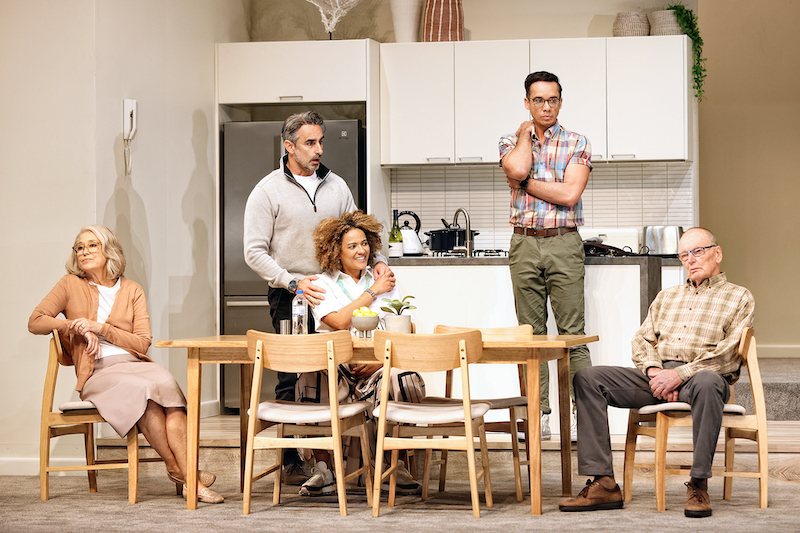
In her latest Tony-nominated comedy, “Grand Horizons” we encounter Nancy and Bill who are 50 years into the picture-perfect marriage. Now, as they settle into the beige walls of their new ‘lifestyle village,’ Nancy announces she wants out and Bill seems to acquiesce.
For their two grown-up sons, it’s a devastating betrayal. Their long-held beliefs about love, family and security are shaken.
The play premiered earlier this year in Sydney where the Sydney Morning Herald said ‘On the surface it is a textbook sitcom from the versatile but undemonstrative kitchen sink set and understated costumes, to the instantly recognisable characters – the grumpy old man, the put-upon wife, the grown-up kids who aren’t sure who’s meant to be the grown-up.
“The revelations, such as they are, are not shocking – at least, not to the audience – and the reactions almost comfortingly predictable. But the power of minute observations builds as the play unfolds.”
“There is a beautiful clarity at the heart of “Grand Horizons”. A big part of this is Wohl’s story, which transforms an everyday family saga into a deftly constructed story arc paced with show-stopping side-tracks and dramatic punchlines.”
The play was so successful in Sydney that it is having another season at the same time as ATC’s
Wohl has become one of the leading playwrights in the US at the moment having written nine plays since 2010 all of which display a wry humour and unerring sense of the way people talk and relate to each.
“Grand Horizons” is directed by Jennifer Ward-Lealand and stars Roy Billing and Annie Whittle.
“Lysander’s Aunty or A Most Rageful Irreverent Comedy Concerning an Offstage Character from A Midsummer Night’s Dream” by Ralph McCubbin Howell 17 Mar – 3 Apr
Jumping from Athens to Aotearoa, with a cast of New Zealand’s finest comic talent, this is an uproarious wild ride of magic, mayhem and mutiny.
In William Shakespeare’s “A Midsummer Night’s Dream”, young lovers Lysander and Hermia defy the Duke by eloping to an aunt’s house in the woods. But just who is this anti establishment aunt who is not much more than cypher.
Explaining the plot of the play, McCubbin Howell says, “Reading A Midsummer Night’s Dream” a few years ago, I was struck by the fleeting mention of Lysander’s Aunt. She is introduced as someone who might help the young lovers defy Athens law and elope in the woods, but the plot then takes another turn and she never gets mentioned again. Shakespeare is littered with characters like this, but this one in such a well-known play seemed particularly intriguing. Who is this law-snubbing, free-loving aunty? Why is she in the woods? And what’s she doing helping runaway lovers elope?
The play takes a similar approach as Tom Stoppard did with his “Rosencrantz and Guildenstern Are Dead” in imagining some of Shakespeare’s characters beyond the confines of the original play
With quick, witty dialogue and a pacey plot, Lysander’s Aunty or A Most Rageful Irreverent Comedy Concerning an Offstage Character from A Midsummer Night’s Dream is a brand-new, energetic, large-ensemble production led by award-winning Trick of the Light duo, director Hannah Smith and writer Ralph McCubbin Howell.
“Witi’s Wāhine by Nancy Brunning 10 – 28 May
“Witi’s Wāhine” tells of four Māori women taking their journeys through history and mythology, sharing tears, jokes and waiata along the way. But these are no ordinary women – they’re matriarchs of New Zealand fiction, finally stepping out from the shadows.
In Witi Ihimaera’s books, characters spring from the page, fully formed and opinionated. Here, some of his most memorable characters, from works like The Parihaka Woman, The Matriarch and Pounamu, step onto the stage.
The result is “Witi’s Wāhine”, a love letter or, more accurately, a love song, to the women of Te Tairāwhiti, the East Coast, who inhabit Ihimaera’s writing: the wāhine of his own whānau. Nancy Brunning has crafted a story that fuses loving tribute with powerful commentary, levity with unflinching reality, sensitivity with warm affection.
Reviewer Simon Wilson said of the production that it serves up “the richness of culture and the wonder of people, with all their warts, with all the laughter and the singing and the pain.” Originally devised and directed by the late Nancy Brunning, we proudly present this Hapai Productions performance of words and song, re-directed by Waimihi Hotere and with a special appearance by Ihimaera’s irresistible ngā tuāhine.
“Witi’s Wāhine” is a co-production between Auckland Theatre Company and Hāpai Productions.
Sydney Theatre Company’s production of “Grand Horizons”
ATC 2022 Season
John Daly-Peoples
The first three productions of the Auckland Theatre Company for next year offer a good range of work from overseas and local dramatists with three very accessible works.
“Grand Horizons” by Bess Wohl 8 Feb – 5 Mar
In the absence of a new Roger Hall play ATC have turned to the American playwright Bess Wohl who mines similar territory to Sir Roger.
In her latest Tony-nominated comedy, “Grand Horizons” we encounter Nancy and Bill who are 50 years into the picture-perfect marriage. Now, as they settle into the beige walls of their new ‘lifestyle village,’ Nancy announces she wants out and Bill seems to acquiesce.
For their two grown-up sons, it’s a devastating betrayal. Their long-held beliefs about love, family and security are shaken.
The play premiered earlier this year in Sydney where the Sydney Morning Herald said ‘On the surface it is a textbook sitcom from the versatile but undemonstrative kitchen sink set and understated costumes, to the instantly recognisable characters – the grumpy old man, the put-upon wife, the grown-up kids who aren’t sure who’s meant to be the grown-up.
“The revelations, such as they are, are not shocking – at least, not to the audience – and the reactions almost comfortingly predictable. But the power of minute observations builds as the play unfolds.”
“There is a beautiful clarity at the heart of “Grand Horizons”. A big part of this is Wohl’s story, which transforms an everyday family saga into a deftly constructed story arc paced with show-stopping side-tracks and dramatic punchlines.”
The play was so successful in Sydney that it is having another season at the same time as ATC’s
Wohl has become one of the leading playwrights in the US at the moment having written nine plays since 2010 all of which display a wry humour and unerring sense of the way people talk and relate to each.
“Grand Horizons” is directed by Jennifer Ward-Lealand and stars Roy Billing and Annie Whittle.
“Lysander’s Aunty or A Most Rageful Irreverent Comedy Concerning an Offstage Character from A Midsummer Night’s Dream” by Ralph McCubbin Howell 17 Mar – 3 Apr
Jumping from Athens to Aotearoa, with a cast of New Zealand’s finest comic talent, this is an uproarious wild ride of magic, mayhem and mutiny.
In William Shakespeare’s “A Midsummer Night’s Dream”, young lovers Lysander and Hermia defy the Duke by eloping to an aunt’s house in the woods. But just who is this anti establishment aunt who is not much more than cypher.
Explaining the plot of the play, McCubbin Howell says, “Reading A Midsummer Night’s Dream” a few years ago, I was struck by the fleeting mention of Lysander’s Aunt. She is introduced as someone who might help the young lovers defy Athens law and elope in the woods, but the plot then takes another turn and she never gets mentioned again. Shakespeare is littered with characters like this, but this one in such a well-known play seemed particularly intriguing. Who is this law-snubbing, free-loving aunty? Why is she in the woods? And what’s she doing helping runaway lovers elope?
The play takes a similar approach as Tom Stoppard did with his “Rosencrantz and Guildenstern Are Dead” in imagining some of Shakespeare’s characters beyond the confines of the original play
With quick, witty dialogue and a pacey plot, Lysander’s Aunty or A Most Rageful Irreverent Comedy Concerning an Offstage Character from A Midsummer Night’s Dream is a brand-new, energetic, large-ensemble production led by award-winning Trick of the Light duo, director Hannah Smith and writer Ralph McCubbin Howell.
“Witi’s Wāhine by Nancy Brunning 10 – 28 May
“Witi’s Wāhine” tells of four Māori women taking their journeys through history and mythology, sharing tears, jokes and waiata along the way. But these are no ordinary women – they’re matriarchs of New Zealand fiction, finally stepping out from the shadows.
In Witi Ihimaera’s books, characters spring from the page, fully formed and opinionated. Here, some of his most memorable characters, from works like The Parihaka Woman, The Matriarch and Pounamu, step onto the stage.
The result is “Witi’s Wāhine”, a love letter or, more accurately, a love song, to the women of Te Tairāwhiti, the East Coast, who inhabit Ihimaera’s writing: the wāhine of his own whānau. Nancy Brunning has crafted a story that fuses loving tribute with powerful commentary, levity with unflinching reality, sensitivity with warm affection.
Reviewer Simon Wilson said of the production that it serves up “the richness of culture and the wonder of people, with all their warts, with all the laughter and the singing and the pain.” Originally devised and directed by the late Nancy Brunning, we proudly present this Hapai Productions performance of words and song, re-directed by Waimihi Hotere and with a special appearance by Ihimaera’s irresistible ngā tuāhine.
“Witi’s Wāhine” is a co-production between Auckland Theatre Company and Hāpai Productions.
I first wrote about Billy’s exhibition “Good as Gold at the Auckland Art Gallery in 1991 and endeared myself to him by comparing him to Michelangelo. This was not in connection with the Renaissance masters work but the way in which he focused on the everyday in his writings. Here he was interested in the price of common goods, art supplies, food and wine.
In 2010 in an article which referred to the deification of Billy Apple I compared him to artists who immortalise themselves with self-portraits such as Michelangelo with his painting of his own flayed skin in the Sistine Chapel’s “The Last Judgement” or Velazquez including himself in “Las Meninas”. This was in connection to his work with the scientist Craig Hilton. I noted that Billy would be preserving his image in a more novel way, preserving biological cells extracted from his blood with some of his 40 million cells being kept forever.
I wrote an article in 2011 about Minter Ellison Rudd Watts text painting with black and white lettering on a red background which bears the words “$100,000 Credit Held By Billy Apple For Legal Servicers From Minter Ellison”. This was one of the artist’s major transactional works It was negotiated in 2008 with artist using the credit to employ MERW staff to register his name as a trademark.
In 2012 which was the 50-year anniversary of the Billy Apple® brand he worked with Waiheke winemakers to produce the Billy Apple®: Official Selection which featured premium red wines from the 2010 vintage from the Waiheke vineyards of Kennedy Point, Man O’War, Miro, Obsidian, Peacock Sky and Poderi Crisci.
I noted that the 50 cases were numbered from 1962 through to 2012, the years of his practice and were priced accordingly: $1962 for gallery members and $2012 for non-members. The design of the case, and the layout of the show, will also followed one of his defining traits in using the Golden Section.
Billy had previously produced his Good as Gold golden rosé with Robard and Butler which came either as a single 375ml bottle or a case of sixteen.
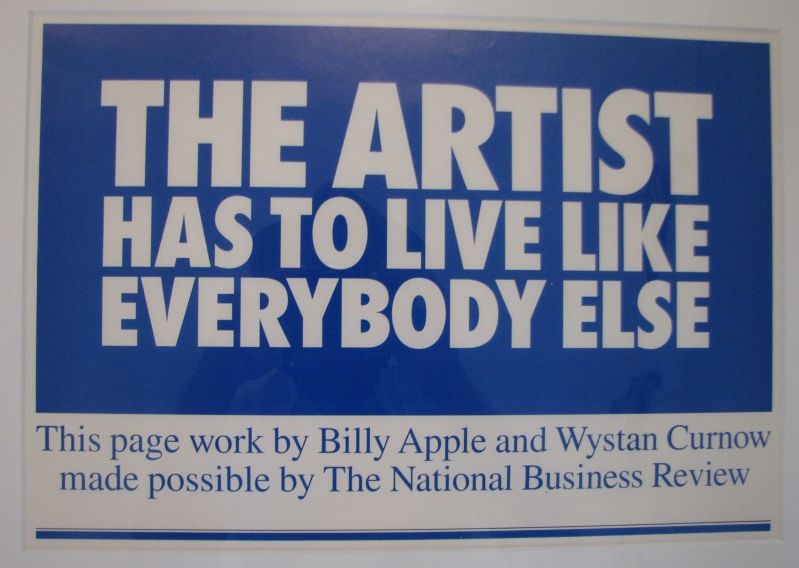
In 2015 in reviewing “The Artist has To Live Like Everybody Else” I noted that audiences could get to see the artist “work” without entering the gallery as for the duration of his exhibition the artist had been allocated a parking space on the forecourt of the Auckland Art Gallery. How do you get Auckland Transport and a host of bureaucrats to agree to something like that? It’s all part of the mystery, magic and manipulation of the artist who doesn’t get to live like everybody else.
Altogether I wrote about a dozen reviews of Billy’s work including a review of the film “Being Billy Apple “. This was one of the “one minute” video reviews I did on the NBR film review site
Every time I wrote something about Billy I would get a phone call as he wanted a copy and not just the article itself. He needed to have the full copy of the paper.
I worked with Billy on a few projects for National Business Review. The first of these was a page work around his notion of “The Artists has to live like everybody else”
The work ended up being on what would have been the back page of the paper but was actually two pages in from the back as another project I was engaged at the time with NBR was a wrap-around for the paper promoting the 1993 exhibition “Rembrandt to Renoir” at the Auckland Art Gallery.
This wrap-around meant the advertiser who was going to be on the last page of the paper no longer had their prime position and declined to proceed so there was no advert to go on the final page. Discussion with the editor Nevil Gibson, owner Barry Colman, Wystan Curnow and Billy meant I was able to do a rush job and got the full (back)page for Billy. This “The Artists has to live like everybody else” piece was Billy’s first page work in a financial paper and we also produced a limited edition of over runs printed on clean paper.
Barry Colman was slightly mystified as to why I kept trying to get NBR sponsor / promote Billy and was also curious about another deal we did with Billy, paying for his airfare to Australia to attend on of his exhibitions. In return NBR got Billy’s duplicate Air NZ ticket. This was one of the then current style of tickets with red printing, a colour which worked well for Billy at the time but ultimately faded.
Barry Colman was delighted a few years later when the framed ticket with its acknowledgement of NBR was used as advertising material for an overseas show of New Zealand art.
I also worked with Billy on a poster for a political campaign when I stood for the ACT Party in the Auckland City Council elections in 1992. This ACT Party was the Auckland Community Team and used the acronym two years before the present ACT Party was formed in 1994.
Between 2005 and 2012 I worked with Bob McMillan BMW, commissioning artists to paint on the display bonnets of BMW Series 7. Each year these ten works were auctioned for various charities
I was aware that Billy was interested in being asked to work on one of these but I also realised that Billy was always very particular about how he went about commissioned works and the difficulties that could ensue so didn’t ask. However, he approached Bob McMillan directly (who serviced his Mini) about being involved and Bob agreed.
Normally with the bonnet commissioned I would deliver the unpainted bonnet to the artist and then collect the completed work a couple of months later. This was not how Billy worked.
First, he required that bonnet be spray painted by an official BMW approved spray painter in the specific white he wanted. The painted bonnet was then to have two apple logos painted by his painter, Terry Maitland. The diameter of these apples was to be the same as those of the Series 7 headlights. I told Billy I would measure them. Again, that was not how it was done. He required facsimile of the original design drawings of the car to be sent from Germany which would include the actual dimensions.
At the exhibition of the works Billy was a bit upset that I wouldn’t agree to have his work hung so that the two circular apple logos were not at the height the two “headlights” would have been above the road surface. At the auction Billy’s work sold for over $10,000, one of the highest prices paid for one of the bonnets
When I was Arts Manager at Manukau City I curated “The Alphabet Show” where artists were sent a single sheet of A4 drawing paper and were asked to draw/paint the first letter of their surname. Billy did a set of lower case “a” for the show.
One commission from that time never came to fruition. One of the Manukau City art galleries, Nathan Homestead had extensive outside areas where sculptural shows were held. One area was the old grass tennis court. Billy was going to use the principles of the Golden Section to turn the area into one of his art works. The project involved placing the net at the point of division based on the Golden Section ratio. A couple of his requirements were going to pose problems. There would need to be a new tennis net which conformed to his measurements and new stanchions to support it. The other issue concerned the lawnmower which would be used to cut the grass. The grass on one side of the net would be cut at one height and the grass on the other side at another height – again determined by the Golden Section ratio.
What had Billy overly concerned was the fact that the lawnmower adjustments were in inches. This meant that we would have to design a new system of adjustment which would have millimetres in order for the grass to be cut to the right height.
It was at this point I sent Billy a letter saying that I was not proceeding with the project as I would not be able to do justice to it.
Over the years I have collected a few of Billy smaller works including the ACT political poster, some of his prints, as well as his coffee and wine. I also have one of his “The Artist has to live like everybody else”. This is a handwritten note on an envelope which had been sent to him asking me to go over to the North Shore and pay Bernie for the repair to his car.
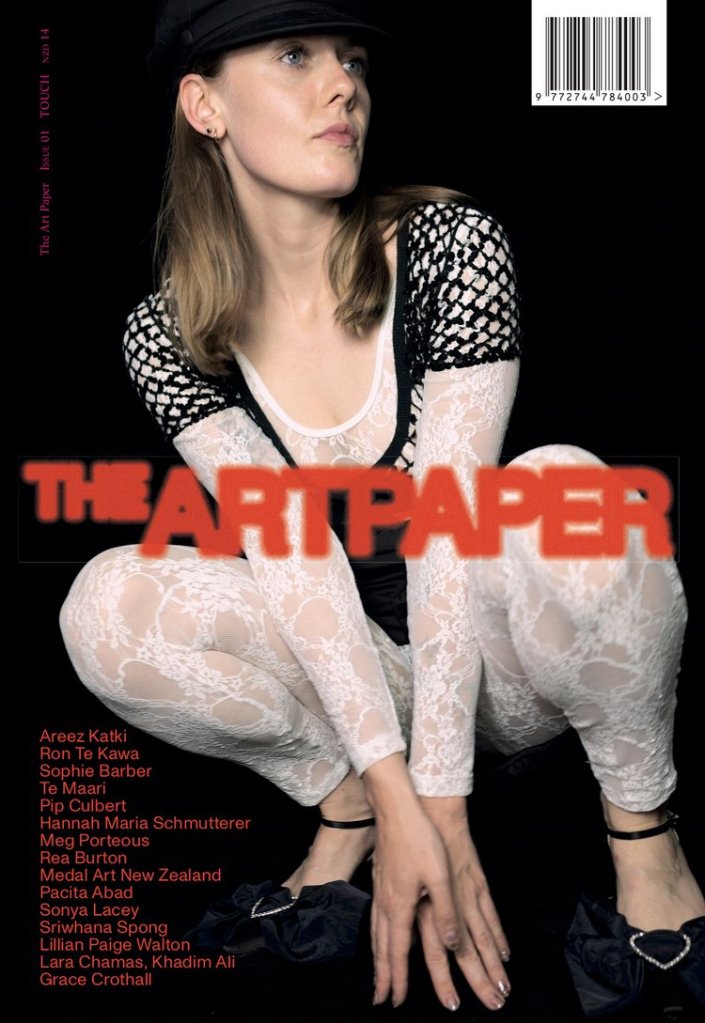
A new art quarterly, The Art Paper has just hit the shelves bringing another set of voices to local arts writing. A number of the articles are about international shows which provide something of a context for contemporary New Zealand practice.
This first edition features twenty articles, interviews and art pieces about local and international artists some of them senior, others newly emerging.
In an article and interview by Bronwyn Lloyd with Marte Szirmay the artist discusses her involvement with Medal Art New Zealand (MANZ) whose members produce a range of cast, objects which can be one sided, two sided or three dimensional. Szirmay talks about the personal, political and aesthetic influences on her own work. The article also serves as a review of the MANZ annual exhibition earlier this year.
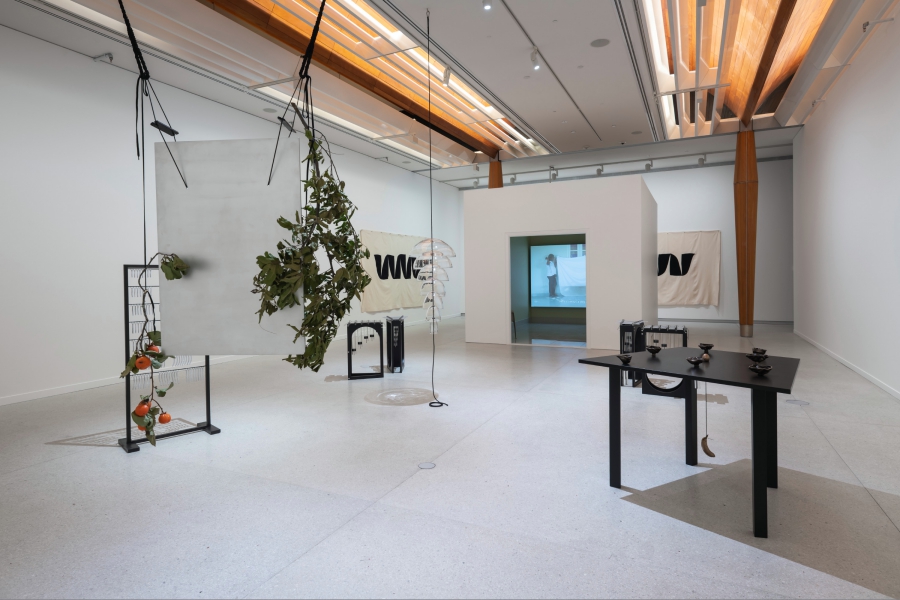
There are two stimulating articles related to the recent Walters Prize. One by Victoria Wynne-Jones on Sonya Lacey’s “Weekend” and Natasha Conland’s on Sriwhana Spong’s “The Painter-Tailor.” These two works both have complex backgrounds which are explored in the two articles.
Sriwhana Spong, “The Painter-Tailor.”
Rea Burton is examined by Millie Dow with work which includes self-portraits as well as her take on other artists such as her reworking of Manet’s “Bar at the Folies Bergère”. Also in the publication are a set of fashion photographs of the artist by Meg Porteous (including the cover image).
There are articles which focus on fabric arts including a piece about Pip Culbert’s final exhibition at Artspace by Christina Barton and an extensive interview with fabric artist Ron Te Kawa about his tapestry / quilts as well as one on Te Maari’s “Manu Figures.
Lillian Paige Walton, Vagabond
There are several reviews from abroad with Vivian Lee discussing Lillian Paige Walton’s “Six Drawings” at the Kings Leap space in New York. Talia Smith’s reviews “The entrance to Paradise lies at your mother’s hand” by Lara Chamas at Melbourne’s Gertrude Contemporary and Khadim Ali’s show “Invisible Borders at the Institute of Modern Art in Brisbane. Chamas in Lebanese and Ali from Afghanistan and there works have a strong political aspect to them.
Editor Becky Hemus and Art director Felix Henning-Tapley have integrated a few inventive aspects into the publication. As well as the traditional articles and images there are text works, handwritten notes, drawings, poetry and advertisements which function as artworks.
Copies of The Art Paper are available from a number of locations nationally
For sixty years Michael Smither has painted his immediate environment – his family, the objects he was surrounded by and the landscapes he inhabited.
These landscapes began in New Plymouth with paintings that often featured the rocky shore and the ever-present Mt Egmont/Taranaki and he later moved to the Coromandel where he continued to paint the local landscapes.
While his early landscapes are crisp with light colour and detail he has progressively abstracted the colours and shape he finds in these landscapes and his latest exhibition sees him further creating simplified expressionist approach.
Where his early works had an emphasis on surface and light his later works and particularly the works in his latest exhibition “Here & Now” are focussed on light and colour. These colours are connections to some of his previous works where music and colour have harmonic relationships.,
These expressionist landscapes convey mood and spirituality, echoing the desire of artists from medieval times to convey ideas through the wonder of intense colours as was seen in the stained glass of churches – an interest also seen in Colin McCahon’s ecclesiastical projects with James Hackshaw.
“Here & Now” can be seen as a reference to and a recreation of the landscape images which were produced on Cooks first voyage to New Zealand. The reference to those often stacked profile drawings of the coastline can be seen in the large “Coromandel Peninsula Quintet” which as well as depicting the changing landscape forms also capture the changing moods of the area.
Where Cooks images were designed to record the changing landscape forms for future navigators Smither aims to create effects of colour, light and atmosphere with images of emotional power that appeal to the viewers’ senses.
There are impressionist flourishes in some of the works, particularly obvious in “Rain Squalls, Kennedy Bay” where the bands of rain are more like columns of light.
There are also surreal aspects to some of the work with the bulbous clouds and crumpled landforms in “Haka”
Michael Smither, Kennedy’s Bay
The use of colour to convey the effects of light can be seen in “Kennedy’s Bay” where the shimmering yellow behind the two sentinel-like headlands sharpens their outline.
A couple of the works take an almost abstract approach. In “Towards the End” the blue hills of the landscape appear to merge with the background and in the masterly “Peninsula Rain Squall” colour and light infuse the landscape so the forms begins to dissolve.
In this series of works Smither has created landscapes that are part representation and part dreamscapes where the interplay of bold light and intense colour convey the aura or mana of the landforms, sea and sky.
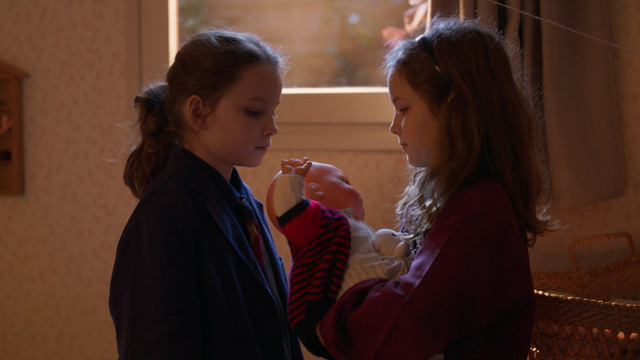
Joséphine Sanz (Nelly) and Gabrielle Sanz (Marion)
Petite Maman
Directed by Céline Sciamma,
In Cinemas From November 25
Reviewed by John Daly-Peoples
With her latest film “Petite Maman” director Céline Sciamma as in her previous film “Portrait of a Woman on Fire” examines a surreal and sensitive relationship, not between adults but between two children.
After the death of her grandmother, eight-year-old Nelly (Joséphine Sanz) helps her mother Marion (Nina Meurisse) and her father ( Stéphane Varupenne) with clearing out her house in the country which is surrounded by woods.
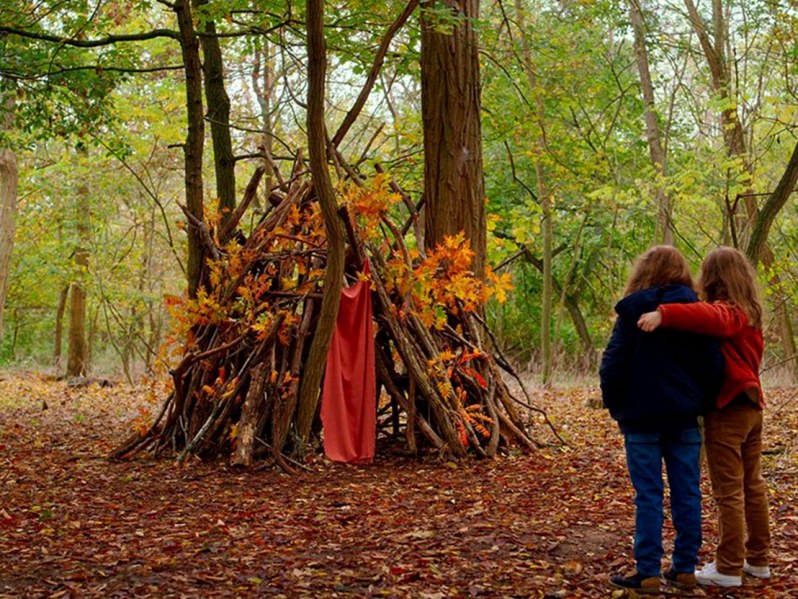
Her mother who has told Nelly about the tree house she made in the woods as a child leaves for a few days during which time Nelly wanders the woods where she meets another young girl who is building a pyramidal shaped tree house.
This young girl Marion (Joséphine’s twin sister, Gabrielle Sanz). shares her mother’s name, Marion, and lives in a nearby house that is strangely similar to her to her grandmother’s house.
The two children are at the core of the film and we observe a world belonging to them and their imagination. They develop a relationship in which imagination and reality are interwoven. Hinted at throughout the film are themes of innocence death, loss and memory
The two children develop a sisterly relationship and play out a scenario in which roles of mother and daughter are explored and where one of them is their future parent. The story takes on the sense of mythic tale, in which Nelly crosses paths with a ghost of her mother. The film dwelling on death, disruption and memory can be seen in the reflecting back on the three generations of Nelly’s family and the forthcoming medical procedure that the child Marion is about to undergo .
This slightly surreal encounter is emphasised by the two children looking alike and the use of the same house used for the interior shots with slight changes of décor.
In one bizarre scene the children row a small boat on a lake where they encounter a concrete pyramid set in the middle of the lake (Axe Majeur near Paris) providing a sense that they have entered a time preserving structure.
The two Sanz sisters give extraordinary performances conveying the behaviours and thoughts of children as well as displaying the maturity and sophistication of adults.
This slow moving, coming of age film brilliantly captures the lives of two children losing their innocence and growing in emotional maturity.
Next year’s NZ Opera season seems designed to cater for the full range of opera lovers. It opens with one of the great musicals and closes with one of the great operas. In between there are several New Zealand works drawing on ancient and recent history
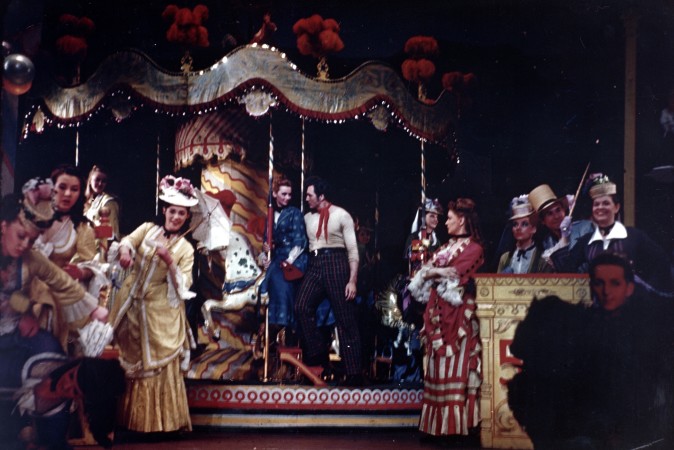
The first work on the programme and only being performed in Auckland will be a concert version of Rodgers & Hammerstein’s “Carousel” which was named Time magazine’s best musical of the 20th Century saying that it set the standards for the 20th century musical and features their most beautiful score and the most skilful and affecting example of musical storytelling.
In a first for opera in New Zealand it will be performed on a stage moored in the water at Wynyard Wharf.
The story tells of carnival barker Billy Bigelow and mill worker Julie Jordan who fall in love. After their marriage ends things go downhill driving Billy to commit crimes and he falls in with con-man Jigger Craigin. He gets caught in the midst of an armed robbery and takes his own life. Billy is allowed to return to earth for one day 15 years later where he encounters Louise, the lonely daughter he never knew.
Richard Rodgers said the show was his favourite of all their musicals, “Oscar never wrote more meaningful or more moving lyrics, and to me, my score is more satisfying that any I’ve ever written.” The work has some notable songs including “If I Loved You“, “June Is Bustin’ Out All Over”, This Was a Real Nice Clambake” and “You’ll Never Walk Alone“..
The production will be directed by Jacqueline Coats and conducted by Paul Christ with costumes designed by Elizbeth Whiting. The cast will include Christian Thurston as Billy, Joanna Foote as Julia Jordan and Bridget Costello as Carrie Pipperidge.
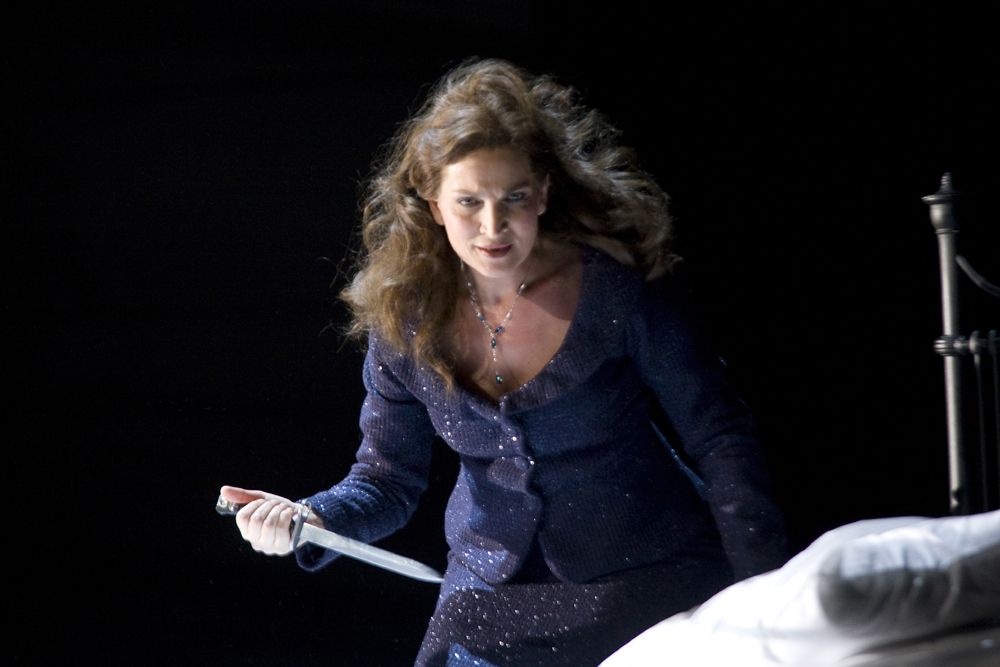
NZ Opera’s 2010 production of Macbeth. Antonia Cifrone as Lady Macbeth Photo credit Bill Cooper
The great traditional opera which closes the season will be Giuseppe Verdi’s “Macbeth” which features a libretto by Francesco Maria Piave based on the play by William Shakespeare.
There are any number of politicians who could have written the script for Verdi’s Macbeth. The combination of personal power struggles, moral debate and the small events from our past coming back to haunt one are all too familiar political themes. They are the major themes of the opera in which a man and his wife, impelled by prophesies that predict he will have greatness thrust upon him decides to take that greatness by force.
Macbeth and Lady Macbeth are driven by personal greed for power and status. They are inspired by witches or fates and they understand that such prophesies do not come from Heaven but rather the darker reaches of the next world.
In accepting what has been prophesied they give over their lives to the Fates. They allow themselves to commit evil deeds, opting out of the moral issues by accepting it that was happens has been foretold.
Lady Macbeth is more dominant than in the original Shakespeare play. Of all the dictators wives she comes close to a combination of Eva Person and Madame Mao, a mixture of the concerned, hectoring and malevolent wife.
While Verdi’s music is not the most memorable of his works, the opera sweeps along with fast paced action and vigorous music which provides an emotional framework for the gruelling and gruesome tale of murder and mayhem.
This new production by Netia Jones, conducted by Christopher Franklin, features Phillip Rhodes and Amanda Echalaz as Macbeth and Lady Macbeth along with Wade Kernot, Jared Holt, Emmanuel Fonoti-Fuimaono, Morag Atchison and the New Zealand Opera Chorus.
The Unruly Tourist
Breaking all the stereotype about opera will be the comedy “The Unruly Tourists”. Written by the award-winning duo of Livi Reihana and Amanda Kennedy (The Fan Brigade) and composed by Luke Di Somma. It will revisit the summer of 2019 when a group of English tourists became the stuff of legends, wreaking havoc around the country.
“Just a great story, a great yarn with larger-than-life characters, and a New Zealand public who responded in a way that only New Zealand responds,” composer Luke Di Somma says.
The tourists were first spotted littering but were then soon destroying hotels, not paying for food, stealing from service stations and ended up in court.
Presented by New Zealand Opera and Auckland Arts Festival at the Bruce Mason Centre, in Takapuna where it all started.
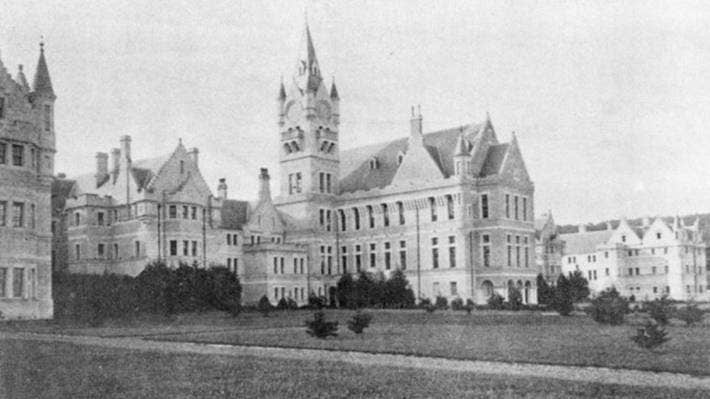
Seacliff Hospital
A poignant and imaginative reflection on events during Janet Frame’s time at Seacliff Mental Hospital, “The Strangest of Angels” is a harrowing and hopeful experience that throws light on mental health then and now.
Co-created by Kenneth Young, Georgia Jamieson Emms and Anna Leese, The Strangest of Angels is born of an exciting and conscious collaboration between composer and performers that explores the contrast between a calm, rational psychiatric patient and a traumatised nurse torn between empathy and the relative power of institutional duty.
World premiere performances directed by Friedlander Foundation Associate Artist Eleanor Bishop and starring Anna Leese and Jayne Tankersley.
Ihitai ‘Avei’a – Star Navigator
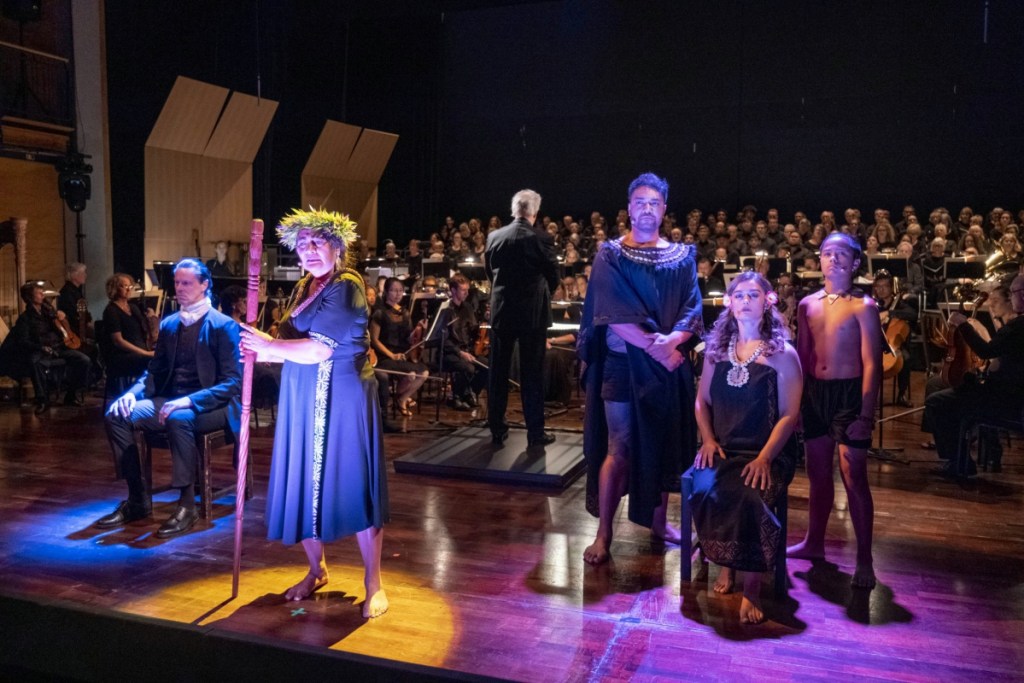
Ihitai ‘Avei’a – Star Navigator which premiered earlier this year at the Auckland Arts Festival is set onboard a cramped British scientific vessel in the vastness of the Pacific where two navigators find themselves locked on a collision course.
One is a Tahitian priest, guided by his ancient knowledge of star pathways. The other a naval officer, desperate to prove both himself and his faith in science.
This work by composer Tim Finn, co-composer Tom McLeod, with Tahitian monologues by Célestine Hitiura Vaite, tells the story of Tupaia, the Tahitian star navigator who sailed with James Cook, on the maiden voyage of the Endeavour in 1769. Ihitai ‘Avei’a – Star Navigator explores the relationship between two master mariners, each from vastly different worlds, both far from home and unable to find their way into each other’s world.
A review by Clare Martin of the original production of the work noted the production “took the audience by storm, a wall of glorious orchestral sound from Manukau Symphony and choral forces providing commentary and colour for this important story. With conductor Uwe Grodd drawing together these elements with fluent ease and Tim Finn himself at the piano, the ocean voyage began.
Any scepticism that the world of rock could find credibility in opera was dispelled within minutes of the mini-Overture. With a vast aural landscape, it was a hugely exciting and affecting ride. Musical materials were never reductive but rather a fresh and broad sonic scape was presented by Finn. Taonga pūoro (Māori flute) and orchestra blended in rich and genuine expression.
Huia
In a new work “Call of the Huia” Michael Vinten takes the audience on an entertaining, informative and frequently fascinating journey of discovery through the forgotten world of the Art Song of Aotearoa.
The now extinct huia was a rare and tapu bird living mainly on the east coast of the North Island. Their calls were mostly a varied array of whistles, “peculiar and strange”, but also “soft, melodious and flute-like.”
Highlights will include works from his collection of mainly unpublished pre-1950 New Zealand Art Songs. These songs – sung by our grandparents and great-grand parents – provide a glimpse into the preoccupations and concerns of their times through peace and war. Discover the significant contribution of women both Māori and Pākehā to music-making of this period as composers and poets.
The work will dispel any notions that there was nothing much happening musically in New Zealand before the Second World War revealing a forgotten chapter of Aotearoa’s musical legacy
Carousel
Wynyard Wharf February 11 – 14
The Unruly Tourists
Bruce Masson Theatre March 9 =- 13
Star Navigator
Te Rauparaha Arena, Porirua, May 13 – 14
The Strangest of Angels
The Piano Christchurch, 27 – 28 May
Mayfair Theatre, Dunedin, October 14-15
Call of the Huia
The Piano Christchurch, July 31
Public Trust Hall, Wellington, August 7
Concert Chamber Auckland, August 14
Macbeth
Aotea Centre, Auckland, September 21 – 25
St James Theatre, wellington, October 5 – 9
Isaac Theatre Royal, Christchurch, October 20 – 22












 New Zealand Arts Review