Categories
Reviews, News and Commentary

Portrait of a City. Wellington Architecture: A Walking Guide

Reviewed by John Daly-Peoples

Wellington Architecture: A Walking Guide

John Walsh and Patrick Reynolds

Massey University Press

RRP $30.00

Reviewed by John Daly-Peoples

John Walsh and photographer Patrick Reynolds have just launched “Wellington Architecture, A Walking Guide” their third book in the series of architectural walking tours following on from their books on Auckland and Christchurch. It is a great addition to books which explore and explain our built environment.

 John Walsh in the introduction notes that he was born in Wellington which was as “compact and confined as a medieval city-state, intensely impressed itself on me, in the most impressionable part of my life. My mother had moved to Wellington where she met my father, and they were married in the church at St Gerard’s Monastery. I remember the Freyberg Pool, where I learned to swim; the summer lights strung on the Norfolk pines along Oriental Parade; and the council yard where my father worked, next to the Herd Street Post and Telegraph Building. My high school was near the old National Art Gallery and Dominion Museum; we’d be sent to mass at St Mary of the Angels and, in blazers and ties, despatched from Wellington Railway Station on rugby expeditions into the hinterlands of the Hutt Valley.”

Public Trust Building

This reviewer also grew up in  Wellington, living in the National Hotel  across from  the corner of Stout St and  Lambton Quay. From our front room we had an impressive architectural vista including The Public Trust Building The Government Departmental Building and The State Insurance Building. Further down the street was the Wellington Railway Station  and the Seamans Mission Building.

On my way to school I passed  Ernst Plischke’s Massey House, The Old Supreme Court, The Old Government Building, The Beehive, Parliament building, the General Assembly Library, Turnbull House and the rather unfortunate Cathedral of St Paul. These were the background to my life at the time and it was only when I moved to suburban Karori that I noticed the difference in my daily environment.

Shed 7, Wellington Harbour Board

The place of architecture in our environment and in our personal and social history is important often more noticeable when we are in foreign cities. A city’s buildings are important in defining the nature of a place. When visiting a place for the first time the visitor will map a city through its buildings. The materials, the orientation, the colours, the decoration and the forms all help create the language of the way the city is perceived.

The buildings of Auckland Wellington and Christchurch have many similarities but the accumulation of the various periods of construction and styles in each of those places has created very individual environments.

“Wellington Architecture, A Walking Guide” features more than 120 significant buildings describing their purpose and history as well as  providing a background on  the architects who designed them. The buildings are grouped into five self-guided walking routes, each with a map together with itineraries which collectively create a portrait of the  city.

St John’s

The building are  a mix of colonial, nineteenth century Gothic, mid-century modernism and buildings of the last fifty years illustrating the changing nature of the architecture along with the changing nature of New Zealand and the city. The buildings are banks, businesses, government departments, churches, apartment buildings libraries, hotels, apartments, and a few  private houses.

One of the tours features several of the government institutions surrounding Parliament including the Old Government Building (now the Victoria University Law School) and one on the largest wooden buildings in the world, all those other buildings I passed on the way to school along with the more recent  brutalist National Library and the modernist Freyberg Building.

Several architects feature with a number of buildings such as Gummer & Ford, Thomas Turnbull and Ian Athfield who is represented by the Wellington Library (soon to be demolished), his quirky First Church of Christ Scientist and his Oriental Parade flats as well as a few, often controversial,  additions he made to existing buildings

DeLoitte, 20 Customhouse Quay

While all the buildings are significant there are a number  scattered through the  walk which have importance beyond their architectural qualities. There are the Dixon Street Flats which were the first multi-story modernist block of flats created under the First Labour Government which show the influence of overseas trends introduced to New Zealand by Plischke.

There is also the remarkable Futuna Chapel designed by John Scott the Māori architect who managed to combine aspects of Māori and mainstream architecture. Walsh notes that Futuna is  one of the few buildings one could refer to as “iconic”.

Walsh writes in an informative style, providing wide ranging information to provide a context for the buildings so that while the book is an ideal complement to a walking tour of the city it is also provides a potted history of the social, political and aesthetics development over 150 years in the city as seen through the buildings.

The photography of Patrick Reynolds enhances the text with many of them showing an appreciation of the design elements of the buildings, 

Anscombe Flats
Categories
Reviews, News and Commentary

Belinda Griffiths portraits emerge from chaos

Reviewed by John Daly-Peoples

Belinda Griffiths, Gesture IV

Belinda Griffiths, Exhale

Föenander Galleries, Mt Eden

Until April 20

Reviewed by John Daly-Peoples

Belinda Griffiths latest exhibition “Exhale” at Föenander Galleries is largely of figures or portraits, employing gestural marks which derive from both the rigorous marks of the calligrapher as well as the emotional and spontaneous gestures of artists such as Max Gimblett.

We are rarely aware of the action of exhaling but when we focus on the way we breathe we become conscious of our environment and our connection with it in a much intimate way, aware of the physicality of the activity. So, with these works she  touches on the nuances of the person, and their awareness of their environment – physically, cerebrally and spiritually.

The gesture in art has been a way for artists and performers to embellish or emphasise their intentions. Actors making grand flourishes, composers with extravagant chords,  musicians with ostentatious ornamentation while visual artists employ colour, contrast and brush strokes to catch the eye.

The gestures of Griffiths range from the light touch  to the dramatic providing a sense of the individual surrounded by or emerging from unrest and  disorder, evoking Milton’s lines from “Paradise Lost”

“ In the Beginning how the Heav’ns and Earth
Rose out of Chaos

With many of her faces the individual is in a meditative pose lost in their own thoughts or reveries but around them swirl lines which emanate from the body or from an outside presence .

The gestural mark of the brush in “Gesture III” ($3000)  becomes the swell of sinews while in “Exhale” ($6800)  these marks may be the outline of exhaled breath and equally the swirling thoughts of the individual.

In Gesture IV” ($3000) the paint itself seems to lift of the surface creating a three-dimensional effect and in “Drift” ($2500) the gesture becomes the dramatic hair style of the figure. With “Intertwined” ($6800) the figure is almost obliterated by the swelling brushstrokes.

A couple of the works don’t relate to the figure and more to the chaos around them with the more abstract “Unwind” ($2200) and “Windswept” ($2200) describing a rugged  landscape with ragged clouds.

There is also a small suite of works in which  figures are  set in landscapes. In “Inhale #6” ($700) a solitary figure seems to confront a swirling  cloud  while in “Inhale #3” ($700) the figure is either emerging or disappearing into a  churning mist.

The small  works in the show are all monotypes but she has also used the technique on some of the larger works and one work “Untethered” has been applied directly to the wall of the gallery.

Categories
Reviews, News and Commentary

Mt Eden’s boutique chamber music festival on in April

John Daly-Peoples

NZ Trio

Mt Eden Chamber Music Festival

Mt Eden Village Centre

Friday 29 April to Sunday 1 May

John Daly-Peoples

Next month will see the return of the boutique Mt Eden Chamber Music Festival which has been delayed twice because of Covid.
The festival offers three one-hour concerts over the course of the weekend, featuring an impressive line-up of New Zealand’s top classical musicians including two important chamber ensembles along with APO Section Principals.

Friday 7pm

NZTrio 

Amalia Hall (violin), Ashley Brown (cello) and Somi Kim (piano)

Christos Hatzis, Old Photographs

Salina Fisher, Kintsugi

Brahms, Piano Trio No

Brahms’s Piano Trio No. 1 began as a  youthful work which was completing in January 1854, when he was 21. This trio version was substantially revised in 1889, 35 years later, so it is a work separated by three-and-a-half decades of experience.

Hatzis’ work is part of his larger “Constantinople”  which  draws on his Greek heritage. It is filled with music which touches on remembering and romancing with sounds from gospel, Sufi and mediaeval chants, along with Greek folksong. The work opened with Somi Kim playing an achingly lovely passage, filled with longing which gradually morphs, along with the other instruments into a Piazzolla style with many tango rhythms such that the work could more aptly be titled “Buenos Aires”.

Parts of the work became quite frenzied which then turned into slow languid passages before returning to more passionate tangos where Hall and Brown engaged in a ferocious bowing competition. Throughout there was a sense of photographic images being examined some blurred, some ripped, some black and white, some filled with colour as well as ancient sepia toned ones

Salina Fisher’s innovative work Kintsugi, relates to the ancient Japanese art of repairing broken pottery and dusting the new work with gold. The music focused on the gaps and fragments highlighting the fragility of the process as the piece was slowly assembled. While the violin and cello seemed to describe the colours, textures and contours of the bowl or vase the piano picked out the seams of the material bonding the broken shards and the shimmering gold.

While describing the physical changes in the pottery the work with its delicate, brittle sounds acted as a metaphor for the ability of humans to mend broken bodies and minds.

Stephen de Pledge, Bede Hanley, Melanie Lancon

Saturday 7pm

Melanie Lancon (flute), Bede Hanley (oboe) and Stephen de Pledge (piano)

Works by Gaubert, Richard and Clara  Schumann, Faure and Dring

NZ Chamber Soloists

Sunday 3pm

NZ Chamber Soloists 

Lara Hall (violin), James Tennant (cello), Katherine Austin (piano)

With Simeon Broom (violin)

Janacek, Sonata for Violin and Piano

Schubert, String Trio D471

Janacek’s  Sonata for Violin and Piano was written in response to the Russian invasion of Hungary at the beginning of  World War I. The Sonata is typical of the mature Janacek in its general style, in the way melodic fragments are tersely repeated and juxtaposed. The first movement, with its dramatic opening on solo violin and agitated piano accompaniment, seems nearest to his depiction of the war. The Ballada, with its long, lyrical main theme is among Janacek’s most romantic inspirations while the ensuing Allegretto has echoes of folk music in its gypsy-like violin slides.

Among the first Romantic era composers of Germany, Franz Schubert served as an important figure in the transition from the Classical era into the Romantic era. This String Trio  was only partly written by Schubert, and has been finished by the Schubert expert Brian Newbould, creating acharming  full length trio in the style of Schubert and using quotations from other Schubert works, as Schubert himself did on occasion.

Simeon Broom

For bookings email info@edenarts.art

Vaccine passes are required for all visitors to the Mt Eden Village Centre.

Categories
Reviews, News and Commentary

Honegger, Wagner and Mendelssohn in APO’s Seasonal Vistas concert

Reviewed by John Daly-Peoples

Honegger, Wagner and Mendelssohn

Auckland Philharmonia Orchestra, Seasonal Vistas

Wagner Siegfried Idyll
Honegger Pastorale d’été
Mendelssohn String Symphony No.9 ‘Swiss’

Conductor Vincent Hardaker

Auckland Town Hall

March 24

Reviewed by John Daly-Peoples

For many people the name Richard Wagner is synonymous with  the worst of operatic music a composer of long turgid Teutonic sagas with valiant Aryan  heroes and large stentorian heroines. But some of his music is also among the most recognised and emotionally powerful such as his Ride of the Valkyries.

There are also musical examples in which he  expresses love such as his  Siegfried Idyll, his birthday present to his new wife, Cosima. On Christmas  morning 1870, the day after her birthday, a small group of musicians directed by Wagner played the new work  to awaken her.

The work is one of the composers most personal as it celebrates both her birthday, their recent wedding and  also their young son Siegfried

Playing this for the first time at Christmas with the  New Year looming it also celebrated a time of renewal for the composer.

It is this sense of a new dawning that was apparent in the APO’s Seasonal Vistas concert. The entire work has various element of dream,  reverie and awakening. The is a sense of the physical awaking from sleep, and creeping consciousness conveyed by the blissful strings, then there are the sounds of birdsong from the woodwinds and towards the end the brass herald the new day and future

Throughout the work the composer creates evocative moods as the sleeper’s images, thoughts and emotions come to them through the haze of slumber.

This sense of seeing the world through a dreamlike state was also apparent in Honegger’s “Pastorale d’été” (Summer Pastoral), which was inspired by the composers vacation in the Swiss Alps in 1920 and references an epigraph by Arthur RimbaudJ’ai embrassé l’aube d’été (I have embraced the summer dawn).

It  is atmospheric work which continues the French symbolist music tradition following on from Claude Debussy’s  Prélude à l’après-midi d’un faune 

It is placid and restrained piece with the opening languid theme on the horn taken up by the strings with their sounds matching the pastoral nature of the theme and the sweep of the music provides an evocation of a lazy, sunny day.   The middle section is livelier, filled with hectic events, the strings bristling with energy. The main theme returns in the same peaceful, manner of the opening to then finish with an abrupt conclusion.

Earlier this week the APO played Britten’s Simple Symphony which was partly based on composition’s the composer had written when he was nine. Last night they played Mendelssohn’s “String Symphony No.9” (The  ‘Swiss) one of the twelve he had composed by the time he was 14. They are  works which shows considerable talent and experimentation in one so young.

The work opened with some leisurely sparring of the strings sections and the orchestra embarked on some variations of dance themes with a whirlwind of sound like some work by a brazen young Mozart. The second movement recalls his debt to Bach’s Art of Fugue with two sets of the strings providing a study in counterpoint. The third movement is almost textbook symphonic style with the instruments battling over various musical themes leading to a feverish conclusion.

Next week concerts

March 29

Haydn Symphony No.44 ‘Trauer’
Brahms Serenade No.2

Conductor Shiyeon Sung

March 31

Respighi Ancient Airs & Dances: Suite No.3
Puccini CrisantemiStravinsky Pulcinella: Suite

Conductor Shiyeon Sung

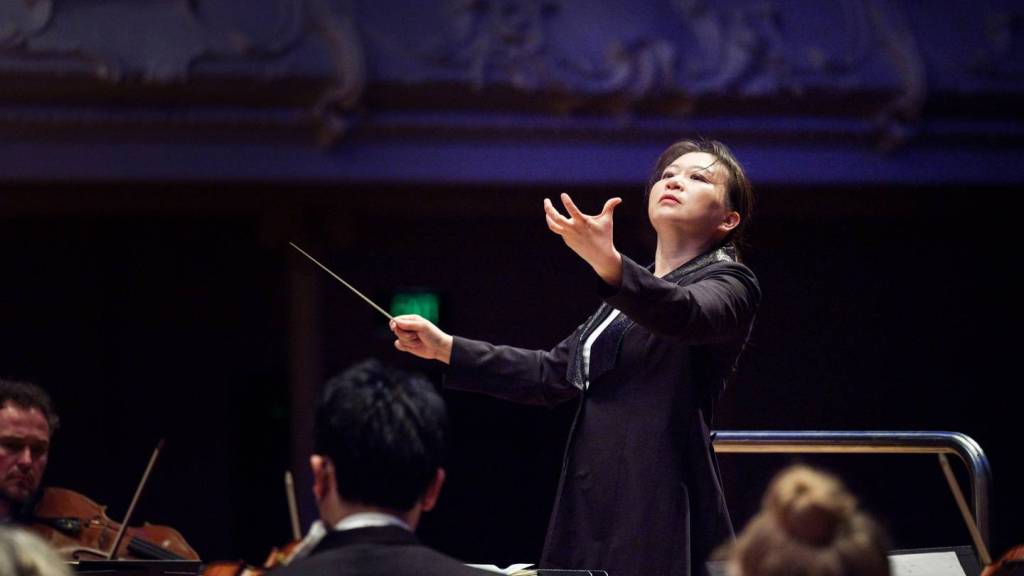
Shiyeon Sung is the first woman to win the Sir Georg Solti International Conductors’ Competition. This is her first appearance with the APO.

Categories
Reviews, News and Commentary

The music of Britten and Bridge in latest APO concert

Reviewed by John Daly-Peoples

Benjamin Britten & Frank Bridge

Auckland Philharmonia Orchestra

Britten. Simple Symphony
Sibelius. Romance in C
Bridge. Suite for String Orchestra

Conductor Vincent Hardaker

Auckland Town Hall

March 23

Reviewed by John Daly-Peoples

The second movement of Britten’s Simple Symphony always surprises as its opening  is the same as the notes which begin the theme of the long running BBC radio show, The Archers. It underlines the pastoral links of much British music and how its elegant simplicity reflects on the country’s rustic dance traditions.

The symphony’s bright and lively quality comes from the fact that the tunes are based on compositions Britten wrote as a nine-year-old, ten years prior to his writing the symphony in 1933. The work also has connections with many of Britten’s other compositions for  children such as “A Young Persons Guide to the Orchestra”. But, as with many other works such as his opera Billy Budd, and Death in Venice there is the occasional ominous aspect, notably in the third movement.

The titles of the movements are not the typical traditional tempo indications, such as  Allegro, but instead are descriptive: a Boisterous Bourrée, a Playful Pizzicato, a Sentimental Sarabande, and a Frolicsome Finale, an indication of his love of dance themes and in creating music for children.

The four dances with their intertwining melodies  conjure up the movement of the limbs and bodies of the dancers. Each of the sequences has a different mood with the first movement a classic country dance, the vigorous bowing and interplay between the strings creating light and shade. The second has a fast-paced pizzicato theme with its hearty stamping of the rowdy  village dance . The third movement features a more elegant and graceful display with a tinge of sadness threaded throughout. This is followed by the energetic final movement where the composer brings together themes and techniques from the past three movements to make up a more elaborate finale.

Conductor Vincent Hardaker guided the orchestra with precision, his own dance-like directions showing that the symphony is anything but simple.

Also on the programme was Frank Bridges engaging Suite for Strings composed in 1909. The work is beautifully designed and  technically sophisticated with solid Edwardian values continuing a British version of the late nineteenth century masters such as Tchaikovsky. It was works like this which inspired much of Benjamin Britten’s own music  .

The orchestra under Hardaker showed off all the suppleness of the work carefully detailing  all its embellishments and flourishes.

Next week concerts

March 29t

Haydn Symphony No.44 ‘Trauer’
Brahms Serenade No.2

Conductor Shiyeon Sung

March 31

Respighi Ancient Airs & Dances: Suite No.3
Puccini Crisantemi
Stravinsky Pulcinella: Suite

Conductor Shiyeon Sung

Shiyeon Sung is the first woman to win the Sir Georg Solti International Conductors’ Competition. This is her first appearance with the APO.

Categories
Reviews, News and Commentary

Little Shop of Horrors -Auckland Arts Festival Online

Reviewed by John Daly-Peoples

Little Shop of Horrors

Live Live Cinema, Silo Theatre and Jumpboard Productions

Available at Auckland Arts Festival Online

Until March 27th

Reviewed by John Daly-Peoples

In 1960 Corman produced and directed the cult classic “The Little Shop of Horrors”, about a hapless florist’s assistant who cultivates a plant that feeds on human flesh and blood. The film includes a cameo appearance by Jack Nicholson as masochistic dental patient. 

The film employs black comedy with farce, Jewish humour and elements of spoof. The scene with Jack Nicholson adds another dimension as the sequence is set at a dentists – “the murder house” in the popular imagination. In Auckland Festivals Online version directed by Oliver Driver the comic elements are further extended by the four performers on screen alongside the original film.

Byron Coll, Barnie Duncan, Laughton Kora and Hayley Sproull re-voice the characters as well as playing instruments and providing sound effects. The quirky antics of the four performers who are in four different location –lounges, bathroom and kitchen provides another entertaining part of the production. The score composed by Leon Radojkovic is an outstanding example of ingenuity and musical humour.

The way it is presented with the four musicians alongside the film means that  the work retains the  films original sensibilities, with its sense of the macabre and film noir.

Its a show which would probably have worked well on stage but this digital; format is innovative and pacy with some  clever dialogue.

Categories
Reviews, News and Commentary

Early Don Binney drawings for auction in April

John Daly-Peoples

Don Binney, Sketch for “The Swoop of the Kotare”

Don Binney: Observer. 

Webb’s

April 12

John Daly-Peoples

In April Webb’s will be presenting the auction  Don Binney: Observer. The auction will feature 57  sketches and field drawings by the artist which have been sourced from the Binney Estate.

The successful bidder on each artwork in this catalogue will receive two additional items along with the drawing. The first is a certificate of authenticity signed by Philippa and Mary Binney, and the second is an NFT derived from the work.

Some of the works on offer are among the earliest drawings he made of birds, many of which later became the basis of his  major paintings

In 1972  I interviewed Don Binney for the video series “Six New Zealand Artists” about his fascination with birds. The following is the transcript of part of that interview

JDP: Why do you choose birds to use as your visual images?

DB: Well, that’s because I’ve been a bird watcher for a lot longer than I’ve been a painter. In fact I was seriously watching birds by the time I’d turned ten and I was still at primary school, and I’ve only really been seriously exhibiting my own paintings, with or without the bird images, since about 1962.

JDP: Do you treat the birds as the real objects or do you abstract them?

DB: This is not  a simple question to answer. I was thinking this to myself today as I was sitting up at Aorangi Pt looking at a number of the spotted shags hatching their clutches on the rocks, in their little nests on the headland, and I was also, at the time, chewing over what I’d been saying to the local ranger last night at Juliet’s place. It seems to me that birds are a pretty fundamental human image, it seems to me that the human species if you like, has perhaps, twenty or thirty or forty odd, primary image references, perhaps tables may be one, perhaps death may be another, the sun is almost certainly another, stars very likely another, birds I think come well within the short-list of ‘say, very essential human images, and birds mean a hell of a lot, whether you’re a cosmopolitan twentieth or twenty-first century person or an eighteenth century person or a barbaric [person]… a bird is an image, is a life quality, imbued with a great many, I think, tangible references to people. It’s a very sensitive point.

JDP: Yes, so you see them as anthropomorphic.

DB: No, I see them as anthropomorphic, but I see them as a whole quality of existence in themselves, and I see them as forms, recurrent forms in space and in place, reappearing in the world of men as they’ve done in New Zealand, as long as men have co-existed with them, in this country and as they’ve always done over the world-.birds have lived in the world for so much longer than the human species, the hominid species and I think we owe them tremendous respect for this alone.

JDP: Do you see the links between bird forms and the natural forms of the landscape?

DB: Oh sure, this of course carries on, without my sounding presumptuous, but what I was saying is that the birds have lived in harmony and have co-existed with the topography, with the space, with the light, of habitable earth space, so much longer than people, and they have won their place, by means of flight, by means of nesting patterns, by means of migration, by means of their feeding habits, and the whole way that they deploy themselves against this, this land and this life, be it in New Zealand, be it New Guinea, be it Iceland or be it East Africa.

Categories
Reviews, News and Commentary

Auckland Arts Festival Online “Lament for Sheku Bayoh”

Reviewed by John Daly-Peoples

Lament for Sheku Bayoh by Hannah Lavery

Online at http://www.aaf.co.nz

Until March 27

Reviewed by John Daly-Peoples

In the early hours of Sunday morning, 3 May 2015, thirty-one-year-old Sheku Bayoh set out to walk home from his friend’s place after watching a boxing match. Just hours later, he had lost his life when police attacked and asphyxiated him  on the streets of his hometown – Kirkcaldy, Fife.

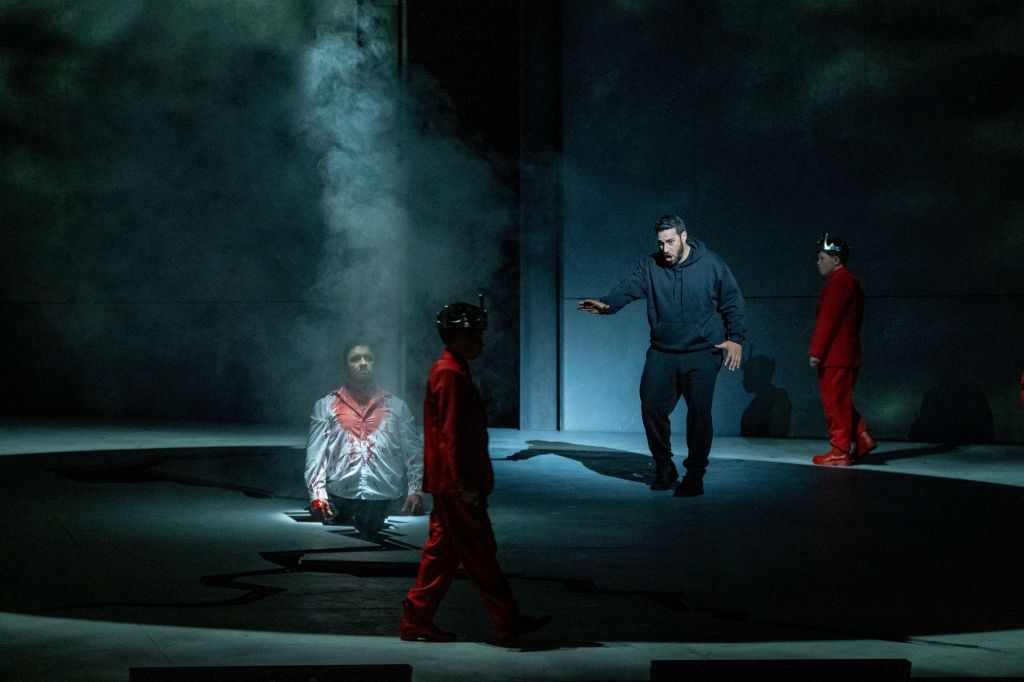
Lament for Sheku Bayoh adapted and directed by Hannah Lavery from her book attempts to examine and explain the tragic event. While expressing the grief and the effects on the family it also looks at the endemic racism which exists in Scotland.

It questions the notion of Scotland as  a liberal and welcoming country and whether this liberalism is only a veneer.

The work was originally commissioned by the Royal Lyceum Theatre, Edinburgh and filmed on stage at the Royal Lyceum Theatre as part of 2019 Edinburgh International Festival.

The work is structured like  a traditional Greek drama with all the action happening offstage  and the three fates represented by Saskia Ashdown, Patricia Panther and Courtney Stoddart commenting on the action and the ethical nature of the events and of the characters.

The lone guitarist, Beldina Odenyo acts as the chorus who opens the play with a gospel-style version of  Roberts  Burns’s “A Man’s a Man for A’ That” .

Much of the play uses the words from accounts by eyewitnesses and the police testimony along with comments made by news media. These lines are repeated in an almost poetic manner over and over like a refrain.

“I heard the man shout to get the police off him and they never moved”

“The BBC understands… The BBC understands”

Mr Bayoh’s muscles were bulging, He wasn’t listening to commands and he looked intimidating and he looked aggressive”

“Move along”

“Textbook training”

“Appropriate action”

There is also a repeated reference to the thirty seconds that it took for Bayoh to die once he had been wrestled to the ground and that thirty seconds is counted down in the final moments of the play.

The stage is in shadows and the three actors move through the dark brooding space articulating the poetic expression of grief for the individual behind the headlines which mirrors the tragic events behind the death of George Floyd  2020 death in America. The three actors switch skilfully from impassioned, expression to forensic detailing of events creating an ominous and threatening atmosphere

Bayoh’s family launched a campaign seeking justice and a statutory public inquiry was established in 2019 to determine the manner of his death, and whether ‘actual or perceived race’ had played a part in it. The inquiry which has been delayed several times will not actually begin until later this year.

Categories
Reviews, News and Commentary

Auckland Arts Festival Online – A Stab in the Dark

Reviewed by John Daly-Peoples

A Stab in the Dark

Nightsong Productions

Written by Carl Bland

Directed by Ben Crowder and Carl Bland

Online until March 13 at http://www.aaf.co.nz

Reviewed by John Daly-Peoples

Nightsong’s “A Stab in the Dark” opens with the Old Testament Noah  moaning, “Why God chose me to save the world is a fucking mystery?” We never really get to deal with Noah’s question but there are lots of other ambiguities and mysteries to be explored.

With “A Stab in the  Dark” there is a melding of two interpretations of the phrase. The main plot line is about a stabbing which has occurred and the police investigation into the murder. Another less specific part of the narrative is around the notion of the  random stab in the dark, where we make choices or decisions which are just as likely to fail as succeed.

The main character John (Joel Tobeck) is accused of murdering Ann (Alison Bruce) and much of the work focuses on his interview with the police in which he tells of meeting his doppelganger Warren who invites him to dinner where he meets Ann, Warren’s wife.

After a short affair with Ann which is discovered by Warren Ann is killed and Warren disappears. Just who is the killer is a bit murky.

However, this is a Surrealist/Absurdist drama in the tradition of Ionesco or Beckett so neither story or staging follows traditional presentation. The interviewing police officer is a large puppet, several times the size of John and towers over him during questioning. Various elements of the production are outsize such as a large glass of water, a fly twice the size of John’s head, a metre long cigarette and  a giant pen.

Alongside the main plot line, we encounter Noah and his story of the Deluge as well as a wooden puppet who informs us that it is  by turns a sandpiper, a crocodile, a caterpillar / butterfly and a peacock. The symbolism of these events and animals never really becomes clear but does  provide for some  philosophical and psychological ruminating. The play can be seen as an inquiry into the nature of the psychotic as well as dealing with the issues of guilt and innocence, trust and lies, reality and illusion

The play would normally have been on stage but with this Covid era production the creators have used other theatrical techniques such as  Noh Theatre and film noir gives the work a visual density which is mesmerizing.

The set which is just a large circular panel is ingeniously used as a podium, a table and a screen which along with the puppets give the play a disconcerting appearance where everything is tilted, on edge and bizarre.

Joel Tobeck gives a compelling performance as he switches between his two characters as well as being presented in a filmed version of John. Ann played by Alison Bruce is only partially and  fleetingly seen but adds a nice dimension to the work. Carl Bland voices the  giant police inspector with a commanding, overbearing tone and Dave Fane, the puzzling Noah.

Categories
Reviews, News and Commentary

Yona Lee rearranges life into five rooms

Reviewed by John Daly-Peoples

Yona Lee: An Arrangement for 5 Rooms

Auckland Art Gallery
Until October 2

Reviewed by John Daly-Peoples

When you first encounter Yona Lee’s installation “An Arrangement for 5 Rooms” from the stairway at the South Atrium of the Auckland Art Gallery, the handrail on your right doesn’t end at the top of the steps like a normal handrail. It just keeps going, becoming part of a maze of interlinked pipes,  becoming part of the architecture.

Many years ago, when I worked at MOW Power Design a Bauhaus trained architect on the staff asked me about a handrail I had designed, wanting to know what it was saying  apart from my notions of functionality. For him the handrail was not just there to hold onto, it was an extension of the eye, the hand and the footstep, leading them into the next space. It was not just a utilitarian addition to the architecture it was an intimate part and experience of it.

Lee’s installation provides that idea of design and architecture being more than pragmatic shapes and spaces. The network of pipes alerts us to  the hidden infrastructure of pipes, tubes and conduits which are all around us but often invisible, underground and inside walls. These become metaphors for interconnectedness of the world in general.

Across five rooms she has installed a maze-like construction from hundreds of metres of stainless-steel pipe of the same shape and texture as the gallery’s handrail taking the hand and eye into a series of surreal Alice in Wonderland-like spaces. The circuitous pipes are both a guide to travelling through the spaces and an experience of the spaces.

In the journey through the five rooms we encounter a domestic interior, a café, a bus, a picnic area and possibly a public bathhouse.

The lone  double bus seat sits with its back to the view of Albert Park and a room away is the bus call button (which can be buzzed) and a hanging strap fixed to a pipe five metres above.

The domestic interior is like a small apartment – a bunk room, a dining space, work bench some hanging plants and a fan which gently blows a shower curtain.

Some of the piping snakes outside through the windows of the gallery to an outside “picnic” area under the trees in Albert Park. It features a table, two benches an umbrella and at night the shapes are picked out in neon tubing. There is also a letterbox stuffed with some irises.

Her constructions recall the quote of Le Corbusier’s that “A house is a machine for living in” and also the exposed functional structural and utilitarian elements of the Pompidou Centre in Paris

The artist  says of the work “‘My ambition for this project is to activate the whole building. To break down the barriers between what is art and non-art, the inside and outside, the day and night, and the public and private. The highlight of the work is where it transitions from the inside to the outside. There is a sense of freedom in this moment that I believe is necessary for this current environment.”

The show is open-ended with various interpretations – as structures or systems, as serious or playful, as authoritarian or utopian, as utilitarian or pointless. But there is one unanswered question – who delivers the irises each day.