There’s something about a standing ovation. Especially when it’s totally impromptu and anything less would either seem churlish and suggest one had possibly been asleep for the last 80 minutes or so.
But that’s what Shane Blaney received at the end of In the Name of the Son at Q theatre on Thursday night. And rightly so.
My initial thoughts were that we were going to get yet another a diatribe about political injustice during the Troubles. But I needn’t have worried. This was merely a context for a story about Gerry Conlon’s personal journey and traces his successive leaps following a 15-year mis-sentence through to international recognition and a descent that plumbs the depths of the human spirit. Ultimately however, it demonstrates the triumph of that spirit over extreme adversity which makes for a very good story indeed.
It seems so long ago now – the IRA Guildford Pub bombings Four and the political upheaval that eventually resulted in their being freed after 15 years in prison. But I remember it well. What I was unaware of however was Gerry Conlon’s journey.
In the Name of the Son achieves this by introducing us to many, many characters and Blaney swiftly skips from one to the other with impeccable timing, sparkling wit and he wrings remarkable depth from each in this one-man show. There are so many I lost count but they are colourful and they are memorable. Blaney even manages to slip in a memorable one-liner from Jack Nicholson and a goodly chunk of Springsteen’s ‘Born to Run’ while in toilet at the Oscars.
The play even manages a subtle side-swipe at Daniel Day Lewis and other cinematic A-listers (the film was the titled ‘In the name of the Father’, a dramatization of the political side).
In the Name of the Son by Gerry’s lifelong friend Richard O’Rawe and Martyn Lynch tells it as it was. And Blaney delivers it switching seamlessly between the different genders, ages and accents of those who played a role in Conlon’s fascinating story. That is what makes this otherwise harrowing tale of injustice worth nothing less than the standing ovation he received at opening night.
A few years ago Waiheke’s Sculpture on the Gulf was included in the New York Times top things to do and the event is regarded by many as one of the great outdoor sculpture exhibitions, not just for the standard of the sculpture but also for the experience of the two kilometre walk with a backdrop of bush, hills, sea and headlands as well as panoramic views of distant Auckland and the islands of the gulf.
The event attracts tens of thousands of people for the five week show which features over twenty-one works, down from the twenty-seven of the last show two years ago.
There is a bit of a surprise mid-way through sculpture walk seeing Jorge Wright’s monumental Corten steel work “Head Within” standing only a few metres from where it was two years. It was bought by the owner of the property which abuts the sculpture walk.
Many of the works in this years exhibition have strong architectural and historical connections, reflecting on the changing built environment and the congruent changes to the natural environment.
Turumeke Harrington “Stumped I-XII”
Turumeke Harrington slices of native trees in “Stumped I-XII” reference the trees which once covered Tamaki Makura while Chevron Hassett’s “Te Kupenga” welcoming entranceway with its 19th century fretwork would have been built with that cut timber.
Chevron Hassett “Te Kupenga”
There is Ana Iti’s “Whakaruruhau”, a deconstructed work of structural elements which is also similar to the more elaborate work of Lonnie Hutchinson’s “Moemoea – A model for Dreaming” where her designs in turn relate to Chevron Hassett’s “Te Kupenga”.
Yona Lee’s “Fountain in Transit” uses the steel tubing she often uses to construct interior space with her to create a shower nestled in the bush.
Oliver Stretton-Pow’s marooned lighthouse “Hard Graft” links architecture to plant growth, timber and the tendrils of ocean creatures, referencing the country’s maritime history.
There are references to international architecture and art with Natalie Guy’s “The Staircase” a homage to Carla Scarpa’s innovative use of materials and designs. Another reference to international art can be seen in Seung Yul Oh’s “Cycloid I, II, III, IV, V, and VI” which mimic Alexander Calder’s lively and colourful shapes . Here the works are like abstract bushes growing alongside the path.
Seung Yul Oh “Cycloid I, II, III, IV, V, and VI”
There is an architectural component to Nicholas Galanin’s “An Unmarked Grave Deep Enough to Bury Colony and Empire” which uses the outline of Queen Victorias statue as a template for the grave he has dug on the headland.
The most powerful of the architectural works is Brett Graham’s “Wakefield Dreaming” which dominates the headland with his references to the justice system and the overreach of surveillance
Gavin Hipkins’ “Hotel Flag” evolved from the nautical flag representing the letter H, the first letter of the artists name, it also references the abstract geometric art of Malevich or Stephen Bambury.
Steve Carr’s bronze tires “In Bloom (Waiheke)” can be seen as a sort of self-portrait while Eddie Clemens’ “Cognitive Reorientation” also references his interest in cars as a defining aspect.
Combing aspects of rural farm architecture and religious iconography is Ralph Hotere’s “Taranaki Gate Stations”. The work is based on the Passion of Jesus Christ and originally conceived for Easter 1981
Ralph Hotere “Taranaki Gate Stations”
The work consists of a cruciform-shaped pen using fourteen standard pipe-and-mesh farm-fence units, with fourteen numbered sheep in. The gates are marked with Roman numerals (I–XIV) and the sheep painted with Arabic ones (1–14), both in a spectrum of fourteen colours. The various shapes and numbers relate to the stations of the cross and other religious concepts. The work also links back twenty years to Gregor Kregar’s “Mathew 12/12” shown St at SOTG in 2003 where he displayed 12 live sheep linked to the biblical text.
Zac Langdon-Pole “Chimera”
Probably the strangest work in the show is Zac Langdon-Pole’s “Chimera”, a dinosaurs skull hanging from a crane which could have been unearthed from the Queen Victoria excavation in a quirky reference to the country’s past.
Oum with conductor Fawzi Haimor and the NZSO Image Jono Tucker
Auckland Arts Festival
Beyond Words
New Zealand Symphony Orchestra
Auckland Town Hall
March 10
Reviewed by John Daly-Peoples
The “Beyond Words” concert which had its third performance following its premiere in Christchurch and a performance in Wellington was a collaboration to promote unity and peace through music and to honour the lives lost in Ōtautahi Christchurch on 15 March 2019.
Conducted by Fawzi Haimor the concert featured the Moroccan vocalist OUM El Ghait Benessahraoui and Cypriot/Greek oud player Kyriakos Tapakis.
Vocalist Abdelilah Rharrabti, saz player Liam Oliver, vocalist and daf player Esmail Fathi, oud player Kyriakos Tapakis, vocalist Oum and composer John Psathas [From Wellington concert] image Jono Tucker
The concert also featured works by the American Valerie Coleman, Reza Vali, Arvo Pärt and the world premiere of a new work by the New Zealand composer John Psathas.
Psathas’ “Ahlan wa Sahlan”, composed in collaboration with OUM and Tapakis, uses the Arabic welcome to let people know they are in a place where they belong. The work fused together musical styles from Eastern and Western music traditions.
The work features energetic and dramatic sounds with subtle changes of texture and moods, providing a background for the two soloists OUM El Ghait Benessahraoui and Kyriakos Tapakis.
The composer as previously demonstrated his ability to compose celebratory anthems having written works for the ceremonies at 2004 Athens Olympics and with this work there is sense of the music being both a lament, a reflection and a celebration. With waves of shifting percussive and evocative sounds
OUM was resplendent in her shimmering gown and elaborate head covering Her voice with its roots in Morocco and in the tradition of Egyptian singers of the 1930’s like Umm Kulthum drifted and soared above the orchestra’s tapestry of eastern sounds along with answering voice of Tapakis’s oud.
Her singing and movements at times suggested she was in a trance-like state while at other times she exuded an emotional intensity and in her singing “Hijra” she sounded like a French chaunteuse. Later there were passages where her voice was close to over-elaborate crooning.
Tapakis provided a riveting performance where he played together with Xylophone and timpani in a filmic sounding section filled with percussive sounds
The other major work in the programme was Arvo Pärt‘s Silouan’s Song which is fine example of the composer’s low-key minimalism with simple repetition and contemplation sequences of notes.
This was a reflective piece which connected contemporary music with Medieval plainchant and Eastern mystical music and the various sections were stressed by the meditative silences between them giving the work a ritualistic feel.
In the first part of the programme there were five shorter works including a traditional work sung by Hasbi Rabbi and Molle Mamad Jan which had an achingly unsettling melodic line as well as a beguiling performance by OUM.
There was also contemplative, work by the Iranian Reza Vali which was filled with despondency and funeral sounds hinting at a vision of paradise.
Kyriakos Tapakis performed his own work “Mantilatos” which was filled with extraordinary sounds and rhythms. While the NZSO accompanied him, emphasising much of the work it would have been more interesting if he had been able to play as a soloist.
A major disappointment with the programme was the lack of English translations for the various vocal segments. Presumably the lyrics were relevant to the spirit of the event and even though the concert was one that was “beyond words” with the music conveying emotional and spiritual dimensions it was pity the audience was not able to appreciate the greater depth which would have come from a knowledge of the word.
The “Follow button” at the bottom right will appear and clicking on that button will allow you to follow that blog and all future posts will arrive on your email.
I am a palangi and my knowledge and detailed understanding of fa’asāmoa is rudimentary at best. So it would be presumptuous to pretend that I do – and no doubt very few Samoans would speak to me again.
My own antecedents settled here from Scotland, harking back mainly to small village communities in the north. I have enjoyed visiting many times and am constantly learning things about their society from long ago. So it would be presumptuous to pretend that I do – and no doubt very few Samoans would speak to me again!
My own antecedents settled here from Scotland, harking back mainly to small village communities in the north where they worked as crofters. I have enjoyed visiting many times and am constantly learning things about their society and the customs young and productive people left behind in the fairly feudal society four or five generations ago when they sought betterment through emigration elsewhere.
However some customs and traditions travelled with them and scraps of those links remain today. The result remains as some kind of low key but deeply-rooted spiritual melange – sort of what was ‘then’ overlaid with what is ‘now’. Let’s face it, in my own case I have a spine that unfailingly frizzles each time I see and hear that lone piper playing Flower of Scotland high on the roof at Murrayfield before a rugby test.
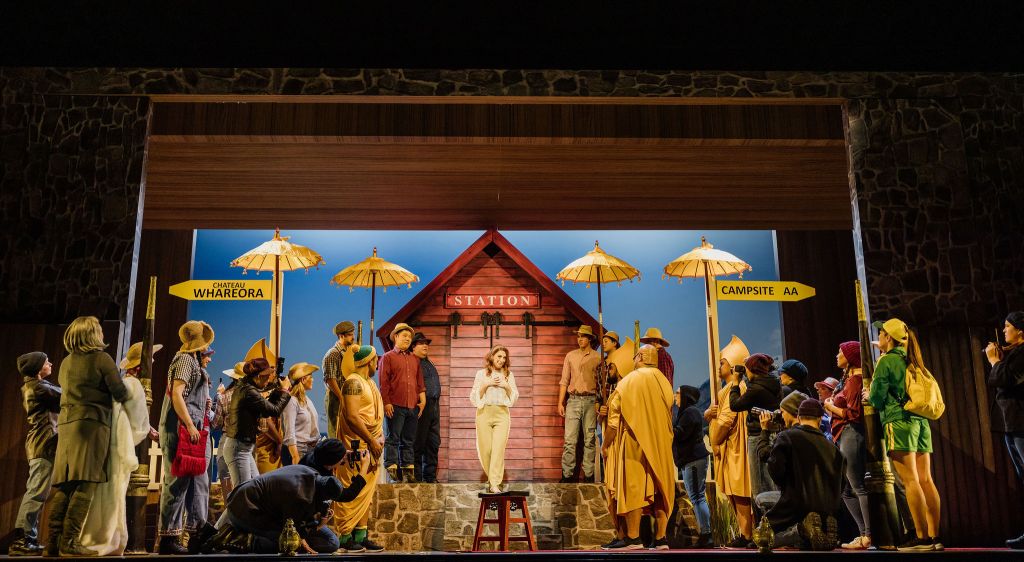
All of which is a long way from Samoa. But the parallels are not dissimilar even though I approached O Le Pepelo with a certain sense of trepidation and even wondered if I had made a dreadful mistake during the first couple of context-setting scenes which are conducted almost entirely in Samoan. Good heavens, I thought – Samoan speakers in the audience seem to be getting all the jokes while I didn’t have a clue!
But that soon changed as Samoan merged with English, my trepidatious concerns evaporated and I became totally absorbed as an excellent piece of theatre revealed itself. You know … something about a simple story told well.
O Le Pepelo started out that way. The publicity machine had outlined the basic plot well – an ageing and ill village elder, concerned about who should inherit his position and status on his passing and the decisions this would require. But that is just a context and this is a play that is so much more. It is about a clash between the traditional value systems and customs confronting Pili and a more modern world where lifestyle becomes a determinant. They are in no way simple.
This leads quite easily to discussion and debate, to adaptation and expectation, and eventually to a form of resolution. Different characters flesh out these themes, and the more they do so, the more complexity and depth is revealed. In fact, this simple story told well quickly moves to a grander more universal scale without losing its more intimate familial setting.
The bones of O Le Pepola are fleshed out with sparkling characterisations, liberal sprinklings of comedy and a remarkably competent cast, while my more personal echoes of the Scottish diaspora points to its universality. Keni and So point to this using a fairly classic idiom that echoes the dilemma of a certain Shakespearean king.
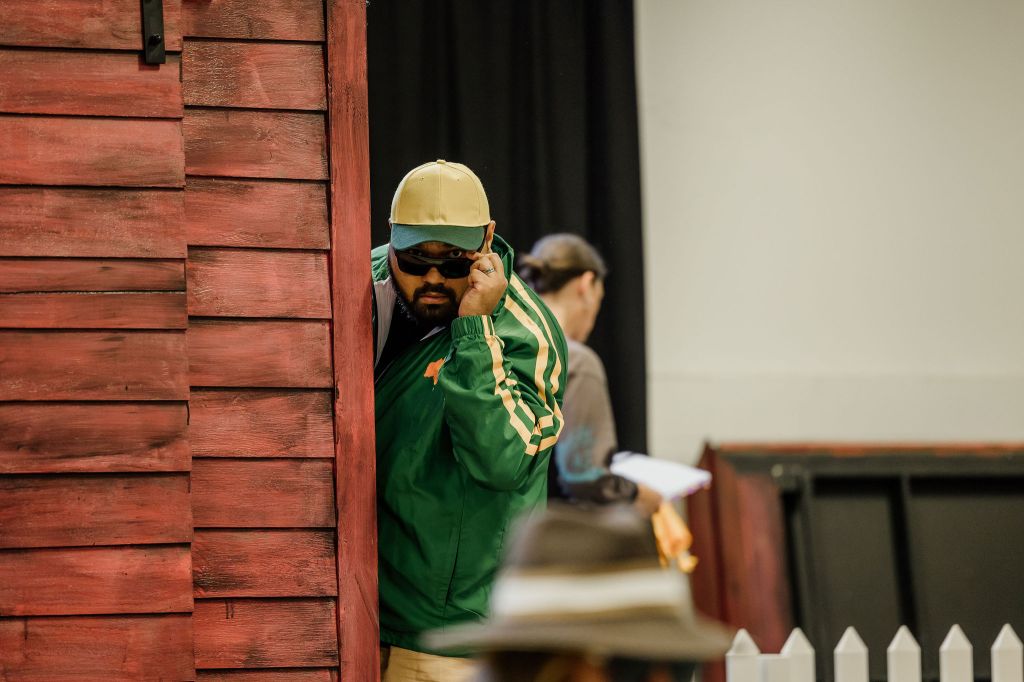
In the village of Moa there are three key protagonists. The ill, aged and dying Pili Sā Tauilevā (Semu Filipo), a longstanding chief or Ali’i and his two children. His eldest son Matagi (Haanz Fa’avae-Jackson) is a traditionalist with high expectations, while his daughter Vailoloto (Ana Corbett) returns from New Zealand embracing the new and the future, appalled because she cannot get a strong wifi signal. Pili is strongly supported by his wife Fa’asoa (Aruna Po-Ching) . But it is Masina (Andy Tilo-Faiaoga) who quietly and assuredly reinforces the dignity, wisdom and humility that underpins the both th inherited position and the play itself and becomes a significant part in its resolution.
Billed as a darkly comic exploration of mores and debate, O Le Pepola expands on something we all know a little about, gives it a contemporary currency and its key characters will remain with me for a while yet.
Auckland Theatre Company and Auckland Festival are to be congratulated on bringing this work to life. It is on point.
The “Follow button” at the bottom right will appear and clicking on that button will allow you to follow that blog and all future posts will arrive on your email.
Goethe once noted that “Ein alter Mann ist stets ein König Lear” – an old man is a King Lear, meaning that the problems which Lear faced were the same for all old men.
Lear’s problems were not necessarily of his own making as events and people conspired to take advantage of him and he found himself virtually alone, deprived of home, authority and family.
This gradual loss of place in society is central to a new play “Not King Lear” which is directed by Adrain Jackson who has worked for many years Royal Shakespeare Company and with people experiencing street homelessness in London
In this latest play he has created a playful yet serious retelling of the story of an old man in conflict with his children, who gives away his authority and falls into homelessness and mental ill-health.
“Not King Lear” has had input from and is performed by members of the Hobson Street Theatre Company which works in partnership with the Auckland City Mission, with an aim to tell stories that are based on real life experiences, addressing social issues.
There is level of sophistication to the play that is rewarding both in terms of the ideas it explores about relationships and homelessness but also in its approach to theatre.
In making use of Shakespeare’s original text, they are able to background some of the issues with a few passages from the play and some brief character and plot outlines. They present most of the Act I dialogue of the speeches of the three sisters which includes the powerful speech by Lear.
The cast also use this as an opportunity for jokes about the characters with Regan being referred to as Vegan and Cordelia as Corduroy. There are other parts of the play which are dealt with in a light hearted and ironic way while others are eloquent and insightful.
The players are uneven in their acting skills but there is a passion and honesty to all the performances which make for a rewarding theatrical experience. Some of the actors are brilliant with the one playing Lear providing a profound and expressive interpretation of the character.
The play has elements of Shakespeare’s approach to drama with the idea of the play within play as we see in Hamlet or Midsummers Nights Dream while another sequence features is a Men’s Group which touches on the issue of estrangement.
The audience participation is at a very different level. Early on the audience was asked to take out their cell phones, divided up into groups who then have to find things on their phones which will get used later in the show. So people had to search for Branch, Climate change, Storm and Trumpet. These then became the source of sounds which audience could then contribute to the soundscape. So when the King first appears the Trumpets let their trumpets blast away.
There is some very effective staging as in the final sequences where projected images of the mean streets of Auckland are used as a counterpoint to Lear’s blasted heath and the filmed images of the homeless pushing shopping trolleys is replicated with a shopping trolley being moved around the stage.
The inclusion of this work by the Hobson Street Theatre Company alongside international productions in the Auckland Arts Festival is to be commended and shows that New Zealand theatre has a crucial role to play in addressing social and personal issues as well as reaching new audiences.
The “Follow button” at the bottom right will appear and clicking on that button will allow you to follow that blog and all future posts will arrive on your email.
Thankfully Manifesto didn’t have a manifesto, any sort of declaration of the intent or views on issues, but they did make manifest their intention to entertain, amaze and transport the audience.
Nine musicians with a selection of drums, cymbals and bells ranged above a group of white clad dancers who sat, calmly facing the audience. But then the first burst of cymbals sent a shock wave through the dancers, followed ten seconds later by another explosive sound with a corresponding eruption of the dancers – and so it begins – torrents of sound which galvanized the dancers into hectic sequences of dance.as they responded to the changing tempo of the drumming. They seemed to be responding as though to electric shocks or the physical impact of the sound waves with their somersaults, kicks, lifts, throws and breakdance moves.
In one sequence one of the dancers took on the role of choreographer / director, controlling the chaotic assemblage with wild gestures.
As with all dance the there is a connection between music and movement but with Manifesto, they are for the most part inextricably linked, each beat corresponding to a jump, twist, leap or limb gesture.
The performances are a mix of modern dance, aerobics, gym workout, athletic workout (one practicing their archery skills) and individual self-absorbed responses.
Some of the sequences are reminiscent of the stylish Cirque de Soliel routines, others are more poetic in their grace and line. There was even sequence which could have alluded to The Rite of Spring with tightly grouped bodies. Other times their movements were epileptic, militaristic or like that of clockwork figures.
One sequence saw the dancers performance a series of fast paced pas de due as they raced around the stage showing off various dynamic, dexterous, challenging , dangerous and expressive moves. These actions and reactions had much in common with contemporary dance
There were a couple respites and in one of periods a Bob Marley look a like engaged briefly with each of the drummers as well as the audience before being assaulted by a thunderous attack from the combined drummers.
The show, choreographed by Melbourne-based Stephanie Lake was full of relentless energy and amazing invention and there is only two more shows on.
In the early nineteenth century it was fashionable to do a Grand Tour with Italy as the prime destination. Artists, writers and composers all sought to travel there to find inspiration.
The APO’s “In The Italian Style” presented works by three composers who were themselves were enthralled by various aspects of Italian music, history and landscape.
The first work on the programme was Schubert’s Overture in C “In the Italian Style” which was not a response to Italy itself but rather to the interest in Italian music at the time , notably the exoticism of Rossini. Schubert’s impressionist depiction of Italy conveys images of street life, dances and the leisurely stroll through classical ruins captures the energy, colours and contrasts of his invented Italy which is a measure of the composer’s ability to convey images and sight he had never seen. The work also shows the young eighteen-year-old trying to move his compositions out of the traditions of Viennese music of the time.
Mendelssohn was twenty-one when he travelled to Italy where he was captivated by the art, architecture and landscape. When he was given a commission, he used his impressions of the country as the basis of his Symphony No 4 “The Italian”. While he had been despairing of Italian concert music, he was taken with local Neapolitan folk dance styles like the saltarello. This influence is seen in the final wild, breakneck movement which captures the drama of the dance and Mendelssohn’s vision of Italy.
The first three movements were filled with dramatic contrasts,- massive sounds which suggested the grandeur of the Alps as well as softer sounds which evoked contemplation of art works and architecture.
Conductor Giordana Bellincampi displayed his astute conducting skills throughout the concert, at times creating dynamic waves of sound while at other times having orchestra whisper as in the opening of the second movement which depicts dawn breaking with bursts of sunlight.
The major work on the programme was Hector Berlioz’s Harold in Italy with Robert Ashworth and his viola taking on the character of Harold, the heroic figure based loosely on Byron’s Childe Harold, a wanderer who observes scenes of Italian life.
The four movements depicting outdoor scenes from various parts of the country were all derived from the composer’s experiences while travelling in Italy.
While the work is the composer’s personal response to Italy there seem to be reference to Byron’s epic poem throughout the work as in the references to Florence, its landscape and history.
A softer feeling for her fairy halls.
Girt by her theatre of hills, she reaps
Her corn, and wine, and oil, and Plenty leaps
To laughing life, with her redundant horn.
Along the banks where smiling Arno sweeps,
Was modern Luxury of Commerce born,
And buried Learning rose, redeemed to a new morn.
Berlioz infuses his music with evocative imagery – the drama of the mountains, the softness of the light and the richness of the country’s art and history.
Robert Ashworth’s muted viola sounds helped paint an initial picture of the world-weary traveller but there were also touches of wonderment, solitude and merriment conveyed by his instrument.
Much of the time Ashworth played as though part of the orchestra, his sounds nestling in the luxurious colours of the orchestra but then there would come passages of sheer exuberance and his playing would rise above the orchestra akin to the emotional outbursts of Harlod himself in his reactions to scenes and events.
Ashworth himself was attentive to the conductor but also the orchestra and he followed their playing intensely, as though he were Harold witnessing a new spectacle.
There was a clever bit theatricality at the close of the work as Ashworth exited the stage to reappear a few minutes later up by the organ where he was joined by a string trio to play the final moments of the work.
The “Follow button” at the bottom right will appear and clicking on that button will allow you to follow that blog and all future posts will arrive on your email.
Straight off a highly acclaimed season at London’s National Theatre, Auckland Theatre Company is presenting The Effect, written by BAFTA, Golden Globe and Emmy award-winning co-executive producer and writer Lucy Prebble of the HBO international hit series, Succession (2018-2023) in their 2024 line up.
“The Effect” will be directed by Benjamin Kilby-Henson (King Lear) and feature major stage and screen stars including; Jayden Daniels (Head High, Celebrity Treasure Island), Zoë Robins (Amazon’s The Wheel of Time), Jarod Rawiri (Long Day’s Journey into Night) and New Zealand screen legend Sara Wiseman (Under the Vines, Creamerie).
British playwright and producer Lucy Prebble shows all the razor-sharp flair that made her a star writer on Succession in this deft dissection of medical ethics and the nature of human attraction.
The review of the work in the New York Times gave it a strong recommendation.
“Are you in love, or are you merely experiencing a giddy dopamine rush? Are those two states even meaningfully different? Is there a true, innermost “you” that is distinguishable from your neurochemistry?
These are some of the tricky questions explored by Lucy Prebble’s thought-provoking play, “The Effect”
The play revolves around two young people, Tristan and Connie, who take part in a trial for a dopamine-based psychiatric drug with powerful antidepressant properties. Initially, they seem to have little in common — he’s a working class lad from East London; she’s a bougie psychology student from Canada — but as the trial progresses, a tender rapport develops.
Throughout the study, the participants are monitored by two psychiatric doctors, Lorna and Toby, who debate their findings: Is the drug pulling their subjects together, or are their feelings organic? And if one of the trial participants was actually receiving a placebo the whole time, what then? Prebble keeps us guessing.
Throughout, the pair’s gradual transition from wary awkwardness to intense mutual magnetism is convincingly rendered, in large part thanks to the actors’ terrific onstage chemistry.
Things get messy in the latter stages of the experiment, as both the doses and the emotional stakes increase, leading to a fraught and affecting denouement.
The stiltedly ambivalent friendship between the two middle-aged doctors provides an intriguing subplot. We learn that Lorna and Toby once romantically involved, many years ago. Lorna is prone to bouts of depression, but refuses to take medication; Toby, on the other hand, is a true pharmaceutical believer.
“The Effect” is healthily skeptical about scientifically deterministic approaches to emotional well-being, channeling a dissenting tradition that dates back to the anti-psychiatry movement of the 1960s; its moral sensibility recalls Ken Kesey’s 1962 novel, “One Flew Over the Cuckoo’s Nest.” The play’s revival is particularly timely as a new generation of wellness gurus have, in recent years, latched onto the idea that much of human behavior can be explained away as neurotransmitters or hormones simply doing their thing.
Prebble invites us to ponder the implications of such thinking. Connie is initially uncomfortable with the notion that two people can fall in love just like that (“It takes work,” she insists), and wary of her attraction to Tristan. He, in response, makes the case for mystery, and thus articulates the play’s key message: That a world in which all feeling is viewed as a matter of chemistry would be a bleak one indeed.”
City Gallery Wellington has recently published a stunning monograph on Reuben Paterson which follows on from his exhibition Reuben Paterson: The Only Dream Left which was exhibited at the gallery last year.
The book is lavishly illustrated with works covering his thirty years of art practice and features writings by Witi Ihimaera, curator and writer Geraldine Barlow, and the exhibition’s curators Aaron Lister and Karl Chitham.
Reuben Paterson, Pounamu and The Jade Cat
There are over 100 full colour illustrations as well as some ”booklet” inserts which captures the unique range and depth of Paterson’s art from his early glitter paintings to his recent major sculptural commissions.
There are images of several of his monumental works such as the “Get Down Upon Your Knees”, the 8-metre square work shown at the Asia Pacific Triennial in Brisbane as well as the mural work “Andale, Andale” at Auckland’s Newmarket Railway Station. There are also the “The Golden Promise” at the Massey University Albany campus as well as the controversial ”Freedom Flowers”, the ANZ cash point terminal on Ponsonby Road commissioned for the 2015 Pride Festival.
His use of glitter and diamond dust on canvas or paper of stereotypical images are manipulated and transformed by his individual treatment of colour, design, pattern and texture. His images often referenced botanical, op art, or Māori iconography along with images which are commercial or kitsch. The sparkling surfaces create an ambivalent visual description with works such as the “Take my hand and off we stride” featuring the idyllic Pacific Island palm tree landscape.
Underneath the seductive images there are more complex ideas and viewpoints which take the viewer into the artist’s view of nature, the tangible and the symbolic as well as his own whakapapa referencing his Ngati Rangitihi, Ngai Tuhoe, Tuhourangi and Scottish descent.
Paterson’s political or social messages are also referenced in some of the works where he has used animal images such as the tiger in “Blessing”, conveying the sense of power, sexuality and fear. These works were motivated by his efforts to highlight the inequality of the ‘gay panic’ provocation defence for murder that was in place before a repeal of the Crimes Act in 2009.
A culmination of many of his ideas and technical expertise has been “Guide Kaiārahi” the major commission for the Auckland Art Gallery. The idea for the ten-metre-high waka which is made from hundreds of shimmering crystals, originated in the legend of a phantom waka that appeared at Lake Tarawera ten days before the eruption of Mt Tarawera in 1886. Combining references to natural and supernatural realms, the sculpture draws upon Māori cosmology and creation narratives.
Reuben Paterson, “Guide Kaiārahi” (detail)
The book shows the extent of his influences and interests apart from his use of cheesy imagery – Dutch still life painting, elements of Greek and Roman art, Op art and Rorschach patterns. The essays also reveal some of his interests in scientific, political and social ideas along with the spiritual aspects of his work.
Nature and botanical subjects are central to the artists life and many of the artist works His father was a landscape gardener and he has a garden himself which can be seen as an influence on his work with its emphasis on colour, seasons, birth and transformation.
One major work which focusses on Nature is “The Golden Bearing”, a life size golden tree which links to the various emblematic trees over history, from George Fraziers “The Golden Bough”, Eastern and Mayan ideas of creation as well as that of Maori.
Reuben Paterson, The Golden Bearing
As Witi Ihimaera says of the work “In Paterson’s garden the tree is a promise of the legacy of nature for a humankind that appears hellbent on destroying the planet. It is an achingly awe-inspiring way point from which we can orient ourselves to a future if we wish it to become a paradise regained rather than lost”.
The book itself is an elegant and lavish production with designers Extended Whānau ensuring that Paterson’s work is presented in a way which allows for an appreciation and understanding of his paintings and sculptural work.
The images and texts manage to not only show the development of the artist’s work but link the poetic, the political and the personal to show an artist who is deeply committed to exploring the many threads which make up contemporary New Zealand culture.
The “Follow button” at the bottom right will appear and clicking on that button will allow you to follow that blog and all future posts will arrive on your email.
The three works in the second APO concert of the Premier Series for 2024: Mozart’s Piano Concerto No. 24 in C Minor, Beethoven’s Symphony No. 7, and the Overture to Rossini’s The Barber of Seville were all written within a thirty year period, 1786-1816: the Mozart in 1785-86, the Beethoven in 1812, and the Rossini in 1816. This period, on the cusp between the ‘classical’ and ‘Romantic’ periods, is one of the most consequential in the history of music. Each of these works is a masterwork in its own right; collectively they made for a supremely enjoyable and satisfying evening. The APO under Giordano Bellincampi, with South Korean soloist Yeol Eum Son in the Mozart, were in fine fettle.
Rossini just missed out on being a contemporary of Mozart’s by being born in the year after Mozart’s death in 1791; Beethoven was twenty when Mozart died, just on the brink of his great career.
The Overture to The Barber of Seville scurries along entertainingly in Rossini’s instantly recognisable and ingratiating style. It is ‘feel good’ music, clearly enjoyed by the musicians, and bound to put listeners into a receptive frame of mind.
With her pale skin and flamboyant scarlet gown, Yeol Eum Son made a striking visual contrast to the pervasive black-and-white of the orchestra. She proved to be an elegant and forceful soloist plunging instantly and confidently into the minor-key depths and mysteries of one of Mozart’s greatest scores.
One of only two piano concertos in a minor key (the other is No. 20), this work has the most elaborate instrumentation of any of Mozart’s concertos, being scored for one flute, two oboes, two clarinets, two bassoons, two horns, two trumpets, timpani and strings: it is especially rare in Mozart for oboes and clarinets to be used simultaneously. One of the great pleasures of seeing this work performed live is to be able to witness as well as hear the subtle and intricate interplay between the wind instruments and strings so important in the emotional ambience of the music. After the rapt complexities of the long opening movement, the limpid simplicity of the slow movement was ravishing; the deft variations of the finale, too, were finely executed.
Apparently the young Beethoven once witnessed a rehearsal of this concerto (presumably with Wolfgang Amadeus at the keyboard) and remarked to his companion: “We shall never be able to do anything like that’. His own break-through piano concerto No. 3 written in 1800, four years later, shares the same C-minor key. Twelve years later Beethoven’s grand Seventh Symphony was one of the triumphs of his career. It was performed with the composer conducting in Vienna in 2013 at a charity concert for soldiers wounded in a battle with the forces of Napoleon (Beethoven’s fallen hero). The first audience apparently demanded an immediate repeat of the second movement allegretto. While not going quite so far as that, the shouts of acclamation from Auckland’s Town Hall audience registered genuine excitement at the conclusion of this electrifying performance. From the solemn and sonorous opening bars to the disciplined frenzy of the finale this marvellous music engaged both musicians and audience alike.
The “Follow button” at the bottom right will appear and clicking on that button will allow you to follow that blog and all future posts will arrive on your email.