New Zealand Symphony Orchestra
Auckland Town Hall
Ross Harris Concerto for Orchestra (World Premiere)
Saint-Saëns Piano Concerto No. 5 Egyptian
Elgar Enigma Variations
November 14
Reviewed by John Daly-Peoples
The major work in “Enigma”, the NZSO’s latest concert was Edward Elgar’s “Variations on an Original Theme”. The enigma behind the work is a two-part musical riddle that the composer left intentionally unsolved along with character sketches of his closest friends.
In these ”Variations” various musical instruments are used to convey impressions of people that were close to the composer. The variations feature the composer’s own ideas about his friends and close contacts conveying their physical, psychological and spiritual personalities.
They start, with a simple elaboration on the main violin theme along with the winds playing a depicted the composer’s wife. Elgar described this opening variation named as C.A.E. as a “prolongation of the theme” with romantic and delicate additions.
This first variation has mysterious quality to it along with a tender, romantic theme. There is a liveliness to it which gives a very intense portrait of the person who was his muse and greatest supporter.
Other variations such as H,D.S.P. hint at pianist HD Steuart-Powell who was one of Elgar’s musical collaborators, the rushing, playful sounds referring to the way he played the keyboard as a warm-up and Variation 3 R.B.T. depicts the actor RB Townshend whose variation in vocal pitch is mocked in the music,
Variation IX Nimrod with its heavenly sounds and viola solo was a reference to his confidant August Jaeger who offered encouragement and support during Elgar’s frequent bouts of self-doubt and depression, the opening bars subtly echo the slow movement of Beethoven’s Pathétique Violin Sonata, which Jaeger had once whistled to Elgar.
There were other variations which seem to refer to other musicians, colleagues, friends, aristocratic friends as well as the final triumphal variation referring to the composer himself.
Conductor Gemma New was able to ensure that each of the portraits was interpreted with the appropriate mood, pace and colour and she seemed to relish both the music and the narratives of the work. Her sharp, sensitive gestures had her performing like some grand puppet master manipulating the dozen characters of Elgar’s world.
Camille Saint-Saens in his middle years was a conductor much in demand and he was constantly travelling making 179 trips to 27 countries. Concert tours took him regularly to Germany, England and the United States, and he also went to Spain, Portugal, Italy, Scandinavia, Greece, Russia, South America, Sri Lanka and the Canary Islands. But it was in North Africa that he found his spiritual home, and he frequently travelled to Egypt.
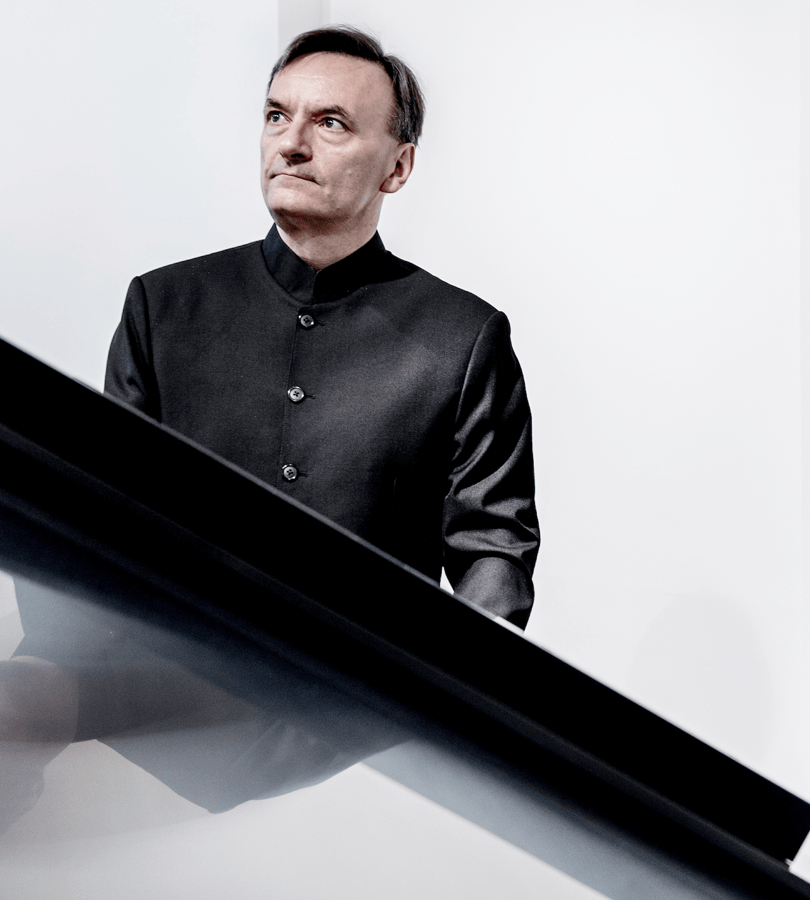
His Piano Concerto No8 “The Egyptian” was written in 1896 when he holidayed in Luxor. The slow and expressive second movement was followed by an intensely rhythmic string part with pianist Sir Stephen Hough who raced up and down the keyboard on the piano. This dramatic movement takes up a theme based on a Nubian song which is the source of the concertos “Egyptian” title. this movement was filled with exotic musical sounds and the piano and orchestra produced impressionistic, sounds such as the Niles’ croaking frogs.
Stephen Hough has an extraordinary gift as a performer with a superb technical ability he also has a keen understanding of the music, While the music of Saint-Saëns was conservative and he railed against the progressive French musical landscape of the time, his music notably in “The Egyptian” had some exciting chord structures which Hough managed with extreme confidence.
The first work on the programme was a new commission by composer by Ross Harris. It was filled with invention and novelty, opening with a huge blast of sound followed by music which suggested landscape and the sounds of the forest. With many of the sequences we found the composer allowing the various instruments try out their sonic abilities in depicting New Zealand’s natural world.
Woodwinds and strings convey the notion of birds peeking out from the forest canopy and through though the mists of the xylophone and percussion followed by some lengthy sequences which faded away to more interesting slow and enigmatic passages.
There was a dream-like, nostalgic sequence along with interesting sounds which created novel and dramatic sounds featuring brass, percussion and double bass which was followed by a boisterous and dramatic conclusion by the full orchestra.
Next NZSO Concert
Dame Gillian Karawe Whitehead Hoata
Beethoven Symphony No. 9
Wellington
Thu, 19 Nov, 5:45pm
Renouf Foyer
Dunedin
Sat, 21 Nov, 6:45pm
Dunedin Town Hall
Its audacious juxtaposition of styles, sounds and forces, including the revolutionary inclusion of a choir, marked the Ninth as a landmark work, not just for Beethoven but for music itself. Its monumental achievement and undeniable emotional power will be brought to stunning life with the help of Orpheus Choir Wellington and City Choir Dunedin.
An essential need for community and connection is at the heart of Dame Gillian Karawe Whitehead’s Hoata. Named for the Māori phase of the moon where the moon is barely visible, Hoata was written in 1979 during a cold northern hemisphere winter and evokes the icy blizzards and intense isolation that swirled around the composer as she wrote.


