Reviewed by John Daly-Peoplea
Royal New Zealand Ballet
Winter Season
Aotea Centre
July 23 – 25.
Reviewed by John Daly-Peoples.
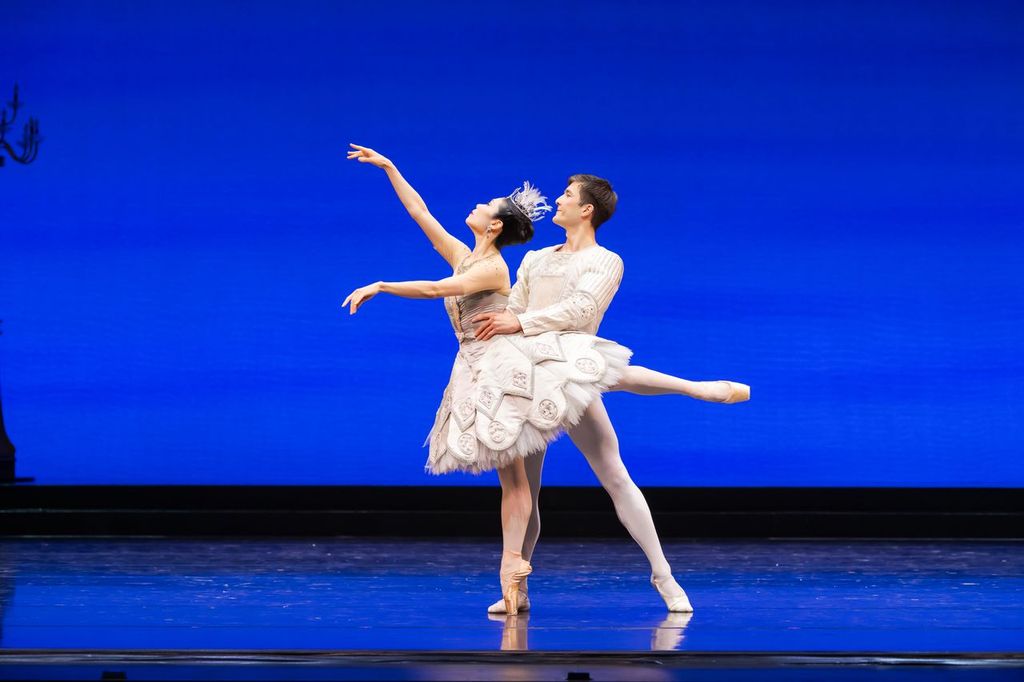
The Royal New Zealand Ballet’s Winter Season featured a triple bill featuring and two contemporary ballets, and the premiere of Sir Frederick Ashton’s more classical, Birthday Offering.
Ashton was the principal architect of the “English style” of classical ballet and choreographed Birthday Offering in 1956 for The Royal Ballet’s 25th anniversary, Birthday Offering. The ballet was originally a tribute to fourteen of its premiere dancers which included New Zealand ballet legend Dame Rowena Jackson along with Dame Margot Fonteyn.
Danced to Alexander Glazunov’s waltzing music the work demands perfection and precision and that is what the dancers delivered.
The seven female dancers each danced sequences which displayed their various talents and took inspiration from the Glazunov score. One of the dancers performed like a clockwork Coppelia, another gave a display of gentle, relaxed limbs while another presented a more romantic approach.
The seven dancers handled all the intricacies of the dance with a calm serenity, all using their body, arms and legs expressively.
Their displays presented what amounted to a primer of modern classical dance which they performed with technical virtuosity and panache.
When the female dancers partnered with their male partners both dancers became more animated and expressive but there was not the engaging emotionalism one might have seen later– not the sort of dancing seen between Fonteyn and Nureyev
There were some stylish vignettes, there was elegance and beauty, but it was too formal with a lack of heart.
This was simple ballet staged cleanly and stylishly in colourful mid-length gowns (Kenneth Rowell) that bounced along to the spritely footwork.
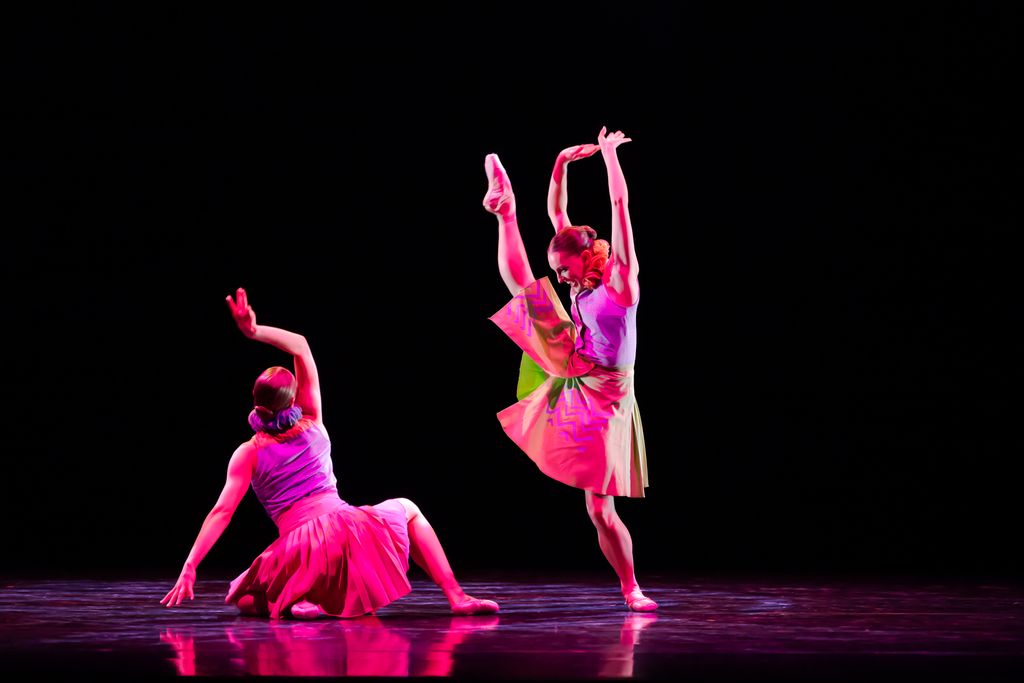
Sarah Foster-Sproull’s Ultra Folly opened with the dancers appearing to communicate with each other using their own form of semaphore in a homage to the choreographer Crystal Pite. Then, dancing to La Folie, music from the seventeenth century but played by Jordi Savilo and Hyperion XXI, they displayed a range of engaging dance routines with sharp moves and gesturers, mirroring the music and exploring the notion of communication.
Their dancing took inspiration from a range of sources varying from the courtly dance of the seventieth century to Highland dance while at other times their dancing evolved from the chance encounter on the street to the meeting of two lovers.
Then there were the more elaborate group interactions, the dancers appearing create hieroglyphics or an elaborate signing system and they became bound up in their intricate dance movements.
The almost tactile music was reflected in the dance at times as it morphed from the mechanical to the sensual.
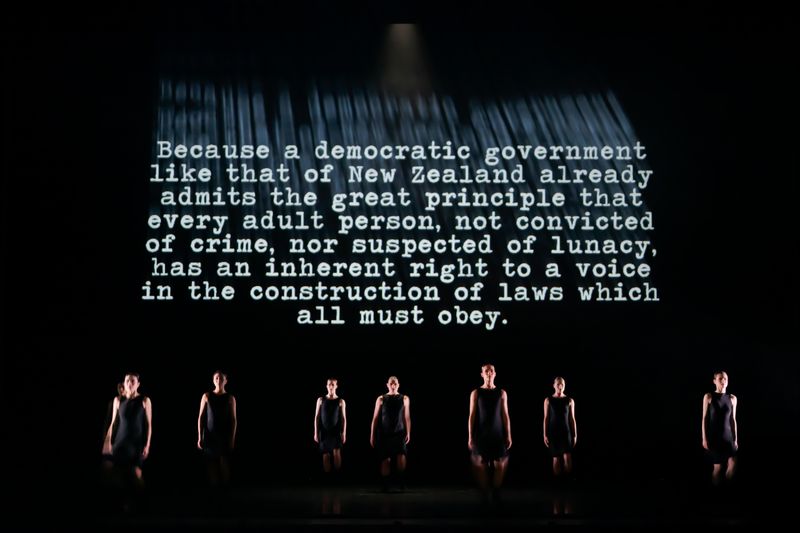
South African Andrea Schermoly’s Stand to Reason which was the more political of the three works took inspiration from the pamphlet “Ten Reasons Why A Woman Should Vote” written by Kate Shephard in 1888 in which women had to clearly convince, explain and justify their right to political participation.
The text of the pamphlet was projected onto a screen behind the all-female dance ensemble who were dressed in black tunics which referenced the women of Sparta, or the Amazons as well as a nod to the various black clad New Zealand sports teams.
The notion of the strong woman was also highlighted in the way that the dancers confronted the audience often fixed their gaze on us.
The dancers performed the roles of support and impetus normally taken by male dancers and while much of their movements had an aggressive quality with great physicality this was tempered by more subtle gestures.
In the final sequence of the work danced to the music of Beethoven the intensity of the dancing increased as the volume of the music increased with raw energy, breast beating and frenetic dancing. The dancers seemed to be struggling against unseen forces as they broke the bonds restraining them just as the sound system seemed close to imploding.
While the music by Johann Paul von Westhoff, Ludwig van Beethoven, and Marin Marais, drove the work, the choice of male composers seemed at odds with the feminist nature of the work.
In two of the works the lighting played a significant part with the surreal lighting of Daniel Wilson in Ultra Folly and the minimalist approach by Andrew Lees in Stand to Reason.


