Reviewed by John Daly-Peoples
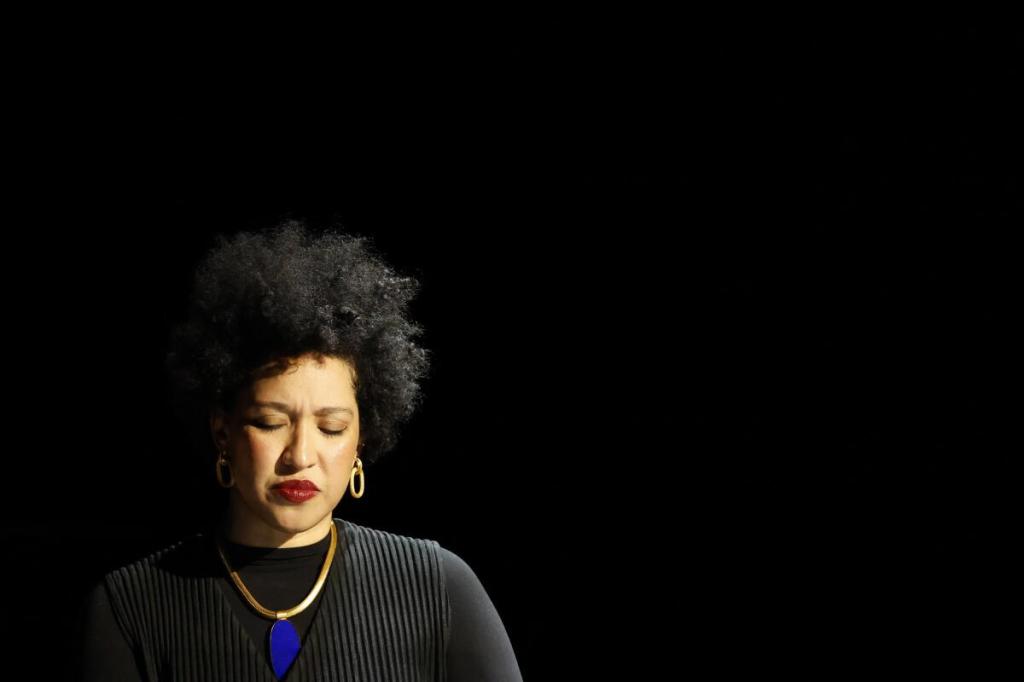
Julia Bullock with the Auckland Philharmonia
Conductor, Christian Reif
Auckland Arts Festival
Auckland Town Hall
March 7
Reviewed by John Daly-Peoples
In her recent concert at the Auckland Town Hall Julia Bullock sang a group of songs which she considered as having an “American” sound. These included George Gershwin, Leonard Bernstein and Margaret Bonds. Bonds is a pianist / composer who Bullock has championed for several years a major black composer who was overlooked for many years primarily due to systemic racism and sexism in the classical music industry, exacerbated by the loss of her manuscripts and a lack of publication.
Bullock included three settings of poems by Langston Hughes – “The Negro speaks of Rivers”, “Winter Moon” and “Poeme D’Automne” which gave voice to black aspirations in the 1920’s. With Bullocks singing of “The Negro speaks of Rivers” she provided a fine sense of the Negro spiritual, the softness of her delivery veiling a strong, insistent voice and a slowly developing dramatic force. Her voice delivered an emotional and haunting tone capturing the essence of heritage and endurance.
“Poeme D’Automne” was an astonishing song in which images of falling leaves and the colours of autumn were linked to the human body. She sang this with a surging operatic voice providing and intense and emotional sound.
“Winter Moon” was a short piece, but it showed that Bond was not just writing music to accompany the words of the poem, she had the ability to write dramatic meaningful music.
She sang Stephen Sonfheim’s “Somewhere” as though it was an anthem for the displaced and disadvantaged – a piece very relevant today’s America. There was also the poem “To Julia de Burgos” by Bernstein, a vibrant piece of music which spoke of an angry revolutionary adventure in which she projected the words as though a personal statement.
She also sang a couple of George Gerswin songs, “Somebody from Somewhere” and “Summertime “from “Porgy and Bess”.
She also sang “La Conga Blicoti” a vibrant, Afro-Cuban jazz-influenced song performed by Josephine Baker with the Lecuona Cuban Boys, which features a distinctive conga rhythm.
She also sang Billy Taylor’s “I wish I knew how it feels to be free” like a requiem or funeral lament, very appropriate as a song for freedom.
There was also “I have Two Cities” by the French composer Henri Varna and lyricist Geo Koegar with lines such as
Manhattan is beautiful,
But why deny it.
What enchants me is Paris,
All of Paris
Which she sang as a hymn to Josephine Baker.
The concert opened with the Auckland Philharmonia playing Erich Korngolds “Theme and Variations” and closed with them playing Kurt Weill’s “Symphony No 2”.
Bullock has an affinity for the outsider artist which has led to her interest in Josephine Baker who made the journey from the US to Europe where she made her name while the two composers became outsiders under the Nazis and were forced to move from Europe to the US.
Korngold who was a major composer in Austria influenced the style of composition and singing in the 1920’s and 30’s with operas such as “Die Tote Stadt” while Weill was influential in bringing Bertolt Brecht’s work to the public with works including “The Threepenny Opera”.

 New Zealand Arts Review