Reviewed by John Daly-Peoples

Peter James Smith, Zealandia
Orexart
Until 27 September
Reviewed by John Daly-Peoples
Peter James Smith in speaking about the impetus behind his landscape paintings has noted his debt to T S Eliot’s “Four Quartets” and in particular “Burnt Norton” with its notion of transcending time to achieve a sense of timelessness.
Time before and time after
In a dim light: neither daylight
Investing form with lucid stillness
Turning shadow into transient beauty
This can be seen in his latest exhibition “Zealandia” where the artist examines Zealandia, the earth’s largely submerged continent beneath the waters of the Southwest Pacific Ocean with only a few islands like New Zealand and New Caledonia breaking the surface to reveal parts of the super continent of Gondwana.
These islands, historical remnants of an ancient time and still revealing themselves, link past and present through a process of discovery both scientific and historical.
With many of his paintings the landscape forms are often shrouded in this dim light and their shadowy forms seem to take on a substantial form, transporting them from the eighteenth century and the voyages of Capt Cook as well as later voyagers.
With “Zealandia” ($8500) there is sense that the artist is describing the underlying landscape of rocks, islands and headlands beneath the water’s surface, as though these forms are thrusting their way upwards.
Smith like many other artists with a Romantic approach to landscape see his subjects as a powerful, emotional forces, depicting the raw, uncontrollable aspects of nature such as storms, mountains, and wild, untamed places. The landscapes used to express subjective feelings and the sublime, highlighting nature’s grandeur.
Unlike many Romantic artist Smith does not include human figures to emphasis the grandeur of nature but rather includes ideas about man’s measurement of the forces of nature.
In his paintings he employs diagrammatic symbols and marks which indicate of natural forces and aspects of scientific enquiry such as concepts of the angle of sunlight, speed of tide or ocean currents.
The marks he often applies to his paintings can be cartographic indicating the outlines of landscape or the passages into harbours, they can also be the recording of rainfall or the forces of nature.

Then there are the written descriptions of the landscape giving the location, the dates of original or important events as well as a references to Plato’s concept of perception which is noted in “Rain Shadow (Lake Tekapo”) ($8,500).
With his “The Passage of History” ($15,500) the artist includes a short summary of Captain John Grono’s adventures in Doubtful sounds in 1813 where he rescued several marooned sealers. He also includes a map of the area as well as a distance indicator in sea miles.
A similar work “Wind Across Dusky Bay” ($15,500) features a map of the Dusky Bay area with a text about Capt. Cook’s arrival in 1773 which includes the route taken by his ship “Resolution”. He has also included wispy shapes of the water being driven across the surface of the bay.
The view in this work is frames as though being seen through an observation window, emphasizing the notion of historical distance and that this was the area where Cook established an observatory so enable him to accurately fix his position in New Zealand.
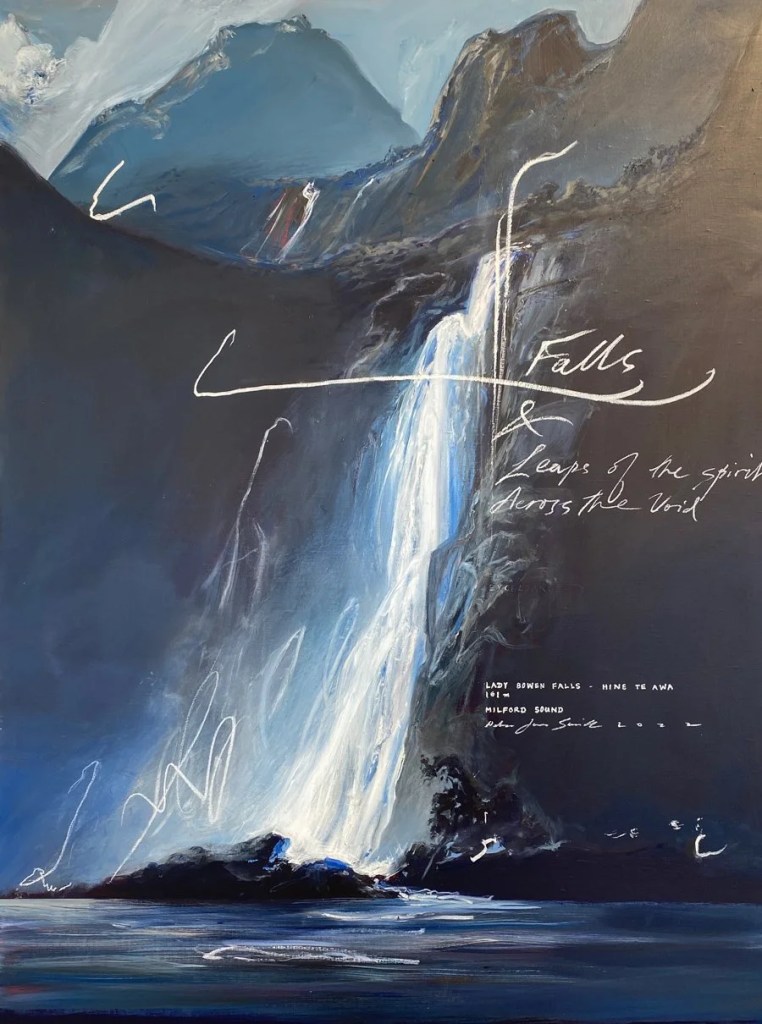
The work “Leaps of the Spirit” ($10,500) which depicts the Lady Bowen Falls combines Romantic landscapes with gestural marks exploring themes of artistic intervention, history, time, and perception.
The works full title “Leaps of the Spirit Across the Void” has something of a Miltonian flavour and reflects the artists notion of the interconnectedness of science and spirituality, where mathematical certainty meets artistic vision to create a holistic understanding of the world.
To subscribe or follow New Zealand Arts Review site – www.nzartsreview.org.
The “Follow button” at the bottom right will appear and clicking on that button will allow you to follow that blog and all future posts will arrive on your email.
Or go to https://nzartsreview.org/blog/, Scroll down and click “Subscribe”


One reply on “Peter James Smith’s Zealandia”
Great review John. Insightful as always.
LikeLike