Reviewed by John Daly-Peoples


Gary McMillan, City in Progress
Fox Jensen McCrory Gallery
September/October
Elizabeth Rees, The Bay
ARTIS Gallery
Until October 7
Reviewed by John Daly-Peoples
Two recent exhibitions see artists responding to the to the light, colours and textures of the environment just as artists of 150 years ago did with some variations on Impressionism.
In his latest exhibition “City in Progress” Gary McMillan has continued his depiction of views of the inner city, the motorways and industrial buildings.
These are nearly all seen from the interior of a car, capturing the often-fleeting images we have when driving. He also captures light in its various forms –sunlight at dawn and dusk, reflected light, refracted light, motorway lamps, industrial lights and traffic lights.
Each of the images has the simple title of “Scene” plus a number, an indication of the artist’s referencing photography and film which gives many of the works a slightly surreal quality.
As well as the connections to film and photography his work connects with traditional realist painting, pointillism and neo-Impressionism.
Many of the works capture the flash of recognition, of half seeing objects seen from a moving car as Scene 52 ($9500) – the rain speckled windscreen, parts of the car, overhead road signs, lamp standards and a blinding sun. They are the impressions the brain takes in as it makes the journey.

Scene 63 ($9500) provides a complex view – light blooming on the car’s window screen, light shining through obscuring foliage, another view reflected in the cars side mirror. It becomes an image composed of different elements of light. But these various elements of light are all painted illusions created by the artist.
In these works, he investigates the way in which paint creates the illusion of the photographic pixel as well as the painterly impressionist dot.
At a distant his works look like photographs but as the viewer gets closer to the work one is more aware of the Seurat-like pointillism or the pixilation of low-resolution photographs.
With “Scene 57” ($5500) the pointillism is far more apparent with the sky and clouds stippled with the small dots of colour. The artist has added a sense of structure to the work with parallel power lines and one of his ever-present lamp posts.
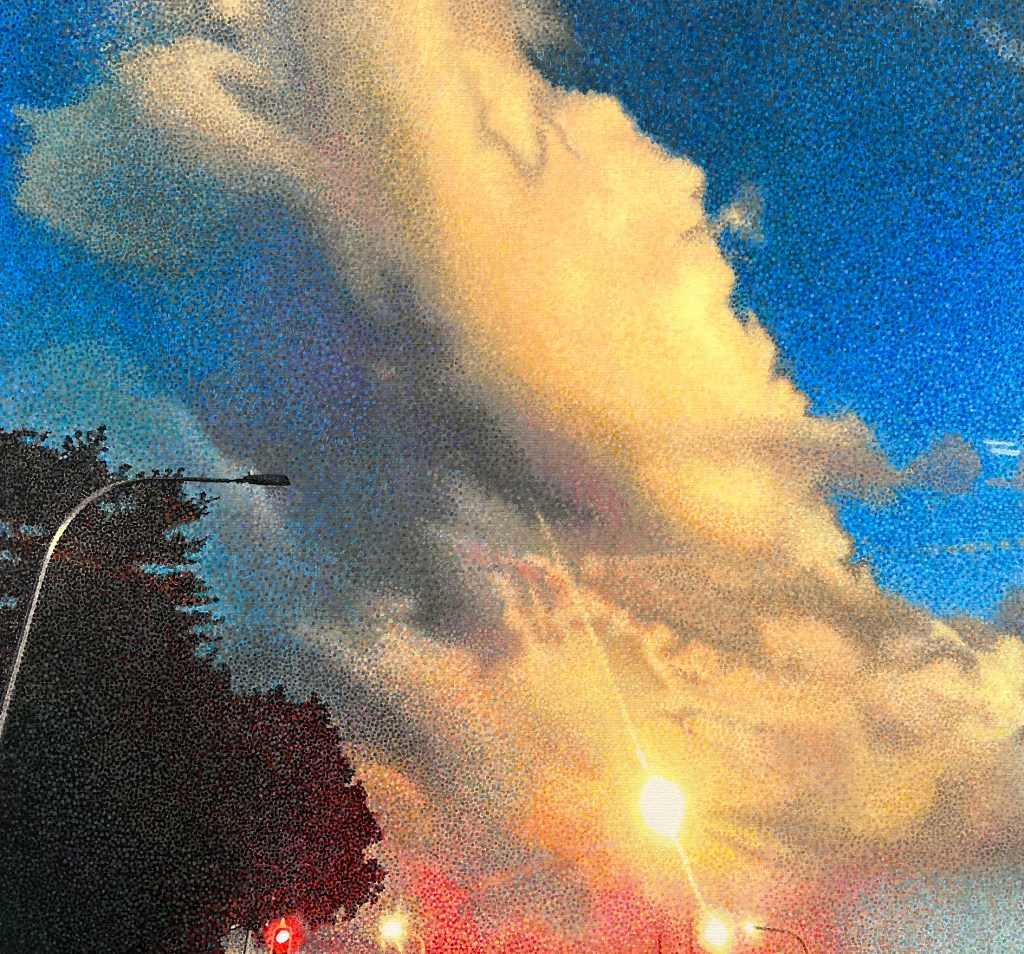
This focus on sky and cloud is also seen in “Scene 60”($8000) where the billowing cloud looks like a massive explosion saturated with colour.
Where Gary McMillans exhibition looks at the urban environment Elizabeth Rees’s work is focussed on an isolated area of Northland. As she notes in the catalogue – “”The Bay” is a response to my new small-town life in the Bay of Islands where light ever changes the sea and bushclad land. My recent acquisition of a boatshed in a small tidal bay has now become my full-time studio. Being surrounded by water, this change has offered me yet another perspective – being able so closely connected to the natural environment.”
Her paintings owe much to the style of the Impressionists with a sense of the artist painting in the open air surrounded by her subject.
In responding to an environment she feels some connection with these paintings are a record of the various times of day, moods and qualities of light she has observed
Many of her previous works featured figures in a landscape, their presence providing a sense of isolation. In these newer works it is the landscape itself which provides that sense of isolation.

Here there are brooding landscapes such as “Summer Shade” ($10,000) where the touches of colour seep through the dark foliage.
With works like “A High Tide” ($8000)) the colours are almost bleached out with light swirling around the shapes of trees.

A similar work “On the Beach” ($8000 where the foliage is almost shattered by light, could have been used as the cover illustration for the Nevil Shute novel “On the Beach” which tells of impending nuclear pollution in the South Pacific
A further connection could also see the work in reference to the origins of the title in the lines from T S Eliots “The Wasteland”
In this last of meeting places
We grope together
And avoid speech
Gathered on this beach of the tumid river. connection
Two of the works features figures as in “Low Tide” ($8000) where the small figures contribute to the sense of isolation and drama. “Last Light” ($10,500) feels less successful as the two figures contemplating the vista do not contribute to the sense of remoteness.
With “The Bay” ($10,500) there is more colour contrast with the blue of the water and the sky more dominant and the colours of the foliage picked out by light.

“Nestled in the Bay” ($13,500) also alludes to the human presence with several low buildings or boathouses which merge with the light colours of the sand and sea.
The merging of sands and sea is also apparent in “Dunes Beyond” ($10,500) where the dunes seem to be the foam of crashing waves.
With nearly all these works it is light which is the dominant aspect with the artist endeavouring to create an ethereal presence of cloud and sky .The hills and foliage created with scumbled paint give a sense of seeing through a darkened or fogged glass.

 New Zealand Arts Review