Reviewed by John Daly-Peoples
La traviata by Giuseppe Verdi
Pub Charity, Opera in Concert
Auckland Philharmonia and the Freemasons Foundation NZ Opera Chorus
Aotea Centre, Auckland
June 7
Violetta Valéry Luiza Fatyol
Alfredo Germont Oliver Sewell
Giorgio Germont Phillip Rhodes
Annina Felicity Tomkins
Flora Bervoix Katie Trigg
Doctor Grenvil Joel Amosa
Baron Douphol Pelham Andrews
Marquis D’Obigny James Ioelu
Gastone de Letorières Andrew Goodwin
Reviewed by John Daly-Peoples
“La traviata” or “The Fallen Woman” centres on the life of Violetta Valéry, a courtesan living in Paris, and her struggle to find love and escape her past. It deals with the societal and familial judgments faced by her due to her profession and choices, highlighting the opera’s themes of love, sacrifice, and social hypocrisy.
The opera is more intimate than much of Verdi’s output, focussing on contemporary social issues and has autobiographical elements paralleling his relationship with the singer Giuseppina Strepponi with whom he had a scandalous relationship in the 1840’s It is also the only one of Verdi’s operas to specifically take place in his own time,
At the centre of the various themes of the opera is the nature of love in all its forms – romantic love, lust, the love of family and the love of individual freedoms.
Being a work about love any production succeeds or fails on the way in which these notions of love are conveyed and emphasised. Without sets which can often add to the drama and symbolism it means it is the voices which have to convey the emotional nature of the story and relationships.
This production succeeded by having exceptional voices, intelligent direction and a superb conductor.
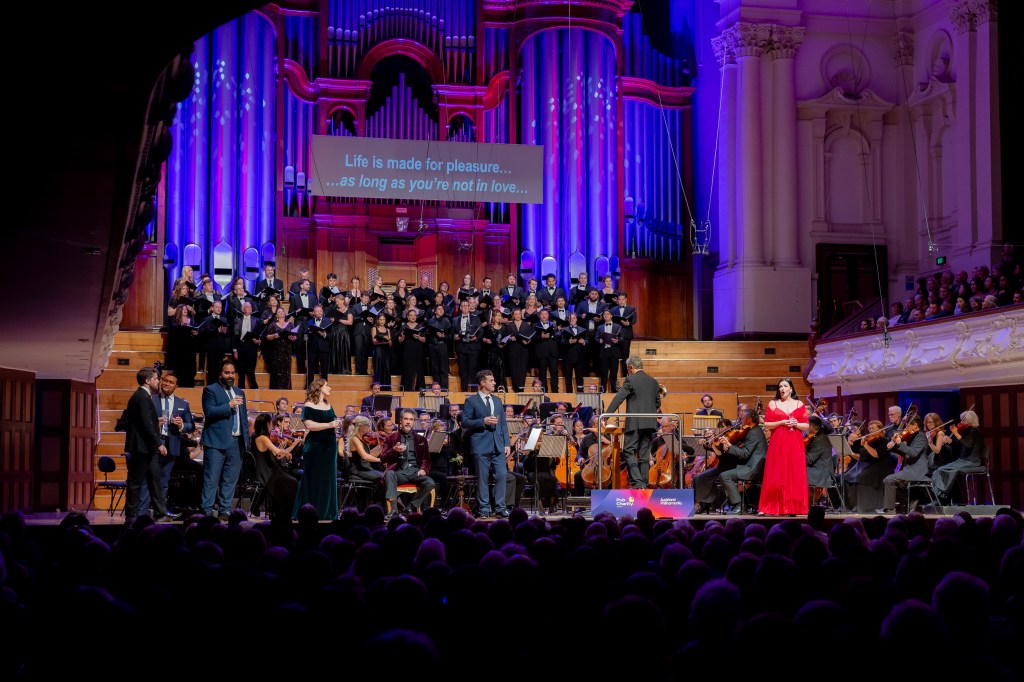
In the first half of the opera we were treated to some impressive singing by Luiza Fatyol dressed in red, standing out from the black costumers of the chorus.

Almost immediately the two lovers, Violetta and Alfredo (Oliver Sewell) sing “Un di, felicé, eterea” in which they speak of the torments and delights of love, succinctly capturing the nature of their love and love generally.
Luiza Fatyol provided some touching moments with her singing notably with the aria “Sempre Libera” at the beginning of the opera, after Alfredo confesses his love. Here she is torn between wanting to be free to live her life and reflecting on her possible future with her lover.
That division between the two lovers was emphasised by Alfredo singing in a distant voice from offstage.
At times she seemed to be singing directly to the audience, baring her soul as in her singing of “Un di, felicé, eterea”. Where she lamented her fate “alone in the desert of Paris”
There were times when she used her calm recitative voice to convey secrecy and at other times her voice was not much more than a whisper. Then, in her meeting with Giorgio Germont she engaged in a raging vocal duel and in her final minutes her voice sounded as though sung from a failing body, robbed of sensation.
Later in the opera she produced some stunning singing as with her “Alfredo, di queste core” (If you know how much I loved you), which she sang with a forlorn pathos flecked with anguish and despair. Her final death scene was heart wrenching as her voice gasped and quavered with a real sense of loss, love and sadness.
Oliver Sewell as Alfredo was impeccable . He presented as a simple down-to-earth male whose life is suddenly filled with an urgent passion and the realization of his mature love.
He gave the role a realism and authenticity expressing his love, anger and turmoil
with genuine emotion .
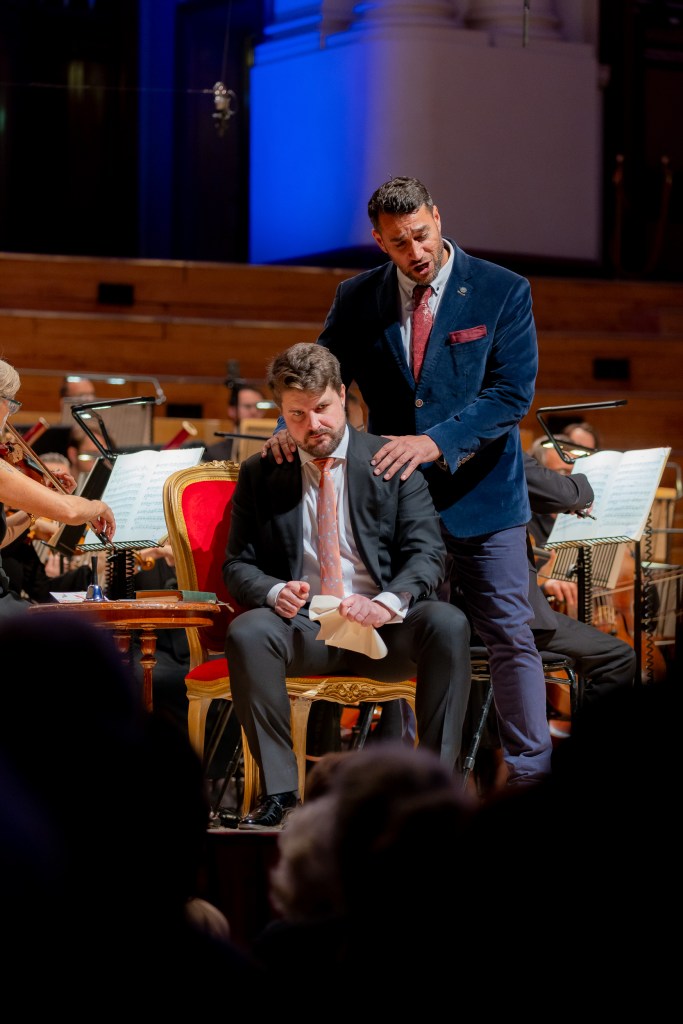
Phillip Rhodes was impressive as Giorgio Germont, Alfredo’s father. He provided a strong emotional character with his furious and exciting singing, which was genuinely powerful and unsettling. He brilliantly conveyed, with gesture demeanour and voice a man using his superior moral station to impose his will.
All the main characters as well as having great voices also displayed great acting talent conveying personalities through well-judged voice action and facial expression.
The Freemasons Foundation NZ Opera Chorus, as ever sang gloriously and inhabited the upper levels of the Auckland Town Hall stage in a relaxed and realistic way. Although the “dance sequence” featuring Gypsies and Matadors could have been better performed with only a few of the cast.
The Auckland Philharmonia was guided by conductor Giordano Bellincampi who followed the singers intently and ensured that the music added to the emotional drama of the opera, never dominating the singers, creating a rich soundscape which enveloped cast and audience making for a moving and inspiring evening.
To subscribe or follow New Zealand Arts Review site – www.nzartsreview.org.
The “Follow button” at the bottom right will appear and clicking on that button will allow you to follow that blog and all future posts will arrive on your email.
Or go to https://nzartsreview.org/blog/, Scroll down and click “Subscribe”


 New Zealand Arts Review