Categories
Reviews, News and Commentary

Murder on the Orient Express: Unadulterated Entertainment

Reviewed by Malcolm Calder

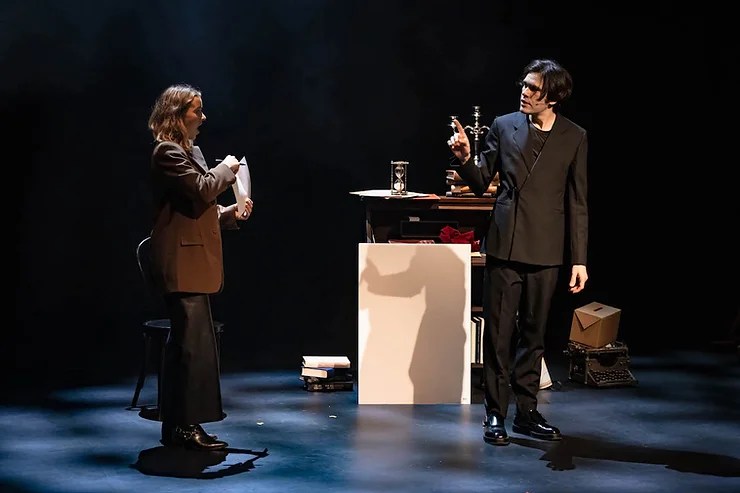
Cameron Rhodes (Hercule Poirot), Edwin Wright (M Bouc) Photo Andi Crown

Agatha Christie’s Murder on the Orient Express

Adapted for the stage by Ken Ludwig

Auckland Theatre Company

Dir: Shane Bosher

Set: John Verryt

Lighting: Sean Lynch

Costumes: Elizabeth Whiting

Composition and Sound: Paul McLaney

Motion: Harley Campbell

Dialect: Kirstie O’Sullivan

Intimacy: Todd Emerson

Engine Room Assistant Director: Nī Dekkers-Reihana

With Bronwen Ensor (Greta Ohlsson), Sophie Henderson (Countess Andreyi), Jennifer Ludlam (Princess Dragomiroff), Mayen Mehta (Hector McQueen), Ryan O’Kane Col Arbuthnot/Samuel Ratchett), Mirabai Pease (Mary Debenham), Cameron Rhodes (Hercule Poirot), Jordan Selwyn (Michael/Head Waiter), Rima Te Wiata (Helen Hubbard), Edwin Wright (Monsieur Bouc)

ASB Waterfront Theatre

Until 10 May

Reviewer Malcolm Calder

Photo: Andi Crown

I’ve had a busy time of it lately.  What with school holidays, two successive long weekends and a seemingly endless round of rather long and demanding days, I had half a mind to settle for a quiet glass of red, a good book and an early bedtime blithely avoiding any additional responsibilities that might involve going out to the theatre. Had to rush to make the 7pm start too!

Thank goodness I didn’t.

With this re-vamp of the original classic, Director Shane Bosher has turned in a blinder for Auckland Theatre Company and come up with something that is pure, unadulterated entertainment. 

Adaptor Ken Ludwig’s cull of the original murder mystery, after having been approached by Agatha Christie’s grandson for the Christie Estate, was first performed in 2017.  So if you are a Christie devotee looking for a simply stage-adaptation of her original go no further.

Ludwig adamantly insists that he is a writer of plays and not simply a ‘murder-mystery guy’.  As a result he has redrawn, reduced and compacted the number of characters, enhanced the comedy and come up with a tightly-scripted and genuine ensemble piece that adds to the already enormous output that has made him arguably the most produced playwright of his generation.

It is sometimes suggested that more serious undertones may have underpinned aspects of Christie’s original but few are evident here.  Bosher may have drawn some slight allusions to contemporary geo-political issues that underpin the entire structure but this may or may not be the case.  What he has done however, is generate something that entertains big time. 

The result is an actor’s piece to die for.  And this cast do more than just deliver.   Just as Auckland Theatre Company, CEO Jonathan Bielski has urged audiences to avoid spoilers about resolution of the murder, mystery and mayhem of the play itself, it would be churlish to single out any one cast member.  The entire cast is let loose, projecting archetypes rather than convincing portrayals of real people.  Each character is distinct, their backgrounds are as varied as their accents and the ensemble functions as a singular unit predominantly by using that essence of great comedy – precision timing and the credibility of relationships between them.

ATC is to be congratulated too on once again continuing to develop pathways for increasing numbers of younger actors and production people who we are seeing as first-time performers with ATC.

This is a consummate, professional ensemble and even a tiny glitch with a prop on opening night was more than successfully ad-libbed around, the comedy was sustained and the professionalism acknowledged by an audience who got it.

I am advised that ticket sales for MOTORE are already strong and ATC is to be congratulated on both the production itself and for hopefully hitting a jackpot.

The 7pm start time may have been a bit of a scramble but it had the bonus of my being home and abed well before 10pm.  No book though – my head was still laughing inside itself.
Categories
Reviews, News and Commentary

Peter Pan: Loads of Command but little Control

Review by Malcolm Calder

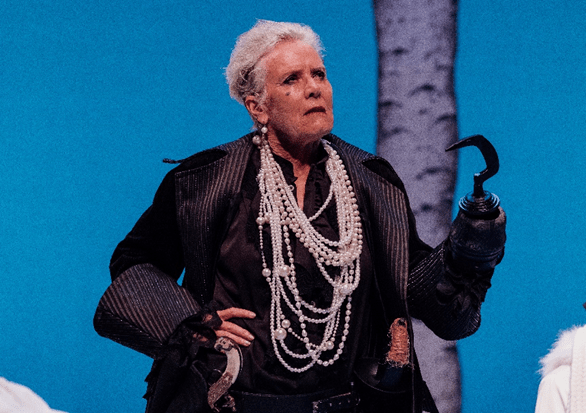
Jennifer Ludlum as Captain Hook Photo Andi Crown

Peter Pan

By Carl Bland

Adapted from the story by J M Barrie

An Auckland Theatre Company and Nightsong production

Directors, Ben Crowder and Carl Bland

Set, John Verryt

Lighting Sean Lynch

Costumes Elizabeth Whiting

Composer and Music Claire Cowan

Sound Max Scott

Choreography Dayna Pomare Pai

With Andrew Grainger, Jungwhi Jo, Tupe Lualua, Jennifer Ludlam, Anika Moa, Nova Moala-Knox, Lotima Nicholas Pome’e, Theo Shakes, Angus Stevens, Tess Sullivan, the Nightsong Youth Company and Roux the dog.

ASB Waterfront Theatre

Until 27 October

Review by Malcolm Calder

Whether as Captain Hook or the understated Mr Darling, Jennifer Ludlum commands the eyes, the ears and the senses every time she takes to the stage in this rather unique production.  Striding around guiding, leading and even cueing other actors, she is totally in command.  Her pedigree and experience is clear in her every nuanced action and clearly demonstrates why she is one of this country’s finest character actors. 

However it seems she is not supported by any kind of control structure at all in this Peter Pan and that is a great pity.

Nightsong has developed a fine reputation over the years and its I Want To Be Happy remains one of my 2023 standouts.  But this collaboration under the Auckland Theatre Company umbrella has confused me.  It would be easy to dismiss it as a rather ginormous mishmash with no one in control.  That is possibly true to a degree but there are clues as to what it is trying to do.

Writer Carl Bland pays homage to Barrie’s 1920s original.  This is not a hi-tech show and he has kept it old-fashioned in many ways.  However his work as a director is where things go a little awry – a good reason why writers who direct their own work sometimes incline towards the over-indulgent.  Bland has tinkered with Barrie’s original and thrown in many asides, one-liners and loads of whimsy.  Many of them work while others are wasted and become mere throwaways.

It is a bit like all those things got put in a bucket and then someone threw them at the stage.  As a result things just sort of ‘happen’ in this Peter Pan rather than become magically ‘revealed’ after characters evolve, situations develop their own dynamic energy and tension has been drawn tighter and tighter.

Perhaps these things may have evolved after another week or two of rehearsal, but inter-character dynamics were all but absent and few did little more than appear onstage and utter their lines.

Some did their best. Theo Shakes developed a certain presence as Pan, especially in Act 2, Lotima Nicholas Pome’e sang with beauty towards the end of Act 1 and Andrew Grainger blustered about a lot.

Perhaps the whole thing could be summed up by the inclusion of Anika Moa.  Apart from providing some, admittedly nuanced, contributions to the accompanying soundscape I have no idea why she was included.  Her Mermaid Queen simply occupied a space, may have added an occasional vocal harmony and tickled a few percussion instruments.  Poor Anika wound up a distracting sideshow. I felt sorry for her.

John Verryt’s set looked like it might possibly have been relocated from Barrie’s era, a beautifully-crafted wolf suit seemed to cover Tess Sullivan’s mic so we could barely hear her words, low-tech flying is a bit yawn-inducing these days and the whole thing looked under-rehearsed –at a production level too.  Even the intelligently-included ATC Youth Company, making up numbers as pirates and Lost Boys, occasionally looked a little lost themselves.

Through all of this the missing element was command.  One could almost sense Ludlum willing others in the cast to react, respond and become personalities matching the energy, effort and detail she put into her work  – but this production allowed them to do so only rarely.  As her Captain Hook met his demise I’ll swear I could hear her sigh of relief as the crocodile finally clamped its jaws around her and carted her off to who knows where.

And, while conceding that Barrie’s original has a dark side and may provide a few giggles for children I’m inclined to believe its moral about transitioning from childhood is somehow lost in translation for children anyway.  On leaving the theatre I overheard a 10-year-old son respond to his father’s question about what he thought of the show.  His response ‘too long but I liked the dog’ was his summation.

So, thank you ATC for your policy of diversifying your product range in 2023.  However this Peter Pan raises other questions too.  Not least its timing – one wonders why a show specifically targeting children and families should open at the very end of the school holidays.  There have been many successes this year and I am sure this little blip does not negate the others.

But, finally, congratulations to Jennifer Ludlum for two finely-crafted characters.  They commanded the stage.

To subscribe or follow New Zealand Arts Review site – www.nzartsreview.org.

The “Follow button” at the bottom right will appear and clicking on that button  will allow you to follow that blog and all future posts will arrive on your email.

Or go to https://nzartsreview.org/blog/, Scroll down and click “Subscribe”

Categories
Reviews, News and Commentary

Diptych: Memorable Risk with Rewards aplenty

Reviewed by Malcolm Calder

Reviewed by Malcolm Calder

Auckland Arts Festival

Diptych

Peeping Tom, Belgium

Kiri Te Kanawa Theatre, Aotea Centre

Diptych: The missing door & The lost room

Concept / Directors, Gabriela Carrizo and FranckChartier

Until 24 March

Review by Malcolm Calder

I normally try and write these words as soon as possible after a performance.  But this time I couldn’t and eventually decided to sleep on it.  Only I couldn’t sleep either.  In my mind images and thoughts swirled in what I could only describe as atmospheric convolution.

But first things first. Diptych comprises two parts – the first about a missing door, and the second about a lost room.  There is a third part, making it a Triptych, but we don’t see that here in this Auckland program.

My over-weaning sense of this company is the dynamic, slick and truly mesmerising movement in its choreography.  Belgian founders Gabriela Carrizo and Franck Chartier have established Peeping Tom as a unique force in dance theatre transforming hyperrealist settings into unstable universes that defy the logic of time, space, and mood.  This work and the company’s lineage to Pina Bausch are clearly evident and I can easily see why Artistic Director Shona McCullagh chose it as one of the centrepieces of her 2024 Festival.

As well as movement, Diptych also owes much to an all-enveloping soundscape that adds a hypnotic quality, overlaying music with live percussion and everyday noises.  This underpins the sheer physicality and many of the jarring and emotional shocks that lie ahead.

The staging starts out tiny and winds up using the full breadth of the stage giving it a cinemascopic quality.  And, just in case we missed it, the entire work is cinematic.  This is underscored by the introduction of rolling klieg lights, a boom mic and a set that is deconstructed then reconstructed by technicians in full view of the audience.

Completing the context, and further highlighting the illusion, are costumes that writhe and twist almost becoming creatures and taking on characters of their own, whilst echoing the movements of the dancers whose movements who, it seems, are controlled by non-logical and even gravitational forces.

Then my mind returned to ponder the word ‘convolution’ itself.  Turns out it’s a term that describes a form or shape that is folded in tortuous windings, or one of the irregular ridges on the cerebrum of higher mammals oran intricacy of form, design, or structure in which the combinations of power and the caprices of the powerful are ever-present dangers to survival (thanks Mr Merriam-Webster).

Yep, that’s about right I decided.  And henceforth, for me, Diptych became a convoluted dance theatre work.

I knew it was about a man’s mental anguish and I immersed myself in that tangled web.  It has no single direction veering between reality, memories, desires, dreams and nightmares.  At times I was slow to grasp a thread; at others I got it instantly.

Eventually I just stopped fretting about trying to work things out in any logical or linear fashion, sat back and let it wash or surge, over me.  And I’m glad I did because that is what Diptych is all about.  Rather than trying to ‘understand’ what Carrizo and Chartier were trying to say, the production itself taught me to just soak in it, to absorb it.

Yes, there was a missing door; and yes there were many surprises when some were opened.  But the perceptions, context, memory and horrors of doing so were different for every character on stage.   Similarly, an entire room got lost and the same applied.

What Festivals are supposed to do is introduce us to the new, the different and the normally unattainable.  So congratulations to the Festival for taking this risk with Dyptych.  It was certainly memorable for me – so much so that it never occurred to turn my phone back on again when leaving the theatre and I missed a raft of calls the next morning.

To subscribe or follow New Zealand Arts Review site – www.nzartsreview.org.

The “Follow button” at the bottom right will appear and clicking on that button  will allow you to follow that blog and all future posts will arrive on your email.

Or go to https://nzartsreview.org/blog/, Scroll down and click “Su

Categories
Reviews, News and Commentary

A Very Old Man With Enormous Wings: Delightful Ingenuity

Reviewed by Malcolm Calder

Genevieve Hulme-Beamanand Manus Halligan

Auckland Arts Festival

A Very Old Man With Enormous Wings

By Dan Colley and Riverbank Arts Centre, Newbridge

Based on the short story by Gabriel García Márquez

Herald Theatre, Aotea Centre

Until 24 March

Review by Malcolm Calder

Director, Dan Colley

Lighting, Sarah Shiels

Sound, Alma Kelliher

Just outside of Dublin is a small town in Co Kildare called Newbridge. Its Riverbank Arts Centre, is funded by both the local authority and the Arts Council of Ireland, and it serves its community well. Rather like similar ventures in this country its facilities are available to local community groups, but at its artistic heart is a carefully-curated program featuring selectively chosen professional work from all over Ireland, the UK and Europe.

Unlike the vast majority of its New Zealand counterparts however, the Riverbank Centre is much more than just a receiving theatre. It also carefully nurtures talent and creativity and has developed into what is referred to in the trade as a ‘producing theatre’ with some of its work touring extensively

A Very Old Man With Enormous Wings typifies this. It is the work of a small cooperative group under the leadership of Dan Colley who have created a perfect show for young and old to share, gorgeously formed around music, puppetry and live video, but also thoughtful and emotionally rich in its exploration of human nature.

Its informality and studied casualness is very quickly established. Non-speaking actor Manus Halligan (well he makes some mouth-noises) is ‘doing things’ with tiny models on a table as the audience is seated. When the lights find a little focus, narrator Genevieve Hulme-Beaman simply announces “we’ve started”. She goes on to urge the audience for this offbeat adaptation of Gabriel García Márquez’s children’s story, to not go looking for a lesson. “There isn’t one.”

And that’s precisely what we get. It’s like a children’s story told by children and, as is often the case with children’s stories, introduces flashes of unexpected insight and depth. The story certainly examines the human response to those who are weak, dependent, and different and there are moments of striking cruelty and callousness throughout. But it essentially brings a magical revelation of itself to the stage and reveals itself through a beautiful, strange, emotional richness. It is offbeat, quirky, funny and its 43-minute runtime flies.

Above all it reveals what creative minds can generate using little more than ingenuity. And what can gestate in a small regional arts centre where producing is as important as receiving.

Categories
Reviews, News and Commentary

“The Effect”: A sizzling chemistry lesson coming to Auckland Theatre Company

John Daly-Peoples

Zoe Robbins (Connie) and Jayden Daniels (Tristan)

The Effect by Lucy Prebble

Auckland Theatre Company

ASB Waterfront Theatre

 April 16 –  May 11

John Daly-Peoples

Straight off a highly acclaimed season at London’s National Theatre, Auckland Theatre Company is presenting The Effect, written by BAFTA, Golden Globe and Emmy award-winning co-executive producer and writer Lucy Prebble of the HBO international hit series, Succession (2018-2023) in their 2024 line up.

“The Effect” will be directed by Benjamin Kilby-Henson (King Lear) and feature major stage and screen stars including; Jayden Daniels (Head High, Celebrity Treasure Island), Zoë Robins (Amazon’s The Wheel of Time), Jarod Rawiri (Long Day’s Journey into Night) and New Zealand screen legend Sara Wiseman (Under the Vines, Creamerie).

British playwright and producer Lucy Prebble shows all the razor-sharp flair that made her a star writer on Succession in this deft dissection of medical ethics and the nature of human attraction.

The review of the work in the New York Times gave it a strong recommendation.

“Are you in love, or are you merely experiencing a giddy dopamine rush? Are those two states even meaningfully different? Is there a true, innermost “you” that is distinguishable from your neurochemistry?

These are some of the tricky questions explored by Lucy Prebble’s thought-provoking play, “The Effect”

The play revolves around two young people, Tristan and Connie, who take part in a trial for a dopamine-based psychiatric drug with powerful antidepressant properties. Initially, they seem to have little in common — he’s a working class lad from East London; she’s a bougie psychology student from Canada — but as the trial progresses, a tender rapport develops.

Throughout the study, the participants are monitored by two psychiatric doctors, Lorna and Toby, who debate their findings: Is the drug pulling their subjects together, or are their feelings organic? And if one of the trial participants was actually receiving a placebo the whole time, what then? Prebble keeps us guessing.

Throughout, the pair’s gradual transition from wary awkwardness to intense mutual magnetism is convincingly rendered, in large part thanks to the actors’ terrific onstage chemistry.

Things get messy in the latter stages of the experiment, as both the doses and the emotional stakes increase, leading to a fraught and affecting denouement.

The stiltedly ambivalent friendship between the two middle-aged doctors provides an intriguing subplot. We learn that Lorna and Toby once romantically involved, many years ago. Lorna is prone to bouts of depression, but refuses to take medication; Toby, on the other hand, is a true pharmaceutical believer.

“The Effect” is healthily skeptical about scientifically deterministic approaches to emotional well-being, channeling a dissenting tradition that dates back to the anti-psychiatry movement of the 1960s; its moral sensibility recalls Ken Kesey’s  1962 novel, “One Flew Over the Cuckoo’s Nest.” The play’s revival is particularly timely as a new generation of wellness gurus have, in recent years, latched onto the idea that much of human behavior can be explained away as neurotransmitters or hormones simply doing their thing.

Prebble invites us to ponder the implications of such thinking. Connie is initially uncomfortable with the notion that two people can fall in love just like that (“It takes work,” she insists), and wary of her attraction to Tristan. He, in response, makes the case for mystery, and thus articulates the play’s key message: That a world in which all feeling is viewed as a matter of chemistry would be a bleak one indeed.”


Categories
Reviews, News and Commentary

Romeo and Juliet. An entertaining theatrical production of a theatrical production

Reviewed by Malcolm Calder

Natasha Daniel as Juliet

Romeo and Juliet

By William Shakespeare

Pop Up Globe Company

Director David Lawrence

SkyCity Theatre, Auckland

Until 25 February

Review by Malcolm Calder

After a brief, and apparently successful, season of Twelfth Night at Q Theatre last year, Pop Up Globe Shakespeare Company has popped back up again in 2024.  This time with one of Shakespeare’s safest classics Romeo and Juliet running in a brief back-to-back season with a remounted Twelfth Night, at the larger SkyCity Theatre.

This venue is a far cry from the company’s heyday in the scaffolded pseudo-replica behind the Q Theatre, followed by 3 years in the leafy environs of Ellerslie.  Romeo and Juliet makes the transition well and the house-full sign was out for Opening Night.

This is rumbustious theatre with the primary aim of entertaining people.  And if it manages to change a few minds that’s a bonus.  The Opening Night Romeo and Juliet audience was an interesting and highly-varied bunch with a huge age spread and attending for many different reasons.  Not unlike the audiences at Ellerslie. Nor, come to think of it, many of Shakespeare’s own audiences.

This one ranged from boomers to their grandchildren and all points in between. There were probably some serious Shakespearean afficionados, but many seemed to be longstanding Globe-converts along with some who were just looking for a good entertaining night out, rather than a draining one with significant mental effort required to ‘understand’ often subjective new work.

David Lawrence’s Romeo and Juliet certainly had something for everyone.  No longer in the scaffold-replica Globe, he has developed a close-knit ensemble that works and moved them around both the stage and the theatre itself so that they came to own the joint. This resulted in part of the audience being on stage, and the actors spending a fair bit of time in the auditorium.

More importantly and perhaps significantly, he achieved this with a cast that largely exuded strength. Today, holding a large-ish room for a long-ish time is an effort for many actors  –  even more so when the language and its Shakespearean rhythms are pretty important and this cast manages to do so almost uniformly. Juliet’s balcony speech(Natasha Daniel) is a great example, accentuated by her very location in the theatre.  Her clarity and power was something shared throughout the ensemble.  No spoiler alert about where she was though.

In fact, all the more serious characters hold their ground well, and set things up for others to generate a load of belly-laughs.  Let’s face it, pretty much everyone knows that R&J is rife with deaths, so why not play the lead-up to them comedically.  Keeps the masses entertained y’know.  And while we’re about it, let’s make the deaths a bit gory and gruesome as well!  So it’s perhaps no accident that the ticketing categorisation for this Romeo and Juliet avoids the conventional header ‘Theatre, tragedy’ and uses ‘Theatre, comedy’ instead.  It is.  And it works.  As both a comedy, but one undershot with tragedy.

Many of Lawrence’s cast have appeared with Globe in one form or another over several years.  For example, I found Salesi Le’ota (Nurse), who I first saw in Globe’s Hamlet  5 or 6 years back, has grown immensely, developing his strength, energy and immaculate timing considerably  He is at the heart of the comedy, ably supported by Frith Horan, whose energetic, clownish Mercutio really becomes the ‘saucy merchant’ Nurse brands him to be and almost overshadows Tybalt (Adrian Hooke) and even Friar Laurence (Kevin Keys).

That said, this production remains a tragedy at its core.  And Natasha Daniel and Alistair Sewell (Romeo) give us two very young lovers drawn together by adolescent passion but tragically fated to wind up nowhere.  They carry it well.

However, this remains essentially a theatrical entertainment.  The cast is aware of this and the audience is too.  And that leaves plenty of space for the delivery of Shakespeare’s words, time to play with the emotions he has drawn and just plain have fun. 

In summary ?  Well,  Romeo and Juliet seems almost like a theatrical production about a theatrical production.  That is just great and it’s refreshingly good to see the Pop Up Globe Company at work again. – Enjoy

Categories
Reviews, News and Commentary

An Arts Festival show which has the reviewers wondering

John Daly-Peoples

Auckland Arts Festival

Scott Silven “Wonders”  

March 19 – 24

One of the more intriguing acts on at the Auckland Arts Festival this year will be Scott Silven’s Wonders.  The clairvoyant, mentalist, and performance artist has dedicated his career to unique form of theatrical  illusionism which fascinates audiences.

He studied hypnosis in Milan at 15, gained recognition from the American illusionist David Blaine at 19, and headlined one of the United Kingdom’s most prestigious theatres at 21.

In Wonders, Silven invites the audience on a journey through his childhood memories in the lowlands of Scotland, connecting his participants with the myth and mystery of the landscapes that shaped him. This show is said to go beyond the traditional theatre experience, offering an interactive, audience led, performance that explores the power of connection through illusions.

What is extraordinary about his show is the response of reviewers who grapple with trying to explain what they have witnessed in seeing one of his shows

A Melbourne Time Out reviewer said of Silven, who talks to the audience about his early exploration of the family attic –  “he also explored the corners of his own mind, and he claims that he began to discover his ability to make mental connections to the world around him in weird and wonderful ways. Interspersed in this narrative are demonstrations of Silven’s extraordinary skill as a mentalist, which involves audience members at every turn. His ability to convince that he’s reading minds – and that random audience members are able to perform similar feats under his instruction – is absolutely dazzling. The complexity of his work is spectacular, and he draws together the threads of just about every “ta-dah” moment in the final moments of the show. Even non-believers, like myself, will be blown away by the artistry.”

A Sydney reviewer was also baffled  “Silven does not perform your typical brand of magic, using visual illusions and tricks to stun the audiences. Instead, he uses the power of language and of the imagination to draw the audience in, fostering magic out of the power of human connection. One by one, he brought members of the audience up and seemed to be reading their minds. In reality, a lot of the time he was actually guiding them as to what to think. That prepared monologue at the start that felt out of place was actually an ingenious way of planting motifs and ideas in the audience’s mind that they would bring back to him later. Every little bit of speech had a purpose.

Some moments felt scarcely believable. When an audience member said their prize possession as a child was a “Snoopy” dog, Silven reached under his chair and pulled out a billboard he had written earlier predicting that the prize possession of the audience member he called upon would be a “Snoopy” dog. Is this too much of a coincidence? Did he have plants in the audience? Did he have an assistant furiously typing up a billboard backstage and slipping it under the stage curtain to his chair when we weren’t watching?”

And The Guardian reviewer said of another of his shows  “Silven’s use of storytelling and setting creates something genuinely magical, and it’s a joy to willingly suspend disbelief and slide into a sense of wonder not experienced since childhood.

And with that comes connection. Not the psychic kind Silven suggests, but the kind forged by a shared sense of discovery. Across the table, eyes are shining, guards are down, and there’s the odd report of goosebumps. The childhood game of Chinese whispers, further confounded by whisky, brings things to a delightfully silly finish.

I emerge still a sceptic, but certainly not a cynic.”