Reviewed by John Daly-Peoples

Stop. Look Both Ways
Murray Savidan
Ugly Hill Press / Bateman Books
RRP $70.00
Reviewed by John Daly-Peoples

Murray Savidan’s new photographic book “Stop. Look Both Ways” is something of a travel diary, a record of his journeys through Aotearoa/New Zealand and around the globe to diverse locations in Europe, Africa, Asia and the Americas. There are images of his time in Vietnam and Nepal, Egypt and Zanzibar, Italy and Spain, Japan and Vietnam.
But as well as a travel diary documenting the places he has been the images are also a record of the people of these places, seeing the aspects of other people’s lives which make them distinct but also seeing the similarities between us – partly ethnographic and partly the photographers own quirky approach to life.
Each of the individual photographs are the result of a keen eye, often capturing a moment, a contrast, a reflection or a facial expression which offers more than a simple photograph.
With many of the photographs Savidan has paired them in a way which emphasises their stories and creates new narratives. These often-subtle connections are an indication that he has reflected on the images and his way of contemplating the world around him.
There are spreads where he has contrasted the physical world a such as pairing the architectural shapes of the Guggenheim Gallery in Bilbao with those of a shrine in Bhaktapur – two different temples to culture.
The clash of cultures is seen is several of the works such as the linking of a beach on the Cinque Terra filled with sunbathing figures with a horde of burqa clad woman on a beach in Zanzibar.

With some of the works there isa nod to other photographers such as his image of a crocodile in Madagascar which owes much to a similar work by Peter Peryer and his image of a woman contemplating a painting by Christian Schad at the Pompidou Centre is reminiscent of the similar gallery photographs of Thomas Struth.
He manages to find quirky connections as well. So, his view of the Anish Kapoor Dismemberment, Site 1 at Gibbs Farm is contrasted with horn shapes in an atrium in South Africa.
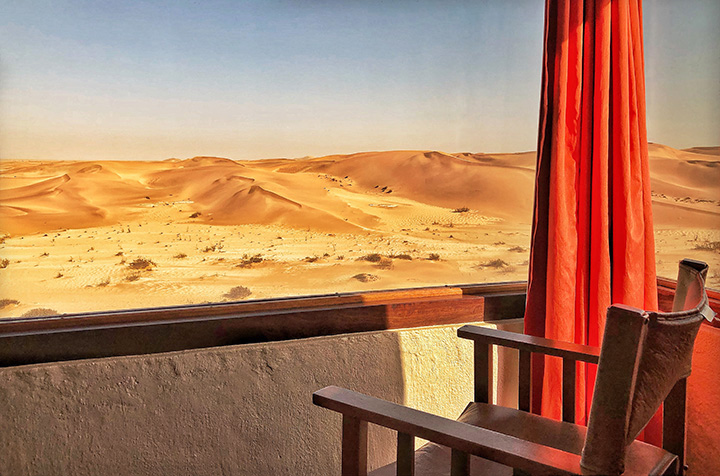
Then there are the landscapes such his pairing of a forlorn, misty landscape at Meola Reef with a desert landscape in Namibia. There are also some individual landscapes such as the drama view of a climber scaling a mountain in Fiordland.
He contrasts a street scene in Kathmandu with one in Madagascar and a simple church in Northland with one in Madagascar as well as the contrasting portraits of a father and his child in Nepal and Egypt
While these paired images are serious reflections on culture and society there are many in which Savidan is making witty, or ironic comments.in one spread he pairs a gaudy jukebox with a church organ and in another he has juxtaposed the various parts of fish at a fish market in Vietnam with a figure lazing on a beach during a fishing competition on the East Cape., an image which itself is a droll comment on recreational fishing.

He uses these images to create drama, explore history, culture and sexuality which become meditations on society and the individual, but in all of them he captures humanity.
 New Zealand Arts Review