Categories
Reviews, News and Commentary

The Auckland Philharmonia’s Daphnis et Chloé

Reviewed by John Daly-Peoples
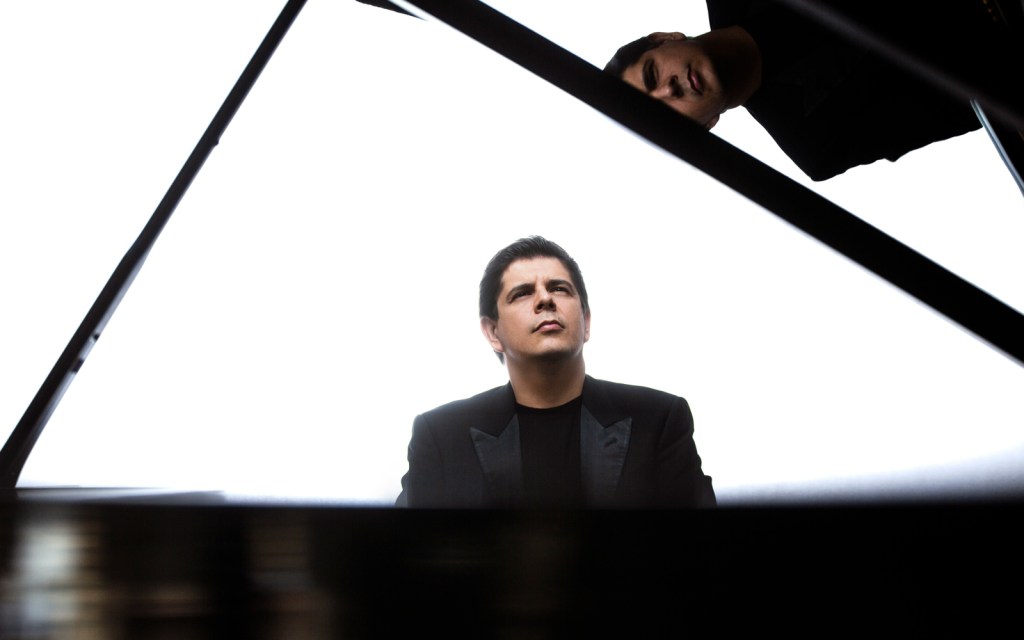
Javier Perianes

Daphnis et Chloé

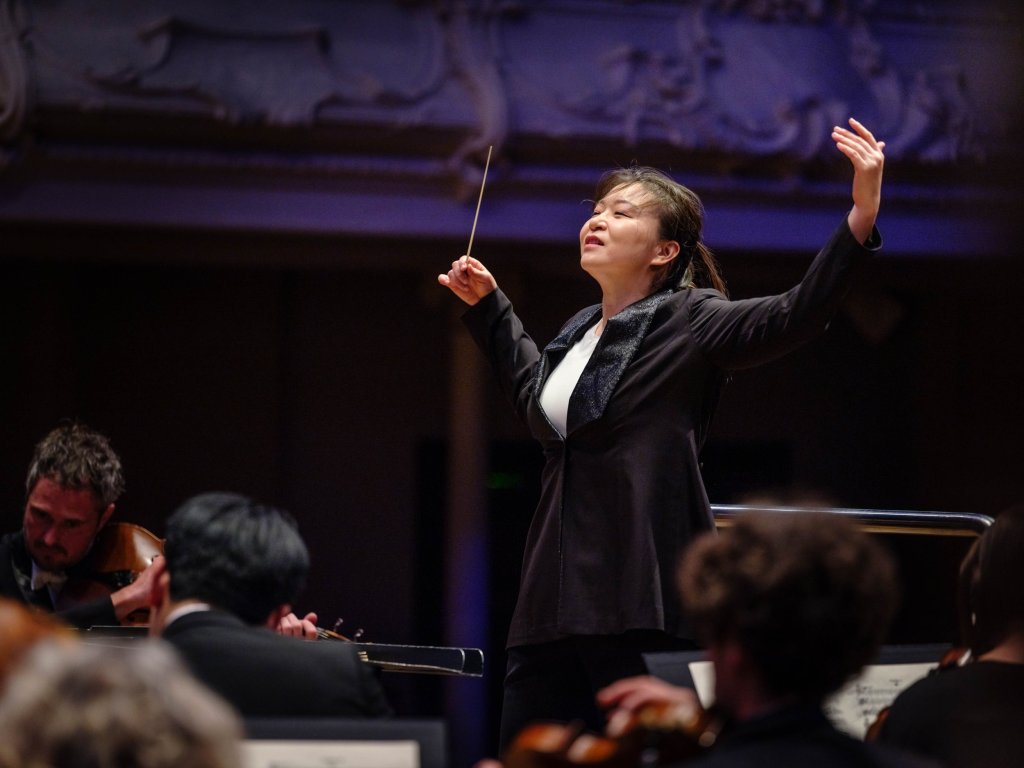
Conductor – Jun Märkl
Piano – Javier Perianes
Choir – Sydney Philharmonia Choirs

Saint-Saëns, Piano Concerto No.5 ‘Egyptian’
Ravel, Daphnis et Chloé  (complete ballet)

Auckland Town Hall

August 7

Reviewed by John Daly-Peoples

While Camille  Saint-Saëns composed much of his music at the same time as Debussy, he rejected the idea that he was an impressionist composer however, with his Piano Concerto No 5 which is rooted in the romantic tradition he does display some  impressionist ideas.

The work is referred to as “The Egyptian” as he wrote in Luxor during a holiday in Egypt, incorporated some  Impressionist and other exotic elements. These include images of clouds, sky and sea in the first movement, the croaking sounds of frogs in the central movement and the the sounds of a ship’s propeller in the third.

Despite his traditionalism, Saint-Saëns’s use of colourful harmonies provided a foundation that influenced the French Impressionist composers who came after him.

The piano concerto is a  light drenched work with pianist Javier Perianes picking out colour flecked details, contributing ot the sense of landscape and history referencing the French fascination with Orientalism particularly in the late nineteenth century.

Perianes played with an assurance and was also very aware of conductor Jun Märkl. He handled the dramatic changes as well as the many runs and trills without being overly demonstrative playing with a restrained elegance manging to discover subtle nuances in the work.

Many of the passages  were very  descriptive and Perianes handled these effectively notably in the second movement with its changing  exotic tonal qualities replicating the sounds of Arabic  stringed and wind instrument. The orchestra also depicted the gentle flowing Nile with the oriental themes woven into the musical landscape.

The work has many passages of experimental and novel sounds for both the orchestra and piano with some dark and mysterious sounds as well as effervescent and graceful passages.

In the third movement which has hints of a return journey across the Mediterranean both the orchestra and piano were more  energetic with a tranquil passage from the piano before the orchestra’s massive finale.
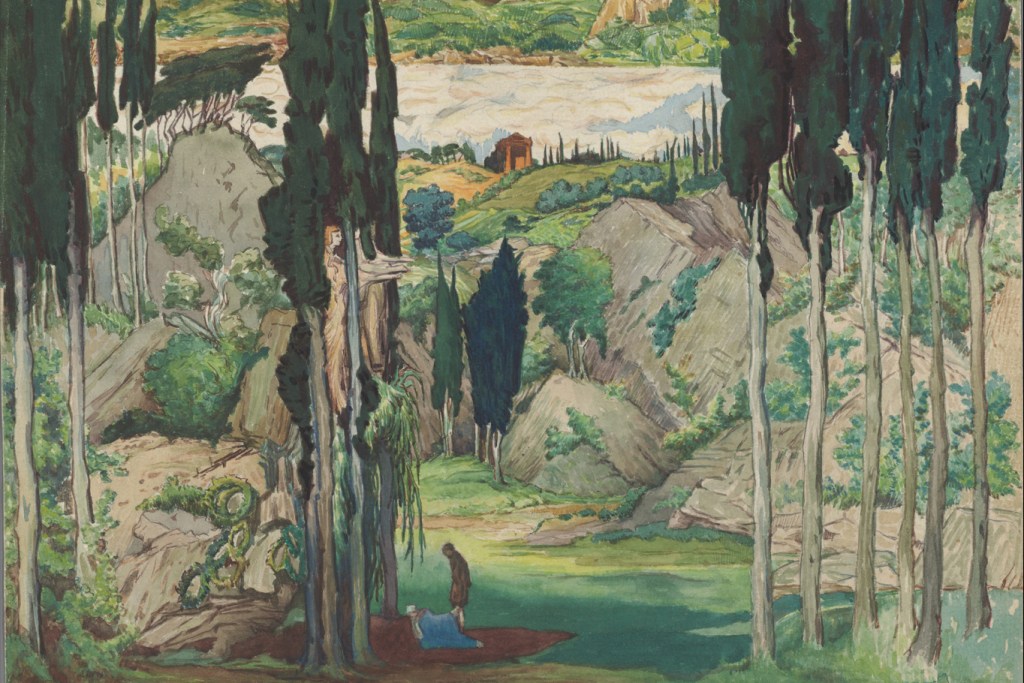
Leon Bakst. Set design for Daphnis and Chloe

Ravel’s ballet “Daphnis and Chloé is set  in the rural, idyllic landscape of Lesbos where myth and legend combine.  The original set design by Léon Bakst reflected that setting as well as the idealised Grecian style costumes for the dancers. Ravel’s music has a sensuous flow to suit the ballet as well underscore the lover’s adventures. The music provided elements  of drama and description as well as atmosphere for the evolving narrative.

The work is Ravel’s longest composition, lasting nearly an hour, and includes  a wordless chorus which was sung  by the Sydney Philharmonia Choir as well as a range of percussion instruments – harps, harpsichord, castanets and wind machine.

Ravel referred to the composition as a “choreographic symphony” and it  has a complex narrative built around several recurring themes and a number of dance sequences which gives the work a sense of ritual.

The Sydney Philharmonia Choir which was integrated into the orchestral work gave a sumptuous performance. It performed at the opening of the work and at various points throughout. Its ethereal sounds provided a rich musical texture adding to the expressive quality of the work. They also provided some intriguing, choral work for the Pirate Camp war dance.

Some of the music for the  dance sequences was tense and abrupt while other were more sinuous and graceful. The orchestra also highlighted some of the dramatic moments in the ballet such as Chloes kidnapping  and Daphnis’s despair at the thought of losing Chloe.

Categories
Reviews, News and Commentary

Auckland Philharmonia’s “Tchaikovsky 5”

Reviewed by John Daly-Peoples

Alexander Gavrylyuk Image Adrian Malloch

Tchaikovsky 5

Auckland Philharmonia

Auckland Town Hall

April 15

Reviewed by John Daly-Peoples

First up on the Auckland Philharmonia’s “Tchaikovsky 5” programme was Kenneth Young’s “Douce Tristesse”, a work composed in 2012 in response to the composer’s final visit to the  long-time family holiday spot near Tauranga.

Strings and woodwind opened the work with a description of landscape, with swathes of colour conveying the changing light and textures of the land, sea and sky.

These vignettes were studded with musical highlights deftly conveyed by the small group of percussion instruments – cymbals, glockenspiel, crotales and harp suggesting the sparkles of light on water, the movement of clouds and the chirping of birdlife.

The work manages to suggest panoramic images from dawn to dusk suggesting the romanticism of the idyllic as well as a nostalgia for lost times and memories.

The composer says that the title ‘Douce Tristesse’ means ‘ sweer sadness and that the piece is about looking at a familiar scene for the last time, a view never to be seen again.

Prokofiev’s third Piano Concerto was written in 1921 during a period of self-imposed exile from Russia and a period when he did not feel oppressed by war or demands on his time and seems to have  more leisurely ambience . The work was first performed in Chicago with the composer playing. The audience and press raved over the music with The Chicago Daily Herald calling it the “the most beautiful modern concerto for piano,”

It opens with the sounds of a clarinet and strings playing a floating melody emblematic of his own more relaxed life. This led quickly to pianist Alexander Gavrylyuk racing into the first movement of the work with fiery sounds from both orchestra and  pianist who played as  though the piano were a percussion instrument

Hunched over the piano his playing was by turns delicate and ferocious as he grappled with the various sequences. There were times when his sounds were languid and romantic and other times when he took a delicate almost spiderly  approach to his playing.

In the second movement he turned the slow dance-like opening into a cacophony of jarring sounds and the intense finale of the third movement saw him in studious concentration.

He displayed a mastery of stylish playing, able to ignite the orchestra with his passion and drive.

His playing technique – changing tempos, charging through themes and varying the tonal qualities added to the excitement of the playing and appeared to enliven conductor Shiyeon Sung well as the orchestra.

Shiyeon Sung Image Adrian Malloch

The major work on the programme was Tchaikovsky’s “Symphony No 5” which saw Shiyeon Sung and the APO deliver one of their outstanding performances. The work is full of sensuous melodies, intense emotions and dramatic climaxes which make it one of the composers more invigorating works.

Some of the sequences are monumental with music similar to his 1812 Overture while there were traces of his ballet music in others.

Sung deftly, guided the orchestra, building musical images, of landscapes, seasons and events creating a world of sensation and emotions.

There were joyous  moments throughout the work but these were set against contemplative sections with the composer finding redemption in the grandeur of the work.

From the anguish of the first movement through the graceful mid-section and onto the final tumultuous fourth movement the orchestra provided a rich and satisfying performance.

While the orchestra was expertly conducted and the players superbly coordinated there were some stand-out performances by the bassoons, flutes, clarinets and French horns.

Categories
Reviews, News and Commentary

NZ Trio’s Untamed Hope

Reviewed by John Daly-Peoples

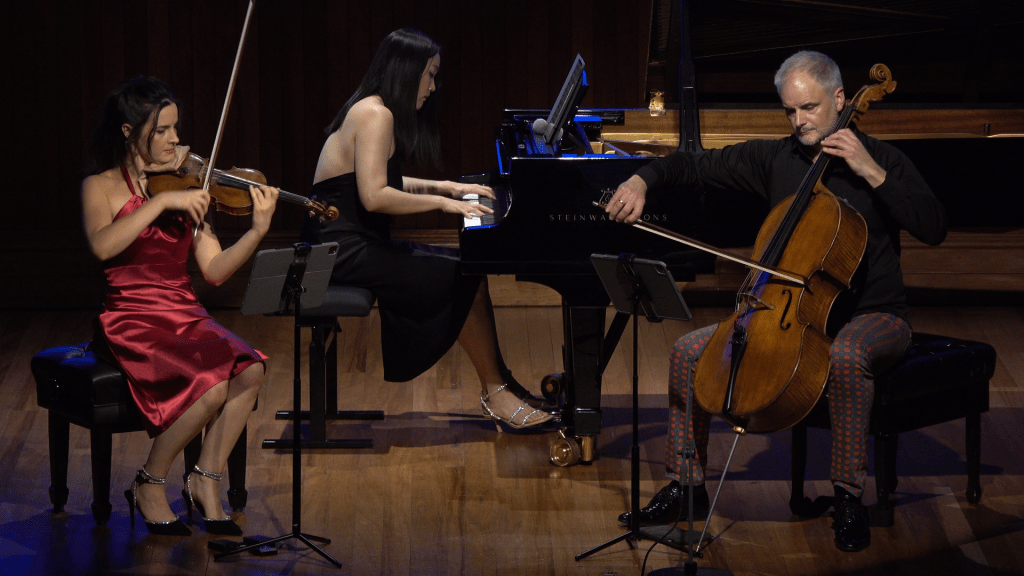
NZ Trio. Amalia Hall, Somi Kim and Ashley Brown

NZ Trio

Triptych 3: Untamed Hope

Auckland Concert Chamber

November 17

Reviewed by John Daly-Peoples

NZ Trio as well as being one of the finest groups of players in Australasia are also one of the most innovative and inspiring with their stimulating programmes. This was clear in their latest concert, “Untamed Hope” which featured four women composers from New Zealand, England, Germany and the USA with works spanning three centuries.

The title of the concert, “Untamed Hope”: probably alludes to the fact that at least three of the  women were constrained in some way by the environments in which they began their musical careers. Their hopes of being able to be in the concert hall on equal terms with their male counterparts was largely tamed by that environment.

The opening work was English composer  Ethel Smyth’s Trio  in D minor, a work  written when she was twenty-two having left the England to study in Leipzig.  At the time she met many contemporary composers including Clara Schumann and Brahms.

The first movement could even have been written by Brahms, which was apparent in the  sinuous playing of Somi Kim who was accompanied by delicate melodies from the strings. Initially violin and cello were in harmony with the piano but then their playing began to diverge, with each of the instruments developing their own musical themes.

Parts  of the second movement seem to be based on a folk song (French or English) with theme passed between the three instruments, all suggesting a soulful introspection as well as displaying the composers sophisticated writing.

Third movement entitled “Leid” had many aspects of the “song without word” with hints of a Scottish dance melody played by Amalia Hall

The dramatic finale saw a long  passage by the piano with the strings entering, playing a Hungarian-like tragic theme.

Eve Bedggood’s Ukiyo 浮世 –The Floating World relates to the Japanese concept of “the floating world” which evokes an imagined universe of wit, stylishness, and extravagance, a state which was often experienced through theatre, song, stories  and pictures.

Bedggood says of the notion of “the simplicity of just existing  and immersing yourself in the floating world or sense of calm is something I think music and other art forms can evoke”.

Much of the work had musical images of floating, flowing and meditation states with the work opened with dark rumbles from the piano suggesting sombre depths with strains of the violin and cello making interventions .

We heard exciting glissando from the Amelia Hall’s violon and careful, controlled repetition from Ashley Brown cello, while many of the sequences  saw an almost minimalist backing with the scudding sounds of the strings hovering above.

The work was like a reverie, the various themes creating dreamlike images much like those of many Japanese prints of an earlier period.

The American Joan Tower’s “Trio Cavny” opened with some tingling high notes from the piano with the violin and cello responding with equally high-pitched sounds creating a taut musical mood.  A following sequence saw Somi Kim creating crashing waves of sound leading to a tension between the three instruments which then played independently of each other before arriving at a point of intense harmonisation.

The music ranged from the soundtrack of a horror movie to a musical version of the Doppler Effect to the sounds of sympathetic voices in  minimalist mediation.

The final work on the program was Fanny Mendelssohn’s Piano Trio in D Minor. It is a beautifully conceived work with the violin and cello flowing around the energetic displays of Somi Kim

Amalia Hall provided both a delicacy and sharpness with her playing, contrasting with Ashley Browns sedate cello.

The introspective and reflective  second movement which opens with  a romantic  sequence from the piano contained elements of waltz tunes  while the third suggested elements of German folk song.

In the final movement the three players displayed a vigorous drive and energy, beginning with some  mesmerising playing by Kim before Hall and Brownjoined in creating an eloquent dialogue, leading to repeated motifs to end the work with an optimistic conclusion

The group announced that cellist Ashley Brown will be leaving the group to take an appointment as Principal Cellist with the Auckland Philharmonia Orchestra next year. He  has been involved with the trio since its founding twenty-three years ago and his presence with the trio will be greatly missed.