Categories
Reviews, News and Commentary

The passion and drive of Alexander Gavrylyuk

Reviewed by John Daly-Peoples
Alexander Gavrylyuk

New Zealand Symphony Orchestra

Alexander Gavrylyuk

Auckland Town Hall

November 16

Reviewed by John Daly-Peoples

Opening the NZSO’s latest concert “Alexander Gavrylyuk”, conductor Vasily Petrenko spoke about the three works on the programme and what he saw as the  links between them. The three composers had all left their native homes – Lera Auerbach and Sergie Rachmaninov from Soviet Russia and Bela Bartok from Hungary to escape the Nazis. He also noted the three composers search for freedom of expression and the nature of transformation in the three works.

The major work on the programme was Rachmaninov’s “Rhapsody on a Theme of Paganini” which has some interesting history or mythology to it  . The nineteenth  century violinist Nicolò Paganini was such a virtuoso, that many believed he had made a pact with the devil. Rachmaninov seems to have subscribed to that view as he  includes a reference to  the medieval melody Dies Irae (Day of Wrath) and some of the darker elements in the music reflect those diabolic aspects.

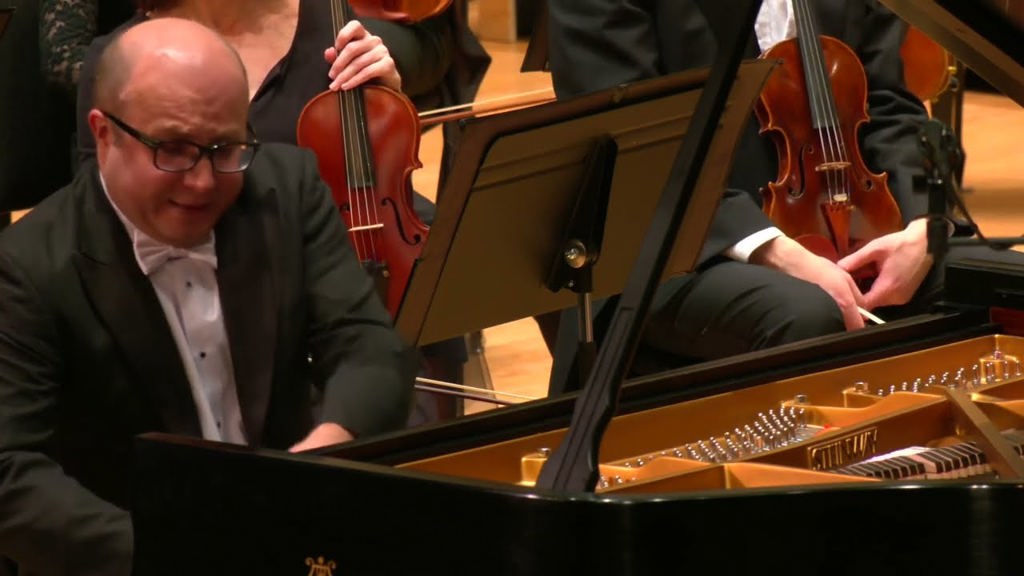
This drama and other elements were highlighted by pianist Alexander Gavrylyuk in a perfect performance that showed a perceptive approach to the music

He displayed a mastery of stylish playing, able to ignite the orchestra with his passion and drive.

His playing technique: changing tempos, charging through themes and varying the tonal qualities added to the excitement of the playing and appeared to enliven conductor Vasily Petrenko well as the orchestra.

Hunched over the piano his playing was by turns delicate, whimsical and ferocious. There were times when his sounds were like rippling water while at other times they were more like gushing torrents.

This was brazen and adventurous playing which slowly revealed the technical and emotional depths of the work moving from the childlike to the theatrical and  onto the grand and funereal.”
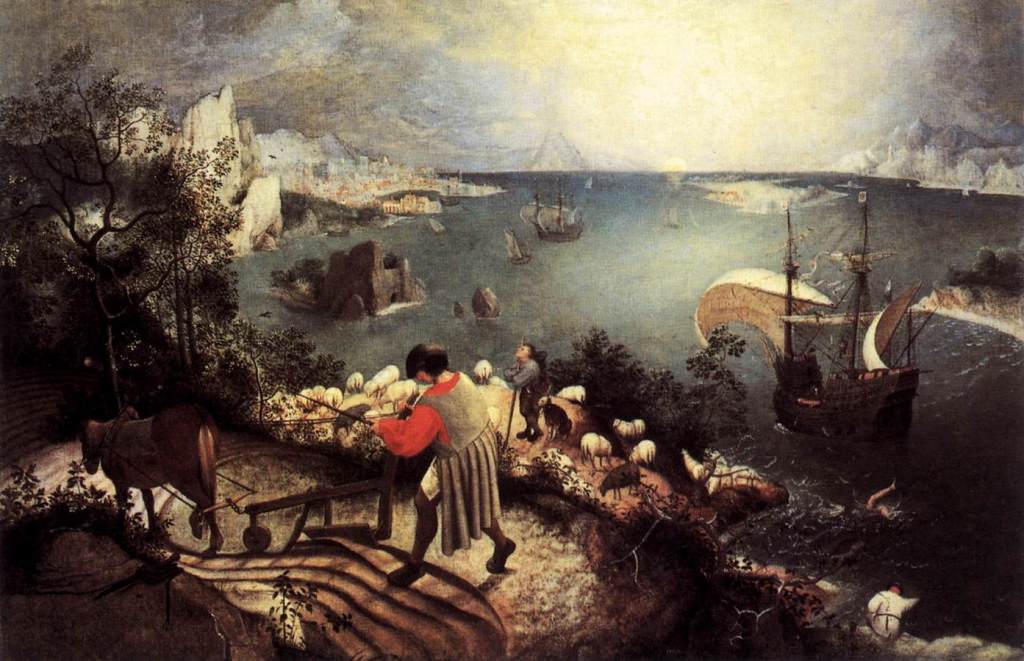
Breugel “The Fall of Icarus

The first work on the programme had been Lera Auerbach’s “Icarus” which tells of the myth of Icarus who ignored his father Daedalus and flew too close to the sun, causing the beeswax securing his wings to melt and him to fall into the sea.

The composer said of the work “What makes this myth so touching is Icarus’s impatience of the heart, his wish to reach the unreachable, the intensity of the ecstatic brevity of his flight and inevitability of his fall.”

The opening strings and brass provided a sense of take-off and the exhilaration of Icarus. This was followed by a galvanised orchestra and flutes suggesting flight. Sounds of alarm from  the orchestra signalled the coming disater  and Concertmaster  Vesa-Matti Leppanen brilliant little solo took a dreamlike diversion which became increasingly tense. This led to the insistent brass heralding Icarus’ fall.

The final sequences could be seen as the composer’s response to Bruegel’s painting “The Fall of Icarus” where the action of the event is reduced to a leg just visible, poking up  from the water . The pulsing strings suggested the vibrancy of the sun which is a counterpoint to the disaster, the quivering sounds a refence to Icarus’ fall into the water and the scattering of feathers. The work ends with a gentle requiem suggesting Icarus becoming a mythic hero.

The final work on the programme was Bartok’s five movement Concerto for Orchestra

It was his last major work and can be seen as some sort of musical autobiography of his last few years having had to leave his native Hungary and settle in the US

Composed a couple of years after his escape from Hungary it traces out his journeying from a bleak Europe to a new life, moving from a dark period in his life to one of  freedom and light. The music reflects this moving with ominous and threatening sounds through to lively and energetic melodies.

The work opened with sombre music punctuated by the flutes and raucous brass. Anguished strings confronted by ferocious brass, woodwind and percussion and the continued presence of the flutes sounded out the call for  freedom.

There was a sense of evolving events and narrative and about remembrance and loss with whimsical passages as well as a constant sense of oppression and mystery.

While there were references to horrors and drama of WWII the work is filled with inventive  music which was constantly evolving with a carnival-like sequence, playful sounds as well as hints of folk melodies  and strains of Eastern music.

The success of the work was in part due to the focused conducting of Vasily Petrenko with his lively and energetic approach and his precise direction in shaping the music’s dramatic sounds
Categories
Reviews, News and Commentary

The NZSO’s Copland, Cresswell and Mozart concert

Reviewed by John Daly-Peoples

Gemma New

Jupiter: Mozart & Copland

New Zealand Symphony Orchestra

Auckland Town Hall

September 21

Reviewed by John Daly-Peoples

Aaron Copland’s Appalachian Spring which opened the NZSO’s latest concert featured music the composer originally wrote for Martha Graham’s ballet of the same name. The work has a simple narrative  following aBride and Husband as they get married and celebrate with the community. The work contains  various themes – faith, love and the joys of a new life.

The work is a celebration of the American West as well as an acknowledgement of the country’s past times of violence, referencing both the Civil War and World War II (the work was written in the midst of the war).

Copland used American folk music for melodies, harmonies and textures, that he had used in previous works such as Billy the Kid and  Rodeo and he also  included a theme and variations on the Shaker tune “Simple Gifts”.

Like those other two ballets the composer has responded to the notion of fluidity, representing the dancer’s movements.

The piece starts off with one of the great descriptions of the dawning day but with it is also the couple’s wedding day. This is described with soft chords from the strings, followed by soaring woodwinds with the flute and clarinet sketching out the storyline.

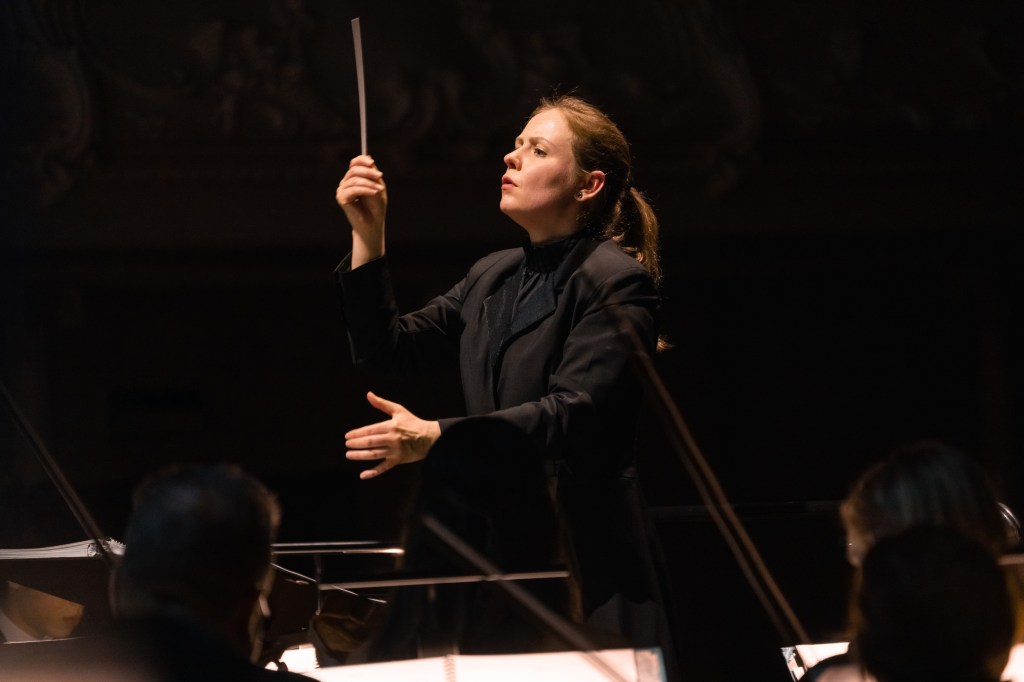
Quiet and wistful vistas and activity merge into cheery dance-like passages echoing the early American folk tunes and Conductor Gemma New responded with a little dance, caught up in these lively  rhythms

The work was punctuated by dramatic use of the percussion and horns which contrasted with the lively, dancing strings.

The finale with its grand statement along with Copland’s others works added a new dimension to the idea of rural America and the West elevating them to a sophisticated and iconic level.

The second work on the programme was Lyell Cresswell’s Piano Concerto No 3  which was given its world  premiere, played by Stephen De Pledge, a long-term admirer and advocate of the composer’s work.

The concerto is full of contrasts, between the instruments  themselves as well as the musical colours and textures which are all bound together with innovative instrumentation.

It opened much like the Copland with a dawning with suggestions of Nature, the stillness of landscape and the sounds of the forest. This was soon followed by the aggressive orchestra which merged with De Pledge’s piano where shimmering clouds hovered over the raucous strings.

Throughout the work there were musical suggestions of observations of his environment linked to a strange, abstract realm of sound with De Pledge and the orchestra contributing a range of textures – delicate, frenzied, lush and meticulous.

The brutal sounds of the orchestra were often matched by the equally brutal sounds of the piano, orchestra and piano creating interweaving and inventive sounds. These included the pianist using the instrument as a percussion instrument, knocking on the piano keys or playing long passages of a repeated single note.

Much of the piano work was sparse but there were occasional energetic bursts of sound accompanied by the orchestra  with the whispering strings at time sounding like the gentle wind in the trees or a breath slowly exhaled.

The final work in the programme was Mozart’s Symphony No 42 , The Jupiter one of his last symphonic works and one in which the composer is producing work which is at the centre of the transition of music form the classical to the Romantic…

With this work Gemma New seemed to be interested discovering nuance and depth in the composer’s work.

Even in the opening sequence which is full of drama she created contrasts so that the great melodies took on a more impressive sound with New seeing possibilities in the music that even Mozart  may not have been  aware of.

Her approach was obvious in the intensity of many passages, reducing some to more of a sigh while the dramatic moments featured immense surges of sounds.

The mysterious quality of the second movement featured  some beautiful balance between the woodwinds and orchestra while the energetic final movement with multiple themes and intricate playing  demonstrated the orchestra’s superior musicality.

To subscribe or follow New Zealand Arts Review site – www.nzartsreview.org.

The “Follow button” at the bottom right will appear and clicking on that button  will allow you to follow that blog and all future posts will arrive on your email.

Or go to https://nzartsreview.org/blog/, Scroll down and click “Subscribe”

Categories
Reviews, News and Commentary

Sylvia Jiang’s lively and energetic performance of Prokofiev’s Piano Concerto

Reviewed by John Daly-Peoples

Sylvia Jiang

Auckland Philharmonia Orchestra

Scheherezade

Auckland Town Hall

July 4

Reviewed by John Daly-Peoples

The first half of the APO’s Scheherezade concert featured two works composed a century apart with Melody Eötvös’ “The Saqqara Bird” of 2016 and Prokofiev’s “Piano Concerto No 2 of 1913/1923.”

The highlight of the concert was the Prokofiev Piano Concerto played by Sylvia Jiang. She is a Chinese born New Zealander and Juilliard graduate  who was ranked as a Rising Star in the Asialaw Profiles of 2023.

Last year she performed Liszt’s Second Piano Concerto with the Auckland Philharmonia and later in the year she will also be making her debut national tour as a soloist with Chamber Music New Zealand playing seven concerts.

Prokofiev’s second Piano Concerto is considered to be one of the most difficult piano concertos to play. Thankfully Jiang appears to have not been told that and she never faltered in her exploration of the work even when she was faced  with the massive solo cadenza of the first movement.

This section saw Jiang playing vigorously for over 4 minutes before the orchestra joins in again.

She opened the work delicately creating  gentle, magical sounds along with the woodwinds and strings which hinted at a shimmering watery setting with the orchestra developing the theme and Jiang providing streaks of colour and drama.

This quiet lyricism didn’t last long and was soon interrupted by menacing sounds from the orchestra and a darkness emerged which overpowered the piano which then responded with some ferocious sounds.

This early interaction of orchestra and pianist highlighted the emphasis of the concerto. This was the sense of competition between player and orchestra. With most  concerti there is a collaboration between soloist and orchestra but with this work there was more of an antagonism and intervention.

This is in part due to Prokofiev s music where we hear a clash between romanticism and modernism which is an indication of the composer struggling with his own idea.

In playing the first movement solo cadenza Jiang seemed to be physically attacking the keys and her playing eventually revealed an emerging theme and she was rejoined with the orchestra which enveloped her with the gentler music which had preceded the cadenza.

The short second movement saw Jiang playing  with a  lively energy, butting up against the  savage and insistent tones of the orchestra.

The third movement which opens with huge swells of brass and percussion and a rustic theme where Jiang dashed off flashes bright notes inserting herself into the orchestral themes. Here again the pianist and orchestra were in competition, with the orchestra seeming to overpower Jiang who fought back with a relentless energy finishing the movement with a few quiet  notes of victory.

She opened the fourth movement with a rapid-fire assault on the piano followed by a lethargic sequence where her fingers seemed to wander across the keyboard in search of a theme. Then as she managed to discover the theme the orchestra joined in, expanding and enhancing it.

Her playing at times seemed to be urged on by the energetic orchestra while at other times she seemed to strive against the orchestra.

In the final minutes of the work her playing returned to a simple romanticism before morphing into some frantic playing matched by an equally frenetic orchestra which overpowered the piano before the  final race to the climatic conclusion.

The “Saqqara Bird” refers to a bird/plane shaped relic found at Saqqara in Egypt in the late nineteenth century whose function was unknown. Melody Eötvös’ work explores the imagined reasons behind its creations and purposes and envisages it in search of its identity.

The work opens with the sounds of bird-like twittering from the woodwinds and strings which seem to be emerging from a dark forest of sounds conveyed by the blasts of brass and thumping drums.

Several of the instruments appeared to have been adapted or employed to create eerie sounds as though a backdrop to a fairy tale filled with shadowy beings.

In the middle section the woodwinds replicate  the sounds and movement of birds along with the ghostly forms leading to enigmatic encounters and discoveries.

The intriguing music ranged from sequences of unruly and strident sounds to the use of the simple single note which ends the work.

Categories
Reviews, News and Commentary

The APO’s “Brahms and Bellincampi”

Reviewed by John Daly-Peoples

Alexander Melnikov and Giordano Bellincampi Image. Sav Schulman

Auckland Philharmonia Orchestra

Brahms and Bellincampi

Auckland Town Hall

June 6

Reviewed by John Daly-Peoples

The opening of Brahms’ Piano Concerto No 1 is dramatic with the timpani delivering a tumultuous sound accompanied by ferocious strings. The intense opening  was intended by the composer to be a depiction and reflection on  Robert Schumann’s attempted suicide in leaping into the Rhine at Dusseldorf few years earlier.

For the first few minutes it was the orchestra which dominated  as pianist Alexander Melnikov waited for his entry. Showing what would be his intense approach to playing he seemed  restless as he contemplated the piano – leaning into it and caressing its surface as though communing with the instrument.

Following the stormy performance of the orchestra Melnikov made his entrance, referencing the orchestras’ dramatic themes but with simple and deliberate playing as though reflecting on the drama which had just occurred.

Much of the first movement saw him responding to the themes that the orchestra had explored with a bravura performance where he developed  the main theme, playing with a relentless  insistence.

Melnikov’s relationship with the piano continued, at times he appeared to be praying and at other times conducting. All the time he appeared to physically respond to the performance of the orchestra, his body moving reflectively in time to the music.

In the second movement his playing was almost lethargic inserting some delicate passages into the orchestras brooding sounds. Then in the third movement the music seemed to electrify him with some relentless playing which was  almost  Byronic, of the individual confronting his demons, loves and destiny.

His Brahms encore finished as a cell phone call came through in the hall, so when he was leaving the stage, he put his hand to his ear with the universal sign of “I’ll call you”, eliciting  further applause from the audience.

The other work on the programme was Brahms’s symphony No 2, a glorious pastoral work inspired by a holiday at the resort of Lake Worth in Austria. The work is full of images of nature and the heightened drama of the alpine  environment.

While it is a captivating depiction of the landscape there are  undertones of melancholy with the strings, timpani and brass creating a sense of disquiet.

The more reflective second movement conveys a sense of an emotional  journey and the delights of life. all leading to enlightenment.

Then in the third movement there were charming dance-like seqcnces followed by the dramatic fourth movement with its big crescendos punctuated by idyllic interludes, the audience kept in suspense as the work raced to its fiery conclusion.

To subscribe or follow New Zealand Arts Review site – www.nzartsreview.org.

The “Follow button” at the bottom right will appear and clicking on that button  will allow you to follow that blog and all future posts will arrive on your email.

Or go to https://nzartsreview.org/blog/, Scroll down and click “Subscribe”

Categories
Reviews, News and Commentary

NZ Trio’s “Unquiet Dream”

Reviewed by John Daly-Peoples

Amalia Hall, Sarah Watkins and Ashley Brown Image Chris Watson

NZ Trio

Unquiet Dream

Auckland Concert Chamber

May 19

Reviewed by John Daly-Peoples

With their latest concert “Unquiet Dream” the NZ Trio have shown again their ability to deliver concerts featuring music which is innovative as well as drawing on the established canon. This approach shows an intelligent and sophisticated approach to chamber music  which makes their concerts  always rewarding.

The first work on the programme was  Benjamin Britten’s “Introduction and Allegro for Piano Trio”, a very early work in which the young composer  was trying out his approaches to the modernist music which was then beginning to take an interest in.

The work opened with the instruments tentatively seeking out an elusive  melody, playing various sequences which overlapped and intersected as though the composer was assembling his musical structure out of disparate elements.

Many of these sequences were ethereal, touching on the flickering images of water, wind, shadows and scudding clouds. This search for physicality was reflected in the physicality of the playing of the instruments – the blunt striking of the piano and the sharp rasps of the violin and cello.

In Chris Cree Browns  “The Second Triumvirate”  he imagines each of the instruments having its own language  with which they engage in communications  which range from the  simple human conversations  to the more intricate interactions of animal and bird sounds. All these interchanges there are filled dramatic echoes and reverberations.

Lera Auerbach’s  “Trio No2 Triptych” is sub-titled “This mirror has three faces” and she says of the work that “one can look at three different faces or roles of the same person or at three different personalities”.

So, each of the instruments takes on an aspect of the personality which can be in conflict or in harmony with the other. This psychoanalytic approach hints at the idea of multiple personalities or the different faces a person presents – the public, the private or the intimate.

The work is filled with shifting dynamics. Simple sequences develop and change, minimalist statements escalate to create bold and adventurous musical forms.

Shards of music coalesce and then disperse, in surreal juxtaposition, the various elements leaving the image of the person unresolved.

Where  things seem to fall apart in Auerbach’s piece there is a very different outcome with Mendelsohn’s “Piano Trio in D Minor”. With this piece the Trio was focussed on drawing all the elements together to create a symphonic sweep for one of his great “songs without words” providing the work with an emotional richness and depth.

The work hints at the composer’s own desires and struggles using the instruments to create a narrative in which he is by turns heroic, romantic and despondent.  

Throughout the work pianist Sarah Watkins provided the measured mainstay with both a delicacy and vividness of expression. Amalia Hall’s violin  provided a range of emotion from the sensuous to the dramatic and Ashley Brown’s cello ranged from the melancholic to the agitated.

With their playing they were able to capture the romanticism, the wistfulness and the drama of the work as well as effortlessly  incorporating references to  the composers his own Midsummer Night’s Dream and the that of Bach.

Categories
Reviews, News and Commentary

APO’s Other Worlds

Reviewed by John Daly-Peoples

Shuiyeon Sung

Other Worlds

Auckland Philharmonia

Auckland Town Hall

March 28

Reviewed by John Daly-Peoples

It’s easy to appreciate why Sibelius’s Symphony No 2 has been  seen as a programmatic work conveying idea about patriotism and nationalism. At the time of writing the symphony the Russian  occupiers were restricting the use of the Finnish language and attempting to change the nature of Finnish society.

So, with this symphony, while the Finnish language was being stifled  Sibelius was allowing the Finnish voice to be heard through music  which reflected on Finnish language, landscape  and history.

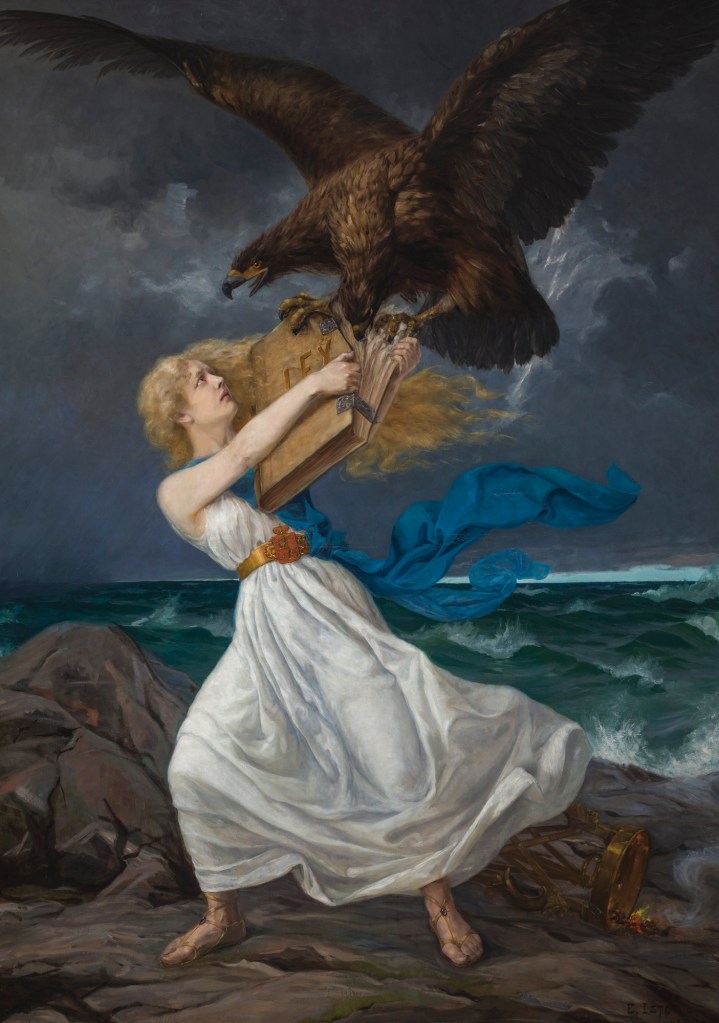
He attempted to convey in music what the painting, ”The Attack” by the Finnish artist Edward Isto did visually. Painted at the same time it illustrated the feelings of many Finns. The work depicts a double headed eagle, representing the Russian state, attempting to snatch a book of laws from a while clad female.

Edward Isto, The Attack

The opening movement with its stirring blasts of the woodwinds and horns followed by the surging strings provided musical images of landscape which conveyed ideas of Finnish Nationalism.  Later when the vigorously plucked cellos contrasted with the deep sounds of the  bassoons there  a sense of personal loneliness or struggle.

The notion of the individual alone in the landscape and awe at their surroundings which is present throughout the work was also apparent in the opening work on the programme, Mendelssohn’s “Hebrides Overture” which also linked landscape, history and myth.

Later the militaristic sounds of a rampant orchestra ended with  a triumphant anthem all this sounding like  a great storm  and its aftermath.

The work was by turns  nostalgic, revolutionary and celebratory with repeated themes evoking a call to arms and a new dawn.

The newest work on the programme saw a trio of South Korean artists  on stage with violinist Inmo Yang playing Unsuk Chin’s 2001 work  “Violin Concerto No 1“ and the orchestra conducted by Shuiyeon Sung.

Inmo Yang

Unsuk Chin’s Violin Concerto is one of her most famous works and has won a number of awards and is  fine example of cross-cultural music where the experimental and the traditional are fused.

Inmo Yang backed by a percussion rich orchestra – marimba, gongs, harps, bells and xylophone  gave an extraordinary performance.

From the first bars of the first movement with his rapid bowing, he attempted to dominate the orchestra in what seemed at times like a competition.

His almost dementated, playing and the  abstract sequences he produced contrasted with the more controlled playing of the orchestra with many of the sequences sounding  as though Yang and the orchestra were responding to  different musical scores.

His high-pitched sounds worked well with the percussion instruments producing otherworldly feelings and soft disturbing moments. There were also random moments of intimacy as well as magical sounds full of exuberant colour as he joined with and riffed off the various percussion instruments.

In the final movement his dexterous playing  set the stage for  a battle between violin and orchestra where their sounds would combine and then separate with a massive sonic, Doppler Effect.

Chin’s violin concerto requires a player who has focus, exceptional technical skills and understanding of the work. Inmo Yang possessed all those qualities.

Future APO concerts

April 11th

Viennese Feast

Conductor Christoph Altstaedt
Violin Amalia Hall

Brahms Variations on a Theme by Haydn
Haydn Violin Concerto No.1
Mahler (arr. Britten) What the Wild Flowers Tell Me
Schubert Symphony No.6 ‘Little C major’

May 2

Bach & Bruckner

Conductor Johannes Fritzsch
Piano David Fray

J.S. Bach Keyboard Concerto No.5, BWV 1056
J.S. Bach Keyboard Concerto No.4, BWV 1055
Bruckner Symphony No.9

To subscribe or follow New Zealand Arts Review site – www.nzartsreview.org.

The “Follow button” at the bottom right will appear and clicking on that button  will allow you to follow that blog and all future posts will arrive on your email.

Or go to https://nzartsreview.org/blog/, Scroll down and click “Subscribe”

Categories
Reviews, News and Commentary

IMPASSIONED MUSIC ACROSS THREE CENTURIES.

Reviewed by Peter Simpson

Julian Steckel

Passion & Mystery

Auckland Philharmonia

Auckland Town Hall

February 15th

Reviewed by Peter Simpson

This was a concert of impassioned music across three centuries. Or four if you count the exquisite Bach encore played by Julian Steckel after his commanding performance of Shostakovich’s Second Cello Concerto (representing the twentieth century), which was preceded by Gemma Peacock’s sonorous White Horses, representing the 21st century and followed by Tchaikovsky’s mighty Symphony No. 6, The Pathétique, representing the nineteenth century.

‘Passion & Mystery’ was the opening concert of the Auckland Philarmonia Orchestra’s 2024 Premier Series, under its capable conductor Giordano Bellincampi.

I am not a musician; I can’t read a musical score or play a musical instrument, so am incapable of informed discrimination when it comes to performances, though I can point to more than half a century of avidly listening to concerts, radio and records as a dedicated consumer of music.

I found this an absorbing and enjoyable concert. All three works are emotionally intense, as was to be expected given the concert’s moniker, ‘Passion and Mystery’, though sufficiently various in musical idiom to avoid monotony. So far as I could tell the orchestra played splendidly throughout and was well directed by the resident conductor. The house was nearly full and the applause was deservedly prolonged.

Gemma Peacocke’s White Horses is a kind of orchestral tone poem, inspired by an extraordinary event in 1937 when a pioneer female New Zealand aviator, Waud Farmar, fell to her death in the ocean. In the words of the composer – a New Zealander working in the United States – ‘Farmar leapt without warning from a bi-plane above Cook Strait…The pilot saw her hit the sea and disappear.’ The pilot said: ‘The sea was pretty rough, with white horses everywhere’. These words provide the clue for Peacocke’s music treatment with lots of ominous rumblings of percussion, and intermittent sharp accents from strings and wind instruments. The sonic range is impressive, from a poignant violin solo to thunderous orchestral climaxes.

German cellist Julian Steckel was at his best in the intense opening Largo of Shostakovich’s sinewy concerto dating from 1966, the year of the composer’s 60th birthday. Like its predecessor, the concerto was written for the great Mistislav Rostropovich. How fortunate the Russian composer was to have such sublime musicians as Rostropovich, David Oistrakh and Svatoslav Richter for whom to write his concerti! Unsurprisingly the score exploits to the full the virtuosic capacities of the instrument, demands which the soloist was clearly capable of meeting with ease and polish.

Tchaikovsky’s last symphony was first performed just nine days after his death in 1893, and it is hard to avoid inferring that he poured his heart and soul into it as a kind of final testament. The music is remarkably various, from the achingly lovely melody of the opening movement, through the delicacy and fire of the middle movements to the surging, sobbing melancholia of the final Adagio. The orchestra sounded magnificent throughout every nuance of sentiment wrung from the composer’s feelings. A cathartic experience altogether for the satisfied audience.