Categories
Reviews, News and Commentary

Beyond Words: a lament, a reflection and a celebration

Reviewed by John Daly-Peoples

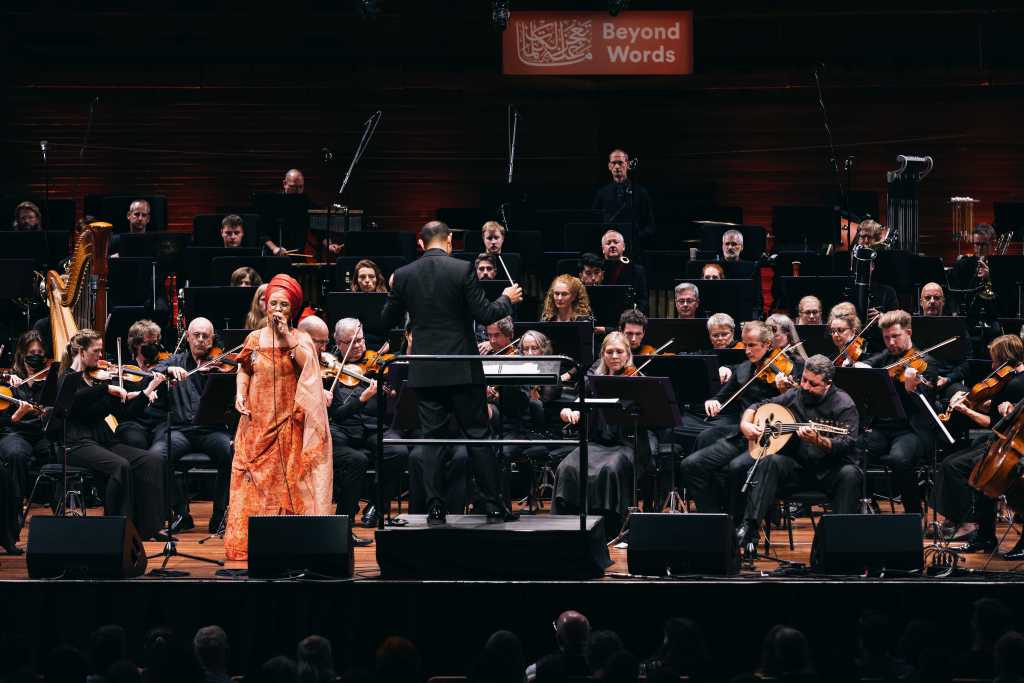
Oum with conductor Fawzi Haimor and the NZSO Image Jono Tucker

Auckland Arts Festival

Beyond Words

New Zealand Symphony Orchestra

Auckland Town Hall

March 10

Reviewed by John Daly-Peoples

The “Beyond Words” concert which had its third performance following its premiere in Christchurch and a performance in Wellington was a collaboration to promote unity and peace through music and to honour the lives lost in Ōtautahi Christchurch on 15 March 2019.

Conducted by Fawzi Haimor the concert featured the Moroccan vocalist OUM  El Ghait Benessahraoui and Cypriot/Greek oud player Kyriakos Tapakis.

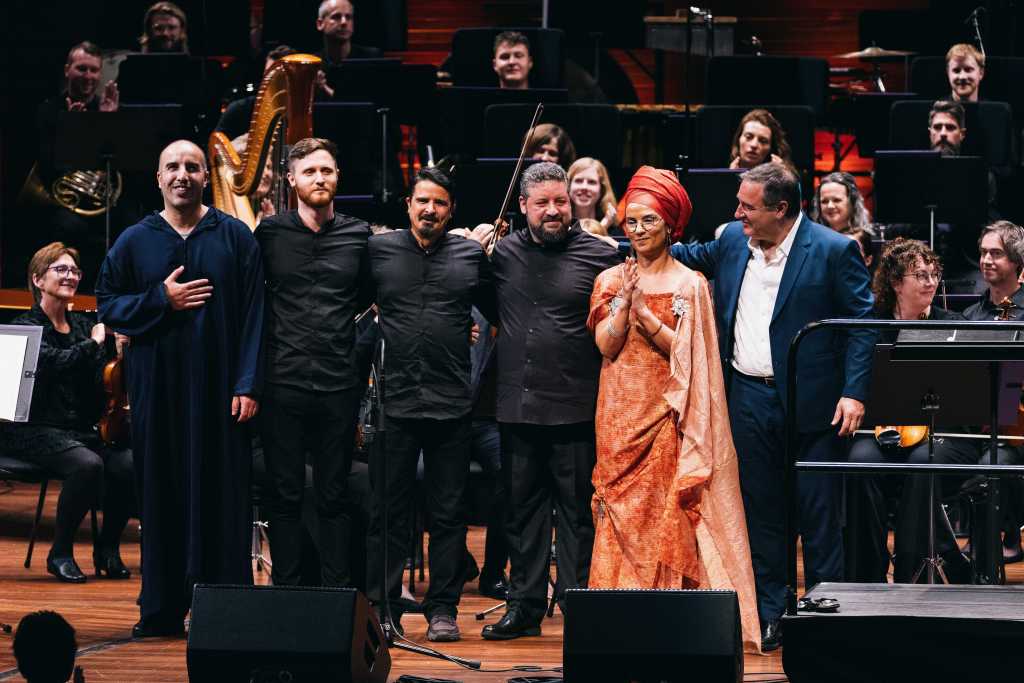
Vocalist Abdelilah Rharrabti, saz player Liam Oliver, vocalist and daf player Esmail Fathi, oud player Kyriakos Tapakis, vocalist Oum and composer John Psathas [From Wellington concert] image Jono Tucker

The concert also featured  works by the American Valerie Coleman, Reza Vali, Arvo Pärt and the world premiere of a new work by the New Zealand composer John Psathas.

Psathas’ “Ahlan wa Sahlan, composed in collaboration with OUM and Tapakis, uses the Arabic welcome to let people know they are in a place where they belong. The work fused together musical styles from Eastern and Western music traditions.

The work features energetic and dramatic sounds with subtle changes of texture and moods, providing a background for the two soloists OUM  El Ghait Benessahraoui and Kyriakos Tapakis.

The composer as previously demonstrated his ability to compose celebratory anthems having written works for the ceremonies at 2004 Athens Olympics and with this work there is sense of the music being both a lament, a reflection and a celebration. With waves of shifting percussive and evocative sounds

OUM was resplendent in her shimmering gown and elaborate head covering  Her voice with its roots in Morocco  and in the tradition of Egyptian singers of the 1930’s like Umm Kulthum drifted and soared above the orchestra’s tapestry of eastern sounds along with answering voice of Tapakis’s oud.

Her singing and movements at times suggested she was in a trance-like state while at other times she exuded an emotional intensity  and in her singing  “Hijra” she sounded like a French chaunteuse. Later there were passages where her voice was close to over-elaborate crooning.

Tapakis provided a riveting performance where he played together with Xylophone and timpani in a filmic sounding section filled with percussive sounds

The other major work in the programme was Arvo Pärt‘s Silouan’s Song which is  fine example of the composer’s low-key minimalism with simple repetition and contemplation sequences of notes.

This was a reflective piece which connected contemporary music with Medieval plainchant and Eastern mystical  music and the various sections were stressed by the meditative silences between them giving the work a ritualistic feel.

In the first part of the programme there were five shorter works including a traditional work sung by Hasbi Rabbi and Molle Mamad Jan which had an achingly unsettling melodic line as well as a beguiling performance by OUM.

There was also  contemplative, work by the Iranian Reza Vali which was filled with despondency and funeral sounds hinting at a vision of paradise.

Kyriakos Tapakis performed his own work “Mantilatos” which was filled with extraordinary sounds and rhythms. While the NZSO accompanied  him, emphasising much of the work it would have been more interesting if he had been able to play as a soloist.

A major disappointment with the programme was the lack of English translations for the various vocal segments. Presumably the lyrics were relevant to the spirit of the event and even though the concert was one that was “beyond words”  with the music conveying emotional and spiritual dimensions it was pity the audience was not able to  appreciate the greater depth which would have come from a knowledge of the word.

To subscribe or follow New Zealand Arts Review site – www.nzartsreview.org.

The “Follow button” at the bottom right will appear and clicking on that button  will allow you to follow that blog and all future posts will arrive on your email.

Or go to https://nzartsreview.org/blog/, Scroll down and click “Subscribe”
Categories
Reviews, News and Commentary

DakhaBrakha explores the rich past and the future of Ukraine

John Daly-Peoples

Auckland Arts Festival

DakhaBrakha

Auckland Town Hall

March 14

The Ukrainian performance group DakhaBrakha which is having one performance at the Auckland Arts Festival  is known for playing Ukrainian songs which display the traditional polyphonic harmonies of their traditional music. However, they give this music  a contemporary, transformation referencing hip-hop, punk and contemporary dance sounds. While using traditional Ukrainian instruments their performances also  derive from the indigenous instrumentation of Africa, the Middle East, India and Russia.

Their more recent music though has taken on a much more political edges as they try to counter the Russian propaganda which tries to obliterate  the culture, history, and language of Ukraine.

A recent New York Times review of the group references Maria Sonevytsky an ethnomusicologist who says,

“I think one of the most powerful things that DakhaBrakha can offer is that they show both that there is a very rich past in Ukraine, and they show this by bringing together a diversity of musical practices from different regions of Ukraine, from different ethnic groups within Ukraine,” Sonevytsky says. “And they fuse them together in a beautiful way that also suggests a future for Ukraine. It gives the lie to Putin’s propaganda that Ukraine has no culture or history of its own.”

“In fact,” Sonevytsky continues, “what we see in DakhaBrakha’s artistry is a deeply heterogeneous and complex history, the inheritance of multiple imperial experiences, the long history of attempts for Ukrainian sovereignty, and they blend together these kind of fractured pasts into a beautiful whole that is not simple, and it can’t be simply reduced down to a story of one nation that is occupied by one people, but instead suggests a vibrant, if imperfect, democracy.”

A US review enthused about the performance – “How to describe the sound?  A drum kit, djembe, and darbuka were all used together and individually.  A cello, a couple of accordions, and harmonica, along with the varieties of sounds made by the voice – words and sounds.

It was the voices that were so phenomenal – not just used for singing.  How do they get those sounds?  Often high, keeping sounds.  But, and this was my favourite – animal sounds.  Some were made with small tools, but what about the cats?  The owls?  And then, to close out the song, the piercing “CAW”!

Throughout the evening, as an accompaniment, an artistic slide show.  Animation, mesmerizing designs (reminiscent of folk embroidery), background photos of the war and its damage.“