Categories
Reviews, News and Commentary

Gravity & Grace : a refreshing and inventive NZ play

Reviewed by John Daly-Peoples

Auckland Arts Festival

Gravity & Grace by Eleanor Bishop and Karin McCracken.

Q Theatre

Until March 24

Reviewed by John Daly-Peoples

Gravity  & Grace is adapted from Kraus’ account of the unsuccessful film she made in the 1990’s – Gravity & Grace. That film follows Grace as she finds a connection to a cult predicting doomsday and the arrival of a spaceship, and Gravity, who leaves New Zealand to try her luck as an artist in New York City.

Kraus is probably most well known for her book and TV series “I Love Dick” but Eleanor Bishop and Karin McCracken have mined he obscure Gravity & Grace to make a play which addresses ideas about the flawed or failed artist as well as reflecting on the creative process generally.

The play set in the US and New Zealand where much of the filming was shot because she had obtained NZ Arts Council funding. We follow her inexperienced attempts as a director and her unsuccessful efforts to get interest from the film festivals and agents. Along with this we delve into her personal and professional relationships which blight the films development.

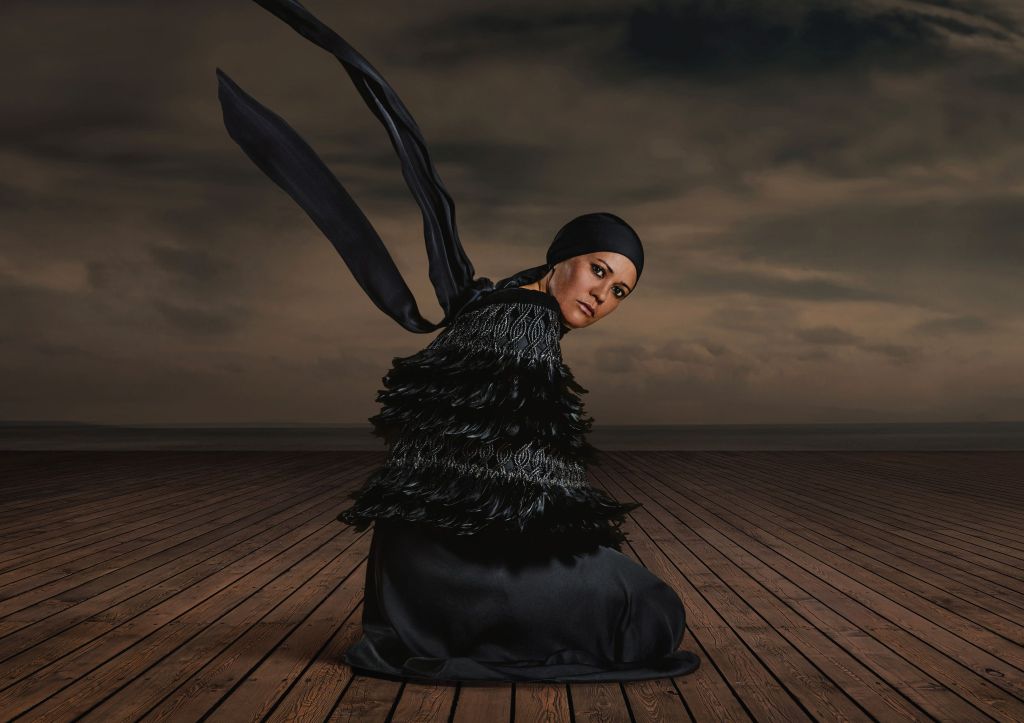
Her own attempts at creating art works are paralleled in her homage  to three other flawed creatives: the French writer and philosopher Simone Weil and her book La pesanteur et la grâce (Gravity and Grace), the American artist Paul Thek whose star burnt out after an initial burst of success and  the German Red Army activist Ulrike Meinhof.

Its as if she is saying these great artists also made mistakes, just like  me.

The two writers of the play also are the stars of the work with Eleanor Bishop’s faultless direction and  Karin McCracken giving an incisive portrayal of  Chris Kraus.

McCracken is on stage the whole time and holds the play together with her range of emotions as well as some witty dialogue . She is  also cleverly presented with many sequences featuring her filmed. Often her projected head loomed over her as she sat at her desk or she was shown from strange angles suggesting the characters many dimensions.

The cast play a variety of roles including Andy Warhol (Sam Snedden); Ulrike Meinhof (Ni Dekkers-Reihana); Simone Weil (Rongopai Tickwell) and Paul Thek (Simon Leary). Sneddon also plays Sylvère Lotringer, Kraus’s husband as well as Gavin her S&M phone lover.

Much of the success of the play comes from the innovative staging created by designer Meg Rollandi, the visuals of Owen McCarthy, and Rachel Neser, the soundscape designed  by Emi 恵美 Pogoni and lighting by Rob Larsen.

The work is overwritten at times and could do with a trim and there are a few sequences such as the cast working on what was possibly a Paul Thek mural which doesn’t seem to add much to the work.

But it is one of the most refreshing and inventive recent New Zealand works with  fine writing, and suburb stage craft.

To subscribe or follow New Zealand Arts Review site – www.nzartsreview.org.

The “Follow button” at the bottom right will appear and clicking on that button  will allow you to follow that blog and all future posts will arrive on your email.

Or go to https://nzartsreview.org/blog/, Scroll down and click “Subscribe”

Categories
Reviews, News and Commentary

Derek Jarman’s Delphinium Days coming in June

John Daly-Peoples

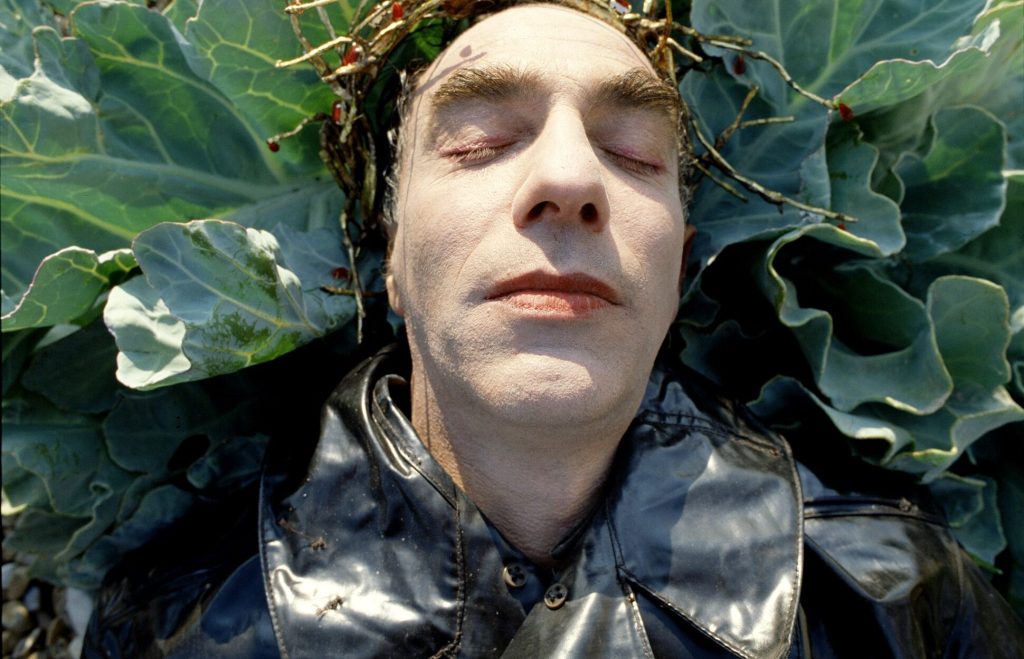
Derek Jarman, The Garden

Derek Jarman: Delphinium Days
Gus Fisher Gallery, 15 June-14 September 2024
City Gallery Wellington, 19 October 2024- 2 February 2025

John Daly-Peoples

This June, Auckland’s Gus Fisher Gallery opens Derek Jarman: Delphinium Days, New Zealand’s first exhibition of this highly significant figure influential artists and gay rights activists of his generation. Entry is free. 

He was the first public figure in the UK to make his HIV positive status known, the exhibition marks 30 years since his untimely death to an AIDS related illness at the age of 52. 

The exhibition curated by Lisa Beauchamp, ( Gus Fisher Gallery), Aaron Lister (City Gallery , and Michael Lett will feature seen paintings, films, photographs and archival material by and about the artist, which will offer an in-depth and affecting view of this celebrated cultural figure whose impact remains profound today. 

Beauchamp says “The exhibition will also cement Jarman’s familial connection to Aotearoa through his father Lancelot,” she says. 

Jarman’s father Lancelot Elworthy Jarman was born in Canterbury in 1907 after Jarman’s grandparents immigrated from Britain in 1888. 

“To bring this part of his life to the fore in Derek Jarman: Delphinium Days will add so much to our understanding and connection to him as one of the most enduringly relevant and impactful artists of modern times,” adds Beauchamp.

Jarman was a prolific creative best known for his avant-garde films, who pushed boundaries to move skilfully between painting, film, writing, set design, performance and gardening. 

Jarman was an early campaigner for the rights of the LGBTQIA+ community and people with AIDs, after being diagnosed as HIV positive himself in 1986.

Co-curator Michael Lett says: “Derek Jarman was one of my first encounters with a fully formed, human gay man. As a teenager reading “Modern Nature” quietly in my room, I found a complex man, who had friends, had sex, got angry, liked to garden and was open about being HIV positive.” 

Jarman’s films are widely known, including Caravaggio (1986) and The Garden (1990) starring his longtime collaborator and muse Tilda Swinton; cult-favourite Jubilee (1978) and his last ever feature film Blue (1993). In Auckland, Gus Fisher Gallery will partner with The Capitol Cinemas to present a selection of Jarman’s most well-loved feature films by the artist.

Jarman helped set the cultural zeitgeist for the time, with his art speaking to and for the dispossessed and alienated, as well as his writing, including Modern Nature (1991) and At your own risk (1992). Many will also be familiar with his music videos for iconic bands like Pet Shop Boys, The Smiths, and Sex Pistols. 

Major painted works from Jarman’s late ‘Evil Queen’ series will be included in the exhibition, as well as a selection of his famous tar paintings and landscapes that connect to his garden at Dungeness. A selection of Jarman’s rarely seen Super 8 films will also be featured.  

The artist himself will feature in a range of tender images by Jarman’s close friend and photographer Howard Sooley.

A dynamic public programme of events will be delivered in Auckland and Wellington to help the exhibition resonate with broad audiences, informed by kōrero with Aotearoa’s LGBTQIA+ communities. 

“By using the exhibition as a catalyst to reduce the stigma associated with HIV and AIDS, we plan to offer meaningful engagement opportunities for rainbow audiences and allies,” says Beauchamp. 

She says Jarman became a beacon of hope for those isolated from society. 

“His artworks and social commentary are a powerful mechanism against a rising tide of hatred and homophobia. Whether through painting, film, gardening or writing, his creativity knew no bounds and continues to influence generations of artists globally.”

Categories
Reviews, News and Commentary

In the name of the Son: a harrowing tale of injustice

Reviewed by Malcolm Calder

Auckland Arts Festival

In the Name of the Son– the Gerry Conlon Story

By Richard O’Rawe & Martin Lynch

Rangatira, Q Theatre

Until 17 March

Green Shoot Productions, Belfast

Director Tony Devlin

Featuring Shaun Blaney

Stage Manager Sinead Owens

There’s something about a standing ovation. Especially when it’s totally impromptu and anything less would either seem churlish and suggest one had possibly been asleep for the last 80 minutes or so.

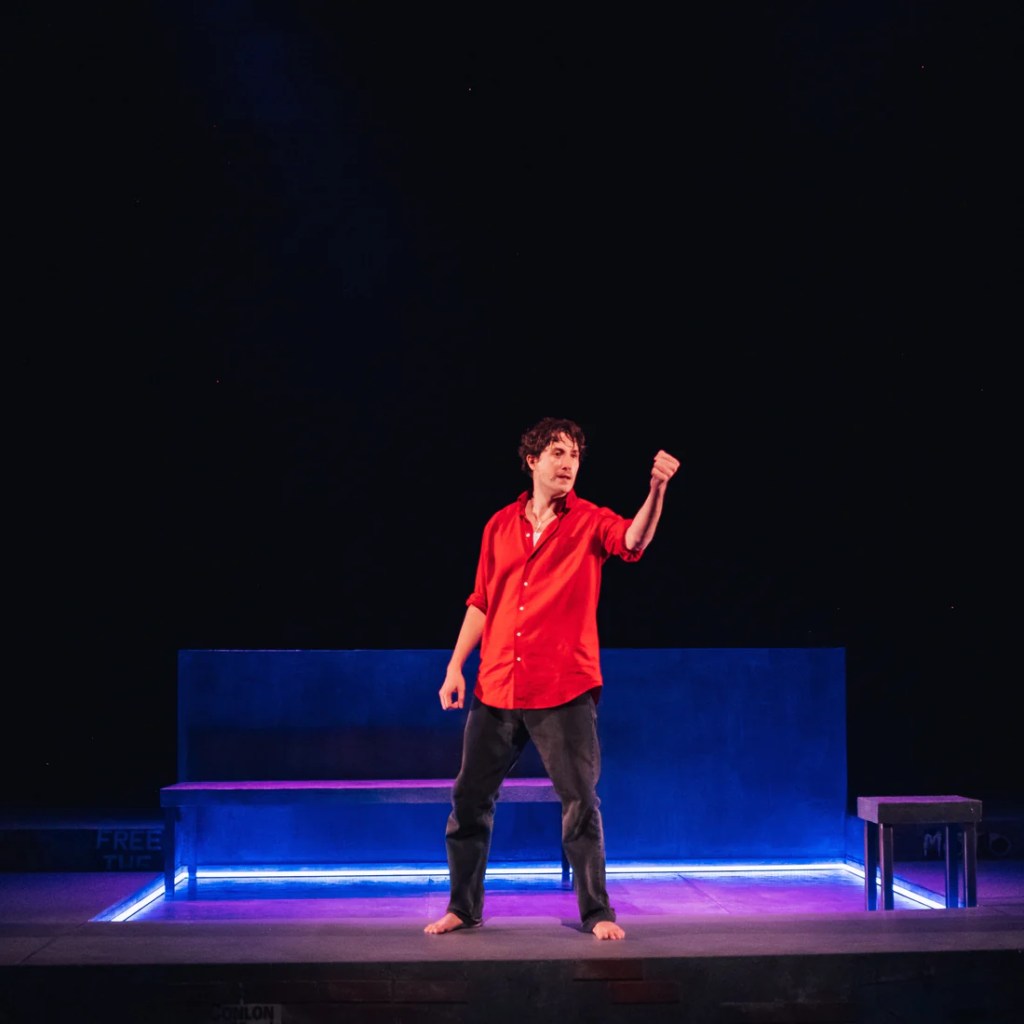
But that’s what Shane Blaney received at the end of In the Name of the Son at Q theatre on Thursday night.  And rightly so.

My initial thoughts were that we were going to get yet another a diatribe about political injustice during the Troubles.  But I needn’t have worried.  This was merely a context for a story about Gerry Conlon’s personal journey and traces his successive leaps following a 15-year mis-sentence through to international recognition and a descent that plumbs the depths of the human spirit.  Ultimately however, it demonstrates the triumph of that spirit over extreme adversity which makes for a very good story indeed.

It seems so long ago now – the IRA Guildford Pub bombings Four and the political upheaval that eventually resulted in their being freed after 15 years in prison.  But I remember it well.  What I was unaware of however was Gerry Conlon’s journey. 

In the Name of the Son achieves this by introducing us to many, many characters and Blaney swiftly skips from one to the other with impeccable timing, sparkling wit and he wrings remarkable depth from each in this one-man show.     There are so many I lost count but they are colourful and they are memorable.  Blaney even manages to slip in a memorable one-liner from Jack Nicholson and a goodly chunk of Springsteen’s ‘Born to Run’ while in toilet at the Oscars.

The play even manages a subtle side-swipe at Daniel Day Lewis and other cinematic A-listers (the film was the titled ‘In the name of the Father’, a dramatization of the political side).

In the Name of the Son by Gerry’s lifelong friend Richard O’Rawe and Martyn Lynch tells it as it was.   And Blaney delivers it switching seamlessly between the different genders, ages and accents of those who played a role in Conlon’s fascinating story.  That is what makes this otherwise harrowing tale of injustice worth nothing less than the standing ovation he received at opening night.

Categories
Reviews, News and Commentary

Beyond Words: a lament, a reflection and a celebration

Reviewed by John Daly-Peoples

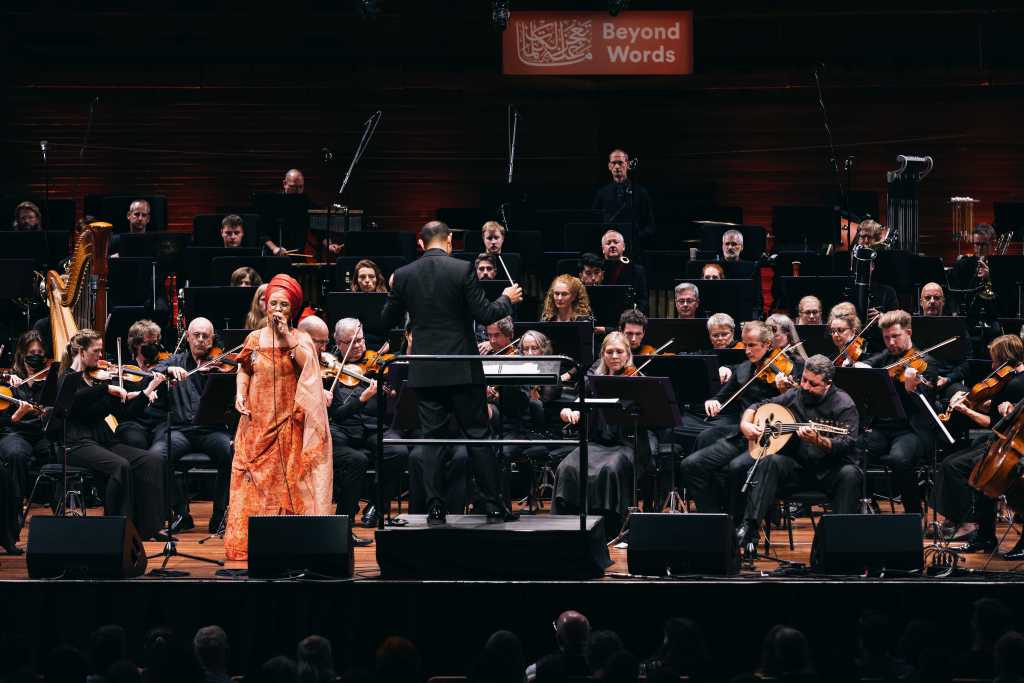
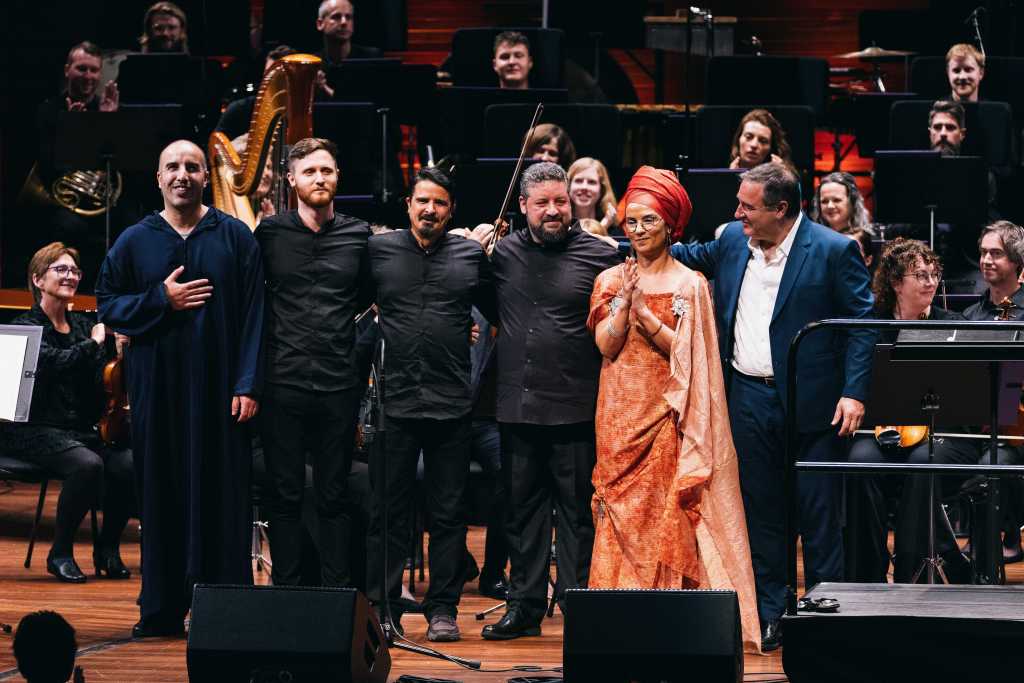
Oum with conductor Fawzi Haimor and the NZSO Image Jono Tucker

Auckland Arts Festival

Beyond Words

New Zealand Symphony Orchestra

Auckland Town Hall

March 10

Reviewed by John Daly-Peoples

The “Beyond Words” concert which had its third performance following its premiere in Christchurch and a performance in Wellington was a collaboration to promote unity and peace through music and to honour the lives lost in Ōtautahi Christchurch on 15 March 2019.

Conducted by Fawzi Haimor the concert featured the Moroccan vocalist OUM  El Ghait Benessahraoui and Cypriot/Greek oud player Kyriakos Tapakis.

Vocalist Abdelilah Rharrabti, saz player Liam Oliver, vocalist and daf player Esmail Fathi, oud player Kyriakos Tapakis, vocalist Oum and composer John Psathas [From Wellington concert] image Jono Tucker

The concert also featured  works by the American Valerie Coleman, Reza Vali, Arvo Pärt and the world premiere of a new work by the New Zealand composer John Psathas.

Psathas’ “Ahlan wa Sahlan, composed in collaboration with OUM and Tapakis, uses the Arabic welcome to let people know they are in a place where they belong. The work fused together musical styles from Eastern and Western music traditions.

The work features energetic and dramatic sounds with subtle changes of texture and moods, providing a background for the two soloists OUM  El Ghait Benessahraoui and Kyriakos Tapakis.

The composer as previously demonstrated his ability to compose celebratory anthems having written works for the ceremonies at 2004 Athens Olympics and with this work there is sense of the music being both a lament, a reflection and a celebration. With waves of shifting percussive and evocative sounds

OUM was resplendent in her shimmering gown and elaborate head covering  Her voice with its roots in Morocco  and in the tradition of Egyptian singers of the 1930’s like Umm Kulthum drifted and soared above the orchestra’s tapestry of eastern sounds along with answering voice of Tapakis’s oud.

Her singing and movements at times suggested she was in a trance-like state while at other times she exuded an emotional intensity  and in her singing  “Hijra” she sounded like a French chaunteuse. Later there were passages where her voice was close to over-elaborate crooning.

Tapakis provided a riveting performance where he played together with Xylophone and timpani in a filmic sounding section filled with percussive sounds

The other major work in the programme was Arvo Pärt‘s Silouan’s Song which is  fine example of the composer’s low-key minimalism with simple repetition and contemplation sequences of notes.

This was a reflective piece which connected contemporary music with Medieval plainchant and Eastern mystical  music and the various sections were stressed by the meditative silences between them giving the work a ritualistic feel.

In the first part of the programme there were five shorter works including a traditional work sung by Hasbi Rabbi and Molle Mamad Jan which had an achingly unsettling melodic line as well as a beguiling performance by OUM.

There was also  contemplative, work by the Iranian Reza Vali which was filled with despondency and funeral sounds hinting at a vision of paradise.

Kyriakos Tapakis performed his own work “Mantilatos” which was filled with extraordinary sounds and rhythms. While the NZSO accompanied  him, emphasising much of the work it would have been more interesting if he had been able to play as a soloist.

A major disappointment with the programme was the lack of English translations for the various vocal segments. Presumably the lyrics were relevant to the spirit of the event and even though the concert was one that was “beyond words”  with the music conveying emotional and spiritual dimensions it was pity the audience was not able to  appreciate the greater depth which would have come from a knowledge of the word.

To subscribe or follow New Zealand Arts Review site – www.nzartsreview.org.

The “Follow button” at the bottom right will appear and clicking on that button  will allow you to follow that blog and all future posts will arrive on your email.

Or go to https://nzartsreview.org/blog/, Scroll down and click “Subscribe”

Categories
Reviews, News and Commentary

DakhaBrakha explores the rich past and the future of Ukraine

John Daly-Peoples

Auckland Arts Festival

DakhaBrakha

Auckland Town Hall

March 14

The Ukrainian performance group DakhaBrakha which is having one performance at the Auckland Arts Festival  is known for playing Ukrainian songs which display the traditional polyphonic harmonies of their traditional music. However, they give this music  a contemporary, transformation referencing hip-hop, punk and contemporary dance sounds. While using traditional Ukrainian instruments their performances also  derive from the indigenous instrumentation of Africa, the Middle East, India and Russia.

Their more recent music though has taken on a much more political edges as they try to counter the Russian propaganda which tries to obliterate  the culture, history, and language of Ukraine.

A recent New York Times review of the group references Maria Sonevytsky an ethnomusicologist who says,

“I think one of the most powerful things that DakhaBrakha can offer is that they show both that there is a very rich past in Ukraine, and they show this by bringing together a diversity of musical practices from different regions of Ukraine, from different ethnic groups within Ukraine,” Sonevytsky says. “And they fuse them together in a beautiful way that also suggests a future for Ukraine. It gives the lie to Putin’s propaganda that Ukraine has no culture or history of its own.”

“In fact,” Sonevytsky continues, “what we see in DakhaBrakha’s artistry is a deeply heterogeneous and complex history, the inheritance of multiple imperial experiences, the long history of attempts for Ukrainian sovereignty, and they blend together these kind of fractured pasts into a beautiful whole that is not simple, and it can’t be simply reduced down to a story of one nation that is occupied by one people, but instead suggests a vibrant, if imperfect, democracy.”

A US review enthused about the performance – “How to describe the sound?  A drum kit, djembe, and darbuka were all used together and individually.  A cello, a couple of accordions, and harmonica, along with the varieties of sounds made by the voice – words and sounds.

It was the voices that were so phenomenal – not just used for singing.  How do they get those sounds?  Often high, keeping sounds.  But, and this was my favourite – animal sounds.  Some were made with small tools, but what about the cats?  The owls?  And then, to close out the song, the piercing “CAW”!

Throughout the evening, as an accompaniment, an artistic slide show.  Animation, mesmerizing designs (reminiscent of folk embroidery), background photos of the war and its damage.“