Categories
Reviews, News and Commentary

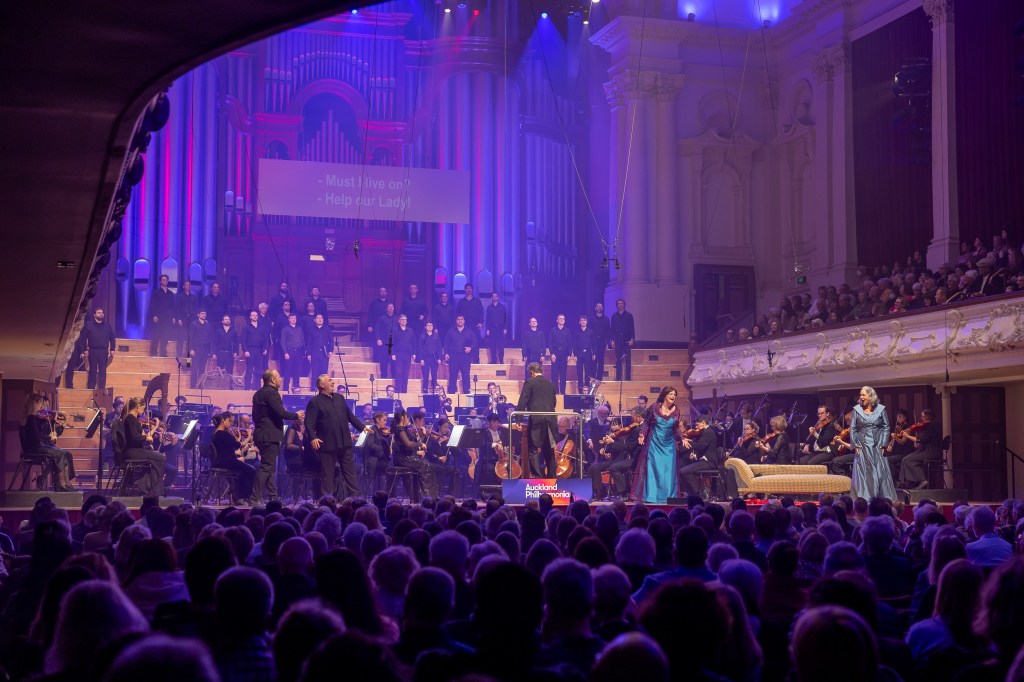
Sylvia Jiang’s lively and energetic performance of Prokofiev’s Piano Concerto

Reviewed by John Daly-Peoples

Sylvia Jiang

Auckland Philharmonia Orchestra

Scheherezade

Auckland Town Hall

July 4

Reviewed by John Daly-Peoples

The first half of the APO’s Scheherezade concert featured two works composed a century apart with Melody Eötvös’ “The Saqqara Bird” of 2016 and Prokofiev’s “Piano Concerto No 2 of 1913/1923.”

The highlight of the concert was the Prokofiev Piano Concerto played by Sylvia Jiang. She is a Chinese born New Zealander and Juilliard graduate  who was ranked as a Rising Star in the Asialaw Profiles of 2023.

Last year she performed Liszt’s Second Piano Concerto with the Auckland Philharmonia and later in the year she will also be making her debut national tour as a soloist with Chamber Music New Zealand playing seven concerts.

Prokofiev’s second Piano Concerto is considered to be one of the most difficult piano concertos to play. Thankfully Jiang appears to have not been told that and she never faltered in her exploration of the work even when she was faced  with the massive solo cadenza of the first movement.

This section saw Jiang playing vigorously for over 4 minutes before the orchestra joins in again.

She opened the work delicately creating  gentle, magical sounds along with the woodwinds and strings which hinted at a shimmering watery setting with the orchestra developing the theme and Jiang providing streaks of colour and drama.

This quiet lyricism didn’t last long and was soon interrupted by menacing sounds from the orchestra and a darkness emerged which overpowered the piano which then responded with some ferocious sounds.

This early interaction of orchestra and pianist highlighted the emphasis of the concerto. This was the sense of competition between player and orchestra. With most  concerti there is a collaboration between soloist and orchestra but with this work there was more of an antagonism and intervention.

This is in part due to Prokofiev s music where we hear a clash between romanticism and modernism which is an indication of the composer struggling with his own idea.

In playing the first movement solo cadenza Jiang seemed to be physically attacking the keys and her playing eventually revealed an emerging theme and she was rejoined with the orchestra which enveloped her with the gentler music which had preceded the cadenza.

The short second movement saw Jiang playing  with a  lively energy, butting up against the  savage and insistent tones of the orchestra.

The third movement which opens with huge swells of brass and percussion and a rustic theme where Jiang dashed off flashes bright notes inserting herself into the orchestral themes. Here again the pianist and orchestra were in competition, with the orchestra seeming to overpower Jiang who fought back with a relentless energy finishing the movement with a few quiet  notes of victory.

She opened the fourth movement with a rapid-fire assault on the piano followed by a lethargic sequence where her fingers seemed to wander across the keyboard in search of a theme. Then as she managed to discover the theme the orchestra joined in, expanding and enhancing it.

Her playing at times seemed to be urged on by the energetic orchestra while at other times she seemed to strive against the orchestra.

In the final minutes of the work her playing returned to a simple romanticism before morphing into some frantic playing matched by an equally frenetic orchestra which overpowered the piano before the  final race to the climatic conclusion.

The “Saqqara Bird” refers to a bird/plane shaped relic found at Saqqara in Egypt in the late nineteenth century whose function was unknown. Melody Eötvös’ work explores the imagined reasons behind its creations and purposes and envisages it in search of its identity.

The work opens with the sounds of bird-like twittering from the woodwinds and strings which seem to be emerging from a dark forest of sounds conveyed by the blasts of brass and thumping drums.

Several of the instruments appeared to have been adapted or employed to create eerie sounds as though a backdrop to a fairy tale filled with shadowy beings.

In the middle section the woodwinds replicate  the sounds and movement of birds along with the ghostly forms leading to enigmatic encounters and discoveries.

The intriguing music ranged from sequences of unruly and strident sounds to the use of the simple single note which ends the work.

Categories
Reviews, News and Commentary

The APO’s “Brahms and Bellincampi”

Reviewed by John Daly-Peoples

Alexander Melnikov and Giordano Bellincampi Image. Sav Schulman

Auckland Philharmonia Orchestra

Brahms and Bellincampi

Auckland Town Hall

June 6

Reviewed by John Daly-Peoples

The opening of Brahms’ Piano Concerto No 1 is dramatic with the timpani delivering a tumultuous sound accompanied by ferocious strings. The intense opening  was intended by the composer to be a depiction and reflection on  Robert Schumann’s attempted suicide in leaping into the Rhine at Dusseldorf few years earlier.

For the first few minutes it was the orchestra which dominated  as pianist Alexander Melnikov waited for his entry. Showing what would be his intense approach to playing he seemed  restless as he contemplated the piano – leaning into it and caressing its surface as though communing with the instrument.

Following the stormy performance of the orchestra Melnikov made his entrance, referencing the orchestras’ dramatic themes but with simple and deliberate playing as though reflecting on the drama which had just occurred.

Much of the first movement saw him responding to the themes that the orchestra had explored with a bravura performance where he developed  the main theme, playing with a relentless  insistence.

Melnikov’s relationship with the piano continued, at times he appeared to be praying and at other times conducting. All the time he appeared to physically respond to the performance of the orchestra, his body moving reflectively in time to the music.

In the second movement his playing was almost lethargic inserting some delicate passages into the orchestras brooding sounds. Then in the third movement the music seemed to electrify him with some relentless playing which was  almost  Byronic, of the individual confronting his demons, loves and destiny.

His Brahms encore finished as a cell phone call came through in the hall, so when he was leaving the stage, he put his hand to his ear with the universal sign of “I’ll call you”, eliciting  further applause from the audience.

The other work on the programme was Brahms’s symphony No 2, a glorious pastoral work inspired by a holiday at the resort of Lake Worth in Austria. The work is full of images of nature and the heightened drama of the alpine  environment.

While it is a captivating depiction of the landscape there are  undertones of melancholy with the strings, timpani and brass creating a sense of disquiet.

The more reflective second movement conveys a sense of an emotional  journey and the delights of life. all leading to enlightenment.

Then in the third movement there were charming dance-like seqcnces followed by the dramatic fourth movement with its big crescendos punctuated by idyllic interludes, the audience kept in suspense as the work raced to its fiery conclusion.

To subscribe or follow New Zealand Arts Review site – www.nzartsreview.org.

The “Follow button” at the bottom right will appear and clicking on that button  will allow you to follow that blog and all future posts will arrive on your email.

Or go to https://nzartsreview.org/blog/, Scroll down and click “Subscribe”

Categories
Reviews, News and Commentary

NZ Opera’s Le Comte Ory

Reviewed by John Daly-Peoples

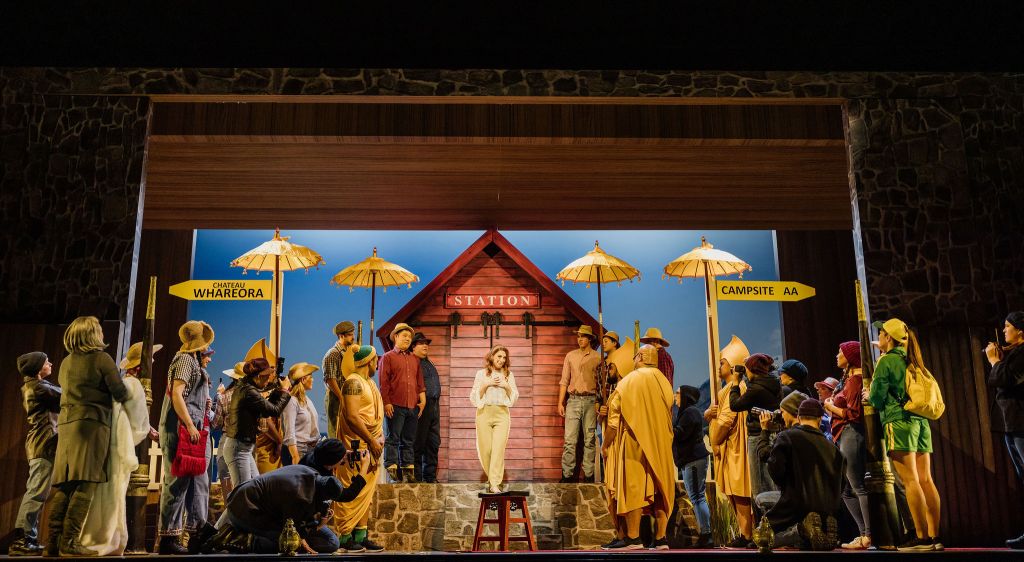
Le Comte Ory (Act I) Image Andi Crown

NZ Opera

Le Comte Ory by Gioachino Antonio Rossini

Kiri Te Kanawa Theatre, Auckland

May 30 & June 1

Reviewed by John Daly-Peoples

If Rossini was still writing operas today his pick for a librettists would have to be Simon Phillips. The original libretto was by Eugene Scribe and Charles Delestre-Poirson, adapted from a comedy they had first written in 1817. While traces of the original can be detected in NZ Opera’s latest version it is Phillips’ new translation, re-write and update which dominates.

This update is what makes the work entertaining and significant. Phillips has taken something of risk in filling the libretto with colloquial speech but it makes for  a clearer understanding of the narrative and his contemporary references give the work an immediacy.

His new libretto avoids having to deal with  the issues of misogyny which are always there in Rossini’s works. It also avoids the contentious issue in the original of having one group of men going off to fight the crusade in Palestine.

Examples of his language updates include someone being referred to as “not a happy camper” “Stuff this for  a caper, I’m buggered” says The Coach after  one adventure, “He really found my chi”  exclaims of one ecstatic young woman  and at the point when Ory is unmasked the entire cast gives a sustained  “What the F…K”

There are lots of rugby references including mention of a John Eales award – this reinforces the idea that Ory’s team is Australian as New Zealand players would not engage in such dastardly undertakings.

The setting for the opera is moved from medieval France to New Zealand, probably the Central Plateau where we find the wives of a rugby team who are off on an international tour staying at a wellness centre in the Chateau Whareora.

Adjacent to the wellness centre is a campsite where Ory and his rugby teammates have set themselves up with the dodgy intentions.

Ory uses this base to  establish himself as a guru / advisor on matters of the heart in an attempt to woo Adele, the sister of the owner of the centre who is away on tour .The team’s personal physiotherapist, Isolier is also in love with Adele and tries to thwart Orys undertakings.

This conflict between pure love and the profane is actually more about a form of selfishness and narcissism which Ory shows in both words and deeds.

The opera revolves around lots of deception, disguises and sexual intrigue where the only character, Count Ory, seems to be in control, yet he is the one who constantly fails ,

Manase Latu as Ory captures the characters inflated sense of self with a bravura performance, parading around the stage in his orange Buddhist robes, behaving like a faith healing tele evangelist.

His voice had the richness of the glib politician / priest with touches of both wit and seriousness, brilliantly captures the suave veneer. In the first act he was great as a Dalai Lama character. Partly his acting, partly the libretto but his character comes over as flawed and despite his belief in his charms and sexual prowess he is never in control of his endeavours.

Emma Pearson as Adele displayed a range of emotional responses with her iridescent voice which at time conveys a sense of rapture.

Hanna Hipp as Isolier played an ambivalent character in taking on  the traditional ‘trouser role’ of female playing male as well as that of a bi-sexual woman in her relationship with Adele. Her duo with Ory was riveting with its mixture of the comic, and sexual friction.

The various duos are performed superbly while the septet at the end of Act I was a great showing off of their voices as they slowly morphed into what sounded like a delightful barbershop singing group.

Andrea Creighton’s Ragonde fulsome voice was a quiet force. Moses Mackay as Raimbaud displayed a fine sense of the comic and Wade Kernot as the Team Manager had a genial style with a nice flexibility of tone.

The sets and costumes by Tracy Grant Lord worked well in defining place and character but some of the costumes worn by the locals in Act I seem to have been borrowed from an amateur production of Oklahoma.

For a little-known opera this production offers originality, riotous performances  with  some of the country’s best voices. The APO conducted by  Brad Cohen brought Rossini’s sparkling music to life, particularly the two overtures.

St James Theatre, Wellington June 13 & 15

Isaac Theatre Royal, Christchurch June 27 & 29

To subscribe or follow New Zealand Arts Review site – www.nzartsreview.org.

The “Follow button” at the bottom right will appear and clicking on that button  will allow you to follow that blog and all future posts will arrive on your email.

Or go to https://nzartsreview.org/blog/, Scroll down and click “Subscribe”
Categories
Reviews, News and Commentary

NZ Opera’s “Le comte Ory” to tour three centres

John Daly-Peoples

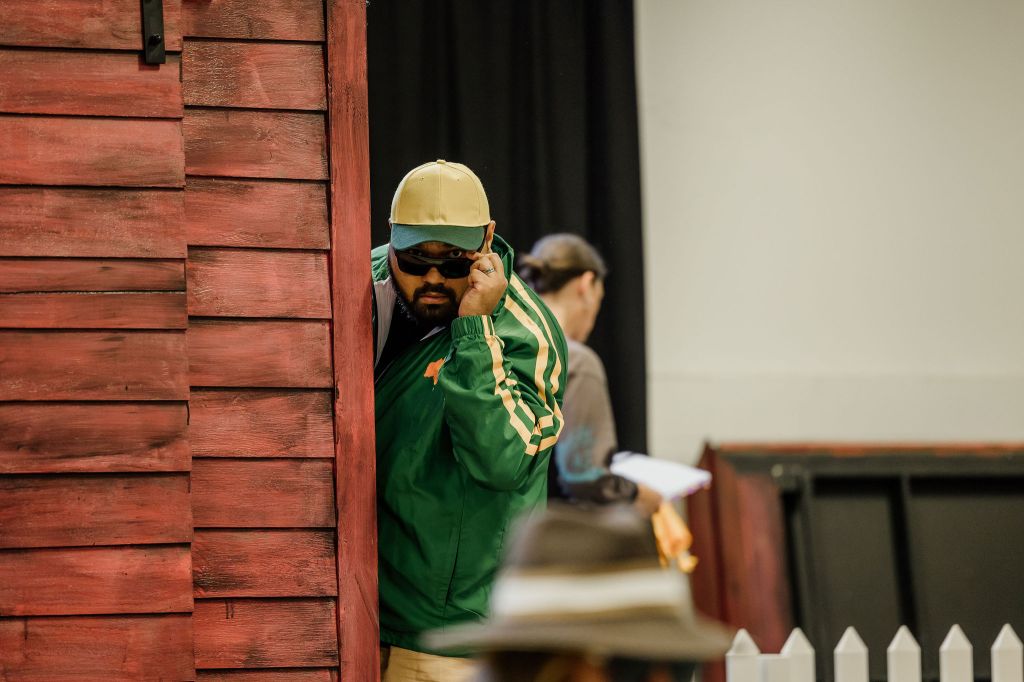
Manase Latu as The Count in rehearsal Image: Andi Crown

NZ Opera

Le comte Ory by Gioachino Antonio Rossini

Kiri Te Kanawa Theatre, Auckland May 30 & June 1

St James Theatre, Wellington June 13 & 15

Isaac Theatre Royal, Christchurch June 27 & 29

John Daly-Peoples

Rossini’s penultimate comic opera, Le Comte Ory has many of the qualities of his other operas with great melodies virtuosic singing and an anarchic plot. However it has  generally been overshadowed by his other works such as The Barber of Seville and La Cenerentola and has not attracted contemporary audiences. Recently however it has had a revival and been produced by a number of the international companies including the MET and Garsington Opera.

The gloriously ribald work was first performed in Paris in 1828, when it ran for over 400 performances. Rossini amalgamated some of his previous work  and  vaudeville components were altered and expanded into the two-act comic libretto with six extended musical numbers from his “Il Viaggio” recycled into the new score. At the time it was hailed as one of his wittiest and most seamless and sophisticated works.

The operas tells of  a libidinous aristocrat attempting to seduce the virtuous Countess Adele and other women while their menfolk are away. In his various attempts, he dons outrageous disguises but continues to fail in his amorous endeavours. .

The work was originally set in  medieval France, but this new production of Le comte Ory is relocated to New Zealand, which allows for more local humour.

Director Simon Phillips says “I have always believed that if you want people to laugh, the closer you bring something to a contemporary era, the more chance you’ll have. We can recognise ourselves, and elements of our society in what we’re watching – and it gives the satire more zing. This production felt like a brilliant opportunity to make a new version of this bonkers, madcap rom-com of an opera – unapologetic, irreverent and funny, just as Rossini intended it to be.”

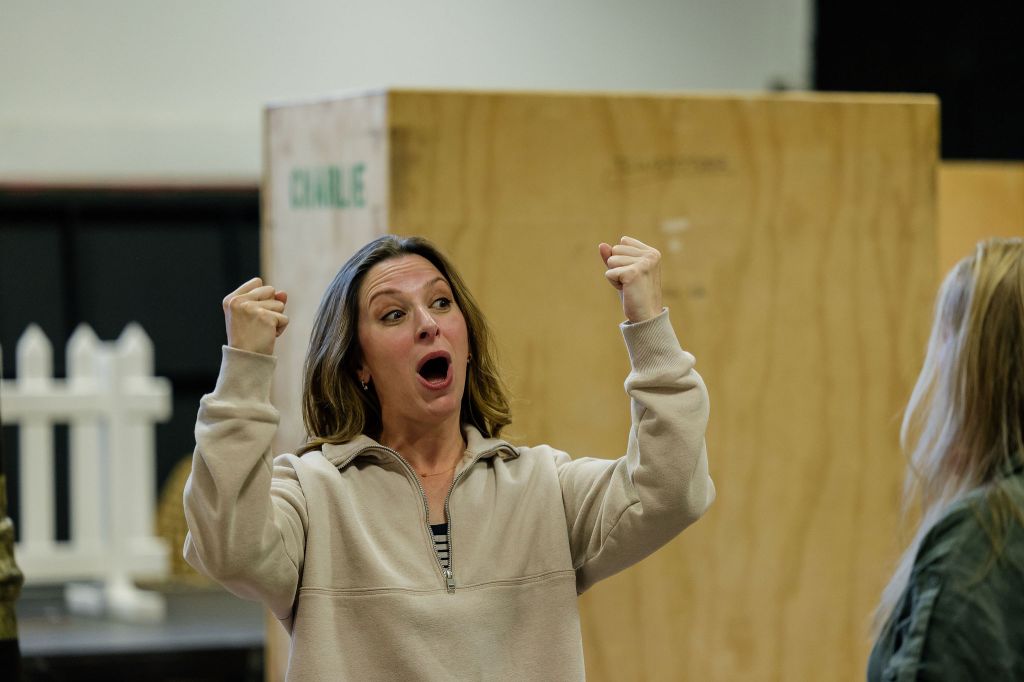
Emma Pearson as Countess Adele in rehearsal Image: Andi Crown

The cast features some great talents including Manase Latu as The Count, Emma Pearson as Countess Adele,  Hannah Hipp as Isolier  as well as Moses Mackay, Wade Kernot, Andrea Creighton and Tayla Alexander.

Categories
Reviews, News and Commentary

NZ Trio’s “Unquiet Dream”

Reviewed by John Daly-Peoples

Amalia Hall, Sarah Watkins and Ashley Brown Image Chris Watson

NZ Trio

Unquiet Dream

Auckland Concert Chamber

May 19

Reviewed by John Daly-Peoples

With their latest concert “Unquiet Dream” the NZ Trio have shown again their ability to deliver concerts featuring music which is innovative as well as drawing on the established canon. This approach shows an intelligent and sophisticated approach to chamber music  which makes their concerts  always rewarding.

The first work on the programme was  Benjamin Britten’s “Introduction and Allegro for Piano Trio”, a very early work in which the young composer  was trying out his approaches to the modernist music which was then beginning to take an interest in.

The work opened with the instruments tentatively seeking out an elusive  melody, playing various sequences which overlapped and intersected as though the composer was assembling his musical structure out of disparate elements.

Many of these sequences were ethereal, touching on the flickering images of water, wind, shadows and scudding clouds. This search for physicality was reflected in the physicality of the playing of the instruments – the blunt striking of the piano and the sharp rasps of the violin and cello.

In Chris Cree Browns  “The Second Triumvirate”  he imagines each of the instruments having its own language  with which they engage in communications  which range from the  simple human conversations  to the more intricate interactions of animal and bird sounds. All these interchanges there are filled dramatic echoes and reverberations.

Lera Auerbach’s  “Trio No2 Triptych” is sub-titled “This mirror has three faces” and she says of the work that “one can look at three different faces or roles of the same person or at three different personalities”.

So, each of the instruments takes on an aspect of the personality which can be in conflict or in harmony with the other. This psychoanalytic approach hints at the idea of multiple personalities or the different faces a person presents – the public, the private or the intimate.

The work is filled with shifting dynamics. Simple sequences develop and change, minimalist statements escalate to create bold and adventurous musical forms.

Shards of music coalesce and then disperse, in surreal juxtaposition, the various elements leaving the image of the person unresolved.

Where  things seem to fall apart in Auerbach’s piece there is a very different outcome with Mendelsohn’s “Piano Trio in D Minor”. With this piece the Trio was focussed on drawing all the elements together to create a symphonic sweep for one of his great “songs without words” providing the work with an emotional richness and depth.

The work hints at the composer’s own desires and struggles using the instruments to create a narrative in which he is by turns heroic, romantic and despondent.  

Throughout the work pianist Sarah Watkins provided the measured mainstay with both a delicacy and vividness of expression. Amalia Hall’s violin  provided a range of emotion from the sensuous to the dramatic and Ashley Brown’s cello ranged from the melancholic to the agitated.

With their playing they were able to capture the romanticism, the wistfulness and the drama of the work as well as effortlessly  incorporating references to  the composers his own Midsummer Night’s Dream and the that of Bach.

Categories
Reviews, News and Commentary

Bach & Bruckner in Contrast

Review by Peter Simpson

David Fray

Bach & Bruckner

Auckland Philharmonia

Auckland Town Hall

May 2

Reviewed by Peter Simpson

The APO’s recent Bach & Bruckner concert was a study in extraordinary contrasts. The Bach pieces: the Harpsichord Concerto No. 5 in F
Minor, BWV 1056 and, Harpsichord Concerto No. 4 in A Major, BWV 1055, date from his Leipzig years, probably around 1740. Bruckner’s unfinished last Symphony No. 9 dates from the 1890s – a 150 year gap between them into which almost all classical and Romantic music falls.


The first contrast was one of scale. For the Bach, a dozen or so stringed instruments clustered around not an antiquated harpsichord, for which the music was written and first performed on, but a shiny black concert grand, looking vast and sleek, like an elephant on the stage surrounded by pygmies.

For the Bruckner after the interval the stage filled up with a crowd of
musicians; I’m not sure exactly how many; my attempts to count them always broke down, but it must have been close to 100, certainly at least 80. In the numerous climaxes – Bruckner’s music often seems composed almost entirely of crescendos and decrescendos – they made the loudest noise I’ve ever heard in a concert hall (at least since Bruce Springsteen’s E-
Streetband drove me out of the Arts Centre in Ottawa fifty years ago); it left me with ringing ears for some time after the finale.

Then there is the matter of time. The concert began at 7.30 with the two Bach concerti. By 8 o’clock, they were all over; all six movements (three for each piece) together with pauses, applause and encore, took less than half an hour (9 minutes 17 second, and 13 minutes, 40 seconds, respectively, according to one recording). By contrast, the Bruckner stretches out to well over an hour in most recordings (Bernard Haitink’s is 67 minutes long), with each of the outer movements taking almost half-an-hour and about 10 minutes for the intervening scherzo.


French soloist, David Fray, born in 1981, has recorded much of Bach’s keyboard music including the concerti. BBC Music described one such recording: ‘Fray’s command of colour and imaginative highlighting is intoxicating, and there is a freshness which makes for indisputably
rewarding listening’. I couldn’t have said it better myself. His playing was as lean and elegant as his person, especially in the lovely melody over pizzicato strings in the slow movement of BWV 1056.


The Bruckner 9th Symphony is sometimes described as a ‘magnificent torso’ of a work, in that it remains uncompleted, the composer having left only sketches of the fourth movement. Even so it seems a shapely structure – I found myself thinking of Gaudi’s Sagrada Familia in Barcelona – with the two vast evenly balanced outer movements joined by the comparatively brief and frenetic scherzo. In my notes I scribbled ‘glorious and sonorous horns suspended over shimmering beds of strings’ and ‘the sensation of bathing in an ocean of sound’.

Replacement conductor Karl-Heinz Steffens, who stood in for the previously advertised Johannes Fritzsch, who was forced to withdraw because of an injury, appeared in total command of music and musicians and had the APO sounding magnificent.

Categories
Reviews, News and Commentary

The NZSO’s Mahler 5

Reviewed by John Daly-Peoples

Gemma New

New Zealand Symphony Orchestra

Mahler 5

Auckland Town Hall

April 6

Reviewed by John Daly-Peoples

The opening work on the Mahler  programme was Salina Fisher’s “Kintsugi” which was originally commissioned  by the NZ trio. This augmented work relates to the Japanese art of repairing broken pottery and dusting the new work with gold.

The music focussed on the gaps in the pottery and the broken fragments of the pieces, highlighting the delicacy of the process as the pieces were slowly assembled.

The music seemed to describe the colours, textures and contours of the bowl or vase with Bridget Douglas’s flute describing curvaceous shapes. The orchestra then picked out the seams of the material bonding the broken shards and the shimmering gold.

While describing the physical changes in the pottery the work with its delicate, brittle sounds acted as a metaphor the ability of humans to mends broken bodies and damaged minds.

The American composer Adam Schoenberg’s Percussion Concerto “Losing Earth” was a dazzling  work inspired the climate catastrophe threatening our natural world with musical images of cities being inundated by rising oceans.

Jacob Nissly Image NZSO/Jono Tucker

The work opened with the sounds of gunshots from drums which were placed around the auditorium. These sporadic salvos, warnings of a present danger were followed by subterranean groaning of the horns which also suggested looming disaster. This was followed by collisions of the strings and horns against the percussion section.

The audiences was then treated  to a remarkable display from Jacob Nissly the soloist who is the San Francisco Symphony’s Principal Percussionist. From  his first appearance at the front  of the hall playing a snare drum he combined the style of a professional percussion player and that of an outlandish rock band drummer.

At his disposal was an array of instruments; drums, gongs marimba, wood blocks and cymbals with which he and the orchestra created the images of an encroaching ocean with the murmuring strings and brass backgrounding Nissly’s s sonic wonderland. This all ended with his making one final display using a spinning Roto Sound cymbal which emitted an eerie sound as the earth-like globe spun to its whispering end.

Where “Losing Earth” addressed a crucial time in the physical nature of our world , Mahler’s Fifth Symphony addressed a crucial time in the composer’s personal world. The work was written at time when he had  a near death experience, his career was blossoming but there many detractors and it was also the time he met future wife.  It is these personal and psychological issues the fears, anxieties and pleasures of his life which form the basis of the work and we were presented with the man and his attempts to understand and explore his inner psychological struggles, endeavourimg to express himself through his music in a way few other composers have  managed to achieve.

While it is an autobiographical work exploring the composer’s personality, there are parallel themes as he depicts narratives, landscapes and other emotion states.

The measure of a great performance is the way in which these aspects of the composer’s life are realized by the conductor and the orchestra. Conductor Gemma New and the NZSO certainly achieved it with an intelligent and emotional performance.

From the opening trumpet blast to the final triumphant conclusion New was firmly in control of the orchestra, understanding the drama, inventions and contrasts of the music. She seemed by turns, a battling duellist, a lithe dancers and meticulous guide. Subtle nuances were made evident and individual instruments were allowed to shine. Even the long silences between the movements became part of the music, allowing the audience to reflect on each of the previous movements.

New managed to give the blaring, brass opening funereal march a sense of desolation while the singing strings provided a sense of optimism. This  romantic reflective mood depicted the man trapped between despair and hope.

In the second movement New seemed to be battling the ferocious sounds of the orchestra and the nightmarish, reckless drama of the music before it morphed into quiet reverie, bringing out nuances and subtleties that seemed to explore the tragedy and triumphs of human and personal history and she allowed the interweaving of the solo violin, the brass and the strings to give the work an intense melancholy.

The final two movements, which included the famous adagio for strings which is considered to be something of a love letter to his wife Alma Schindler, were delivered perfectly filled with an aching sense of love and loss.

The final movement was filled with changing moods, alive with bright woodwinds and brass. New led the orchestra  in a brilliantly controlled finale where the doors of perception open and the funeral tones of much of the work are replaced by more exultant sounds offering hope and renewal.

Categories
Reviews, News and Commentary

APO’s Other Worlds

Reviewed by John Daly-Peoples

Shuiyeon Sung

Other Worlds

Auckland Philharmonia

Auckland Town Hall

March 28

Reviewed by John Daly-Peoples

It’s easy to appreciate why Sibelius’s Symphony No 2 has been  seen as a programmatic work conveying idea about patriotism and nationalism. At the time of writing the symphony the Russian  occupiers were restricting the use of the Finnish language and attempting to change the nature of Finnish society.

So, with this symphony, while the Finnish language was being stifled  Sibelius was allowing the Finnish voice to be heard through music  which reflected on Finnish language, landscape  and history.

He attempted to convey in music what the painting, ”The Attack” by the Finnish artist Edward Isto did visually. Painted at the same time it illustrated the feelings of many Finns. The work depicts a double headed eagle, representing the Russian state, attempting to snatch a book of laws from a while clad female.

Edward Isto, The Attack

The opening movement with its stirring blasts of the woodwinds and horns followed by the surging strings provided musical images of landscape which conveyed ideas of Finnish Nationalism.  Later when the vigorously plucked cellos contrasted with the deep sounds of the  bassoons there  a sense of personal loneliness or struggle.

The notion of the individual alone in the landscape and awe at their surroundings which is present throughout the work was also apparent in the opening work on the programme, Mendelssohn’s “Hebrides Overture” which also linked landscape, history and myth.

Later the militaristic sounds of a rampant orchestra ended with  a triumphant anthem all this sounding like  a great storm  and its aftermath.

The work was by turns  nostalgic, revolutionary and celebratory with repeated themes evoking a call to arms and a new dawn.

The newest work on the programme saw a trio of South Korean artists  on stage with violinist Inmo Yang playing Unsuk Chin’s 2001 work  “Violin Concerto No 1“ and the orchestra conducted by Shuiyeon Sung.

Inmo Yang

Unsuk Chin’s Violin Concerto is one of her most famous works and has won a number of awards and is  fine example of cross-cultural music where the experimental and the traditional are fused.

Inmo Yang backed by a percussion rich orchestra – marimba, gongs, harps, bells and xylophone  gave an extraordinary performance.

From the first bars of the first movement with his rapid bowing, he attempted to dominate the orchestra in what seemed at times like a competition.

His almost dementated, playing and the  abstract sequences he produced contrasted with the more controlled playing of the orchestra with many of the sequences sounding  as though Yang and the orchestra were responding to  different musical scores.

His high-pitched sounds worked well with the percussion instruments producing otherworldly feelings and soft disturbing moments. There were also random moments of intimacy as well as magical sounds full of exuberant colour as he joined with and riffed off the various percussion instruments.

In the final movement his dexterous playing  set the stage for  a battle between violin and orchestra where their sounds would combine and then separate with a massive sonic, Doppler Effect.

Chin’s violin concerto requires a player who has focus, exceptional technical skills and understanding of the work. Inmo Yang possessed all those qualities.

Future APO concerts

April 11th

Viennese Feast

Conductor Christoph Altstaedt
Violin Amalia Hall

Brahms Variations on a Theme by Haydn
Haydn Violin Concerto No.1
Mahler (arr. Britten) What the Wild Flowers Tell Me
Schubert Symphony No.6 ‘Little C major’

May 2

Bach & Bruckner

Conductor Johannes Fritzsch
Piano David Fray

J.S. Bach Keyboard Concerto No.5, BWV 1056
J.S. Bach Keyboard Concerto No.4, BWV 1055
Bruckner Symphony No.9

To subscribe or follow New Zealand Arts Review site – www.nzartsreview.org.

The “Follow button” at the bottom right will appear and clicking on that button  will allow you to follow that blog and all future posts will arrive on your email.

Or go to https://nzartsreview.org/blog/, Scroll down and click “Subscribe”

Categories
Reviews, News and Commentary

Barton and Brodsky

Reviewed by John Daly-Peoples

Auckland Arts Festival

Barton and Brodsky

Auckland Concert Chamber

May 22

Reviewed by John Daly-Peoples

It seems misleading  to describe the didgeridoo as a primitive instrument. The sounds it makes fit well within the scope of much contemporary music, there is  complexity to their playing and they have an extraordinary musical history which parallels the history of many European instruments.

The instrument’s voice also seems to connect with the land and the history of the Aboriginal  people with a deep spirituality .

The opening of the recent Barton and Brodsky concert heard that voice as  the rumble of  the didgeridoo  welled up from the underworld to fill the Auckland Concert Chamber. This was didgeridoo of William Barton joining the string quarter for a remarkable concert of music, where the instrument contributed to several of the works.

Barton performed in Peter Sculthorpe’s “String Quartet No 11 “Jabiru Dreaming” which describes the Australian landscape and its animal life. His fitful and variable  breathing  gave a sense of the breath of life which giving soul to the land, and the sharp bursts of sound mapped out the patterns of landscape and geology. The strings contributed sharp shrill sounds of bird life and the murmurs of the bush.

In” Minjerribah” by Robert Davidson which paints a picture of the North Stradbroke Island Bartons didgeridoo again  provided a sense of the timeless landscape while the strings created  an almost romantic vision with evocative sounds of bird life,  the shrill of cicadas, waves churning over beaches, deep blue skies and sun.

Barton also made a major contribution to the concert with his own composition “Square Circles beneath the Red Desert Sand” which he introduced walking from the rear of the hall channelling the spirits and the song lines of Australia, the sounds of his  voice echoed by the strings.  His singings took the form of a ritual, like the chants of many religions. Here along with the savage strings of the quartet, the sounds of the European instruments and didgeridoo showed the power of music to provide memory and narrative  reaching across cultures.

Before the two works featuring the didgeridoo, the quartet played Henry Purcell’s early “Fantasia No 5 in D Minor” with all the elegance the work requires with Paul Cassidy’s viola adding a deep sonorous tone.

This finely crafted work was in marked contrast to the main work on the programme, “Janacek’s  String Quartet No 11”. This work is subtitled “Intimate Letters” and is a musical representation of some 700 letters sent between Janáček and Kamila Stösslová which represented the composer’s intense emotions in  that doomed  relationship.

Passages of the work were played at not much more than a whisper which were then punctuated by dramatic piecing sounds from the strings as though representing the turmoil of  the composer’s mind. In many of the sequences, violinist Krysia Ocostowicz led the group with her insistent playing and in the final movement played with a fevered urgency mirroring that of the composer.

The group also  played Stravinsky’s “Three Pieces for String Quartet” which was written after his ballet music for Petrushka and owes much to folk music , the carnival and snippets recalling Latin chants.

They also played Salina Fisher’s “Torino – Echoes of the Putorino”. The putorino is  a Māori instrument which can produce sounds as varied as a trumpet or a flute which the group were able to replicate. But while they were able to produce the sounds of the instrument, they were also imitating the sounds of the New Zealand bush and the native birds with the bright strings achieving the sound of several birds including the kiwi.

With Andrew Ford’s “String Quartet No 7: Eden Ablaze” which was a memorial and requiem to the Australian bush fires of 2019 / 20 the group captured the drama of the event, visions of the devastated landscape and the flight of the animals.  There were surging sounds of the combined strings as well high-pitched sounds of distress while  the didgeridoo provided a plaintive background.

To subscribe or follow New Zealand Arts Review site – www.nzartsreview.org.

The “Follow button” at the bottom right will appear and clicking on that button  will allow you to follow that blog and all future posts will arrive on your email.

Or go to https://nzartsreview.org/blog/, Scroll down and click “Subscribe”

Categories
Reviews, News and Commentary

Gravity & Grace : a refreshing and inventive NZ play

Reviewed by John Daly-Peoples

Auckland Arts Festival

Gravity & Grace by Eleanor Bishop and Karin McCracken.

Q Theatre

Until March 24

Reviewed by John Daly-Peoples

Gravity  & Grace is adapted from Kraus’ account of the unsuccessful film she made in the 1990’s – Gravity & Grace. That film follows Grace as she finds a connection to a cult predicting doomsday and the arrival of a spaceship, and Gravity, who leaves New Zealand to try her luck as an artist in New York City.

Kraus is probably most well known for her book and TV series “I Love Dick” but Eleanor Bishop and Karin McCracken have mined he obscure Gravity & Grace to make a play which addresses ideas about the flawed or failed artist as well as reflecting on the creative process generally.

The play set in the US and New Zealand where much of the filming was shot because she had obtained NZ Arts Council funding. We follow her inexperienced attempts as a director and her unsuccessful efforts to get interest from the film festivals and agents. Along with this we delve into her personal and professional relationships which blight the films development.

Her own attempts at creating art works are paralleled in her homage  to three other flawed creatives: the French writer and philosopher Simone Weil and her book La pesanteur et la grâce (Gravity and Grace), the American artist Paul Thek whose star burnt out after an initial burst of success and  the German Red Army activist Ulrike Meinhof.

Its as if she is saying these great artists also made mistakes, just like  me.

The two writers of the play also are the stars of the work with Eleanor Bishop’s faultless direction and  Karin McCracken giving an incisive portrayal of  Chris Kraus.

McCracken is on stage the whole time and holds the play together with her range of emotions as well as some witty dialogue . She is  also cleverly presented with many sequences featuring her filmed. Often her projected head loomed over her as she sat at her desk or she was shown from strange angles suggesting the characters many dimensions.

The cast play a variety of roles including Andy Warhol (Sam Snedden); Ulrike Meinhof (Ni Dekkers-Reihana); Simone Weil (Rongopai Tickwell) and Paul Thek (Simon Leary). Sneddon also plays Sylvère Lotringer, Kraus’s husband as well as Gavin her S&M phone lover.

Much of the success of the play comes from the innovative staging created by designer Meg Rollandi, the visuals of Owen McCarthy, and Rachel Neser, the soundscape designed  by Emi 恵美 Pogoni and lighting by Rob Larsen.

The work is overwritten at times and could do with a trim and there are a few sequences such as the cast working on what was possibly a Paul Thek mural which doesn’t seem to add much to the work.

But it is one of the most refreshing and inventive recent New Zealand works with  fine writing, and suburb stage craft.

To subscribe or follow New Zealand Arts Review site – www.nzartsreview.org.

The “Follow button” at the bottom right will appear and clicking on that button  will allow you to follow that blog and all future posts will arrive on your email.

Or go to https://nzartsreview.org/blog/, Scroll down and click “Subscribe”