Reviewed by John Daly-Peoples

Summer Nights, Joyce DiDonato
New Zealand Symphony Orchestra
Auckland Town Hall
November 29
Reviewed by John Daly-Peoples
The message came though just a short time before the NZSO’s “Summer Nights” concert – “Due to the global grounding of Airbus aircraft today, the NZSO can’t fly enough players from Wellington to Auckland to perform Bruckner’s Seventh Symphony in tonight’s programme. It has been replaced by Mozart’s Symphony No.41 Jupiter
The change does not impact on American mezzo-soprano Joyce DiDonato’s debut with the NZSO in Auckland tonight.
So, it was the Mozart symphony No 21 which opened the “Summer Nights” concert with Berlioz’s “Les Nuits de ete” becoming the major work of the concert featuring Joyce DiDonato’s.
The song cycle is a setting of six poems by Theophile Gautier which Berlioz began in 1841. The work which began as a piece for soloist and piano accompaniment was later orchestrated with an additional song in 1856. It is now one of the composer’s most popular works.
The theme of the work is the progress of love, from youthful innocence to loss and finally renewal.
The opening “Villanelle” invites the beloved to wander through the forest in springtime and features a simple, melody above a chirping accompaniment but there were intimations of darker forces hovering above the surface.
There followed the evocative “The Spectre of the Rose”, the lament “On the lagoon”, the chilling “In the Cemetery” and onto the surreal “Unknown Sea”, depicting a lover steering a ship into the unknown future.
Along with her expressive voices DiDonato conjured up the notion of the lover with gestures which reinforced the text.
Between the songs she appeared to enter a period of repose in which she contemplated the sounds of the orchestra as well as apparitions in the hall as though taking inspiration from them
Her ravishing voice, full of depth flowed effortlessly around the hall, along with the inventive music – the soft pizzicato of the strings or the almost whispering sequences of the strings where the orchestra played what seemed like the soft rumour of a voice.
Then her voice would be increasingly dramatic, singing with an intensity which hovered over the orchestra like cloudburst, a voice which could shatter glass as well as hearts.
She was very attentive to Conductor New, the orchestra as well as the audience and with many of the sequences her forceful gestures and demeanour meant that her singing took on a more operatic dimension, her singing drenched with power and emotion which almost overwhelmed the orchestra.
After rapturous applause she delivered two powerful encores. The first a stunning interpretation of Bizet’s “Habanera” from Bizet’s Carmen which she delivered in true operatic style. This was followed by “Somewhere over the Rainbow” a song which was personally relevant to be sung by a gal from Kansas.
Opening the concert was Mozart’s Jupiter Symphony, a remarkable work which the composer himself probably never heard performed; it certainly owes its name to somebody else. One scholar described it as ‘the greatest orchestral work of the world which preceded the French Revolution’ and the NZSO played the work as if they agreed with that dizzy estimation.
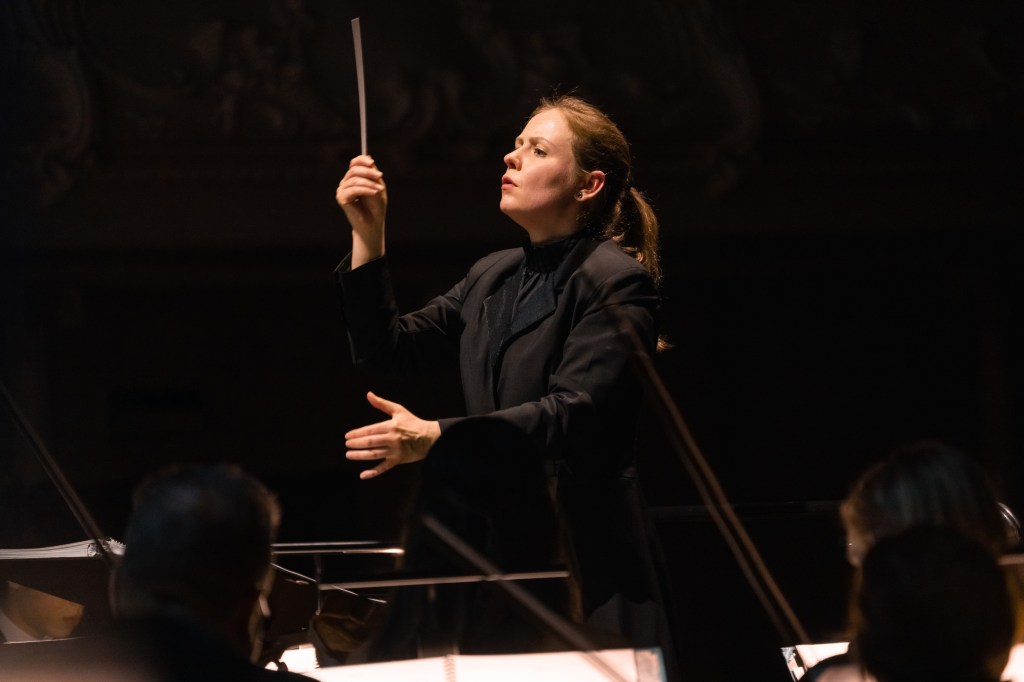
Gemma New reinforced the dance-like qualities of the music with some of her gesture and dance movements. She also was able to explore the qualities of the music bringing out the elegance of the music. So, the opening had an operatic quality much like the opening of “Don Giovani” (which he composes at the same time as the symphony) and many parts of the music had a sense of a conversation, the music often sounding soto voce.
She also highlighted some of the instruments notably the flute playing of Bridget Douglas and the double basses.
The way the symphony combines both clarity and complexity, especially in the last movement, was apparent throughout the orchestra’s sparkling rendition. We may not have got to hear Bruckner’s great work we were well compensated by one of Mozart’s last symphonies.
To subscribe or follow New Zealand Arts Review site – www.nzartsreview.org.
The “Follow button” at the bottom right will appear and clicking on that button will allow you to follow that blog and all future posts will arrive on your email.
Or go to https://nzartsreview.org/blog/, Scroll down and click “Subscribe”


 New Zealand Arts Review